• Skip to primary navigation
  • Skip to main content
  • Skip to primary sidebar

John August

  • Arlo Finch
  • Scriptnotes
  • Library
  • Store
  • About

Search Results for: 3 page challenge

What I Learned Writing a Trilogy

February 3, 2021 Arlo Finch, Author, Books, Projects, Psych 101

In October 2016, I began writing *Arlo Finch in the Valley of Fire*. It’s about a kid who moves to the mountains of Colorado, where he joins the Rangers. Modeled on the scouts of my youth, Rangers can do some kinda magic things because the forest outside their town is kinda magic.
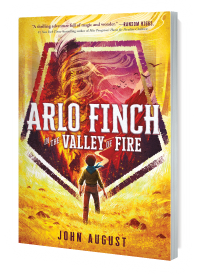
arlo 1Arlo Finch sold to Roaring Brook/Macmillan [as a trilogy](https://read.macmillan.com/mcpg/arlo-finch/), with *Valley of Fire* debuting in February 2018 and *Lake of the Moon* the following year. It has spawned thirteen translations published around the world. I’ve toured extensively across the U.S. and Europe. It’s been a wild trip.

Now the trilogy is finished. The paperback of [*Arlo Finch in the Kingdom of Shadows*](http://johnaugust.com/arlo-finch) arrives in bookstores across the U.S. and Canada today.

As this part of the journey ends, I wanted to look back on what I learned in writing a trilogy. Here’s what I wish someone had told me before I started.

## 1. Have a plan, but be ready to change it.
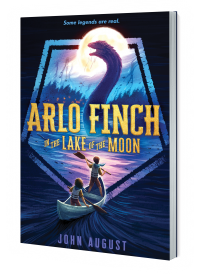
When I sold the trilogy, my proposal included descriptions of books two and three. Here’s a paragraph I wrote in my summary of *Kingdom of Shadows:*

> The Duchess, who has always operated through proxies and emissaries, is finally forced into the open. Charming, clever and ruthless, she’s willing to make a bargain with the boy she can’t seem to kill. Arlo must decide whether to forsake his friends and family in order to keep them safe.

No spoiler warning needed, because **this doesn’t happen.** The Duchess — a character I’d intended to become the series villain — never appears in the trilogy at all. There’s nothing even remotely like her. Early in writing book two, a better villain appeared, one who was a much stronger foil for Arlo.
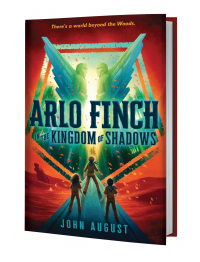
arlo coverAnd it’s not just the Duchess. Here are seven crucial elements in the trilogy that I didn’t know when I sold it:

1. Hadryn, and his connection to Arlo
2. Fallpath
3. The Broken Bridge
4. Big Breezy
5. The Summerland Incident
6. Mirnos and Ekafos
7. Why the Eldritch actually need Arlo

Shouldn’t I have planned better? Was it pure hubris to start writing without locking down these details?

Maybe. But I didn’t know about Hadryn until he showed up in a scene. He was a bit player who caught my interest and ended up becoming a costar. I didn’t know — and perhaps *couldn’t have known* — that I needed him back when I was writing the first book. Many things you only discover while writing.

In the end, **a series outline is like a map.** It can help keep you from getting lost, but if you follow it too closely you may drive right past some amazing discoveries.

## 2. Set rules. Break them when necessary.

Every book has rules. Some are conventions (such as spelling and punctuation), while others are specific to the genre or audience (no swearing in a kid’s book).

These rules help both authors and readers. For example, consider how we handle dialogue in prose. The author doesn’t have to add *he said* or *she said* to every line because readers have come to expect that characters alternate speaking unless otherwise indicated.

The same principle applies to point of view. Like many fantasy novels, Arlo Finch is told from a close third-person perspective. As the reader, we are hovering right behind Arlo’s shoulder. We only see what he sees, and we can only peer inside his head. Arlo Finch is at the center of every scene.

> Fifty feet away, by the edge of the gravel driveway, a dog was watching him. Arlo assumed it was a dog, not a coyote or a wolf, though he had never seen one of the latter in person. The creature had a collar, which at least meant it belonged to somebody.

> Arlo knew to be careful around strange dogs, but this one didn’t seem threatening. It was simply watching him.

Although the book never explicitly states it, the reader quickly understands the rule: *Everything is from Arlo’s point of view.*

This point of view splits the difference between a first-person narrator (e.g. *The Hunger Games*) and an omniscient narrator (*Game of Thrones*). It keeps the reader dialed in with the hero, which makes it a perfect choice for Arlo Finch…until chapter 37 of *Lake of the Moon*.

Arlo and his friend Indra had gotten separated. Now I needed to show what Indra was up to. But how? There was no elegant way to do it without breaking the rule on POV.

So I did it. I broke the rule. **After 100,000+ words from Arlo’s perspective, we shift to Indra’s POV for that chapter.**

And it was fine.

My editor noticed — but no one else did. (Or at least, they didn’t complain.) In context, it felt natural to be seeing these events from the point of view of a well-established supporting character. Later, when Indra meets up with the Blue Patrol, they’re focused on finding Arlo but the reader hardly notices that our POV character isn’t there.

Ultimately, I wasn’t breaking the rule as much as amending it: *Everything is from Arlo’s point of view — unless he’s not present. Then it’s from the POV of the best-known character.*

For book three, I stuck with this modified rule. One of my favorite chapters in *Kingdom of Shadows* is told from Uncle Wade’s perspective.

POV wasn’t the only rule I ended up breaking in Arlo Finch. I initially set out to show that Arlo’s real strength was not as a leader, but rather a follower. If there was a decision to be made, he’d help find consensus but would never take the reins.

This “hero as wallflower” approach lasted until the midpoint of book two, when he found himself facing many more challenges alone. By the third book, he’s standing up against governments and supernatural forces of unfathomable power. He’s a reluctant leader, but he’ll do what it takes.

Doing what it takes is part of writing a trilogy. You need to break rules carefully but unapologetically.

## 3. Build roads, not worlds.

The town of Pine Mountain brushes up against the Long Woods, a vast extra-dimensional wilderness that can only be navigated by mastering a special Ranger’s compass. Unlike a lot of fantasy literature, there’s no map at the front of the novels because the Long Woods cannot be mapped.

But there are *books* in Arlo Finch: Arlo and his friends occasionally consult *Culman’s Bestiary* to learn about the dangerous creatures they’re facing, yet I never seriously considered putting together the actual catalogue. Nor did I write out the oft-cited Rangers’ Field Book. I knew the names of the ranks and a few of the requirements, nothing more.

When it came to world building, I tried to create only what Arlo could himself encounter. I put a sticky note on my monitor to remind myself: **Don’t build more than you need.**

In the case of Arlo Finch, the decision was partly practical; I simply had too many chapters to write. But I also recognized a pattern I’d seen in a lot of fantasy literature:

– Elaborately constructed universes that have little to do with the hero’s story.
– Supporting characters who talk about events that happened long ago.
– Visitors hailing from faraway lands the hero (and reader) will never visit.
– Creatures described but never encountered.

Even over the course of a trilogy, your characters will only see a small corner of their universe. So focus on that. Make it rich, rewarding and most of all relevant.

## 4. Slow and steady wins the race.

I started Arlo Finch as part of [NaNoWriMo](https://nanowrimo.org/about-nano), the annual challenge to write 50,000 words of a novel in thirty days. That’s a pace of 1,667 words per day.

While I’d had a lot of [experience as a screenwriter](https://www.imdb.com/name/nm0041864/), I was a complete newbie to the world of publishing. I knew I had a lot to learn, so I used the excuse of making a documentary podcast (called [Launch](https://wondery.com/shows/launch/)) to ask hundreds of naive questions to editors, booksellers and other authors. They taught me about the joys, challenges and frustrations of getting a book published.

When told I was writing a trilogy, authors invariably offered a sympathetic smile along with a gentle shake of the head. *Oh, child,* they seemed to be saying. *You don’t know what you’ve gotten yourself into.*

Writing any book is a marathon. **Writing three books back-to-back is like a race that never ends.**

I wasn’t prepared for the sheer number of words I’d be typing — 202,595 in all — and having to do copy edits on one book while finishing the next. In the morning, Arlo might be investigating a mysterious campsite in *Lake of the Moon.* In the afternoon, he was back six months earlier in Pine Mountain, meeting his friends for the first time in *Valley of Fire*.

As a screenwriter, I’m used to working on one movie at a time. When writing *Toto,* I don’t need to worry about the sequel; it’ll only happen in wild success.

Instead, my experience writing a trilogy had much more in common with the life of TV showrunnner. My friends who write TV have to map out a season, then write the episodes, then oversee all the tweaks and changes — often all at the same time.

While it’s amazing to have this amount of control over one’s work, it requires a steady pace. There’s simply no way to sprint it.

## 5. The middle book is the hardest, but also the most exciting.

The middle book of a trilogy serves as a bridge between the start of the series and the end. It’s the second act, where stakes and complications are raised. As the writer, you’re spinning a bunch of plates, and then you add more.

You can find many articles about [middle](https://writersedit.com/fiction-writing/6-ways-to-avoid-second-book-syndrome/) [book](https://hatch-books.com/blog/bucking-middle-book-syndrome) [syndrome](https://firstlinereader.blog/2019/12/01/an-exploration-of-middle-book-syndrome/), because if there’s one thing writers love, it’s lamenting about how hard writing is.

For me, the second book felt like the second season of a TV series. And I love second seasons. That’s when shows hit their stride.

Having established the characters and the rules of the world, I could introduce new obstacles and conflicts. For example, Arlo has friends — but what if his friends aren’t getting along? Arlo has a routine with family and school, but what happens when he’s away from all of that?

I wrote the second novel while I was living in Paris. My friend Damon Lindelof was in town and stopped by to record [an episode of Scriptnotes](https://johnaugust.com/2017/television-with-damon-lindelof). In our conversation, we discussed the list of ideas you have as a writer than you never actually get around to writing:

> **Damon:** I always wanted to do a show about time travel. And then I suddenly realized, hey, Lost is that show. There is not time travel embedded in the pilot of Lost, but J.J. and I tried to do everything that we could to open up all possibilities in the pilot so that if we wanted to get to time travel, we could.

> And I always wanted to set a show in the ’70s, and I was like, well, we’ve got time travel now. So Lost is that show, too. And I’ve always wanted to do like a pirate show. Well, Lost could be that show, too.

I always wanted to write some time travel as well. So I decided that was a thing that was possible in Arlo Finch.

Having established the mystery of the lost Yellow Patrol in book one, I wanted Arlo to not only learn what had happened, but to be the cause of it. Figuring out how to do that was brain-melting, but the resulting novel is my favorite of the series.

## 6. Most reviewers only read the first book.

Librarians and professional reviewers have to look at dozens or hundreds of books each year, so even if they love book one, they’re unlikely to review book two unless it’s a publishing phenomenon. That’s a real frustration when you’re writing a trilogy, because you’re deliberately portioning out your story over three books.

In the case of Arlo Finch, I wanted to push back against the tropes of the genre (cf. *Harry Potter* and *Percy Jackson*), in particular the notion that the titular hero is the chosen one. So in book one, Arlo is confused why he’s special. Then in book two, he gets the answer: he wasn’t “chosen” at all. He’s an ordinary kid who made a choice — and in the process, created the villain of the story.

But reviewers won’t see that, because they’re only reading the first book.

Now that all three books are out in the world, it’s been gratifying to see some bloggers and librarians looking at the series as a whole when making their recommendations.

> I am so sad that is over but it ended in such a satisfying way! If you haven’t read this series yet, do so. It will be one of the best stories you read in your lifetime.

Returning to the TV analogy, readers who start reading Arlo Finch now will have a different experience than those who encountered it one book/season at a time. Without a year between installments, Arlo’s arc becomes a lot more clear. The setups and payoffs aren’t separated by time.

## 7. Clear some shelf space.

In addition to the original English version, Arlo Finch is available in [12 translations](https://johnaugust.com/arlo-finch-international-editions). For each of these, I receive five copies, for a total of 195 books, which have to go somewhere.

This is luxury problem, to be sure. It’s great and gratifying that so many international publishers took a chance on Arlo. And it’s exciting to cut open a box to see the new Polish or Romanian translation. But then what? I can’t read them. I don’t need them. Yet I can’t bring myself to get rid of them, either.

I hadn’t anticipated how much space it would all take.
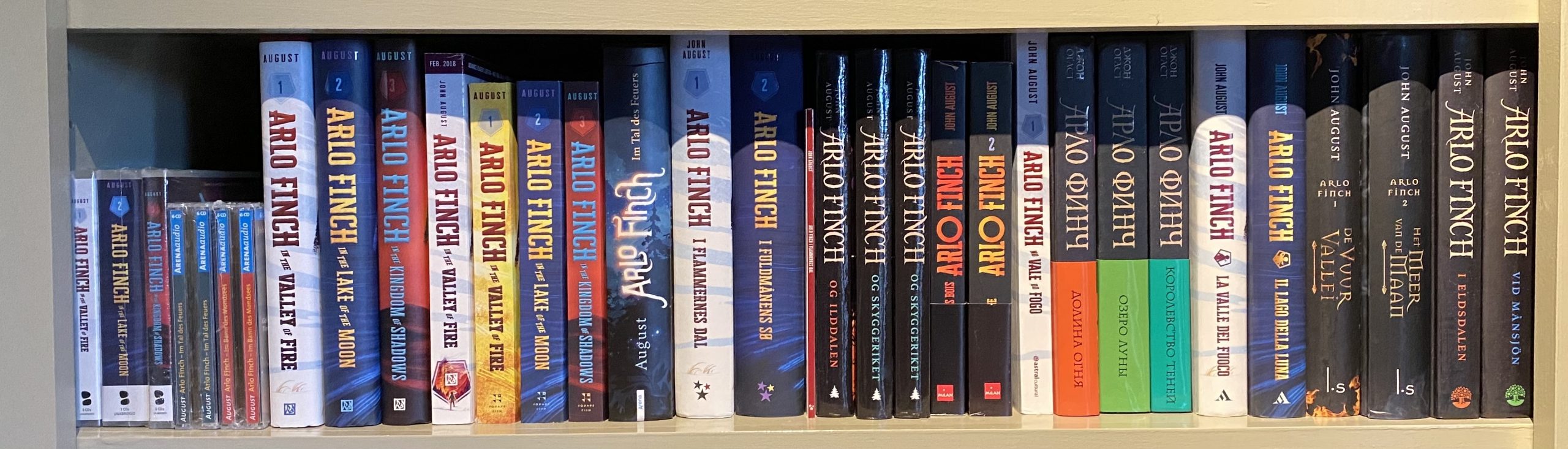
shelf with arlo finch books lined up

In my library, I cleared room for one copy of each translation. The rest are packed away in boxes in a closet.

## 8. You won’t get everything right. (See #1.)

If I could go back to book one, I would make a few changes.

**Capitalize Eldritch.** I didn’t realize these supernatural beings would become so important. (I also didn’t know they were giants.) We started capitalizing Eldritch in book two, but it bugs me that we’re not consistent.

**Set up Arlo’s origin earlier.** In book one, we learn Arlo is a “tooble,” but not what it means. We get an answer in book two, but as noted earlier, most reviewers only read the first book. Fox, who appears at the end of book one, could have been less oblique.

**Name the Warden.** In book three, we learn that the adult Ranger Arlo talks to after the campfire in book one is the middle school band teacher (Mr. O’Brien). I wish I’d given him his name from the start.

**Put Hadryn in book one.** Hadryn appears early in book two, but by the rules of trilogies, he should have shown up in the first book — if not as a character, then at least as a named threat.

**Call out how it’s different from other fantasy trilogies.** Unlike Harry Potter or Percy Jackson, Arlo Finch sleeps in his own bed every night. It’s a much more grounded adventure. I think that’s obvious, but none of the reviewers seemed to notice. I should have underlined that.

## 9. Don’t wait to thank people.

Early on, I decided that I wanted to save all of the thank yous and acknowledgements until the end of the third book. My reasoning was that as a reader I generally skip these sections, so why waste the pages and the ink? Plus, wouldn’t it feel presumptuous to thank a bunch of people for a book that might not be well-received?

In retrospect, this decision was dumb.

I should have included thank yous in the first two books as well. As the past year has demonstrated, anything can happen. There was no guarantee the final book would ever come out, or that everyone would be alive to see it. *So thank people often and publicly.*

## 10. It’s hard to say goodbye.

It’s been almost 18 months since I turned in the final revisions for *Kingdom of Shadows.* I’m finished, yet I don’t entirely *feel* finished.

The series was conceived as a trilogy and definitely resolves the major open questions. Like any finale, I took advantage of the opportunity to burn down the sets and let characters move on.

Could there be another book? Sure.

Does there need to be another book? Not really.

Had Arlo Finch become a runaway best-selling phenomenon, I’d certainly be writing more books in the series. But as a writer, my most precious resource is time, and the best use of it going forward is on other projects.

Still, *Arlo is special.* I’ve lived with it longer than anything except Big Fish. I know every inch of the Finch house. I know Indra’s secrets. I know what happens at the Ranger equivalent of the Philmont Scout Ranch in New Mexico and the circumstances of Arlo’s first kiss.

There are Arlo Finch books that won’t be written and stories that won’t be told. But I’m grateful for the three I have, and the years it took to write them. I’m happy they’ll outlive me.

—

You can find Arlo Finch in [bookstores](https://bookshop.org/books/arlo-finch-in-the-valley-of-fire/9781626728141) [everywhere](https://amzn.to/3trKtfw). The series is appropriate for anyone age 8 and up, including quite a few adults.

Sexy Ghosts of Chula Vista

Episode - 486

Go to Archive

February 2, 2021 Scriptnotes, Transcribed

John and Craig discuss how screenwriters use irony to build tension and texture, and why the term should be freed from its pedantic literary shackles.

Then it’s another round of the Three Page Challenge, where we look at the first three pages of listener-submitted scripts ranging from multidimensional ghost stories to erotic pleasure principles. We also follow up on ethical female characters and why Craig left Twitter.

Finally in our bonus segment for premium members, we discuss money and the return on happiness.

Links:

* [Irony](https://www.masterclass.com/articles/what-is-irony-different-types-of-irony-in-literature-plus-tips-on-how-to-use-irony-in-writing#what-are-the-main-types-of-irony) and [cosmic irony](https://www.studiobinder.com/blog/what-is-cosmic-irony-definition-and-examples/)
* Three Page Challenge: [Echopraxia or an Interdimensional Coming of Age Ghost Story](https://johnaugust.com/index.php?gf-download=2020%2F12%2Fechopraxia-three-pages.pdf&form-id=1&field-id=4&hash=3daf6520c3d18584e970f76e9b48965308dfbca379eb9e229603392f8b8c2ece) by J Vernon Reha
* Three Page Challenge: [The Little Death](https://johnaugust.com/index.php?gf-download=2021%2F01%2FTheLittleDeath_AutumnPalen.pdf&form-id=1&field-id=4&hash=0abfaa550f0e35fa9e1fe7d11adc10079351101e68f0a6e46563289eb367bd82) by Autumn Palen
* Three Page Challenge: [Chula Vista](https://johnaugust.com/index.php?gf-download=2020%2F11%2FChula-Vista-pg-1-3-Kristen-Delgado.pdf&form-id=1&field-id=4&hash=4d0c0d1249961917d27dcfa77679d4b7713ef86147a3a00e2860e4bfacd3d97e) by Kristen Delgado
* Thank you to all of our Three Page Challenge submissions! [Apply here](https://johnaugust.com/threepage) to be considered for our next round.
* [GeoGuessr](https://www.geoguessr.com/)
* [Noah Kalina Newsletter](https://mailchi.mp/6068da7c609b/noahkalina)
* [Get a Scriptnotes T-shirt!](https://cottonbureau.com/people/scriptnotes-podcast)
* [Gift a Scriptnotes Subscription](https://scriptnotes.supportingcast.fm/gifts) or [treat yourself to a premium subscription!](https://scriptnotes.supportingcast.fm/)
* [John August](https://twitter.com/johnaugust) on Twitter
* [Craig Mazin](https://twitter.com/clmazin) on Twitter
* [John on Instagram](https://www.instagram.com/johnaugust/?hl=en)
* [Outro](http://johnaugust.com/2013/scriptnotes-the-outros) by Nora Beyer ([send us yours!](http://johnaugust.com/2014/outros-needed))
* Scriptnotes is produced by Megana Rao and edited by Matthew Chilelli.

Email us at ask@johnaugust.com

You can download the episode [here](http://traffic.libsyn.com/scriptnotes/486standard.mp3).

**UPDATE 2-5-21** The transcript for this episode can now be found [here](https://johnaugust.com/2021/scriptnotes-episode-486-sexy-ghosts-of-chula-vista-transcript).

Scriptnotes, Episode 482: Batman and Beowulf, Transcript

January 28, 2021 Scriptnotes Transcript

The original post for this episode can now be found [here](https://johnaugust.com/2021/batman-and-beowulf).

**John August:** Hey, this is John. Just in case your kids are in earshot and you don’t want them to hear swearing, this is the warning.

Hello and welcome. My name is John August.

**Craig Mazin:** My name is Craig Mazin.

**John:** And this is Episode 482 of Scriptnotes, a podcast about screenwriting and things that are interesting to screenwriters. Today on the show we’ll discuss America’s favorite crime fighter, but more importantly how we talk about him, and the bundle of IP surrounding Batman.

**Craig:** Who?

**John:** Then we’ll look at another unlikely but iconic hero, a Scandinavian king who is clever with words but also great with the sword. Bro, that’s Beowulf. And he was the Dark Knight way back when. Plus we’ll answer some listener questions and in our bonus segment for Premium members I will tell Craig about the Batman teaser trailer I wrote way back in 2001.

**Craig:** Whoa.

**John:** And we’ll discuss what other heroes we would tackle if given the chance.

**Craig:** Well this is going to be fun.

**John:** A good episode. And a good episode for the New Year. Happy New Year, Craig.

**Craig:** Oh. Happy New Year. I mean–

**John:** Happy New Year. I’m optimistic.

**Craig:** Yeah, look, I understand that the calendar is not actually a thing. That we’ve just arbitrarily said this is the beginning and this is the end, because the sun, you could pick any point in the earth’s rotation around the sun and call it day one. But, oh man, this year. Oof.

**John:** Oof.

**Craig:** Oof.

**John:** Yeah. I’m optimistic about the New Year. I’m more optimistic about the back half of 2021 maybe, but still. I’ll happily turn the calendar to a new page. And get started with new stuff.

**Craig:** And I think in 2021 we’re going to hit 500 episodes.

**John:** We’re going to hit 500 episodes. We’ll hit like 10 years or something. It’s a lot.

**Craig:** Jesus Maria.

**John:** Many milestones. Plus I know you have a very busy year coming up. I have a busy year coming up. So, we know that 2021 is going to be eventful just personally.

**Craig:** It’s going to be fun. We’ll still find a way to play Dungeons & Dragons.

**John:** We somehow will. Priorities will be set straight.

**Craig:** Priorities.

**John:** Some follow up. Follow up on follow up actually. We’ve discussed the Rent a Family story. Maria from Argentina but now living in Tokyo writes, “Werner Herzog actually already made that movie released earlier this year called Family Romance, LLC. It’s not a documentary, but the protagonist is the actual owner of the family rental company and many of the actors are real employees as well, so it creates an even stranger dialogue on the meta level on the con within the con” as I was describing.

So there already is a movie, not just How Would This Be a Movie, there already is a movie by Werner Herzog about the Japanese Rent a Family situation.

**Craig:** No one needs to write it especially since Werner Herzog has already done it. You don’t want to follow in those footsteps.

**John:** No.

**Craig:** No.

**John:** No.

**Craig:** It’s Werner Herzog for god’s sakes.

**John:** It would be foolish. And Craig would be forced to break out his Werner Herzog accent which he’s well known for.

**Craig:** [as Herzog] It’s not very hard to do. Why are you making another Family Romance movie when I’ve already made one? Mine is better.

**John:** It feels like Werner Herzog should have been in a Batman movie, but he’s not been which his just crazy.

**Craig:** Weird.

**John:** But let’s talk about Batman, because I have DC Comics on the brain, partly because of the Wonder Woman 1984 movie that came out this past week. But also the announcement that HBO Max/Warners is planning to build a whole stable of movies around their DC characters, sort of how Disney has done with Marvel.

Mike Schur, a friend, he tweeted, “Hoping they finally get into the Batman’s backstory. Like, yes, he’s a vigilante for justice and has this sort of brooding presence, but why? What happened? We fans deserve that explanation.”

**Craig:** [laughs] That’s funny. That’s funny.

**John:** That’s funny. You can’t talk about Batman, it’s always his origin story again and again and again. We’ve seen that damn alley outside a theater so many times. And the pearls dropping from the necklace. It’s just like it’s constantly an origin story. But Batman is actually a fascinating character. He’s a really weird iconic character because he’s just different from all the other characters.

So I want to talk about his history, how he fits into IP, what’s interesting about him as a character to write. And, Craig, have you ever written any scenes with Batman in your career?

**Craig:** No.

**John:** No. I have written half of one, which you’ll see referenced in the bonus segment. But I have written in the DC universe before. So I wrote a Shazam movie which was not the Shazam movie that came out. I helped out on another big DC movie a while back. And while I’ve never written Batman himself, he’s sort of always kind of there. So many of the things I like – Harley Quinn earlier this year was a One Cool Thing. He’s always a background character in that. So he has this weird looming presence over a lot of stuff.

So I thought we’d start by talking about sort of history and then get into sort of what makes him weird and unique as a character.

**Craig:** Sure. I think up until, and I could be wrong, but I think up until the mid-‘80s when the Tim Burton Batman movie came out was just, you know, another superhero. It was a high level superhero that everybody knew. I don’t know about you, but in the ‘70s when we all dressed up for Halloween in those weird vinyl aprons with the mask with the little horizontal mouth hole–

**John:** I can still smell what those masks smell like.

**Craig:** You can smell it. Everyone would stick their tongues through the little mouth hole and cut their tongue. And Batman was definitely one of those. And just like Superman or Spider-Man, or Wonder Woman, or any of them, he was in the League of Justice, the cartoon. And he was fine.

And then the Burton Batman came out, I think it’s sort of alongside the Frank Miller re-imagination, and suddenly Batman just became an entirely different thing and it was fascinating to watch.

**John:** Yeah. So we should stress that we are not Batman historians and so you do not need to write in with any of your corrections to things we get wrong about this.

**Craig:** Do not write in.

**John:** [laughs] Yes. Megana is on this call and just for her sanity and safety please do not write in with your corrections. But let’s briefly sort of talk through the timelines here. Because it starts in 1939. Detective Comics, written by Bill Finger, illustrated by Bob Kane. We move forward to the 1960s. We have that campy Batman series with Adam West. In the ‘70s we start to see Batman as this darker version and obsessive compulsive. We get The Dark Knight Returns which is really probably the first graphic novel I actually remember reading.

**Craig:** Yeah.

**John:** It sort of anchored this idea of like an older Batman and a really dark Batman. And sort of Batman as a political force and sort of questioning his role in society.

But at the same time you referenced the Tim Burton Batman which was such a different feel and take. It was dark, but his Gotham was constructed so differently. And then it became this series of directors. So we had Tim Burton’s Batman. Joel Schumacher’s vision. Chris Nolan. Zack Snyder. We now have Matt Reeves making a version of Batman. It’s a character that’s been sort of continuously re-envisioned but not reinvented because his backstory has always stayed exactly the same.

**Craig:** Yes. Yes. His backstory is fixed. And also his powers are fixed. There’s really no flexibility in terms of what he is and what he does. He is a boy who is incredibly rich, because his parents are incredibly rich. They live in a city that is modeled after decrepit New York. Not fun New York. But crappy New York. So they live in a beautiful part of New York, but then there’s this bad part of town. There’s a guy who I think officially is named Joe Chill who holds up the mom and the dad. Tries to take the mom’s necklace. And ends up shooting the mom and dad, who had been out to the opera with their young child, Bruce.

Bruce Wayne suffers two terrible things that night. First, his parents are killed in front of him. Second, he had to watch opera as a baby, as a kid. That’s just miserable. That’s always the same. And you know what else is always the same? He doesn’t have super powers. And that never changes. And maybe that’s why he’s kind of fascinating to us.

**John:** Yeah. So there’s a relatability to him in that he’s just really good at doing the stuff he’s good at. So he’s really good at fighting. He’s really smart. He can figure stuff out. And so it has that sort of proficiency porn aspect of it. He’s just so good at doing the thing he does.

And so he seems like a self-made man, although he’s a self-made person who starts with a tremendous amount of wealth.

**Craig:** Yes.

**John:** A quote that sort of tracks into this. This was DC Comics’ Jenette Kahn writing that “Batman is an ordinary mortal who made himself a superhero. Through discipline and determination and commitment he made himself into the best. I always thought that it meant that I could be anything that I wanted to be.” And so there’s a relatability to him that’s different than Superman or Wonder Woman or Aquaman who are born into their greatness. In this case he is just a normal mortal human being who is just really, really good at things.

**Craig:** Well he’s a bit of an Ayn Randian kind of hero in that he starts incredibly wealthy but because he’s so smart and so resourceful and so clever and careful he manages to preserve that wealth and grow that wealth. And he uses his wealth and persistence and hard work and determination and sweat and tears and his ability to withstand pain.

**John:** Yeah. Seems like a supernatural ability to withstand pain.

**Craig:** Right. And he uses all of that mustering American ideal independence, standalone masculine thing to become the ultimate cowboy. And he doesn’t need your unions. And he doesn’t need government. He definitely doesn’t need government. The one thing that’s also incredibly consistent throughout Batman stories is that government is bad. Because the police department is either corrupt or incompetent or both. The mental health industry is a total disaster as all they do is just churn out one damaged super villain after another. In short, the city can’t get it done. The people can’t get it done. Only this individual can get it done.

**John:** Yeah. And so in many ways it feels like a very American kind of story because we are the country of the frontier and the going out on your own. We have this sort of cowboy mentality. It’s like the cowboy mentality transferred back to an urban core.

**Craig:** Right.

**John:** And where you need to have some lone ranger of justice there to protect the innocent and beat up the bad guys. But we often talk about hero’s journey/hero’s quest kind of things. He doesn’t seem to have a lot of those, at least in the normal ways. It’s not like he’s born with some great flaw that he overcomes over this quest. He’s always in a state of anguish and pain and a determination to save his parents in ways he never could have saved them before.

He’s not a hero who has a concluding arc.

**Craig:** No. His basic job seems to be to defend and preserve the safety of the people, the good citizens of Gotham. In this regard he’s a very strange hero because presumably there are other cities which also have problems. And he doesn’t seem to give a sweet damn about any of the other ones. He’s a homer. He loves Gotham. That’s his hometown. He loves Gotham. And he is constantly serving as Gotham’s true father. Not their lame stepfather, the government. God forbid the mayor or the police or social services were at all relevant or competent. In Gotham, no. Only he is Gotham’s true father. The father who can come at night and punish the bad by inflicting fear upon them primarily. Fear.

**John:** Exactly. And so his relationship to the law is fascinating. Because he wants to be a force of law, the one who is cleaning up the corruption and the filth of the streets. But he doesn’t actually believe in the law enforcement officers. Or he has a special connection to the law enforcement officers. There’s like the good ones, you know, Chief Gordon as commissioner, but nothing else beyond that does he sort of seem to believe in.

And yet at times he does kill. At times he doesn’t kill. His decision to not use a gun or to use a gun has changed over the years. So the moral code he sets for himself is both specific but changes in a way that a lot of these things about his origin remain fixed.

**Craig:** Yeah. And in that regard he’s an extension of our American fantasy of power. He uses a vast expenditure of money and he harnesses an enormous wealth of technological advancement to shock and awe. All to protect the homeland of Gotham. And if it sounds like I’m down on Batman I’m not because he’s not real. [laughs] Just, you know, I think people lose sight of these things all the time. I should probably mention Batman is not real.

Mostly I’m interested in what our fascination with Batman says about us. I will say that I am a huge fan of the Arkham videogames, which I think are amazing. And as a Batman experience they’re incredibly both enjoyable and also they drive home another fascinating thing about Batman. Batman himself personality wise is boring. Batman does not have a family. Batman is constantly fighting the most amazing collection of villains. Period. The end.

Spider-Man has a lot of cool enemies, but nothing like Batman. No one comes close to the variety of lunatics and larger-than-life villains that Batman is constantly dealing with, all of whom are kitschy as hell and so much fun. And that is also part of the deliciousness of enjoying the Batman story.

**John:** He has a good ecosystem around him. I thought we would wrap up this segment by listening to the audience reaction to the very first teaser trailer for Batman. So this is 1988 at Mann’s Chinese Theater here in Los Angeles. And someone found video from this and so here’s the audio from a newscaster interviewing people and their reaction to the Batman teaser trailer. This is the Michael Keaton Batman directed by Tim Burton. Let’s take a listen.

**Female Voice:** Oh, I can’t wait. I love Michael Keaton. He’s one of my favorite funny people. And I love Jack Nicholson. And I love the trailer. I love the whole thing. I’m ready to go.

**Male Voice:** That’s going to be live man. It’s going to be live. I’m going to come to see it.

**Female Voice:** The trailer was better than the movie we just saw.

**Male Voice:** How do you think Michael Keaton is going to be as Batman?

**Female Voice:** Sexy. [laughs] Very sexy.

**Female Voice:** Oh, he’s just a gorgeous guy. He has great legs and everything. [laughs]

**Female Voice:** Michael Keaton is a great actor, so I’m really excited to see it.

**Male Voice:** What kind of Joker is Jack Nicholson going to be?

**Male Voice:** Nicholson, I can say he’s great all the time. He is a joker, so he’s probably just going to be play himself.

**Male Voice:** I mean, with Jack Nicholson in it, I mean how you can you go wrong? I mean, especially his makeup. That’s great man.

**Female Voice:** Jack Nicholson is casted as the perfect Joker. Michael Keaton is adorable. And my husband will just be counting the minutes to see Kim Basinger.

**Female Voice:** The only thing I could change about it was letting me play the babe.

**Male Voice:** Kim Basinger. Yeah, I can see either you or Kim Basinger.

**Female Voice:** What’s she got that I don’t have?

**Male Voice:** So intense with the eye. Come swooping in on all these scenes. And that car, man.

**Male Voice:** I like the Batmobile. Yeah.

**Male Voice:** Why?

**Male Voice:** I don’t know, it’s pretty cool.

**Male Voice:** Yeah?

**Female Voice:** I love the Batmobile. It looks so cool. I wish I could ride in it.

**Male Voice:** And what was your favorite part of the whole trailer?

**Male Voice:** When Michael Keaton comes in and says, “I’m Batman. I’m Batman.”

**Craig:** [laughs] Oh, we were so young and innocent. Oh, wouldn’t it be nice if we lived in that world again where no one had a goddamned idea of what was coming out. There weren’t 5,000 articles. There wasn’t a campaign just to unveil the tire of the new Batmobile. And people were like, “Oh yeah, Batmobile, it’s cool. That’s why I like it.” It’s so nice. Aw.

**John:** Aw. The time before there were Batman movies.

**Craig:** The time before there was Twitter and the sort of like cottage industry. And no hot takes. Did you notice?

**John:** Not a single hot take.

**Craig:** You do that now and someone is going to be like, “Um, you know, I don’t think that – it doesn’t, you know.” Ugh.

**John:** All right. So Batman is a character we’re all familiar with because we’ve seen him 1,000 different times. But I want to transition to talking about a character who is at least as foundational but sort of less well known. And that’s Beowulf. And to help us out with that let’s bring on Maria Dahvana Headley. She’s a New York Times bestselling author and playwright. She’s also an authority on Beowulf, having written The Mere Wife: A Modern Day Adaptation of Beowulf, and an acclaimed translation of the original this past year which was in fact my One Cool Thing a few weeks back. Welcome Maria.

**Craig:** Hey.

**Maria Dahvana Headley:** Thank you. Thank you for having me on.

**Craig:** So much fun.

**John:** It’s very exciting to talk with you. So I absolutely adored your translation, because I tried to read an earlier version of it that was also acclaimed in its time and I found your version to be just so sparkling and present and fresh. And it felt like someone was just sitting across the bar/table from me telling me this story.

So, I strongly recommend it everybody. That’s why it was a One Cool Thing. But I’m wondering if you could give us a little backstory on what was it that I actually read. Because I think I have this vision that Beowulf is sort of like The Iliad and the Odyssey that it was an oral tradition story passed down for generations, but I don’t really know what it was I read. So what is Beowulf?

**Maria:** Well, you have a pretty accurate possible guess. We don’t know. We don’t really know what it is.

**Craig:** That’s the best answer ever. [laughs]

**Maria:** One manuscript is about 1,000-ish years old, written by two scribes. We don’t know who the scribes were. But they are correcting each other throughout. And it is probably, and in my opinion almost definitely, a transcription of an oral performance. Because it had throughout the poem it’s 3,182 lines of battles and lineage basically. And throughout the poem there will be stopping points where the narrator will be like, “Let me tell you what happened last night,” because he’s clearly, in my opinion, performing for a drunk audience that is shouting and he’s unamplified standing on a table. That’s just how I feel the poem is.

But not everyone has felt that way. Lots of people have felt like this is a normal poem about the sort of glorious traditions and that it should be done in a somewhat fusty language or in a “noble” language. J.R.R. Tolkien really felt this way about it. It’s the thing that inspired everything he did. All of Lord of the Rings was inspired by Beowulf. He was a big Beowulf nerd and he did his own translation which is done – it feels like reading Lord of the Rings. It just doesn’t feel as good.

**Craig:** Because J.R.R. Tolkien, was he a philologist? Is that the word?

**Maria:** Yeah. He was someone who really, really, really cared deeply about Beowulf. And what he cared about most deeply was the attempts to fall into the old traditions, rhyme and meter wise. And so he was driven bonkers by it. He was trying to translate a language, Old English, which does not translate directly to contemporary English. So what you’re reading in my translation and in anyone’s translation is a wild guess.

It’s like – and it’s definitely unlike some languages, this is a language that if you’re translating from Old English it’s so much about the translator, what the translator is choosing out of many different possibilities for most of the words.

**John:** So, anybody who is doing a translation of Beowulf is really doing an adaptation of Beowulf. Because it’s taking what is the sort of foundational story and trying to apply not just modern words to it but kind of modern concepts. And that’s why – it got me thinking about Batman. If you go back to the original issue of Detective Comics that introducing Batman as a character and took that as a foundational text, any new version of it is going to necessarily change some things to have it make sense with sort of modern audiences. And it’s hard to imagine a character who has been more transformed more times than Batman.

In your case, in telling this story of Beowulf, you’re looking at sort of how we approach this character, but also what is even the format of the story it takes place in. Because yours very much feels like an oral tradition. It’s some guy telling you a story like right across the table. But that’s a choice. It’s a way of presenting this sort of foundational text and introducing this character.

**Maria:** Yeah. I decided to do it like a long monologue essentially. Because I thought, OK, well then you can have the POV of the poet as well, which is really part of the original. But lots of people don’t put that in. They feel like it’s needlessly confusing. So they just sort of relate the Beowulf story like it’s history, like here’s the true thing that happened to my boy. Whereas I wanted a sense of POV.

**Craig:** I’m just curious, what do you think – when you do this kind of translation, do you run into a resistance that somehow by making it accessible you are cheapening it? Do people still equate accessible with less than?

**Maria:** Yes. [laughs]

**Craig:** What’s the story with – like why do people do that? And how do you respond to that?

**Maria:** Well, it’s an interesting state of affairs. Like in the case of this translation a lot of the press surrounding it has been that I used a lot of slang. I use bro as the opening word of the Beowulf.

**Craig:** That’s so cool.

**Maria:** Which is a transgressive thing to do, but also a pretty accurate translation idiomatically of what that word means and what [unintelligible] means. But it’s transgressive because people feel like that’s a low word. And they feel like slang is low. Which is ridiculous because the entire English language is slang. It’s slang after slang after slang and all kinds of things have contributed to the language.

So, it’s an interesting thing. I think the tradition of believing that something that’s written in vernacular is low is a tradition that’s based on all kinds of hierarchy and prejudice and lack of accessibility to sort of ivory tower structures that have meant that diverse translators have not been able to get into the tower to do the translating and to give perspective on a lot of these ancient texts.

**Craig:** Right.

**Maria:** So it’s been an interesting experience. Other women have translated Beowulf and there have been maybe 15 other women have translated Beowulf into English. And their translations are really interesting but rarely get a lot of play. And often what has happened is that the old guard comes in and says, “Well, this is a minor translation and it’s not a real translation and it’s for children.”

Most of the women in the early part of the 20th Century who translated it ended up writing children’s translations of Beowulf, even though those are also the things that were taught in Tolkien’s primary school that got him into Beowulf.

**Craig:** Right. So in their own way their translations are more experienced than the other. That’s the kind of strange weird feedback loop is that the more accessible you make it, the more people read it, the more people learn, and that becomes Beowulf.

**Maria:** Yeah. And that becomes the cultural understanding of Beowulf is built completely on accessible translations rather than translations in the sort of Old English meter, for example, that are untranslatable.

**Craig:** Right.

**John:** Now, Maria, I want to talk to you about your character of Beowulf, and he’s so proficient and slays creatures with such aplomb. In your mind as you’re translating this is he supernatural or is he just a really good fighter with a sword? Because he seems to have at times sort of Hercules kind of powers. Other times he’s just really a good fighter. Where do you come down on the nature of him as a hero?

**Maria:** I think I come down all over the place. I’ve thought about it so much because it’s – one of the things that I think is really interesting when you first read Beowulf you think, wait, OK, this guy can sort of slay 30 at one blow, which means he’s not human. And the only other person who can do that is the major monster, Grendel. Grendel also can slay 30 in a blow. And they’re both mentioned with the same number of men.

So, you read that and you think, well, OK, if one of these is a monster the other one is also probably a monster. And so I kind of come down on the no one is really a monster end of the spectrum. The poem itself has a big talk makes you big kind of situation. So, if you talk – I want to say bigly so much – if you talk–

**Craig:** Do it.

**Maria:** If you talk with enough Trumpian volume about yourself, and indeed this is part of how I translated Beowulf’s speeches. If you talk that way about yourself you can sometimes pull it off. You can make other believe it. And even if it doesn’t really work in reality, the story they tell about you will be a story about somebody who swings it really hard.

So, I think it is as much a story about storytelling as it is a story about anything else. And the Beowulf character is a character that’s built on his own story about what he’s capable of doing.

**Craig:** I remember reading The Song of Roland in college and I was struck by how iterative it was a battle that there was this kind of almost hypnotic rhythm once the fight began of just like he killed this guy and then he killed this guy, then he killed this guy. Was this sort of like the action sequence way back when? Let me describe how – or like Sampson killed a thousand Philistines with the jawbone of an ass. I mean, was this the action sequence of the old days when you didn’t have moving pictures so you just had to describe violence over and over?

**Maria:** It’s an interesting thing. I mean, some of those ancient texts are almost like a ship’s manifest. You get the [unintelligible] and their lineage. And along with so I guess they’re the spoils of war itemized. And that’s often something that’s part of the poem, like remembering the names which is interesting when we think about the many ways in which we fail to remember the names of the dead throughout the 20th Century and 21st Century.

Yeah, the blow, blow, blow, blow, blow stuff is very much part of the Old English tradition as well. And in this story, I mean, it’s three big battles basically. But you also hear about a lot of other battles in which whole armies of men die and everybody is scattered and flattened on the ground and Beowulf swims away from one battle with 30 suits of armor in his arms somehow.

**Craig:** That’s awesome.

**Maria:** You know, things like this are happening.

**Craig:** Cool guy.

**Maria:** And you really get a sense of the cost of the big ego. If you are the king you have to choose your time to fight. And sometimes your time to fight – or if you’re the hero, the right hand of the king, which is what Beowulf is for most of the story, sometimes there’s just a big cost. You just have piles of bodies.

**Craig:** Just like Batman.

**John:** Just like Batman. And also just like Batman we see Beowulf in sort of two forms. We see his young form where he kills Grendel and Grendel’s mother and he’s the hero who shows up at the foreign kingdom and is the giant hero. But we also see him much later in life sort of like in Frank Miller’s Dark Knight Returns where he is the aging king going back for one last battle.

To me it feels like there were two volumes or two different comic books that sort of got joined together at some point historically because they feel – they’re related but they’re very different stories. And there’s some sense of all the things he didn’t do in his life. It seems like he never had kids, never had a family, sort of never got to have the normal human life. As you’re translating this did it feel like two stories that got joined together or does it feel like it was always intended to be the arc of this one hero’s journey?

**Maria:** Well, again, there’s lots of debate about that in the Beowulf realm. Some people really feel that the last section of Beowulf which is a battle with a dragon. He’s a king for 50 years and we don’t get any information about that. We get Grendel’s mother. Than he gets home. He gets rewards. He tells his story. And then 50 years pass in a line. And he’s an old man. And we get this thing where he goes up against a dragon by himself and he has to fight the dragon. He’s sure he’s the only guy who can fight the dragon. And he goes in and he kills the dragon, but the dragon kills him, too.

And some people feel like that last third of the poem is just a meanness that was grafted onto it by someone. That it was just stuck on and this like mean situation involving darkness. But I think what it is is youthful sins get payback later. I think that the center of the poem, and this is something I’ve always thought about, when Beowulf kills Grendel’s mother she is acting according to the law of the time. She goes in, her son is killed, she goes in for a revenge killing, which is allowed. She kills one guy. And goes home.

She takes that guy home. She does a little bit of graphic display of his beheading and whatever.

**Craig:** That’s reasonable.

**Maria:** She only kills the one dude, an important guy who is equivalent to her son. And in sort of feudal laws that’s allowed. And what Beowulf does is he breaks into her house under the water. He goes in, like a mercenary, because he is a mercenary. And he comes in and attacks her in her own realm. And she’s an old woman. She’s been queen for 50 years just like Hrothgar, the king he’s serving has been king for 50 years. So she’s probably in her 70s. And Beowulf is maybe 20.

So he goes in, kills an old woman who is so ferocious and hardcore that she almost kills him. And that’s just against the law. Like it’s against the moral code of the poem. So my feeling that the dragon in the end, the last third of the poem, is the wages of sin. It’s sort of like, OK, you can do it, you’re strong enough, you’re big enough, you’re bold enough, your balls are big enough. And you do the thing and then 50 years pass and the whole time you’re having a bad feeling about it.

And I think that Batman has some things like that, too. He always has this sort of morosity. And the morosity is about am I – because he’s declared himself the arbiter of morality in Gotham. And then this difficulty of what if he got it wrong at some point. What if it was a fuck up? And I think the Beowulf story is about – the center battle is a fuck up that he shouldn’t have done.

**Craig:** It is interesting that Batman is constantly struggling with that and yet not really struggling with it, because in the end the dictates of the story are feed us justice. So, he will “wrestle” with it, but the people who generally pay are the people around him. So he gets off the hook. There is no dragon that eats Batman in the end. But a couple of Robins have died, I think.

**John:** And Beowulf ends with a handoff to a Robin kind of character as well. There’s a sense of a generational passing down finally at the end there.

**Craig:** Batman doesn’t pass on. So I think Batgirl at some point canonically is paralyzed. So, people are constantly dying around him. Commissioner Gordon gets killed a few times. And [unintelligible], I think he definitely gets killed. And Batman keeps going. And his anger fuels him to further on. And I kind of love the idea that the wages of – maybe not wages of sin, but truly if you’re living by the sword. Yeah, at some point you can’t be the best forever. And if you beat a 70-year-old woman, albeit a Grendel mom, a mom Grendel, when you’re a 70-year-old guy someone is coming for you. I like that.

**Maria:** Yeah. I mean, there’s always the sort of arc of what is coming for you. And throughout the Beowulf poem that’s discussed, as it is – I mean, it’s interesting thinking about Batman because Batman never becomes the king. He’s the Dark Knight the whole time. And being the Dark Knight means you have to serve. You don’t necessarily get to – I mean, he’s serving a larger moral god. But he still has to serve. He doesn’t get to be the king who is making all of the decisions in terms of his own well-being and in terms of the well-being of others around him. He’s often – I feel like he’s often in a tournament. It’s like more out of the Arthurian myths.

**John:** Yeah, for sure.

**Craig:** Right.

**John:** Maria, it is absolutely a delight getting to talk through Beowulf and Batman with you. Thank you so much for coming on the show.

**Maria:** Thank you for having me on. I could talk about this all year. I love it.

**Craig:** Thank you, Maria.

**John:** Thanks Maria.

**Maria:** Bye.

**John:** All right, bye. So, Craig, that was actually delightful. We did not pre-interview at all with Maria. I just assumed she would be great talking about Batman and Beowulf and I was correct.

**Craig:** You were right. Yeah. Pre-interviews, why would we ever do that? We live on the edge?

**John:** We live by the sword and we die by the sword.

**Craig:** That’s right. We don’t give a sweet damn.

**John:** All right. Now it’s the time on the program where we welcome on our producer, Megana Rao, who asks the questions that our listeners have asked. Megana hi.

**Craig:** Megana.

Megana Rao: Hi, Happy New Year.

**Craig:** Happy New Year.

**John:** Happy New Year to you. What have you got for us this week?

**Megana:** So, Patricia from Canada writes, “I recently started working in the nuclear industry and am easily Google-able. My question is whether producers or network executives like those from a very family-friendly network, which is my genre, might have an issue with my day job if I were to sell my script that has received a bunch of interest this year before I started in the nuclear industry. And if they do are there options for me like using a pen name?”

**Craig:** Huh.

**John:** All right, so Patricia basically is a Homer Simpson somewhere in Canada.

**Craig:** Right. I’m sure she’s a competent nuclear technician.

**John:** I’m sorry. She’s a competent Homer Simpson who has written a script that is now getting attention. She worried that if someone figures out that, oh, she’s actually a nuclear person that they won’t want to work with her. I don’t think so.

**Craig:** No. That’s not – I think people have this sense that Hollywood is incredibly, I don’t know, discriminatory against things that violate their tender snowflake sensibilities. Far from it in fact. I think people would be surprised how compromised people are. It’s a business, right? So billionaires with their billionaire companies are trying to make billionaire stuff.

No, I don’t think your employment in the nuclear industry is at all a problem. If you were, I don’t know, employed as a hacker for the Russian government, yeah, sure. But, no, people working in a nuclear power plant are doing a perfectly fine job. So, no, I don’t think so.

And as far as pen names go, just as a general note for – Patricia I think is from Canada so you have the WGC, I don’t know how they do it there. But in the United States the WGA, which administers credits, we do have a clause that says we can use a pen name but only if we’re paid under a certain amount. I think it’s $250,000. And if we’re over that amount then the studio has to agree to let us use the pen name which is obviously an awkward conversation. It’s an awkward thing to do regardless.

**John:** That said though, if she is just starting her career she can pick whatever name she wants to use as her professional name.

**Craig:** That’s right.

**John:** So a pen name in that situation is like I don’t want my name on this movie that I wrote but I don’t want my name associated with it, that is a different case than sort of like starting with a new name. Because I started my career as John August even though that wasn’t my born name just because it was an easier, better name.

**Craig:** Right. Like Diablo Cody is Brook Maurio and she wanted to go by Diablo Cody. And then at some point like Brook if you’re like, you know, I think people get it I’m just going to use my regular name now and everybody goes, “Cool. That’s good. That works.”

**John:** What next, Megana?

**Megana:** Great. So Jake in Dallas asks, “I agree with the principle that characters will carry your story to a more successful and satisfying conclusion than the plot alone. However, I have a story that has some solid plot and shaky characters. My question is one of time management and expectations. Is it worth it to dig in and try to build up these weaker characters to match the cool framework that is my plot, or am I kidding myself with a task like that? Meaning the fact that I don’t have strong characters in the beginning of my writing process might be an indication that the story itself is a weak and therefore not worth the effort to populate it with compelling people.

“I feel really good about the structure I built but I’m not sure about the occupants I plan on inviting into the building. The décor and furniture will be rad, so it’s just the pesky people I’m sweating.”

**John:** Oh Jake. What you’re experiencing is common. And I think a lot of writers are probably nodding a bit there. Because sometimes you think of a cool idea for a story and like, oh, you could sort of imagine the set pieces and how it all fits together and the plot and the twists, and then you realize like, oh, but who is actually in this story. And then you actually have to sort of unwind some stuff to figure out like who is the most interesting person to be in this story that you have plotted out in your head.

It’s worth the time. It’s worth the time to stop and figure out who are these characters, what is it that they are uniquely bringing to this cool plot that you have figured out. Because otherwise you’re going to have a cool mechanical clock that no one cares about.

**Craig:** Yeah. That’s exactly it. The plot is not there for the audience. The plot is there for the character. It’s what the character is going through. So, if the character is weak it doesn’t really matter what the plot is. Then they might as well just be an observer or the plot is not designed to challenge the character and put the character in situations that are unique for him or her. So when you say maybe this is an indication that the story itself was weak, I would say that you probably want to take a moment to stop divorcing plot and character from each other the way you are and put them together. Because I don’t think when you think about how you’re day went today, Jake, that you’re going to think about yourself and then the things that happened separately. There’s the things that happened to you. And that’s what plot is. It’s something that is happening to a character, therefore one in the same.

**John:** Or because of the character ideally.

**Craig:** Exactly. Well, both, right? So something happens to you, you do a thing, now something new happens and then the da-da-da, and that’s how it works. So they’re actually part of the same thing. And you don’t want to get caught in this sort of scriptic Cartesian duality.

**John:** Yeah. I will say there are forms of writing that are less character-driven. Certainly spy novel books that are very sort of – they’re plot machines. And there are crime procedurals that are kind of plot machines. And if that’s the kind of thing you like writing that’s great, that’s awesome. And they can rely on sort of less characters doing things and just sort of the story doing things.

But it sounds like if you feel this tension right now the thing you’re working on probably should have a strong central character that’s driving it. So stop, think about who that character is, and rewrite it so that character can really be at the center of the story that you want to tell.

**Craig:** Agreed.

**Megana:** Mitch writes, “I work a manual labor job and I most often listen to you gentleman in headphones while my hands are preoccupied and I can’t pause and rewind to hear something clear. I’m pretty sure I heard you two quickly mention something about John earning his Arrow of Light in Boy Scouts, but I couldn’t find it when I tried to listen back. Is John August an Eagle Scout? If so, what was his Eagle project?”

**John:** All right, Mitch, I am in fact an Eagle Scout. I went all the way up through scouts and Arrow of Light refers to – although Arrow of Light could have actually been – is that the Webelos Bridge? I can’t remember which part Arrow of Light fits into, but I know I had it because I had all the patches. I had all of it.

Yes, I did scouts. Yes, I was in the Order of the Arrow which is problematic for Native American cultural appropriation. I didn’t get it at that point. I’m sure I would get it now.

My Eagle Scout project, so when you go up through the ranks in scouts one of the final things after you’ve earned all your merit badges is to do a project which involves 100 hours of planting and community service and getting people together to do stuff. I did an interpretive garden at my public library, so it was putting up signs for what the plants that were there so that people who visit the library could actually learn what plants were used in that garden. I also built a new sign in front of that library which was not good and was replaced about a year later.

But that was my Eagle Scout project. I actually have some ongoing shame about how not good that sign was and how I wish it were better.

**Craig:** That’s like your parents getting killed in the alley, you know, behind the opera.

**John:** That sign in front of the George Reynold’s Branch Public Library in Boulder, Colorado is my parents getting killed in the alley. You’re right. It’s foundational.

**Craig:** Yeah. You have these flashbacks about it. I like that they suffered through it for a year. That every day they came in and they all turned to Verna, who I assume was the senior librarian, and said, “Verna, come on.” And she’s like, “Uh, we can’t. He was an Eagle Scout.” “Oh, please Verna.” And then finally the big Christmas party they’re like, “Verna, it’s Christmas.” And she’s like, “You’re right. Let’s burn it.” [laughs]

**John:** I really think it probably was arson. I didn’t see it burn but I have a hunch that it just burned somehow magically and they replaced it with a much better sign.

**Craig:** I mean, if you put a couple of rum eggnogs in Verna she’s going to light something up. That’s how it goes.

**John:** She’s known for it. All right. Megana, thank you for these questions. They were fun.

**Craig:** Thanks Megana.

**Megana:** Thank you both.

**John:** All right. It’s time for our One Cool Things. My One Cool Thing is a long article by Olivia Nuzzi writing The Fullest Possible Story on Four Seasons Total Landscaping situation.

**Craig:** Oh god.

**John:** So as you recall one of the weird, wacky things that happened in 2020 was there was a press conference held at the Four Seasons about potential election fraud in Philadelphia or in Pennsylvania overall. But of course it wasn’t Four Season the hotel. It was this tiny little place called Four Seasons Total Landscaping. It was weird and how it all happened is crazy. And so she digs into sort of what actually happened and how they ended up at this weird landscaping company and try to pretend it was their plan all along.

So, just as a last read in 2021 or first read in 2021 to remember what happened in that crazy year. It was a nice full accounting of a really surreal moment that feels like a Coen Brothers movie. Just a bunch of people making hasty decisions that turned out poorly.

**Craig:** Unbelievable. Unbelievable. My One Cool Thing, well, so we have a new puppy in our house.

**John:** I’m so excited. I did not know this. Tell us all about this puppy.

**Craig:** Her name is Bonnie and she’s fantastic. And you will meet her tonight, John. I will hold her up to the camera. She will be an NPC somehow in our D&D game.

**John:** Absolutely.

**Craig:** And so I’m a big believer in crate training. If you are not a believer do not write in, because I don’t want to hear from you. But crate training I think is the key to why my older dog is such a wonderful dog. Obviously she doesn’t need the crate anymore. But she’s just an incredibly well-behaved, lovely dog. And that was a big part of it. And it also keeps, I think it keeps the new puppy parents sane as well.

**John:** Oh yeah.

**Craig:** But, you know, dogs – traditionally puppies – do struggle a little bit with the crate initially because they can feel a little bit lonely in there. And so there’s this thing called the Snuggle Puppy. Have you heard of this?

**John:** No, but I can imagine what it would be and I think it’s probably – my guess is that it’s the 2020 version of the alarm clock and hot water bottle wrapped in a blanket?

**Craig:** Bingo. So, well, just with a little extra twist. So it is, of course, a plush little puppy animal and it’s got a little Velcro pouch. And you can stick one of these little, they have like these heat warmer packs, like the hand warmers you get on set when it’s freezing. You put that in its little belly and then it also has its little heart-shaped thing with a battery in it. And you turn that on and it makes a heartbeat little thump-thump. So the puppy can snuggle up against another dog that is warm with a heartbeat which is exactly what they’re used to.

And my goodness. I mean, we put her in there and we didn’t hear anything. You know, for like three hours. Just silence. It was pretty remarkable. And then when we came to take her out, you know, because it was time to come out of the crate and go potty and all that, she was like I don’t want to go. I want to stay in here. I’m tired. I want to stay with my warm friend.

So, huge thumbs up to the Snuggle Puppy people. That was great. Big fan. Not that expensive.

**John:** I’m a fan of crate training as well. Lambert, my current dog, was already well past that, but still like having a crate, a place he can declare as his own, where he can be responsible for defending that and not the rest of the house, game changer.

**Craig:** Yeah. And also really helps house train them as well.

**John:** Oh yeah. For sure. All right. And that is our show for this week. Scriptnotes is produced by Megana Rao. It is edited by Matthew Chilelli who also did our outro this week.

If you have an outro you can send us a link to ask@johnaugust.com. That’s also the place where you can send longer questions. For shorter questions on Twitter, Craig is @clmazin. I am @johnaugust. Maria is @mariadahvana. We’ll have links to all those things in the show notes.

You can find those at johnaugust.com. That’s also where you’ll find transcripts. And you can sign up for our weekly-ish newsletter called Inneresting which has lots of things about writing. You can sign up to become a Premium member at Scriptnotes.net where you get all the back episodes and bonus segments, including the one we’re about to record where I will go into the history of my Batman teaser trailer which was a different teaser trailer than the one we listened to earlier on.

Craig, thank you for a fun show.

**Craig:** Thank you, John.

[Bonus segment]

**John:** Craig, I’m going to play a teaser trailer for you and you probably have seen this trailer, but you don’t remember that you saw this trailer. And then we’re going to talk about it.

**Craig:** All right.

**John:** So, we’ll put a link in the show notes to YouTube, but we can just listen to the audio for now.

Male Voice: Throughout the ages there has been one hero standing watch over us all. One hero protecting mankind wherever he is needed. He moves in shadows. Cloaked in mystery. And now in the summer of 2002 he will be called upon yet again to save the world. [Scooby-Doo sound]

**Craig:** Classic. So much classic marketing in that spot.

**John:** Thank you. So, let me tell you about the origin of this. And obviously if you’re listening to this just as the podcast version what you might not appreciate is we’re going through this mansion, this sort of spooky mansion, and we come upon the silhouette of Batman standing there. And we see his iconic sort of cowl. And he turns and it’s Scooby Doo. Because it always struck me that Scooby-Doo in outline actually looks a lot like Batman because he’s got the pointy ears that are sticking up there. And so he turns and you see that it’s Scooby-Doo.

So I always had this in my head as like at some point I really want to do a teaser trailer for Scooby-Doo when you reveal it’s Batman. And then I ended up being employed for a week, two weeks, to help out a little bit on the very first Scooby-Doo movie. And I said like, “I’m so excited to be writing these scenes, but more importantly I’ve always had this teaser trailer.” So I sent it through and they ended up making that and that became the teaser trailer for the first Scooby-Doo movie. A parody of Batman.

**Craig:** It holds all of the traditional elements. I mean, they don’t really do stuff like this now. I mean, it’s 20 years old. And I was doing similar things for Disney a little bit earlier, maybe like five or six years before 2001 when I wasn’t yet a screenwriter. Obviously you were a screenwriter at that point. But first of all it has that voice. For the kids, that’s a guy named Don LaFontaine. He is no longer with us. But he was essentially the voice of movie trailers and teasers. He did, I don’t know, 70% of them or something. It was insane.

**John:** Oh yeah.

**Craig:** You would go to the theater and there would be seven trailers in front of the movie and four of them would have his voice or something. It was nuts. So it was Don LaFontaine. A misdirection in teaser trailers is incredibly common to the point where nobody was misdirected anymore. They were already onto it from the jump by the time you got to, I don’t know, whatever, 2009 or something. They were like, no, you can’t do it anymore.

And, of course, the ubiquitous needle scratch which became this fascinating sonic signifier that didn’t even mean anything to kids at that point, but yet they somehow understood it meant stop everything.

**John:** This trailer, I just wrote it up in normal sort of screenplay format with that dialogue and sent it through, and I was delighted how it turned out. What was also weird about these teaser trailers is they were completely disconnected from actual footage from the movie. Even now like when Chris McQuarrie has been on the show he talks about every day trying to shoot one thing that could make it into the trailer or the teaser trailer for the Mission: Impossible movies. But in this case it was just a whole special shoot which was just for doing this teaser trailer. And you don’t see that as much anymore where there’s no footage from the actual movie in it. It’s just a premise teaser trailer. Like this is a thing that is going to exist.

**Craig:** Yeah. So when I was working in marketing at Disney, this was like back in 1994 and 1995, this would come up quite a bit where you would do a special shoot. And in fact I was dispatched as a 23-year-old or a 24-year-old to the set of a movie called Mr. Wrong. Do you remember that movie, John?

**John:** Oh, I do. With Ellen DeGeneres.

**Craig:** Exactly. With Ellen DeGeneres and Bill Pullman. It was a comedy. It was ill-fated. It did not do particularly well at the box office. Although I remember reading the script. It was one of the early movie scripts that I read and I really liked it. And I was sent to talk to Ellen and Bill about making a special shoot, some sort of scene that we could shoot to help tease the movie.

And, you know, you rapidly learn as a 24-year-old that no one – they’ve got their hands full making a movie. They don’t want you there. So it was an uphill battle. But we would make those things. I remember The Ref, like I think the marketing campaign for The Ref was entirely a special shoot, which did not help The Ref which is one of my favorite movies. Yeah, they used to do this stuff all the time. Now we have our own trailer and teaser conventions that we cannot seem to break. So the modern version of the misdirect, Don LaFontaine, and needle scratch is a fairly well-known pop song that is played at a much slower speed by a different kind of voice so that it’s this really weird dreamy take on some pop song that we know and love.

And then some wahs and some booge and stuff like that. In 20 years from now people will look back and those, OK, yeah, that’s what they did then.

**John:** That’s what they did. Now, this was the closest I ever got to writing Batman and I don’t know that I’ll ever write Batman in anything, which is fine. But the announcement that Warners and HBO Max are going to be doing a whole big expansion of their thing and of course with all the new stuff that Disney has announced with the Marvel universe, it got me thinking what characters might you or I at some point want to tackle. And so I have a short list here. I’m curious what characters would be on your list.

Obviously we’re differently placed because we could theoretically do one of these things. I don’t think we will do any of these things. But here’s the list of things I would love to tackle at some point.

I really like ATOM as a character. After Ant-Man I’m not sure there’s a space for another guy who can become really small, but I always liked ATOM. I still love Wonder Woman. I get why people didn’t love this last one as much, but I dig her as a character. Thinking sort of mythologically, I’ve always really dug Perseus. I especially love Perseus’s backstory where as a baby he got shoved into a trunk and sent off to sea because his father worried that he was going to usurp him. I love that.

I love Hermes/Mercury as a god who again is just a cool trickster character. And then in terms of the non-superhero characters, I think Indiana Jones/Nathan Drake are great guys who like Batman are super good at the things that they’re good at, but also having a fun attitude. They’d be fun characters to write in ways that I think Batman would not be a fun character to write.

Any iconic characters for you, Craig? Any ones that you’d want to tackle?

**Craig:** I don’t think so. I like comic books. I was mostly a Marvel fan when I was a kid. But I think if someone said to me, “Here’s a blank check. Write any comic book superhero movie you want,” I might say to Kevin Feige I want to do a kind of mumblecore Galactus movie. [laughs] Where it’s like he eats planets but mostly he’s lonely and he has no one to talk to expect his heralds. His heralds start to resist him. I think Galactus’s sister was deaf or [unintelligible] or something like that. So he’s having weird chats with her.

Look, the dream adaptation is happening with other people and that’s Neil Gaiman’s Sandman which in a sense I’m glad that other people are doing it because I would be terrified, absolutely terrified, to tackle that material for fear that I would do it any harm. Because I hold it in such high esteem. So, yeah, I’m going to go with sort of bummed out emo Galactus.

**John:** Yeah. I think one of the good things we’ve gotten better at in the ‘10s and the ‘20s is taking characters who would be villains in normal situations and looking at what is their actual motivation and you put them as the protagonist in the story, the central character in the story. And Harley Quinn is a good example of that. Joker, whether you liked it or not, is an example of sort of looking at that character from his point of view and what it feels like to be in his shoes.

And so, sure. A planet-eating villain, go for it.

**Craig:** A mopey planet-eating Galactus, just bummed out. I eat planets because I’m depressed. I’m depressed because I eat planets.

Links:

* Werner Herzog’s [Family Romance LLC](https://www.imdb.com/title/tt10208194/)
* [Mike Schur’s Tweet](https://twitter.com/KenTremendous/status/1343712071037272066?s=20)
* [1988 Batman Teaser Reactions](https://twitter.com/i_zzzzzz/status/1339728162306011137?s=21)
* [Why Does Batman Matter](https://www.psychologytoday.com/us/blog/black-belt-brain/201203/why-does-batman-matter) by Paul Zehr
* [Beowulf: A New Translation](https://bookshop.org/books/beowulf-a-new-translation/9780374110031) by Maria Dahvana Headley
* [The Fullest Possible Story on Four Seasons Total Landscaping](https://nymag.com/intelligencer/2020/12/four-seasons-total-landscaping-the-full-est-possible-story.html) by Olivia Nuzzi
* [Snuggle Puppy](https://snugglepuppy.com/)
* [Maria Dahvana Headley](https://www.mariadahvanaheadley.com/) on [Twitter](https://twitter.com/MARIADAHVANA)
* [Get a Scriptnotes T-shirt!](https://cottonbureau.com/people/scriptnotes-podcast)
* [Gift a Scriptnotes Subscription](https://scriptnotes.supportingcast.fm/gifts) or [treat yourself to a premium subscription!](https://scriptnotes.supportingcast.fm/)
* [John August](https://twitter.com/johnaugust) on Twitter
* [Craig Mazin](https://twitter.com/clmazin) on Twitter
* [John on Instagram](https://www.instagram.com/johnaugust/?hl=en)
* [Outro](http://johnaugust.com/2013/scriptnotes-the-outros) by Matthew Chilelli ([send us yours!](http://johnaugust.com/2014/outros-needed))
* Scriptnotes is produced by Megana Rao and edited by Matthew Chilelli.

Email us at ask@johnaugust.com

You can download the episode [here](http://traffic.libsyn.com/scriptnotes/482standard.mp3).

Scriptnotes, Episode 481: Random Advice 2020, Transcript

January 28, 2021 News, Scriptnotes Transcript

The original post for this episode can be found [here](https://johnaugust.com/2020/random-advice-2020).

**John August:** Hello and welcome. My name is John August.

**Craig Mazin:** My name is Craig Mazin.

**John:** And this is Episode 481 of Scriptnotes, a podcast about screenwriting and things that are interesting to screenwriters. Today on the show we’re answering listener questions, but not about screenwriting. Instead, we’re answering your questions about love, home ownership, ego, marriage, parenting, coding, and more. To help us out with this we are very lucky to have back Nichelle Tramble-Spellman. She’s the creator and showrunner of the award-winning AppleTV+ drama series Truth Be Told. Her other writing credits include The Good Wife, Justified, Mercy, and two novels.

She last joined us in Episode 424 at the Austin Film Festival. Welcome back Nichelle.

**Nichelle Tramble:** Hello. Thank you for having me back.

**Craig:** Nichelle. We got Chelle back.

**John:** This is our last episode of 2020. And for that we needed just a ray of sunshine and light and hope. And so Craig suggested Chelle and I could not have been more excited when you said yes.

**Nichelle:** Oh, thank you. I’m excited to be here. This is a nice way to end this crazy year.

**Craig:** Yeah.

**John:** Crazy year.

**Craig:** Yeah, let’s end it.

**John:** And while there were highlights, there were lowlights. But this is not going to be really about anything 2020. It’s just about advice for going forward. So it’s not looking back. It’s looking forward.

**Nichelle:** I’m all for that.

**Craig:** What I like is that some people out there legitimately think that John and I know what we’re talking about. That we have some inherent wisdom that stretches beyond our narrow field. Whereas it’s far more likely that Chelle will actually have useful advice, but John and I will continue to fake it until we make it.

**John:** Mm-hmm. And also to wrap this up, in our bonus segment for Premium members we’re going to talk about that Martin Shkreli article because everyone says like, hey, how could this be a movie. And we aren’t going to get it in in 2020 if we don’t talk about it, so that will be our bonus segment talking about the crazy story of the reporter who has fallen in love with her subject. It’s all not good.

**Craig:** It’s crazy town.

**John:** Yeah. But, I’m so excited to answer listener questions. So, I sent out an email to Premium subscribers on Saturday afternoon. By Monday morning at 8am we had 52 emails about all these topics. Here’s where we welcome on our asker of questions. She’s the proxy for our listeners. It’s our producer, Megana Rao. Megana, welcome.

**Megana Rao:** Hi everyone.

**John:** So 52 is what I see in the Workflowy, but there’s probably been more than 52 emails that came in so far.

**Megana:** Yeah. So I think we’re about at 80 the last time I checked. And these emails are just beautiful, about everything. And I’ve had such a joy reading through them.

**Craig:** Oh my.

**John:** Hooray. I look at what you’ve assembled in the outline and it’s a really good sampling. But there’s so many, we should probably get right into it. So do you want to start with our first question?

**Megana:** Great. So Lisa asks, “Dear masters of advice.”

**Craig:** That’s already funny.

**Megana:** At work we had a Secret Santa gift exchange. It was recommended that we try to put some real thought into these gifts and as we’re paid quite well spend some real dough, which I did for my person and felt great about. I’m definitely someone who prefers to give than receive. I had no expectation of my Secret Santa gift, but I was still shocked, as were my close workmates, at what was handed to me. A small, crumply gift bag, a little torn on one side. Inside were what I imagined to be the items from someone’s junk drawer. Metal straws. Some white Ticky Tack. A strange sponge with a marijuana leaf on it. A small box of hard toffee.”

**Nichelle:** Oh my god.

**Megana:** “And pink tinted lip balm. After the effort I put in and seeing all the other lovely gifts given to people reflecting their personal taste is it wrong for me to feel sad about my gift? To feel that this wasn’t just thoughtless but intentionally meant to be insulting. Do I need to find out who my Secret Santa was so I can ask why they’re angry with me?”

**Craig:** Oh, Lisa.

**John:** Nichelle, I’m going to bring out the big guns right from the very start. What do you think of this situation? What’s going on?

**Nichelle:** You know what? It’s so funny because I think there’s an answer for every decade. If I was in my 20s I would have been the person that couldn’t afford to give a gift or forgot the morning of and then felt terrible and then did something like that. And in my 30s I would have gotten my workmate to be like the little in-house detective and find out who Secret Santa was and I would plot their death. And then in my 40s I just would have said, “All right. That’s cool.” And just not thought about it.

But in every decade I would have thought that is a terrible gift and that’s a terrible person.

**Craig:** [laughs] Which is the one thing in there that is the indication that it is the worst – what is the worst of that bunch of stuff? Because I have my theory.

**John:** I think it’s the sponge is the worst thing in there.

**Craig:** I feel like it’s the small box of hard toffee because you could actually eat it, but it’s just like oh my god.

**John:** You’d have toffee resentment every time.

**Nichelle:** Wasn’t there a lip balm or a lip gloss in there?

**John:** Yeah.

**Craig:** Pink-tinted.

**John:** Hey, I think Secret Santa is a terrible idea.

**Craig:** Of course you do. You’re a cyborg. [laughs]

**John:** It’s a bad tradition. It only leads to sort of heartbreak and sadness. No one kind of gets what they want. It just stirs resentment. I think I was also watching an episode with my daughter a couple years ago of some Disney Channel show where there was a Secret Santa thing and people got up in arms. I think we should just stop with Secret Santa. That’s my belief.

**Nichelle:** I agree. I think so, too. I think that there’s one person in charge that gets the same thing for everybody at the Christmas party, when you get your cookies and eggnog. You just pick up one of the little boxes and everybody has the same thing.

**John:** The gift bag mentality.

**Craig:** Well, you guys stink. I love Secret Santa.

**Nichelle:** I don’t love it. I don’t love it.

**Craig:** Well, here’s the deal. You got to understand, every Jew will always have a slightly more fond appreciation for things like Secret Santa, because we’re so Christmas-starved as children. [laughs] But Santa is involved and we didn’t have him. We instead had candles. We had candles.

**John:** Yeah. But they lasted.

**Craig:** God knows how many times I’ve railed against Hanukkah but anyway I like a Secret Santa. There’s a surprise. You know what, Lisa, here’s the deal. Don’t take it personally. Lisa, do you understand how short life is? In the blink of an eye it’s gone. So this feels like you should totally just let it go.

**John:** The only other advice I’d have for Lisa to actually do some introspection and figure out what emotion you’re actually feeling. Because you say sad, but I don’t think you’re really sad. I think you’re probably angry or frustrated or confused. Those are all valid emotions to have. But actually ask yourself what emotion you have because you are a writer who is going to be writing other characters and so don’t say sad when you really mean something else because as a writer you need to be able to understand exactly what the motivations are of those characters you’re writing. And so think about what your motivations are.

What is the question you’re actually trying to answer? Is the question really how could they do this or was it intentional or was it a forgetful thing? If that’s the question you’re trying to answer maybe be Nichelle in her 30s and try to solve it. But you may also just want to be yourself in your 40s and just let it go.

**Nichelle:** It took me 20 years to get to let it go.

**Craig:** Yeah. It’s hard.

**Nichelle:** 20 years of adulthood to get to let it go. It’s hard.

**Craig:** It’s hard.

**John:** It’s hard.

**Craig:** And it’s still hard. It’s not like just when you finally start to get the whole let it go thing, it’s still – I have to remind myself at times to just take a big breath and exhale it out and move along.

**Nichelle:** Yeah. And then there’s the moments where you scream, “I’m not letting it go.” And then there’s just rage that follows. [laughs]

**Craig:** I do like that.

**John:** Megana, what’s our next question.

**Megana:** Great. So Mark asks, “What are the best ways to move beyond professional jealousy? I mean, really? Why is it always that person doing better work than me? And why can’t I just ignore them?”

**John:** I think it’s because you’re human, but Craig, tell us your feelings on jealousy. And Nichelle also talk about jealousy versus envy because they are slightly different things.

**Craig:** I have so many problems and so many weaknesses and flaws. Somehow this is the one that missed me. I don’t have jealousy because I never look at the world around me as like a zero sum thing. The industry is this very flexible, expandable thing. And of course our careers take these strange loopty loops. They go up, they go down. So at no point in time do I ever think that somebody doing well is a reflection on me doing poorly. Or vice versa for that matter. This one is just weirdly not in my head.

But I recognize that a lot of people do struggle with it. So, I’m going to let the two of you come up with answers because I don’t really have one, a good one at least.

**John:** So I definitely relate to what Mark’s feeling, because I would say early in my career I did feel this a lot. And I’ll distinguish envy from jealousy. Classically envy is when you want a thing that you don’t have and jealousy is to be fearful of losing a thing. And I was definitely envious of some writers who had more than I did. But it was very peer-focused. So as I was starting out it was like Kevin Williamson or David Benioff. When I would see them doing well I wasn’t angry at them, but I was asking myself why can’t I do that thing. Why can’t I get that?

And sometimes that negative feeling can be motivating. Can sort of jumpstart you. You’re sort of modeling yourself after what you perceive that they’re doing. But, of course, it can fall under this trap where you’re comparing your perception of them to what you actually know about yourself. And those things are a bad match in most cases.

Nichelle, did you feel jealousy/envy at any stage in your career?

**Nichelle:** You know what? I just always had this weird thing that I felt like there was enough for everybody. So Malcolm sometimes will say, “You’re really happy for that person?” And I’m like, yeah, why wouldn’t I be?

**Craig:** [laughs] With surprise in his voice?

**Nichelle:** Yes.

**John:** I can completely hear it.

**Craig:** Good lord.

**Nichelle:** Total surprise. He’s like, “Are you happy?” And I’m like, yes. I mean, because I honestly feel like it doesn’t have anything to do with me what someone else’s, you know, accomplishments and successes are, because then I would have to internalize their failures, too. And everybody else’s failures. And so I just really have blinders on straight ahead. And if I am getting weird about something that’s going on I usually just turn it into work. I’m like, OK, you know, I’m going to go work on something. And then I get so lost in whatever that project is that it goes away anyway. But usually it’s like good for them. And then we just keep going.

**Craig:** Yeah. And you know what? Mark, I would say when you ask the question why is it always that person doing better work than me, or better work than I, by the way, you should be jealous of my grammar skills. The answer may be that they’re better than you. There’s nothing wrong with that. If you encounter somebody that continually does better work than you get closer to them and learn. That’s the best you can do. There’s always somebody better than you. Always.

**John:** Yeah.

**Craig:** Always. So, you know, just keep looking up. And finding those people – as best as I can I’ve always tried to get closer to people who are doing excellent work to see what kind of lessons I could pick up or how their standards would impact mine. So, maybe it’s a good thing.

**Nichelle:** I think that the success I’ve never been jealous of. What I get jealous of or envious of, sometimes the way that people work. You know, the people that can just sit down, butt in the seat. I have this to accomplish today. And they get it done. I’m so curious about that because I sit down and I get started and I have everything going and then I’m like, oh yeah, there’s a sale at Saks today. Or, you know what I mean? And I’m like off chasing a rabbit here and there.

But that I feel a little bit more jealousy or envy of, the people that can sit down, do those eight hours, and every single day it’s the same thing. And I don’t really get started until like 11 o’clock at night. So I spend the entire day going “I should get started” when my routine is just to start at 11 o’clock at night.

**Craig:** That’s yours. That’s your routine. And by the way, it’s working.

**John:** Yeah.

**Craig:** Of course, look, we all want to be this imaginary person that has all of our plusses and none of our minuses. But that person does not exist. And the person who is working eight hours a day just may not be doing work at the level that you’re doing for two hours a day or one hour a day. We are what we are. We can’t do any better than we can do, except as we can. So you know what Mark? Accept it. Accept it buddy. There is no perfectible you.

**John:** For sure. Megana, what’s next?

**Megana:** Jeffrey asks, “Should everyone learn to code? And if so, where to start? I’m in my early 40s and did some C++ in junior high school. I’d love to teach myself to code, not for web design (snores) but along the path that could theoretically prepare me to be a (white hat) hacker. Advice?”

**John:** All right, I’m probably the coder among the three of us I’m guessing.

**Craig:** I did code. I mean, when I was in high school I was a coder.

**John:** And what were you coding back in high school?

**Craig:** Pascal.

**John:** Yeah. That was an educational language people used back then. So Pascal is not being used anymore.

**Craig:** No.

**John:** My answer would be sure. You can absolutely learn to code now. It’s absolutely great and fine. And if you want to make apps, you should learn something like Swift for making apps for iOS or for Macintosh. It’s a really straightforward language and it’s applicable to a lot of stuff.

But if you want to try to do anything on the web don’t learn Swift. Instead, focus on JavaScript which is the [unintelligible] of a lot of web stuff. You can go into Node with that and build some really cool things.

If you want to do hackery kind of stuff, something like Ruby or Python would be good because that’s the scripts that take down stuff and sort of do big database hacks. That’s Ruby or Python or a language that’s like one of those would be a more like what you’d be doing.

But, yeah, there’s great resources online. It’s not hard to learn. And if you like it, great. If you don’t like it, that’s fine, too. You’ll learn quickly how much you enjoy it.

**Craig:** I accept that answer.

**Nichelle:** Me too.

**John:** Megana, what’s next?

**Megana:** OK, so Adam asks, “What’s the hardest either of you have ever laughed?” And a follow up, “What shared moment is the hardest you’ve laughed together?”

**Craig:** This is crazy.

**John:** Craig, what’s the hardest you’ve ever laughed?

**Craig:** I think the hardest I’ve ever laughed was watching Team America World Police when the little puppet vomits for about two minutes. I was actually nervous while I was laughing that I was dying because I couldn’t breathe. I remember legitimately being concerned that I was going to die because I could not stop. That’s the most amazing thing I’ve ever seen in my life.

**John:** Chelle, how about you? Hardest you’ve laughed?

**Nichelle:** Oh my god, it just made me start laughing again. It was during quarantine and I was in bed. And Malcolm came in and he said, “I want you to see this.” And he was holding his computer and keyboard, he even showed me, “I just lost [unintelligible].” [laughs]

**Craig:** For no reason?

**Nichelle:** For now reason. I seriously had tears coming down my face. Then it set him off. And it still [unintelligible]. So he finally turns it around and it’s footage, it’s random footage with this German man narrating, oh my god, this seagull that’s killing pigeons for no reason. And it’s the most insane thing. And there are a ton of people on this beach but no one but this one man is noticing that this seagull is just murdering pigeons all up and down the beach. And he drowns one and Malcolm and I were – it’s horrible – we were laughing so bad that he said, “We’re going to die.” So he ran out in the backyard in his underwear to get fresh air so he could stop, because we were both afraid we were going to die laughing. And that was it. It was completely goofy. And we just could not control ourselves.”

**Craig:** That’s beautiful.

**John:** I have the same experience of being afraid for my life while laughing. So this is the taping of the Sarah Silverman special Jesus is Magic, which if you haven’t seen Jesus is Magic do yourself a favor. It’s streaming. You can find it.

It is so funny. But there’s a joke sequence where she talks about her grandmother dying and how her grandmother was in her 90 or whatever. And so of course Sarah insisted on a full rape kit. [laughs] And I was laughing really hard before that point, but then I just couldn’t stop laughing. And this whole thing is being filmed, and so I’m worried that I’m going to die on camera. The camera is going to pan past me, so I’m sure some editor out there has all the footage and you can find me somewhere in the middle of that audience just about to die.

So I had to do that thing where I just tuck my head down and just sort of don’t look and don’t react, because I couldn’t take anymore comedy in. But it was hard to breathe. It’s so weird that humans have the ability to laugh. It’s not productive in any meaningful way. I can’t believe it’s actually an advantage.

**Craig:** See, this is what he does. This is when you know he’s a robot when he literally talks about us like we’re different. Why do humans laugh? I do not understand.

**John:** I mean, there’s no evolutionary advantage to laughing, but man it’s so great to laugh.

**Craig:** Well laughing is crying. Laughing and crying are literally the same thing, it’s just that one feels good and one feels terrible. But they’re the same. As far as I can tell.

**John:** Yeah. I don’t think Craig and I have ever laughed together though. This is the only time we’ve ever laughed together.

**Craig:** Very grim. Very grim. Always.

**John:** Megana, what’s next?

**Megana:** OK, so I hope you guys are ready for this one. Michael asks, “How do you know if you should marry someone or not?”

**Craig:** Well, You know what?

**John:** Fundamental question.

**Craig:** All three of us are married. And we’ve been married for a long time. So, we’re good to answer this.

**John:** Yeah. We’re all on keeper marriages, so yeah.

**Craig:** Yeah.

**John:** Yeah. Nichelle, start us off. What’s your take?

**Nichelle:** I don’t know if I can really give advice. Malcolm and I, it took us 17 years to get married.

**John:** Wow.

**Craig:** But then you knew.

**Nichelle:** We lived together, yeah, we did know. We knew the whole time, but for some reason we just didn’t do it. But we’ve been together almost 30 years and we’ve only been married like 11 years now.

**Craig:** That’s a lot. 11 is still a lot. I mean, especially if you were together for 30, then my feeling is you can back qualify certain years if you eventually get married.

**John:** Yeah.

**Craig:** So like Melissa and I got married I think in – I want to say 1996 maybe. Something like that. We’ve been together since 1991. So, I can back date us to ’91. I feel good about that.

**Nichelle:** Yeah. We actually celebrate our meeting. We met on Halloween. So we actually celebrate that every year more than we actually celebrate our wedding day, because we did it for so long.

**John:** The same with me and Mike. So we count as 20 years, which is really from our first date, because we couldn’t get married for many years along the way. But, yeah, I would say 20 years that we’ve been together. The time you’ve been together is what really counts. So the question here though is–

**Craig:** How do you know?

**John:** How do you know if you should actually marry? How do you know if this is the person that you should actually marry? And some tests for me would be like is this the first person you want to tell a piece of good news, or a piece of bad news? Is this the person you want to go to first with that information? Do the pros significantly outweigh the cons of this person? And can you accept the fact that you will not change them? You will not change this person. And is that OK and you’re willing to live with the flaws that are going to be there. Don’t go into a marriage thinking you can change a person because you cannot.

**Nichelle:** Yes, I agree with that wholeheartedly.

**Craig:** That is true. I recall thinking that, you know, look, people fall in love and sometimes they fall out of love. There is no surefire way to know that you should or shouldn’t marry somebody. But I think the most important things for me were this. I was very comfortable with Melissa. It wasn’t work. It was easy, which I think is actually important. Because when people say marriage is work, it is work. But then make it easy work. You know, just find somebody that it’s easy with. Otherwise, you know, it’s just going to get harder and harder as you go.

And the other thing is it’s really important to see how the two of you weather a problem. Somebody gets sick. There’s some sort of trauma, accident, sickness, loss of a job, something – a crisis occurs. How do you act together in that crisis? And if it makes the crisis better and easier, that’s a huge sign. If you crumble under it, uh-uh, it ain’t gonna last.

**Nichelle:** Yeah.

**Craig:** Because more crises are coming.

**Nichelle:** I agree. Those 17 years we were together, the year that my mom – my mom was in hospice for four months and then she died. And without any discussion we decided to get married after all of that. We weather all of that together, even though we’d been together 17 years. It was just regular stuff and that was the really big one. And I think it was about five months later we got married after all that dragging our feet and all the discussion and this and that. And it was just like, no, this is what it’s all about. And you see everything up close. We saw how heartbroken we all were. My stepfather. And it was just like what are we waiting for? And we weathered that together very well.

**Craig:** In those moments there is no romantic love. And that’s important.

**Nichelle:** Nope.

**Craig:** Because romantic love is going to go away. That is a function of chemistry. And it can’t last. If you’re legitimately in romantic love for 30 years, like where your heart is pounding and you’re sweaty and you can’t – then there’s something seriously wrong with you. And that’s not healthy. So finding a moment where the non-romantic love is defined and passes the test, that’s a big deal.

**Nichelle:** That’s a big one.

**John:** Megana, what’s next?

**Megana:** All right. So next up Desi asks, “Why do people get so stuck in the preparation phase of things? Why do people go to film school instead of making films? Why do they research and outline and built backstory for things and never get around to just writing a shitty first draft?”

**Craig:** Hmm. Well, they’re scared.

**John:** There’s definitely people who get stuck in that. It’s fear. It’s fear of failure. It’s perfectionism. It’s just easier to think about doing the thing than actually doing the thing. That’s a natural thing.

What’s weird though is I always get frustrated when people talk about writer’s block. You don’t hear about like potter’s block. Or woodcutter’s block. There’s an aspect of it that you just actually have to do the thing and writing is just one of those things where it’s easy to distract yourself from actually doing the real thing.

**Craig:** Yeah.

**John:** Nichelle, are you a preparer? Are you an outliner? Are you a take a bunch of notes person? Or are you a get down to doing the draft?

**Nichelle:** I’m not an outliner. I do a lot, a lot, a lot of research. And the research starts to take form because I’m putting sections of the research in different categories. And then it starts to form sort of a loose shape. And so I don’t have an extensive outline. I just do – like when I was writing the novel I’ll just do what that chapter is about. What the next chapter is about. And there may be three to four sentences in a paragraph. But I do get lost in research. And I know I’m spinning my wheels when I just am not ready to write yet, or I am afraid to start for whatever the reason. So the procrastinating is the research part for me.

**Craig:** Yeah. I mean, I think these things are – the reason that there is no potter’s block is because you’re not particularly vulnerable when you finish a pot. Or a woodcutting. It’s just a very vulnerable thing to show people this work. And until you show it to them it could be the great American novel, or the best screenplay ever written. The rubber hits the road when you’re done and you show it.

And so I think a lot of people just want to live in the warm comfort of possibility, because you’re invulnerable in possibility. Unfortunately, if you want to actually do this and write things you need to expose yourself to pain. There’s just no way around it. You just have to do it.

**John:** Yeah. And a thing we talked about on the show frequently is that a lot of times people will give up early in a draft and it’s the mismatch between what they thought the script was going to be versus what they actually are seeing underneath their fingers and it’s not as good as they sort of hoped it would be and they recognize that and so they don’t finish stuff.

You’ve got to finish things. You’re not going to actually improve until you have written that first script, and then the second script, and then the third script. And so I’m not telling you to rush blindly into things, but probably you’re better off getting started a little bit before you’re ready than getting over ready and never actually starting a thing.

**Craig:** Yup.

**John:** What’s next?

**Megana:** Great. So Kevin writes, “I’m a screenwriter eyeing a move to LA in the fall. And my wife and I are looking to finally own our own place. But I only know a little bit about the process of making such a big purchase. When is a good time to buy? And at what point did John and Craig stop renting? What are the neighborhoods I should be looking at for a starter home? It would be great to hear from two people with experience, especially from the perspective of two screenwriters.”

**John:** And you’ve got three writers here. I don’t know if 2021 is the right time to buy a house or not. LA rents have fallen a lot, just like they’ve fallen in a lot of other big cities, so this might be a great year to try out a neighborhood and rent someplace and see what you think and whether you like it. Because you might decide – here’s the thing about moving to LA is that you might be a person who likes living on the west side by the beach, or you’re a person who lives on the east side. But you got to kind of make one choice because there’s no both kind of. So that’s a thing you may want to – that’s why you might try something out to see what side of the city makes sense for you because your life is going to be very different based on where you pick.

**Nichelle:** I think that if you’re moving to Los Angeles for the first time I’d say you rent first. The city is so big and the neighborhoods are so different. The east side is different from the west side. But then within that area there are a ton of tiny neighborhoods with their own character. And you just have to get here, feet on the ground. Figure it out. What feels like home to you? Because to buy and then get stuck. And I also would just be a little nervous about buying in 2021 until we know how the world is going to really shake out.

**Craig:** Yeah. I think, you know, the sport of surfing Los Angeles real estate prices is a dangerous one. You never quite know what the ocean is going to do. So, you look at it as a long term purchase where you are buffeted from any particular trend. And when all the trending is said and done you’ll be ahead. That generally is the way it goes.

But I would recommend is this. Take a look at the kind of house, or imagine the kind of house that you think you can afford. What can you afford? Well, ideally you can put 20% down of the home value in cash. The rest will be a mortgage. And you want that monthly mortgage payment to be something that you feel comfortable you can cover each month with plenty left over for the rest of your living.

Once you get a sense of what that number is, take a look at what kind of houses you would get for that money. Then, totally agree with John and Chelle, rent. But rent a home and rent the kind of home that is roughly the kind you’d be able to buy. Because what you don’t want to do is rent a home that’s really a lot nicer than the one you can buy, because then you’re just never going to want to buy. You’re going to feel bad when you do buy.

So, find your slot, be in that slot. Check out a neighborhood. East side is kind of like funkier, cooler. West side is a little swankier and kind of New Agey. Those are super broad things. West Hollywood, there’s a lot of great shopping and nightlife. Hollywood Hills are a bit sleepier and bedroomy. Check it out. You rent. You see how it goes.

**John:** Yeah. The other thing I would say is you don’t say whether you and your wife are planning to have kids, but if you’re planning to have kids moving into a neighborhood that has a good public school will save you a tremendous amount of money and also let you use the public school system, so that is going to be a factor. A house in a good public school system is going to be more expensive but could totally be worthwhile. So, again, that’s a thing you can figure out when you’re actually here and seeing what the neighborhoods are. Then you can figure out what would be the elementary school that I could go to that would make sense. So that’s another factor.

**Nichelle:** Another option that you would have right now, which was not there when we first moved to Los Angeles, is you can kind of bop around a little bit if you do like maybe six months of Airbnb and just check out different neighborhoods that way. And so you’re not tied down and you’re not committing. And then possibly from that see what you really like and then rent there.

**Craig:** Yup. All true.

**John:** Yeah. Good thinking. Megana, what’s next?

**Megana:** Richard writes, “Is it wrong to lie to the Red Cross about the gay sex question when you know you have a scarce blood type and they’re always in short supply of it?”

**Craig:** That is an excellent question.

**John:** Yeah. And so it’s a question I’ve had to ask myself often. So, as a gay guy I have not been allowed to donate blood since college. And I have a good useful blood type. I’m an O, so I’m a universal donor?

**Craig:** You’re O-positive?

**John:** O-positive.

**Craig:** Yeah. So you are not a universal donor. O-negative is universal donor.

**John:** Oh, OK. Oh, no, I think I am O-negative.

**Craig:** Ooh my god, if you’re O-negative for god’s sakes lie. Yeah.

**John:** So, anyway, I know I’m type O and I don’t remember if I’m positive or negative. The point I want to make though is I haven’t donated blood since that time because it comes to the real fundamental question of like when is it OK to lie and when is it not OK to lie. And I don’t think we ever talked about Sissela Bok’s book on lying. But it was a really great book I read in college and it sort of stuck with me since that time. Craig, have you read Lying?

**Craig:** No. I’m tempted to say that I have. [laughs] Just to violate the title of it, but I did not.

**John:** Nichelle, I don’t know if you’ve read this either.

**Nichelle:** I have not.

**John:** So it’s a really great book. And so she’s a philosopher who is sort of looking through systematically at when is it acceptable to lie and when is it not acceptable to lie. And lying to protect others and lying to liars. It really sort of goes through all the scenarios. And for me the decision is that if I lie in that case and sort of say that I’ve not done this thing, systematically nothing changes. To me it’s a better – not giving blood until the system has changed is a better solution than to, in this case, to accept the fallacy of why they are keeping the blood out of supply, when they could test it and they should test it regardless.

So I think it’s a dumb system. It’s a bad system. And I’m not willing to sort of lie to perpetuate that system. In an emergency, if it were literally like this person is dying, of course I’m going to give blood. I don’t have a problem with blood donation overall. It’s just that I’m not willing to lie to hold up this system.

**Craig:** If you are O-negative I really would love you to lie. Because the way I – I mean, this is just my ethics. I evaluate things based on impact. Right? I mean, everybody lies. There’s no way to go through life without lying. You have to make little white lies all the time. And we usually do it because the act of lying will actually be of benefit to other people. We’re trying to protect someone’s feelings. Or to ease a difficult situation. And so you try as best you can to stick to that kind of lying. Lying that actually works to other people’s benefit. And of course it’s a slippery slope. Where do you draw the line? I get it.

In my mind, if you have my blood type, which is A-positive, it’s not a particularly rare blood type. It certainly isn’t super useful in a hospital if you have a patient and you don’t know what their blood type is. You know, I donate blood but no one is clamoring at my door for it.

If you have O-negative, you got to lie. Because it is such a powerful benefit for everyone. And the people it’s going to benefit are almost certainly not going to be the people that are holding up or sponsoring or insisting upon the continuation of a system by which gay men are not allowed to donate blood. They could be children. And so, yeah, I mean, if you’re O-positive I’m not going to twist your arm. But if you’re O-negative I’m going to bring it up every month. [laughs] Until you finally just go.

**John:** Nichelle, do you have any opinions on it?

**Nichelle:** Nope.

**John:** Nope.

**Craig:** So smart.

**John:** Megana, what’s next?

**Megana:** So Sarah asks, “Dear Segue Man and Sexy Craig.”

**Craig:** Yes.

**Megana:** “I recently dated a guy for about three months who broke up with me when I asked to define the relationship. He claimed he wasn’t looking for anything serious, but acquired a girlfriend shortly afterwards. This is not the first, but just the most recent in a series of dating experiences that have left me feeling like the practice girl before someone else’s real relationship. The heartache has been great for my writing, but not for much else. I wonder if you can shed light on what motivates a person to categorize a romantic partner as either serious or not serious. Or what kind of character flaw a person might have to trigger the same non-committal reaction from their partners?”

**Craig:** Aw.

**John:** Oh, Sarah.

**Craig:** Let’s fix this. Let’s fix this for Sarah.

**John:** OK, first off, ouch, I’m sorry that this happened. You don’t say in your letter how old you are. I’m guessing you’re in your 20s, because it’s a different thing if it’s early relationships in your 20s versus later on. Also, if this person had left and then gotten engaged to or married to another person I think it would be a bigger hit than what this is, but it still sucks. Sucks to be in that situation.

**Craig:** I think Sarah that you could probably imagine a situation in which a guy asked you out and you went out with him and he was nice. Weren’t super turned on or anything, but you were OK with it. And so you had a few dates and maybe things went a little bit further and it was cool. But you were sort of like this is not my forever home here. And then so you just sort of get to a place where you think it’s better to just end it here rather than continue on. And you do. And partly you tell him it’s because you’re not looking for anything serious. And maybe you’re not.

And then three weeks later you meet some guy that just absolutely blows your heart out of the back of your chest and you’re like oh my god I’m fully in love. Well, you can’t not go down that road just because three weeks ago you thought you weren’t looking for something serious.

So, the reason I’m saying all this is maybe it’s not about you at all in the sense that this is going to happen sometimes. It doesn’t connect. There’s inherently not committable about you. There’s nothing that you that makes you more or less worthy of being serious. It’s just the two of you together didn’t make – the equation didn’t work out. And it’s awful. It’s just awful. I hate it. And I’m so sorry that you went through it. But literally everyone does. Everyone. Including that guy. Everyone.

**Nichelle:** Yeah. It’s hard to improve on that. But it really comes down to something that Craig said earlier and it’s that easiness. And people – even if they don’t know that’s what they’re looking for, when it sparks and you meet that person where it just clarifies so many things. And I know that you didn’t say what age you’re in, but there’s something about the 20s dating where everybody is just kind of running around and trying to find that. And give it time.

Nurse your broken heart and give it time. And like Craig said it is really not about you. It is just when those things happen sometimes it’s so easy and it’s perfect for both people. And then other times it’s just not. But I’m sorry for you.

**Craig:** Yeah.

**John:** Yeah. You say it’s been good for your writing, Sarah, and that’s awesome that it’s been great for your writing. And obviously you understand, you have your own emotions, and it’s great for you to be able to look at those. But you can also as a writer imagine what it might be, what’s the story look like from his point of view? And what Craig said in terms of like maybe he just got his eyes opened when this next person came along. Look at it from other character’s point of view, other people’s points of view, because there’s something great about having had the experience you had as a writer and be able to sort of remember what that was like.

So, you know, if you’re Taylor Swift or Dua Lipa, you could write a song out of it, but you are a screenwriter, so you can use this write a scene or a movie. So cherish that you actually have this experience even though it kind of sucks to be experiencing right now.

**Craig:** And also remember, Sarah, you’re changing because you’re aging. We are all in the midst of it. Everybody ages at a different speed. You may be – your peers may not be where you are. You may be ahead or behind them emotionally, in terms of being ready for commitment. How they define commitment. You know, if somebody is serious about commitment and they ask for a commitment that can be very intimidating. If somebody isn’t serious about commitment and they’re like, oh my god, we should totally get married one day, you’re like, “Yeah, we totally should because I know you don’t actually mean that. Because you’re nuts, and I’m nuts, and wee.” That’s a different story, right?

You just may be in a different place. Just stay open. You’re not the practice girl. You are somebody’s conclusion. You just have to find that person.

**John:** Yeah. All right, let’s go to a listener question that actually came in in audio form. So we’re going to take a listen to Ben’s here. So I’m going to share this with you guys so you can hear it.

**Ben:** Hey John and Craig. I am 30 years old and have a great job. But I’ve always dreamed of getting my Master’s degree. I found a great program where I can earn my degree on the weekends and still keep my wonderful job during the week. The only issue is telling my parents. I know I’m an adult and should just do the things that bring me joy, but they worked really hard so that I wouldn’t have any debt after I got my Bachelor’s degree. And this would mean going into debt for a little while. It feels like a betrayal of some sort.

I’m from the Midwest, but live in LA, and there’s tons more competition than back home in my tiny hometown in Nebraska. I think this Master’s program would help me advance my career. So, how do I tell my parents who are very money conscious that I want to do a Master’s degree? I love them very much and don’t want to break their hearts. You guys are great. Thank you all so much.

**Craig:** That’s the sweetest thing. Somebody likes his parents. You know, that’s nice. [laughs]

**John:** It is so nice. Aw. Hey, what advice should we offer to Ben there? Nichelle, do you have any first thoughts?

**Nichelle:** Well, is he asking them to pay for it?

**Craig:** Doesn’t sound like it.

**John:** I don’t think so. I think he’s embarrassed that he’s going to have to pick up student debt to pay for this Master’s program.

**Nichelle:** Oh, I see. Well, if it’s his debt and not theirs, it’s his life and he should do it.

**Craig:** Of course. Of course. I mean, Ben, you had to know we were going to tell you that, right? The deal is not whether or not your parents are correct. They’ve obviously done their job. Their job was to instill in you a very strong doubt about incurring debt. And they were right. You shouldn’t go running around incurring debt like that. So they’ve done it. In fact, the fact that you’re feeling this is a great sign. If you want to tell them, and you don’t need to by the way. If you want to tell them you can say, “I want you to know you did your job. The fact that I’m taking on debt is a sign of how serious I am about this but I’ve already come up with a plan for paying it back. So that is not going to be an issue. I’m never going to be a guy that ends up on the sidewalk, or coming to you with his hand out, because I’ve figured it out.”

And I’m sure they’ll be happy to hear it. And, Ben, if they’re not, then it’s time to turn your back on them. [laughs] Which I tell you is a great feeling. And just, you know what? You’re 30. And if there were ever time to stand on your own two feet and make choices about yourself it would be this. And if this helps, consider this. When I was 30 I had my first kid. So now I was a parent. So at your age I needed to be the guy that would now instill these things in my child, even though he was one month old. And as it turns out I’m not sure how well I did there.

But, I tried my best. You’re ready. You’re ready to at least father yourself. So, go forth young man. Get that Master’s degree.

**John:** Yeah. Ben, I wonder if you’re using your parents to kind of outsource your worry. I wonder if you’re worried and you’re using them as the proxy for your own worry. You got to move past this because if you’re worried about this thing and parents and theoretical student debt, there’s a lot more life events that are doing to happen that they’re going to have opinions about. And you can’t let them dominate that. And it feels honestly very Midwestern. It was interesting that you describe yourself as being from the Midwest, because I know what that’s like and it’s that fear of overstepping and doing too much. But you’ve got to move past that.

Do the thing that you want to do. Take this as the win. Take this as, hey, I found a great program that I can get into that’s going to be a really great help. I’m going to do this thing. I’m letting you know that I’m just going to do this thing. You’re not asking for permission. You’re just telling them what’s happening. And at some level they’re going to be impressed that you’re telling them what’s happening.

**Craig:** Yeah.

**John:** Yeah. All right, let’s try another question that way. This is Victoria.

**Victoria:** Hi John. Hi Craig. My name is Victoria and I live in Southwestern Canada. My question is for both of you. A lot of writers really struggle with depression and mental health conditions, something that’s really exacerbated this time of year for all kinds of reasons. Excluding the additional stress of Covid, if that’s even possible, I was wondering how both of you manage your mental health and keep from being overwhelmed. Also, I know you both lost parents this year and I just wanted to say I’m really sorry. I know how difficult that is. Thank you so much for everything that you do.”

**Craig:** Aw, that’s very nice.

**John:** That’s a very nice thing for her to send in.

**Craig:** Thanks Victoria. That was very nice of you.

**John:** And you have three experts here. So you also have Chelle. People didn’t even know that they were going to have this bonus perspective. Craig, you’ve talked about depression a fair amount and I have depression in my family as well. And the season tends to make things like this worse for certain people. And everyone has their own strategies for dealing with it, especially as you get older. You sort of learn kind of what works for you. Exercise can be really helpful. Lights can be really helpful. A therapist can be helpful. Medications can be helpful. What am I leaving off this list?

**Craig:** Well, I find that for me and my issue has always been anxiety as opposed to depression, the thing that has probably helped the most is a full acceptance of the fact that I actually have a mental health – I don’t even call it a problem. I just have a mental health condition. And I take medication for it. And I acknowledge it. And when it gets me, and it creeps up on me and jumps on me which is frequently, instead of kind of thinking I am anxious, I am scared, I am depressed, I am afraid, I think, ah, my mental health is inflamed right now. The way my knee is acting up. It’s my thing is acting up. So, what should I do when it’s acting up?

I separate it from myself. I don’t add this extra burden of personal failure on it. I just try and do some of the things that I know help. Like deep breathing exercises. Very helpful for me. But mostly just remembering and reminding myself, ah, yes, of course. This interesting churning sensation of fear inside me is actually disconnected from real danger. This is just my mental health condition. So, let’s keep it in that perspective.

I find that that gets me off the hook of feeling like I am “falling apart.”

**John:** Chelle, any insights on this?

**Nichelle:** Whenever I get sort of anxious or I’m dealing with depression in any way and it’s brought on a lot by stress, so the first year of the show when we were in production and just the craziness of launching a first year show, it was hugely difficult. And I would spend entire days just listening to music. That somehow just kind of contained things and brought me down from the edge. And then the other activity that I got into which was creative but was separated from writing because I needed a break was baking. And then when it got really big and I couldn’t handle it I was like what can I do outside of myself that will help control all of this and turn this energy into something good. And so I started this organization called Dorm Key. And it was born in the middle of the biggest stress month while we were putting the show up.

And the idea was simple that there are a lot of young women going off to school for the first time and they didn’t have anything that they could take. Whether it was sheets for their bed, stuffed animals for comfort, basic food items. Whatever it was. So I came up with this idea that we would find young women from disadvantaged backgrounds who were going off to college for the first time and just basically make their dorm room turnkey. And that’s how I came up with the name Dorm Key.

And that occupied me for about three weeks, shopping, getting everything together, finding the girls, this and that. And it was just something about stepping outside of what was worrying me and focusing and doing something for someone else that was so stabilizing and so great. And so, you know, I learned that lesson late in life. A lot of people grow up knowing that. But I learned that later and it was so helpful. And so that’s a thing that I’ve been trying to do when I get those moments. OK, I feel really awful today. What can I do outside myself that might help other people? And in the process it’s helped a lot.

So that’s been my kind of cheat code for this the past couple of years.

**Craig:** Nice.

**John:** That’s amazing. And you’ll give us a link that we can put in the show notes for that?

**Nichelle:** Yes.

**Craig:** She’s already hitting me up for dough on that one. Don’t you think that Chelle didn’t come at me hard. And I was like what? No. [laughs]

**Nichelle:** And actually what’s so great is that we did this thing this year because we couldn’t – we shop and we do their rooms for them. And this year we couldn’t do it because of Covid. And a lot of girls weren’t going to school. So we did gift certificates from the places that I shopped for them.

**Craig:** Oh, that’s smart.

**Nichelle:** Yeah, and so they had that. And then when they turn the receipts in to prove that they actually focused on things that they needed for the dorms they got a bonus gift certificate of $250 just as their mad money. And then we expanded it because of this unusual year, again, where they got one once they completed their finals and then when they completed the semester they all got another one for Christmas.

**Craig:** That’s awesome.

**Nichelle:** So it’s been great. Yeah. It’s been great.

**Craig:** Fantastic.

**John:** Megana, let’s get to Riley’s question.

**Megana:** Great. So Riley wrote in and said, “Open relationships? Do they work? For whom? What is film and TV getting wrong when it comes to polyamory? Or right?”

**John:** All right. Let’s tackle some open relationships.

**Craig:** Yeah, open.

**John:** I would say that…open it up.

**Craig:** Open.

**John:** I would say that I am less skeptical of them now than I would have been five, ten years ago. Just in that I know some folks who do have open relationships, which is a very broad category, but they make it work. And they make it work because of honesty and open communication. And I think the thing I get frustrated about sometimes when I see like cheating or infidelity or the assumption of cheating or fidelity it’s like maybe they have an open relationship? Maybe it’s actually fine. Maybe they’re actually not cheating on each other. Maybe that’s kind of how their marriage works, or their relationship works.

So I think I’m less judgmental about how people choose to conduct their relationships because what works for them may work for them. And that’s great. So, and that said, I acknowledge I’m coming at this from a perspective of a same sex couple. And the thing about a same sex couple is they may be on more equal footing about some of that stuff. And so just acknowledge my biases there. But I think it is possible to do if people are treating it openly and honestly and with respect.

**Nichelle:** Well, I wonder if we see terrible versions of it because maybe it’s something that people go into a room and they pitch because they read about it. But they’re not coming at it from a place of real understanding. I would be a terrible person to put that on screen and that’s why I haven’t done it. And I wonder if it’s something that happens where if you’re sitting around in the writer’s room and everybody is trying to come up with something that would be cool and they just pitch something that came from something that they read and that’s why it just feels stiff and unnatural and salacious. And not organic.

**Craig:** Yeah.

**John:** I can totally see how that would happen.

**Craig:** Absolutely. Like writing what you know about and then when you have no clue, or you have no internal connection to it, then it’s really hard to do, or to do well. I have no problem writing a same sex couple because for some reason I think really the thing that I ultimately dial into is the amount of people. Is that it’s two human beings looking at each other and feeling something for each other. And if you are heterosexual or homosexual you should be able to kind of just project yourself into that very similar situation. You’re changing the bits downstairs, but otherwise it’s the same thing. It’s that connection and love and all the things that can happen between two people.

But I will say that when it comes to things like this, I mean, the overall question, open relationships do they work? Riley, you know that thing that you can make with an emoji of the little smiley guy with his hands up going I don’t know. I hope so. I hope so for the people in them. I root for everybody to be happy and be in love. I don’t judge any of it as long as everybody is in there willingly. Who am I to say? I don’t know.

**Nichelle:** Yeah. And I think that if I got assigned a script that had that I would write from the point of view of the person in that that didn’t quite understand how they got there, or how it works. That would be the way that I would tackle that sort of relationship. That lack of understanding, deep lack of understanding on my part, is what I would approach as the way to write it.

**John:** A zillion years ago we had Dan Savage on this podcast and we talked about some stuff. And I do want to sort of distinguish, I said it’s a broad umbrella. Open relationships from polyamory which mean very different things. And so when we talk about like, you know, this is throuple, a long-term committed group of three people, I don’t have any experience with that either. And I don’t have insight to sort of how that works. In my experience, people who I know who have attempted such things, it hasn’t worked well for the reasons we can all imagine. There’s so many relationships you have to manage within three. That just becomes a lot.

But more towards the open relationship, we’ve had open relationships throughout all of history. We’ve always had mistresses and stuff like that. And it’s actually a fairly recent I think invention, this idea that you are 100% monogamous to this one person. We’ve always sort of had people on the side. And you watch The Crown and they knew they were having affairs and that was–

**Craig:** Men had it. I don’t know if women always had that opportunity. I think men always had that opportunity.

**John:** Yes. I think there’s a paternalistic aspect to it that is – misogyny has sort of always been there. And, again, coming at this from the same sex couple side, that’s not the same. Those factors are different.

**Craig:** Yes. Yes.

**John:** Let’s move onto our next question. What do you got Megana?

**Megana:** All right. Chris asks, “What are the most important personality traits to have as a player of Dungeons & Dragons, or any other roleplaying game?”

**Nichelle:** You have as a what? I didn’t hear it.

**Megana:** To have as a Dungeons & Dragons player.

**Craig:** You should take this. [laughs]

**John:** Absolutely. You’re the expert here.

**Nichelle:** All I know is that my husband was kicked out of your group.

**Craig:** Yeah. And let me tell you why. I mean, this is important to discuss.

**Nichelle:** I know.

**John:** This will be in canon now.

**Craig:** We need people to know. We need people to know. So, we played together for many years and Malcolm was part of our crew. And, you know, there are only a few things, and this is actually important. We’re going to answer Chris’s question by saying don’t be Malcolm.

So here’s how it works. You play this game and there are just a few fundamental things you have to tick off on your list. Show up roughly on time. Stay for the session. Know the rules. That’s it. OK?

**John:** No, no, stay conscious.

**Nichelle:** And don’t fall asleep.

**Craig:** Don’t fall asleep. Malcolm would routinely show up late, would not know the rules aggressively. I mean, I’m talking like years have gone by. In Dungeons & Dragons every time you try and hit someone you roll a 20-sided die. Every single time. He goes, “I attacked that guy.” Great. Roll. “Which one?” Goddamn it. Malcolm.

And then at some point he would just move from the chair on the table to a couch and then suddenly he was horizontal and then we would hear the snoring. And I would be like you don’t have to come. Are you looking for an excuse? “No, man, I love it.” And then we’re like, no. No more. That’s it, you’re out. Can’t have this anymore.

**Nichelle:** [laughs] I just sat at home wondering when is the call going to come that he’s kicked out.

**Craig:** You knew. You knew. Yeah. Sometimes he would show up – this is even worse – he would show up late and then not come in but stand outside on the phone talking loudly. So he was there, but not there. So none of that. So, Chris, none of that. If you can cover that stuff, then I would just say in all seriousness like positive personality traits for Dungeons & Dragons, be creative. Enjoy playing the character, even if the character – make sure your character is flawed. No one likes the perfect character that does everything exactly right. The min-max and all that stuff.

Allow your flaws to come through. Allow your play to be imperfect. And have fun. Try and find the funny in it. And as a dungeon master please don’t harass your dungeon master over nonsense.

**John:** No. No.

**Craig:** As they frequently harass me.

**John:** I would say conviction to the bit. So whatever your character is, play your actual character. And don’t be the player trying to win the game. Play your character. Even through combat, don’t stop playing your character when swords come out.

Be curious. And be thinking about the storytelling of it all, because it’s really this group project. You’re putting on a play in a way. So just participate, too. It’s like an improv troop really that you’re all sort of doing this together. So, just commit to the cooperation that it takes to do that and you’ll have a much, much, much better time.

**Craig:** Yes.

**John:** What’s next?

**Megana:** All right. So Benjamin asks, “Bringing a child into this world has arguably never been more complicated. If you were faced with starting your families in the year 2021, would you change anything? How would issues like climate change and political upheaval shape your decision-making?”

**Craig:** I am arguing this Benjamin. I’m arguing it hard. I’m not saying that bringing a child into this world is simple or without concerns or fears. But let’s look slightly on the bright side for a moment. We don’t live in a time where children are being enslaved, at least here in America. We don’t live in a time when the infant mortality rate is sky high. We don’t live in a time where smallpox and bubonic plague are ravaging entire populations.

We have medicine. We have antibiotics. We have MRIs. You don’t die because you, I don’t know, you cut your hand.

There’s a billion reasons why bringing a child into this world is a lot easier now. You can bring a child into this world without experiencing labor pain. So, I just want to – let’s just acknowledge how things are better than they were in 1400. That said.

**John:** Or you and I both grew up in 1980s. So nuclear war was always hanging over us, and yet our parents chose to have kids.

**Craig:** We didn’t have car seats. Benjamin, they didn’t have a car seat. I drove around in the back of a Volkswagen Bug, banging around without a seatbelt, in the dead of winter, in a car with no crumple zone or anti-lock brakes or airbags while both of my parents smoked with the windows up.

**John:** Yeah.

**Craig:** So I’m just saying like—

**Nichelle:** I feel like there is a real coffee table book in ‘70s parenting because it was just like hey man, whatever goes, goes. My mom is like read your book, sit here in the car in the parking lot while I go in and grocery shop.

**Craig:** That’s right.

**John:** Oh yeah.

**Nichelle:** And me and my sister would wait in the car and there were other kids waiting in the car. And we would wave to each other.

**Craig:** Yes.

**Nichelle:** I mean, you’d go to jail for leaving your kids in the car while you shop now.

**Craig:** Yes.

**Nichelle:** But there’s always something. I think that you – I don’t think that the craziness of this year should stop you from becoming a parent if that is your heart’s desire.

**John:** Agreed. And, Craig, you and I both had kids relatively early. You were 30. I was 34 when we started. I would totally have kids again. I mean, and we tried to have a second kid. It just didn’t work out for reasons I’ve blogged about. Kids are great. Kids are a lot, but if you want to have kids don’t wait, don’t delay, and don’t use climate change, which is real, but it shouldn’t be a reason to stop you from having kids. My opinion.

**Craig:** Yeah. I mean, Benjamin, people were having children in the ’40s in France when it was occupied by Nazis. I mean, people were having children in Ukraine during Stalin’s forced famine. The world is tough. There’s always going to be trouble. Some places more than others. But don’t think that we live in a time that is so brutal and awful that we should just end things.

Stay hopeful. I’ll tell you who will be hopeful. Your kid. Because your kid is going to be younger, and alive, and not dying the way you are. Because we’re all dying. We’re just dying man. We’re old. We’re dying. And once you have a kid it’s like, oh good, I’ve replaced myself. Go on. Let me die in peace over here and then your kid makes you die faster because they make you crazy.

But your kid has got great knees, and doesn’t have arthritis, and doesn’t have back pain, and wakes up and pops right out of bed, yay. So the kid is going to be fine. You’re going to be the one who is going to be miserable. You’ll see.

**John:** All right. I want to make sure we get to as many questions as possible. So let’s try to speed round some things. So we’ll ask the questions but we’ll try to get through these quickly and see how many we can bang out.

**Craig:** Great.

**Megana:** OK. How do John and Craig invest their money for retirement? Stocks? Real estate? Businesses? How does being set up as S-corps change things? SEP IRAs?

**John:** Great. So I have an S-corp which is my loan out company. But really the money that comes in it goes to my investment guy at Merrill Lynch. He puts it in these little funds that are very much like index funds. I don’t think about it much. I don’t talk about it. I talk with him like twice a year. I don’t worry about it that much. They’re pretty normal, standard investments. There’s tech in everything because tech is in everything. They’re global because the whole world is global at this point. Every company is global.

But in general if you act like you have much less money than you have then you will never need to worry about it.

**Craig:** Yeah.

**John:** That’s my goal.

**Craig:** Yeah. My only advice is invest in as money retirement instruments as available to you. So I have IRAs, I have 401(k)s. I also have a defined benefit plan. These things are available to you when you are a corporation. They are not always available to you when you’re not. But just try and invest as much as you can in retirement because it grows faster. Because you don’t get taxed on that income. And then it’s available to you later in life. It forces you to protect your old age. When, like Benjamin, you find yourself dying in a fragmented, burning world.

**John:** Chelle, any insights on money?

**Chelle:** You know, I’m an old school saver.

**Craig:** Mattress.

**Chelle:** I really like the comfort of having a savings account. Every woman that was a friend of my mother’s, and a relative when I left home, was like always have your own money.

**Craig:** Yup.

**Chelle:** Have the cookie jar money. Have the mattress money. Always have your own money. So there’s just something about that message being told to me by 50 different women makes me really hardcore love savings accounts. And then we do small investments and things like that. But I’m a saver.

**John:** Cool. Next up.

**Megana:** Great. Aaron asks, “How can I be as cranky as Craig and still stay married?”

**Craig:** That’s a question for Melissa.

**John:** Craig, are you cranky to Melissa?

**Craig:** No.

**John:** Because in the times I’ve been in your home I don’t see that happening at all.

**Craig:** No. I’m not cranky. Melissa actually loves – so you’ve got to understand, Aaron, what happens is sometimes I’ll go off on a rant about the world and how nah-nah-nah-nah-nah and she just sits there and is deeply amused and possibly slightly turned on occasionally by my passion about things. But I’m not cranky at her. I’m not that guy that sits there going, wait a second, this fork doesn’t go with this plate. I’m a super nice dude. I’m awesome. I just don’t like things like the way everybody thinks that college is the answer. And then I’ll just go – and then that’ll be 45 minutes of me angrily going on about college. And she’s just sort of sitting there with a little smirk on her face. Watching the show.

**John:** Next up.

**Megana:** Leah asks, “What do you do if your two-year-old doesn’t eat or sleep well? It takes him two hours to fall asleep. Two hours of crying. I thought about reading him the Final Draft 11 instruction manual, but you know—“

**Craig:** That’ll make him cry more.

**Megana:** “He’s just an innocent kid and not a war criminal. Sleep appreciated, I mean, help appreciated.”

**John:** Yeah, so Leah, yes, it happens. Talk to your pediatrician just to make sure there’s nothing unusual, because it could be like an ear infection. There could be some actual cause to it. The thing the pediatrician will be probably tell you is that this is both normal but also addressable. And there will be strategies for getting through this. And you will get through this and you’ll get on the other side and it’ll get better. But it’s terrible when it’s [unintelligible] so you have my sympathy.

**Craig:** I will say at two years old this is not super common for two hours of crying in advance of sleeping. I would probably – absolutely make sure that there’s no underlying condition. But also, Leah, let’s take a look at the general way that you’re dealing with your child when he – it’s a him – when he is crying. Is there any kind of – are you going in there to comfort him? Because if you are that is probably going to extend the crying.

There are some wonderful books out there about sleep scheduling. There’s Feberization, I think the person’s name is Ferber, which is sort of the most strict version. But there are a couple of versions. I would insist that if there is no underlying medical condition and no underlying behavioral condition that you try and follow one of those programs. And the person who is going to be suffering is you. Because they’re just screaming. But you are feeling like a monster. So, part of it is going to be training yourself. But that is not ideal and it is going to put an enormous strain on you and if you’re parenting with a spouse, on your spouse. It is really disruptive when you have a kid who doesn’t sleep well.

The eating, they’re not going to starve to death. I see parents constantly forcing food into their kid’s mouths. They’re like why won’t you eat, why won’t you eat. They’ll eat. They’re not going to die.

**John:** Yeah. Your pediatrician will tell you if they’re grossly underweight or something, but if they’re not it’ll be OK.

**Craig:** Exactly. They’re not willingly starving themselves to death. Let’s put it that way.

**John:** Megana, I think we have time for one more question.

**Megana:** Great. So Derek says, “I often listen to your podcast while doing dishes or cleaning up around the house. A question my wife and I often debate is how long should one spend looking for an item before they ask their spouse for help in locating it?”

**John:** That’s a great, great question.

**Craig:** I know what I do.

**John:** Nichelle, what’s the answer?

**Nichelle:** Oh my god. [laughs]

**Craig:** This is going to be big.

**Nichelle:** I cannot abide it. I cannot abide it. Just keep looking until you find it.

**Craig:** But does he even look at all? Or is he just like, “Chelle!”

**Nichelle:** Now it’s turned into a comedy routine because he’s like, “Chelle, where is this?” This is the best one ever. I swear to you. I went on a writer’s retreat for a week in Hawaii. I was with seven other women. We’re in this gorgeous house in Maui. The phone rings at 7am on the house phone and then I hear the hostess say, “Chelle, there’s a call.” I go downstairs and it’s Malcolm in LA. And I was like hey what’s going on. And I was asleep. And he says, “Where’s the remote?” [laughs]

**Craig:** That is so him. God, this is why we had to kick him out of D&D. I mean, literally he would do the that of D&D.

**Nichelle:** And it’s one of my favorite stories ever. I just had to laugh because it was like he took it to such a, just a level.

**John:** I have a real time example of this. And so earlier Craig asked, we were debating whether I was type O-positive or type O-negative. So I’m looking through on my iPhone in the Health App and I cannot find, because I know we just – I did a blood test really recently, like during Covid times I did this. And I know the answer is there someplace. But I was like, screw it, I’m just going to text Mike. So I texted Mike and he texted back that I’m O-positive. So Craig can stop harassing me.

**Craig:** Yes, I will.

**John:** But that’s an example of like I could have kept looking for it, but I knew that Mike would have the answer.

**Craig:** Yes.

**John:** In my experience it’s been about 30 seconds is how long I’m willing to look for something before I go to Mike who just will know the answer.

**Craig:** Yeah. I will – if I can’t find something that I know, OK, I thought it was here. It’s not there. I can’t find it. The second it becomes arduous I’m coming to Melissa. And she’ll come to me and I’m sure my reaction is the same as what hers is which is like, “For god’s sake. Really? You’re an adult. Now I have to move around a house, opening drawers with you?”

And of course the person who was looking, even if you were looking for five seconds, when you go and they’re like, “Well did you look here?” Yeah. “Did you look here?” No, it’s not going to be there. It’s not going to be there. You begin denying that it’s anywhere. What you’re really saying to the person is this doesn’t exist anymore in this dimension. And then they’re like, “But it does.” And you make them find it for you in this dimension.

**John:** Yeah. A thing I will also do is like do you see my phone anywhere, or do you see my keys anywhere? Because I feel like I am just blind sometimes. And I suspect they probably are within sight, I just don’t see them. So I’ll say like do you see this thing. Do your eyes work?

**Craig:** Do you see what I see?

**Nichelle:** Oh, this is amazing. This is amazing.

**John:** All right. Let’s go to our One Cool Things. So, my One Cool Thing comes from Fernando Polanco. So back in Episode 403 Craig did the solo episode on How to Write a Movie. Fernando Polanco has translated it into Spanish.

**Craig:** So nice.

**John:** So we will put a link in this so it’s just a Google doc that has the translation. Kind of a summary, but really it’s pretty much all of it. And some of what Craig says in that, I think it’s a good episode in general, but some of what he says actually feels more poetic in Spanish. So, here’s an example. Escribir es construir algo desde la nada, y para esto se necesitan otras instrucciones.

So, to write is to create something out of nothing, and for that you need different instructions. What poetry.

**Craig:** It’s like I know Kung-Fu. I said that in Spanish because someone did it for me. Thank you, Fernando.

**John:** Yeah. So anyway, thank Fernando for that. It’s a good reminder of a good thing that happened, well it wasn’t this year, but in the past.

Craig, do you have a One Cool Thing?

**Craig:** I do. I do. Little late for Christmas gifts, but you know why not. Is there anything better than Christmas being over and you’re like, “Oh, bummer,” and then suddenly, surprise, it’s January 3rd and there’s one more.

So, I play in addition to the game that I DM with John’s group I also play in a game with Joe Manganiello who is a big D&D guy. Everybody knows that. And he has this merchandising thing called Death Saves. It’s really cool. And you can find it. It’s death-saves.com where they make really cool t-shirts. Cool hoodies for men and women. And jackets and stuff. And they also – he sent me, it’s so cool, this new thing. It’s a Death Save Dime. So, Chelle, if you haven’t passed out from boredom already, a death save is when you’ve been reduced to zero hit points. Your health is down to zero. You have to start rolling a die to see if you’re going to survive or die permanently. And this is this big heavy die that they made with these really cool – so it’s basically instead of numbers, because the numbers don’t matter, it’s just save images and death images on each face of the 20-sided die. It’s really cool.

So, check out death-saves.com

**John:** Nice. Nichelle, do you have a One Cool Thing to share?

**Nichelle:** You know, I read a book recently that was the best book of the year for me. And Craig, Melissa is reading it right now.

**Craig:** Oh, she is so grateful to you for this book. She will not stop talking about it.

**Nichelle:** Oh my god, it’s incredible. And I am going to Google right now so I get the author’s name correct. But it’s called Notes on a Silencing. It’s by Lacy Crawford. And it’s the story of sexual abuse and the community at St. Paul’s Boarding School not addressing it and what happened to this young woman. And her writing about it from a distance of about 30 years. It is so beautifully written. It is harrowing and frightening and I feel like every high school freshman should have to read this book. And then I think they need to read it again when they get to college.

It’s just incredible. What she went through. The way that she’s able to relate it. The way that adults just failed her and the way that the school and the alumni organization worked so hard to keep all of this under the rug, sweep it under the rug. It’s a beautiful book about a really tough subject.

**Craig:** Melissa completely agrees. She’s been going on and on about it.

**Nichelle:** Yeah. Malcolm has heard about it every single day when I was reading. And she and I texted back and forth about it. It’s just really, really a great book.

**John:** Excellent. Well that is our show. Our final show of 2020. So, as always, produced by Megana Rao. Edited by Matthew Chilelli. Our outro this week is by Rajesh Naroth. If you have an outro you can send us a link to ask@johnaugust.com. That’s also the place where you can send longer questions. For short questions on Twitter, Craig is @clmazin. I am @johnaugust. Nichelle, I don’t think you’re on Twitter. You’re not on Twitter.

**Craig:** Wisely.

**Nichelle:** I’m on Instagram as @tramblegirl.

**John:** Fantastic. We have t-shirts and they’re great. You can find them at Cotton Bureau. You can find the show notes for this episode and all episodes at johnaugust.com. That’s where you’ll find the transcripts. You can sign up for our weekly-ish newsletter called Inneresting which has lots of other links to things about writing.

And you can sign up to become a Premium member at Scriptnotes.net where you get all the back episodes and bonus segments like the one we’re just about to record on Martin Shkreli.

Most of all, I want to thank Nichelle for coming on the show.

**Craig:** Thank you, Chelle.

**Nichelle:** Thanks for asking me.

**John:** It was absolutely a delight.

**Craig:** You’re the best.

**John:** And just to hear your laughter. It was a nice way to round out 2020.

**Nichelle:** Well thank you. Happy Holidays.

[Bonus segment]

**John:** All right. In our bonus topic I want to talk about this article that’s in Elle Magazine about the reporter who fell in love with her subject, which sounds like it could be a good romantic plotline, except the guy she falls in love with is Martin Shkreli who is the pharma bro. Terrible, terrible person. What was fascinating to me about this article is it was Ashely Nicole Black had tweeted about it and was like, oh well, I have to read this article. So I immediately read the article because she recommended it. And then to see the cycle that happened. Within 12 hours there was the interview with the person who had written the article about the reporter. It was all this weird swirl of stuff. And just confusion over the role of journalists and subjects and the criminal justice system.

Nichelle, what did you make of this article, this whole situation?

**Nichelle:** I thought it was so nuts. And so disturbing. And she seems to be completely unaware even now that she got completely played.

**Craig:** Yeah.

**Nichelle:** That’s what it came across to me. It just did not seem like it was a relationship that was reciprocal. It felt like he had something to gain. He got it. And then he ghosted her. And she blew up her life. And is trying to put the pieces back together. And he’s not even talking to her. What did that article say? That he hasn’t spoken to her since March? And she’s still holding a torch?

It was just disturbing on every level.

**John:** Yeah. It reminded me – you see those articles where somebody falls in love with a bridge. And they truly have a romantic attraction to a bridge. It’s like this is a person who cannot love you back because, first off, they’re in jail. But also they’re not good in any meaningful way.

Craig, you’re a student of psychology. What’s going on there?

**Craig:** Well, there are people who are high performing, they seem well put together. I think a lot of competent people have done a very good job covering up their weakness. They have a weak spot. And every now and again someone even more clever and more perceptive comes along and not out of malice, but rather out of their own need for connection, sees that opening and they fit themselves perfectly into your weakness so that you feel more than you’ve ever felt before.

Someone is solving a fundamental problem of you. And that is so powerful. That it is I would imagine very easy to, as this woman did, blow her life up. The problem is that the person who did that, their intensity of feeling can leave as quickly as it arrived. And they move on. But you – you are now addicted to them. They got you.

And she seems like someone who has been fundamentally altered by this encounter. That she needs him now. And I don’t know what it is that he did, or said, but I would treat him like a dangerous person. Anybody should treat somebody who can do this like a dangerous person.

Look, I feel terrible for Ms. Smythe’s husband, who was an innocent collateral damage in all this. He was her husband. She cheated on him. And then she left him. And I feel bad for her. Because here she is with nothing, including no job, no husband, no boyfriend, no love life, no fixed problems.

**John:** And a career that’s really in question because you have a hard time taking her seriously as a reporter given sort of what you know about all this stuff. And it’s challenging.

Inevitably people send this to us as a How Would This Be a Movie and it got me thinking about where have I seen this story in fiction before. And so some of what you were describing there, Craig, reminded me of Silence of the Lambs. You have the incredibly proficient person there who is being manipulated by someone who is just remarkably good at manipulating her. Also I was raving about Harley Quinn, the TV series, and the Joker dynamic with Harley Quinn has aspects of that as well.

But it’s one thing to be purely in the realm of fiction. If you were to try to do this story right now as an author, as the writer assigned this project, I don’t know how I would get into the mindset of what it’s like to be her in this situation. Because I cannot put myself in her shoes. That’s the challenge.

Nichelle, you write mysteries and psychological stories. How would you as a writer’s room approach something like this?

**Nichelle:** You know, I think that one of the things that we’re addressing on the show with Octavia is journalism and what it means now. And my personal thought is that it’s turned less into journalism and more into opinion everywhere. So this would be a really, really great story in that we would just go on the journey to see what was going on in her life that made her open to this guy. Like what was her story before she had her first encounter with him? Where were her vulnerabilities? What was lacking? What was missing from her past? How was she unfulfilled? And then look at all of that to see how as Craig said he just filled in all those spaces for her. It would just be a deep dive into her character and less almost about him, in my opinion.

Because I’m just so curious how she burned everything down so quickly.

**John:** Yeah. In some ways this feels more like a podcast than it does a book or TV series or anything else. Because you’re describing that deep dive kind of thing. That’s what I am used to podcasts now doing in the 2020s. Filling in all that stuff and taking on the psychological journey of how these people get to this place.

So you look at Dr. Death or any of these stories of manipulation, podcast feels like the natural way to sort of get into these character’s heads for these things. Because it really is a journey. And what I find so fascinating though is to have a character at the center of this, Smythe who, I don’t know if it’s Smythe or Smythe, but who is so articulate and even in the follow up stories after this feels completely rational and yet she’s making choices that anyone standing outside could say like, “Well that doesn’t seem rational at all.”

**Craig:** Yeah.

**Nichelle:** Yeah.

**Craig:** The problem with these stories is it’s hard to empathize. Unless you’ve been through something like this, and I think people who have been – for instance, subject to cult behavior and cult control can empathize with this. You are being asked to empathize both with someone that is almost another species, the sociopath, and someone who is wounded in a way that you don’t yet know you also might be wounded.

Because I think until this happens to you it seems like I never thought this would happen to me. I can’t imagine how this would happen to me until the right asteroid crashes into the right planet and then it happens to you.

I don’t get the sense, unless I’m wildly wrong, that this particular had had a lot of experiences like this before. She seemed almost shocked herself as it was happening. That she could look at herself from the outside and go, “Well this is so strange, but here we are kissing in prison in a room that smells of chicken wings while I blow up everything.”

**Nichelle:** Right.

**Craig:** It’s hard to connect to them. Yeah, I don’t know how I would approach this as a show. I think, yeah, maybe I would want to stay in the documentary zone.

**Nichelle:** Mm-hmm. I think that you’re right. It feels like it’s a podcast. You know, just talking to the different people in her life, hearing their story, hearing what she’s saying. I’m not sure where we would go with the movie because I would just, you know, I’d sit down in a theater and go, “What? What is she doing?”

**John:** Yeah. And actually part of the reason why a podcast may make more sense for it is we’re used to podcasts not really resolving. We don’t have an expectation that they’re going to finally come to an end, a conclusion, a dramatic, thing. Versus a series or a movie, where is the exit point for that character? And I just don’t think there is one now or yet. It’s too early at this stage. We want to see what the third act of this is, and we really don’t have a good sense of what that could be.

**Nichelle:** Yeah.

**John:** Nichelle, thank you very much for talking us through this.

**Nichelle:** Thank you. This was fun.

**John:** Thanks Chelle.

**Nichelle:** Bye. Talk to you later.

**Craig:** Bye.

**John:** Bye.

Links:

* [Donate to Dorm Key](https://lovebeyondlimits.org/), make sure to ear mark your contribution!
* [Sarah Silverman, Jesus is Magic](https://www.imdb.com/title/tt0422528/)
* [Lying: Moral Choice in Public and Private Life](https://www.amazon.com/Lying-Moral-Choice-Public-Private/dp/0375705287) by Sissela Bok
* [Episode 403, How to Write a Movie in Spanish](https://docs.google.com/document/d/1xHFkKvbdTnTSAg1M4vrk2al1cxf1A_DobMo7eUszpfk/edit) translated by Fernando Polanco
* [Death Saves](https://death-saves.com/collections/frontpage) merch
* [Notes on a Silencing: A Memoir](https://bookshop.org/books/notes-on-a-silencing-a-memoir/9780316491556) by Lacy Crawford
* [The Journalist and the Pharma Bro](https://www.elle.com/life-love/a35021224/martin-shkreli-christie-smythe-pharma-bro-journalist/) by Stephanie Clifford
* [Nichelle Tramble Spellman](https://www.imdb.com/name/nm2838492/) and on [Instagram](https://www.instagram.com/tramblegirl/?hl=en)
* [Get a Scriptnotes T-shirt!](https://cottonbureau.com/people/scriptnotes-podcast)
* [Gift a Scriptnotes Subscription](https://scriptnotes.supportingcast.fm/gifts)
* [John August](https://twitter.com/johnaugust) on Twitter
* [Craig Mazin](https://twitter.com/clmazin) on Twitter
* [John on Instagram](https://www.instagram.com/johnaugust/?hl=en)
* [Outro](http://johnaugust.com/2013/scriptnotes-the-outros) by Heidi Lauren Duke ([send us yours!](http://johnaugust.com/2014/outros-needed))
* Scriptnotes is produced by Megana Rao and edited by Matthew Chilelli.

Email us at ask@johnaugust.com

You can download the episode [here](http://traffic.libsyn.com/scriptnotes/481standardv2.mp3).

« Previous Page
Next Page »

Primary Sidebar

Newsletter

Inneresting Logo A Quote-Unquote Newsletter about Writing
Read Now

Explore

Projects

  • Aladdin (1)
  • Arlo Finch (27)
  • Big Fish (88)
  • Birdigo (2)
  • Charlie (39)
  • Charlie's Angels (16)
  • Chosen (2)
  • Corpse Bride (9)
  • Dead Projects (18)
  • Frankenweenie (10)
  • Go (29)
  • Karateka (4)
  • Monsterpocalypse (3)
  • One Hit Kill (6)
  • Ops (6)
  • Preacher (2)
  • Prince of Persia (13)
  • Shazam (6)
  • Snake People (6)
  • Tarzan (5)
  • The Nines (118)
  • The Remnants (12)
  • The Variant (22)

Apps

  • Bronson (14)
  • FDX Reader (11)
  • Fountain (32)
  • Highland (75)
  • Less IMDb (4)
  • Weekend Read (64)

Recommended Reading

  • First Person (87)
  • Geek Alert (151)
  • WGA (162)
  • Workspace (19)

Screenwriting Q&A

  • Adaptation (65)
  • Directors (90)
  • Education (49)
  • Film Industry (489)
  • Formatting (128)
  • Genres (89)
  • Glossary (6)
  • Pitches (29)
  • Producers (59)
  • Psych 101 (118)
  • Rights and Copyright (96)
  • So-Called Experts (47)
  • Story and Plot (170)
  • Television (165)
  • Treatments (21)
  • Words on the page (238)
  • Writing Process (177)

More screenwriting Q&A at screenwriting.io

© 2026 John August — All Rights Reserved.