• Skip to primary navigation
  • Skip to main content
  • Skip to primary sidebar

John August

  • Arlo Finch
  • Scriptnotes
  • Library
  • Store
  • About

Archives for 2011

Workspace: Phil Hay

November 23, 2011 Workspace

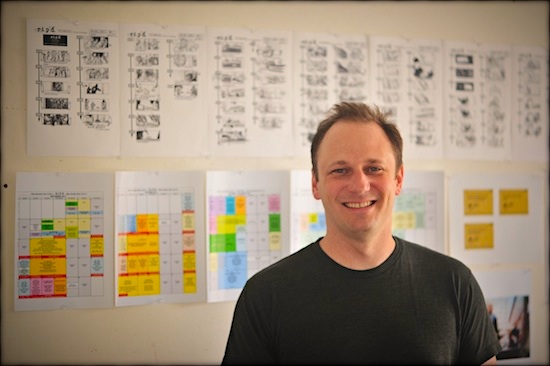
phil hayWho are you and what do you write?
—-

I’m Phil Hay, a screenwriter. I write (always have) with a partner, [Matt Manfredi](http://www.imdb.com/name/nm0542062/).

At the moment, our film [R.I.P.D.](http://www.imdb.com/title/tt0790736/) is in production in Boston, and we are back and forth from here to there. We wrote, with Adam McKay, an adaptation of the great Ennis/Robertson comic The Boys. McKay is putting that together right now. We’re also working on a quasi-secret movie for Fox and an adaptation of a Japanese movie called Big Man Japan for Sony and Neal Moritz (who is, indisputably, our main man.)

Before all this, we wrote [crazy/beautiful](http://www.imdb.com/title/tt0250224/), [Aeon Flux](http://www.imdb.com/title/tt0402022/), and co-wrote the [Clash of the Titans](http://www.imdb.com/title/tt0800320/) remake, and directed a movie, [Bug](http://www.imdb.com/name/nm0006534/) (2001).

Where and when do you write?
—–
workspaceFrom the beginning, Matt and I have tried to keep to a very regular schedule. We go Monday-Friday, 10-5:30 or 6 in normal times. Obviously, if in production, or when we’re close to a deadline, we can scramble into any hours.

For many years, we worked out of an office lovingly hewn from my garage. Recently, we moved to a place called “The Lot,” in West Hollywood. It looks pretty much exactly as you’d imagine a 1930s studio lot would. It’s mellow, and several of our writer and director friends are here, too, or come here when they are cutting or shooting.

We have one bigger room with two desks and a couch, and one smaller room with the corkboard and a table with chairs around it. We have a mini-fridge with beer in it, acquisition of which was a personal and professional high water mark.

My desk is piled with stuff — scripts, notes, books, scrawls. Matt’s is completely, eerily, annoyingly clean. The desks face the same direction but are angled slightly toward each other so we can talk. We used to sit directly across from each other, but I think we can all agree that that’s a bit much, right?

We’ve both realized that the immediate surroundings don’t affect us all that much. Our HQ used to be the kitchen table in an apartment we shared. At times it’s been a hotel room, a veritable broom closet at Warner Brothers, a spotless, oddly narrow room at Studio Babelsberg in Potsdam, a shivery, cavernous room with dangling electrical wires at Longcross (a tank-proving-ground- turned-studio in England,) a glass fishbowl in Boston that actually, and truly, and deeply, smells of fish.

(An interesting bit about production: during the last couple weeks of preproduction, the editorial department always comes sniffing around your office, measuring, assessing… craving. They will inevitably annex your space and kick you down the hall. 3-for-3 so far.)

But at home, going to our own office every day is a ritual that is very helpful. We always outline together, then we divide scenes and write — sometimes still in the same office, sometimes at home, sending files to each other at the end of the day. When we have the raw scenes down we manufacture a Frankenstein’s monster version, stitch it together, then come back together and work (battle) it through.

What hardware do you use?
—-

I use a previous-generation MacBook Pro, because I always, always pull the trigger on a new computer moments before the new model debuts. Matt uses a MacBook Pro of the current generation, bought two weeks later. I love all office products. I buy a lot of them, but I rarely I end up using them. Little cardboard folders, aluminum boxes (the greatest), envelopes, binders… going to Staples is like going to Toys ‘R Us. But as I said, I can’t figure out what to use them for. I guess what I’m realizing is that I love to store office products. That my true passion is for warehousing.

I truly love pens. I’ve only met one person who loves them more, and that’s [Robert Schwentke](http://www.imdb.com/name/nm0777881/), our friend and the director of R.I.P.D., who turned me on to the greatest pen in the world. Pilot G-TEC-C4. Do yourself a favor.

**Drawing pens.** I scribble and doodle a lot, maybe even obsessively, over all surfaces.

**Notebooks.** I also love notebooks. I’ve had some great composition books from Japan that have weirdly translated slogans on the front: “It must Perfection try to it” or “Information: here fell the NewHand”. I used to use those great hardcover lab books when I was in grad school. Now, I like those orange Rhodia deals that are the size of a pack of cigarettes and can fit in your back pocket.

**Freitag bag.** I got my first in Berlin, where they are very popular. They’re made of old truck tarps and seatbelts. For me, it’s the greatest computer bag in the world.

**A corkboard.** We aren’t big on notecards, but we post a 10-12 page outline sequentially on a corkboard, and kind of check it down as we are writing. We often write out of sequence — our belief is that we should write the stuff that most excites us on any given day, both because it’s more productive for us and it eventually exposes any scene that feels obligatory or dutiful — so this is really helpful. We also put storyboards up here, diagrams of action sequences, things like that.

What software do you use?
—-

[Final Draft](http://www.finaldraft.com). Never occurred to me to use anything else.

Sometimes, [iAnnotate](http://itunes.apple.com/us/app/iannotate-pdf/id363998953?mt=8), which allows you to write on PDF’s on the iPad. It’s the first thing that has come around in a while that feels like a leap forward and has made a dent in my totally locked-down habits. Still, I generally need to print a script out and make notes by hand.

What would you change?
—–

Here’s what I definitely wouldn’t change: having an extremely talented and excellent partner. He’s truly great.

What I would change: I’d write more.

I’d be less snowed under all the time by an avalanche of thoughts and fragments and 100 movies or stories I’d like to write. I’d be more methodical and I’d move on faster. No matter how much we write — and I think objectively we write pretty much — it never feels like enough. That definitely haunts me.

But I bet I have a lot of company in this feeling out there (don’t I?!). So maybe what I’d change is accepting that more. I never stop thinking about stories. Even though I feel I do 90 percent of my own work while walking around doing something else, there’s something very important about having the dedicated physical space and an ironclad ritual about attending to it every day.

Someone once told me that as a writer you’re like the proverbial Newton under the apple tree. Your job is to be there when the apple finally falls. Sometimes that is the job, just being there, putting in the hours, as many as you can. You have to be sitting there so you don’t miss it.

Help Stuart with AdWords

November 22, 2011 Hive Mind, Software

beeOn Sunday, we submitted our first app to the Mac App Store for approval. It’s a utility screenwriters will hopefully find useful, but it actually has a much wider potential user base.

The Mac App Store queue apparently varies wildly, so I don’t have an ETA for when our app will be available. Hopefully by Christmas.

Because our app is a good answer to something users might type into a search box (“*something* *something* mac”), Stuart will be overseeing a Google AdWords campaign to promote it. He’s reading up on all the official documentation and tips, but I have a hunch that some readers may have a lot of experience with AdWords. You might have good advice for him, both in terms of maximizing exposure and minimizing frustration.

So this is an open call for suggestions and links. (And hopefully not too much spam.) Thanks in advance.

Undervalued simplicity, and WGA coverage for videogames

Episode - 13

Go to Archive

November 22, 2011 Scriptnotes, Transcribed, Videogames, WGA

John and Craig tackle reader questions about self distribution, pseudonyms, separated rights, and studios’ feelings about international versus domestic box office.

They also explain the fallacy of equating effort in with value out, discuss why the WGA should address sweepstake pitches and coverage for videogame writers, and offer a Kentucky-born 21+ cure for the common cold.

This and more on the thirteenth Scriptnotes.

LINKS:

* Director [Todd Strauss-Schulson](http://ulteriorproductions.com/)
* [Sweepstakes Pitching](http://screenwriting.io/what-is-sweepstakes-pitching/) on screenwriting.io
* Michael Mohan’s [One Too Many Mornings](http://www.onetoomanymornings.com/)
* Kevin Smith’s [Red State](http://coopersdell.com/)
* Edward Burns’s [Nice Guy Johnny](http://www.edwardburns.net/movies/?movie_id=12)
* The Polish Brothers’ [For Lovers Only](http://forloversonlymovie.com/)
* [The Remnants](http://vimeo.com/2755105) on Vimeo
* The domestic/international box office split for [Talladega Nights](http://boxofficemojo.com/movies/?id=talladeganights.htm)
* [Scribblenauts](http://itunes.apple.com/us/app/scribblenauts-remix/id444844790?mt=8) for iOS
* [Elder Scrolls V: Skyrim](http://www.amazon.com/dp/B004HYK8Y8/?tag=johnaugustcom-20) on Amazon
* [Call of Duty: Modern Warfare 3](http://www.amazon.com/dp/B00503E8S2/?tag=johnaugustcom-20) on Amazon
* [Uncharted 3](http://www.amazon.com/dp/B004EQCCI4/?tag=johnaugustcom-20) on Amazon
* Intro: [Pac-Man: The Animated Series](http://www.youtube.com/watch?v=D6IMeouxu3U)
* Outro: [The Elder Scrolls V: SKYRIM Official Trailer](http://www.youtube.com/watch?v=FBd3qYLS4FA)

You can download the episode here: [AAC](http://traffic.libsyn.com/scriptnotes/scriptnotes_ep_13.m4a).

UPDATE 11-27-11: The transcript of this episode can be found [here](http://johnaugust.com/2011/scriptnotes-episode-13-undervalued-simplicity-and-wga-coverage-for-videogames-transcript).

From thesis script to feature film

November 21, 2011 Education, First Person

Jamie Jensen recently wrote and co-directed her first feature with Nadia Munla. I asked her to talk about her experience taking a project from graduate school thesis script to finished film.

——-

first personIn 2007, I moved from New York City to Los Angeles to pursue a screenwriting career. I did it by way of the Peter Stark Producing Program at USC, where I was fortunate to meet some of my very best friends.

One of these friends was Nadia Munla, a Lebanese-German transplant with a sociology degree and a passion for independent producing. Within six months she became my best friend, roommate, producer and ultimately, co-director.

It was in our second semester, after each being burned from recent relationships, that we found ourselves living together. Once again single, we revisited the joys and frustrations of being unattached, independent women. In trying to navigate the world of dating and “no strings” sexuality, we unearthed some personal bones to pick and in turn, a lot of comedy.

Why, we asked, was it so hard for women to get laid? We’re all familiar with movies like American Pie or Superbad, where the lead males go on a journey to “get it in.” But what about girls? Why was it so hard for us to find boys to sleep with? Or were the men in L.A. just incredibly repellant? ((It turns out boys in L.A. aren’t any more repellant than boys in Lebanon or New York, but the grass is always greener, isn’t it?))

More importantly, why didn’t any films address the reality that we girls have to do more than just show up and point at a boy to get laid? That was a story we wanted to see. That was a story I wanted to write.

Nadia and I thought that a movie where women try to get laid the way men typically do was fresh, subversive and authentic to some of our experiences. I had a blast digging up stories of humorous or strange sexual encounters from old friends and outlining some of my choice set-pieces.

It was the feminist message and friendship story at the heart of the script that really drove us forward. The concept took an entire summer to really crystallize into Hannah Has a Ho Phase and ultimately the script became Nadia’s thesis project for Stark.

Next steps: defending our gender
——-

Over our second year in school, I continued to work on Ho Phase, juggling it with another feature script and classes, my own thesis and internships. I used my holiday breaks to their fullest potential and wrote with every free moment I could. Whenever I had a block of time to attack outlining a new draft, I would.

We went through six drafts in two years and the process was the greatest learning experience any writer could have.

As part of our program’s thesis, Nadia had to create a budget, marketing and finance plan for the film as well as a short list of the ideal talent to package the project with. The process of finding a strong female director was surprisingly challenging. We both had thesis projects that were intended to be “by women, for women,” and yet we were both grasping at straws trying to find the right female directors.

We knew there weren’t many women directing comedy features but we were genuinely surprised when all our director picks came from the TV world, and even those were slim pickings. Sad face.

Ho Phase was becoming more and more challenging to defend at almost every budget level. Nadia did so, and did so with flying colors, but upon graduating we both continued to struggle with finding this project the right home. It was too raunchy and dangerous for a studio to ever touch. And the voice of the script was a too commercial to really appeal to most indie companies.

On the upside, we got a lot of positive feedback on the writing. The strong characters and dialogue piqued the interest of an up-and-coming manager and some more established agents. But at the end of the day, the message was the same: “If you want to sell this, or set this up, bring men into the picture.”

At this point, I want to make something very clear. Nadia and I are not anti-men. We love them, to be perfectly frank. The more, the merrier, as far as we’re concerned. But we felt the significance of our project was that it was strictly a woman’s story told from a woman’s point of view for a female audience. We knew a lot of the comedy would appeal to men. But we also knew we didn’t have to write more men into the story to do that.

We left our agency meeting and thought very seriously about how to rewrite the project – how to make it the “female Hangover” – which was what was being asked of us. I spent a couple of weeks toying with various ideas, and I think it was Nadia who ultimately said that the agent didn’t say that we didn’t have a movie. We just didn’t have a studio movie. “We can make this movie for $100,000 on our own terms.” And she was right.

Producer + writer = directorial team?
———-

Only one year after graduating from Stark, I had held three separate jobs in television and film, depleted my entire savings account trying to live on assistant’s wages, and hadn’t moved forward in my writing since finishing draft six of Ho Phase. Nadia had to leave for Lebanon, where a new film project awaited her, and I had had enough of Hollywood for the moment.

So we put all of our stuff in storage and I went home to New York City to bartend and become a modern-day Mae West.

Three short months later, Nadia had some real letdowns on her other project. Waiting on name talent was taking a century and she didn’t want to wait anymore. We Skyped and complained about our jobs, lives, and careers. Nadia’s rationale was: if she was going to work like crazy for no money against all odds on independent films, she might as well own the material.

So she said “Let’s make Ho Phase. I’ll raise the money.” And I said, “Great. Let’s do it. We can direct it together.” Nadia did initially laugh off my suggestion to co-direct. But then she realized: if the money is all private equity, it’s creative carte blanche –- and probably the only time we’d ever get that.

Nadia flew to NY and we sat down for a week budgeting, scheduling, strategizing and writing a million to-do lists. At the end of the week, we evaluated the numbers, the calendar, and our sanity, and then green-lit the film. And just like that, we became film directors.

Money, money, money
———–

It was November. We had the initial $20,000 that Nadia had raised in Lebanon, a projected shooting schedule for April and the goal of finishing the film for Sundance’s following September deadline. So we needed to raise another $80,000 in less than four months. Yikes.

Nadia flew to AFM to navigate the distribution terrain and see if she could wrangle some more financing with pre-sales. One company offered us 50% of our budget in exchange for worldwide distribution rights, EP credits and creative involvement. At a time when you can’t even get presales with recognizable names, we were very surprised that we even got an offer. But we didn’t take it.

Although turning down $50,000 really sucked, Nadia ultimately felt the project would suffer under the creative direction of a production company that was used to a specific formula. Typically, their projects broke even by casting a B-list TV actor and leveraging their strong distribution relationships.

If we were forced to go this route with our project, it would probably not further our career. Most likely, the company would veto our decision to co-direct as we had no previous feature film credits. And if they didn’t, we could be forced to cast the wrong talent, which might have resulted in a product that would damage our reputations altogether.

There was also the issue of time. Nadia and I had made the decision that come hell or high water, we were going to shoot the thing in April. Had we taken the company’s offer, there’s a good chance we would probably still be waiting on a locking down some “name” talent, which can take years.

We had already run some numbers and felt that even in the worst-case scenario, without getting picked up for distribution, we could probably make our money back through DIY self-distribution methods. It’s obviously not ideal, and requires lots of time, but it was our Plan B.

Nadia pushed forward with pre-production and managed to patch together the rest of the budget through private equity. She designed a production calendar and put together an all-female team in four short months, including three weeks of intense casting.

We shot our feature over 18 days in April with a truly magical assistant director and a stellar comedic cast. We did one weekend of pick-ups and B-roll in July, and locked picture one month later. Nadia is still clearing music as we grind through the remainder of post-production.

Great, you made a movie. Now what?
———

In school, we were told that the average life span of a film from concept to completion was seven years. Going the independent route, we did it in a little over three. I never thought it would have been possible, but here’s proof that it is.

We still have no idea what to anticipate at this point, and that is just part of the unstable nature of the entertainment business. Everyone who chooses to pursue filmmaking needs to accept this. It’s like a marriage. You take the good with the bad.

Maybe we’ll get into Sundance. Maybe we’ll get into Slamdance. Maybe we’ll get into the Marfa Film Festival (although I doubt it). Maybe we’ll sell our film to a distributor. Maybe only our close friends and family will ever actually see it.

Our hope is that we will have the opportunity to reach our audience, however big or small it may be, and that the demand for female-centric comedies (as demonstrated by the recent success of Bridesmaids) gives us an extra boost this festival season. In the meantime, Nadia and I can only focus on our other jobs and projects and wait it out.

In truth, you don’t need the right degree or even the right connections to make a movie – just a good idea, some private equity and a lot of hard consistent work. Next time, I think we’ll both try for a slightly bigger budget and longer shooting schedule…

Nadia’s producing tips
————

The right budget

The biggest challenge is finding the right budget for your independent film. Once you’ve done this, everything else is just a lot of hard work to make it happen. The biggest issues I’ve seen with films that fail are the results of a mis-allocated budget. We knew from the beginning that green directors + niche target audience + controversial subject matter = microbudget.

The right talent

I may change my mind after we navigate the world of distribution, but I do think finding the best-matched talent for the role is key for a micro-budget. Don’t fixate too much on trying to get bigger names. I’m not saying don’t try, but only if they are the right person for the role, not because you think it will sell. And if you do pursue recognizable talent, give yourself a deadline and stick to it. Or else your film won’t be made.

The right attitude

Speaking of deadlines, I truly believe that one reason this film was made so quickly was because we gave ourselves a deadline and stuck to it. Our motto when we green lit was that we were going to shoot in April no matter who we had or how much money we had. I had witnessed horror stories where people waited years, and — well — I guess our ADD generation has less patience. Hopefully this is a good thing.

« Previous Page
Next Page »

Primary Sidebar

Newsletter

Inneresting Logo A Quote-Unquote Newsletter about Writing
Read Now

Explore

Projects

  • Aladdin (1)
  • Arlo Finch (27)
  • Big Fish (88)
  • Birdigo (2)
  • Charlie (39)
  • Charlie's Angels (16)
  • Chosen (2)
  • Corpse Bride (9)
  • Dead Projects (18)
  • Frankenweenie (10)
  • Go (29)
  • Karateka (4)
  • Monsterpocalypse (3)
  • One Hit Kill (6)
  • Ops (6)
  • Preacher (2)
  • Prince of Persia (13)
  • Shazam (6)
  • Snake People (6)
  • Tarzan (5)
  • The Nines (118)
  • The Remnants (12)
  • The Variant (22)

Apps

  • Bronson (14)
  • FDX Reader (11)
  • Fountain (32)
  • Highland (73)
  • Less IMDb (4)
  • Weekend Read (64)

Recommended Reading

  • First Person (87)
  • Geek Alert (151)
  • WGA (162)
  • Workspace (19)

Screenwriting Q&A

  • Adaptation (65)
  • Directors (90)
  • Education (49)
  • Film Industry (489)
  • Formatting (128)
  • Genres (89)
  • Glossary (6)
  • Pitches (29)
  • Producers (59)
  • Psych 101 (118)
  • Rights and Copyright (96)
  • So-Called Experts (47)
  • Story and Plot (170)
  • Television (165)
  • Treatments (21)
  • Words on the page (237)
  • Writing Process (177)

More screenwriting Q&A at screenwriting.io

© 2026 John August — All Rights Reserved.