• Skip to primary navigation
  • Skip to main content
  • Skip to primary sidebar

John August

  • Arlo Finch
  • Scriptnotes
  • Library
  • Store
  • About

Search Results for: notes on notes

Screenwriting gurus and so-called experts

Episode - 15

Go to Archive

December 6, 2011 Books, Scriptnotes, Transcribed, Videogames

Craig and John look at why the books and seminars purporting to teach screenwriting are generally terrible, trying to reduce the hard work of the craft to a series of formulas and templates.

It’s a rare podcast in which I sway Craig’s opinion whatsoever, but if you listen really carefully, I think he leaves the show just slightly less negative about screenwriting books than he started. It’s all about degrees with Craig.

Plus, we get a visit from the LAPD, follow-up on residuals, and a bit more about unionizing videogame writers.

LINKS:

* [Crime rates in Los Angeles](http://www.wolframalpha.com/input/?i=crime+rates+in+los+angeles) (Wolfram-Alpha)
* Syd Field’s classic book [Screenplay](http://www.amazon.com/dp/0385339038/?tag=johnaugustcom-20).
* Christopher Volger’s [The Writer’s Journey](http://www.amazon.com/dp/193290736X/?tag=johnaugustcom-20)
* Stuart’s [review](http://johnaugust.com/2011/the-writers-journey-mythic-structure-for-writers) of Vogler’s book
* Linda Seger’s [Making a Good Script Great](http://www.amazon.com/dp/1935247018/?tag=johnaugustcom-20)

(Note that none of the books listed above are actually recommended. But we talk about them, so it feels fair to provide links.)

* Intro: [Jem and the Holograms](http://www.youtube.com/watch?v=Oz4QRB25DSI)
* Outro: [Exquisite Corpse](http://itunes.apple.com/us/album/exquisite-corpse/id405127549?i=405127554) by Casey Spooner

You can download the episode here: [AAC](http://traffic.libsyn.com/scriptnotes/scriptnotes_ep_15.m4a).

UPDATE 12-13-11: The transcript of this episode can be found [here](http://johnaugust.com/2011/scriptnotes-ep-15-on-screenwriting-gurus-transcript).
Workspace: Christine Boylan

December 2, 2011 Psych 101, Television, Workspace

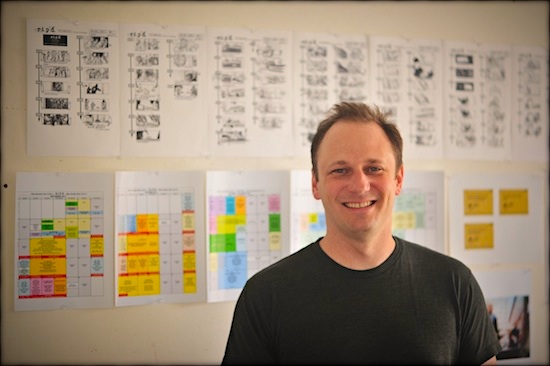
Christine Boylan

Who are you and what do you write?
—

My name is Christine Boylan. Most of my day is spent writing and producing television — I started on [Leverage](http://www.tnt.tv/series/leverage/) (TNT), worked on the sweet but never aired alien invasion series Day One (NBC), then [Off the Map](http://www.imdb.com/title/tt1587694/) at ABC and now I’m a co-producer on [Castle](http://www.imdb.com/title/tt1219024/).

I occasionally write short stories (such as [Hoss](http://www.mulhollandbooks.com/popcornfiction/stories/Hoss_by_Christine_Boylan.html) at Popcorn Fiction) and plays. I’ve also written comic books for DC, Marvel, Boom, Tokyopop and NBC, including two of the Heroes comics.

On the Twitter, I’m [@kitmoxie](http://twitter.com/kitmoxie).

Where and when do you write?

—-

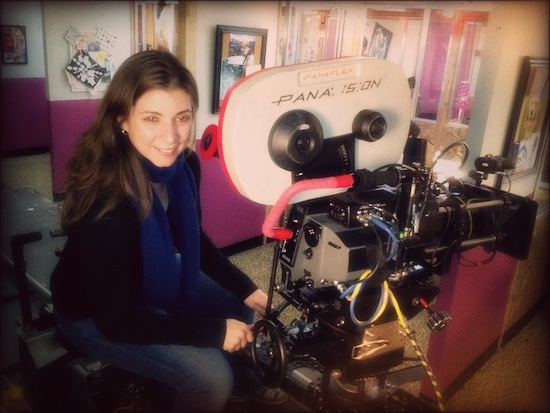
workspaceMost of the time I write in my home office, which is a stone’s throw away from my husband’s office, but, luckily for him, we have doors.

I can write anywhere if I can get the spirit to move me (or I have a heart-stopping deadline) — passenger seat of cars (no motion sickness), trains, planes (usually drunk), the middle of the jungle, etc.

I try to change locations during a long writing session to keep myself going — this might be as simple as moving up to the kitchen and sitting on the annoying bench that hurts my back but keeps me awake, or it might mean just lying on the floor in some kind of weird cobra-pose for an hour and writing there. My office has a giant wood desk that’s more like a table than a desk. I alternate using two different chairs: an Aeron I stole from my husband when I moved in and a [Swopper](http://swopper.com/www.swopper.com/index.html).

I had spine surgery when I was younger, so I try to move around and change positions as much as I can. I have yoga blocks and a foam roller, too. Also, a heating pad. And Vicodin. It’s a back-friendly office.

If left to my own devices, I’m a night person. When I was unemployed and writing my first spec pilot, I would sleep until noon, run errands, and then settle down to write from about 4pm to 8, then break, then 10pm to 4am. That was a very special, very Scotch-driven time in my career.

Now that I’m employed, I find that every TV writers’ room has its own culture and rules, so I adjust my schedule to theirs when the season starts.

John Rogers ([@jonrog1](http://twitter.com/jonrog1)) at Leverage is a productivity nerd, so he likes to use his writing staff to try out new processes. A lot of what we did there has stuck with me: working on a story for 48 minutes, then resting for 12. That one’s inviolable. You can’t fool around too much during a 48, you can’t discuss work on a 12. If caught, John would stop you — “Respect the 12!” — thus inculcating the idea of an earned rest period.

Speaking of rest, Mark Waid ([@MarkWaid](http://twitter.com/MarkWaid)) taught me the value of walking away for a few hours and letting something simmer. If I’ve put in the time, then sleep, then I shower or take a yoga class, an idea will come. Maybe the idea is for the next project, but hell, it’s an idea, and I’ll have it happily.

This has been my schedule since June: I’ll get up at 7, head to the gym for swimming or yoga, then to the Castle offices in Hollywood. We run writers’ rooms all day, usually 10 to 7, and we often have two going at once. Then in the evening I’ll spend two or three hours working on one of my own projects or, if I’m burned for the day, have a drink and watch TV or read.

Weekends are exercise, writing in the afternoons, socializing. If I really need to get a personal project done, I’ll get a hotel room in Malibu or Palm Springs and marathon — room service is very, very helpful.

What hardware do you use?
—-

I have a Macbook Pro at home and on the road, and I sometimes use the desktop Mac provided for me at the Castle offices. If I want a little extra crunch or manual exercise, I’ll hook up the [Das Keyboard](http://www.daskeyboard.com/) recommended to me by the lovely and talented Leverage writer M. Scott Veach ([@mscottveach](http://twitter.com/mscottveach)).

I use an iPad (first gen) for reading scripts and some books (GoodReader and Kindle for iPad, respectively) and watching shows on Netflix or the beautiful HBO Go. I have in the past written entire first draft outlines on my iPhone while on set. (I love being on set. Everyone knows what his or her job is. Boundaries are such a relief sometimes.)

I use index cards — something else I picked up at Leverage — to break story. I have cork squares on an entire wall of my home office, and it’s a nice, big wall space useful for everything from pilots to plays to features. We use white boards at Castle, which I admit I still dislike. I have the distinction of having really terrible handwriting on the board.

What software do you use?
—–

I handwrite my first drafts, which drives some of my colleagues crazy. I don’t know if it’s advantageous or not, but it’s just how my brain works. It’s good to be away from the computer (though I may use the dictionary/thesaurus on the phone or iPad); it’s good to feel the pen in your hand (I use a Libelle fountain pen, because the nib forces me to hold the pen correctly and not hurt my hand); it’s great to see the legal pads (letter sized) stacked up, full of scenes. They may be terrible, they may be marvelous, but they exist, and now you can rewrite them.

So then I type it all up — I use tall document holders from Fellowes (one at home, one at Castle) and I rewrite and edit to an extent while I’m typing that first draft. Then I print and go through it with the red or green pen — the pilot G2 works great. (I can’t stand ball points. Using one feels like scratching nails on a chalk board.) Then I re-type the changes.

If I’m in a real hurry — and on Leverage I had to write the first draft of one episode in a weekend — I’ll get someone in and dictate the script. My gorgeous friend Alex Engel can use all the software and can also read my mind. Unfortunately, he’s now a working writer and I can no longer take advantage of him for long dictation sessions. Sometimes I’ll dictate the boards in the writers’ room to our writers’ assistant at Castle, Adam Frost, and it ends up becoming a rough draft for the outline. Whether I dictate the script or not, I always have a step in the process where I read it through out loud.

Some people are visual, but I’m predominantly aural. I can hear if it’s wrong faster than I can see it.

For software, I use whatever the show uses. My first three shows used [Movie Magic Screenwriter](http://www.screenplay.com/p-29-movie-magic-screenwriter-6.aspx), and I still use it for comic books and stage plays. Castle uses [Final Draft](http://finaldraft.com), which I hadn’t picked up in four years, but I’m getting used to it again.

None of these programs feels particularly elegant to me, though. Hand writing helps me avoid any software frustration early in the process, so by the time I’m typing I feel enough urgency to learn the damn keyboard shortcut and move forward.

For notes and research archives I use [Evernote](http://evernote.com). I don’t know how I ever got along without it…except I do, and the evidence is scraps of paper in project-specific piles all over my office floor.

For organization purposes I swing insanely between [orthodox GTD](http://en.wikipedia.org/wiki/Getting_Things_Done) and [total chaos](http://thegloss.com/career/bullish-how-to-be-a-productivity-unicorn/), but I’ve been through [Things](http://culturedcode.com/things/) and [OmniFocus](http://www.omnigroup.com/products/omnifocus/) and now I use 3×5 cards in a [Levenger Circa PDA](http://www.levenger.com/PAGETEMPLATES/PRODUCT/Product.asp?Params=Category=326-339%7CLevel=2-3%7Cpageid=5654%7CLink=Img).

Sometimes I listen to music when I’m working, usually something without lyrics unless I’m desperately trying to evoke a tone. Then I can put the same song on repeat for a few hours. Otherwise white noise apps are great (I listened to a lot of Amazon jungle sounds while writing Off the Map), and a good, solid metronome helps me find rhythm.

What would you change about how you write?
—

I would eliminate some of the self-loathing that takes up a lot of the energy I need to write. Procrastination is both useful and deadly. Again, if I’m stuck on a problem and I go away for four hours to ride horses, I’ll come back with a solution and I can get to work. But if I’ve procrastinated all weekend and then my time is up, I’m going to go to bed unhappy and have five miserable wake-ups in the week ahead.

I’m a huge fan of Steven Pressfield’s [The War of Art](http://www.amazon.com/dp/0446691437/?tag=johnaugustcom-20) – I have it on my Kindle, I keep a copy on my desk at home, I have an audio version on my iPod. Those lessons unfold themselves every day.

A really good friend of mine, [Jacob Krueger](http://www.writeyourscreenplay.com/ ), instills some of this stuff in his screenwriting classes, acting classes and hypnosis sessions in New York. It’s not about removing blocks per se, but about embracing the part of yourself that puts up those blocks.

Or maybe it’s about needing another Scotch.

How residuals work

November 29, 2011 Scriptnotes, Transcribed, WGA

Craig and John take a look at awards-season screeners before diving deep into a discussion of how residuals work and why they’re so important to screenwriters.

Plus, a visit from Craig’s cleaning lady, who thinks he’s insane.

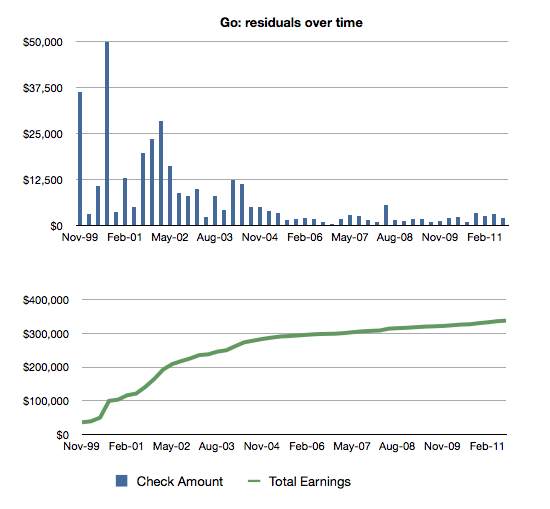
Near the end of our discussion on residuals, I give some actual numbers on an actual movie. Percentages are abstract; money is money.

I chose Go because I had the most data on it, going back to 1999. It’s also useful because the movie was only moderately successful at the box office.

As you can see in the charts below, residuals taper off over the years — but that long tail still adds up:

go residuals

Keep in mind, there’s a possibility that residuals could spike if another home video medium takes off — digital downloads or rentals, for example.

I went into the podcast thinking I could easily reverse the math to figure out how much the studio has made off the movie, but as Craig points out, it’s more complicated than it appears at first. Most home video is calculated as 1.5% of 20% of gross earnings, so in order to get an accurate number I would need to sort out how much of Go’s residuals are coming from home video (and not television licensing).

But we can still get a sense of minimums: Go brought in at least $30 million in the aftermarket, and likely much, much more.

LINKS:

* [Downton Abbey, Season One](http://movies.netflix.com/Movie/Masterpiece-Classic-Downton-Abbey/70155164) on Netflix
* [Father Ted](http://movies.netflix.com/WiMovie/Father_Ted/70217141?trkid=2361637) on Netflix
* [Security theater](http://en.wikipedia.org/wiki/Security_theater) as defined on Wikipedia
* The WGA’s [Residuals Survival Guide](http://www.wga.org/subpage_writersresources.aspx?id=133)
* Intro: [Tree Top Apple Juice commercial](http://www.youtube.com/watch?v=8Ub0zlogFCY&feature=related)
* Outro: [Country Lane](http://itunes.apple.com/us/album/country-lane/id413671408?i=413671527) by Telekinesis

You can download the episode here: [AAC](http://traffic.libsyn.com/scriptnotes/scriptnotes_ep_14.m4a).

UPDATE 11-30-11: The transcript of this episode can be found [here](http://johnaugust.com/2011/scriptnotes-ep-14-how-residuals-work-transcript).

Workspace: Phil Hay

November 23, 2011 Workspace

phil hayWho are you and what do you write?
—-

I’m Phil Hay, a screenwriter. I write (always have) with a partner, [Matt Manfredi](http://www.imdb.com/name/nm0542062/).

At the moment, our film [R.I.P.D.](http://www.imdb.com/title/tt0790736/) is in production in Boston, and we are back and forth from here to there. We wrote, with Adam McKay, an adaptation of the great Ennis/Robertson comic The Boys. McKay is putting that together right now. We’re also working on a quasi-secret movie for Fox and an adaptation of a Japanese movie called Big Man Japan for Sony and Neal Moritz (who is, indisputably, our main man.)

Before all this, we wrote [crazy/beautiful](http://www.imdb.com/title/tt0250224/), [Aeon Flux](http://www.imdb.com/title/tt0402022/), and co-wrote the [Clash of the Titans](http://www.imdb.com/title/tt0800320/) remake, and directed a movie, [Bug](http://www.imdb.com/name/nm0006534/) (2001).

Where and when do you write?
—–

workspaceFrom the beginning, Matt and I have tried to keep to a very regular schedule. We go Monday-Friday, 10-5:30 or 6 in normal times. Obviously, if in production, or when we’re close to a deadline, we can scramble into any hours.

For many years, we worked out of an office lovingly hewn from my garage. Recently, we moved to a place called “The Lot,” in West Hollywood. It looks pretty much exactly as you’d imagine a 1930s studio lot would. It’s mellow, and several of our writer and director friends are here, too, or come here when they are cutting or shooting.

We have one bigger room with two desks and a couch, and one smaller room with the corkboard and a table with chairs around it. We have a mini-fridge with beer in it, acquisition of which was a personal and professional high water mark.

My desk is piled with stuff — scripts, notes, books, scrawls. Matt’s is completely, eerily, annoyingly clean. The desks face the same direction but are angled slightly toward each other so we can talk. We used to sit directly across from each other, but I think we can all agree that that’s a bit much, right?

We’ve both realized that the immediate surroundings don’t affect us all that much. Our HQ used to be the kitchen table in an apartment we shared. At times it’s been a hotel room, a veritable broom closet at Warner Brothers, a spotless, oddly narrow room at Studio Babelsberg in Potsdam, a shivery, cavernous room with dangling electrical wires at Longcross (a tank-proving-ground- turned-studio in England,) a glass fishbowl in Boston that actually, and truly, and deeply, smells of fish.

(An interesting bit about production: during the last couple weeks of preproduction, the editorial department always comes sniffing around your office, measuring, assessing… craving. They will inevitably annex your space and kick you down the hall. 3-for-3 so far.)

But at home, going to our own office every day is a ritual that is very helpful. We always outline together, then we divide scenes and write — sometimes still in the same office, sometimes at home, sending files to each other at the end of the day. When we have the raw scenes down we manufacture a Frankenstein’s monster version, stitch it together, then come back together and work (battle) it through.

What hardware do you use?
—-

I use a previous-generation MacBook Pro, because I always, always pull the trigger on a new computer moments before the new model debuts. Matt uses a MacBook Pro of the current generation, bought two weeks later. I love all office products. I buy a lot of them, but I rarely I end up using them. Little cardboard folders, aluminum boxes (the greatest), envelopes, binders… going to Staples is like going to Toys ‘R Us. But as I said, I can’t figure out what to use them for. I guess what I’m realizing is that I love to store office products. That my true passion is for warehousing.

I truly love pens. I’ve only met one person who loves them more, and that’s [Robert Schwentke](http://www.imdb.com/name/nm0777881/), our friend and the director of R.I.P.D., who turned me on to the greatest pen in the world. Pilot G-TEC-C4. Do yourself a favor.

**Drawing pens.** I scribble and doodle a lot, maybe even obsessively, over all surfaces.

**Notebooks.** I also love notebooks. I’ve had some great composition books from Japan that have weirdly translated slogans on the front: “It must Perfection try to it” or “Information: here fell the NewHand”. I used to use those great hardcover lab books when I was in grad school. Now, I like those orange Rhodia deals that are the size of a pack of cigarettes and can fit in your back pocket.

**Freitag bag.** I got my first in Berlin, where they are very popular. They’re made of old truck tarps and seatbelts. For me, it’s the greatest computer bag in the world.

**A corkboard.** We aren’t big on notecards, but we post a 10-12 page outline sequentially on a corkboard, and kind of check it down as we are writing. We often write out of sequence — our belief is that we should write the stuff that most excites us on any given day, both because it’s more productive for us and it eventually exposes any scene that feels obligatory or dutiful — so this is really helpful. We also put storyboards up here, diagrams of action sequences, things like that.

What software do you use?
—-

[Final Draft](http://www.finaldraft.com). Never occurred to me to use anything else.

Sometimes, [iAnnotate](http://itunes.apple.com/us/app/iannotate-pdf/id363998953?mt=8), which allows you to write on PDF’s on the iPad. It’s the first thing that has come around in a while that feels like a leap forward and has made a dent in my totally locked-down habits. Still, I generally need to print a script out and make notes by hand.

What would you change?
—–

Here’s what I definitely wouldn’t change: having an extremely talented and excellent partner. He’s truly great.

What I would change: I’d write more.

I’d be less snowed under all the time by an avalanche of thoughts and fragments and 100 movies or stories I’d like to write. I’d be more methodical and I’d move on faster. No matter how much we write — and I think objectively we write pretty much — it never feels like enough. That definitely haunts me.

But I bet I have a lot of company in this feeling out there (don’t I?!). So maybe what I’d change is accepting that more. I never stop thinking about stories. Even though I feel I do 90 percent of my own work while walking around doing something else, there’s something very important about having the dedicated physical space and an ironclad ritual about attending to it every day.

Someone once told me that as a writer you’re like the proverbial Newton under the apple tree. Your job is to be there when the apple finally falls. Sometimes that is the job, just being there, putting in the hours, as many as you can. You have to be sitting there so you don’t miss it.

« Previous Page
Next Page »

Primary Sidebar

Newsletter

Inneresting Logo A Quote-Unquote Newsletter about Writing
Read Now

Explore

Projects

  • Aladdin (1)
  • Arlo Finch (27)
  • Big Fish (88)
  • Birdigo (2)
  • Charlie (39)
  • Charlie's Angels (16)
  • Chosen (2)
  • Corpse Bride (9)
  • Dead Projects (18)
  • Frankenweenie (10)
  • Go (29)
  • Karateka (4)
  • Monsterpocalypse (3)
  • One Hit Kill (6)
  • Ops (6)
  • Preacher (2)
  • Prince of Persia (13)
  • Shazam (6)
  • Snake People (6)
  • Tarzan (5)
  • The Nines (118)
  • The Remnants (12)
  • The Variant (22)

Apps

  • Bronson (14)
  • FDX Reader (11)
  • Fountain (32)
  • Highland (75)
  • Less IMDb (4)
  • Weekend Read (64)

Recommended Reading

  • First Person (87)
  • Geek Alert (151)
  • WGA (162)
  • Workspace (19)

Screenwriting Q&A

  • Adaptation (65)
  • Directors (90)
  • Education (49)
  • Film Industry (489)
  • Formatting (128)
  • Genres (89)
  • Glossary (6)
  • Pitches (29)
  • Producers (59)
  • Psych 101 (118)
  • Rights and Copyright (96)
  • So-Called Experts (47)
  • Story and Plot (170)
  • Television (165)
  • Treatments (21)
  • Words on the page (238)
  • Writing Process (177)

More screenwriting Q&A at screenwriting.io

© 2026 John August — All Rights Reserved.