• Skip to primary navigation
  • Skip to main content
  • Skip to primary sidebar

John August

  • Arlo Finch
  • Scriptnotes
  • Library
  • Store
  • About

Search Results for: notes on notes

2011, by the numbers

January 1, 2012 Meta

As the new year begins, this feels like a good time to look at some quantitative measures for how it went with this site and various projects.

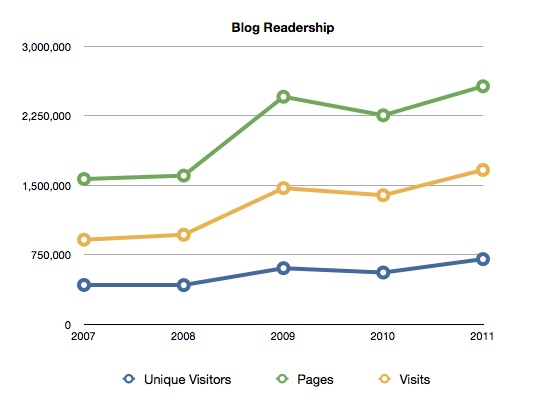
I’ve had Google Analytics running on johnaugust.com since 2007. Here’s a look at how readership has grown over the past four years:
blog readership chart

Other than links to stuff I’ve made, I don’t run any ads on the site, so readership metrics aren’t especially important. But it’s interesting to see the numbers edging up after dropping a little in 2010.

My best guess for why: Twitter. This year, I’ve been fairly consistent about tweeting each new post. That brings in both regular readers and new readers who come to the site through re-tweets.

A lot of the basic question-answering, which used to be this site’s main focus, has transitioned over to [screenwriting.io](http://screenwriting.io), which now has 96 posts on various topics. Daily visits are low, but most of the traffic is coming as the result of very specific Google searches — [“How long should a screenplay be?”](http://screenwriting.io/how-long-should-a-screenplay-be/) — which was its goal at inception.

Apps and audio
—-

The [Scriptnotes](http://johnaugust.com/podcast) podcast that Craig Mazin and I started in August has grown a lot, but it’s less obvious which numbers to count.

We have more than 2,000 subscribers through iTunes (which we can measure via FeedBurner), but that figure doesn’t count folks listening to it through their browser — on this site or others. Tracking audio file downloads off the S3 server brings us to 28,000 listeners per installment.

Again, without advertising, it’s not essential to know hard numbers. It’s been gratifying to hear from listeners who’ve been enjoying the podcast.

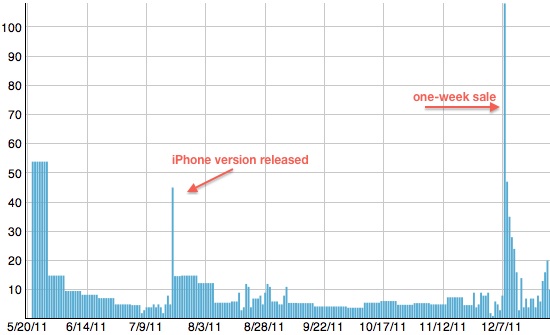
This year marked the launch of our first iOS app, [FDX Reader](http://fdxreader.com). This chart of unit sales shows the falloff from our initial launch, the spike when we introduced the iPhone version, and the results of a one-week sale:
fdx reader chart

As I blogged before, we’re not going to be adding anything new to FDX Reader. Our next app is for the Mac, and we have other iOS apps in the pipeline. More news on that this week.

What do producers do?

Episode - 17

Go to Archive

December 20, 2011 News, Producers, Scriptnotes, Transcribed

Craig and John explain what producers do — at least, what they’re *supposed to do* — and discuss the myriad subclasses of producers that litter the opening titles of many movies.

Which is the more impressive credit — producer or executive producer? In film, it’s the former. In TV, it’s the latter. But whatever the title, producers are integral to getting a movie or TV show made.

Craig feels producers can be either anxiety buffers or anxiety conductors. John breaks down four essential roles you find producers filling:

1. **The general.** This producer keeps things moving forward and protects the production. She forces you to make decisions.
2. **The diplomat.** This producer makes sure crazy people feel respected, even when they’re being giant pains-in-the-ass. He talks the actress out of her trailer.
3. **The creative.** This producer reminds everyone what kind of movie they’re trying to make. She performs quality control for the production.
4. **The bulldozer.** This producer will smash down a phone booth to help the director get his shot. (This actually happened.)

Some producers can fill multiple roles (like diplomat-creative), but you’ll often find these qualities spread out among several people on a production, regardless of the size.

Who’s that fat cat, and how did he afford such a fancy cigar? Find out on episode seventeen of Scriptnotes.

LINKS:

* [Producer credits and what they mean](http://johnaugust.com/2004/producer-credits-and-what-they-mean)
* [Producers Guild of America](http://www.producersguild.org/)
* [Kelly Manners](http://www.imdb.com/name/nm0543128/) on IMDb
* INTRO: [The Weebles](http://www.youtube.com/watch?v=hy4lfHYDWt4&feature=related)
* OUTRO: [What More Can I Say (Falsettoland)](http://itunes.apple.com/us/album/what-more-can-i-say-falsettoland/id251490303?i=251490410) performed by the San Francisco’s Gay Men’s Chorus

You can download the episode here: [AAC](http://traffic.libsyn.com/scriptnotes/scriptnotes_ep_17.m4a).

UPDATE 1-4-12: The transcript of this episode can be found [here](http://johnaugust.com/2012/scriptnotes-ep-17-what-do-producers-do-transcript).

Workspace: Chris Sparling

December 14, 2011 Workspace

chris sparling

Who are you and what do you write?
—–

My name is Chris Sparling. I write screenplays and, on occasion, wills for old people I plan on squandering money from after they die. My first paid writing gig was for a website I had never even heard of, and the article was on veterinary pet insurance – a topic I had no knowledge of whatsoever. I was paid $20. Boo-yah.

I won Best Original Screenplay in 2010 from the National Board of Review for writing [Buried](http://www.experienceburied.com/), and also won a Goya Award in the same category.

These days I’m prepping two projects, Mercy and Incident on 459, which are being produced by Peter Safran and Mike DeLuca, respectively. I primarily write feature-length thrillers, including the upcoming film ATM, which will be released by IFC Films in early 2012, and Reincarnate for producer M. Night Shyamalan, the second of three films in The Night Chronicles series.

I will be making my feature directing debut this spring with the supernatural drama/thriller Falling Slowly.

I recently joined Twitter. Find me [@ChrisSparling](http://twitter.com/chrissparling).

Where and when do you write?
—-

workspaceMost times, I write in this little-known coffee shop not far from my house. I’m not sure what it’s called. Stardust? Starburst? Hold on, let me ask the girl behind the counter…

She said it’s called Starbucks. What a stupid name.

Anyway, here I am, and here I usually am, stealing their electricity and working for at least a four-hour clip. I have a small office in my house, but because my wife works from home (and we have an achingly cute little daughter toddling around), it’s nearly impossible to not forego work for the day to instead hang out with them. So, Starburst it is.

I sometimes like to change things up and visit my satellite office, a.k.a. Panera Bread. I’ve been lobbying for them to change their name to Pantera Bread, thinking it will cool up the joint a bit, but they don’t seem all that receptive to the idea. I steal their electricity, too.

Typically, I split my day around my trip to the gym. My daytime writing happens outside the house, but I also try to put in about three or four hours of work at home each evening. As pretentious as it probably sounds, I also do a good deal of “writing” in my head while driving. Thankfully this hasn’t resulted in a car accident yet.

If I have any “process” (dangerously toeing the pretension line again here), it’s plugging in my headphones and listening to some movie scores that match the tone of what I’m currently writing.

Also, I have a fantastic manager, and he’s great with feedback — such as, “Dude, this fucking sucks.” Well, maybe not that exactly, but he’s not one to pull punches, and that’s incredibly valuable. When I’m done with a draft, or a treatment, or even just a sentence describing a new idea I had, I’ll run it by him. It might not be the most scientific approach, but it seems to work pretty well.

What hardware do you use?
—

I use an HP laptop. It’s about two years old by this point. I’m not really a tech guy, so it suits me just fine. The only problem is battery life (hence why I’m always stealing electricity). I frequently travel back and forth between the east and west coast, and my battery barely lasts half the flight. The other weird thing about it is that these obscure websites — showing attractive women in various states of undress — always seem to randomly pop up on my screen. Go figure.

My wife’s a Mac user, and she pulled the trigger on buying an iPad. I love that freakin’ thing. I don’t really know how to use it, but that doesn’t stop me from loving it. Primarily, I read scripts on it and/or source material (books, producers notes, character bibles, etc.) either for an assignment I’m going after or as a general point of reference. It’s also great for watching movies during cross-country flights after my laptop battery dies.

Lastly, I sometimes still rock the pad and pen. I have a bunch of old notebooks filled with ideas, sketches, and nearly-incoherent scrawling that I refer to from time to time. I had my fair share of crappy jobs in my pre-screenwriting days, and I used to always jot stuff down that I could plug into a script I was working on when I got home that night. Or morning, depending on the hours said crappy job ran.

What software do you use?
—

I’ve always used Final Draft, but it was only about a month ago that I finally upgraded to Version 8. Before that I had been using Version 5 for over a decade. Again, I’m not really a tech guy, so upgrading didn’t seem all that necessary. Both versions format screenplays; I didn’t need all the bells and whistles later versions offered. That is, except for the ability to convert to .PDF, which Version 5 did not do.

Prior to the upgrade, I used a separate .PDF-conversion program; however, the text would, on rare occasion, show up all funky on certain computers. So, I said enough is enough and upgraded to Version 8.

How’s that for a boring fucking story? Wow.

What would you change about how you write?
—-

For starters, I would stop wasting so much time online. Twitter has been fun so far, but it is a pretty big time suck. Same for Facebook, and I don’t even have an account. I would also like to be better at prioritizing projects I’m working on simultaneously, rather than bouncing back and forth so much. The work suffers, I feel.

But all in all, I don’t think I’d change too much about how I write. I mean, it’s writing; you think up some stuff, you write it down, and you hope people like it. Sometimes they do and sometimes they don’t. And, sometimes they actually pay you for it, even if it’s only twenty bucks.

Thirteen questions about one thing

December 13, 2011 QandA, Scriptnotes

Craig and John plug a book by their very first sponsor and discuss elective brain surgery, before tackling an exhaustive but illuminating list of questions from listener Daniel Barkeley.

They’re residual questions about residuals, which seems very meta:

* Do TV show creators get compensated for every rerun?
* How do residuals differ from profit participations and foreign levies?
* And where does new media fall in all of this?

Thirteen conversations about a few things, on episode sixteen of Scriptnotes.

LINKS:

* [Dark Men](http://www.amazon.com/dp/1605982717/?tag=johnaugustcom-20) by Derek Haas on Amazon
* [Popcorn Fiction](http://www.mulhollandbooks.com/popcornfiction/previous.html) short stories by screenwriters
* [UltraViolet](http://en.wikipedia.org/wiki/UltraViolet_(system)) the studios’ digital locker platform
* [Follies (New Broadway Cast Recording)](http://itunes.apple.com/us/album/follies-new-broadway-cast/id481773992) on iTunes
* Jane Epenson’s [Husbands](http://husbandstheseries.com/)
* Lisa Kudrow’s [Web Therapy](http://www.lstudio.com/web-therapy/)
* INTRO: [Riptide main theme](http://www.youtube.com/watch?v=OMq59GCaIfw)
* OUTRO: [What More Can I Say](http://itunes.apple.com/us/album/what-more-can-i-say/id3566075?i=3566051) by Jay-Z

You can download the episode here: [AAC](http://traffic.libsyn.com/scriptnotes/scriptnotes_ep_16.m4a).

UPDATE 12-15-11: The transcript of this episode can be found [here](http://johnaugust.com/2011/scriptnotes-ep-16-thirteen-questions-by-daniel-barkeley-transcript).

« Previous Page
Next Page »

Primary Sidebar

Newsletter

Inneresting Logo A Quote-Unquote Newsletter about Writing
Read Now

Explore

Projects

  • Aladdin (1)
  • Arlo Finch (27)
  • Big Fish (88)
  • Birdigo (2)
  • Charlie (39)
  • Charlie's Angels (16)
  • Chosen (2)
  • Corpse Bride (9)
  • Dead Projects (18)
  • Frankenweenie (10)
  • Go (29)
  • Karateka (4)
  • Monsterpocalypse (3)
  • One Hit Kill (6)
  • Ops (6)
  • Preacher (2)
  • Prince of Persia (13)
  • Shazam (6)
  • Snake People (6)
  • Tarzan (5)
  • The Nines (118)
  • The Remnants (12)
  • The Variant (22)

Apps

  • Bronson (14)
  • FDX Reader (11)
  • Fountain (32)
  • Highland (75)
  • Less IMDb (4)
  • Weekend Read (64)

Recommended Reading

  • First Person (87)
  • Geek Alert (151)
  • WGA (162)
  • Workspace (19)

Screenwriting Q&A

  • Adaptation (65)
  • Directors (90)
  • Education (49)
  • Film Industry (489)
  • Formatting (128)
  • Genres (89)
  • Glossary (6)
  • Pitches (29)
  • Producers (59)
  • Psych 101 (118)
  • Rights and Copyright (96)
  • So-Called Experts (47)
  • Story and Plot (170)
  • Television (165)
  • Treatments (21)
  • Words on the page (238)
  • Writing Process (177)

More screenwriting Q&A at screenwriting.io

© 2026 John August — All Rights Reserved.