• Skip to primary navigation
  • Skip to main content
  • Skip to primary sidebar

John August

  • Arlo Finch
  • Scriptnotes
  • Library
  • Store
  • About

Search Results for: notes on notes

Undervalued simplicity, and WGA coverage for videogames

Episode - 13

Go to Archive

November 22, 2011 Scriptnotes, Transcribed, Videogames, WGA

John and Craig tackle reader questions about self distribution, pseudonyms, separated rights, and studios’ feelings about international versus domestic box office.

They also explain the fallacy of equating effort in with value out, discuss why the WGA should address sweepstake pitches and coverage for videogame writers, and offer a Kentucky-born 21+ cure for the common cold.

This and more on the thirteenth Scriptnotes.

LINKS:

* Director [Todd Strauss-Schulson](http://ulteriorproductions.com/)
* [Sweepstakes Pitching](http://screenwriting.io/what-is-sweepstakes-pitching/) on screenwriting.io
* Michael Mohan’s [One Too Many Mornings](http://www.onetoomanymornings.com/)
* Kevin Smith’s [Red State](http://coopersdell.com/)
* Edward Burns’s [Nice Guy Johnny](http://www.edwardburns.net/movies/?movie_id=12)
* The Polish Brothers’ [For Lovers Only](http://forloversonlymovie.com/)
* [The Remnants](http://vimeo.com/2755105) on Vimeo
* The domestic/international box office split for [Talladega Nights](http://boxofficemojo.com/movies/?id=talladeganights.htm)
* [Scribblenauts](http://itunes.apple.com/us/app/scribblenauts-remix/id444844790?mt=8) for iOS
* [Elder Scrolls V: Skyrim](http://www.amazon.com/dp/B004HYK8Y8/?tag=johnaugustcom-20) on Amazon
* [Call of Duty: Modern Warfare 3](http://www.amazon.com/dp/B00503E8S2/?tag=johnaugustcom-20) on Amazon
* [Uncharted 3](http://www.amazon.com/dp/B004EQCCI4/?tag=johnaugustcom-20) on Amazon
* Intro: [Pac-Man: The Animated Series](http://www.youtube.com/watch?v=D6IMeouxu3U)
* Outro: [The Elder Scrolls V: SKYRIM Official Trailer](http://www.youtube.com/watch?v=FBd3qYLS4FA)

You can download the episode here: [AAC](http://traffic.libsyn.com/scriptnotes/scriptnotes_ep_13.m4a).

UPDATE 11-27-11: The transcript of this episode can be found [here](http://johnaugust.com/2011/scriptnotes-episode-13-undervalued-simplicity-and-wga-coverage-for-videogames-transcript).

Follies, Kindles and Second-Act Malaise

November 16, 2011 Scriptnotes, Transcribed

Craig and John discuss musicals, split time lines, split personalities and the human brain.

How does your inner-screenwriter affect how you see plays? Why is writing the second act of a screenplay such a slog? And is hearing voices in your head an asset as a writer? All this and more in the twelfth episode of Scriptnotes.

We spend a good chunk of time talking about the iconic musical Follies, and while there are some good screenwriting lessons to learn, no one will judge you if you skip forward to our discussion of brain books (17:30) or second-act malaise (20:30).

If you haven’t Liked us and you like us, consider Liking us: [facebook.com/scriptnotes](http://www.facebook.com/scriptnotes).

LINKS:

* [Herman Miller Embody chair](http://hermanmiller.com/Products/Embody-Chairs) (the one John couldn’t remember)
* [Reprise!](http://www.reprise.org/) at UCLA
* Follies at [the Marquis](http://www.marquistheatre.com/)
* [Follies (Wikipedia)](http://en.wikipedia.org/wiki/Follies)
* [Yvonne De Carlo](http://en.wikipedia.org/wiki/Yvonne_De_Carlo)
* [Kindle](http://www.amazon.com/dp/B0051QVESA/?tag=johnaugustcom-20)
* [Is Everyone Hanging Out Without Me? (And Other Concerns)](http://www.amazon.com/dp/0307886263/?tag=johnaugustcom-20), by Mindy Kaling
* [Thinking, Fast and Slow](http://www.amazon.com/dp/0374275637/?tag=johnaugustcom-20), by Daniel Kahneman
* [The Origin of Consciousness in the Breakdown of the Bicameral Mind](http://www.amazon.com/dp/0618057072/?tag=johnaugustcom-20), by Julian Jaynes
* Intro: [Thundercats](http://www.youtube.com/watch?v=2Qd_IsxgAf8)
* Outro: [Losing My Mind](http://www.youtube.com/watch?v=ZU9CE6N_Dck) sung by Dorothy Collins

You can download the episode here: [AAC](http://traffic.libsyn.com/scriptnotes/scriptnotes_ep_12.m4a).

UPDATE 11-18-11: The transcript of this episode can be found [here](http://johnaugust.com/2011/scriptnotes-ep-12-follies-kindles-and-second-act-malaise-transcript).

More on movie money

November 15, 2011 Film Industry, Follow Up, Scriptnotes

One of the many reasons I’m lucky to be married to my husband Mike is that he used to manage a bunch of movie theaters in LA, so he knows a lot about exhibition.

After listening to the Scriptnotes podcast on [movie money](http://johnaugust.com/2011/how-movie-money-works), he had some additional figures to share.

first personFilm rentals depend on various factors including length of run (the storied 90/10 split in opening week, but perhaps 30/70 in week 15) and location (“showcase” locations like Hollywood may have average film rentals around 35-40% due to studios’ eagerness to have the film at the most-visited or most-visible locations).
When I left exhibition in 2001, our average ticket price was about $6. Our film rental cost percentage was usually in the mid-50s. Assuming 55%, we paid the distributor $3.30 out of that $6 average ticket and kept $2.70.

Meanwhile, our average concession revenues were about $5 per transaction. However, only about 40% of customers bought something at concession, so the concession “per head” (analog to the average ticket price) was $2. So, revenue-wise, ticket sales were 75% of total revenues while our concession revenues were 25%.

However, concession cost of goods was about 15%, so out of the $2 concession sale per head, we paid 30ยข in expenses and kept $1.70. Given that, concession profits were 39% of the combined ticket and concession net.

Expenses are enormous, so even with super-high concession profits, exhibition was (and still is) always strapped for cash. You have a lot to pay out:

* Facility costs. This includes rent for the building, plus maintaining and upgrading furniture, fixtures, equipment.

* Staff and management payroll. Around 80% of employees were making within $1.50 of minimum wage, but you also have salaried management at both the theater and national level.

* Utilities and supplies, all the way down to soap and toilet paper.

One expense mentioned in the podcast was co-op ads. Co-ops were always a line item on our theatre P&L, and I was told that the studios placed the ad, but then charged every theatre whose name was listed in the theatre-list box below its proportional amount for the cost of that ad.

In LA, there are “showcase” theatres in the most important parts of the market (Santa Monica, Century City, Hollywood, Westwood) whose names appear larger in the co-ops, and for which actual show times are listed. Accordingly, the co-op cost to those locations is higher than for others.

How movie money works

November 8, 2011 Film Industry, Scriptnotes, Transcribed

When you read articles claiming every Hollywood movie loses money, an obvious question arises: “Why do they keep making them, then?” In this installment, John and Craig explain how the film industry spends and makes money.

It’s a big and complicated topic. You could easily spend a semester studying it — John did — but this overview should give you a sense of how it all works.

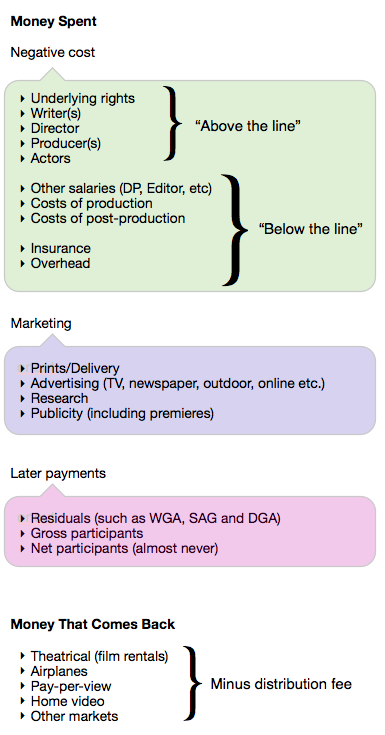
The most important thing to understand is that each film is accounted for separately. Studios charge distribution fees that earn money for the company without paying down the investment in each movie. That’s how Theoretical Pictures can turn a profit even when each of the last 20 films it has released shows a loss.

Because we’re throwing a lot of terms around this episode, here’s a handy cheat sheet:

John couldn’t remember the name of it (The Paramount Decree) but it’s worth reading up on the 1948 court decision [barring studios from owning movie theaters](http://en.wikipedia.org/wiki/United_States_v._Paramount_Pictures,_Inc.). Not only is it a fascinating anti-trust case, but it greatly influenced how the modern film industry works.

LINKS:

* Intro: [Mister T cartoon intro](http://www.youtube.com/watch?v=W4WAG0z-hDo)
* Outro: [Fatback Band – (Are You Ready) Do The Bus Stop](http://www.youtube.com/watch?v=PeeOPR8bxac)

You can download the episode here: [AAC](http://traffic.libsyn.com/scriptnotes/scriptnotes_ep_11.m4a).

UPDATE 11-17-11: The transcript of this episode can be found [here](http://johnaugust.com/2011/scriptnotes-ep-11-how-movie-money-works-transcript).

« Previous Page
Next Page »

Primary Sidebar

Newsletter

Inneresting Logo A Quote-Unquote Newsletter about Writing
Read Now

Explore

Projects

  • Aladdin (1)
  • Arlo Finch (27)
  • Big Fish (88)
  • Birdigo (2)
  • Charlie (39)
  • Charlie's Angels (16)
  • Chosen (2)
  • Corpse Bride (9)
  • Dead Projects (18)
  • Frankenweenie (10)
  • Go (29)
  • Karateka (4)
  • Monsterpocalypse (3)
  • One Hit Kill (6)
  • Ops (6)
  • Preacher (2)
  • Prince of Persia (13)
  • Shazam (6)
  • Snake People (6)
  • Tarzan (5)
  • The Nines (118)
  • The Remnants (12)
  • The Variant (22)

Apps

  • Bronson (14)
  • FDX Reader (11)
  • Fountain (32)
  • Highland (75)
  • Less IMDb (4)
  • Weekend Read (64)

Recommended Reading

  • First Person (87)
  • Geek Alert (151)
  • WGA (162)
  • Workspace (19)

Screenwriting Q&A

  • Adaptation (65)
  • Directors (90)
  • Education (49)
  • Film Industry (489)
  • Formatting (128)
  • Genres (89)
  • Glossary (6)
  • Pitches (29)
  • Producers (59)
  • Psych 101 (118)
  • Rights and Copyright (96)
  • So-Called Experts (47)
  • Story and Plot (170)
  • Television (165)
  • Treatments (21)
  • Words on the page (238)
  • Writing Process (177)

More screenwriting Q&A at screenwriting.io

© 2026 John August — All Rights Reserved.