• Skip to primary navigation
  • Skip to main content
  • Skip to primary sidebar

John August

  • Arlo Finch
  • Scriptnotes
  • Library
  • Store
  • About

Search Results for: notes on notes

Workspace: Cherry Chevapravatdumrong

November 6, 2012 Television, Workspace

Who are you and what do you write?
—

cherry chevapravatdumrongI’m Cherry Chevapravatdumrong. I write for Family Guy and I also write books.

I co-wrote a Family Guy book called [It Takes a Village Idiot and I Married One](http://www.amazon.com/gp/product/B001G8WWOW/ref=as_li_ss_tl?ie=UTF8&camp=1789&creative=390957&creativeASIN=B001G8WWOW&linkCode=as2&tag=johnaugustcom-20) with Alex Borstein. I’ve written two YA novels, [She’s So Money](http://www.amazon.com/gp/product/B005DICQVK/ref=as_li_ss_tl?ie=UTF8&camp=1789&creative=390957&creativeASIN=B005DICQVK&linkCode=as2&tag=johnaugustcom-20) and [DupliKate](http://www.amazon.com/gp/product/B0046LUE50/ref=as_li_ss_tl?ie=UTF8&camp=1789&creative=390957&creativeASIN=B0046LUE50&linkCode=as2&tag=johnaugustcom-20).

I also have a short story in an anthology that’s being published next year by Candlewick. The YA stuff is under the name “Cherry Cheva” which is also where you’ll find me on twitter: [@cherrycheva](http://twitter.com/cherrycheva)

Where and when do you write?
—

workspaceMostly at the Family Guy office, five days a week. It’s a regular day job with fairly regular hours, although on occasion we’ve ended up staying there till super late at night (typical for comedy shows…and I’ve heard of much worse, like staying all night every night, and/or working weekends, so no complaints here). Our staff is huge, so we’re actually rarely all in the same room at the same time (when we are, there’s always a few people sitting on the floor); rather, we usually break into smaller groups and go off to various other offices/conference rooms to work on different sections of the script. Divide and conquer!

When I’m by myself writing a Family Guy script or doing book stuff, I generally do it at home. Not really a café person; occasionally a library person. I’m pretty much a weekend warrior when it comes to non-Family Guy stuff, since it’s nearly impossible for me to motivate to write more after having just spent a whole day at the office doing it. Hell, it’s hard to motivate after spending the whole day doing any job, which meant I was a weekend warrior back in my assistant days as well. I’m definitely not a “get up early and do it before work!” kind of person.

What software do you use?
—

Final Draft for Family Guy scripts and other script stuff, Word for outlines and book stuff.

What hardware do you use?
—

At Family Guy, we’re on Macs, and in the main writers’ room we have a big long conference table that has monitors every few seats, plus a few couches, so that everybody can be looking at the same thing at the same time as the writers’ assistant types.
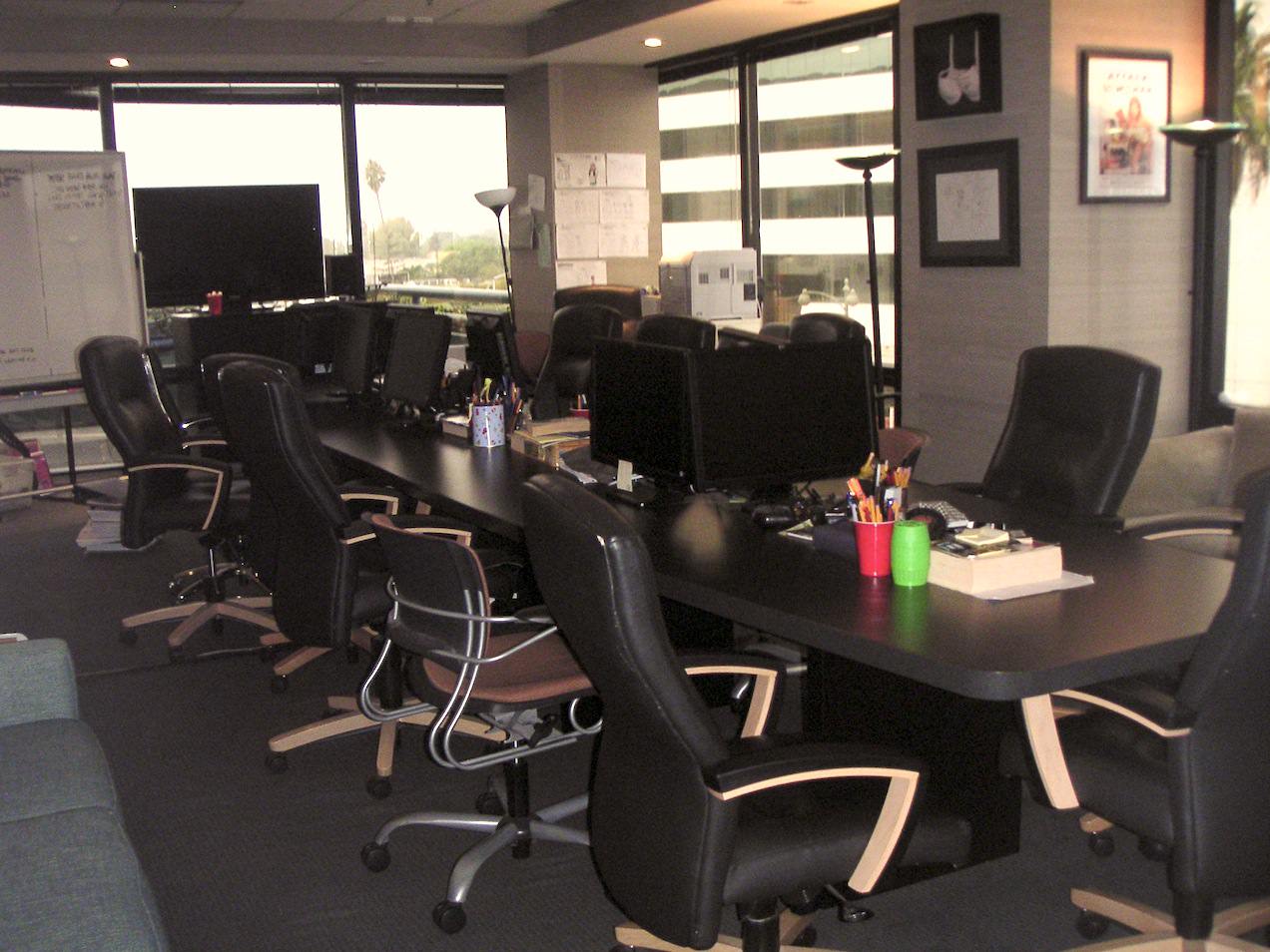
family guy room

The New York Times [ran a photo](http://www.nytimes.com/slideshow/2012/09/30/magazine/writers-rooms.html#3) that shows what it looks like when we’re all around the table.

There’s also a TV for when we’re rewriting animatics (the rough, black & white early version of an episode that’s basically all the storyboards strung together) or colors (version after it’s been animated), so we can watch it as we go, and we outline stuff on big whiteboards that have wheels so we can move them between all the different rooms as necessary.

People generally handwrite notes on their scripts, so we have many, many containers of pens and pencils all over the table. Like, way more than enough, which is great for when people are doing bits involving throwing them around the room or chucking them at the ceiling.

At home I have a Dell desktop and one of those wavy ergonomic keyboards. I don’t have a laptop, which everyone thinks is insane but is actually fine because on the rare occasion I’m trying to work somewhere that’s not my house, I just bring a pen and legal pad and I’m just jotting down notes or whatever.

I still have the same desk I acquired the first day I moved to LA (I was subletting from this girl who didn’t want her desk anymore so she gave it to me; it’s gigantic so I have lots of surface area to throw stuff everywhere). I also sometimes do that thing of putting up notecards on a corkboard when I’m trying to loosely outline something (one scene or chapter per card, depending on what I’m working on).

What (if anything) would you change?
—

I would write more (and/or procrastinate less)! I’m SO LAZY. I’m fine if there’s an actual deadline, I can totally kick it into high gear then, but if there isn’t one staring me right in the face, yikes. This is probably also a problem with writing at home most of the time…it’s so easy to be like “Oh, there’s the TV.” “Oh, there’s the kitchen where the snacks live.” “Oh wow, what if I turned on some music and had a one-woman dance party for the next hour?”

At Family Guy, of course, it’s different; that’s like an actual office job so you just do it, no problem. There I would just change the available candy to be more often the kinds I like (yeah, look at me, complaining about the free food).

We’re all Disney princesses now

Episode - 62

Go to Archive

November 6, 2012 News, QandA, Scriptnotes, Transcribed, Videogames

John and Craig discuss the big movie news of the week: Disney buying Lucasfilm, and with it, the rights to Star Wars.

Everyone’s already talked about what it means for fans and stock prices, but what does it mean for screenwriters? It could lead to new jobs creating extensions to the Star Wars universe — both in film and television — but does the reliance on giant brands make it harder to create the next culturally-defining franchise?

On the topic of new old things, John has his first-ever videogame coming out tomorrow on Xbox: Karateka, a reinvention of Jordan Mechner’s seminal fighting game from the 1980s. He talks about the challenges of making an indie game and what his role was as an executive producer.

From there, we answer listener questions. Is it okay to love your own writing? How young is too young to write a screenplay? What can be done about a 212 page script? And what does “going out wide” with a spec script really mean?

All this and more in episode 62 of Scriptnotes.

Special thanks to everyone who’s rated us and left comments in iTunes. They help new users find us, so if you haven’t left one recently, drop us a line.

LINKS:

* [Disney buys Star Wars](http://www.variety.com/article/VR1118061434)
* The [original Karateka](http://en.wikipedia.org/wiki/Karateka_(video_game))
* [Karateka](http://karateka.com) launches Nov. 7 on Xbox
* [Letterpress](https://itunes.apple.com/us/app/letterpress-word-game/id526619424?mt=8) game for iOS
* [Screenshot](http://johnaugust.com/Assets/johnvcraig.jpg) of John beating Craig in Letterpress
* [Red Cross](https://www.redcross.org/donate/index.jsp?donateStep=2&itemId=prod10002&utm_source=Disney_DayofGiving&utm_medium=web&utm_campaign=Sandy) donations to Hurricane Sandy relief
* [Scriptnotes](https://itunes.apple.com/us/podcast/scriptnotes-podcast/id462495496) on iTunes
* INTRO: [Card Sharks theme song](http://www.youtube.com/watch?v=nDugzjCJP6Y)
* OUTRO: [Star Wars Call Me Maybe](http://www.youtube.com/watch?v=dBM7i84BThE)

You can download the episode here: [AAC](http://traffic.libsyn.com/scriptnotes/scriptnotes_ep_62.m4a).

**UPDATE** 11-9-12: The transcript of this episode can be found [here](http://johnaugust.com/2012/scriptnotes-ep-62-were-all-disney-princesses-now-transcript).

Alt-universe panels

October 30, 2012 Follow Up, Scriptnotes, Transcribed, Words on the page

Craig and John ret-con the Austin Film Festival, placing themselves on panels in which they didn’t participate. It’s a chance to give the answers they would have given without the bother of being asked (or listening to other people’s opinions).

For example, Terry Rossio’s seminar on “The Throw” — his term for how you end a scene — was presumably terrific. We didn’t attend, but it’s fun to spitball what we would have said about this interesting and under-discussed aspect of screenwriting.

Other topics discussed this week include:

* Setiquette
* Kyle Killen’s secret shower
* Videogame storytelling
* Amazon Studios
* Pilots vs. presentations

Happy Halloween, everyone. Stay safe and dry.

LINKS:

* [Marti Noxon](http://www.imdb.com/name/nm0637497/)
* [Kyle Killen](http://www.imdb.com/name/nm3189831/)
* John’s [pitch and outline](http://johnaugust.com/library#dc) for D.C.
* [Amazon Studios panel write-up](http://johnaugust.com/2012/amazon-studios-at-aff)
* [Popcorn Fiction panel write-up](http://www.moveablefest.com/moveable_fest/2012/10/popcorn-fiction-derek-haas.html)
* [Terry Rossio](http://www.imdb.com/name/nm0744429/)
* INTRO: [I Dream of Jeannie](https://www.youtube.com/watch?v=JwpH_IYg0N8)
* OUTRO: [I Want to Be Evil](https://www.youtube.com/watch?v=SS02GeKuWQ4), by Eartha Kitt

You can download the episode here: [AAC](http://traffic.libsyn.com/scriptnotes/scriptnotes_ep_61.m4a).

**UPDATE** 11-2-12: The transcript of this episode can be found [here](http://johnaugust.com/2012/scriptnotes-ep-61-alt-universe-panels-transcript).

Amazon Studios at AFF

October 24, 2012 Film Industry, First Person, Follow Up

Amazon Studios has been a [much](http://johnaugust.com/2010/on-the-amazon-film-thing)-[discussed](http://johnaugust.com/2011/amazon-studios-now-slightly-less-terrible) [topic](http://johnaugust.com/2012/amazon-studios-and-the-free-option) on both the blog and the podcast. Last week at the Austin Film Festival, the company made a presentation explaining how they work with screenwriters.

Reader Mike attended and took notes, which he generously offered to write up.

—

first personA little bit about my background: I started out working at a production company as an intern and as a reader, kept working at writing and eventually got representation from a manager and an agent. I’ve had scripts go out and I’ve done the studio water bottle tour a couple of times, but have yet to earn a single penny as a writer.

I consider myself in that grey, ugly pool of zombie writers: Part alive, but mostly dead inside.

I’m guessing the crowd ranged from people like me to those who are thinking about writing their first screenplays. I had heard a lot things about Amazon (including on the podcast), so I went in with an ass-load of skepticism along with a tiny bit of hope. Unfortunately, very little during the panel moved the skeptic needle, and it pretty much pissed all over the hope.

Again, I can only speak for myself.

First, it wasn’t really a panel. There was one Dude at a podium, so it was more like a new-hire presentation at Dundler Mifflin rather than a Q&A with a studio exec. The Dude, head of development at Amazon Studios I think, seemed nice enough and intelligent enough, but he used the phrase “I’d rather not get into the details of that” way too often for my tastes.

Bullet points:

* Writers can upload their scripts to the Amazon Studios site as a non-WGA writer, or if they are WGA they can have their rep upload.
* Once a writer uploads his script, he cannot sell his script to anyone for 45 days. Essentially a free 45-day option.
* If Amazon is interested, they will option the script for a period of 18 months for $10k.
* If that script goes into production, the writer will be paid $200k, with some other pay-outs if the film reaches certain financial milestones.
* They also have open writing assignments from time to time, and these are handled much the same way, with writers submitting their work on the website for consideration for the gig.

All of this is well and good on the surface. I am not a million-dollar-screenwriter by any stretch of the imagination, but I do have some access to the lords of Hollywood. If I didn’t have anywhere to go with my scripts, I would probably be interested in what the Dude had to say. However, once he said they have somewhere around 10,000 submissions with 22 projects in development, it doesn’t take a Harvard grad to do the math and realize your odds are just as good in the traditional studio system.

The things that I found puzzling were mainly around their development process and their overall plan.

The Dude explained their development process by talking about information studios gather from test screening and how it is used. Basically saying that once you shoot a film, you have a test screening and get feedback from the general public on what they liked and didn’t like about the story, the characters or whatever. Meaning that the problem is that the film is already shot, so there is only so much you can do to alter it.

At Amazon (wait for it) they want to get public feedback (through their website) on the script as it is being developed so they can make changes before they begin shooting. They plan on doing this through several methods. They already have comic books made from a script in development that they are asking for feedback on. They are also thinking of making short videos and other things to get parts of the script out there and gather opinions from Amazon’s customers. The writer will get this info and incorporate it as notes for rewrites. Now, the Dude did say it is up to the writer to do what he wants with these notes. You be the judge on that. On one hand, I’d like to congratulate them on thinking outside the box on development. But I see problems with this, as I’m sure you do as well.

The other problem I had was with their overall plan: There doesn’t seem to be one.

They have a first-look deal with Warner Bros., but when he was asked questions about the deal he defaulted to the “I’d rather not get into the details of that.” He was asked what type of genres or budget ranges they were looking at, and he didn’t really have an answer. I would have been more impressed if they picked a direction, like saying, “We want to provide funding for small, independent minded stories that might not get a shot in the Hollywood system,” or saying, “We are looking for big, tent-pole, event movies.”

I had other concerns, but that was pretty much the thing in a nutshell. I think it great that someone with money is jumping in, and I hope for the best, but it looks like there are problems with hair on them, and I think there are some very rough growing pains in the making.

« Previous Page
Next Page »

Primary Sidebar

Newsletter

Inneresting Logo A Quote-Unquote Newsletter about Writing
Read Now

Explore

Projects

  • Aladdin (1)
  • Arlo Finch (27)
  • Big Fish (88)
  • Birdigo (2)
  • Charlie (39)
  • Charlie's Angels (16)
  • Chosen (2)
  • Corpse Bride (9)
  • Dead Projects (18)
  • Frankenweenie (10)
  • Go (29)
  • Karateka (4)
  • Monsterpocalypse (3)
  • One Hit Kill (6)
  • Ops (6)
  • Preacher (2)
  • Prince of Persia (13)
  • Shazam (6)
  • Snake People (6)
  • Tarzan (5)
  • The Nines (118)
  • The Remnants (12)
  • The Variant (22)

Apps

  • Bronson (14)
  • FDX Reader (11)
  • Fountain (32)
  • Highland (75)
  • Less IMDb (4)
  • Weekend Read (64)

Recommended Reading

  • First Person (87)
  • Geek Alert (151)
  • WGA (162)
  • Workspace (19)

Screenwriting Q&A

  • Adaptation (65)
  • Directors (90)
  • Education (49)
  • Film Industry (489)
  • Formatting (128)
  • Genres (89)
  • Glossary (6)
  • Pitches (29)
  • Producers (59)
  • Psych 101 (118)
  • Rights and Copyright (96)
  • So-Called Experts (47)
  • Story and Plot (170)
  • Television (165)
  • Treatments (21)
  • Words on the page (238)
  • Writing Process (177)

More screenwriting Q&A at screenwriting.io

© 2026 John August — All Rights Reserved.