• Skip to primary navigation
  • Skip to main content
  • Skip to primary sidebar

John August

  • Arlo Finch
  • Scriptnotes
  • Library
  • Store
  • About

QandA

The Next 117 Pages

Episode - 65

Go to Archive

November 27, 2012 Adaptation, Follow Up, Formatting, QandA, Scriptnotes, Three Page Challenge, Transcribed, Words on the page

John and Craig talk about everything that comes after the oft-discussed First Three Pages, speculating on the kinds of issues they’d spot if they were looking at full scripts.

They also answer listener questions on topics ranging from proper spacing protocol to novelists rewriting their screenplay adaptations.

LINKS:

* [“The exception that proves the rule”](http://en.wikipedia.org/wiki/Exception_that_proves_the_rule) on Wikipedia
* Stuart’s post, [Learning from the Three Page Challenge](http://johnaugust.com/2012/learning-from-the-three-page-challenge)
* [Brining](http://www.cookingforengineers.com/article/70/Brining) on Cooking for Engineers
* [Cook’s Illustrated](http://www.cooksillustrated.com/)
* [Ticket to Ride](https://itunes.apple.com/us/app/ticket-to-ride/id432504470?mt=8) for iOS
* [German-style board games](http://en.wikipedia.org/wiki/German-style_board_game) on Wikipedia
* INTRO: [Folger’s “Peter Comes Home for Christmas”](http://www.youtube.com/watch?v=I4kNl7cQdcU)
* OUTRO: [Train Song](https://itunes.apple.com/us/album/train-song/id303463575?i=303463582) by Feist and Ben Gibbard on iTunes

You can download the episode here: [AAC](http://traffic.libsyn.com/scriptnotes/scriptnotes_ep_65.m4a).

**UPDATE** 11-29-12: The transcript of this episode can be found [here](http://johnaugust.com/2012/scriptnotes-ep-65-the-next-117-pages-transcript).

Workspace: Leo Chu & Eric S. Garcia

November 16, 2012 Television, Workspace

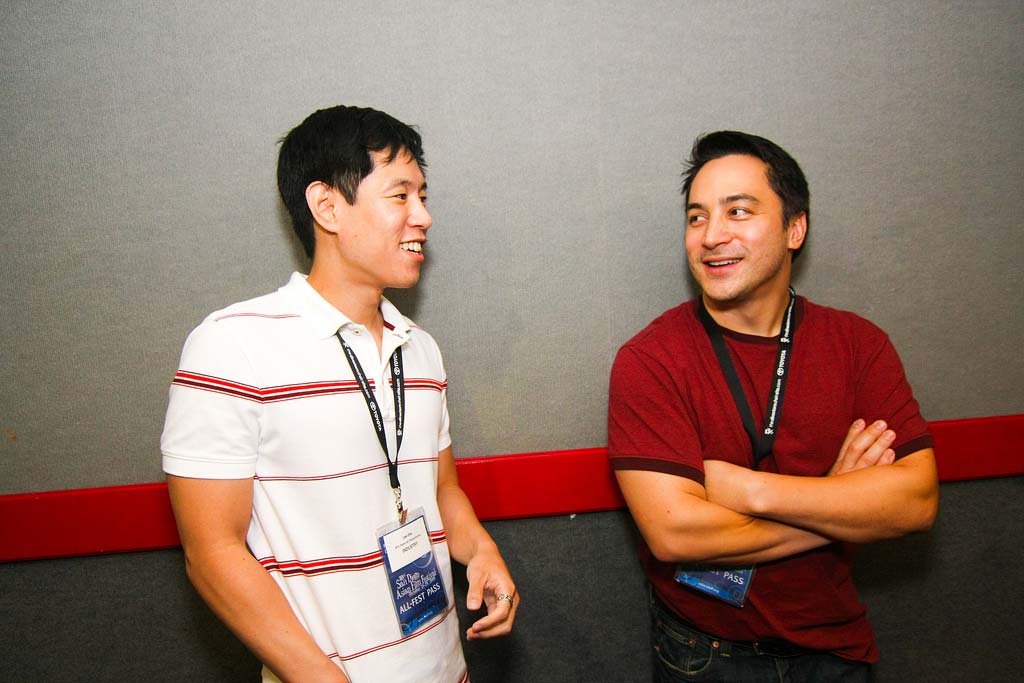
Leo Chu and Eric Garcia at SDAFF

Who are you and what do you write?
—

We’re [Leo Chu](https://twitter.com/leochu88) and [Eric S. Garcia](https://twitter.com/planeteric), and we mostly write television. We are currently the creators, executive producers, and showrunners of Nickelodeon’s live-action, single-camera, action-comedy series [Supah Ninjas](http://www.nick.com/shows/supah-ninjas/). It’s the #1 show in its time period for boys, and earlier this year, we won the [WGA Award for Outstanding Writing in Children’s Episodic & Specials](http://www.wga.org/awards/awardssub.aspx?id=1517). We just finished shooting the second season, which premieres early next year.

Although we have been working in live-action for the past three years, our roots are in animation. Previously, we were the executive producers and showrunners of the animé series [Afro Samurai](http://www.afrosamurai.com/), which aired on Spike TV and starred Samuel L. Jackson. The follow-up, [Afro Samurai: Resurrection](http://www.spike.com/shows/afro-samurai-resurrection), made history when it became the first animé to ever win a Primetime Emmy Award.

Where and when do you write?
—

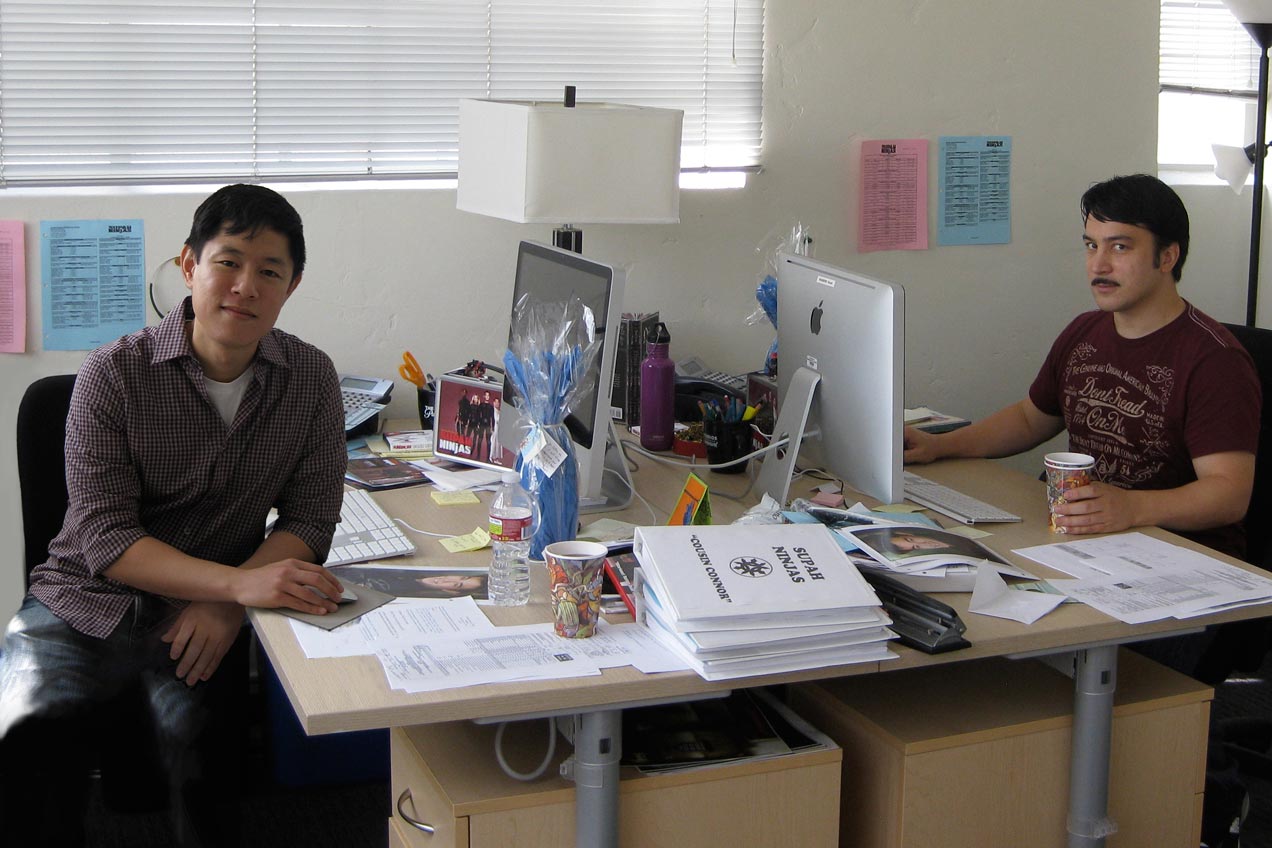
workspaceIf we are lucky, we get to write in our home office. We start our day at 10am and don’t change out of our pajamas. But when the show is in production, we have to wear pants.

We write anywhere to get the job done: the production office in LA, the one in Pittsburgh, on the plane, or in the hotel. So, in total, that’s five places. We do not write in cafés. That’s where we draw the line. If we are going to meander, we do *real* meandering — like driving out to Monterey Park for some delicious bing or cashing in reward points at fancy stores like Banana Republic.

Bling

The weirdest thing about being a writer lucky enough to create and run their own show is that there is precious little time to write. When we write, we tend to be really focused. We find that we do our best work in intense bursts — which is often during nights and weekends if we are in the midst of our Monday-Friday shooting schedule.

For us, the most important part of the writing process is having a clear plan about what we’re going to do. If we don’t have a plan, we always make sure we take the time to clear our heads and come up with one. To us, there is nothing worse than diving into a script with only a vague notion of what we want to accomplish. (It’s a great way to screw up what’s working.) If we need some true creative time to come up with new breakthrough ideas, we would rather remove a tree stump or clean out the closets. Creative thoughts are always running through our heads, so we make sure to nurture those ideas until it is time to give them form.

What software do you use?
—

[Final Draft](http://www.finaldraft.com/), which is what everyone uses. We know, boring. But since there’s two of us, we frequently need to be working on the same document at the same time. So, rather than hovering and fighting over the keyboard, we use this neat little thing called [iChat](http://www.apple.com/osx/apps/#messages) on our Macs. Under iChat, there’s a function called [Bonjour](https://developer.apple.com/opensource/). Provided you’re on the same network, it allows us to share screens –- and both of us can type! How cool is that?!

When we are not on the same network, we use [GoToMeeting](http://www.gotomeeting.com/). It’s kind of like Skype with screen sharing. We can see the script from anywhere we have an internet connection and hear the other person via computer or conference line. (The phone line typically works better for audio.) The catch is only one of us can type, which is useful when we want to shut down ideas from our writing partner. Simply refuse to type them.

What hardware do you use?
—

We both have two computers: [iMacs](http://www.apple.com/imac/) for home and [MacBook Airs](http://www.apple.com/macbookair/) when we’re on the road. In the writers’ room, we use white boards to break stories and a large cork board with index cards to track character arcs and season storylines.

Leo Chu and Eric Garcia work face-to-face

But let’s get really low-tech for a moment and talk about another type of hardware that is inexplicably overlooked – chairs! In our home office, we have these amazing [LifeForm chairs](http://www.lifeformchairs.com/) from [Relax the Back](http://www.relaxtheback.com/). We don’t care that they look ridiculous. The entire chair is made out of memory foam and contours to your butt and supports your back like *crazy*. We’ve tried Eames and Aerons and other ergo brands, but these are the Cadillac of Chairs. (For the record, we do not own stock in Relax the Back, but they should seriously send us coupons for how much we go on about these chairs, chairs, chairs.)

And while we’re at it – desks! We arrange them face-to-face like detectives. (Hey, if it works for solving murders, it works for writing!) We’ve tried other configurations, but we find this works the best. The computer screens have the added benefit of providing privacy so we don’t have to stare at each other all day. This set up also comes in handy when pitching jokes because Leo can’t see Eric when he rolls his eyes… and Eric can’t see Leo’s tears.

What (if anything) would you change?
—

Eric would write in a little cabin nestled in a deciduous wood with a burbling stream running by. And he would go out and take more walks. Leo would like more massages, an architecturally significant home, and a white butler (like [Woodhouse on Archer](http://archer.wikia.com/wiki/Woodhouse)) who brings him pie.

Workspace: Cherry Chevapravatdumrong

November 6, 2012 Television, Workspace

Who are you and what do you write?
—

cherry chevapravatdumrongI’m Cherry Chevapravatdumrong. I write for Family Guy and I also write books.
I co-wrote a Family Guy book called [It Takes a Village Idiot and I Married One](http://www.amazon.com/gp/product/B001G8WWOW/ref=as_li_ss_tl?ie=UTF8&camp=1789&creative=390957&creativeASIN=B001G8WWOW&linkCode=as2&tag=johnaugustcom-20) with Alex Borstein. I’ve written two YA novels, [She’s So Money](http://www.amazon.com/gp/product/B005DICQVK/ref=as_li_ss_tl?ie=UTF8&camp=1789&creative=390957&creativeASIN=B005DICQVK&linkCode=as2&tag=johnaugustcom-20) and [DupliKate](http://www.amazon.com/gp/product/B0046LUE50/ref=as_li_ss_tl?ie=UTF8&camp=1789&creative=390957&creativeASIN=B0046LUE50&linkCode=as2&tag=johnaugustcom-20).

I also have a short story in an anthology that’s being published next year by Candlewick. The YA stuff is under the name “Cherry Cheva” which is also where you’ll find me on twitter: [@cherrycheva](http://twitter.com/cherrycheva)

Where and when do you write?
—

workspaceMostly at the Family Guy office, five days a week. It’s a regular day job with fairly regular hours, although on occasion we’ve ended up staying there till super late at night (typical for comedy shows…and I’ve heard of much worse, like staying all night every night, and/or working weekends, so no complaints here). Our staff is huge, so we’re actually rarely all in the same room at the same time (when we are, there’s always a few people sitting on the floor); rather, we usually break into smaller groups and go off to various other offices/conference rooms to work on different sections of the script. Divide and conquer!

When I’m by myself writing a Family Guy script or doing book stuff, I generally do it at home. Not really a café person; occasionally a library person. I’m pretty much a weekend warrior when it comes to non-Family Guy stuff, since it’s nearly impossible for me to motivate to write more after having just spent a whole day at the office doing it. Hell, it’s hard to motivate after spending the whole day doing any job, which meant I was a weekend warrior back in my assistant days as well. I’m definitely not a “get up early and do it before work!” kind of person.

What software do you use?
—

Final Draft for Family Guy scripts and other script stuff, Word for outlines and book stuff.

What hardware do you use?
—

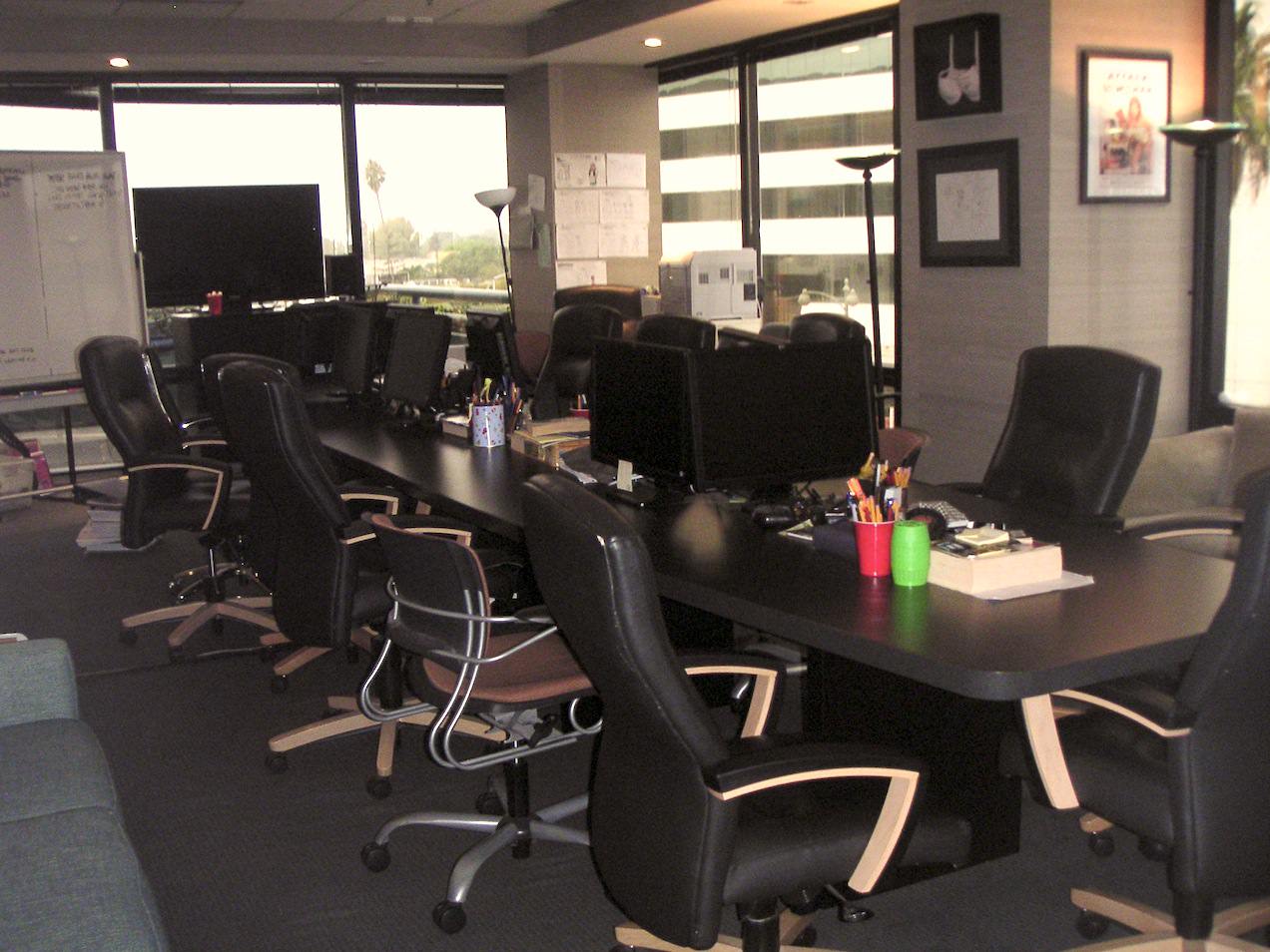
At Family Guy, we’re on Macs, and in the main writers’ room we have a big long conference table that has monitors every few seats, plus a few couches, so that everybody can be looking at the same thing at the same time as the writers’ assistant types.

family guy room

The New York Times [ran a photo](http://www.nytimes.com/slideshow/2012/09/30/magazine/writers-rooms.html#3) that shows what it looks like when we’re all around the table.

There’s also a TV for when we’re rewriting animatics (the rough, black & white early version of an episode that’s basically all the storyboards strung together) or colors (version after it’s been animated), so we can watch it as we go, and we outline stuff on big whiteboards that have wheels so we can move them between all the different rooms as necessary.

People generally handwrite notes on their scripts, so we have many, many containers of pens and pencils all over the table. Like, way more than enough, which is great for when people are doing bits involving throwing them around the room or chucking them at the ceiling.

At home I have a Dell desktop and one of those wavy ergonomic keyboards. I don’t have a laptop, which everyone thinks is insane but is actually fine because on the rare occasion I’m trying to work somewhere that’s not my house, I just bring a pen and legal pad and I’m just jotting down notes or whatever.

I still have the same desk I acquired the first day I moved to LA (I was subletting from this girl who didn’t want her desk anymore so she gave it to me; it’s gigantic so I have lots of surface area to throw stuff everywhere). I also sometimes do that thing of putting up notecards on a corkboard when I’m trying to loosely outline something (one scene or chapter per card, depending on what I’m working on).

What (if anything) would you change?
—

I would write more (and/or procrastinate less)! I’m SO LAZY. I’m fine if there’s an actual deadline, I can totally kick it into high gear then, but if there isn’t one staring me right in the face, yikes. This is probably also a problem with writing at home most of the time…it’s so easy to be like “Oh, there’s the TV.” “Oh, there’s the kitchen where the snacks live.” “Oh wow, what if I turned on some music and had a one-woman dance party for the next hour?”

At Family Guy, of course, it’s different; that’s like an actual office job so you just do it, no problem. There I would just change the available candy to be more often the kinds I like (yeah, look at me, complaining about the free food).

We’re all Disney princesses now

November 6, 2012 News, QandA, Scriptnotes, Transcribed, Videogames

John and Craig discuss the big movie news of the week: Disney buying Lucasfilm, and with it, the rights to Star Wars.

Everyone’s already talked about what it means for fans and stock prices, but what does it mean for screenwriters? It could lead to new jobs creating extensions to the Star Wars universe — both in film and television — but does the reliance on giant brands make it harder to create the next culturally-defining franchise?

On the topic of new old things, John has his first-ever videogame coming out tomorrow on Xbox: Karateka, a reinvention of Jordan Mechner’s seminal fighting game from the 1980s. He talks about the challenges of making an indie game and what his role was as an executive producer.

From there, we answer listener questions. Is it okay to love your own writing? How young is too young to write a screenplay? What can be done about a 212 page script? And what does “going out wide” with a spec script really mean?

All this and more in episode 62 of Scriptnotes.

Special thanks to everyone who’s rated us and left comments in iTunes. They help new users find us, so if you haven’t left one recently, drop us a line.

LINKS:

* [Disney buys Star Wars](http://www.variety.com/article/VR1118061434)
* The [original Karateka](http://en.wikipedia.org/wiki/Karateka_(video_game))
* [Karateka](http://karateka.com) launches Nov. 7 on Xbox
* [Letterpress](https://itunes.apple.com/us/app/letterpress-word-game/id526619424?mt=8) game for iOS
* [Screenshot](http://johnaugust.com/Assets/johnvcraig.jpg) of John beating Craig in Letterpress
* [Red Cross](https://www.redcross.org/donate/index.jsp?donateStep=2&itemId=prod10002&utm_source=Disney_DayofGiving&utm_medium=web&utm_campaign=Sandy) donations to Hurricane Sandy relief
* [Scriptnotes](https://itunes.apple.com/us/podcast/scriptnotes-podcast/id462495496) on iTunes
* INTRO: [Card Sharks theme song](http://www.youtube.com/watch?v=nDugzjCJP6Y)
* OUTRO: [Star Wars Call Me Maybe](http://www.youtube.com/watch?v=dBM7i84BThE)

You can download the episode here: [AAC](http://traffic.libsyn.com/scriptnotes/scriptnotes_ep_62.m4a).

**UPDATE** 11-9-12: The transcript of this episode can be found [here](http://johnaugust.com/2012/scriptnotes-ep-62-were-all-disney-princesses-now-transcript).

« Previous Page
Next Page »

Primary Sidebar

Newsletter

Inneresting Logo A Quote-Unquote Newsletter about Writing
Read Now

Explore

Projects

  • Aladdin (1)
  • Arlo Finch (27)
  • Big Fish (88)
  • Birdigo (2)
  • Charlie (39)
  • Charlie's Angels (16)
  • Chosen (2)
  • Corpse Bride (9)
  • Dead Projects (18)
  • Frankenweenie (10)
  • Go (29)
  • Karateka (4)
  • Monsterpocalypse (3)
  • One Hit Kill (6)
  • Ops (6)
  • Preacher (2)
  • Prince of Persia (13)
  • Shazam (6)
  • Snake People (6)
  • Tarzan (5)
  • The Nines (118)
  • The Remnants (12)
  • The Variant (22)

Apps

  • Bronson (14)
  • FDX Reader (11)
  • Fountain (32)
  • Highland (73)
  • Less IMDb (4)
  • Weekend Read (64)

Recommended Reading

  • First Person (87)
  • Geek Alert (151)
  • WGA (162)
  • Workspace (19)

Screenwriting Q&A

  • Adaptation (65)
  • Directors (90)
  • Education (49)
  • Film Industry (490)
  • Formatting (128)
  • Genres (89)
  • Glossary (6)
  • Pitches (29)
  • Producers (59)
  • Psych 101 (118)
  • Rights and Copyright (96)
  • So-Called Experts (47)
  • Story and Plot (170)
  • Television (165)
  • Treatments (21)
  • Words on the page (237)
  • Writing Process (177)

More screenwriting Q&A at screenwriting.io

© 2026 John August — All Rights Reserved.