• Skip to primary navigation
  • Skip to main content
  • Skip to primary sidebar

John August

  • Arlo Finch
  • Scriptnotes
  • Library
  • Store
  • About

John

Screenplays and the iPad mini

November 26, 2012 Tools

Several folks on Twitter have asked me whether the iPad mini is good for reading screenplays.

It is. It’s really good.

Everything on the mini screen is slightly smaller than normal — annoyingly so in the case of some UI elements — but because screenplays are set at 12 point, the text is plenty big enough for comfortable reading, even when zoomed out to full-page.

The screen isn’t retina, so text isn’t as sharp as it can be on the newer full-size iPad. But the screen is not bad at all, and you’d only notice the difference if you directly compared the devices.

If you’re considering getting the mini to read screenplays, I’d advise you to take a look at it for yourself next time you’re at the Apple store. Scripts for most of my movies are available in the [Library](http://johnaugust.com/library) here at johnaugust.com, so pull up one of the PDFs and see how you like it.

Both Safari and iBooks can handle screenplay PDFs, but for anything more complicated than simple reading, I’d suggest you pick a dedicated app. When the iPad first launched, I recommended [GoodReader](https://itunes.apple.com/us/app/goodreader-for-ipad/id363448914?mt=8) as the best PDF reader. It’s still solid — but it’s complicated, and kind of ugly. There are many PDF readers available for iOS, and they’re all cheap, so it’s worth trying out a few to see which you like the most.

Is the iPad mini *better* for screenplays than the full-size iPad? Maybe. It’s smaller and lighter, and much more comfortable to hold for long periods of time. If I were buying something primarily as a screenplay reading device, I’d get the mini. But the truth is, I’m not reading ten scripts a week. For me, my full-size iPad is just fine.

For reading books, I still prefer the [Kindle Paperwhite](http://www.amazon.com/gp/product/B008UB7DU6/ref=as_li_ss_tl?ie=UTF8&camp=1789&creative=390957&creativeASIN=B008UB7DU6&linkCode=as2&tag=johnaugustcom-20). The sidelit screen is nice, but the main advantage is psychological: it’s *only* good for books, so there’s no temptation to check email or play another game of [Ticket to Ride](https://itunes.apple.com/us/app/ticket-to-ride/id432504470?mt=8).

Moving past micro-budget

November 9, 2012 First Person, Follow Up, Sundance

Long time readers might remember Michael Mohan from back when his first film, [One Too Many Mornings](http://johnaugust.com/2010/one-too-many-mornings), was being self-released. He claims that more people saw the film from the mention on this blog than a front page ad on YouTube.

His second film, Save the Date, comes out on VOD today. It features Lizzy Caplan, Alison Brie, Martin Starr, Geoffrey Arend and Mark Webber. Here’s the red-band [trailer](http://www.youtube.com/embed/vsXA7RTjdMY):

Michael offered to write-up some backstory of how the film came to be. For any writer/directors trying to escape the micro-budget world, this might be of particular interest to you.

—

first personWay back in 2007, a friend of mine sent me the script to Save the Date. I was a rabid fan of one of the writers, Jeffrey Brown. Jeffrey is actually a graphic novelist. His early books depicting his failed relationships are some of my favorite books of all time. (You may actually be familiar with his latest book [Darth Vader and Son](http://www.amazon.com/gp/product/145210655X/ref=as_li_ss_tl?ie=UTF8&camp=1789&creative=390957&creativeASIN=145210655X&linkCode=as2&tag=johnaugustcom-20)).
I fell in love with the script. Like his other work, the characters actually felt like people I knew. The film had a director attached and was on its way to production. I set it on my shelf, eagerly awaiting when I could see it in theatres.

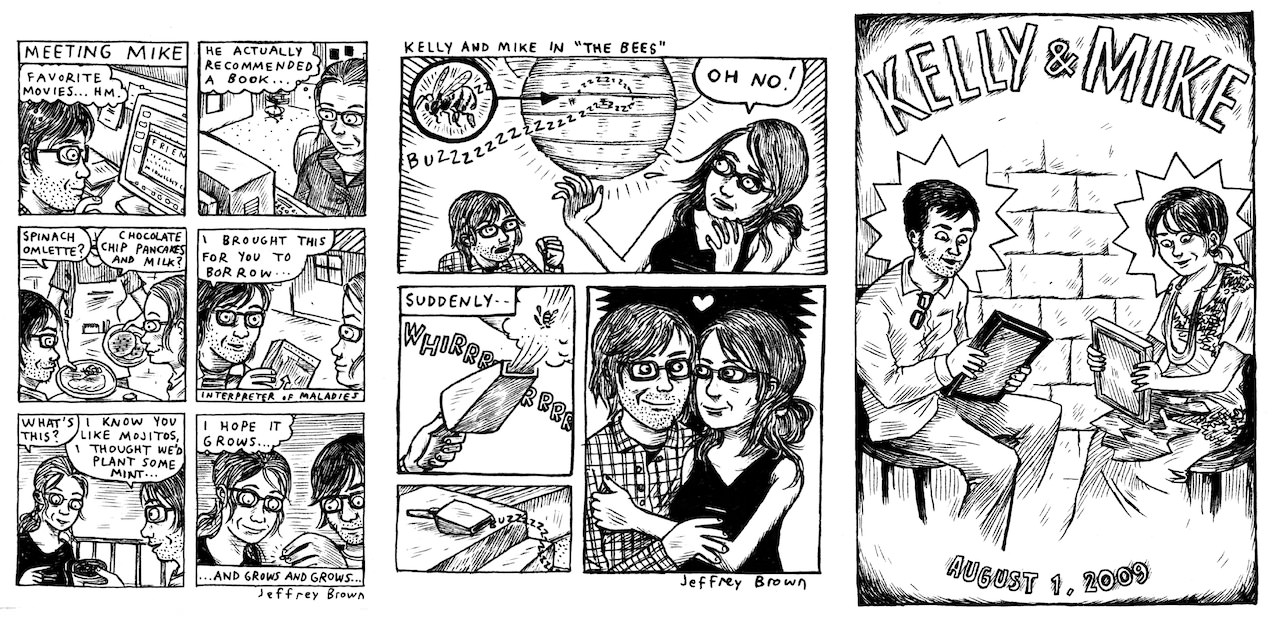
In 2009, I reached out to Jeffrey for a very different reason. I was about to get married, and hoped I could hire him to draw a comic of my wife and me. A wedding gift. To be clear: I didn’t know Jeffrey, I just wrote to the email address on the back cover of one of his books. He graciously wrote back agreeing to do it.

The night before our wedding, at the rehearsal dinner, I noticed that my wife’s gift to me was about the same size. And when we simultaneously opened our presents, I discovered that my wife had the exact same idea. We both wrote to an artist we did not know to commission a work for us. Hers was of our first date. Mine was when we moved in together. We then commissioned a third work, a meta-piece documenting the moment we opened these gifts.

illustration

Fast forward to 2010. One Too Many Mornings was about to premiere at the Sundance Film Festival, and I was figuring out what to write next. A friend who was working with Jeffrey’s publisher told me that the director of Save the Date had dropped out, and the project was sitting idle.

Immediately, I wrote a cold email to the producer, Jordan Horowitz, sending him the drawings above and expressing my passion for the script. Jordan was also headed to Sundance with a then-unknown film called The Kids Are All Right. We met in Park City and hit it off.

Jordan, Jeffrey, co-writer Egan Reich and I all agreed the script still needed work. While it was a passion project for everyone, there was no money. Everyone graciously allowed me to run with the script.

At this moment I was so ready to dive into the re-write, when suddenly my day job became more busy than ever. I was working for a boutique record label at the time, and quickly found myself bouncing all over the country filming bands, making content, and eventually directing music videos. While Save the Date was always on my mind, I constantly kept having to step away from the world of the story. My focus was split.

Little did I know that this complete career tangent ended up being a crucial moment in my artistic development. It’s one thing to direct a feature film on nights and weekends with your friends, having infinite time to edit. It’s another thing to listen to a song on Monday, shoot a video for it on Friday, and have only two weeks to edit it (with managers and label heads looking over your shoulder). The lack of time and abundance of pressure forced me to operate on a much more instinctual level than I was ever able to do.

For instance, the conception and execution for this video for Fitz and the Tantrums was so fast, it happened almost simultaneously:

From a directing point of view, it was really fun. But ultimately, these were merely exercises in style. They weren’t personal.

A blessing in disguise: that August I was laid off (apparently people download music illegally off the internet?), so I grabbed my team and made a short film. Yes, I had already made a feature film that had played festivals, but I really wanted to take this new process and apply it to narrative. We shot it for next to nothing, and worked in the spirit of the music videos: quickly and intuitively. We filmed it over the course of a weekend, by that Friday it was done. It was the most creatively fulfilling experience of my life.

I still had the feature script to finish, but no job to clock in to. I had earned a free flight, so I went to my parents’ house in rural Massachusetts. They don’t have wi-fi, and therefore it was one of the most productive periods of my entire life. Finally I was able to focus, energized from the experience of making the short. Jeffrey and Egan were on speed dial, should I need them. And the instant I had a decent enough draft of Save the Date, I booked my return ticket back to Los Angeles.

Here’s where timing really came into play, none of which was engineered. Ex-Sex was accepted into Sundance. The Kids Are All Right was nominated for Oscars. Save the Date was ready to be sent out. When people asked if I was a first time director, the answer was no.

The dominos fell from there. In the months that followed, I got my dream cast, producer Michael Roiff (Waitress) came on board, and financing showed up. When I look back, there’s nothing I can think of that I would have done differently.

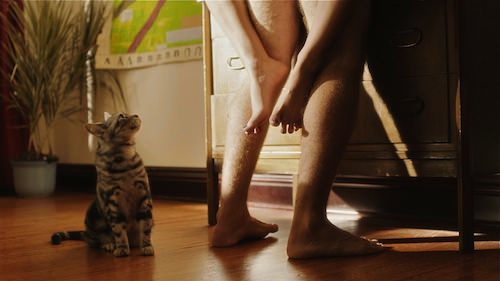
still image

There are a few takeaways here, but they’re very simple.

When you discover something you truly love, hold on to it. Don’t forget about it. I hadn’t directed anything of note back when I first read the script for Save the Date and literally right now you can turn on your tv and watch it.

Focus on the work. Your instincts are what set you apart from every other filmmaker, so create any opportunity to sharpen them. This is what instills the confidence and trust in your collaborators to create the groundswell of energy needed to get your film off the ground. It can be tempting to get distracted by what I like to call “warp zone stories:” filmmakers who may make one short film and find themselves directing a feature for a studio. It does not make you a better filmmaker to waste your time lamenting over the fact that this hasn’t happened to you yet. That hasn’t been my path, and most likely it’s not going to be yours.

Make sure it’s personal. Even though I didn’t come up with the idea for Save the Date, it hit me on a very deep level. No matter what scale you find yourself working on, if you simply have to tell your story, you’ll find a way to get it done. Personal stories are also trend-proof: truth never goes out of style.

Save the Date is available on pretty much every VOD platform TODAY. [Watching it via iTunes](http://bit.ly/savethedatemovie) between now and Sunday will make the biggest impact. The film will be hitting theatres on December 14th.

A big thanks to John for letting me share my story with you.

Punching the Hawk: Karateka 2.0

November 7, 2012 Karateka, Videogames

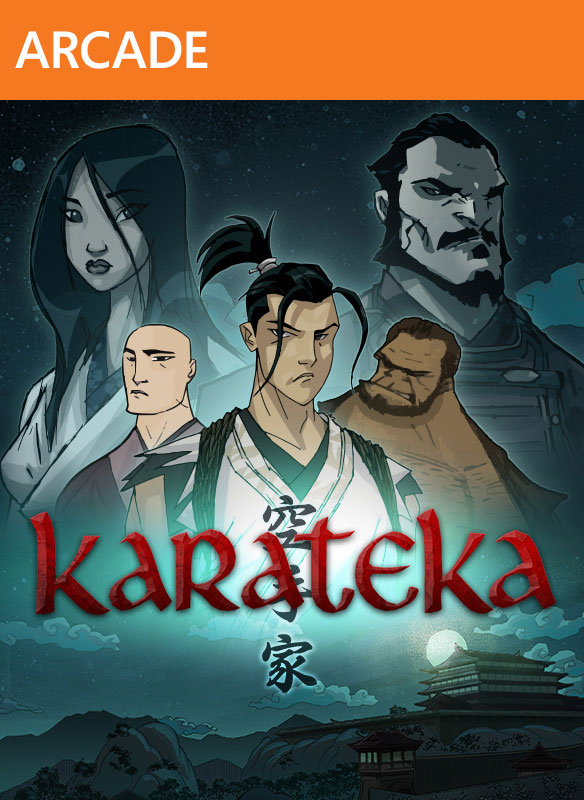
karateka cover artAlmost three years ago, Jordan Mechner and I set out to make a new version of his amazing 1984 videogame Karateka, which I’d played endlessly one summer on the Atari 800.

Rather than going to a publisher, we decided to make the game ourselves. We raised money. We hired artists and coders. We sweated a lot of details, from story points to footfall sounds.

Today, we shipped. Karateka is [now available on the Xbox](http://marketplace.xbox.com/en-US/Product/Karateka/66acd000-77fe-1000-9115-d8025841128c), with a free trial download.

If you have an Xbox, stop reading and start punching.

If you have a PS3, a PC, a Mac or an iOS device, your version is coming soon. So sit tight.

Even if you don’t normally play fighting games, I think you’ll enjoy it. The combat rewards precision rather than button-smashing, and Jordan’s multiple-protagonist mechanic makes it easy to survive but hard to triumph. I think you’re going to see other games adopting this idea.

Plus, Karateka looks and sounds terrific. Christopher Tin’s music isn’t just frosting on top — it’s integral to the gameplay in a unique way.

I was so happy with how the game was coming together that last March I went to [Adam Lisagor](http://sandwichvideo.com/people/adam-lisagor/) and asked (well, begged) him to make a video for us.

That debuted today as well:

(There’s a [director’s cut](http://www.youtube.com/watch?v=6pDy-CSFsPs&feature=player_embedded) available too.)

I’ll have more to blog about as we discover how the game fares in the wild, but it’s been an amazing process to get to this point.

I’ve made movies and I’ve made apps, but making a videogame was another beast altogether. Jordan deserves all the accolades, yet I’m sure he’d agreee that it wouldn’t have been possible without his remarkable team at Liquid. I also need to single out Jeff Matsuda for creating the look of the world with his concept art, and Ryan Nelson for building countless iterations of product artwork in every conceivable specification.

It’s hard to believe it’s finally in the store. [Check it out](http://marketplace.xbox.com/en-US/Product/Karateka/66acd000-77fe-1000-9115-d8025841128c), and as always, ask questions.

Workspace: Cherry Chevapravatdumrong

November 6, 2012 Television, Workspace

Who are you and what do you write?
—

cherry chevapravatdumrongI’m Cherry Chevapravatdumrong. I write for Family Guy and I also write books.
I co-wrote a Family Guy book called [It Takes a Village Idiot and I Married One](http://www.amazon.com/gp/product/B001G8WWOW/ref=as_li_ss_tl?ie=UTF8&camp=1789&creative=390957&creativeASIN=B001G8WWOW&linkCode=as2&tag=johnaugustcom-20) with Alex Borstein. I’ve written two YA novels, [She’s So Money](http://www.amazon.com/gp/product/B005DICQVK/ref=as_li_ss_tl?ie=UTF8&camp=1789&creative=390957&creativeASIN=B005DICQVK&linkCode=as2&tag=johnaugustcom-20) and [DupliKate](http://www.amazon.com/gp/product/B0046LUE50/ref=as_li_ss_tl?ie=UTF8&camp=1789&creative=390957&creativeASIN=B0046LUE50&linkCode=as2&tag=johnaugustcom-20).

I also have a short story in an anthology that’s being published next year by Candlewick. The YA stuff is under the name “Cherry Cheva” which is also where you’ll find me on twitter: [@cherrycheva](http://twitter.com/cherrycheva)

Where and when do you write?
—

workspaceMostly at the Family Guy office, five days a week. It’s a regular day job with fairly regular hours, although on occasion we’ve ended up staying there till super late at night (typical for comedy shows…and I’ve heard of much worse, like staying all night every night, and/or working weekends, so no complaints here). Our staff is huge, so we’re actually rarely all in the same room at the same time (when we are, there’s always a few people sitting on the floor); rather, we usually break into smaller groups and go off to various other offices/conference rooms to work on different sections of the script. Divide and conquer!

When I’m by myself writing a Family Guy script or doing book stuff, I generally do it at home. Not really a café person; occasionally a library person. I’m pretty much a weekend warrior when it comes to non-Family Guy stuff, since it’s nearly impossible for me to motivate to write more after having just spent a whole day at the office doing it. Hell, it’s hard to motivate after spending the whole day doing any job, which meant I was a weekend warrior back in my assistant days as well. I’m definitely not a “get up early and do it before work!” kind of person.

What software do you use?
—

Final Draft for Family Guy scripts and other script stuff, Word for outlines and book stuff.

What hardware do you use?
—

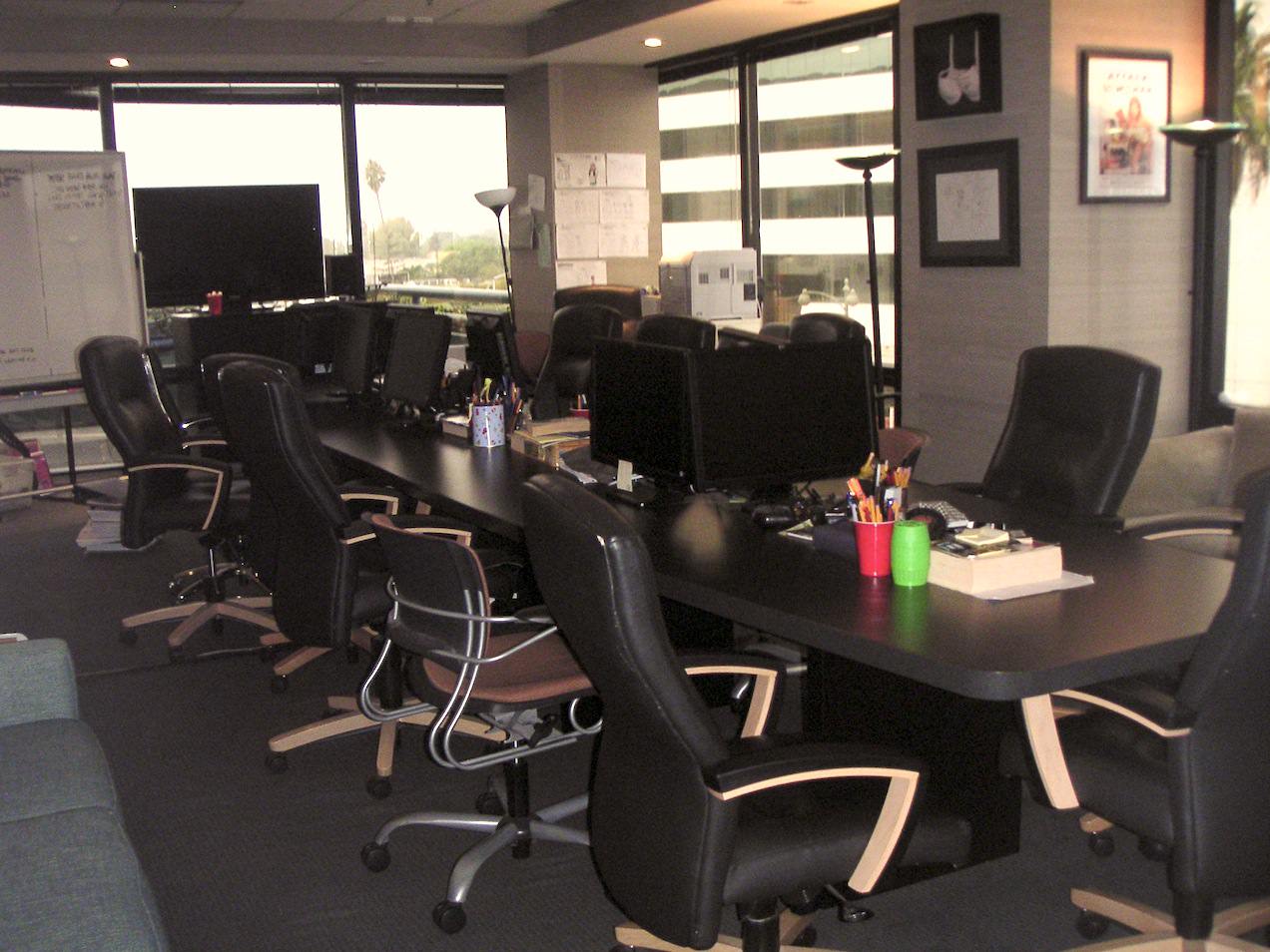
At Family Guy, we’re on Macs, and in the main writers’ room we have a big long conference table that has monitors every few seats, plus a few couches, so that everybody can be looking at the same thing at the same time as the writers’ assistant types.

family guy room

The New York Times [ran a photo](http://www.nytimes.com/slideshow/2012/09/30/magazine/writers-rooms.html#3) that shows what it looks like when we’re all around the table.

There’s also a TV for when we’re rewriting animatics (the rough, black & white early version of an episode that’s basically all the storyboards strung together) or colors (version after it’s been animated), so we can watch it as we go, and we outline stuff on big whiteboards that have wheels so we can move them between all the different rooms as necessary.

People generally handwrite notes on their scripts, so we have many, many containers of pens and pencils all over the table. Like, way more than enough, which is great for when people are doing bits involving throwing them around the room or chucking them at the ceiling.

At home I have a Dell desktop and one of those wavy ergonomic keyboards. I don’t have a laptop, which everyone thinks is insane but is actually fine because on the rare occasion I’m trying to work somewhere that’s not my house, I just bring a pen and legal pad and I’m just jotting down notes or whatever.

I still have the same desk I acquired the first day I moved to LA (I was subletting from this girl who didn’t want her desk anymore so she gave it to me; it’s gigantic so I have lots of surface area to throw stuff everywhere). I also sometimes do that thing of putting up notecards on a corkboard when I’m trying to loosely outline something (one scene or chapter per card, depending on what I’m working on).

What (if anything) would you change?
—

I would write more (and/or procrastinate less)! I’m SO LAZY. I’m fine if there’s an actual deadline, I can totally kick it into high gear then, but if there isn’t one staring me right in the face, yikes. This is probably also a problem with writing at home most of the time…it’s so easy to be like “Oh, there’s the TV.” “Oh, there’s the kitchen where the snacks live.” “Oh wow, what if I turned on some music and had a one-woman dance party for the next hour?”

At Family Guy, of course, it’s different; that’s like an actual office job so you just do it, no problem. There I would just change the available candy to be more often the kinds I like (yeah, look at me, complaining about the free food).

« Previous Page
Next Page »

Primary Sidebar

Newsletter

Inneresting Logo A Quote-Unquote Newsletter about Writing
Read Now

Explore

Projects

  • Aladdin (1)
  • Arlo Finch (27)
  • Big Fish (88)
  • Birdigo (2)
  • Charlie (39)
  • Charlie's Angels (16)
  • Chosen (2)
  • Corpse Bride (9)
  • Dead Projects (18)
  • Frankenweenie (10)
  • Go (29)
  • Karateka (4)
  • Monsterpocalypse (3)
  • One Hit Kill (6)
  • Ops (6)
  • Preacher (2)
  • Prince of Persia (13)
  • Shazam (6)
  • Snake People (6)
  • Tarzan (5)
  • The Nines (118)
  • The Remnants (12)
  • The Variant (22)

Apps

  • Bronson (14)
  • FDX Reader (11)
  • Fountain (32)
  • Highland (75)
  • Less IMDb (4)
  • Weekend Read (64)

Recommended Reading

  • First Person (87)
  • Geek Alert (151)
  • WGA (162)
  • Workspace (19)

Screenwriting Q&A

  • Adaptation (65)
  • Directors (90)
  • Education (49)
  • Film Industry (489)
  • Formatting (128)
  • Genres (89)
  • Glossary (6)
  • Pitches (29)
  • Producers (59)
  • Psych 101 (118)
  • Rights and Copyright (96)
  • So-Called Experts (47)
  • Story and Plot (170)
  • Television (165)
  • Treatments (21)
  • Words on the page (237)
  • Writing Process (177)

More screenwriting Q&A at screenwriting.io

© 2026 John August — All Rights Reserved.