• Skip to primary navigation
  • Skip to main content
  • Skip to primary sidebar

John August

  • Arlo Finch
  • Scriptnotes
  • Library
  • Store
  • About

John

Present tension

January 2, 2013 Words on the page

While most fiction is written in the past tense, screenwriting is all about the present tense — including the present progressive, a topic I’ve [blogged about](http://johnaugust.com/2009/present-tense).

But not all prose fiction is written in the past tense. Robert Jackson Bennett looks at the benefits and drawbacks of [writing in the present tense](http://robertjacksonbennett.wordpress.com/2013/01/02/on-the-present-tense):

> The past tense actually separates the audience from what’s happening in the work they’re reading by making it so that the story has already happened. While you might not think about it, the past tense actually sets works in the past – there is a division of time between the audience and the work, in the same manner that there is a division in time between me and World War II. If I read about World War II, I am not experiencing World War II, I am merely hearing about it. I will never experience World War II: I will only have someone tell me what it was like.

> The present tense, to a certain extent, bypasses this division, or it simulates the feeling of bypassing it: you are witnessing something happening right now. Everything is immediate.

> […] It bypasses the fixed, static feeling of an event that has already happened, being told from a fixed narrator’s voice, and instead feeds you an experience that is currently ongoing.

That’s exactly why screenplays are written in the present tense. It’s not about what *did* happen; it’s what’s right in front of the audience.

Still, for traditional fiction, the present tense often feels wrong — too insistent, to in-your-face.

Bennett compares it to shaky-cam, but to me closer analogies would include the 48 frames version of The Hobbit or the sniffily live-sung close-ups of Tom Hooper’s Les Misérables. The hyper-reality either works for you or it doesn’t.

Punching the Hawk

December 20, 2012 Apps, Karateka, Projects

Karateka IconKarateka, our remake of Jordan Mechner’s groundbreaking game, is finally (finally!) available for iOS. So fire up your iPhone or iPad and tap over to the [App Store](https://itunes.apple.com/app/id560927460).

I really think you’ll love it, even if you’re not someone who usually plays fighting games. It’s beautiful. It’s simple. It’s like playing a Japanese fairy tale.

One of the best things about Karateka is that you don’t need to carve out a weekend to play it. You can pick it up and flatten some bad guys between finals. You can punch the hawk in the bathroom while hiding from your family. ((That sounds dirty. That’s intentional.))

If you have half an hour, you can make it to the final boss — but you’re unlikely to finish the story, because to get there with the True Love is going to require some practice.

But it’s the holidays. You can find the time.

Karateka is also available on Xbox, PS3 and Steam. Parents love all their children, so of course I love these platforms, too. But the iOS version is where I’ve spent by far the most time, both at work and play. I live my life on Apple products. The iPhone and iPad are my home turf, and I wanted their version of Karateka to be great.

We’ve actually had development builds of the iOS version since the summer. My seven-year-old daughter has probably played it 100 times. She’s better than me, except when it comes to the hawk. When she knows it’s coming, she’ll pause the game, find me, then have me deal with it. (Same with real-life spiders.)

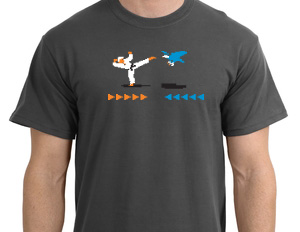
Jordan and the team at Liquid did the hard work of porting the console game to iOS — getting those polygons to behave is a beast — but we did quite a bit in our offices too. Ryan Nelson designed the icon, the menus, and these awesome shirts we’re giving away this afternoon:

t-shirt

People often ask me why I don’t sell any advertising for the site or the podcast. After all, both have a big audience, and hosting them costs money. But it’s just always felt weird to me stumping for something I don’t necessarily believe it.

I believe in Karateka. I love it and I own a chunk of it, both emotionally and financially. So if you’re a loyal reader and/or listener, a $2.99 download in the App Store would mean a lot to me.

(And if you love the game, a glowing review is also a big help.)

When you’ve had a chance to play the game, [tweet me](http://twitter.com/johnaugust) and [Jordan Mechner](https://twitter.com/jmechner) to let us know what you think.

We’ll also be looking for tweets hash-tagged [#punchthehawk](https://twitter.com/search?q=%23punchthehawk), so a witty one might find itself retweeted a lot.

A Hollywood Christmas Story

December 18, 2012 First Person

In a speech to Nicholl Fellowship winners, screenwriter Billy Ray offered a seasonally-appropriate explanation of Hollywood rankings.

—

first personI grew up revering writers.

This is largely because I came of age in the ’70s, when Francis Coppola and Mario Puzo were writing *The Godfather*. Robert Towne was writing *Chinatown*. Frank Pierson was writing *Dog Day Afternoon*. Paddy Chayefsky was writing *Network* and *The Hospital*. William Goldman was writing *Butch Cassidy* and *All the President’s Men*.

Throw in *Rocky* by Sylvester Stallone and *The Candidate* by Jeremy Larner, *Jaws* by Peter Benchley and Carl Gottlieb, *Kramer vs. Kramer* by Robert Benton, *The Omen* by David Seltzer, *Annie Hall* and *Manhattan* by Woody Allen and Marshall Brickman… and you have the beginnings of a writers’ hall of fame. These people were my heroes.

But the other reason I grew up revering writers was that my father represented them. He was a literary agent, a great one. And when I was nineteen I walked into his office and told him that I had decided to become a screenwriter.

Back in those days literary agencies still kept all their clients’ scripts on paper. My father’s office had a huge storeroom of tall metal shelves, stacked high with scripts. On one of those shelves were the scripts of his client, Alvin Sargent. My father pulled from it Alvin’s brilliant shooting script for *Ordinary People*. Then he handed it to me and said, “Here. Do this.”

He was setting the bar for me. I have been trying to hit it ever since.

Because WGA rules require that all successful writers begin their careers by struggling so they’ll have a story to tell later, I spent three years after college working at a regular job during the day and writing at night. But after I finally sold a script, things started happening for me pretty quickly.

At the age of 25, I was writing two movies for a big-time producer at Universal and was very much feeling like the flavor of the month.

One day, I was in this producer’s office for a meeting when I saw something spitting out of his dot-matrix printer. (This was the late ’80s for those of you unfamiliar with that technology.) On the page coming out of the printer I saw a list. At the top of it were the letters “AA” and the names of the producer’s wife and his lawyer.

I suddenly realized: I was looking at his Christmas list.

“Billy,” I told myself, “Stop reading. You don’t want to know what letter you are.”

But several weeks later, a Christmas gift arrived at my apartment from this producer’s office. It was a beautiful silver tray with a gingerbread house on it — inlaid with candies and lights.

And I said to myself, “Okay. I’m not ‘AA,’ but I’m ‘A’ and I’m only 25. That’s pretty good.”

The next year, both movies I was writing for him went into turnaround, and when Christmas rolled around again I found myself thinking, “I don’t think there’s another silver tray coming my way this year.”

Soon, a messenger from his office came to my house, and handed me a beautiful gift basket. It had wine and salami and an assortment of cheeses, and I thought to myself, “Okay, I’m not ‘A’ anymore — but I’m still ‘B’ and I’m only 26. That’s pretty good.”

An hour later I got a call from a panicked assistant who worked for that producer: “Did you get a gift from us?”

“Yes, I did.”

“Don’t open it.”

“Why not?”

“We got your gift mixed up with someone else’s.”

“No problem. I’ll take his. He’ll take mine. It’s really fine.”

“Don’t open it. Someone will be right over.” He hung up, still palpitating.

Ten minutes later I hear a screech of tires outside my apartment, and the frantic steps of this assistant on his way to my door. He pounded. I answered.

His face was ashen: “Do you have it?”

I handed him the gift basket.

And he handed me a tin of yogurt-covered pretzels.

When people ask me what it’s like to be a young screenwriter in Hollywood, that’s the story I tell them.

—-

Billy Ray’s [screenwriting credits](http://www.imdb.com/name/nm0712753/) include Shattered Glass and Breach — both of which he also directed — along with State of Play and The Hunger Games. He serves on the WGA Board of Directors.

Frankenweenie scripts now online

December 3, 2012 Frankenweenie

Now that it’s officially awards season, Disney has given me their blessing to post the screenplay for Frankenweenie. You can find it in the [Library](http://johnaugust.com/library), along with many of my other scripts.

There are actually two Frankenweenie scripts available to read.

1. The first is my December 2010 draft, which got the greenlight. It’s probably my second or third draft, but the story didn’t really change that much from the very beginning.

2. The second script is conformed from animatic, and incorporates all the changes made during storyboarding, production and editing.

The first one probably reads better — because it was written to be read. The second one more accurately reflects the final movie. If you’re curious about the process of animation, you’ll probably want to look at both. I especially like the trimming and tightening that happened in the third act during storyboarding. It takes a village to make a movie, and I’m indebted to the all the pencil-wielding citizens of Three Mills Studios who worked to make those story beats happen.

This morning, as I was writing up this post, Frankenweenie got [five Annie Award nominations](http://www.latimes.com/entertainment/envelope/moviesnow/la-et-mn-brave-wreck-it-ralph-nominees-annie-awards-20121202,0,4731958.story), including Best Animated Feature and Writing in an Animated Feature. We were also named [Best Animated Film](http://www.huffingtonpost.com/2012/12/03/new-york-film-critics-circle-awards-2012_n_2231093.html) by the New York Film Critics Circle. It’s great to see the film getting such a warm reception.

« Previous Page
Next Page »

Primary Sidebar

Newsletter

Inneresting Logo A Quote-Unquote Newsletter about Writing
Read Now

Explore

Projects

  • Aladdin (1)
  • Arlo Finch (27)
  • Big Fish (88)
  • Birdigo (2)
  • Charlie (39)
  • Charlie's Angels (16)
  • Chosen (2)
  • Corpse Bride (9)
  • Dead Projects (18)
  • Frankenweenie (10)
  • Go (29)
  • Karateka (4)
  • Monsterpocalypse (3)
  • One Hit Kill (6)
  • Ops (6)
  • Preacher (2)
  • Prince of Persia (13)
  • Shazam (6)
  • Snake People (6)
  • Tarzan (5)
  • The Nines (118)
  • The Remnants (12)
  • The Variant (22)

Apps

  • Bronson (14)
  • FDX Reader (11)
  • Fountain (32)
  • Highland (75)
  • Less IMDb (4)
  • Weekend Read (64)

Recommended Reading

  • First Person (87)
  • Geek Alert (151)
  • WGA (162)
  • Workspace (19)

Screenwriting Q&A

  • Adaptation (65)
  • Directors (90)
  • Education (49)
  • Film Industry (489)
  • Formatting (128)
  • Genres (89)
  • Glossary (6)
  • Pitches (29)
  • Producers (59)
  • Psych 101 (118)
  • Rights and Copyright (96)
  • So-Called Experts (47)
  • Story and Plot (170)
  • Television (165)
  • Treatments (21)
  • Words on the page (237)
  • Writing Process (177)

More screenwriting Q&A at screenwriting.io

© 2026 John August — All Rights Reserved.