• Skip to primary navigation
  • Skip to main content
  • Skip to primary sidebar

John August

  • Arlo Finch
  • Scriptnotes
  • Library
  • Store
  • About

John

Another look at junkets

October 25, 2012 First Person, Follow Up

On a recent podcast, Craig and I discussed press junkets from the screenwriter’s perspective.

Tim from London wrote in to offer the view from the other side of the roundtable.

—

first personI’ve been working as a producer in the UK for the past 15 years, the last nine of which have been spent making various film-themed shows for a major TV broadcaster. A lot of these shows (be they weekly review-based programmes, or promotional specials focused on individual films or documentaries) are based around on and off-screen talent discussing their films, and so the majority of original material is gleaned from junkets.

Apologies to both John and Craig but unfortunately our paths have never crossed in the junket room — although Big Fish was one of my first junket experiences, followed a couple of years later by Scary Movie 4.

Junkets are an incredibly strange phenomenon, and the horror stories from the corridors of The Dorchester, The Four Seasons and The Hotel Du Cap are legendary. There’s definitely a movie to be made there somewhere — although both America’s Sweethearts and Notting Hill absolutely nail aspects of the experience.

The thing that has struck me more than anything is how few screenwriters seem to be invited to participate. I would estimate that less than 1 in 10, maybe even 1 in 20 junkets that I’ve attended has included the writer.

From my experience, I get the impression that writers tend to be involved in junkets when they themselves offer some kind of unique story the studio knows they can use to sell the movie. Examples include films like Juno or The Social Network where, at least in publicity terms, the writers could be seen as “the star” or “the story” in some circles.

Other than these two examples, I’m struggling to think of too many other occasions when the writer has played a significant role in a junket that I’ve attended. There are plenty of times when writers are made available for interview, but really only when it’s either a very big or very small film.

The behind-the-scenes folk tend to get forgotten — quite literally in some cases. I’ve seen interviewers not even bother taking interview tapes from directors, producers and writers from a junket. (I’ve always found this to be pretty reprehensible behaviour). I honestly think the reason for this is that very few of the outlets are specifically aiming at a film enthusiast audience or readership. They want the stars.

The upcoming James Bond movie, Skyfall, will be a great example of this. I can pretty much guarantee that the attending press will consist of no more than five percent representing movie-orientated publications or shows. The vast majority will come from news, lifestyle, gossip and celebrity type outlets whose main purpose will be to get their host seen on screen with Daniel Craig. Whether anything of interest is actually discussed is pretty much secondary to their show/newspaper/magazine featuring a big movie star.

I have no real problem with this, as it’s clearly the way the film companies are choosing to sell their product.

The more specialised nature of internet coverage is changing things, but it seems to be a very slow process. I don’t think the studios have been as proactive as they could be in embracing the opportunities that online provides for publicising a movie, as opposed to simply marketing it. To my mind it makes much more sense to utilise a writer or director’s publicity schedule by placing them with more filmmaker-friendly outlets.

For all the great work writers do to make a movie happen, let’s face it, they’re not getting a lot of airtime on E!, so why not use that junket day for something more direct and something more effective?

Personally, I always find it fun to interview writers, because they rarely seem to be caught up in the crazy hoopla of either making or selling the movie. It’s an opportunity to talk about the plot and the characters of a film without the conversation feeling like a sales pitch or a soapbox. More often than not, it feels like they’re just enjoying the culmination of the work that they were responsible for starting and are genuinely looking forward to seeing what the audience will make of the finished film.

Either that, or they’re just very good at faking it.
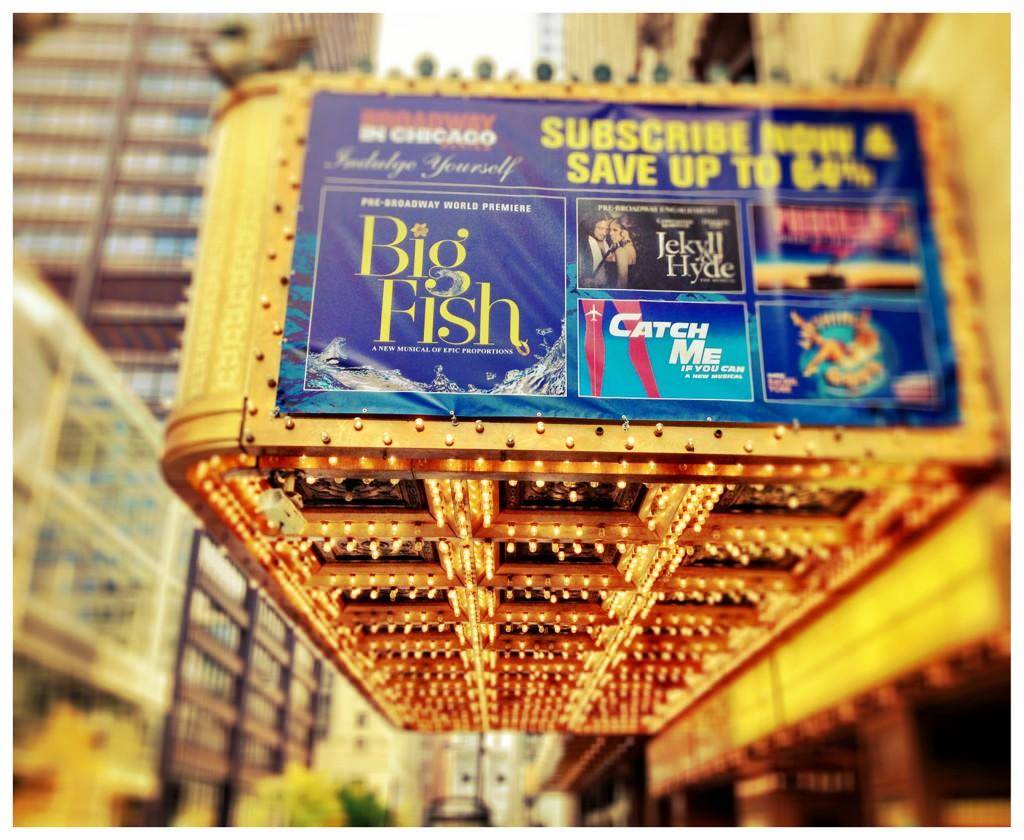
Big Fish in Chicago

October 24, 2012 Big Fish

big fish marquee

Oriental Theater in Chicago
Performances begin April 2, 2013
Group and season tickets [on sale now](http://www.broadwayinchicago.com/shows_dyn.php?cmd=display_current&display_showtag=bigfish13).
(Single shows coming later.)

Photo by [@morganzetajones](http://twitter.com/morganzetajones)

Amazon Studios at AFF

October 24, 2012 Film Industry, First Person, Follow Up

Amazon Studios has been a [much](http://johnaugust.com/2010/on-the-amazon-film-thing)-[discussed](http://johnaugust.com/2011/amazon-studios-now-slightly-less-terrible) [topic](http://johnaugust.com/2012/amazon-studios-and-the-free-option) on both the blog and the podcast. Last week at the Austin Film Festival, the company made a presentation explaining how they work with screenwriters.

Reader Mike attended and took notes, which he generously offered to write up.

—

first personA little bit about my background: I started out working at a production company as an intern and as a reader, kept working at writing and eventually got representation from a manager and an agent. I’ve had scripts go out and I’ve done the studio water bottle tour a couple of times, but have yet to earn a single penny as a writer.

I consider myself in that grey, ugly pool of zombie writers: Part alive, but mostly dead inside.

I’m guessing the crowd ranged from people like me to those who are thinking about writing their first screenplays. I had heard a lot things about Amazon (including on the podcast), so I went in with an ass-load of skepticism along with a tiny bit of hope. Unfortunately, very little during the panel moved the skeptic needle, and it pretty much pissed all over the hope.

Again, I can only speak for myself.

First, it wasn’t really a panel. There was one Dude at a podium, so it was more like a new-hire presentation at Dundler Mifflin rather than a Q&A with a studio exec. The Dude, head of development at Amazon Studios I think, seemed nice enough and intelligent enough, but he used the phrase “I’d rather not get into the details of that” way too often for my tastes.

Bullet points:

* Writers can upload their scripts to the Amazon Studios site as a non-WGA writer, or if they are WGA they can have their rep upload.
* Once a writer uploads his script, he cannot sell his script to anyone for 45 days. Essentially a free 45-day option.
* If Amazon is interested, they will option the script for a period of 18 months for $10k.
* If that script goes into production, the writer will be paid $200k, with some other pay-outs if the film reaches certain financial milestones.
* They also have open writing assignments from time to time, and these are handled much the same way, with writers submitting their work on the website for consideration for the gig.

All of this is well and good on the surface. I am not a million-dollar-screenwriter by any stretch of the imagination, but I do have some access to the lords of Hollywood. If I didn’t have anywhere to go with my scripts, I would probably be interested in what the Dude had to say. However, once he said they have somewhere around 10,000 submissions with 22 projects in development, it doesn’t take a Harvard grad to do the math and realize your odds are just as good in the traditional studio system.

The things that I found puzzling were mainly around their development process and their overall plan.

The Dude explained their development process by talking about information studios gather from test screening and how it is used. Basically saying that once you shoot a film, you have a test screening and get feedback from the general public on what they liked and didn’t like about the story, the characters or whatever. Meaning that the problem is that the film is already shot, so there is only so much you can do to alter it.

At Amazon (wait for it) they want to get public feedback (through their website) on the script as it is being developed so they can make changes before they begin shooting. They plan on doing this through several methods. They already have comic books made from a script in development that they are asking for feedback on. They are also thinking of making short videos and other things to get parts of the script out there and gather opinions from Amazon’s customers. The writer will get this info and incorporate it as notes for rewrites. Now, the Dude did say it is up to the writer to do what he wants with these notes. You be the judge on that. On one hand, I’d like to congratulate them on thinking outside the box on development. But I see problems with this, as I’m sure you do as well.

The other problem I had was with their overall plan: There doesn’t seem to be one.

They have a first-look deal with Warner Bros., but when he was asked questions about the deal he defaulted to the “I’d rather not get into the details of that.” He was asked what type of genres or budget ranges they were looking at, and he didn’t really have an answer. I would have been more impressed if they picked a direction, like saying, “We want to provide funding for small, independent minded stories that might not get a shot in the Hollywood system,” or saying, “We are looking for big, tent-pole, event movies.”

I had other concerns, but that was pretty much the thing in a nutshell. I think it great that someone with money is jumping in, and I hope for the best, but it looks like there are problems with hair on them, and I think there are some very rough growing pains in the making.

Final Draft Reader’s limited view

October 22, 2012 Apps, FDX Reader, Highland, Screenwriting Software

Late last week, Final Draft released a new version of [Final Draft Reader](https://itunes.apple.com/us/app/final-draft-reader/id497421221?mt=8), adding support for iPhones to their heretofore iPad-only app.

From a basic design standpoint, their iPhone implementation is almost identical to what we did with [FDX Reader](https://itunes.apple.com/us/app/fdx-reader/id437362569?mt=8), using a continuous scroll rather than page-flipping to accommodate the smaller screen. I won’t break out the old imitation-is-flattery bromide; it’s simply the right choice given the situation.

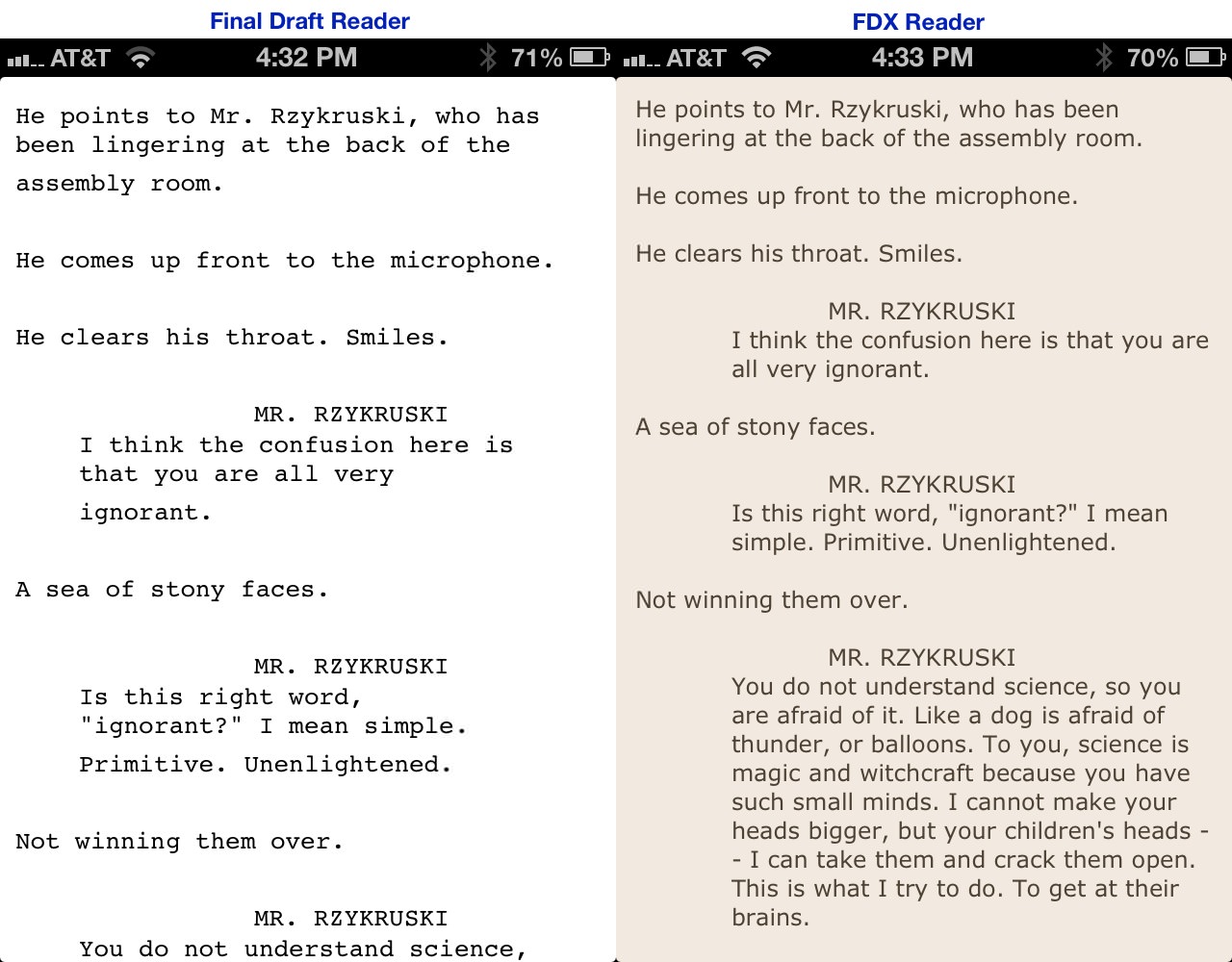
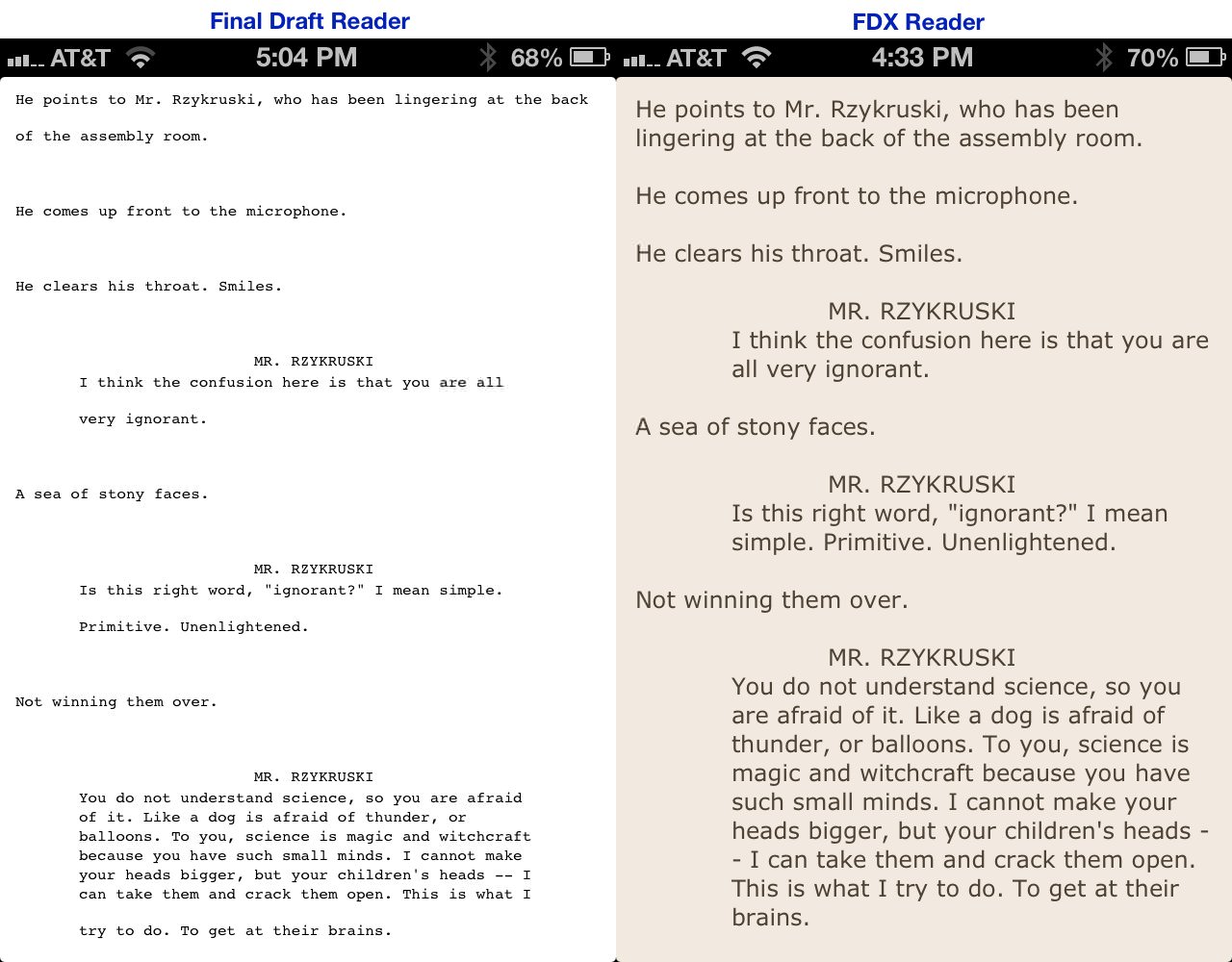
Unfortunately, you’re going to be scrolling a lot with Final Draft’s version, because they insist on using traditional Courier. It’s a mistake. You simply can’t fit very much on the screen using that font.

Compare [two screenshots](http://johnaugust.com/Assets/fd-v-fdx-72.jpg) from Frankenweenie:

iphone screenshots

Like FDX Reader, Final Draft Reader allows you to reduce the font size. By doing so, you can fit the same amount of Frankenweenie on the screen. But you probably wouldn’t like the [results](http://johnaugust.com/Assets/smaller-fd.jpg):

smaller final draft screenshot

Final Draft Reader isn’t trying to match printed pages like it does in portrait view on the iPad, so there’s simply no good argument for sticking with Courier for this “Reader View.” It’s just bad design.

Being an official product, the app provides “100% accurate Final Draft pagination, formatting and page breaking.” That’s like saying only Coca-Cola can provide pure Coke flavor, but fine.

Their app can do several things FDX Reader doesn’t even attempt, such as editing ScriptNotes and showing colored page revisions. You can link to your Dropbox account, but only for exporting files *from* the app, so it’s not particularly useful. That’s consistent with a lot of what I found: placeholders and possibilities rather than actual utility.

Final Draft Reader is now free. That makes sense; they want users to pay for the $50 Final Draft Writer app.

We’ll keep selling and supporting FDX Reader as an alternative, but as I wrote [back in February](http://johnaugust.com/2012/pricing-fdx-reader), we’re not actively developing it anymore. Our next projects include more ambitious efforts like [Highland](http://quoteunquoteapps.com/highland/).

« Previous Page
Next Page »

Primary Sidebar

Newsletter

Inneresting Logo A Quote-Unquote Newsletter about Writing
Read Now

Explore

Projects

  • Aladdin (1)
  • Arlo Finch (27)
  • Big Fish (88)
  • Birdigo (2)
  • Charlie (39)
  • Charlie's Angels (16)
  • Chosen (2)
  • Corpse Bride (9)
  • Dead Projects (18)
  • Frankenweenie (10)
  • Go (29)
  • Karateka (4)
  • Monsterpocalypse (3)
  • One Hit Kill (6)
  • Ops (6)
  • Preacher (2)
  • Prince of Persia (13)
  • Shazam (6)
  • Snake People (6)
  • Tarzan (5)
  • The Nines (118)
  • The Remnants (12)
  • The Variant (22)

Apps

  • Bronson (14)
  • FDX Reader (11)
  • Fountain (32)
  • Highland (75)
  • Less IMDb (4)
  • Weekend Read (64)

Recommended Reading

  • First Person (87)
  • Geek Alert (151)
  • WGA (162)
  • Workspace (19)

Screenwriting Q&A

  • Adaptation (65)
  • Directors (90)
  • Education (49)
  • Film Industry (489)
  • Formatting (128)
  • Genres (89)
  • Glossary (6)
  • Pitches (29)
  • Producers (59)
  • Psych 101 (118)
  • Rights and Copyright (96)
  • So-Called Experts (47)
  • Story and Plot (170)
  • Television (165)
  • Treatments (21)
  • Words on the page (237)
  • Writing Process (177)

More screenwriting Q&A at screenwriting.io

© 2026 John August — All Rights Reserved.