• Skip to primary navigation
  • Skip to main content
  • Skip to primary sidebar

John August

  • Arlo Finch
  • Scriptnotes
  • Library
  • Store
  • About

Archives for 2013

Scriptnotes, Ep 74: Three-Hole Punchdrunk — Transcript

February 1, 2013 Scriptnotes Transcript

The original post for this episode can be found [here](http://johnaugust.com/2013/three-hole-punchdrunk).

**John August:** Hello and welcome. My name is John August.

**Craig Mazin:** My name is Craig Mazin.

**John:** And this is Episode 74 of Scriptnotes, a podcast about screenwriting and things that are interesting to screenwriters.

Craig, I hope you have Diet Dr. Pepper in hand, because we have a very busy show this week.

**Craig:** I’m opting for Diet Coke.

**John:** [gasps]

**Craig:** I feel like that gives me a little extra boost.

**John:** Well, you may need it, because we have five main topics today.

**Craig:** Oh god. Oh, god!

**John:** Can you handle it?

**Craig:** Yes! [laughs]

**John:** We’ll go through some feedback on the Raiders episode we did last week.

**Craig:** Great.

**John:** We’ll segue to the results of the listener survey that we put up. And we had a bunch of people who wrote into that, so we want to get to some of the responses.

There’s a new report that just came out this last week that tallies up all the spec sales and pitches from 2012, which is kind of crazy that someone did that, but good for them.

I want to talk to you about a brand new type face called Courier Prime.

**Craig:** Exciting.

**John:** And we have three listener questions.

**Craig:** Great. That is a full docket. Let’s get to it.

**John:** Let’s get right to it. Well, let’s start with Raiders. So, last week we did a special episode which was just about Raiders of the Lost Ark. And it was just sort of a trial run, like what would it be like if we just talked about one movie the whole time. And people seemed to really dig it. I got a lot of good response on Twitter about that.

**Craig:** Yeah. I saw a lot of it. And I think my favorite comment was somebody was like, “Oh god, they’re just going to talk about a movie the whole time and it’s Raiders, and everybody has seen Raiders so who cares?” But they were like, “No, actually, it was really good.” [laughs] So, that was great to hear.

And I love talking about Raiders. I wish every podcast were about Raiders.

**John:** Yeah. Some podcasts should probably be just about Raiders. I’m sure there actually is a Raiders podcast. And we’ll find it and Stuart will link to it. But, what I really liked is people would write in with their theories about sweater guy. And sweater guy is the guy who puts the apple on the desk as he’s leaving, and they’re like, what is his deal, is he gay, what is it?

And so my favorite response was from Christopher Wilson who tweeted, “Raiders sweater guy has written ‘I love you’ on the apple, which Brody then reads and wipes off on his sleeve before pocketing it.”

**Craig:** Hmm. Interesting. Interesting. It’s not true…

**John:** Nope.

**Craig:** …but I wish it were.

**John:** That would be fantastic if it were. And I think in the ret-con version, I think if we were to go back and sort of redo it or see Indiana Jones from sweater vest guy’s perspective, that would be a very good explanation. The Rosencrantz and Guildenstern version of Raiders of the Lost Ark, that would be a feature film.

**Craig:** And what happened the days leading up to the apple incident. How he dealt with the aftermath of the apple incident.

The other thing that someone tweeted which I really liked, and I had never noticed it, and it’s funny how you just don’t see the things — and no matter how many times you’ve seen a movie you just miss these things. The famous shot of Indiana Jones going under the — in the beginning, when that wall is closing down on him and he rolls under it at the last second, then reaches back, grabs his hat, and then goes through again, the hat is actually dropped from above.

**John:** Yeah.

**Craig:** And somebody put a GIF on there and you can just watch it over and over. And once you see it, you cannot unsee it. [laughs]

**John:** [laughs] Just ruined it.

**Craig:** I mean, everybody knows the shot of the snake that’s reflected in the protective glass between Indiana Jones and the snake. Everybody knows that goof. But that hat, how did I miss that? Incredible. Just incredible.

**John:** Sleight of hand. The GIF has ruined it for you. Or the “JIF.” And I guess you can pronounce it either way.

**Craig:** I say “GIF,” because it’s graphic interchange format, so it should be “GIF.”

**John:** I agree with you, but apparently the people who make it say it’s “JIF.” We’ll never resolve that issue as we will never resolve many sort of big, important movie issues.

**Craig:** I disagree with you; I think we just resolved it. And it’s “GIF.” [laughs]

**John:** So, one of the other things that happened on Twitter is I asked, well, if we were to do another one of these movie-centered episodes, what movie should we do? And, of course, a lot of people wrote in with responses.

It was interesting, a lot of people wrote in with like, “Do North by Northwest.” “Do Casablanca.”

**Craig:** Oh, come on.

**John:** And I say, “Oh, come on,” because realistically those are fantastic movies, but no one is going to be writing those movies now. I don’t think it’s actually a helpful exercise. And that’s why I get so frustrated when I see those brought up in, like, How to Write a Screenplay books, because those aren’t movies that people actually get made.

So, I think if we are to do another one of these in the future, and I think we should, it should be a more modern movie that reflects the kinds of movies that listeners are actually making these days.

**Craig:** Yeah. Plus, also, if you want to read insight or analysis of Casablanca, go pick up every single book on film ever written. It’s been done. We get it. There’s nothing left to say about those movies.

It’s far more interesting, I think, to hear an analysis of a film that perhaps academics don’t think is worthy of analysis or isn’t sufficient for analysis, but we who write movies for large mass audiences do think is valuable for analysis. Why would we ever, ever waste our time analyzing North by Northwest? What else is there to say?

**John:** Yeah, instead of Casablanca, I think it should be Caddyshack.

**Craig:** By the way, it would great to have fun with… — I mean, the thing is Caddyshack is actually really hard to analyze because the story is all over the place. I mean, for instance, if it were me, if I got to pick the next one, Groundhog Day. That would be fun to go through.

**John:** That is a great one. But Groundhog Day is done a lot, though. There’s a whole book on sort of — there’s a lot of stuff written about how Groundhog Day was made. That doesn’t mean it’s not a great movie and you can learn a lot from it. It’s a high concept comedy. That’s a good choice; you’re right.

I was going to — if we we’re going for comedy — I was going to go for Clueless which is just a brilliant movie. Or Animal House.

**Craig:** Yeah, I mean, there are so many that we could talk about. But, what we should never do is analyze the same old movies that everybody else analyzes, for all of the reasons that you’ve mentioned, and all the reasons I’ve mentioned. So, there — there is your dose of umbrage for the day. Come on!

**John:** Now, one of the readers also sent through this script page which is apparently from Harrison Ford’s actual script from Raiders of the Lost Ark. And I guess the backstory is that at some point this original script was up for auction, and so online there were scans of some pages, or photos of some pages. Now, I haven’t found a link yet from some other site that has it, because I kind of want to post it up ourselves, something that’s not really supposed to be out there in the world. But this page was really interesting, and what I liked about it was it was actually a page that we talked about in the podcast.

This is the moment where Indiana Jones is talking to the two Army guys and they’re in the big lecture hall. So, I want to read a little of what’s actually written in the script and then we can talk about some of the notes that Harrison Ford has scribbled on the script which I think are important as well. So, this is page 18, at least what I’m reading.

“…through rings in the corner of the Ark. The painting is…” So, he must be talking about the book. Basically the book has been flipped open and you see the Ark and the painting of the Ark. “The painting is very dramatic, full of smoke, tumult and sinewy dying men. But the most astonishing thing in the picture is the brilliant jet of white light and flame issuing from the wings of the angels. It pierces deep into the ranks of the retreating enemy, wrecking devastation and terror.”

So, it’s a very kind of literary block of scene description there, but it really gives you a very good sense of what that drawing is ultimately going to be in the book, and why the other characters are responding to it in that way.

This is the section where Indiana Jones says, “Lightning…fire…the power of God.” What I like about the handwritten notes in this is it says, “Imp,” which I think means important, and the question is, “Is Indy a believer?”

**Craig:** Oh! There we go!

**John:** “Where in bible?” And it’s scratching out some lines and it’s suggesting alts for things. And it’s just fascinating to look at while they were making the movie, these are the kind of questions that do come up on set. And as you’re on set working on Hangover II, or Hangover III, that kind of stuff does come up and that’s why it’s so valuable to have you as the writer on set is that you can say like, “Why am I doing this right here? What if I did this thing? What’s important about this scene?”

Even as you’re making a movie you’re asking these questions, and sometimes those questions get reflected in the text of the scene you’re shooting probably that day.

**Craig:** Well, yeah, and first of all the question that he asks, “Is Indy a believer?” goes right to the heart of what you and I were talking about last week. That is the core of the movie. And the answer to that question, for me at least in that point in the movie is, no, he’s not, but he will be.

And it’s interesting that… — If you want to be a screenwriter, this is the way you have to think about movies. It is quite likely that no one sitting in the movie theater, save for a very select few people, ever watched Indiana Jones and thought this is a movie about faith, and belief, and this is a movie about one man’s journey from skepticism and scientificism to religiosity or spirituality.

But that’s what it is. For the actor who has to play the part, he must understand in those moments why he’s saying the things he’s saying, or else it just will be bad acting. And no matter what the movie is, actors need to understand what they’re saying and why they’re seeing it in the moment.

And because they are performing the character, inevitably they’re going to come to a line that is not consistent with the way they’ve been performing everything else. And in those moments, those lines get tested by everybody before you shoot, you know, on the day. “Why am I saying this? It doesn’t feel right.”

And when you’re a screenwriter on set, the last thing you can say is, “Well, I don’t care how it feels. That’s what I wrote. I believe it’s right. Just do it.” You’ll get a terrible line reading, or you’ll get an angry actor. Either way, it’s not productive. So, the question you have to ask yourself is: Is this person correct? Is the line reading incorrect for…is it inconsistent with the character I intend? Or, is the line inconsistent with the character that I intended as currently being portrayed by this actor? Or, is the actor just wrong?

And if the actor is wrong, part of our job is to explain our intention and see if they agree. Sometimes it’s that no one is wrong. It’s just that this other person is a human being and they need to make it feel real. And if it’s not real to them, you have to rewrite it so that it is real to them. Otherwise it’s going to stink.

So, for instance, at the bottom of the page, why don’t you read what it says there.

**John:** “Indy goes and shuts window, lost in thought.” That part? Or, the “Oh, please.”

**Craig:** Yes. Exactly. [laughs] So, what Indiana Jones as scripted is supposed to say…

**John:** “Most certainly.”

**Craig:** …in response to the CIA guy. And Harrison Ford wrote next to that, “Oh, please,” because in his mind he’s like, “That’s not how Indiana Jones is going to talk. That’s not consistent with the character that I’m building in my mind. That’s not going to be consistent with my performance.”

Now, sometimes as screenwriters this hurts. You’re Larry Kasdan. You’re an amazing writer, and here’s a guy going, “Oh, please,” in response to some line you’ve written. But, by the same token, it’s an emotional response, and it’s just as emotional for them as it is for us when somebody suggests a line to us and we think in our minds, “Oh, please. That’s ridiculous.”

But, you have to be able to trust the people you’re with and even give them room to be a little brusque, because everybody… — The thing that scares us the most — and “us” includes writers, directors, and actors — is being embarrassed by the totally wrong thing. And that fear oftentimes comes out in a bit of a harsh way.

**John:** That’s true. What I’ll go back to with actors needing to change things on set is the challenge as a writer, and a director, and a producer, when you have actors who are trying to change lines is the actors are sometimes not aware, or sometimes they are aware but they’re being sort of deliberately blind to the fact that if they change their lines then all of the other lines change, too.

And that can be a very difficult situation on sets where writers just have to sort of negotiate between these actors who are starting to change their lines and suddenly it becomes a less-than-happy situation.

**Craig:** Yeah.

**John:** On good sets, with good actors, it’s a delight. And everyone is finding the exact right moments and they’re handing lines to other actors because they’re like, “I don’t need to say this, you can say this instead,” and everything is happy and joyful.

Sometimes it’s not that situation.

**Craig:** That’s right. And what you’re looking for, hopefully, in your creative partners and the main cast certainly fits that bill, you’re looking for people who act in good faith. We don’t always agree about things, but everybody should be working towards the notion that they want the movie to be good.

There are times when actors, and writers, and directors, behave badly. And they put their ego first, or considerations that have nothing to do with the movie first. And when those things happen they are toxic and they often ruin movies.

And they are scary. I mean, we’ve all — anybody who makes movies has been through those situations and they’re very, very difficult. Very difficult. I would so much rather have an incredibly, physically arduous shoot of difficult material with people that are working together than an easy, slam-dunk, walk-in-the-park movie production where the two main actors don’t see eye-to-eye about what the movie is supposed to be, who the star is, who the hero is.

I mean, I’ve sat in rooms with actors while they explain to me what their vision for the character was, and I thought in my head, “Oh no! They think they’re the protagonist. OH NO! What do I do now?” That’s a rough one.

**John:** Luckily in this situation we have Harrison Ford who is playing Indiana Jones. He is clearly the hero of the movie. And he seems to be making the right choices and asking the right questions. So, maybe it’s just one more sign of how Raiders of the Lost Ark became so good.

**Craig:** Yeah. And you can even see on that page that he circles a big chunk of dialogue and gives it to Denholm Elliott.

**John:** Yeah. Nice of him to do.

**Craig:** Yup.

**John:** All right. Topic two. Two weeks ago on the podcast we asked, “Hey, we are trying to do a survey of who our listeners are and figure out what is interesting to them about the podcast, what we could be doing better, where these people live.” We asked like eight questions and so many people wrote in with responses.

As we’re recording this show we have 1,811 responses, which is nuts. So, thank you so much to everybody who chimed in and gave us their opinion. If you still want to do it, the survey form is still up there. It’s johnaugust.com/survey. And you can weigh in with your thoughts, and there is also a free response section.

But I thought we’d run through some of the stats. There will also be a link to the PDF that shows all the stats at johnaugust.com.

Geography: This was different than I would have guessed. So, we asked, “Where do you live?” And 30% roughly of our listeners live in Los Angeles, which is understandable because that’s where a lot of movies are made. Somewhere outside of Los Angeles but still in the US is 46%. The UK is 9%. And somewhere else in the world is 16%.

**Craig:** That’s still pretty high though, right?

**John:** It is high. But I would have guessed the somewhere-else-in-the-world would have been higher than that. That’s just based on the questions that actually come into the podcast are, I would say, almost 50% sort of international readers. So, I was surprised that we are still so North American centric.

**Craig:** Well, maybe it is that for those people who live elsewhere we are the most convenient place to ask questions.

**John:** That’s a very good point. See, you’re providing answers. I like that, Craig.

**Craig:** Yeah, you know, I’m here for solutions.

**John:** Most of our listeners listen every week. 72% said they listen every week.

**Craig:** That’s gratifying.

**John:** That’s so gratifying. So, I wondered whether people were cherry picking based on the kinds of things we talk about, but it sounds like most people really do listen every week. And most of our listeners have been listening since the beginning, or nearly the beginning. 62% said they’ve been listening right from the start, which is great.

**Craig:** That is good.

**John:** At least 62% of the people who filled out this survey, I should say. There could be a selection bias there because it’s our really dedicated listeners were the people who filled out the survey, but still, that’s awesome.

This was surprising to me. “Do you currently make your living in film or television?” 32%, yes.

**Craig:** Now, I am surprised that that’s actually that high. Are you surprised that it’s that high or that low?

**John:** I am surprised it’s that high.

**Craig:** Yeah. Me too. And it’s cool. I mean, look, you know, sometimes we talk about stuff that really is only applicable to people that make their living in film and television. And I think, “Oh, what are we doing if only 4% of people listening actually care?” So, it was very cool to see that the number was as high as a third.

And, you know, the great majority of the rest want to work in the business.

**John:** Yes. 57% want to work in film or television. I guess, keep in mind that the “yes”s in that 32%, those could also be people who are working as assistants at places, who are working in those very entry-level jobs, which is great too. So they can also be people who are still aspiring screenwriters, but they are currently working at least in some aspect of the industry.

**Craig:** You’re right. Yes, you’re right. We may have a lot of assistants there, but they count.

**John:** Assistants count. Assistants are awesome.

Next question was, “How do you listen to the show?” 23% of listeners listen directly on johnaugust.com. That is, they go to the blog, they press play there, and listen to it playing in the browser. 16% listen to it just directly on iTunes. 47%, so almost half of the people, are listening to it on the iPhone or i-gizmo. Android, only 5%.

**Craig:** Yeah, well, you know, because Android stinks. And I like to think that the people that listen to us are cool and understand that things that are technological and aesthetic rip-offs should not be rewarded. [laughs]

**John:** See, what’s so unfair, Craig, is that I’m the one who actually has to check the email account, so when people write their angry things I’m the person who sees all those. Actually, well, Stuart sees them. Eh, Stuart can deal with it.

**Craig:** You know what, Stuart? Enjoy. Enjoy the avalanche from the 5% on their goofy Android devices.

**John:** They’re a very loud 5%. I will say that your Twitter handle is @clmazin, so if Android users want to talk to you about Android usage they can do that right there.

**Craig:** Yeah, bring the noise from your little pieces of plastic. Go ahead.

**John:** This was also important and surprising to us is that 35% of people do read the show’s transcripts, or at least sometimes read the show’s transcripts. So, every episode of the show has a transcript where Stuart and other folks have actually typed out everything we’ve said — god bless them.

And so we were wondering, “Well, is that good? Is that useful? Are people finding it helpful?” And people are apparently finding it helpful. So, if you don’t look at the transcripts, here’s what I can tell you: Every Tuesday we come out with an episode. Usually by Thursday, sometimes by Friday we have the transcript ready and up. That transcript shows up as a link at the bottom of the post, the original post on johnaugust.com.

You click through that link and it shows up as a special post that has all the text. And so if you are someplace where you can’t listen to the podcast but you want to read up on it, that’s an opportunity.

**Craig:** By the way, how do you listen to the show?

**John:** I listen to it on my iPhone with Instacast, which I think is the best podcasting app for the iPhone.

**Craig:** Interesting. I’m one of the 23% that listens to it directly on johnaugust.com, although I’m also one of the 35% that sometimes just reads the transcripts.

**John:** Ah. And how do you find the transcripts, because I honestly don’t read them. I just don’t have the time in the day to actually look through. Stuart sort of proofs them. Do you find them largely accurate?

**Craig:** Yeah. For sure. I mean, occasionally you see some slightly goofy typo or something in there, but by and large they’re very accurate. And I have to say the two of us come off so well in transcript form.

**John:** Ha! [laughs]

**Craig:** There’s something about the text that strips away all the goofiness. And I will also say you and I have a tendency to speak in complete sentences, which isn’t something you always see, or hear.

**John:** I want to answer in a complete sentence somehow because you just said that.

**Craig:** And you just did.

**John:** I did. Thank goodness.

Next question was about the Three Page Challenge, because I was curious whether people like it, don’t like it so much, they get sick of it. We try to space them out. We try to never do two Three Page Challenges week after week, because that’s just a lot we know. And some people don’t want to be able to do it.

But 35% of people say they love it, so that’s great. And 60%…58% of people say it’s just fine at the current levels, so don’t do it any more, don’t do it any less. And so we will keep doing them, but I think we will keep spacing them out; so, we don’t want to do it every week.

Some people had suggested like, “Oh, maybe just do one at the end of every show.” That doesn’t feel right either. I think we will keep them as sort of blocks, and some weeks we’ll have some of them, and most weeks won’t.

**Craig:** Sounds good to me.

**John:** People have asked for more guests. Well, you’re in for a treat because we are going to have more guests coming in soon, as soon as next week in fact.

**Craig:** Yeah.

**John:** This was an interesting question we had to do a little more digging on. So, we asked, “If we were to do another live session like the one we did in Austin, would you come?” And 54% of people said probably not. But then when you actually looked through the responses of people who live in Los Angeles, a ton of people would. So, it sounds like we could probably schedule one of these for Los Angeles, and we should try to do that at some point.

**Craig:** Yeah. That would be fun to do. It would be nice to meet the Scriptnotes Army. Should we have some…you know, like Lady Gaga has her Little Monsters and stuff, shouldn’t we have some sort of name for the people who listen to us, other than nerds, you know, ScriptNerds.

**John:** ScriptNerds, yeah. We could also probably have tee-shirts. I’ll talk to Ryan about tee-shirts, because tee-shirts are awesome.

**Craig:** Sell tee-shirts like we’re at a concert. I like it.

**John:** I like it. We need a big tee-shirt cannon to shoot it to the back rows.

**Craig:** That’s the vibe we’re going for!

**John:** Totally. It’s a party vibe. And finally we asked about how old people were. And our audience is largely, like 47% is between 25 and 35. 38% is over 35. So, we don’t have a lot of teenagers, which is great.

**Craig:** Yeah. Because, frankly, teenagers are annoying and stupid.

**John:** Yeah. That’s @clmazin on Twitter.

**Craig:** [laughs] Yeah. All these teenagers with their Android devices. We don’t need you. Keep not listening. Don’t want you.

**John:** Now, we also had a section for sort of free comments, where people could write in and say whatever they wanted to say about anything. And so the most common thing filled in the little box was “Thank you.” It’s like, “Oh, how lovely!” People are so nice.

There were a couple of comments that sort of came at both sides a lot, so, more umbrage/less umbrage. I think we have plenty of umbrage.

**Craig:** [laughs] The great thing about umbrage is I just don’t care. I think the only way to have gotten more umbrage out of me is if 98% of people had said less umbrage.

**John:** Yeah, some common comments, I had Stuart sort of go through, because there were so many to look for. So I asked Stuart to sort of find common themes and threads. So, here’s his sort of sampler platter:

He said that some folks say we’re too kind. We shouldn’t be afraid to disagree with each other or say when we don’t like something. I think I speak up when I don’t agree with you.

**Craig:** Yeah. For sure. I’m pretty sure that you hate my guts. I’m not sure what they’re talking about. I mean, sometimes they may think that we are over-agreeing with each other on these Three Page Challenges, but I think that’s only because usually there’s a right answer to those Three Page Challenges. Usually they are good or they are bad. I mean, we both do the same job. We’ve both been doing it for awhile. There’s a reason we have a podcast together.

I mean, and you know, I like you.

**John:** Aw…Craig!

**Craig:** [laughs]

**John:** Some listeners said that they wanted to bring back comments, and that must be reflecting the blog, because I used to have comments turned on on the blog. I turned off the comments on the blog and I’m just so much happier without comments, so those aren’t coming back.

But, if you want to respond to something that happens on the podcast, send us an email ask@johnaugust.com, or just tweet us directly: @johnaugust or @clmazin.

People asked for chapter marks or section time stamps.

**Craig:** That’s a good idea.

**John:** Yeah, it’s a good idea. I did that for the flashback episode, the one where we did stuff from previous episodes. So, we’ll try to get chapter markers in, and maybe this episode will actually have some chapter markers in it.

People said that Lindsay Doran is amazing, and gosh, she really is just great.

Since the show started people say that they’ve had various things of success and they couldn’t have done it without us, which was lovely. So, thank you. If you have a success story and we’ve been helpful, a lot of you have been writing nice emails. And so thank you for that and continue to write those nice emails, because it does give us warm fuzzy feelings.

**Craig:** Yeah. And tell us your story, too. I mean, it would be cool if somebody had a success story and we actually did have some slight bit of help with it, tell us the story. We’ll read it.

**John:** Regarding the Three Page Challenge, a common comment was something like, “I don’t read along with you. Instead I read them myself and then I see if I agree with you.” That’s a great strategy. So, if you’re tuning in for a Three Page Challenge and you have the opportunity to, I might stop the podcast, print those pages, read them, and then look along with us. Because if you are just listening to what we’re going to say, by the time you read the PDFs you’re probably going to agree with us. But it’s great to sort of develop your eyes and your ears for sort of what the good and the bad things about some of these scripts are. But, looking at them yourself and then seeing if we agree with your opinions.

**Craig:** Yeah. Smart idea.

**John:** People asked for a ten-page challenge, an act one challenge, a full script challenge. That’s not going to happen.

**Craig:** No!

**John:** Sorry. That’s a terrifying amount of work.

**Craig:** Not as long as I’m on this podcast!

**John:** [laughs] People have said, “Do an episode with some of the worst Three Page Challenges submitted and why they’re bad.” And this is a misunderstanding of, I think, the point of the Three Page Challenge. And also Stuart really is picking some of the best ones. And so he’s not deliberately, like, throwing the turkeys in there. There are some really, really bad ones. And I don’t think that really helps people.

I think what probably helps people is saying like, “This is what was promising about this, and this was what didn’t work about this.” Or, “This was just so fantastic and here’s why it’s fantastic.” It’s easy to write something terrible.

**Craig:** I saw that suggestion and I have to say part of me thought it might not be a bad experiment to try, and what we’ll do is we can leave off the names of the people so it’s not so personally gross for them, but the possible value is if people are listening and they hear us say, “Okay, so let’s talk about why these are huge, fundamental mistakes,” maybe they’d think, “Oh, I’m making that mistake right now.”

So, that’s one reason that we might want to do just like a horror show Three Page Challenge one week, just to kind of talk about some of the real glaring mistakes people make.

**John:** But here’s my problem with that. Anyone who sent in that Three Page Challenge, they are a listener to the show, so of the — who knows how many listeners we have — that one person is going to tune into that episode and see us saying that this a terrible, terrible, terrible, terrible, terrible sample, and how is that person going to feel?

I just feel like there’s sort of compact of trust that has been entered into by sending it into us. I just don’t want to…

**Craig:** That’s a good point. You’re right. You’re right.

**John:** All right. I’m the nice one.

**Craig:** [laughs] So true.

**John:** People wrote in to say do a prompt-based challenge, which I think is sort of going back to — I used to do on the blog the scene challenge, where I would say, “Write me a scene that takes place in a laundromat and involves this kind of thing.” And so people would write in, in the comments, they’d write in this little scene that did that. And I would get like 200 of them. And it was exciting to do for awhile, and then it just got to be such an incredible drain.

I worry that with as many listeners as we have right now, it would just be unmanageable.

**Craig:** I don’t even like that kind of stunt writing anyway. You know, that’s like…I don’t like it. [laughs] That’s as articulate as I can be. I don’t like it.

**John:** So, we had a couple topic requests that I wanted to respond to. One topic was what to do when you first move to LA — where to live, where to get a job, how to approach your contacts out there — which I think is a really good general topic. So, we should do that sometime, sort of that first, you-just-arrived kind of thing. And that might be a good topic for a special guest, like a newer writer who is just getting started.

We had a lot of requests for certain kinds of guests, for directors, and writer-directors, and people in different things. And you’re going to see a lot more of that this year.

**Craig:** Yup.

**John:** We had a specific request to do a cross-panel with the Nerdist Writer’s Panel, and that’s something we actually talked about with Ben Blacker. And that show is great. We love them. So, if we can find something to work out this year to do with them, that would be great.

And last topic was they really want Stuart on the podcast at some point.

**Craig:** Yeah. I mean, at some point it does seem like he’s got to be on the podcast.

**John:** I just feel like Stuart is sort of our Maris from Frasier. And that if you actually reveal who she is at this point it sort of spoils everything.

**Craig:** Well, what if we just have Stuart on the way that Marcel Marceau is in Mel Brooks’ Silent Movie. You know, he was the only person that said something and he said one word or something, [laughs] and then left.

**John:** Well, here’s the thing. Stuart actually is in every podcast. He’s just downstairs, you just don’t hear him. So, he really is part of every podcast.

**Craig:** He lives and breathes through ever second of this.

**John:** Yeah.

**Craig:** Good point. Yeah, maybe, see, I’m the nice one now because I’m feeling like, “Oh, it would be nice to talk to Stuart.” But then, you know, I also feel like here’s what’s going to happen: People are going to listen to Stuart and they’re going to go, “Nah, I liked him so much better when he was a man of mystery.”

**John:** Yeah. Stuart is sort of a man of mystery, but this last weekend I went to a party at his house, and there’s a whole separate podcast which is just talking about Stuart’s crazy, insane house that was clearly built by 1980s drug dealers and is somewhere on the top of a mountain in East Los Angeles. It was just fascinating.

It was also fascinating to do some introspection on myself as a 42-year-old at a party of like young 20-somethings and what that is like.

**Craig:** Yeah, you know, you can’t go back.

**John:** No, you can’t go back. But, we can go forward. And let’s go forward to our next topic which is…

**Craig:** What a segue!

**John:** I’m just getting so much better a year into this whole podcasting thing.

A reader — thank you so much reader for sending this to me — sent this thing called the Scoggins Report. And it’s done by Jason Scoggins and Cindy Kaplan. And there will be a link to it, and there’s a PDF you can download.

But what it is is they’ve taken all the spec sales and pitch sales from the year and calculated them up by studio and by agency and sort of genre and sort of what happened over the course of the year. And god bless you for sort of quantifying this information that would otherwise go missed. They call it a “terribly unscientific analysis of Hollywood’s movie development business.” And I think that’s the way to really look at it. I wouldn’t look for the exact percentages, but you can definitely notice some trends among what’s actually selling in Hollywood.

So, you got a quick chance to look at this, but I want to highlight a few things. The top buyer of spec scripts this last year was Paramount, and spec scripts and pitches was also Paramount. So, Paramount bought 20 specs and pitches this year, tied with Universal when you factor in pitches as well. That’s a lot. And that’s compared to like the lowest of the big studios was Fox with six. So, Paramount was buying a lot more.

The agencies that sold specs, William Morris sold the most specs according to this listing. UTA, then CAA, then APA, then Paradigm.

**Craig:** Yeah. That was actually interesting to me. The studio buyers, I think, kind of wobbles up and down each year. Sometimes one is on top, sometimes the other. I mean, for instance, they called out Warner Bros. as having really reduced the amount that they bought and suddenly Paramount really increased the amount they bought. And sometimes that just has to do with their own development cycles. So, sometimes they have a development cycle where they’re like, “We’re short on original material. Let’s just buy stuff this year.”

But that means next year they won’t as much. The total number of spec sales for 2012 was 132. In 2011, it was 132. [laughs] So, there is actually incredible stability to the overall appetite for specs. I was surprised by the sellers, the piece of data you just called out there. William Morris sold 35 specs. UTA sold 24. CAA only 16. That’s a fascinating number. I suspect that part of that has to do with the fact that CAA represents a lot of writers who do a lot of assignment work. And that William Morris may be willing to take more of a flyer on writers who are younger, or breaking in, or newer, or just more oriented to selling speculative material.

That was an interesting number to me. I mean, CAA’s numbers are quite low, frankly.

**John:** Yeah.

**Craig:** And when you look at combining specs and pitches, CAA’s number comes up quite bit, but William Morris doubles — nearly doubles — to 62. So, William Morris seems to be far and away the most entrepreneurial agency when it comes to selling specs and original material.

**John:** Now, one thing to keep in mind is that it’s not always clear how they’re getting their data. Are they getting data based on what gets reported in the trades? Or are they talking to individual people at studios?

For example, Fox only listed six scripts sold, but is mine one of them? Because I have a project that’s sort of at Fox that’s, you know, it’s a spec, it’s at Fox, but it’s sort of a special/unique situation. So, am I one of those six or am I not one of those six? It’s hard to know.

**Craig:** Mm-hmm.

**John:** I guess I could probably look at the end notes and figure it out, but I’m just spitballing.

What is probably more useful for most of our readers is to take a look at spec sales by genre, because what they do is they break down into six rough categories and see what percentage of sales came from the different genres. So, the most common genre for a sale this last year was thrillers. 27% of spec sales were thrillers. 22% were action-adventure movies. 21% were comedies. 11% were science-fiction. 10% were horror. And 8% were drama.

So, that 8% drama, that feels true. Selling a drama spec is very, very tough these days. Horror and thriller, I think, kind of overlap a lot, so I’d be curious sort of where the distinction is made between those two. But, I would say those numbers feel kind of true to what gets sold, not necessarily always what gets made, but to what gets sold among specs.

**Craig:** Yeah. And one thing to remember when you’re looking at numbers like this is that the numbers are skewed somewhat by the nature of the original material versus material that’s adapted. Thrillers tend to be original because there frankly aren’t a lot of underlying properties that specifically fall into the thriller category. So, we know that when it comes to things like comedy or action-adventure or sci-fi, a lot of times there is underlying material. There’s an article, there’s a remake, there’s a sequel, whatever it is.

Thrillers, there’s not — it doesn’t seem like there’s a lot of, for whatever reason, thrillers that people are interested in adapting. Most of the stuff I see out there for adaptations are sort of in the adventure area, or sci-fi, or comedy. So, that may be part of why thrillers are so high. I mean, in short, they buy more thriller specs because they have less other avenues to generate thriller material.

**John:** Yeah. I also have to say: dramas, even though we make very few dramas over all, I would say most of the dramas we make tend to be based on books and sort of big sell, big books that sold out of New York. So, it’s not surprising that of spec script sales there aren’t going to be a lot of them.

**Craig:** Mm-hmm.

**John:** And I just did a quick check, and no, the script that I have at Fox did not show up on this thing, so there could be seven for Fox. The numbers could be off a little bit.

**Craig:** Bump Fox up to seven.

**John:** So, if you are thinking about a spec, if you are thinking about a pitch, I think it’s worth taking a look at. This is just how the movie business worked this year. I would say most writers these days are doing both film and television, so your career is not sort of pigeonholed into one or the other as much as it used to be, but useful to take a look at.

**Craig:** Yeah. And I just want to give one final caveat, because I was talking about this actually on DoneDealPro the other day in terms of specs: You could look at this report and say, “Well, if I wanted to be a spec selling machine I would have an agent at William Morris, I would have a manager at Energy,” — which is a company with which I was up until this day unfamiliar — “I would be selling that script to Paramount or Universal. And it would be a thriller.”

However, please note that Paradigm sold the fewest specs, and say Fox bought the fewest specs, and say drama represented the genre of the fewest specs, and yet they exist and sales occurred. In the end, this is interesting to look at, but honestly irrelevant to you, because if you’ve written something that you love, that’s what you write. And if you love your agent, that’s who he is. And if there’s a company that’s really into it, that’s the company.

So, don’t chase. I guess that’s my advice: Don’t chase this stuff. The best agent to sell your spec is the agent who represents the spec you’ve written who loves it. Simple as that.

**John:** I agree. I would also remind listeners that a spec script might sell, but if the spec script doesn’t sell it is a writing sample that gets you a job, and gets you hired for another bit of work. And so writing the thing that you can write the best is always going to be your best option.

**Craig:** Yeah. For sure. So don’t chase.

**John:** Don’t chase.

Topic four. I think we’re at four. Maybe it’s five. Our next topic is type faces. And so, Craig, I think we may have talked about this on the podcast before. In my career and life before I became a screenwriter I was actually a graphic designer. And so I was the kid who walked around campus with the box of fonts. I had like the 3.5-inch floppies. It was full of fonts. And back in those days you had your bitmap fonts and you had your laser writer fonts. And I was the one who had sort of the alternate versions of things.

I was a big font nerd. And then I entered into a career in which my entire output is 12-point Courier, which is just…I don’t know if you can really say it’s irony, but it’s just sort of sad. It’s just sort of sad that I love fonts so much and most of my work was coming out in a really not-attractive Courier face. To the degree that when I bought my first laser printer, which was back when I was at USC, I hated the Courier that was in it so much because it was super really thin Courier, that I actually had this utility that pulled the outlines out of the printer and I used Fontographer to make myself my own Courier, which I called Dorphic. And my first scripts are printed in Dorphic.

So, if you actually look at my original things, like Here and Now, they’re printed in a face that basically looked like Courier, but it’s a little bit jagged, it’s a little bit off, and it’s Dorphic. And that was like my own little type face.

And so I used that for several years and then eventually Courier started looking better. I liked the standard Mac Courier. It was fine. And for awhile I was just satisfied with that. But now I’m not really satisfied. So, a couple months ago a very talented font designer named Alan Dauge-Greene wrote to me. He said, like, “Hey, would you ever be interested in doing a custom font for any of your app stuff?”

I said, “You know what I really want? What I want more than anything else? I want a much better version of Courier.” And so I’m so excited because now it exits. We made a type face called Courier Prime. And I had just sent you the webpage that sort of announces it, so you’ve had a chance to take a look at that.

**Craig:** I have. And John, how much is this new Courier type face going to cost me, the consumer?

**John:** Would you believe that it will cost you absolutely nothing?

**Craig:** What?! [laughs]

**John:** It’s completely free.

**Craig:** I mean, how cool are you guys? It is a really nice looking, I mean, I also — it drives me nuts. And I hate Courier. Courier is aggressively ugly. It is a pointless tradition as far as I’m concerned. I would love for you and your elves to figure out how we can get a fixed width font that looks cool and doesn’t look like butt, which is what Courier looks like. But while we’re all stuck with Courier, it is a much nicer Courier.

And the Courier marketplace is getting really confused, because when I started writing screenplays it was just Courier. And then there was Courier New. And there was Final Draft Courier. And there was Movie Magic Courier. And there are all different Couriers. And I never understood what’s the difference between all of these.

And they didn’t always match up right, you know, like suddenly if you changed Courier and then you moved to another program you get pages moving up and down. So, this sounds like a great universal solution to all of that.

Your Courier is cool. I already have it installed on my computer and I think it looks great. But can’t you just make a better one? Like a better font?

**John:** So, here’s the thing: I think Courier gets knocked because it so often is so incredibly ugly. And it was designed for an age of typewriters. And it is a mono-space font. Mono-space fonts have great qualities to them that things will always line up and every character can actually fit the same space. But they have some drawbacks.

They tend to be not as readable because your eye likes to see some differences between letter widths, and there’s not a lot of color on the page.

I think Courier for — first off, if you have Courier New installed anywhere on our computer, just get rid of it. It’s just the worst the worst face ever.

**Craig:** So bad.

**John:** Just the worst. A couple sort of unique challenges for any type face that is designed for screenwriters, and Courier Prime is specially designed for screenwriting. So, you could use it for coding. You could use it for a letter you’re sending to your grandma. But the reason why we did it for screenwriting is if you actually look at page of a screenplay, there’s actually not a lot of text on the page. There’s a lot of white space.

And so most Couriers look kind of thin and the page looks kind of — doesn’t have a lot of good color to it. You want something a little bit bolder. So, we were able to beef it up just a little bit more than you would normally see for a Courier. The letters are just a tiny bit fatter. The other thing we could take advantage of is like resolution of not just printers, but also your screen has increased as well. So, we’re able to open up the space inside letters a little bit more, and it just gives a little bit more — I don’t know — it helps the readability and it makes it look a little bit nicer and more inviting on the page.

The other thing we did, which I’m surprised that more Couriers haven’t done along the way, is right now Courier, basic Mac Courier and Courier Final Draft, for their italics they just slant the letters. What we did is we created a true italic where the font actually looks better and different when you go into italics.

**Craig:** I know. It’s cool. I like that a lot.

**John:** So, the lower case “f” is sort of the classic example of this, is that it really sort of leans forward in a kind of scripty sort of way. And yet everything matches fine. So, we had to pick metrics so that things wouldn’t break and that you could feel safe swapping it. So, we matched the metrics of Courier Final Draft. It just looks a lot better.

**Craig:** Yeah. Good job. I mean, and what a lovely service for you to provide to the screenwriting community. I hope it is wholeheartedly adapted by many.

**John:** Thanks. Cool. And so if you go to Apps, there is a link there for Courier Prime. It’s free to download. You can install it on Mac or on PC. If you’re installing it on Windows, it works great. If you’re using it with Windows Final Draft, there are some special warnings because Final Draft does crazy things, because Final Draft has to do crazy things. So, there are some special caveats for you there. But, you’re free to use it in any way you want to do it. And we have it on a very open license, so if you are an app developer who wants to use it inside your app, you can do that with immunity.

**Craig:** Cool.

**John:** Cool.

Lastly, we’re getting into some questions. First question comes from April in Ohio. She writes, “A few months ago a friend of a friend of a friend said he would help me make some industry contacts, but I would have to contact them through Facebook. Their friend followed through and I’m currently Facebook ‘friends’ with several people working in the industry. Most of them are mainly actors, but a few work in other areas as well. I haven’t had any ‘conversations’ with these contacts via Facebook because I’m not really sure how to approach them. What’s the proper etiquette to reach out to somebody through social media?”

**Craig:** Oh, I mean, you know, you just send them a message and just say, “Hi, my name is so-and-so. I’m a friend of so-and-sos. I’m sorry to bother you.” You know, just be very humble and polite. And just ask your question and don’t expect an answer. And if you get one, you know, respond politely. Don’t stalk. Don’t be a weirdo. You know, the usual stuff.

**John:** Yeah, that’s exactly my approach. And I’m barely on Facebook. I don’t sort of accept friend requests from people on Facebook, but I’m very much on Twitter. And so sometimes people will send me something on Twitter and if I’m in the right mood for it, and it strikes me right, I might watch their little movie on Vimeo or read their blog post. That kind of stuff is fine as long as you feel like you’re just being, you know, appropriately respectful to what the relationship is, then it’s great.

So, I wouldn’t be afraid of doing it with those people. If they are, you know, friends of friends of friends, and they’re some actor who like occasionally works on a TV show, it’s unlikely that that person is going to be a huge asset to you as an aspiring screenwriter, but that doesn’t mean that you can’t like their video when they show up in something, or just participate a little bit in their online life.

**Craig:** Yeah. You know, the Twitter thing is great because everybody is forced to write as concisely as possible, so you’re never stuck with these long screeds. I mean, if you send somebody this long thing they’re just not going to read it.

And the other thing is, I want people to understand that this is not about ego or we think we’re so cool we don’t have to respond. You cannot imagine the asynchronous aspect of people who want to send material and talk to people who are in the business and the available amount of time we have to do that. And frankly the available amount of will we have to do that.

I mean, we’re reading and talking about movies all day long. It’s our jobs. And then we go home and all we want to do sometimes is watch TV, or talk to our children, or take a nap, or just play a game, you know. And so at some point, it’s unfortunate, you start to get forced into being rude. Not overtly rude, but rude in the sense that sometimes I just don’t answer people because I just don’t have time or the will. I’m sorry.

**John:** Yeah.

Next question comes from Pat in Stamford, Connecticut. She or he…we’re going to say it’s a he. “I reached the point where I occasionally have to send out physical scripts, not just PDFs over email. The only hole-punchers I can find that would cut through an entire screenplay range from $180 to $300 and up. This seems far too expensive for something I will only use a few times a year. Is there another possibility I’m simply missing? Is there a model you recommend?”

**Craig:** [laughs] This can’t be real.

**John:** No. It’s completely real. “I feel slightly foolish asking, but somehow I don’t want to make sure I miss something somehow.”

**Craig:** He definitely missed something.

**John:** No, but here’s the thing Craig. I actually have two really good answers for this, and this is why I picked this question.

**Craig:** This can’t be real! [laughs] It’s just impossible.

**John:** No. It’s going to be great. I have three good answers. While you’re laughing I have three good answers.

**Craig:** Okay, good. Give them.

**John:** First off, the simple solution by far is if you go to Staples just get the three-hole punch paper.

**Craig:** Yeah!

**John:** Get that. That’s by far the easiest solution.

**Craig:** They did it for you!

**John:** They did. They already drilled the holes for you. It’s perfect and it works great. And honestly, you can kind of leave it in your printer most of the time because most of the stuff you’re printing out, eh, it’s still on three-hole paper, who cares.

So, first choice: Three-hole paper.

Second choice: This is something I actually found out about through Big Fish is there will be times where you have to do like colored revisions or you have to do something and you just can’t find the three-hole paper that’s already been drilled. They make a really big punch that can actually punch up to 130 pages at a time. The one that we ended up getting is a Stanley Bostich 3200 Heavy Duty Hole Punch.

This thing is actually kind of terrifying. You have to lean on it with your entire body weight, but it does punch through all of those pages at once. And if you had to do it for a bunch of scripts, that would be a solution. But, really, you’re going to use the pre-drilled white paper if you can possibly be on white paper. It’s really only if you’re going to do it on colored paper, something that you can’t find pre-drilled that it makes sense.

**Craig:** I just can’t believe that this person was not aware that they manufacturer three-hole punch paper. I can’t believe it. I can’t believe that they knew enough about computers to send us this question, but not enough to Google “three-hole punch paper.” I can’t believe it. It’s a setup. It’s not real. This can’t be real.

**John:** I think it’s absolutely completely true.

**Craig:** Good god.

**John:** My last solution for you is this: You know, you don’t have to punch through the whole thing at once. You can just take ten pages, punch them, take ten pages, punch them. That’s what honestly you had to do back in the day.

**Craig:** That’s what I used to do, but you missed a fourth option which I have done which is you take your screenplay, and this is an extreme — when you don’t have the three-hole punch paper and you don’t have a hole puncher or anything — you take the script and you put it vertically like on a music stand or something. And you get your rifle.

**John:** Yeah.

**Craig:** You’re going to want to use a high caliber, but not hollow point or anything. You want to make sure that there’s no spread on the slug when it impacts the script. And naturally a laser site is really helpful here. And you’re going to fire three times. And, you know, for typical brads I think you’re going to want to maybe do, like 22 sometimes is just not big enough. Try a slightly higher caliber. Avoid ammunition manufactured in the Middle East or China. It’s just not reliable.

**John:** So, what I would say: make sure you really aim right, because there’s nothing more embarrassing when you’re just a little bit off and like, oh my god, it won’t actually fit in. And then you have to make a second hole right next to it. And that’s a tough shot, too.

**Craig:** Yeah. And everybody knows what happened. And, of course, we would be remiss if we didn’t make sure if you do have a friend or assistant that’s helping you with this that they are not behind the script when you do discharge your weapon.

**John:** If they’re holding the script in the music stand, then you can sort of crouch down behind the music stand, not right in the line of fire.

**Craig:** I mean, listen. I’ve done that in a pinch. Don’t be like me. Don’t be stupid. I mean, I got lucky, but don’t do that.

**John:** You never know what’s going to happen. I would also say they do make the very powerful green lasers which are somewhat controlled, like you’re not supposed to shine them at an aircraft, because they could blind a pilot. But, when you’re not blinding a pilot with them you can use them to burn holes through the paper.

And so, again, the challenge may be that it’s a white paper, so you may need to find some sort of solution to actually make the paper dark enough so that the laser light will burn through it. But I can imagine you can build some sort of, like, sled, possibly out of Lego, that could slide in the right ways and so it could burn through a hole. And then you slide it to the next, they can burn it through the hole.

**Craig:** Yeah. That’s not a bad idea. I mean, the other option is if you’re friends with Cyclops from the X-Men, you could always have them come over and just give a quick, you know.

**John:** Well, Craig, I just don’t think you’re taking it seriously anymore. I mean, Cyclops is a fictional character.

**Craig:** No, he’s not. Oh, he is?

**John:** Yeah.

**Craig:** Oh.

**John:** That’s James Marsden. And James Marsden is hugely talented and a very handsome man, but he can’t actually shoot light out of his eyes.

**Craig:** Oh, really? Oh.

**John:** Anonymous writes, “I’m a writer from the UK and have optioned two screenplays to people in Los Angeles.” Congratulations, Anonymous.

**Craig:** Well done.

**John:** “One of these options is now 14 months old and I’ve done several rewrites for the producer, and the producer hasn’t asked for any more rewrites. There’s a director circling the project, and I was wondering if there’s an action I can take other than sending emails asking what’s happening to move the project forward, or is it just a matter of waiting?”

Simplest answer of all: It’s waiting.

**Craig:** Yeah. It’s pretty much waiting. I mean, you can occasionally lob in a check-in email, but just understand it’s not paused because you haven’t checked in.

**John:** Yeah.

**Craig:** It’s paused because it’s paused. They don’t have an interest there, or the person that they need to get interest from has not turned their focus upon it. The amount of waiting that occurs in Hollywood is extraordinary. It almost seems sometimes that this town has two speeds exclusively, just nothing is happening in a weird purgatorial way, or things happen so fast you can’t even catch your breath.

Nothing ever seems to proceed in any kind of regimented, expected way.

**John:** I completely agree. And that happens at every stage of your career. You just have to sort of get used to it.

One of the nice things about writing this pilot for ABC is that things do come more quickly, but then they just come way too quickly. And as we’re recording this podcast, I don’t know if the show got picked up or not for pilot, so I’m just waiting.

And I can lob in a phone call and say, “Hey, what’s happening?” But the answer is they don’t really know. Nobody really knows. There will be a decision and we’ll shoot a pilot or we won’t shoot a pilot, but my asking the question, I’m powerless to change anything at this point.

**Craig:** One thing that comes to min — sorry to jump back to the other question — If you have a large drill press you could drill press three holes through your script, but just wear eye protection.

**John:** Yeah. That’s actually what Kinko’s would do for you. Kinko’s actually has a drill and they can do that kind of stuff.

**Craig:** Yeah. Yeah.

**John:** Yeah. That’s very practical. A nice thing.

Speaking of practical things, do you have a One Cool Thing this week, Craig? I forgot to email you to remind you.

**Craig:** I mean, no, but the truth is now my One Cool Thing is Cyclops. And here’s the deal: I refuse to believe what you’re saying to me, because I’m a believer. And I do think, and I’m going to find James Marsden and I’m going to bring a script that was printed not on three-hole punched paper. And watch what I do, buddy.

And I’m going to take pictures of it and we’re going to put it on johnaugust.com. James Marsden, call me. We’re going to do this together.

**John:** I would just argue that if such a fantasy creature existed, Triclops would be much better because he could do all three holes at once. I’m just saying.

**Craig:** You know, now you’re not taking it seriously. [laughs] Okay, because Triclops is ridiculous.

**John:** My One Cool Thing is actually a video that, well, I posted a video that a reader sent in about a casting director named Pat Moran. And she is sort of a legendary casting director from the Baltimore area. And I just loved it because it’s something we don’t really talk about on this show that much is sort of everyone else’s sort of jobs. And casting directors are so great and wonderful and can make your life so much better, or so much worse if they’re really bad.

But I thought she was a fascinating example because she is a casting director for a small market. So, she gets to know everybody who’s available in that market, and that’s just a great insight. So, there will be a link in the show notes for this video about Pat Moran. And everything else we talked about it the podcast this week will also be in the show notes.

And, Craig, thank you again for a fun podcast.

**Craig:** I think this may have been our best podcast, frankly.

**John:** Okay.

**Craig:** Pat, wherever you are, I love you. Thank you for that gift. This was a great podcast. And I’ll be back with Marsden. I will be back!

**John:** Cool. Thanks sir.

**Craig:** Thank you. Bye.

LINKS:

* [IndyCast](https://itunes.apple.com/podcast/indycast-indiana-jones-news/id275916349?mt=2) on iTunes
* The truth about [Indy’s hat drop](http://pikdit.com/i/indiana-jones-hat-didnt-fall-off-someone-off-camera-threw-it-at-him-cant-be-unseen/)
* [Harrison Ford’s shooting script for Raiders](http://bid.profilesinhistory.com/Harrison-Ford-heavily-annotated-complete-shooting-script-for-Raiders-of-the-Lost-Ark_i10030668)
* [Scoggins Report](http://scogginsreport.com/2013/01/2012-year-end-spec-market-scorecard/) on spec sales for 2012
* [Scriptnotes survey results](http://johnaugust.com/Assets/scriptnotes_survey.pdf)
* [Courier Prime](http://quoteunquoteapps.com/courierprime)
* [Stanley Bostich Heavy Duty Hole Punch](http://www.amazon.com/gp/product/B000H0XFSC/ref=as_li_ss_tl?ie=UTF8&camp=1789&creative=390957&creativeASIN=B000H0XFSC&linkCode=as2&tag=johnaugustcom-20) on Amazon
* Casting director [Pat Moran](http://www.thecredits.org/2013/01/the-queen-of-casting-meet-emmy-award-winning-baltimore-legend-pat-moran/) from The Credits
* OUTRO: [Ben and Kate](http://www.fox.com/ben-and-kate/) opening theme by Michael Andrews
Three-Hole Punchdrunk

Episode - 74

Go to Archive

January 29, 2013 Follow Up, Meta, News, Scriptnotes, Transcribed

Craig and John discuss a new report that tallies spec script sales for 2012 — with the reminder that selling a spec isn’t necessarily the most important thing for new writers.

After some follow-up on last week’s Raiders episode, we crunch the numbers on our listener survey and discuss the genesis of Courier Prime, the typeface all the best scripts will be sporting in 2013.

Finally, we tackle reader questions on topics ranging from Facebook connections to “just checking in.”

All this and many suggestions for hole-punching in this week’s Scriptnotes.

LINKS:

* [IndyCast](https://itunes.apple.com/podcast/indycast-indiana-jones-news/id275916349?mt=2) on iTunes
* The truth about [Indy’s hat drop](http://pikdit.com/i/indiana-jones-hat-didnt-fall-off-someone-off-camera-threw-it-at-him-cant-be-unseen/)
* [Harrison Ford’s shooting script for Raiders](http://bid.profilesinhistory.com/Harrison-Ford-heavily-annotated-complete-shooting-script-for-Raiders-of-the-Lost-Ark_i10030668)
* [Scoggins Report](http://scogginsreport.com/2013/01/2012-year-end-spec-market-scorecard/) on spec sales for 2012
* [Scriptnotes survey results](http://johnaugust.com/Assets/scriptnotes_survey.pdf)
* [Courier Prime](http://quoteunquoteapps.com/courierprime)
* [Stanley Bostich Heavy Duty Hole Punch](http://www.amazon.com/gp/product/B000H0XFSC/ref=as_li_ss_tl?ie=UTF8&camp=1789&creative=390957&creativeASIN=B000H0XFSC&linkCode=as2&tag=johnaugustcom-20) on Amazon
* Casting director [Pat Moran](http://www.thecredits.org/2013/01/the-queen-of-casting-meet-emmy-award-winning-baltimore-legend-pat-moran/) from The Credits
* OUTRO: [Ben and Kate](http://www.fox.com/ben-and-kate/) opening theme by Michael Andrews

You can download the episode here: [AAC](http://traffic.libsyn.com/scriptnotes/scriptnotes_ep_74.m4a).

**UPDATE** 2-1-13: The transcript of this episode can be found [here](http://johnaugust.com/2013/scriptnotes-ep-74-three-hole-punchdrunk-transcript).

Introducing Courier Prime

January 28, 2013 Apps, News

Today, we’re introducing a new typeface designed for screenwriters. It’s called Courier Prime.

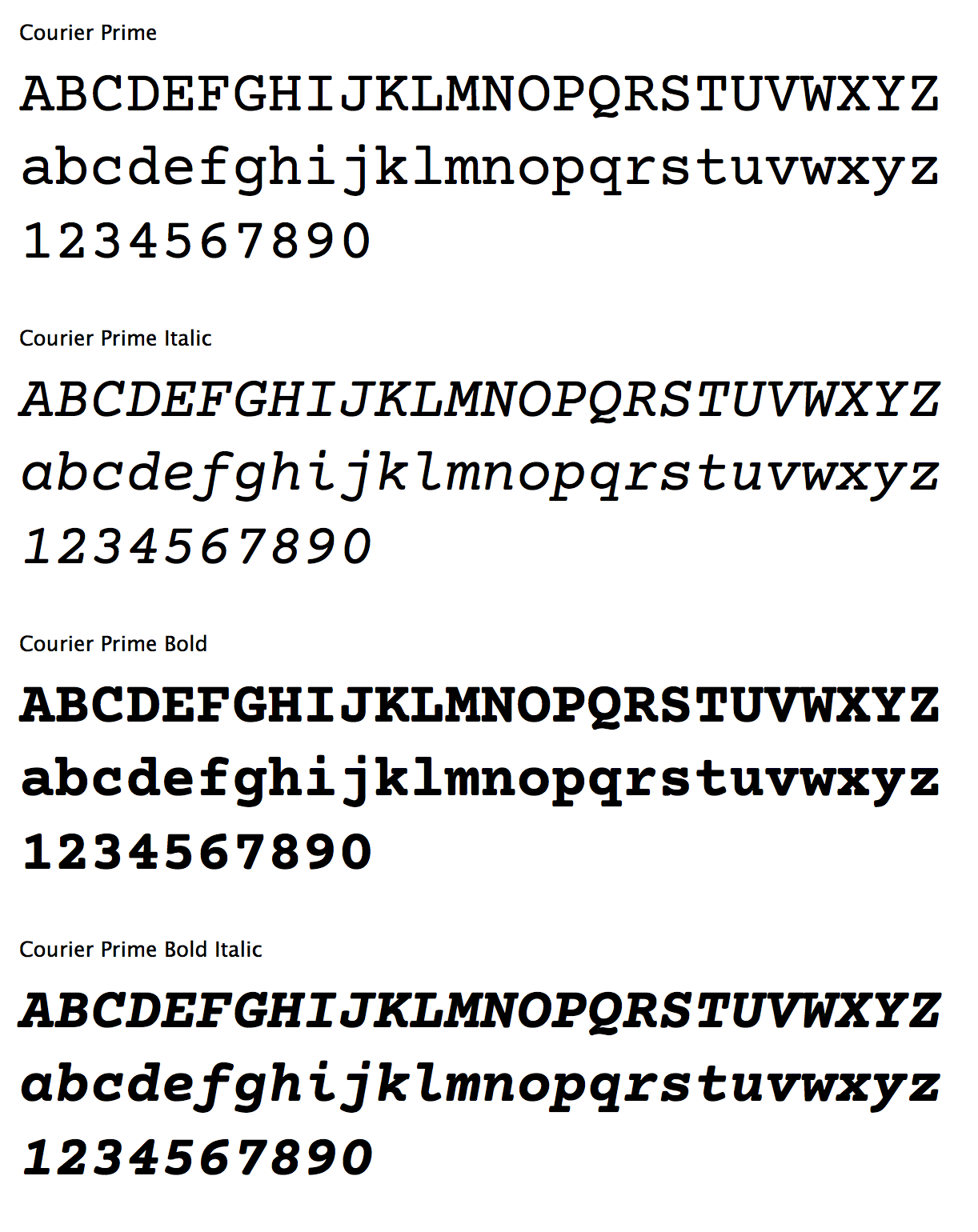
It’s Courier, just better:

courier chart

It’s free, and available at [Quote-Unquote Apps](http://quoteunquoteapps.com/courierprime/).

How we got here
—-

Novels were once written by hand. So were plays and poems and speeches. As readers, we don’t see the original scrawl because they’ve been typeset along the way, transformed into something easier to read.

Screenwriting began in the era of typewriters, and it’s always been served raw. What the screenwriter pulls out of the typewriter isn’t a manuscript to be sent to the publisher — it’s the final product.

Over the years, the tools have changed, with the advent of computers and printers and PDFs. But we still expect scripts to look like they came out of a typewriter.

Specifically, we want screenplays to be twelve-point Courier.

The Courier typeface was designed in 1955 by Howard “Bud” Kettler for IBM. It’s classified as a monospaced slab serif, with each character taking up the same space and constructed with even stroke widths. IBM deliberately chose not to seek any copyright, trademark, or design patent protection on Courier, which is why it’s royalty free. It was the standard typeface on IBM’s best-selling Selectric II typewriter, and soon became the default typeface in Hollywood.

By standardizing around one typeface set at a specific size, we can take advantage of some rules-of-thumb.

For example, one page of screenplay (roughly, sometimes) equals one minute of screen time. More importantly, producers can be assured that a 119-page draft really is shorter than a 140-page draft. Unlike college freshmen, screenwriters can’t fiddle with the font to change the page count.

The biggest problem with Courier is that it often reveals its low-res heritage. Designed for an era of steel hitting ribbon, Courier can look blobby, particularly at higher resolutions.

But it doesn’t have to.

It’s Courier, just better.
—–

In July 2012, I asked type designer Alan Dague-Greene to come up with a new typeface that matched the metrics of Courier — thus protecting line breaks and page counts — while addressing some of its weak spots.

I wanted a font that could be substituted letter-for-letter with Courier Final Draft, but look better, both on-screen and printed. I wanted a bolder bold and real italics, not just slanted glyphs.

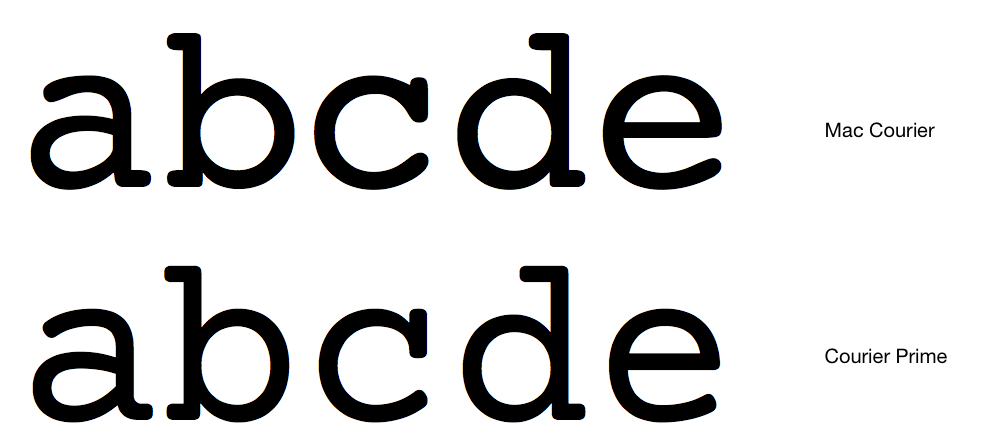
Alan rose to the challenge, creating a typeface that is unmistakably Courier, but subtly improved in ways you wouldn’t necessarily notice at first. Here’s a primer.

abcde comparison

The serifs are crisper and less rounded. They’re also less blobby where the serif connects — particularly in the lower-case c.

Look at the spaces inside the b and d. They’ve been opened up slightly, and the surrounding stroke tapered.

Still, you might occasionally wonder if you’re looking at regular Courier or Courier Prime. The quickest giveaway is the lowercase y, which loses its “foot” in Courier Prime.

y comparison

We ultimately went through 25 builds for Courier Prime.

With each new version, I’d prepare three sample screenplay pages — the same text but in three different fonts (standard Mac Courier, Courier Final Draft, and Courier Prime). The samples were given codenames (e.g. Fish, Dog, Bird) then shown to Actual Screenwriters, who voted on their favorite, not knowing which was which.

The early results were Not Good.

Screenwriters consistently preferred standard Mac Courier to our custom face. But we soon realized why: the standard Mac Courier is fairly heavy. Screenplays have a lot of white space, which makes thin Couriers look even thinner. As we gradually nudged up the stroke weight, we found the Goldilocks spot which was just right.

I want to thank all the screenwriters who participated in both the voting and the beta tests, and of course Alan Dague-Greene and Ryan Nelson for all their work getting the typeface out the door.

Courier Prime is [available today](http://quoteunquoteapps.com/courierprime/), free, for Mac and Windows. It’s released under a very liberal license so developers can use it for iOS and Android apps. We hope screenwriters get a lot of use out of it.

Scriptnotes, Ep 73: Raiders of the Lost Ark — Transcript

January 25, 2013 Scriptnotes Transcript

The original post for this episode can be found [here](http://johnaugust.com/2013/raiders-of-the-lost-ark).

**John August:** Hello and welcome. My name is John August.

**Craig Mazin:** My name is Craig Mazin.

**John:** And this is Scriptnotes, a podcast about screenwriting and things that are interesting to screenwriters, such as a little 1981 movie called Raiders of the Lost Ark. Perhaps you’ve heard of it, Craig?

**Craig:** Raiders of the Lost…? No. Raiders of the Lost…what?

**John:** Ark. Ark with a “K,” not with a “C.”

**Craig:** Oh, I always thought it was Raiders of the Lost Art. I’ve never seen the film, but I hear it’s quite good.

**John:** Well, in later years it was remarketed as Indiana Jones and the Raiders of the Lost Ark.

**Craig:** Oh, that movie! [laughs]

**John:** That’s the movie. And so it was directed by a guy named Steven Spielberg who went on to have a pretty successful career and is up for an Oscar this year, which is…good for him. He’s continuing to work. The writing credits on this film are by Lawrence Kasdan — pretty successful writer in his own right — George Lucas, and Philip Kaufman, who collaborated on story.

The actual collaboration that formed Raiders of the Lost Ark is also documented in these audio transcripts which are fascinating reading, which we’ll link to in the show notes. It’s basically these long, day-long sessions where Lawrence Kasdan, and Spielberg, and Lucas are all sitting around a table talking about how they’re going to make this movie, which is great reading material I’ll also link to.

**Craig:** They are fascinating to read. I mean, amazing to read those. So much fun seeing the genesis of something that you know is going to turn out to be incredible. And, well, I guess we’ll talk about it as you wish. I have so many things to say about one of my favorite movies ever.

**John:** So, I thought we’d do something a little different this week, and we’re not going to talk about anything other than Raiders of the Lost Ark. Because so often on the podcast we’re talking about little small things, or little bits and details, but it’s very hard for us to talk about the whole movie, or things like structure, or things like set pieces, or sort of how everything works together, because we can’t expect people to read a whole screenplay and be following along with us.

And it’s hard to talk about movies that are in theaters right now because people may or may not have seen them. Most people will have seen Raiders of the Lost Ark. But, I figured it would be best to start with a summary of what actually happens, because I watched it again this last week and I had this sort of memory of what happens, but actually the story unfolds in a different way than I’d remembered.

So, I thought I would talk through a quick summary of what’s going on. We can start and stop a little bit and talk about what’s happening structurally before we get into some of the detail work, okay?

**Craig:** Sure.

**John:** Great. So, here’s a plot summary of Raiders of the Lost Ark:

We first meet Indiana Jones and he’s making his way into this Peruvian temple, this lost temple that’s filled with booby traps. The classic moment where he takes the idol, puts the sandbag, and everything seems to be going great. And, of course, everything starts going very, very wrong.

There’s an associate named Satipo, who is played by Alfred Molina, who portrays him at a certain point, and like three seconds later gets killed by one of the booby traps.

We have the giant rolling boulder sequence — iconic moment. Indiana Jones gets out of this temple and is outside and he’s met up with by Belloq — who is going to be the villain of our story — and a whole bunch of native tribespeople who take the idol from him. He barely escapes with his life. He gets onto a seaplane and flies off into the sunset.

That is your opening sequence to Raiders of the Lost Ark.

**Craig:** Perhaps the best opening sequence of any movie. Ever.

**John:** Yes. And it’s quoted endlessly from The Simpsons to everything else. All the little small detail moments of, like, grabbing your hat, and the way everything keeps getting worse and worse and worse, and suddenly flying off at the very end.

**Craig:** And I know you’re doing a summary, but if I can just interject, that opening sequence with also the addendum of where we next meet Indiana Jones is a master class on how to start a movie. It is a master class.

Everything that the movie is about is going to happen in the first ten pages. The tone, the characters, their weaknesses, their strengths, their internal flaw, the promise of what the movie will be, the spirit of the adventure, the rules of the world — everything is not only packed in perfectly, but it’s packed in interestingly and dramatically. It is a master class on how to begin a movie.

**John:** Craig, how long do you think that opening sequence is? I have the answer.

**Craig:** From the logo turning into the mountain up until the point where he and Jocko, or Jock, fly away?

**John:** Yes.

**Craig:** I would guess it is 4.5 minutes.

**John:** 13 minutes.

**Craig:** It’s 13 minutes? God, isn’t that incredible?

**John:** Isn’t that incredible? Really it’s amazing because you realize there’s actually quite a bit that happens here. So, as debates and things come up, I actually have it on my iPad so I will be able to tell you exactly how long things go.

**Craig:** Isn’t that amazing. Boy, that just… — Man, you know when you talk about page count, and how, you know, a lot of times you’ll get these notes, “Oh, it’s taking forever because it was 15 pages.” You know what? 15 pages goes by in the blink of an eye if they’re interesting. And two pages can be molasses forever if they’re not.

**John:** Yes. So, as we talk though this, and we’ll go back to the actual plot summary, but one of the reasons why I wanted to bring this up on the podcast today is I think this movie is fantastic. Everyone needs to watch it because it’s great and I love sort of every frame of it.

But, there is a lot of stuff that happens in this movie that if we were to do in a movie right now we would get criticized for. And that’s not saying that we’re right now and they were wrong then or vice versa. It’s just there’s a lot of stuff which actually doesn’t sort of fit the expectations of the kind of movie that we make now, which is ironic because is the template for all the kind of movies we make now.

When we talk about set pieces we’re really referring back to Raiders of the Lost Ark to a large degree. And so much of how it does its thing is different than how we would do it now.

**Craig:** Yeah.

**John:** And we would be called to the mat for some of the things that work great in Raiders.

**Craig:** Yeah.

**John:** So, about 13 minutes in, the plane flies off into the sunset, and now we are back to visit Indiana Jones in his normal life as a university professor, to a really quick class, his archeology class. His students are in love with him. The girl has “I love you” on her eyelids. There is a weird little moment where the guy puts an apple on his desk, which I’ll talk about later on.

**Craig:** [laughs]

**John:** There’s a scene with Brody, who is a museum curator who is essentially his boss. And Brody says the Army wants to meet with him. We then have quite a long scene where the two guys from the Army explain that the Nazis are looking for something. I’m actually giving the Wikipedia summary because it’s pretty complicated what actually happens in this scene.

So, the Army says that they’re looking for Abner Ravenwood, who is Indiana Jones’s old mentor. Ravenwood is the leading expert on the ancient Egyptian city of Tanis and possesses the headpiece of an artifact called the Staff of Ra. Indiana deduces that the Nazis are searching for Tanis because it is believed to be the location of the Ark of the Covenant, the biblical chest built by the Israelites to contain the fragments of the Ten Commandments; the Nazis believe that if they acquire it, their armies will become invincible. The Staff of Ra, meanwhile, is the key to finding the Well of Souls, a secret chamber in which the Ark is buried.

And that’s a huge mouthful and I think I want to circle back around to this later on to talk about how well Kasdan does this scene and how he keeps our hero driving the scene despite all the exposition that’s in there.

**Craig:** Again, a master class. I love that scene. Maybe it’s my favorite scene in the movie. And I’ll talk about why with you as well when we get to it.

**John:** So we’ll circle back and get to that. After that scene, which is a five-minute scene, there’s a quick moment back at Indiana Jones’s house where Brody says the Army has authorized his trip to go look for the Ark before the Nazis get there.

So, we’re at 22 minutes into the movie at this point. We’re in a seaplane to Nepal. We’ve got our first animated map. Also on that plane is the first time we see the Nazi dressed in black. There’s this Arnold Toht. “Tote” I think we’re supposed to pronounce it?

**Craig:** Toht (tote), which is essentially the German word for death.

**John:** Death, of course, perfect.

**Craig:** Although, his name is never mentioned in the movie.

**John:** Oh, how nice.

**Craig:** Yup, we only know that from afterwards from the credits. But no one ever says his name in the movie.

**John:** No. So, we are arriving into… — We know that Indy is going to Nepal, but interestingly here for the first time we break perspective and we have a scene with Marion Ravenwood, who is Abner’s daughter, and Indy’s former lover. And she’s in a drinking contest, another iconic moment that’s been quoted a lot of times, where it seems like she’s not going to be able to finish the shot, but then she finishes the shot and is able to drink the other.

I always just thought it was a man, but you watch it again, “Oh, it’s a woman.” She drinks the other person under the table. So, breaking perspective is an important thing that happens here because it establishes — well, we’ll say why it is important, but we do break perspective when we see things from only Marion’s point of view.

Indiana Jones arrives. He explains what he’s looking for. He says he’ll give her $3,000 for this headpiece, for the Staff. She says she’ll think about it. Indiana Jones leaves. Toht arrives. Toht wants the headpiece. He will torture her. Indiana Jones arrives and we have the second big set piece of the movie which is a big fight in this bar. Over the course of this fight the whole bar burns down. Toht get his hand burned on the blistering hot headpiece of the Staff.

Indiana Jones and Marion are safe and alive and Marion says, “I’m going to stick with you because I’m your goddamn partner.” So, they are going to be searching together for this next step of things. So, they still have the headpiece but they know the Nazis are onto it to.

This is 33 minutes into the movie. This is where we could argue is the end of the first act. You could also argue the end of the first act was flying off to Nepal, but this feels sort of more like that moment.

So, Indiana and Marion travel to Cairo where we meet Sallah, an old friend of Indy’s. He says that Belloq and the Nazis, led by Colonel Dietrich, they’re digging for the Well of Souls. And somehow they have a replica of the headpiece. And at this point it’s not established how they have a replica of the headpiece. But, we’re establishing this. We’re meeting Sallah’s family. We meet this charming little monkey who ends up being one of the most despicable creatures in cinema.

Next we have our third big set piece, which takes place in a bazaar. I’m not entirely sure quite what Indiana Jones and Marion are doing in the bazaar, maybe shopping for supplies for this trip I guess, sort of. But these Nazi operatives try to kidnap Marion. They want to get the Staff. They want to get the headpiece.

It ends up being a big giant fight and we have some other iconic moments that happen in here. We have a lot of comedy fighting; a lot of choreographed comedy fighting. We also have the classic Indiana-Jones-pulls-out-the-gun-and-shoots-the-sword-guy. A lot of moments that you really remember.

What I didn’t remember is that Marion dies in this sequence, or at least Indiana Jones thinks that Marion dies.

**Craig:** Yes.

**John:** Following this there’s a short scene with Indiana Jones and Belloq where Belloq talks about their differences of philosophy. Indiana Jones starts to pull his gun. He’s just going to shoot him. All of Belloq’s men pull their guns on him. Indiana Jones is rescued by Sallah’s children who say, “Uncle Indy, Uncle Indy.” And for whatever reason these guys won’t kill the children, so the children escort Indiana Jones out. And he is safe at the moment.

With Sallah, Indiana Jones realizes that the Nazis have miscalculated the height of the Staff, the headpiece it’s supposed to be attached to, so therefore they’re digging in the wrong place, so they decide they need to go to the excavation site and find it for themselves.

They infiltrate that. They use the Staff of Ra to figure out the right place on this giant map of the building, of sort of the compound, whatever you call that place — the ruins. A nice little visual effects sequence there where they show the sun and the Staff and all of that working.

Along the way — and again, a moment I had forgotten — Indiana Jones actually finds Marion there tied up and realizes she’s still alive. And he leaves her there because he’s like, “Well, you’re going to get in the way, while the men folk need to go and find this place.”

While Sallah and Indiana Jones are excavating the real place and getting into the Well of Souls, we actually intercut. We intercut between them and Marion and Belloq who are having another drinking contest. And, again, I had forgotten sort of how all this worked. But there is actually quite a few scenes with Belloq and Marion during this time, sort of letting time pass as we’re cutting back and forth between them.

Down in the Well of Souls they find they Ark of the Covenant. And you’re like, “Wow, this is really kind of early in the movie to be finding the Ark of the Covenant,” but they do. They find it. They get it out of the Well of Souls, out of the hole, but Belloq is there, and the Nazis are there, and they are not going to let Indiana Jones out of there. He’s going to be trapped down there with a bunch of snakes. They throw Marion down there and they seem to be trapped down below.

Knocking over a statue, they’re able to escape the Well of Souls, and then we get into our fourth big set piece which is a fist fight on an air strip. We’ve got the giant Nazi mechanic. You have a plane flying around. You have Marion trapped inside. Classic sort of escalation of things and a lot of things blowing up.

That leads right into our fifth set piece which is Indiana Jones trying to chase down the truck that’s carrying the Ark of the Covenant and trying to stop it before it gets shipped to Berlin. He succeeds in doing that.

Indiana Jones and Marion leave Cairo on a pirate ship to take the Ark to England. It’s really vague about sort of whether they hook up and have sex or if he just falls asleep, but it’s a romantic moment.

The next morning their boat gets boarded by Belloq, Dietrich, and all the Nazis. They take the Ark back. They kidnap Marion. Indiana Jones stows away on their U-boat and follows them to this isolated island where Belloq’s plan is to test the Ark to make sure it works before taking it to Hitler. This is 96 minutes into the movie.

Indiana Jones disguises himself as one of the other Nazis. He has a rocket-propelled grenade; he’s going to blow up the Ark unless they release Marion. Belloq calls his bluff and says, “You won’t actually do it,” and he’s right. They take Indiana Jones, they tie him and Marion to a post. Belloq opens the chest, the Ark, a big visual effects sequence which was probably incredibly difficult at that time to do.

**Craig:** Yes.

**John:** Indiana warns Marion not to look into the light, not to look into what’s actually happening. They survive. The Nazis all melt. And they survive.

**Craig:** Yes.

**John:** Cut to back in DC. They say that the Ark is now someplace safe. Everything is okay and everything is going to be fine. Indiana Jones seems a little bit unsatisfied, but that’s the end of this part of the story. And the final sort of shot shows that the Ark has actually been loaded into a crate and is tucked into a warehouse never to sort of be opened again, at least for quite a long time.

And that’s our movie.

**Craig:** That is Raiders of the Lost Ark. Now, there is so much to discuss. So much beautiful writing in this. So much exciting writing. So much smart writing.

You and I should really have Larry on. One of the great blessings of my life is that I’ve come to know Larry Kasdan and he is an amazing guy. I love counting him as a friend because I do feel like Larry Kasdan is one of the giants of our craft. And I include all of it, from the beginning of making movies to now. The breadth of the films he’s written and directed are astonishing in their range.

This was one of his finest moments. Larry was kind enough to sign a poster for me because my son became obsessed with Raiders of the Lost Ark, as well he should have been. And I just want to talk through all of the wonderful things from a screenwriting point of view that Larry accomplished. And I want to also give George Lucas credit, because when you look at those transcripts of those early story sessions, there are moments that are breathtaking when you read it because — look, let me take step back on George Lucas:

Everybody gives this guy a hard time. You know, after Star Wars, you know, he made some movies, he was producing some movies, but the prequels came and everybody gives him crap. And the fourth Indiana Jones, everybody gives him crap. But you look at those story sessions and there are ideas coming out of him fully formed that are in the movie.

George Lucas says, “No, no, no, no. He should have a whip.” But Spielberg — and I’m sorry, I’m going to just ADD this for a little bit — Spielberg has a moment in those transcripts, if I’m remembering correctly, that is astonishing. He’s just sort of sitting along, going along with Larry and George. He’s tossing some ideas out; frankly, a bunch of them are bad.

**John:** Mm-hmm.

**Craig:** You’re thinking, “Gee, Steven Spielberg has some bad ideas.” Feet of clay, I’m heartbroken somehow. And then suddenly he goes, “Oh, I have a great idea,” which is always a weird thing to say to people because what if it’s not a great idea. He goes, “I have a great idea. When he’s in that temple he should set off a booby trap and there should be this enormous rolling boulder that comes after him. And he’s running and this thing is just right behind him.”

And you go, “Oh my god, he really did have a great idea, fully formed.” So much cool stuff went on in that story session. If you’re a screenwriter, you’ve got to read that stuff from start to finish. It’s amazing. But, anyway, do you want to go through the beginning? How do you want to do this?

**John:** Is there anything in the opening set piece that you want to talk through in more specific detail?

**Craig:** Yes.

**John:** Because it’s really terrific.

**Craig:** Okay, so look. Putting aside the incredibly directorial flourishes that made that set piece what it is — you know, even the simplest thing, the very beginning of the Paramount mountain dissolving to an actual mountain, them moving through. The guy saying, “Poison. The Hovitos are nearby. It’s three days fresh.” There’s all this wonderful tension that’s growing and we don’t even see Indiana Jones’s face until someone turns on him. One of his own guys turns on him and tries to kill him. And Indiana whips the gun out of his hand.

And in that moment we learn so much already. We learn that, A) Indiana Jones is a badass guy. We learn that this is a movie where treachery is woven in already into the very fabric of it. Who do you trust?

And we also learn that he has this incredible skill of whipping things out of people’s hands. It’s such a wonderful way of doing it. You know, when we talk about stacking things, it’s a simple screenwriting error to say, “He’s really good with a whip; let’s show him whipping cans off a fence.” [laughs]

How about this? How about instead let’s show a moment of treachery and in that moment of treachery bake in this new information that this guy has this incredible ability to whip things out of your hands. But when they go in to that place, the people around him are running away. They literally don’t want to be near him anymore because he’s approaching someplace that is supernatural and evil to them. And Indiana Jones is completely unconcerned with that.

He is essentially a skeptic. He’s a scientist. He is there after an artifact because it belongs in a museum. And that right there, when those guys run away, is what this movie is about. Indiana Jones doesn’t believe. He instead — his passion for the items, the artifacts has eclipsed his faith in other things, in bigger things. So, that’s just baked right in there without anybody saying a word about it, which I loved. It’s all sub-textual.

There’s incredibly clever and exciting things that go on in that cavern, beautifully smart things like — and wonderfully when Indiana Jones is replacing the idol with the sand because he’s smart enough to know, smart enough to know, that you can’t just take it off that thing, which is also new information to us. He’s afraid.

So, we have now this other thing. He’s not afraid of whipping guns out of guys’ hands, but he is afraid of what the people who built this temple have designed, the way a scientist would be. He’s not afraid of the demons, he’s not afraid of the legends, he’s afraid that darts are going to shoot out or something is going to happen to kill him. Wonderful.

**John:** I would also clarify: He’s a skeptic but he’s a gambler. Because even at that moment where he’s using the sand to replace the idol, he’s guessing. I mean, he’s like a little bit more, a little bit less. I mean, he’s estimating, it’s like, “Yeah, this should probably do it.” and that’s a crucial thing for not only who this character is, but what this movie is around him.

This is a movie where he will sometimes get lucky, but he will sometimes get unlucky. And because you don’t know which way the coin is going to land in this movie, that keeps you engaged.

**Craig:** Yes. And he’s passionate. Because in this moment he knows enough to know this is very dangerous. He knows enough to know that he’s guessing. In fact, there’s that wonderful bit while he looks at the sand and decides, “No, I’m going to take some sand out,” which is a fatal error — he second guesses himself.

But his passion…

**John:** Well, Craig, we don’t necessarily know that. Maybe he actually needed to take more sand out. Maybe it was too heavy.

**Craig:** That’s true. It’s possible. He miscalculates one way or another, but his passion for the object overrules his sense of self-preservation. He has an obsession, which is very important when we start to talk about Belloq, because then wonderfully after he escapes that huge rolling ball, after we see that Satipo, his guide, played by Alfred Molina beautifully, is dead because of his stupidity. See, Indiana Jones is smarter than everybody. And other people are subject to greed where he is not.

After he escapes all of that, there’s Belloq. And Belloq is his shadow in the best possible way. Paul Freeman, I believe, is the actor, a wonderful actor. And he says, “Once again we see that there is nothing you can possess that I cannot take away.” And here, at last, we see the opposite of Indiana Jones; a guy that is ruthless and willing to kill because he has the same passion — he wants The Thing.

And what’s interesting is later we’re going to find out that these two men are very, very similar. In that wonderful scene in the bar after Indiana Jones is drinking himself to death because he thinks Marion is dead, here comes this guy who says, “These Nazis, that’s not me. I’m working with them because I have to. I don’t care about Nazis. I don’t care about any of this. I don’t even care about money. I want The Thing, just like you do. It’s just that I’m willing to go the extra step to get it.”

So, we have this wonderful villain setup, who is not a mustache-twirler, who isn’t motivated by anything different than Indiana is. He’s just more ruthless about it. And as Indiana Jones escapes, [laughs], we see that he’s definitely afraid of snakes. And what’s so smart about the way Larry did this is that it’s played as a joke. So, the joke is you just whipped a gun out of a guy’s hands, you just went through this death tunnel, you just escaped a rolling ball, you just ran away from a bunch of crazy Hovitos with their blow darts. But snakes are what gets you crazy. [laughs] That’s really cute.

And, of course, quietly setting up something big for later on. Wonderful sequence. Amazing.

**John:** Well, the snake moment, it’s the one last thing. So, you believe that you’re safe. You believe, like, we’re in the plane, the plane is taking off, and then you realize there are snakes. It’s that moment of like, “Okay, we’re actually here. It’s going to be okay.” And then the snake becomes the one more thing and that’s a terrific little moment.

**Craig:** Yeah. And a great little performance from Harrison Ford, as he’s running, and we’ve already established that hat, how important the hat is to him, which is a wonderful character touch. This is a man of specifics: His hat and his whip mean a lot to him. And he’s running and he’s got his hand on his hat so he doesn’t lose his hat. And there are all these people running behind him trying to kill him. And he’s, “Start the plane!” He’s screaming in total panic to start the plane.

And that humanity is why he’s funny. He is the opposite… — It’s funny. The inspiration for Raiders of the Lost Ark were all the wonderful serials of the ’50s, but those were the old school heroes, like Doc Savage. I don’t know if you’ve ever read any Doc Savage books when you were a kid?

**John:** No, I didn’t at all.

**Craig:** Doc Savage was this wonderful pulp fiction series. I think it was, I want to say ’30s and ’40s. I could be a little off there, but in that general zone. And a lot of what Indiana Jones is is inspired by Doc Savage who is this — Doc Savage, Man of Bronze. He was a brilliant guy. He was a doctor. He was a scientist. He was a surgeon. He was an inventor. He was strong. He wan tan. He was amazing. And he would go on these incredible adventures for artifacts and things and come back. But he was all hero. No fear, ever, the way that James Bond often had no fear.

And here’s this other side of it, of a very human person in the middle of all of it. So, you have in this entire sequence we’ve watched, what we’ve seen absorb on one level is excitement of booby traps, and scares, and thrills. But underneath it Larry has packed in this incredibly rich character that’s going to pay off huge.

**John:** Who is damaged, and afraid, and funny, and isn’t always right, which is so crucial.

**Craig:** Right.

**John:** So, after this wonderful open set piece, which could be a movie in and of itself — if you could do that as a Pixar film, you could just make that its own movie, and like, “Oh, that’s a terrific little short.” That is all sort of packed up together. — we never see that idol again. We don’t care about that idol. It’s just a thing. It was just the topic of the first little movie.

Now we get onto our real A-plot of the film, which is back at the university. We have a very perfunctory kind of teaching of a class scene. And so he’s talking, you know, it’s just enough lines of dialogue to let us know that he actually does have undergraduate students. That he really is a professor. That he’s not just this wild adventurer and he actually can teach a class, and he can wear glasses. And it’s acknowledged that even in this world everyone does find him attractive, so that’s helpful.

**Craig:** And yet he’s incredibly modest and oblivious.

**John:** Yes. But then we get to our real showcase scene, which is the Army has come to talk to him about Hitler and everything else and sort of setting up; once you sort of bring Hitler into it you know, “Okay, well there’s the plot.” Once Hitler’s name gets mentioned we know that there’s actually some real serious stuff at stake.

So, what I found so interesting about — and I really do want to focus on story rather than staging — but this moment, this scene in which the Army comes and talk to him, it’s something that could take place in a little small office, but instead it’s staged in this very big lecture hall, really huge, like 15 times the size of the room you actually need to stage it in. I think largely so because Spielberg recognizes like, “Man, we’re in here for a very long time and I need to be able to move around this space and give some air to this.”

So, it’s very smartly done, directorial-wise, but just in its writing. You look at all the moments that Kasdan has found for Jones to really be leading the conversation, even though the other people are coming in with the challenge and the quest, he’s the one that actually has the information that can get us moving along. He’s the one that actually knows what the city of Tanis is. He is the one who knows this guy. He’s the one who knows what the Staff is and what it’s supposed to be doing, and that you put the Staff in and light goes through it.

He’s setting up so much stuff that seems so important for the back half of the movie, including what actually happens when you open up the Ark. He’s showing us the picture of what this is going to be so we know the stakes of what’s really involved here.

**Craig:** Mm-hmm.

**John:** It’s really an amazing sequence.

**Craig:** It really is. And leading up to it, as they’re walking into this auditorium, Denholm Elliott, who plays the curator of the museum and is sort of like Indy’s boss. And he’s saying, “I had it. I had it in my hands. God, I can get it back. I can get it back.” You see his singular obsession over this item. And Denholm Elliott is saying, “It’s okay. Don’t worry about that. And, yes, we’ll buy the other things, but just don’t worry.” This guy is saying, “I’m worried about you.” Without saying I’m worried about you he’s saying, “You’re obsessed over the wrong things.”

And then they enter this auditorium and I agree with you. At first you’re like, “Why do we need this huge room?” And I think part of it, not only aesthetically is it nice to be in this big room, but what is going to be discussed in here needs to be in a big room, because what is discussed in here is of enormous importance. It is metaphysical. It’s cosmological.

And we learn more in this scene than just the details. We also learn what ultimately is the hinge of the character piece of this movie. These CIA agents are saying, “We have a problem. We think that Hitler is looking for this thing. And we are concerned that if he gets it he could use it as a weapon.” Whether they know it or not, the CIA agents are believers. They’re believers because maybe they’re just paranoid and they need to believe everything just in case something turns out that way. They’re very sort of dispassionate and calculating.

Denholm Elliott, on the other hand, Indy’s boss, you can tell is more of a believer. Because like Indy, he’s an expert; he knows that this Ark is tremendously powerful and of great significance and in an evil man’s hands could be something terrible.

But not Indiana Jones. And this is why this scene is so amazing to me. He starts talking with great passion about the Staff of Ra. He starts explaining it. And we are into it because he’s into it. His passion sells us. And this is an important lesson for those of you who are looking to get through exposition — make somebody care. Because what we’ll latch onto is their passion. It’s less about the details; it’s their passion that we love. And he’s talking about the objects and the trick of it, and Tanis. I mean, he and Denholm, they found Tanis. They get so excited because this is the obsession of the object for him.

**John:** Mm-hmm.

**Craig:** But when the CIA agents look at this picture in the book that Indiana shows them of the Israelites carrying the Ark, the open Ark, and this wonderful image of power shooting out of it. They say, “What’s this?” And suddenly Indiana Jones loses interest entirely. And this, to me, it’s the best moment in the movie. He goes, I don’t, something like — I’m paraphrasing — something like, “Lightning, thunder, power of God,” or something. He doesn’t believe it at all. To him, that is hokey baloney.

That’s not what this is about. Hitler is after that. The CIA is worried about that. Denholm Elliott is worried about. But not Indiana Jones. All Indiana Jones wants is The Thing.

**John:** Yeah. He sees it as an opportunity rather than a crisis.

**Craig:** Yes. So great. It’s so great.

**John:** Going back to this moment of exposition, and it’s such a crucial lesson that the things that are said in this story, like the important story points, like my little Wikipedia summary, the CIA people could have known a lot of that ahead of time. They could have found out other stuff and they could be telling this to Jones’s character. It wouldn’t work at all.

And it’s because our hero knows this information, and our hero that we like and trust and believe can speak with authority on this topic that we’re listening to it. If another person came in and delivered this information, we wouldn’t care and you would cut most of it out, or you’d cut the whole scene out. You’d reshoot it somehow because it just wouldn’t work.

You certainly couldn’t sustain five minutes of it if it were someone else telling you all this information.

**Craig:** Quite right. And the other thing that that accomplishes is it makes us understand, without saying a word, why they want him to do it. Why this guy? Because he knows and we don’t.

**John:** I will say, just stepping out of this specific movie for a moment, I don’t think even Kasdan could get away with this scene right now. I think at its length it would be under such a microscope for how much stuff is put in this scene. They would ask you to break this into two moments, or just to not let it be this. Or, “Can we walk to a new place while we’re doing this?” Because it does — just looking at it on the page, not seeing it shot — you say like, “Well that’s just too much. That’s just too long. That’s too long of a scene.”

Which is unfortunate, because there are reasons why movies should have some scenes that are setup this way. It’s great.

**Craig:** Yeah. That’s why they are wrong. And this is why we talk a lot about what is the ideal way to develop a screenplay and make a movie. And I’ve said “writer and director, writer and director, writer and director.” Because what a writer and director know is the proper relationship between what’s on the page and what will be on the film. And it’s very hard sometimes for other people to see that.

They know that this is going to be delivered passionately. They know that there is going to be drama inherent to this conversation. They know that the theme of the movie and the character’s — call it flaw — or his stasis that’s going to change is all gorgeously buried in this wonderful stuff. They know it. And a lot of times other people who don’t make movies, who literally sit and write them and then shoot them, don’t know.

And, so, how did you get away with this back then? Because you had Steven Spielberg, George Lucas, and Larry Kasdan. And they said, “We’re making it this way and that’s the way we’re making it.” And that’s it.

**John:** Yeah. Done.

**Craig:** And that’s the way it should be now. And, by the way, I’m not saying to our studio friends who are listening to this, “Therefore you should just trust every threesome of yokels in your office to do stuff.” No. But try and work with Spielberg, Lucas, and Kasdan as much as you can, [laughs], because when you have guys that know what they’re doing, and they’re excited about something, trust that — trust that passion. It will work out.

**John:** Yeah. A scene I’d forgotten until I rewatched it this week, there’s actually a quick scene after this at Indiana Jones’s house.

**Craig:** Yes.

**John:** Which we never go back to in the whole rest of the movie. Brody says that the Army has authorized the trip. And so we have basically just Indy packing and wearing a robe. And it’s an odd little scene, and it’s a scene that you think you could cut out. What’s crucial about it is it establishes that Marion Ravenwood exists, and that’s Ravenwood’s daughter, and that they have a history.

And we also see Indiana Jones tosses in his gun into the suitcase. It’s not my favorite scene of the whole movie, but it’s a helpful scene to sort of establish that Marion Ravenwood exists and in a scene from now we’re going to be spending time with her and that’s who this woman is.

**Craig:** Yeah. And what I do like, I mean, granted, in terms of everything we’ve seen up to that point, it’s like, okay, that’s just a regular scene. But, again, smartly what it does is it creates an anticipation that they’re going to better, which I always like. Let the audience think they’re going to get the same old meat and potatoes and then give them great meat and potatoes. They’re really just setting up that there is — that this relationship, that he has to actually go talk to the one person he really didn’t want to talk to, and it’s a woman. And they had a romantic past. And you go, “Okay, that’s going to be whatever.”

But when we meet her we realize it’s actually so much tougher than that, which is wonderful. And that’s where we go next.

**John:** Yeah. The other reason why I think the scene may actually help the movie, even though it’s not a phenomenal scene by itself, is it is short. And we’ve come out of such a very long scene that if we went directly into the Marion sequence in Nepal, which is also a very long sequence, we’re like, “Ah!” like everything just seems very long.

It’s nice to break up the rhythms a little bit, to have a nice little small moment here.

**Craig:** Yeah.

**John:** So, we’re going from here to the seaplane to Nepal, which is a completely new environment. And what I like about this movie is it doesn’t double back on itself. Once we sort of hit the road, we are on the road, and we’re going to get back to home at the very, very end, but once the road trip starts we’re on the road the whole time through.

**Craig:** Right.

**John:** We get to Nepal. The first time we break perspective — and this is a really crucial thing. Up until this point in the movie every scene has been driven by Indiana Jones. We’ve not had a scene in which other people are leading it. We’ve had the cutaway to Jock at the plane like fishing, but that’s like five seconds before Indiana Jones is running to him.

This is a whole scene being driven by a character we’ve never seen before. And the first time you choose to do that in a movie is really important because it’s putting a lot of weight on this person. And she is the white, beautiful, English speaking person, and we clearly know that she is an important person because she’s getting to drive the scene all by herself.

And so that was an important choice to make. Because you could have just, like, had Indiana Jones walk into the bar and find her there. And by giving her her own moment ahead of time, it greatly elevates her position.

There’s a movie you and I both helped out on a little bit that exactly that discussion came up. It turns a movie from being a one-hander into a two-hander if you early on establish that someone else has the power to drive scenes by herself.

**Craig:** That’s right. And it’s so important here because Marion Ravenwood, what we come to understand without them ever spelling it out, and again Larry is so good at this, is that the problem between the two of them ultimately is that Indiana Jones had an issue seeing this person as a person but as that Thing — his obsession over things.

The deal with Indiana Jones is he becomes obsessed with these things and sees them as thing-ness but doesn’t see necessarily what’s so important about them. He has a problem putting his faith in things. And you can tell when they do — from the bits and pieces of the story you put together — that he just didn’t love her the way he should have.

And what’s so nice about this scene is that it presents her as somebody worthy of that kind of affection. So, she is beautiful and she’s special, and she’s also formidable.

**John:** Yes.

**Craig:** I mean, the way we meet her, screenwriters are constantly — constantly — trying to “how do I meet somebody in an interesting way, so not just buying groceries.” That first moment I see somebody should tell me something about them. Well, god, did they nail this one! She is a beautiful woman who is strong as an ox. She is going to be tough.

And he wants something from her. So, you know, we know he’s going to get something from her, and then the next thing Spielberg and Kasdan show us is, “Good luck, because she is tough.”

**John:** We also know that she’s damaged though. No undamaged woman owns a bar in Tibet. There’s backstory there. And even though we’re not going to get all the backstory, we get a sense that something has put her here in life, and that’s interesting, too.

Even though in the movie we don’t really explore all that much backstory on her, we feel like she existed before this scene started, which is crucial.

**Craig:** Great point. Because a lot of times what we run into is this problem, well, what’s going on in this person’s life that they can just pick up and go on and adventure with a guy? And here they use that to their advantage. She is hidden away from the world. She could leave this place any time she wants. The whole point is she’s hiding from things.

So, now her decision to go with him is an active choice that relates to her prior choices. It’s not simply an, “Oh my god, a handsome man came here. I think I’ll go with him somewhere.”

**John:** Yeah. Now, there’s a moment here I don’t love as much. Basically she says, “Well, I’ll think about it.” And he says basically, “I want the headpiece. I’ll give you $3,000.” She’s like, “I’ll think about it.” And then it reveals that she actually does have it and she’s thinking about it.

The evil Nazi arrives. Toht arrives with some thugs and is going to torture it out of her. And Jones returns. And it’s a little bit of a false exit. I do wonder whether in the development there was something more given to like where he was in this interim moment. It works fine, because we sort of know he’s going to come back at some point and probably save her, but it is a strange little moment for me that as I watched it again this last week I was like, “Huh, that was a little bit of a stutter step there.”

**Craig:** Well, maybe I’m just so deep into my hero worship of this movie that I excuse everything. But for me what I always liked about that moment was that this guy hurt her. And he’s offering her something, and he’s offering her something connected to her father, because it was her father’s medallion. And it’s something that means something to her and she doesn’t believe, or know, that she can really trust him because of what he’s done to her. So, it was rational.

Granted, his return is convenient.

**John:** Yes.

**Craig:** On the other hand, it is proof positive to her that perhaps Indiana Jones is trustworthy now.

**John:** Yeah. This fight in the bar, this set piece, is really terrifically done. And it has a lot of comedy and it has a lot of sort of those slap-sticky kinds of moments, but there’s also a lot of like people taking knives. And there’s a fair amount of blood in it, too. And the whole bar is burning down. It’s a great escalation. It’s really well-choreographed and establishes that this is the kind of movie where people are going to get into fisticuffs. They did a great job of it.

**Craig:** Fisticuffs and death. The stakes of this movie aren’t soft-shoed, you know, or soft-pedaled. And there’s that one wonderful bit where the guy dies and all the blood spills out of his mouth and he keels over in this bar. And you realize that the movie is not pulling punches. This stuff is for real. It just makes everything seem so much more exciting.

There was a time when studio movies weren’t so shy about real violence. And that really kind of blossomed in the ’70s as a reaction to the soft-pedaled, fake, cartoon violence of movies that had existed prior. And you can see that continuing here. That’s the thing, interestingly, when I watch the movie now where I think that’s what they would have the biggest problem with today.

I mean, look at Spielberg’s movies, or even the movies he produces like Transformers. There’s no blood in Transformers, you know? It’s a bloodless action because there’s this fear that somehow this will turn people off when, in fact, in the right context it’s incredibly dramatic and effective.

**John:** From here, the bar burns down. She says, “I’m your goddamn partner.” And so they’re going to be traveling together to Cairo which is our next big set piece.

It’s interesting when we get to Cairo, it’s sort of like a “let’s catch our breath and have a nice little happy moment.” And so it’s Sallah with his family and the charming little monkey. And there’s opportunity there that we could get into a lot of exposition and sort of talking about the A-plot, and we decide not to. And so instead it’s sort of a happy moment.

Then we go out into the street and we very quickly get into our next set piece which is the big fight in the streets of Cairo, the classic sword fighting. There’s just a lot of terrific detail work in here, but again, very much in a comedy perspective, like hiding in baskets.

**Craig:** Yeah.

**John:** And it’s much funnier than you remember it being.

**Craig:** Yeah. Exactly. I mean, the idea of that whole sequence is fun, you know. The bar sequence was dangerous. Toht is a dangerous man who is threatening to torture here. And the death in there is very real and bloody. And then this suddenly is fun. And that’s okay because the importance of that sequence to me is we’ve left our old world behind. We’ve now entered this new world of mystery and we don’t want to just completely blow our wad by going crazy.

Again, that’s not what this movie is about. It’s about adventure and it’s about treachery. And this is really where we get that next wave of treachery. The monkey can’t be trusted. No one can be trusted.

**John:** Yes. The monkey will give a Heil Hitler salute which is just…

**Craig:** Genius.

**John:** …wonderful and bizarre. And it’s absurd and yet it largely makes sense within the context of the movie. And the tone of the movie is pushed enough towards comedy that you can accept that like, well, this happens in this kind of movie. And that’s okay. That little monkey; like to make me want a monkey to die, a charming little monkey to die. I mean, you write movies with monkeys.

**Craig:** Yes.

**John:** To actually make the movie where you hope that the monkey dies is a strange feat, but they do it for you.

**Craig:** Yeah. We made a character out of a monkey. I mean, the monkey in Hangover II is definitely a psychopath. I don’t even think it’s in the movie. I think we cut it out, but there was line — it was always one of my favorite lines — where after the monkey gets shot Alan says, “Oh, no! They shot the monkey!” And Phil turns around and goes, “Who cares? He’s a drug-dealing piece of shit.” [laughs]

**John:** [laughs]

**Craig:** Which is true. And I think we might have cut it out because people really did love the monkey anyway. But, I like bad monkeys. And this monkey is truly the king of all. He’s the Godfather of bad monkeys.

**John:** Yeah. He also seems to actually understand English. It’s not just that he can follow commands; he’s actually like listening and like sort of doing — he’s far, far, far too smart, and yet it actually kind of works in the context of the movie.

Again, a thing I’d forgotten until I watched it this week is that Indy does believe that Marion is killed because he sees the truck that had the basket he thinks has her blow up. And he believes that she’s dead for a moment. And then he gets a really great little quick scene with Belloq to talk about their differences in philosophy which is, again, a moment you love to be able to find because it’s so challenging to find moments of which your hero and your villain can talk in a meaningful way about something and yet still believe that they can have a rational conversation and wouldn’t just kill each other immediately.

**Craig:** Yeah, I mean, the notion — I often think about second acts as heroes starting to see glimpses of another way of living their lives. And those glimpses can be challenging and they challenge their central belief of how the world is on their way to eventually realizing, “No, this is how I should live. This is the way the world is.”

And here in this moment where Marion gets killed, we see Indiana Jones coming face to face with the fact that he might care about something more than just its objectness. That there maybe is more to life than a Thing. That perhaps he should even go home because there is something that is more important than finding this object of desire.

So, it’s a brilliant little thing to do to his character because he doesn’t abandon the quest, but he is knocked back on his heels and almost surprised by the depth of his own emotion about it.

**John:** Yeah. Let’s talk about the next two set pieces because one of the things I think that writers often get sort of perplexed about is like, “Well, how much do we need to focus on plot versus how much to focus on sort of big set pieces?”

As you look through the transcript they really were thinking about set pieces. And, yes, they were thinking about story and they were thinking about sort of what leads to what leads to what. But they were also talking about what are the big set pieces. What are the action pieces that sort of can build in here? And there are things that didn’t make it in here, like a coal mine chase that made it into the next movie.

You do think about those things sort of as packages. And the next two packages in this movie is the big fistfight on the airstrip, and the plane spinning around, and then the chase where he’s chasing down the truck on horseback, which is just beautifully done, and the whole truck sequence.

You really have to think about these things the same way if you were making a musical you would think about, “Where does the song go?” and “Where is the dancing?” because they are these big moments. And they need to — they’re going to be complete little packages in and of themselves. And you can take any one of these little set pieces and break out it out as its own little short film and it has a beginning, a middle, and an end. It has escalation over the course of it.

And think about these little moments. And sometimes they do slide around as you’re figuring out where the movie goes, but you can’t make this Indiana Jones without this set piece. It just doesn’t make sense.

**Craig:** Right. It’s true. And, again, what I appreciate about that stuff, because to me… — Look, there are a lot of movies that have amazing set pieces. For instance, The Island, the Michael Bay movie, has one of the best car chases I’ve ever seen in my life. It’s stunning. The problem ultimately is that we didn’t quite care enough about the characters and the situation before or after it to raise it to the level of Oh My God.

But here what happens before that stuff is, again, keying off of this notion that Indiana Jones’s life view is being rattles is he’s now forced to make choices. He comes into the tent and he finds Marion there. And he makes a choice to not just leave with her, but to go get the thing.

He’s struggling, [laughs], even when he finally — and then she gets thrown into the pit with him. When they escape, and that’s always a wonderful thing when characters are essentially sent to their death and die, and then escape. You know, so that’s the moment where he dies in the movie to me. And he is reborn when he comes out.

Something inexorably has changed in him. He still pursues the object, but that experience with Marion, you just know something has changed inside this guy. If he started this journey obsessed about an item, now there is this woman who is now on equal footing with the item. He is being torn between the two. And it becomes very important as you proceed through.

**John:** Yeah. Going back to his burial moment there, I think one of the crucial things that you have to remember as the writer is you want to make things as difficult for your characters as possible at all times. And so, you know, sealing him into that chamber, which there’s absolutely no way that he can escape from, is a good thing because you should make things absolutely impossible. If they had established earlier on that there was some other way out of there, it wouldn’t be meaningful at all, because it wouldn’t have resonance to us.

But the fact that we know it’s just that awful that he’s in there makes it exciting, makes it thrilling, makes it have real weight to it. And so, again, the way they figure out to break out of it is really, really clever and is believable in the course of the world, but it’s great that we didn’t have any inkling that it was possible beforehand.

**Craig:** Right. And in that moment, when they put them in there, first of all we have the wonderful deliciousness that it’s full of snakes, thousands and thousands of snakes. So, we’ve taken his tiny nightmare and blown it up to absurdity. So, our fear in watching this is not just the fear of the circumstances of fake skeletons and snakes. It’s our sympathetic fear with the character who’s afraid, which is wonderful.

The other thing that’s so smart is when it comes time to put Marion in there, Belloq doesn’t want to put her down there. The Nazis put her down there, if I’m remembering correctly.

**John:** You are remembering absolutely correctly.

**Craig:** And that tells us, too, again, that these two men have something in common. And what we start to feel when we see movies where heroes and villains share obsession is that the hero is not so much fighting a person to just get a thing; they’re fighting themselves. Belloq is Indiana Jones. The whole thing of fighting Belloq all the way though is just an externalization of what he’s fighting in himself.

**John:** I agree. And by finding those sort of small moments where a character who you despise — Belloq — you feel like this little glimmer of sympathy for him, for just a moment, as they throw Marion in. It’s like, oh, well I feel — I mean, obviously I feel much worse for her, but it’s like, “Oh, they’re even dicks to him,” is sort of a great change.

**Craig:** Yes. And his regret is the sort of diminished regret. It’s lacking the humanity of Indiana Jones’s regret when he thinks Marion dies. His regret is, “Ooh, that’s a shame. That’s a waste of a beautiful thing.”

**John:** [laughs]

**Craig:** You know, and I love that. Because Indiana was drinking himself to death because that was a waste of beautiful human that he loved. And that’s where these two guys are different. And that’s where Indiana Jones is separately himself from Belloq, which is wonderful.

**John:** Yes. So, I just looked through on my copy of it. And so the truck sequence is a nine-minute sequence. It’s a big, hefty chunk of your movie. And so, so often you think about like, “Well, it’s just one little note card on the board.” Like, “Oh, there’s the truck sequence.” That’s a tremendous amount of movie taking place there. And so there’s not a lot of A-plot story happening there. It starts at a place and it goes to a place, and in the course of the big movie there’s not a lot that actually happens there.

But, in terms of the experience of watching the movie, that’s one-twelfth of your movie is just that truck sequence. And it’s a beautifully done sequence. And, a lot of things which I guess we’ve seen excerpted so many other times since then about sort of how people get onto and off of vehicles and that stuff, but it’s so smartly done.

And evenly the climbing onto the front of the truck. And so you’ve seen Indiana Jones do it, and then you see the other guy try to do the same thing and have the different outcomes, when you jump in with both feet through the window, how that works. You see Indiana Jones get shot in it. Like he gets shot and actually really hurt. And he gets punched in the same arm where he got shot before.

There are very specific details and you really feel it because, wow, that would really hurt a lot. It’s just incredibly smartly done.

**Craig:** It’s an amazing sequence. And as a kid I think it was one of the most formative things for me. When I look back at what influenced me and how I write things now, when I write comedy, when I write action comedy, I’m always thinking back in a weird way to that sequence, not so much for the mechanics of the car chase itself, which is gorgeously done, but for the human rhythm that’s going on.

And the human rhythm of that scene is this: “I gotcha now. Oh no, you got me now. Oh no, I got you now.” So, there’s this wonderful ebb and flow of confidence, and it becomes most clear when it’s Indiana Jones versus the one guy who knocks him through the windshield. Indiana Jones goes over the hood, goes underneath the car. Manages with that kind of incredible homage to the great…Yakima…

**John:** Being dragged by the horse, yeah.

**Craig:** What’s his name, the great stuntman?

**John:** I don’t remember his name either. The being-dragged-guy, yeah.

**Craig:** Being dragged by horses and stuff. And so they’re doing this amazing homage to him going under the truck. He comes back around. He beats that guy — he knocks him through the thing and now we laugh because that guys is in the same spot. [laughs] It’s so great. And so that kind of, the kind of switching of control in those situations is why those sequences are so much fun for me because that, again, it just connects back to what’s human.

And I think sometimes in modern action they forget that because they become obsessed with the stuff, you know, the noise and the light.

**John:** One of the also great moments is about two-thirds of the way through the sequence they show the back of the truck and you realize that, “Oh that’s right, I forgot there’s other Nazis in the back of that truck.” And there’s a shot of them looking, “Wait, should we do something now?” And so they start to climb on the outside of the truck. And you realize that Jones doesn’t have a count of how many people are actually in the back of the truck, so he’s not expecting that they’re going to be jumping in on him, too. It’s a great sort of, you know, another escalation. Like, “Oh yeah, we forgot about that thing.”

**Craig:** Right.

**John:** And it was great that you did not remind us about them until it was actually useful to remind us about them. And it’s very smartly done.

You love movies where the minor characters are doing smart things, and they’re actually doing reasonably smart things and getting hurt in the process.

Coming to the end of the sequence, I will confess that I got a little frustrated that Jones conveniently knew exactly where to drive the truck and have people hide him away. I’m glad he escaped. It felt a little wonderfully convenient that he could do that.

But, he got through the sequence and it was terrific and we all clapped. It was a big sort of flourish at the end. And it’s like a button. It’s a nice little “and now the sequence is done.” The curtain can come down now. The curtain will rise as we’re aboard this sort of pirate steamer tramp ship theoretically headed towards London.

**Craig:** And take note for those of you who decide to go back and watch this movie: The scene at the dock when he’s talking to Sallah, and the pirate captain, and arranging for transportation and then Marion kisses Sallah, there’s one very long take that Spielberg does there. And just about everybody else would have covered it traditionally. And he just does it in this wonderfully old-school wide shot with this great tracking bit that allows him to change the perspective of where the camera is from whose point of view to whose point of view.

It must have taken forever to block. It’s gorgeous. It’s like a…I’m giving Larry a ton of praise, and he deserves it. I also want to give Spielberg, who I think is incredible. I think Spielberg is just unreal. And what Spielberg does there directorially is, again, a master class on how to stage a scene in a way that you wouldn’t normally think about doing.

**John:** Yeah. It seems really weird to say that Spielberg is underrated, but watching this movie again I was like, “Oh yeah, he’s kind of underrated.” Like, if something terrible had happened and he weren’t alive for the last 15 years, you’d go back to these movies and like, “Oh my god, he was a genius,” and it’s absolutely true.

He’s done amazing things since then, too, but you just look at this early work and you’re like, “Wow, he really is fantastic. There’s a reason why he’s Steven Spielberg.”

**Craig:** Yeah. I don’t know if he’s underrated as much as he’s taken for granted.

**John:** That’s a better way to say it.

**Craig:** It’s like, “Well, we’ve always had Spielberg and he’s always done that Spielberg thing. And thanks for those great Spielberg movies, Spielberg. But what am I supposed to do? Applaud for you? That’s what you do, you’re Spielberg.”

Yeah, you’re supposed to applaud for him because it’s really, really hard. And he’s incredible. He is singular. I just think… — I met him once, [laughs], and it was so surreal for me. You must have met Spielberg.

**John:** Well, I made three movies. I worked with him a lot of times.

**Craig:** Oh, you did, which one?

**John:** So, Steven Spielberg was attached to Big Fish originally. He was attached to Big Fish for a year, and so I did development with him. I did work on Minority Report with him. And then I did Jurassic Park III for him.

**Craig:** Oh, that’s right, I forgot, of course, Jurassic Park III. Well, look, you’ve had this wonderful experience. I’m super jealous. I just think he’s incredible. Just incredible.

**John:** He was one of my last sort of star-struck moments in the sense of I remember during the second Charlie’s Angels, or no, I’m sorry, during the first Charlie’s Angels it looked like Spielberg might sign onto Big Fish and so I said, “Hey, McG, is it okay if I use your office because I need to take a phone call.” And he’s like, “Oh, yeah, it’s fine.” And so I took it and he’s like, “Oh, who were you with?” I’m like, “Oh, Steven Spielberg.” And you can see — it was just so much fun to be able to say, “I have a phone call with Steven Spielberg.”

And just being so nervous on that phone call. And he was lovely. He’s great. He’s wonderful.

**Craig:** I just think the world of him. Anyway, so they get on the boat, and then, you know, this boat thing to me is — you know, sometimes studio executives or producers will say the following without understanding really what the point is. They’ll say, “Well, and then there’s this low point.”

The low point isn’t always, and this is to me the end of the second act, and the low point isn’t always, “Oh boo-hoo me.” For me, the low point is the character has lost his way. The character is separated from the confidence that they had in the beginning of the movie that this is the way the world is and this is who I should be. They have not yet, however, gotten to a place that they will eventually get to where they have a reformulation of, “This is the way the world is and this is how I think I should be.”

They are trapped between two things. Indiana Jones at this point is with Marion. She is kissing him. And he, in a sense, is — this is the point where he’s not sure. Am I supposed to be with her, or am I supposed to be with my thing?

**John:** Well, and very quickly he gets to pursue them both because the Nazis are going to come and they’re going to take both of them away from him. And that is very classically the worst of the worst moment that’s happening at 96 minutes into the movie, kind of exactly where you would hope for it to happen.

What I do find interesting is watching the movie again you realize how early he actually gets the Ark. Considering that the movie’s name for the quest to get this Ark, he actually has it in his possession quite early on in the movie. It just keeps getting taken away from him.

**Craig:** Yes.

**John:** And it’s, again, a thing that I think development notes would say like, “Oh, he shouldn’t actually find the Ark until the very end of the movie because that’s the quest.” It’s like, well, that’s actually not going to be how it works. That’s not the point.

**Craig:** That’s exactly right. And that’s my problem with treasure hunt movies is that what you get in the end is treasure. Whoop-Dee-Doo.

See, that’s why I love the way they did this. And they had to give him the Ark in the middle of the movie because you need this moment when it’s taken away from him with her. And you said it perfectly. The Nazis take both of the things he wants. And now he’s going to go through this super human U-boat riding experience, and we’re not sure who he’s after exactly. He’s not sure who he’s after. That’s what is so wonderful about it. That’s why it has to be this way.

In the end we don’t care about treasure. We care about people.

**John:** Yeah. So, ultimately he’s going to steal this rocket launcher. He has a moment where he has them pinned to this little rocky valley and he says, “Let go of the girl or I’ll blow up the treasure.” So basically it seems like he’s made his choice.

**Craig:** He’s made his choice.

**John:** Yes. But, of course, Belloq is able to — like, “I know you will not actually destroy this thing, this precious artifact.” And he hesitates and ultimately does not fire. And then he gets taken from behind by the other Nazis.

I will say, again, in watching this this last week, I wasn’t completely sold on his little moment there, but I think it was a very nice idea for like this is the choice he’s made. It seems, like, “Okay, well I’ve got you pinned here.” He had the upper hand and realizes when he actually has it in his sights that he can’t do it.

**Craig:** Well, he can’t do it for a couple of reasons. First, let’s remember something important that happens right before the sequence, before he gets on the U-boat, while he’s having his moment in his bunk with Marion on the boat, Spielberg cuts to a shot of the crate that the Ark is in — the crate the Nazis had used to package it. And there’s this wonderful base rumbling sound. A rat keels over and dies. And the Nazi symbol is obliterated by essentially a spreading burn.

And we realize, oh god, it’s real. It’s not just a chest. [laughs] The stuff in the beginning, remember that wonderful scene in the auditorium where he was like, “I don’t know, thunder, lightning, the power of god or something.” Yeah. Power of god. It’s real.

But Indiana Jones doesn’t know that which is important. You don’t want to have your character see evidence of something he must demonstrate faith in. Very important.

**John:** Yeah.

**Craig:** When he gets out there on the cliff he’s going to blow it up, “Let her go or I’ll blow it up,” and Belloq is saying, “No. I’m not going to let her go. If you blow it up you’re going to kill her, too. You’re going to kill all of it.” And he says to him, “You and I are just passing through history. This — this is history.”

And in the moment when Indiana Jones lowers the thing, he’s not just saving Marion from being obliterated. You might think, “Well, oh, is he saving the Ark?” No, because Belloq has the Ark. What he is finally doing in that moment is giving himself over to the fact that this is not just an object. He is demonstrating faith that this is actually something bigger.

In a weird way, it’s a faith that Belloq has always had because, you know, minutes later when Belloq is preparing to open up the Ark, his Nazi cohort is saying, “I’m a little uncomfortable with this Jewish ritual.” But Belloq is completely into the Jewish ritual because Belloq is a believer. It’s just that Belloq is an immoral believer. He’s willing to do anything ruthlessly to get to the power inside. And now Indiana Jones is a believer, and that’s when he’s switched over. It’s pretty remarkable.

**John:** Yeah. Now, the actual opening of the Ark releases big gruesome visions of the angels of death. There’s wonderful melting. It’s terrific. One could criticize that our actual hero has very little to do in this sequence…

**Craig:** Yes.

**John:** …other than to say, “Oh, just don’t look at it.” Oh, that’s a good choice. But you have to say that his hero’s quest, and his arc, has been to get him to that place, and to be the person who doesn’t get melted by god because he’s smart enough to know what not to do.

**Craig:** Right.

**John:** So, they seem like they’re tied up like they’re sacrificial people there, but they’re actually not sacrificed and it’s all the evildoers are put away.

**Craig:** Yeah. It’s the moment where he expresses the faith. When he tells Marion, “Shut your eyes,” he is saying, “I now believe that there is the power of god in this thing. That this is not an object. And if I believe in the power of god then I believe, in fact, that things like you and me are more important than a chest.”

And so that is the choice he makes. I know people will say, “Well he’s just, it’s a weird thing; your hero is tied up and he’s just passive.” He’s incredibly passive; he can’t even move his feet. He shuts his eyes, which is a huge deal in a way when you think back to where the movie started. And that’s what’s so wonderful about this, and frankly, is a lesson for those who are developing screenplays and writing screenplays who run into a kind of cookie-cutter objection to something like that. You need to articulate why it matters. And you need to articulate why in a subtle, interesting, different way the character actually is being active, and in fact is defying everything that’s led up to this point in his life.

It’s wonderful. It’s the best. Love it.

**John:** That said, I would recommend that if you have your own movie and you end at a place where your hero and the girl are tied up and a terrible event is happening right next to them, that’s been done. So, maybe don’t do exactly what Raiders of the Lost Ark did.

**Craig:** Oh, for sure, yeah.

**John:** I wouldn’t use, like, “Raiders does it” as a defense to do exactly that same kind of thing. Because, I did feel some frustration there, even though I loved and enjoyed the movie, this wasn’t my most favorite spot. And I don’t have a better solution for this moment, but it wasn’t my most favorite thing of all.

You would love to see him make a choice at that moment. And his choices were sort of taken away from him. He was able to make a choice in not destroying it a few beats earlier, but, yeah, that’s…

**Craig:** Yeah. He makes a choice not to destroy it, and he makes a choice to believe. And, granted, those are not action choices. On the other hand, the movie had so pumped action into that point that in a weird way it’s hard to imagine any action at that moment trumping what had come before. It’s almost like now we come to the place in Indiana Jones where daring do and hijinks and bravery are not what is required. What is required now is faith in something larger, the very thing you never had.

**John:** Yes.

**Craig:** But, I grant you it is an incredibly unorthodox choice. I think it works amazingly personally.

**John:** Yeah. Our last sequence sort of harkens back to the — it’s a joke but it’s also sort of the serial nature of what this is, and I think also very smartly feeds into the acknowledgment that this also the same time that they were building the nuclear bomb. Because the whole establishment of, like, this is the mission and Hitler is working on this thing, the parallels for this obviously are that Hitler is doing this thing, but that’s really talking about the A-bomb. It’s talking about the nuclear research.

So, it’s so fascinating that at the end of this story it’s like we’re going to take this incredibly powerful artifact and Jones is so worried that they’re going to study it, like what are they going to do? Do they know the kind of power they have. “Don’t worry, we have our best people working on it.” So, our assumption is like, “Okay, well we’re going to see the Manhattan Project.” They’re going to be doing this and then they just stick it in a warehouse someplace.

**Craig:** Right.

**John:** It’s a nice meta joke for it.

**Craig:** Well, it’s a great joke that the wonderful line is Indiana Jones says, “Well, what are you going to do with it?” And the CIA says, “We have top men working on it.” And Indiana Jones looks at him, like top men? Obviously he’s the top man. He goes, “Top men? What top men?” And the guy says, “Top men.” And then you see it being shoved away because they don’t know what to do with it.

But then the nice part is Marion says, “Hey, hey,” essentially, “look at me, I’m right here. Forget the object. It’s just an object. I’m real.” And he goes with her and it’s wonderful. And then we cut away to see what happens to objects, and the proper fate of objects which is to be stuck in warehouse and ignored. Wonderful.

Just wonderful. I mean, every choice…I just…and there’s so…the intelligence behind everything. The cleverness. It’s just unreal.

We’ve got to get Larry. I’m going to reach out to Larry.

**John:** Yeah.

**Craig:** We should talk, I mean, he’s the most wonderfully grumpy person in the world, so it will be a really funny podcast. [laughs] But I would love to talk to him about… — And he won’t, by the way. That’s his thing. “Eh, who wants to talk about that? What are you doing?” That’s his whole thing. Like, “Who cares what I’m doing!” Talk to me about Raiders of the Lost Ark.

**John:** Well, Craig, thank you so much for talking through Indiana Jones with me.

**Craig:** It was a pleasure. I could talk for 20 hours about it and annoy everybody. I hope everybody goes and watches it again and reads the wonderful transcripts online which I know you’ll post a link to. And I’m going to sing, “I am the Merchant…I’m Merchant of the Sea.” What is that song?

**John:** [laughs] Yea, what was it? I think it’s Merchant of the Sea.

**Craig:** [sings] “I am the merchant of the sea.”

I’m going to sing that now.

**John:** That sounds good. There are a couple more links that are going to be at johnaugust.com. So, we have the transcripts, a link. I also have a link because on Twitter this morning I asked, “What’s the deal with that guy who puts an apple on Indiana Jones’s desk?” There’s the scene that everybody remembers in the classroom is like the girl has “Love You” written on her eyelids. It’s such an amazing moment.

But there’s also this guy who puts this apple on his desk as he’s leaving. And it’s so weird. I think it was meant to place a prop so that somebody could pick it up later on, and he’s sort of a teacher’s pet, but it just came off kind of weird. And that does happen sometimes where it reads as something very different than what it was actually intended.

And so I posted on Twitter, like, “What’s the deal with that?” and a bunch of people wrote back, including Seth Grahame-Smith who sent me a link to a whole thread that dates back to 2002 on the Internet about what is the deal with the guy and the apple, so I’ll put that there as well.

**Craig:** That’s really funny. By the way, now that I’m thinking about it, it’s probably, “The Monarch of the Sea.” [sings] “I am the monarch of the sea.”

But, regardless, I always thought that that guy was just gay.

**John:** Oh, and that’s my first instinct, but then I scrubbed back and forth and looked through it and there’s no eye contact. There’s nothing sort of acknowledged. So, Indiana Jones gives like this half-second look but doesn’t sort of deal with it. It’s just odd.

So, it feels like because the scene right before that is the girl falling in love with him, and of course you’re going to fall in love with Indiana Jones because who does not want to sleep with Indiana Jones? Like he’s so incredibly sexy in this movie. So, it makes sense that this guy would have a crush on him. Yet, it just doesn’t play that way. And if you actually see the expression on the actor’s face as he puts it down there it’s sort of like weird disgust. [laughs] It’s such an odd moment when you actually freeze-frame it, so.

**Craig:** [laughs] Oh, then we should come up with some fan fic for that.

**John:** Maybe self-hatred. Oh, absolutely. We’ll do a whole backstory of who that guy was. We’ll spin him off as his own character.

**Craig:** We’ll write a 50 Shades of Grey based on that guy. I love it.

**John:** I like it. All right, Craig, thank you so much.

**Craig:** Thank you, John. See you next time.

LINKS:

* Raiders of the Lost Ark [official website](http://www.indianajones.com/), and on [IMDb](http://www.imdb.com/title/tt0082971/?ref_=sr_1), [Netflix](http://dvd.netflix.com/Movie/Indiana-Jones-and-the-Raiders-of-the-Lost-Ark/60011649?strkid=1024294360_0_0&strackid=28d787371bc40f39_0_srl&trkid=222336), [iTunes](https://itunes.apple.com/us/movie-collection/indiana-jones-complete-adventures/id561542568) and [Amazon](http://www.amazon.com/dp/B0014Z4OMU/?tag=johnaugustcom-20)
* George Lucas, Steven Spielberg and Larry Kasdan’s [Raiders story conference transcripts](http://moedred.livejournal.com/2009/03/04/)
* [“Apple for teacher? Why’d he do that?”](http://raven.theraider.net/showthread.php?t=6083) thread on theraider.net (via [@sethgs](https://twitter.com/sethgs/status/292779295905021952))
* OUTRO: [A British Tar](http://www.guntheranderson.com/v/data/britisht.htm) from the HMS Pinafore by Gilbert and Sullivan, performed by John Rhys-Davies

« Previous Page
Next Page »

Primary Sidebar

Newsletter

Inneresting Logo A Quote-Unquote Newsletter about Writing
Read Now

Explore

Projects

  • Aladdin (1)
  • Arlo Finch (27)
  • Big Fish (88)
  • Birdigo (2)
  • Charlie (39)
  • Charlie's Angels (16)
  • Chosen (2)
  • Corpse Bride (9)
  • Dead Projects (18)
  • Frankenweenie (10)
  • Go (29)
  • Karateka (4)
  • Monsterpocalypse (3)
  • One Hit Kill (6)
  • Ops (6)
  • Preacher (2)
  • Prince of Persia (13)
  • Shazam (6)
  • Snake People (6)
  • Tarzan (5)
  • The Nines (118)
  • The Remnants (12)
  • The Variant (22)

Apps

  • Bronson (14)
  • FDX Reader (11)
  • Fountain (32)
  • Highland (73)
  • Less IMDb (4)
  • Weekend Read (64)

Recommended Reading

  • First Person (87)
  • Geek Alert (151)
  • WGA (162)
  • Workspace (19)

Screenwriting Q&A

  • Adaptation (65)
  • Directors (90)
  • Education (49)
  • Film Industry (489)
  • Formatting (128)
  • Genres (89)
  • Glossary (6)
  • Pitches (29)
  • Producers (59)
  • Psych 101 (118)
  • Rights and Copyright (96)
  • So-Called Experts (47)
  • Story and Plot (170)
  • Television (165)
  • Treatments (21)
  • Words on the page (237)
  • Writing Process (177)

More screenwriting Q&A at screenwriting.io

© 2026 John August — All Rights Reserved.