• Skip to primary navigation
  • Skip to main content
  • Skip to primary sidebar

John August

  • Arlo Finch
  • Scriptnotes
  • Library
  • Store
  • About

Archives for 2013

Big Fish on Broadway, iteration and why I’d love to see you in September

August 17, 2013 Big Fish, Broadway

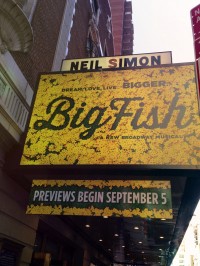
big fish signI’m in New York for two months as we get Big Fish ready for its Broadway debut. After five weeks of performances in Chicago and a summer hiatus, it’s terrific to be back in rehearsal with the same group of people I adore.

But it’s also strange.

In movies and television, once something is produced you never really get a second crack at it. If a movie is a hit, you might make a sequel. If a television show gets picked up for another season, you shoot new episodes. But you don’t get to go back and reshoot the pilot. ((An exception: the Buffy pilot. And that worked out pretty damn well.))

That’s the rare opportunity we have with Big Fish. I’m obviously focused on the writing side of it — it’s been a very busy summer for me and Andrew Lippa. But I see that same drive in every department, each one asking “How can we do that thing we did before, but better?” From sets to lighting to every step of choreography, we get the chance to assess and improve. It’s exhausting but amazing.

In software design, you call this iteration. You release and refine and repeat. Each generation builds on what came before. When it works right, the results seem obvious — *well of course it should be that way* — but you couldn’t see that when you started.

In TV and film, you don’t get much chance to iterate. Yes, you have all the drafts of the script, but with those you’re making changes to the *plan* for making the project. It’s only in the editing room that you can tweak and test. But by that point, you’re limited to what you shot. Extensive reshoots are rare and costly.

By contrast, iteration is very much the experience of making live theater. You do readings and workshops and finally get to the stage. Then every night, you’re putting on a show and seeing how it works. Every morning, you’re figuring out how to make tonight better.

And if you’re lucky, you get to stage the whole thing twice: once out-of-town and then on Broadway. We’re a much better show for our five weeks in Chicago, and the months we’ve had to regroup and rethink. We got to make version 2.0, and I’m ridiculously proud of it.

But we’re not done.

##Where you come in
One of the things that was most helpful to me during our Chicago run was that I had a lot of readers and podcast-listeners come see the show during previews. Having familiar strangers in the audience was comforting, and honestly, empowering — *those are my people in the balcony*. It also gave me a reason to escape the backstage whirlwind and socialize like an actual human being.

After the hellos and handshakes, I cut right to the chase: “What did you think? What did you love? Did something confuse you? If you had magic scissors, what would you take out?”

Granted, I could ask these questions of anyone in the audience, and believe me, I did. ((The luxury of being unrecognized is that I can start conversations in the lobby with folks who assume I’m just a fellow audience member.)) But my readers are smarter, or at least more sophisticated. I could dig deeper. I could drill down with follow-up questions: *At what point did you start feeling that way about that character? What if this happened first? Right now, at intermission, what do you hope happens next?*

We got solid reviews in Chicago, and endless helpful notes from smart people who see a lot of theater for a living. But the conversations I had in the lobby of the Oriental Theater with readers and listeners were some of the most valuable feedback of all.

So I want to do that again. I want you to come.

For Chicago, I asked the producers to give me a discount code for the first week of previews. For Broadway, I’ve convinced them to let me have **the whole four weeks of previews**, starting September 5th.

The discount code SCRIPT unlocks seats that are approximately half-off list price:

**From September 5th to ­October 5th**
$74.00 Orchestra and Front Mezzanine
$52.00 Mid-Mezzanine

**From October 8th ­to October 13th**
$85.00 Orchestra and Front Mezzanine
$62.00 Mid-Mezzanine

You can use the SCRIPT code both on [Ticketmaster](http://www.ticketmaster.com/Big-Fish-a-New-Broadway-Musical-tickets/artist/1859083?tm_link=edp_Artist_Name) (when looking at the seat map, click the “Got an Offer Code?” button) and in-person at the [Neil Simon Theatre](http://www.bigfishthemusical.com/tickets.php) box office on 52nd Street if you want to save the Ticketmaster fee.

There’s a chance that if we start selling way too many SCRIPT tickets, they’ll pull the offer — our producers are generous, but not foolish — so if you’re thinking about coming, don’t dally.

And if you’re coming, please let me know. You can [tweet me](http://twitter.com/johnaugust) or send an email to the ask@johnaugust.com account to let me know your date and seats. I’ll be here at least through the official opening on October 6th.

In Chicago, I tried to track down people where they were sitting, which was surprisingly difficult. What ended up working better was for people to wave me down. I look like myself — Google me — so if you see me, say hi. The lobby at the Neil Simon is incredibly small, so you’re more likely to find me in the house or on the street near the stage door. ((A note about the Neil Simon: the mezzanine is pretty great and really close to the stage, so if you can’t get orchestra seats, don’t despair about being up in the balcony. The first couple of rows are some of the best in the house.))

Unlike our five-week run in Chicago, the Broadway run is theoretically open-ended; we’re already selling a lot of tickets for the holidays. So if you can’t make it for previews, still come and tweet me what you thought. I’m eager for you to see it.

Scriptnotes, Ep 103: Disaster Porn, and Spelling Things Out — Transcript

August 15, 2013 Scriptnotes Transcript

The original post for this episode can be found [here](http://johnaugust.com/2013/disaster-porn-and-spelling-things-out).

**John August:** Hello and welcome. My name is John August.

**Craig Mazin:** My name is Craig Mazin.

**John:** And this is Episode 103 of Scriptnotes, a podcast about screenwriting and things that are interesting to screenwriters. Craig, three things I want to talk about today.

**Craig:** Very good.

**John:** First off something you suggested which was this interview that Damon Lindelof did about big movie stakes and story gravity which I thought was great.

**Craig:** Right.

**John:** I want to talk about this idea of spelling things out in dialogue, which is a thing that you sort of face at every stage in your career. And so let’s talk about what that actually means when someone tells you that they want to spell stuff out.

**Craig:** Yup.

**John:** And, finally, I want to talk about — as we talk about movies, why do we never read stories about what went right? We sort of only read stories about what went wrong. And sort of what that is and maybe how would fix it.

**Craig:** In my bones I believe this is going to be an excellent podcast.

**John:** I hope so, too. I’m a little better prepared for this podcast than I am for some, so I’m eager to get into this.

**Craig:** I am equally as unprepared for this as I am for all.

**John:** Yes, but sometimes you just wing it, and winging it is sort of the Craig Mazin way.

**Craig:** I’m more of a jazz podcast kind of guy. Yeah, absolutely.

**John:** [laughs] Your variations on a basic theme.

**Craig:** Yeah.

**John:** First, sticking with our basic themes, there is always some housekeeping and sometimes some follow up. Some housekeeping: we’ve sold quite a few of those 100 episode Scriptnotes USB flash drive thingies. So, basically if you have an interest in previous episodes of the show and you like maybe caught up with us in the eighties and would like all those first episodes, you can now buy them all on one little USB drive that you can stick in your computer and listen to — 100 hours of me and Craig talking through the things that I’ve carefully thought through and Craig has improvised.

**Craig:** [laughs] That’s a lot of haphazard, off-the-cuff theories and opinions.

**John:** We are taking orders for these little drives. They cost $20 apiece. We’re taking orders through this Friday. And then we’ll ship them two weeks later. So, if you would like one of these buy one now because I’m not sure we’re going to make any extra ones, so it’s good for you to buy them if you would like to buy them.

**Craig:** You’re like when Disney puts out the animated movie and says, “And this is it. For the last time ever…”

**John:** Yes. It’s your only chance to buy Pocahontas…

**Craig:** Ever!

**John:** …on DVD. That would maybe be okay. Or Song of the South which they never even actually release.

**Craig:** Song of the South, just as a side note, is watchable on YouTube.

**John:** How nice.

**Craig:** Yeah, the entire thing. And, you know, just as a side note again, I watched it because, you know, it’s a big part of Disney history.

**John:** Yeah, Zip-a-dee-doo-dah.

**Craig:** Yeah. And I was sort of curious to see if Disney was being a little fuss budgety about just pretending it didn’t exist anymore. And the answer is, no, it’s incredibly racist. [laughs] It’s so much worse than I could have imagined.

**John:** Okay, while we’re side-barring here, speaking about incredibly racist, have you seen Pinocchio, not Pinocchio, blah, Peter Pan? Have you seen Disney’s Peter Pan recently?

**Craig:** Recently, no, but I have yes.

**John:** “And it makes the red man red.”

**Craig:** Yeah, I know, it’s bad.

**John:** It’s bad.

**Craig:** It’s bad.

**John:** And that movie is out there in the world.

**Craig:** It is. Yeah, but the thing is it’s animated and there are humans in this movie, [laughs], that are being forced to portray… — It’s just bad.

**John:** It’s the Aunt Jemima problem.

**Craig:** It’s super bad. It’s no good.

**John:** So, let us return from our sidebar. Do you think our sidebar was on the left hand column or the right column?

**Craig:** I instinctively imagine sidebars on the right, but I’m Jewish and we tend to do right to left.

**John:** Okay. Let’s slide back left then and a common question about these little USB flash drives were selling — are the Three Page Challenge PDFs on them? Yes, they are.

**Craig:** Absolutely.

**John:** So, again, if a nuclear apocalypse happens and we’re all wiped out, or maybe zombies — it could be anything that actually wipes out all of humanity and our ability to access the internet, if you had one of these little drives and some sort of computer that was capable of reading them, like a laptop that you’re powering through some sort of pedal bicycle in a kind of Gilligan’s Island scenario, you would still be able to listen to all of them and be able to follow along on the Three Page Challenge which is I think really important as we’re rebuilding civilization that you have access to not just our words of advice but the words on the page that you can see why we were giving the notes we were giving about these Three Page Challenges.

**Craig:** I don’t know where it would fall on the hierarchy of goals, but certainly it would be probably between procuring food and medicine.

**John:** Yeah, I mean the shelter — the hierarchy needs is shelter, shelter and safety, right?

**Craig:** Yeah. Actually, I think food and water first.

**John:** Yeah, okay.

**Craig:** Then shelter. Then podcast. And then belonging.

**John:** Yeah. A sense of community. A sense of place.

**Craig:** Yeah, Maslow put our podcast somewhere in the hierarchy. I just can’t remember specifically where.

**John:** Yeah, it’s tough. We’ll ask her onto the show at some point to talk about it.

**Craig:** Yup.

**John:** Maslow is a she, isn’t it?

**Craig:** I believe it’s a he.

**John:** I could be wrong. Oh, I’m thinking of stages of grief. That’s a she.

**Craig:** That is a she. That’s what’s her face? That’s Kübler-Ross.

**John:** Absolutely. So, if we could only introduce Kübler-Ross to Maslow and have them combine things, put them together in a merger scenario would be fantastic.

**Craig:** They could discuss their hierarchies and steps all day long.

**John:** Very good. Another bit of follow up. At the same time we are selling these little USB drives, we’re selling off the very few remaining Scriptnotes t-shirts we have left. They’re almost all gone. Almost all of the normal sizes are gone. But if you are small person you’re going to find yourself in luck because as we’re recording this podcast the smaller sizes are what we have a lot of. And like one or two stray extra large extra-larges, or extra extra-larges.

That’s confusing. I’m not saying extra-extra-large. We have one or two extra —

**Craig:** Additional, you mean? You have one or two additional extra-larges.

**John:** Additional would have been the right word to choose for that because otherwise it was confusing. Thank you.

**Craig:** You’re welcome.

**John:** Thank you. A very good writer there.

**Craig:** There. [laughs]

**John:** [laughs] That one example, Craig. You have been tremendous help on this podcast.

**Craig:** At last.

**John:** Several people have written in saying you should sell other stuff, you should sell mouse pads, you should sell hats. Uh, no we shouldn’t.

**Craig:** Slow down folks.

**John:** I have learned a tremendous amount about the shipping of physical goods through this exercise, and I like to learn new things. And so I feel if at any point we decide to sell more t-shirts, or now we’re selling these USB drives, we’re better at it than we were four weeks ago. But it’s certainly not our goal. Our goal is to make movies and to some degree apps. It is not to sell t-shirts. T-shirts are just a fun little side thing.

**Craig:** Yeah, no mugs. No mugs for you.

**John:** No mugs for us. We have a bit of follow up. Last episode we talked about Daniel Loeb, the hedge fund investor who is telling Sony you have to split off Sony Entertainment and Sony Entertainment is going underwater because of these two big tanked movies. And George Clooney yelled at him and there was all that brouhaha.

A bit of follow up, a listener in Japan name Stevie — Stevie in Japan wrote: “Although George Clooney brings up valid points, Loeb’s actual aim of suggesting spinning off Sony Entertainment from the parent is to maximize the advantages of Sony Entertainment. It’s not that Sony Entertainment is unsuccessful, it’s that the parent company is unsuccessful. He describes Sony Entertainment as a hidden gem and that the Sony parent is relying on it for much of its profit. The other very successful arm is Sony Financial, I think. He suggests a breakup because the parent company is limiting the scope of what Sony Entertainment can do and has made it impossible for Sony Entertainment to be an alternative to the iStores or iTunes, and Netflix.”

**Craig:** Uh…no. [laughs] That’s not what he said.

**John:** Well, basically this is sort of the Japanese perspective. Let me get to the second paragraph. “Of course, Loeb could be playing Gordon Gekko and everyone. He supposes that Sony is undervalued and its breakup values much higher than the listed value. But his comments about the fundamental differences in the business culture between the parent and Sony Entertainment have gotten a lot of press here in Japan.”

**Craig:** Oh, okay.

**John:** So, Stevie is telling us how it is being portrayed in Japan where Sony is, of course, a very big and important company.

**Craig:** Yeah, it’s been a big subject in Japan ever since Sony bought Columbia and wrote of $3-point-something billion as part of its overinvestment.

**John:** My recollection is Sony bought it from Coca-Cola. Didn’t they own Columbia at that point?

**Craig:** No, I think…I read that book Hit and Run. I don’t remember who… — I think they were just their own company, I think.

**John:** Maybe. Anyway. Since we recorded the previous podcast the Sony board unanimously rejected Loeb’s idea of doing the spinoff and sort of wrote a very detailed letter to Mr. Loeb saying, “Thank you but no thank you for your suggestion.”

**Craig:** Yeah.

**John:** And then Loeb gave this interview with Variety, which coincidentally he owns a piece of.

**Craig:** Eh!

**John:** And so this is what Loeb wrote. “‘Notwithstanding the fact that the media likes to create a stir, I admire Mr. Clooney’s passion for Sony and his loyalty to Sony and his friends there,’ said Loeb, suggesting that he and Clooney share ‘a common goal’ and that ‘a more disciplined company with better allocation of capital means less mess money spent on bureaucracy and more investment in motion picture.'”

“We are all aligned for intelligent investment and creative content. I believe our interests are aligned in a way he probably doesn’t realize.”

Eh.

**Craig:** Yeah. Congrats on spinning your stupid statement that was either stupid or transparently manipulative. Either way, yeah, you know, we’re not necessarily financial geniuses here in Hollywood but we’re really good at words. And, no, you need a rewrite.

**John:** So, I think it fundamentally comes down to the question of is he really looking to improve Sony Pictures or is he doing what financial people do which is look at, “Can I make money by breaking this thing apart? Can I make money by gluing it back together?”

And there’s a long tradition of that in all corporations, but especially I think Hollywood corporations. You look at what’s happened with MGM and the travails of MGM over the years, essentially it’s been bought and sold, sometimes by the same people, multiple times within a decade. And so they’ll split off the library because it’s worth more separately. “Oh, no, let’s glue it back together because it’s worth more together.”

That’s just what they do.

**Craig:** Yeah, they will do that with companies that are vulnerable to that sort of thing. But you don’t see it at the big, long-standing stable companies that seem very allergic to the idea of fragmenting any part. If anything they want to consolidate everything. So, when you and I entered the business studios didn’t own networks. And now every network is owned by a studio. The consolidation is the name of the day.

This guy, I think what it really comes down to is he doesn’t really care about movies. He cares about whatever is going to lead his stock to be worth more and so he’s attempting to insert himself into a creative discussion about what movies will make more money because he thinks he knows the answer. And Clooney’s response, which was correct, is you don’t know the answer. And if you just shut up and let us do the movies that we do, you’ll be fine. You’ll be better off than if we listen to you. But unfortunately the people that make decisions have to listen to you, so would you please shut up?

**John:** Yes. I think that is a good summary of what Mr. Clooney said.

Speaking of Sony specifically, Sony is a hardware manufacturer that also owns a content business. And there would seem to be natural synergies there, but I don’t know that we’ve actually seen evidence of tremendously great synergies there. Not in music, not in movies. It’s one of those things like, well, this should work better together, and so far it really hasn’t worked better together.

**Craig:** Yeah. The only company that seems to truly capitalize on synergy — a terrible word that was invented a decade ago — is Disney. And Disney capitalizes on it because they’re the only entertainment company that actually has a brand, a significant meaningful brand to the consumer.

**John:** Yeah.

**Craig:** So, I understand when they take a property that they have at a theme park and they convert it into a motion picture and then convert it back into a television show and merchandise and a cruise experience, this all makes sense because Disney means something to the consumer. But Universal doesn’t mean anything to the consumer, and certainly Sony doesn’t.

**John:** And hardware has not been a Disney strength, either. People don’t remember that Disney actually tried to make phones and they also made like an ESPN phone. And those did not work well.

**Craig:** Right. Precisely. Yeah, because it’s not really — the Disney brand is connected to an experience. A family experience where parents and children can share an experience together in a safe way that doesn’t totally bore the parents to death and delights children.

**John:** Yes. And Sony is not that yet.

**Craig:** No, and never will be, because Sony — even when the marketplace was such that content needed to be played on devices, you know, in a way that they don’t, because even your laptop now can play this content. You don’t need a device. But everybody had Walkman and remember the Watchman. But the problem is that those devices rely on content, not Sony content, all content.

So, for device manufacturers, in fact, the broadness of application is the key, not synergy. Anti-synergy. Standards basically.

**John:** Standards help. All right, let’s go to today’s new business. First off was this article that you had said, “Ooh, we should talk about,” and I agree that we should talk about. So, there’s an article by Scott Brown, which was in both Vulture and in New York Magazine, the article headline was “Star Script Doctor Damon Lindelof Explains the New Rules of Blockbuster Screenwriting.”

And, Craig, why don’t you give me the highlights of this because this was your impetus.

**Craig:** Sure. Well, this is, I guess, one in a series of 14 billion articles that have come out in the last three weeks about Hollywood falling apart, even though it’s not. But it was unique because Damon who actually writes a lot of these movies is pointing out something that for a change is true and relevant.

What he’s saying is the problem with the bigness of movies isn’t what people think. What everyone else has been saying is the problem is financial, that the movies cost too much, and so if they if they don’t succeed they crater the studio and then the studio can’t make little movies, or they can’t make this kind of movie, or they’re going to drive the audience away.

And his point is none of that is in fact relevant or even true. His point is that the problem with the bigness factor is that it’s necessarily infecting, irrevocably infecting the way the stories for those movies must be written.

**John:** Here’s a quote from what he says in the article. “Once you spend more than $100 million on a movie, you have to save the world. And when you start there, and basically say, I have to construct a MacGuffin based on if they shut off this, or they close this portal, or they deactivate this bomb, or they come up with this cure, it will save the world — you are very limited in terms of how you execute that. And in many ways, you can become a slave to it and, again, I make no excuses, I’m just saying you kind of have to start there.”

**Craig:** Yeah, that’s right.

**John:** So, basically by saying like we are going to make a big giant tent pole movie, by its nature we’ve come to expect that the stakes in a big giant tent pole movie have to be sort of save the world stakes. And so to try to do anything that is not that gets met with huge resistance and fear quite early on in the development process. And through successive iteration will scale bigger, and bigger, and bigger until sometimes these movies are kind of absurd.

**Craig:** And when we say that the audience is feeling fatigued because they’ve seen a succession of movies this summer that have destroyed cities or chunks of the planet. The problem isn’t that “Hollywood has run out of ideas,” which you often hear. The problem is that the concepts of the movie require it. And I don’t think people understand this. When you’re a screenwriter you have to write within certain parameters.

Forget budget. I’m talking about creative parameters. If you had me a concept and say, “The concept is five of the world’s most powerful superheroes ban together and form a team to fight a threat,” creatively that threat must be enormous. One of the people on my little team is literally a god, and the other one is so strong that he can throw tanks. So, obviously the threat needs to be formidable or there’s no drama.

Well, what’s formidable? Somebody that’s even more powerful than they. And, well, what would that person do, rob a bank? No. The threat therefore must be concomitant with the hero’s and the heroism. And that’s what’s going on here. So, you know, for me when I read this I just though, first of all, I thought it was important that Damon did it. I was really glad that he did it because he is part of the machine of these kinds of movies in a very important way. But also in a smart way I think Damon kind of issued his own memo to Hollywood on behalf of all of us who are writing movies saying, “How about we become aware that this is a thing creatively so that we don’t just keep doing it blindly? At least if you’re going to make me do it, you acknowledge that you’re doing it.”

**John:** Yeah. Well, what’s happened is that there’s an escalation which is sort of natural where, you know, you were talking about the assemblage of super heroes. And Damon actually calls this out and says, “The Avengers aren’t going to save Guam. They’re going to have to save the world.” And so they can’t have a small challenge. They have to have a huge challenge because you’ve made these things so bad.

It’s also a challenge of sequels in that you feel this pressure to have to top yourself over what you did last time. So, whatever the big set piece was in this last movie, it has to be bigger than that.

**Craig:** Right.

**John:** You know, in the most recent Star Trek movie, the first Star Trek movie actually had more planets being blown up than the current one, but he says, “Did we have to have a gigantic Starship crash into San Francisco? I’ll never know. But it felt like it did.” And that was the issue of audiences approach these kind of big tent pole movies with a set of expectations. And one of those expectations for better or worse has been that big stuff needs to blow up. Big things have to be destroyed.

**Craig:** And that is leading us to an almost pornographic celebration of big stuff from a creative point of view, because the movies begin to stack up against each other. And there is a fear that you’re simply going to disappoint people if you blow up a smaller city than a big city. If I had just watched New York explode, it just seems like a little bit of a dramatic letdown to watch Portland explode. But, the truth is, I think, that we are collectively as an audience quite a long way from that day when we sat down in a theater, saw Jurassic Park, and went, “Oh my god!”

**John:** Yeah.

**Craig:** “Look, there are dinosaurs!” Right? We don’t have that anymore because we’ve seen it a lot now. We have become comfortable with the spectacle of impossibility. So, admittedly when I saw Pacific Rim on one level I thought, “Wow,” and on the level I thought, “Eh.”

You know? Okay, so, I get it. Yup, that is quite an accomplishment to show huge robots fighting enormous monsters, but on the other level, not enough.

**John:** I want to step back and look at some of our earlier blockbusters and figure out sort of if we can track where this pattern came from. I’ll start with Star Wars because Star Wars I think about as this classic hero story, this boy rises up and sort of has to learn who he really is and that destiny and he would restore balance in the force. But it does end up with blowing up the Death Star. And it does have that expectation of like that really big thing has to blow up and our hero has to do it. And if we don’t see the destruction of something giant at the end of that movie it wouldn’t be as rewarding.

**Craig:** That’s true.

**John:** I go to Indiana Jones and the end of Indiana Jones you have Indy and Marion, they’re tied there. So, he wants to save the girl, but it’s also you’ve got the Nazis and you know if the Nazis get this thing it’s going to be really, really bad.

**Craig:** But you don’t see anything other than about 14 Nazis dying.

**John:** Yeah, on a soundstage.

**Craig:** Right. On a soundstage. And even with the Death Star exploding, what you didn’t see, I mean, the sort of shocking moment of Star Wars is when they blow up Alderaan, you know, when they blow up a planet. But even that in a way what you didn’t get was what you get now where you’re on the ground and you see people vaporized and the buildings flittering —

To me, the moment I always think of is Terminator 2. To me Terminator 2 is the movie that sort of said, “Hey everyone, I’m so far beyond you. Look what I’m doing. And I’m going to blow up Los Angeles with a nuclear bomb. And I’m going to have this guy be liquid metal. And I’m going to do all this stuff. And I’m going to visually blow your minds.”

**John:** Yeah. But you also brought up Jurassic Park. And what I think is interesting about Jurassic Park is the dinosaurs don’t leave the island. And the goal of the heroes in Jurassic Park is not to stop the dinosaurs from taking over the world. It’s to survive.

**Craig:** Right.

**John:** And those stakes are very small and relatable and wonderful. And that’s a hugely successful movie.

**Craig:** Yes.

**John:** So, by creating a world in which there never was the expectation that they had to stop the dinosaurs from taking over the world, you’re able to keep those stakes really intense for the characters you actually know and care about and not have to destroy the pier. But then, of course, in Jurassic Park 2 you do destroy the pier.

**Craig:** Well, that’s the thing. I mean, look, what happens is as size escalates there is a certain antiseptic nature to the whole thing. Because on some level we understand none of it is real which is the death of drama.

I remember watching the Star Wars prequel, the first prequel, and the movie concludes with a fight between CGI creatures and CGI robots. And I just couldn’t feel anything. I couldn’t possibly feel anything. But, I think sometimes of the ending of the first X-Men movie. And that was very smartly done because even though in a sense the world was at stake because there was one of those silly movie gatherings of luminaries, and there was a beam that was going to turn them all into mutants and therefore the world would sort of head towards mutant-ville, it was all focused through the pain of a little girl and this unloved man who had formed a bond with her.

So, the managed to be both big and small. And I think if you can be big and small it’s okay. But if it just is about size, you got a problem.

**John:** Damon is also an interesting person to be talking about this issue with because of course he and Drew Goddard and Chris McQuarrie came onboard World War Z. And the third act of World War Z was originally huge. It was this giant battle in Red Square.

**Craig:** Right.

**John:** And it was apparently not what the movie wanted to be. And Damon in the article says that had he come in to write the first draft of it and had been the writer who got it into production he would have written that version.

**Craig:** Of course.

**John:** He would have written the version that was big at the end because you write big things for the end. What they discovered is that you stopped caring about Brad Pitt’s character in it and that what you really wanted was to see Brad Pitt succeed in a small, and relatable, and human way. So, all of the stuff in the end of that movie from the plane flight on, all the stuff at the CDC lab is small. And it’s contained and it’s very thriller personal stakes. And that it movie ended up working for, god bless it.

**Craig:** Yeah. I really liked it. And I particularly enjoyed the ending because I felt that once I had gotten through the sequence in Israel which was enormous that the movie itself was a little microcosm of what’s gone on this summer. Well, we just had this insane scene in the middle of the movie, I guess we’ll have to end really insane. At that point it’s so insane you just lose connection with it.

So they went the opposite way when they reconceived the ending and it worked great. And Damon is right; if you, or I, or anybody had come in, our instinct of course is you’re making a movie called World War Z. The climax needs to be WORLD WAR Z, not Laboratory Z.

**John:** Yeah.

**Craig:** But it turns out Laboratory Z was a little more human and more relatable and there is a good lesson contained in there.

**John:** Yeah. You would never have set out to write the movie with that ending because a lot of the stuff should not work — I’m going to go back and say I don’t think the ending is fantastic. I think the ending is good for what the movie needs to do. But, the idea that you would end up in a lab with a bunch of people you’ve never seen before and that’s going to be the end of your movie is not the idea you would set out to write. You would never set out to write that script that way.

**Craig:** Yup.

**John:** You would have found some way to make it more relatable to characters we’ve actually seen longer. But, it was a good, salvaged shot.

**Craig:** Well, if somebody had come to you and said, “Listen, I’ve been to the future and I know that you can — the audience can only withstand one massive sequence in this move. Go ahead and write it now. You would save that for the ending probably.

**John:** You would.

**Craig:** Yeah.

**John:** Yeah. Let’s move onto our second topic today which is the idea of spelling things out. So, this was sort of generated by a question that came in through the mailbag, but also based on a meeting I had this week with a studio about this book property to adapt. And it was an interesting difference between this is a book and there are certain things that are on the page in the book that work really well and certain things that felt a little forced because you’re just reading the same words again and again. There are like terms given to certain groups that made me feel like, “Oh no, I’m reading a very obvious parable about something.”

And so in doing it for the movie version I wouldn’t have to be so literal about that, which was going to be really useful. But an issue that we as screenwriters face on every script throughout our careers is how much information do we have to have characters say.

**Craig:** Right.

**John:** Or speak aloud so the audience will be able to follow along with what’s going on in the story. So, a lot of times we call this exposition, or if we have a character who is doing it too much we call him a plot-bot. But it can also be more subtle. So, I want to give you some examples of some more subtle things that happen.

You need to get out a specific thing about a character’s background. So, if you need to know that a character is a nuclear physicist who specializes in quantum gravity. Sometimes you find yourself having to get that spoken so a character actually hears that. Sometimes you need world background — why there’s a giant wall of ice in the north. Or, sometimes you need to make it clear to the audience what the limit of the character’s knowledge is, like, “I never actually saw my father die,” so you know what the boundaries are of what this character really does know and what you as the audience know that the character doesn’t know.

So, I want to talk about spelling things out and, Craig, how we make decisions about what needs to come out of a character’s mouth and what we could just let the audience figure out for themselves.

**Craig:** Well, part of the game is to figure a way to give the audience all the clues they need to solve the mystery. And every little one of these expository moments can be viewed as a mystery. Sometimes it doesn’t matter. Sometime a guy a walks in and he flashes a badge and says, “Lieutenant Smithers, LAPD.” That’s fine.

**John:** Yeah.

**Craig:** But sometimes you want somebody to convey information naturally because the two people in the scene know each other and probably know this information already. It’s just that we in the audience don’t. That’s where we start to feel that weird tension. And that’s where we find the clumsy exposition where people start sentences with, “As you know…” And we hate that.

So, the game is let’s seed in little clues that the audience can kind of put together either sub-textually or even if it’s just a visual thing that’s happening and have fun with that so we can do it in a way that is satisfying for them. They feel engaged. However, as a producer said to me just a couple weeks ago, sometimes you have to spell it out more in the script because people are reading it. And if they miss it because they’re not watching the movie and experiencing the puzzle the way it’s intended then they’re not going to enjoy the script as much. Good point.

**John:** Yeah. An example being like do we understand that the character has registered that thing we just saw in the movie? And so sometimes, visually watching the thing, oh, we clocked that he saw that and knows what’s going on. Sometimes in a script you will actually have to have him say or acknowledge that he saw something so that we know that he saw it and that can be frustrating.

An earlier point you made though I think is worth sort of underlining is that we have conflicting goals. We don’t want the audience to miss something important, yet at the same time every scene needs to be about what the actual characters in the scene want to do and are trying to do. And so if you try to wedge something in there that isn’t what the characters would naturally be talking about, that’s going to feel forced. And so finding that balance is really tough.

So, what you say about like a character introducing his name and showing his badge, well I believe that actually could happen in the real world so that I would totally accept and buy that. But no character wants to suddenly reveal that he was fired from his job for gambling. That’s just not a natural thing that’s going to come out. Unless you very specifically construct a scene so that he has to get that information out, which may work fine. But if the whole purpose of that scene is to get that piece of information out, then that character probably isn’t moving the story ahead in the way that the character would want to move the story ahead.

**Craig:** Yeah. And these moments, even when you’re scripting them, you can turn them to your advantage by essentially crafting them as little pieces of surprise. So, I’m thinking of The Ring. There is a moment where you suddenly are surprised by the fact that this man we’ve been watching and this boy who have had these weird encounters that have been mute and silent are father and son.

**John:** Yes.

**Craig:** And if it’s a surprise you’re actually allowed to be kind of overt about it because you’re fooling the audience and then pleasing them with this sense of suspense followed by surprise. But even within a scene, a man and a woman are in an office, they’re talking, and you know that it’s important to your story that they’re married, but you certainly don’t want to have somebody walk in and say, “Hi sweetheart, how are you? You’re my wife. Now let’s discuss business.”

So, there’s two lawyers arguing over something and they finish arguing and then they get up and then she kisses him on the mouth and says, “Pick up dog food on the way home.”

**John:** Yeah.

**Craig:** Just find ways to do that, but, you know, there are moments. I will say that my tendency always is to provide as little as possible and I never get the note, “You’ve spelled it out too much.” I often get the note, “You should spell out it more.” And my response to that note is always, “But did you know?” Because a lot of times producers or just people reading a script will presume that they’re the only smart one. And that’s not in fact the case.

**John:** Some other techniques which I’m not going to say are good or bad for getting this information out, but you will see them used and used effectively can help you. Have a character who is a proxy for the audience who knows as little as the audience knows.

And so Jurassic Park is a good example of this. We have to explain how dinosaur cloning works. And so David Koepp writes this terrific sequence in which the characters are shown this little movie that explains how dinosaurs are cloned. It’s funny, it’s witty, and it’s good, and it tells us everything we need to know.

The only reason that works is because we have characters who are coming into the environment with the same amount of information that we have. And so the new person into the world is often a conduit for getting all this information out. You’ll see this in TV pilots where it’s someone’s first day on the job and they’re being shown around and this is how it all works.

It’s kind of a clichéd scene, so if you can find a new way to spin it, you’re going to be better off. But it is a way of letting us sort of in to what this environment is and what the situation is.

It doesn’t have to be like a person who is brand new into the world. It might be like the “Hey, how are you,” first time they’re ever meeting, but a person who is not normally part of that world. So, someone else who is, you know, the sister who has come into this thing. I’m thinking about like Homeland where Carrie’s sister is a way of getting out information about how the agency actually really works because she’s not actually part of the agency normally.

**Craig:** Yeah.

**John:** Finding those sort of proxy characters for the audience can be a useful tool for doing it. But it’s tough and, you know, as you’re constructing your scenes, as you’re looking at the big outline either on the whiteboard or on the cards, you have to always be mindful of what will the audience know at this point. What is the audience expecting to happen next? And is there a way that you can use the audience’s expectation to sort of fill in those gaps?

If the audience expects that like, “Oh, I think they might be married,” then you have to give them a little thing to sort of prove that they’re married. And you don’t have to have this whole long explanation.

**Craig:** That’s right. And similarly if you feel like the fact that they’re married is something that the audience is too easily onto, then go the other way and then surprise. Always be surprising. In a way your relationship with the audience is a little bit like a judo match. They bring a certain weight of expectation to the experience of watching a movie. And your job is to use that weight against them.

**John:** Yes.

**Craig:** They like being thrown to the mat, basically.

**John:** Well, what I would say about expectation is that audiences are always going to have an expectation. They’re going to have expectations about genre. They’re going to have expectations about characters. Expectation about the kind of movie this is that they’re watching. And most of the time you want to meet their expectations, or hopefully exceed their expectations. But make them feel smart. Make them feel like, “Oh, I got it. I’m with it, I got it. I think it’s going to happen. Oh, and it happened. Oh, and it happened, that’s great.”

And then if they’re with you that way then you can pull the rug out from under them every once and awhile and surprise them.

**Craig:** Right.

**John:** If you surprise them every scene they’re going to stop trusting you. So, you have to sort of balance those two things of making the audience feel really smart and also making the audience feel rewarded for closely watching.

**Craig:** Correctamundo.

**John:** So, how do we, I don’t know, how do we advise people to talk about exposition then? What kinds of things do you think you have to have a character say? Can you think of any examples of things that characters need to speak aloud?

**Craig:** You mean exposition that sort of requires that sort of thing?

**John:** Yeah.

**Craig:** No, I don’t think so. I think ultimately there’s a visual way to do anything, or a conversational way. Two other people can comment on another person. There are moments, though, where you want them to say it out loud.

**John:** Yes. And an example I think of is when they articulate what the plan is for how they’re going to do something. You love to actually hear what the plan is so that if everything goes right you know what to look for. So, they’re laying out the roadmap ahead. And usually that’s a reasonable thing to do because the characters would need to do that. They would actually need to articulate what the plan is supposed to be.

You have to find the right moment to do it, because if they’re in the middle of it and then they’re suddenly talking through all this stuff that they should have talked about five minutes ago, that’s frustrating. But if going into something you see what the plan is supposed to be, that’s generally helpful and I believe that when I see it in a movie.

**Craig:** Yeah. Even then, though, if you watch Ocean’s Eleven you’ll see that Ted Griffin gives you only pieces of the plan. So, he actually again is kind of judo-ing the audience. He’s spelling it out overtly to make you feel like you just heard what the plan is. But you haven’t.

**John:** Well, what he’s done is he’s giving you little markers to show these are components of the plan. And then when you, you know, “We’re going to need a very limber guy” It’s like, well why do you need a very limber guy? We’re not going to tell you now, but now we know like, okay, we should look for that really limber Asian guy.

**Craig:** Sure.

**John:** And then when we see him again, “Oh, okay, that was part of the plan.”

**Craig:** But he also leaves out huge chunks like — spoiler alert — we’re going to build a fake version of the vault and we’re going to film ourselves robbing the fake vault on a soundstage.

**John:** Yes.

**Craig:** And then we are going to play SWAT team guys who come in and he’s literally going to call us and we’re going to rob the bank after he thinks he’s been robbed when he hasn’t been robbed. That’s just simply not articulated in the plan.

**John:** Because if it were fully articulated all the suspense of–

**Craig:** Movie over. [laughs]

**John:** Movie over, yeah. Like, you know, will it go? According to that, the plan was too detailed.

**Craig:** And that’s why I think even when you’re spelling out a plan, don’t spell out everything. Just give us what we need to know but don’t be afraid to cheat a little bit. I mean, stylistically that’s the beauty of editing. You don’t know that the camera was there for the entire conversation. Obviously it wasn’t.

**John:** Let’s move onto our final topic of the day. This is about what went right. And so this actually is based on an email interview I did with Scott Brown who is the same guy who wrote the Damon Lindelof article. So, he was interviewing me to talk about sort of the summer’s movies and sort of what went wrong. And so I sort of challenged him back to say, yeah, okay, I get why you’re writing this article, sort of. But I also never see the articles about what went right.

And so it feels like it’s become the air duct of entertainment journalism is we just keep writing the same story. We keep writing the same story of like, you know, movies cost too much, ticket prices are too high, everything used to be better back when, and Hollywood is doomed. We keep writing that same story. And the story we always write though is what went wrong and we never actually write the stories about what went right.

And, honestly, a small exception to that is World War Z which is one of the few stories you’ll read in the popular entertainment press about like this presumed disaster sort of righted itself. But I think the only reason we’re reading about it is because it was supposed to be a disaster.

**Craig:** And we’re reading about it because they wrote about it and they were wrong. The amazing thing is they create this thing that simply is unrelated to the movie itself. They didn’t see the movie. They’re just creating this thing — oh, there’s trouble, we hear there’s trouble, there’s supposedly trouble, it’s a disaster because we believe it’s a disaster and now we’re saying it’s a disaster so it’s a disaster. And we just read other people saying it’s a disaster, so let’s repeat that it’s a disaster.

And then a news story comes along. Wow! How about that? It’s not a disaster. That’s an interesting story. No, it’s actually not. All you needed to do was not write the first story and then you wouldn’t have to write the second story. You’re now writing stories to answer your own stories. It’s gross.

And similarly this pattern of, well, what went wrong? Uh, I don’t know, the same thing that always goes wrong: some of the movies don’t work. I mean, hasn’t this happened every summer since the beginning of movies?

**John:** Well, I think we’re treating failure as an exception rater than failure as sort of like the normal state of things.

**Craig:** Yeah.

**John:** It’s the wild successes that are the exceptions. It’s the things didn’t go as well as we’d sort of hoped they would go is the norm actually. And when they go just a little bit wrong, they still make money. When they go really wrong, then they lose money. But failure is kind of the normal state for what this is. And we don’t ever want to acknowledge that.

So, I think back to the R-rated comedies of the summer. And the R-rated comedies of the summer did really well.

**Craig:** And continue to.

**John:** Hangover 3 did great. The Heat did great. We’re the Millers is doing really well. And I don’t think we’re going to see stories about how amazing these movies did because that’s not a doomsday scenario. There’s nothing —

**Craig:** It’s boring, yeah. It’s boring. People, you know, give them dirty laundry. So, let’s just refer to the book of Don Henley here. That’s what interests people. If it bleeds it leads. And in the entertainment journalism version of that is if it fails it sells. I had to do like a southern accent to make the run.

**John:** Or you can make sails like a sail boat.

**Craig:** Right. If it fails it sails. Exactly. So, you know, and of course underlying all of it is the fact that the chattering classes have a contempt for Hollywood and popular fare anyway. They have a contempt for movie studios. They love movie stars who speak their mind in concordance with the chattering class topics.

But, they hate Hollywood studios and they hate big Hollywood movies and they hate popcorn movies. And so this is fun for them. They delight in it. They get angry when a lot of these movies do well, frankly. They get confused. They’re still wondering why people showed up for the second Pirates movie, you know?

**John:** Yeah.

**Craig:** So, that’s what sort of fuels a lot of it is a general sense of resentment and bad faith combined with a delight in the thought that Hollywood would collapse under its own weight and return to what they believe the ’70s were, the worship of the ’70s, or as I like to put it, the worship of 2% of the movies that were made in the ’70s.

**John:** Yes, it’s that golden age fallacy of all the movies when I was young were amazing because I only remember the good movies when I was young. And you didn’t see the other 97% which were not.

**Craig:** Endless crap. Yeah.

**John:** Yeah. Specifically this summer there is a lot of talk about, oh, the sequels aren’t working or it’s all sequels and there’s this whole problem. And yet Fast & the Furious did tremendously well.

**Craig:** Huge.

**John:** And I don’t see anybody talking about that now.

**Craig:** Or Iron Man 3.

**John:** Or Iron Man 3. Another huge hit.

**Craig:** Huge.

**John:** You don’t see people talking about that now. They’re only talking about like these last couple of movies that didn’t work or like there are no movie stars left. Well, okay, fine, but maybe that’s because you’re sort of only talking about the movie stars.

**Craig:** Right.

**John:** Even if you go back to Damon Lindelof and World War Z or –there are a few writers whose names are actually sort of mentioned in relation to their movie, so Joss Whedon is, J.J. Abrams is, Sorkin, Lindelof. I think the only reason you see their names mentioned is because we already knew who they were. We already knew who Damon Lindelof was because of Lost. And that’s the reason why you see his name brought up so often in relation to World War Z and not Drew Goddard or Chris McQuarrie who are just not the profile of Damon Lindelof.

**Craig:** Well, and also Damon chose to talk to Vanity Fair when they did their big article and Chris and Drew didn’t. And so that was part of it, too. And also Damon is kind of an interesting public figure. He’s made a public figure of himself because he likes engaging the media on his movies, for better or for worse. And so they feel like now that’s somebody they can — they’re very simple. I mean, the media’s understanding of how Hollywood works is a child’s understanding of how it works.

**John:** Yeah. But here’s where I’m trying to get to with the point of these sort of star writers is that I really think that’s a carryover from television, is that I think ten years ago we started to notice who TV showrunners were. We started to notice who Aaron Sorkin was, who Shonda Rhimes was, you know, Joss Whedon and J.J. Abrams — showrunners.

And so we started to see their names in popular entertainment press. And now that some of those people have moved into movies, if we see that they’re associated with a movie, we assume that they are the showrunner of that movie. And so therefore we want to talk to that person as if they are the showrunner of the movie. And as we talked about before with Screenwriters Plus, sometimes they kind of are a little bit more of a showrunner. They’re doing more than just writing the movie. They’re producing in a meaningful way.

But we associate them strongly with a movie because we actually already knew who they were. You look at Fast & the Furious 6, Chris Morgan wrote that. You never see anything written about Chris Morgan writing that. Look at The Heat, Katie Dippold, I’ve seen nothing about her and that was one of the biggest movies of the year. And that is singularly her movie.

We see writing about these writers because they were already famous. It’s the sort of self-fulfilling prophecy. Because they already are famous, anything they touch that does really well or doesn’t do well, they’re going to get more press about it.

**Craig:** And ultimately the attention is irrelevant. The attention that we get and the attention that directors get is dwarfed by the attention the actors get. I don’t — I know the media is into it, but, you know, I mean, Brad Pitt and Melissa McCarthy are names on the tips of everyone’s tongue, not necessarily Damon Lindelof or, I don’t know.

**John:** Here’s where I disagree when you say it doesn’t matter. I think it does matter for the perception of what a screenwriter does and what a screenwriter’s responsibilities are. Because I’ve long maintained and even — I don’t think statistically I can prove this, but you will see that every great movie just happened and every bad movie had a bad script. And every bad movie had a bad writer kind of behind it.

And I think that’s become sort of the narrative. Like if a movie doesn’t do well, it’s because of the script. And if a movie does great, you never hear about the script. You only hear about how good that actor was in it, as if they sort of made up all their lines themselves.

**Craig:** Yeah, That’s true. And I don’t know — I guess all I can say is that for me it’s — there’s nothing wrong with, even toiling in obscurity and success and being called out in failure, if along with that the people that make decisions about how movies are made don’t care. That’s the big one. And I don’t know if they do. I don’t think studios really care that Damon gets — that they blame Prometheus on Damon Lindelof. They don’t appear to care at all.

**John:** They don’t care at all.

**Craig:** Yeah.

**John:** But I come back to that showrunner idea, and I think maybe the closest we really have in the feature world for showrunners has been the writer-director. And you look at the people who have been making interesting movies the last couple years, I look at Rian Johnson who is that guy. He’s the writer-director. You look at Chris Nolan, who even if he doesn’t write everything himself, is very intensely involved in the very genesis of the idea. That’s who — I feel like that’s who we need to spotlight if we’re going to get people to pay attention to the good contributions of writing to movies.

**Craig:** In the end I think that you have more faith in the media righting their ship and doing a good job of reporting on this stuff than I do. I just think they’re dopes. Of course, the feeling is mutual. [laughs] So, there you go.

**John:** There you go.

I think it’s time for some One Cool Things.

**Craig:** Woo-hoo!

**John:** Woo! I can go first or second. Your choice.

**Craig:** You know me, I remain passive.

**John:** All right. I will go first. So, my One Cool Thing this week is kind of self-serving but it’s also hopefully generous for our listeners.

So, I am in New York for 11 weeks to get Big Fish, the Broadway version of Big Fish up on the stage and out into the world, which is very exciting. It’s been a very long nine years to get to this point.

So, back in April we did our run in Chicago which was exhausting and fun, but one of the most things about it was I had a bunch of listeners come to see the show. So, I had a couple hundred people who came over the four week run, which was great.

And part of the reason we were able to get those people there is because I asked the producers to give me a promo code so they could get discounts.

**Craig:** Okay.

**John:** And so I went back to the producers and said like, hey, for Broadway can we do this? And they said, “Eh, maybe, maybe, sure, sure.”

So, I said for Chicago I could only get the discount on the balcony seats and that theater was huge and those balcony seats were a very long way from the stage. So, I asked could we get like for all the seats in the house and they said, “Okay, sure, we can do that.” And not only for Ticketmaster but actually at the box office.

So, now if you would like to come see Big Fish during its first month of previews, you can do so for quite a lot less. Big Fish starts previews on September 5, 9/5. And so for the orchestra seats and for the first part of the balcony, the mezzanine, it’s half-off basically.

**Craig:** Nice.

**John:** So, $74 versus $150.

**Craig:** Nice.

**John:** If you want a little bit further back in the balcony, it’s about a third off the price. So, it’s $52 for those seats.

**Craig:** That doesn’t make any sense. If you’re giving them good seats for $75, don’t save the $23 or whatever.

**John:** Yeah, I think you’re probably better off getting the 74. I think you kind of want to be on the floor. Although, so now having actually been in the Neil Simon Theater. It’s so much different than our Chicago theater. Our Chicago theater was huge.

**Craig:** Broadway theaters are small.

**John:** They are small. And so by seats the Neil Simon Theater is about a third smaller than the Oriental Theater is. But by actual volume it feels like half the size because it’s just crammed so much tighter together.

**Craig:** Yeah, everything — but I like being level with the show. It’s that looking down on the show that bugs me.

**John:** Yes. So, I will say that the first row of balcony in New York is probably better than the best seats were in Chicago, which is kind of amazing.

**Craig:** Wow.

**John:** So, you won’t get a bad seat in this house because it’s nice and small. If you want to come see the show, get tickets because they will at some point not be available. September 5 is first performance. You can go to Ticketmaster Big Fish Broadway if you want to do it online. If you want to come by the theater box office, that is at the Neil Simon Theater on 52nd. The promo code, I believe, is SCRIPT. I will correct this in the podcast if it is not SCRIPT. But that should be the one that gets you your discount.

So, we officially open October 5, or October 6, which is a month after our previews. At that point all the ticket prices go up like ten bucks, but for that first week you can still come and see us. So, please come.

**Craig:** I was spending some time yesterday with Aline and she and I — we’re figuring out how to get out there to see.

**John:** Very nice. I would love to have there.

**Craig:** The previews are — I mean, are you still tweaking, or is this really just about tech previews?

**John:** Previews are still tweaking. The luxury of having four weeks in Chicago is we could do a lot of tweaking. And so the show is I think honestly a lot better. And better in ways that I would never have been able to anticipate if we had gone straight to Broadway. Because there are things you recognize. It’s like as if someone said to you, Craig, like, “Hey, we just had a test screening for The Hangover. Do you want to go back and reshoot? Anything you want to reshoot? Anything you want to do, go for it.”

**Craig:** Yeah, ooh.

**John:** By god, you would love that chance. And so that’s what we’ve had the chance to do. So, we did some tweaking while we were in Chicago, stuff we could do on stage during our limited afternoon rehearsals. But over the summer there were bigger things we wanted to change around and move. We have new songs. We have new ways that stuff works. And that’s great.

**Craig:** But I’m not going to see a greatly different show in previews than I would once it has its official — ?

**John:** No. It will be the same show. It’ll be nicely put together and worth every penny.

**Craig:** Great. Plus I get to sit next to the creator of the show, the author of the book.

**John:** Yes.

**Craig:** That’s pretty cool.

**John:** And next to Aline Brosh McKenna which is honestly sometimes more rewarding.

**Craig:** Always rewarding.

**John:** What I will say, whether you’re coming with the special promo code or jut some other time coming to see the show before opening, send an email to Stuart and let him know that you’re coming. Because if I have a chance to find I will find you. The lobby is so much smaller in this theater than the old one, but I will somehow track you down.

**Craig:** I love New York. It’s tiny. I mean, it’s a big city and it’s a tiny city. Great. I’m looking forward to it. I’m really excited for this. And I’ve just got a good feeling, you know? I’ve got a good feeling.

I don’t look at reviews, as you know. I just have a good feeling about the show. I feel like you’ve done it the right way. You have a great, great partner in Lippa. He’s so talented. And I like that you guys didn’t just like jump from a really tiny — sometimes shows go from — I saw a show recently that went from La Jolla to Broadway. It just seemed a little kooky.

I like that you were in Chicago. I mean, you’ve got a great cast. It just feels like everything is right.

**John:** I think everything is right. And one of the things I’m sort of trying to emotionally prepare myself for is like everything can be right and we could run for ten weeks, or ten years.

**Craig:** That’s right.

**John:** And some of that is just out of my hands.

What is strange — and this is my last sort of plug for the show — with a movie, like if you don’t see a movie, well you can catch it on DVD. If you don’t see this show while it’s on stage in Broadway, you may never sort of get the chance to see it, or at least not see it with the A-level team and cast because this is sort of the one chance. And we hope to be running for fifteen years like wicked. But realistically that’s probably not going to happen. So, come see the show as soon as you can.

**Craig:** Yeah. That’s right. Well, I’m very excited. And I’m hoping that I can time it so that I can see the show with Seth Rudetsky, my best friend Seth Rudetsky, but I suspect that Seth sees every show like in the first week.

**John:** Yeah, he probably sees opening week.

**Craig:** Well, I’ll make him go see it again with me. How about that?

**John:** Yeah, do it.

**Craig:** Okay. Terrific.

So, my One Cool Thing is a person. I had a really interesting day yesterday. The producer Lindsay Doran had this fascinating gathering of people at a home in Hermosa Beach. And the whole day was really just a discussion of creativity and it was led in part by this brilliant man named Marty Seligman who basically there are chapters about him in psych textbooks.

He famously coined the term “learned helplessness” to describe the nature of depression. And his new thing lately is creativity and questioning whether or not we can teach creativity, enhance creativity in people. It’s an interesting line of inquiry. And so we had this day where we all just talked. And there were very cool people there. Aline was there. Lord and Miller, the guys who did the terrific 21 Jump Street and also Cloudy with a Chance of Meatballs. Really cool guys. Jen Celotta who is a former showrunner of The Office. Just neat people like that.

But the person that made me the happiest was a guy I didn’t even know. His name is David Kwong and he’s a very unassuming guy, just sort of sitting there. I didn’t know who he was. And he got up to talk about what he did. And he’s a magician. And I thought, okay, that’s cool. I like magicians. They’re impressive. And he was super impressive. I mean, his tricks were remarkable. He did a bunch of close-up magic for us, it was great.

That aside, I’ve seen awesome magicians before. It’s great, but it doesn’t change my world. No, what made me fall in love with this man was that he is a huge crossword puzzle guy. And in fact he has written a number of crossword puzzles for the New York Times. And I don’t know if you know this but I do the New York Times crossword puzzle every day.

**John:** I can believe that. It’s not surprising to me. I didn’t know it, but it’s not surprising.

**Craig:** Every day. I am a crossword puzzle connoisseur. I only do the New York Times crossword puzzles. And I love them. And, in fact, he mentioned — he started to describe a Sunday puzzle he did and I stopped him. I’m like, “I did it. I know exactly what you’re talking about. It was great.” It was an amazing Sunday —

So, the Sunday Times crossword puzzles have themes and a lot of times, there’s always some sort of gimmick. And sometimes they’re simple gimmicks like word play gimmicks. And sometimes they’re more involved. And he created one that was so brilliant. The theme was basically, it referred to Mad Magazine. And in the end you did a fold in.

**John:** Ah!

**Craig:** And I like the Mad Magazine fold-ins to create answers to certain starred clues. It was really smart. I was just very inventive and I love that. So, I got super excited. However, what’s so cool and we’re going to put a link to it is that he does a particular trick that isn’t even a trick. Well, it’s a trick, but god, it’s so amazing.

In part of his show what he does is first he does a deal where he fans the deck and he has somebody pick a card. He doesn’t see it. They show it to the audience. They put it back in the deck and he puts the deck away. He moves onto a bunch of other stuff.

Then, he does this bit where he creates a crossword puzzle right in front of you using words that the audience is suggesting, which is already remarkable. To create a crossword puzzle is a very complicated thing.

Well, he starts with this 15×15 grid and he follows the rules of American crosswords which is that all words must be three letters or more. It has to be rotationally symmetric in terms of where the black boxes go. There can’t be too many black boxes. They can’t be clumped together in any particular way. So, all these rules.

And the thought of just creating on the fly a crossword puzzle from random things people are shouting out is amazing. He does it and then when he’s done, as if that weren’t impressive enough, he has embedded the card —

**John:** The card, yeah.

**Craig:** Running diagonally through the puzzle. And it’s just mind-blowing. And the truth is, the only trick part is that he knows what card that person picked. The other stuff isn’t a trick. It’s just a fascinating Rain Man like ability to manipulate words in a way that is just awesome to me. Awesome.

So, his name is David Kwong. He does magic shows around… — I believe he does a standing once a month appointment at the Soho Club here in Los Angeles. Brilliant guy. Super nice guy. Check out this video of what he does. It’s astonishing.

**John:** That sounds great. Craig, thank you again for a fun podcast.

**Craig:** Thank you, John August. Thank you.

**John:** And I’ll talk to you again next week.

**Craig:** Awesome. Bye.

**John:** Bye.

LINKS:

* Scriptnotes First 100 Episodes flash drives [are available until Friday, 8/16](http://store.johnaugust.com/)
* Daniel Loeb’s [Variety interview](http://variety.com/2013/film/news/exclusive-interview-daniel-loeb-vows-to-end-sony-spinoff-quest-at-least-for-now-1200572856/)
* Vulture: [Star Script Doctor Damon Lindelof Explains the New Rules of Blockbuster Screenwriting](http://www.vulture.com/2013/08/script-doctor-damon-lindelof-on-blockbuster-screenwriting.html)
* Use discount code SCRIPT for a deal on select [Big Fish on Broadway tickets](http://www.bigfishthemusical.com/) (And be sure to [tweet](https://twitter.com/stuartfriedel) or [email](mailto:ask@johnaugust.com) Stuart and let him know when you’ll be there)
* David Kwong’s [crossword puzzle magic](http://www.youtube.com/watch?v=U1VPUZDr-fY) will blow your mind
* Outro by Scriptnotes listener Bryan Duke

Disaster Porn, and Spelling Things Out

Episode - 103

Go to Archive

August 13, 2013 Broadway, Film Industry, Follow Up, News, Scriptnotes, Story and Plot, Transcribed, Words on the page

John and Craig discuss Damon Lindelof’s interview about how plot stakes have escalated lockstep with budget, perhaps to the point of absurdity.

Then it’s a look at why screenwriters get the note to “spell things out,” and the situations in which it’s okay or troubling to have characters speak story points. Finally, we tackle the media’s obsession with Hollywood’s demise, and why you never read a story about “what went right.”

All this, plus hedge funds, Big Fish discounts and crossword magic in the new Scriptnotes.

LINKS:

* Scriptnotes First 100 Episodes flash drives [are available until Friday, 8/16](http://store.johnaugust.com/)
* Daniel Loeb’s [Variety interview](http://variety.com/2013/film/news/exclusive-interview-daniel-loeb-vows-to-end-sony-spinoff-quest-at-least-for-now-1200572856/)
* Vulture: [Star Script Doctor Damon Lindelof Explains the New Rules of Blockbuster Screenwriting](http://www.vulture.com/2013/08/script-doctor-damon-lindelof-on-blockbuster-screenwriting.html)
* Use discount code SCRIPT for a deal on select [Big Fish on Broadway tickets](http://www.bigfishthemusical.com/) (And be sure to [tweet](https://twitter.com/stuartfriedel) or [email](mailto:ask@johnaugust.com) Stuart and let him know when you’ll be there)
* David Kwong’s [crossword puzzle magic](http://www.youtube.com/watch?v=U1VPUZDr-fY) will blow your mind
* Outro by Scriptnotes listener Bryan Duke

You can download the episode here: [AAC](http://traffic.libsyn.com/scriptnotes/scriptnotes_ep_103.m4a) | [mp3](http://traffic.libsyn.com/scriptnotes/scriptnotes_ep_103.mp3).

**UPDATE** 8-15-13: The transcript of this episode can be found [here](http://johnaugust.com/2013/scriptnotes-ep-103-disaster-porn-and-spelling-things-out-transcript).

Scriptnotes, Ep 102: Hits, misses and hedge funds — Transcript

August 9, 2013 Scriptnotes Transcript

The original post for this episode can be found [here](http://johnaugust.com/2013/hits-misses-and-hedge-funds).

**John August:** Hello and welcome. My name is John August.

**Craig Mazin:** My name is Craig Mazin.

**John:** And this is Scriptnotes; it’s a podcast about screenwriting and things that are interesting to screenwriters.

Craig, it’s been 10 days as we record this since our live 100th episode. How are you feeling about it now in the aftermath?

**Craig:** Well, I feel great. I mean, we had a great time. That went great. I mean, it’s a little sad now suddenly to be doing it the old way, you know, just you and me, quietly.

**John:** I’m kind of enjoying it though. It’s nice to have total control over things.

**Craig:** True.

**John:** Because what people probably don’t understand is that the live crowd was amazing and like it was great to be in that space, it was a nightmare to edit that episode. And poor Stuart lost his mind because you were the one who sort of noticed, “Oh, there’s sort of a buzz in the speakers.”

**Craig:** Yeah.

**John:** So, before the audience came in, Craig was standing at the speakers, trying to get the stuff to deal with the sound guy to make it all sound good. And we thought like, oh, it’s a speaker problem, it will be fine. But actually it was a soundboard problem. So, there was a hum in the soundboard and so our recording was bad. So, we had to take that out and then we had to make the crowd sound good. And then everything kept falling out of sync.

**Craig:** Ooh.

**John:** So, poor Stuart; he had a rough time. But I was delighted with the end result of the episode.

**Craig:** Yeah. I mean, that aside, and listen, it’s very easy for me to carve Stuart’s pain out of my sphere of acknowledgment.

That aside, it was a great crowd. Obviously the venue was terrific. Bettina and Greg over at the Academy did a terrific job on our behalf. And we had great guests. And it was just a terrific crowd. I stayed pretty late. I didn’t close the place down or anything, but I stayed late talking to people.

Everyone was — with the exception of one person — everyone was incredibly well behaved.

**John:** I do want to talk about behavior, because I noticed also that people were so much better behaved after this than other sort of live things.

**Craig:** Yes.

**John:** Probably because I think these were our people, so they had come specifically to see us. And so therefore when we were shaking hands afterwards, they would do like that 30 second thing rather than the five minute “let me tell you all about how I am and what my life story is.”

**Craig:** Right. Or the “follow you around” thing, or the “suddenly there you are again” thing.

**John:** Yes. People were terrific and I really enjoyed that.

**Craig:** Yes. They were. They were great.

**John:** A few things to follow up from the 100th episode. First off, Matt Smith was the guy who won the Golden Ticket.

**Craig:** Congratulations Matt.

**John:** He had the ticket underneath his seat. He apparently just sent in his script to us, so we will be taking a look at that.

**Craig:** I saw his tweet. Yes, very exciting.

**John:** So, we will take a look at it. If it seems like the kind of thing which would be appropriate to discuss on the air, we will discuss it on the air if he agrees to that. I noticed he also has a podcast, so he may actually be a person who could even join us on this. So, we’ll see how that all works out.

**Craig:** Very good.

**John:** Today, I would like to talk about some developments at Sony Pictures.

**Craig:** Yeah.

**John:** You actually sent me an article and I think there’s two interesting things that have happened at Sony Pictures that we need to talk about.

**Craig:** Good.

**John:** I want to look at three Three Page Challenges.

**Craig:** Great.

**John:** It’s been awhile since we’ve done that. And, as always, we have to do some housekeeping. So, here is some housekeeping for today. People have been writing in saying, “Hey, you referenced the Raiders episode, or I see that there’s only 20 episodes available in iTunes, where are all the back episodes?”

The truth is the back episodes have always sort of been on the site at johnaugust.com. But we don’t put that whole feed through to iTunes just because it overwhelms things and makes it hard to sort of process stuff. I asked Stuart and Ryan to figure out if we were to take all the episodes, both the normal m4a, which is on iTunes, or the mp3 which some people need, we took all those episodes, took the transcripts, took all the Three Page Challenges, how much space would that be. And they came back to me and said it’s a little bit under 8GB.

And so I said, you know what, let’s just put that on a USB flash drive so people can buy that if they wanted to.

**Craig:** Nice!

**John:** And so we’re going to do that. It turns out we can actually stick them all onto a little drive. So, if you are a person who has come in late to the podcast and want to catch up on back episodes, or if you just want to go back and have easy reference to them, or have them all in one little place, you can buy that. So, we’re going to start selling that today, as of this podcast.

**Craig:** And how much would that cost?

**John:** That will cost $20.

**Craig:** Ooh! I like it. $20 for the whole back catalog.

**John:** You get the entire catalog of Scriptnotes for $20. And the thing that Nima pointed out — Nima Yousefi, who is my third employee here — the drive itself is actually like a pretty good useful drive. So, even if you just want the drive, you dump all the episodes onto your hard drive, then you have an 8GB flash drive which is super useful.

**Craig:** Normally that’s like ten bucks anyway.

**John:** Yeah.

**Craig:** That’s awesome. And please assure me, as you always do, that we’re not actually really making money off of this.

**John:** No. Basically it will cover our costs and it also pays for stuff like the server and for the other little things we need to do like transcripts, which is an ongoing cost for us.

**Craig:** Does any of it get converted into food for Stuart?

**John:** You know, it probably does hopefully get converted into some type of food, some coffee, some —

**Craig:** I like to call that Stuart Feed.

**John:** Yes. [laughs]

**Craig:** Comes in a huge bag.

**John:** You scoop it out. You put it in a bowl.

**Craig:** You put it in a bowl. It clanks —

**John:** If he’s really good then you sort of wet it down and soften it for him.

**Craig:** Or, well, if he’s really good then there’s like a special Stuart treat. But you can only do like three or four of those a day or else Stuart has gastrointestinal problems. I mean, really, Stuart is best with just his feed, twice a day, in a bowl.

**John:** Yeah. I find it so weird that we talk about him and then he has to edit these podcasts.

**Craig:** [laughs] I know. It’s the greatest! It’s the greatest. And he can’t get rid of this. Because the cool thing about Stuart is he knows that this is the best. This is really why people show up. He is, god, what are we going to do if something should ever happen to Stuart?

**John:** Well, Stuart will become tremendously successful. I mean, that’s a thing that’s going to happen. And so at some point he will move on, and it will be sad, but it will be good.

**Craig:** It will be good.

**John:** Progress is progress.

**Craig:** Do you think one day, maybe like 80 years from now, when Stuart finally passes away, that he’ll just disappear and his clothes will just flop away. And then you look up and there will be a new star in the sky?

**John:** It’s entirely possible that he’ll be raptured. He could be raptured this very week.

**Craig:** [laughs] Stuart would be… — Let me tell you something. The worst part of the Rapture is that we’ll lose Stuart. That’s the worst thing. That’s the worst thing. Most everybody else I know will be right here with me.

**John:** So hopefully the Rapture won’t happen in the next ten days, because it’s ten days from now that you have to order the USB drive.

Basically we’re going to take preorders for ten days and then we will make them and then we will ship them out. And so I can’t promise that we’ll make any extra ones. So, if you would like one of these things, you should do it within the next ten days by Friday, August 16th, that would be. Because then we’re going to make them and we’re going to ship them out and that’s probably going to be it. So, that is the hope to get these 100 episodes out the door in a handy package form.

**Craig:** I just have to say, the thought of Stuart being raptured and the smile on his face as he hurdled towards heaven would just be — I just love it. I just love him just hurdling nude towards heaven.

**John:** Did you see This is the End?

**Craig:** No, I haven’t seen it yet. But I heard it’s really funny.

**John:** Yeah. And so the Rapture, of course, is a central idea within it. And it’s nicely done.

**Craig:** Yeah, I got to check it out.

**John:** Yeah. Jews being raptured.

**Craig:** Ha, ha, ha, that’s ridiculous.

**John:** Also, at the same time that we’re going to be selling these USB drives, we have a few — and seriously just a few — extra t-shirts that we will put up there. So, quantity is incredibly limited; some sizes are there, some sizes will not be there. But, if you wanted a t-shirt and didn’t get in on the t-shirt thing the first time through, there are a few t-shirts left.

We’re also going to be putting up some Karateka t-shirts that we just have sitting around and someone should wear it because they’re cool. So, all that stuff is $20 apiece. It’s at store.johnaugust.com. So, get that stuff if you want it.

**Craig:** Sweet.

**John:** Cool.

Today, let us talk about Sony Pictures and what’s going on with Sony Pictures.

**Craig:** Yeah.

**John:** You had sent me this article specifically about this investor guy, but essentially some backstory here, Sony Pictures is Columbia Pictures and TriStar pictures. But TriStar Pictures has been sort of inactive for a long time.

**Craig:** Right.

**John:** There’s also Sony Pictures Classics, which I think still exists? I’m never really quite clear what they’re doing with Sony Pictures.

**Craig:** Sony Pictures Classics, I think has — I don’t think they’re still around.

**John:** All right. It’s never entirely clear.

**Craig:** Or, if they are it is moribund.

**John:** Yes, moribund. Moribund is such a great word.

So, Amy Pascal has run Columbia Pictures and then Sony Pictures for quite a long time. This summer has not been a fantastic summer for Columbia Pictures. They had White House Down, which underperformed, and After Earth, which underperformed, both of which had huge movie stars and seemed like they would be movies that should work and did not work.

So, this has raised the ire and focus of a man named Daniel Loeb, who is an investor. He runs an investment company called Third Point, which bought a 6.4% stake in Sony Pictures. This is where I get really confused by the finances.

**Craig:** I think in Sony itself.

**John:** In Sony overall?

**Craig:** Yeah, I think so.

**John:** And so he has been pressuring — he has been pointing to the failure of these two movies, calling them the Waterworld and Ishtar of the day, and basically calling for some heads to roll and for Sony to split the entertainment part off and he’s calling for a lot of changes. And you had sent me an article that was George Clooney’s response to that.

**Craig:** Yeah. And I’ll be honest, usually when actors start talking about things that have nothing to do with acting, my eyes glaze over, or I just get angry. But in this case I think Clooney absolutely nails it, is absolutely correct.

So, the deal is this guy made a choice running a hedge fund to invest in the Sony Corporation. And now he’s making a choice to basically say to the Sony Corporation, “Get rid of your entertainment arm because its ‘perpetual underperformance is embarrassing.'”

And here is what Clooney basically said. He says, “Daniel Loeb is a hedge fund guy who describes himself as an activist but who knows nothing about our business. And he’s looking to take scalps at Sony because two movies in a row underperformed. When does the clock stop and start for him at Sony? Why didn’t he include Skyfall, the 007 movie that grossed a billion dollars? Or Zero Dark Thirty? Or Django Unchained?” Great point.

Absolutely correct. I have no, I don’t — first of all, I think the answer to that is the clock stops and starts for him when it’s convenient, because he’s not about actually saying that Sony “perpetually underperforms.” The people who run Sony aren’t morons. If Sony Pictures lost money year, after year, after year, they would have dumped it a long time ago.

No, this guy is up to something else.

**John:** Yeah.

**Craig:** Clooney then says, “How can any hedge fund guy call for responsibility? If you look at these guys there is no conscience at work. It is a business that is only about creating wealth, where when they fail they get bailed out and nobody gets fired. A guy from a hedge fund entity is the single least qualified person to be making these kinds of judgments and he is dangerous to our industry.”

Well, to be fair, a lot of the people that run movie studios also have no conscience either. However, great point in as much as, again, when a hedge fund guy starts saying things like, “Well, the problem is underperformance,” you just can’t believe them. They’re up to something else. And he says what he’s doing is scaring studios and pushing them to make decisions from a place of fear. Why is he buying stock like crazy if he’s so down on things? He’s trying to manipulate the market. Ding, ding, ding, ding! Right?

**John:** There’s your answer.

**Craig:** There you go, okay? There you go. He’s trying to manipulate the market. This is such a load of bull that you’re going to go after two movies, which by the way, aren’t the Ishtar and Waterworld of their day. Waterworld wasn’t the Waterworld of its day, by the way.

**John:** Yes, Waterworld was actually much more successful than people acknowledge.

**Craig:** Correct. Correct. And the fact of the matter is that one massive hit, as we’ve often discussed, will dwarf one massive failure, because it’s repeatable. Simple rule of Hollywood bigness: failure is not repeatable and success is repeatable, therefore in the long run you’ll be okay, unless all you do is failures. Right?

But you can go ahead and make John Carter, and you can make Lone Ranger because you’ve made, now it’s going to be five Pirates.

**John:** Yes.

**Craig:** Plus all of the things that spin off of Pirates. So, this guy — and this guy knows this. I mean, Daniel Loeb may be, as George Clooney says, “Conscienceless,” and he may be a joyless individual who has no appreciation for anything in life other than the pointless existentially bizarre creation of wealth for its own sake. But, he’s not stupid. [laughs]

**John:** Yeah.

**Craig:** And so lastly George Clooney says, “If guys like this are given any weight because they’ve bought stock and suddenly feel they can tell us how to do our business — one he knows nothing about — this does great damage that trickles down. The board of directors start saying, ‘Wait a minute. What guarantee do you have that this movie makes money?’ Hedge fund guys do not create jobs and we do.”

Well, I don’t know if that’s quite true, that last part. And I think that board of directors are already pretty scared at these studios. But, no, they shouldn’t be given any weight. Smart people in Hollywood should look at a guy like Daniel Loeb and say, “You are basically just a greed head who is saying stuff that you believe will accrue to your financial benefit. And it has no meaning beyond that.”

**John:** Yes. So, a sidebar here to talk about George Clooney, because I’m very glad we have George Clooney in that I think he’s a very good actor, but he’s also a good filmmaker. I’ve like the movies he’s produced. I’ve liked the movies he’s directed. I like that he seems very interested in making good movies, which not everyone seems to be actually interested in making. So, I’m glad we have him.

And if you can sort of imagine the alternate scenario in which we didn’t have George Clooney, things would be just a little bit worse, and I don’t know who would have stepped up to fill his function, but things would not have been as good as they would be. So, I’m grateful that George Clooney exists and that he’s saying these things.

His point about sort of starting and stopping the clock is absolutely true. You can take the most successful filmmaker, the most successful studio, and if you want to make a little time slice, there are moments of great failure in there.

**Craig:** Sure.

**John:** And that’s just the reality of it all. And so you can say like, “Well, they haven’t released a movie in six months,” well, maybe because they released these big giant tent poles in Christmas and summer and they have no released no movies at this time. So, you could say like, “Oh, this studio has lost money over this time.” Well, that’s just the way it’s going to be.

This sort of fear-based moviemaking is also — it’s everything that is dangerous about this kind of guy is that you have to be able to justify the decision to make any movie. And then the only movies you’re going to make are the things that are considered incredibly safe like the sequels.

**Craig:** And you’ll run out of them.

**John:** You’ll run out of them, because you’ll burn through them and you won’t be able to make more movies in the future. You can’t make sequels until you make originals.

**Craig:** Right.

**John:** And, trust me, when they made After Earth, when they made White House Down, they would have loved for those movies to be so successful that they could make a sequel.

**Craig:** Of course.

**John:** But it didn’t happen. Yeah.

So. A different development that happened at Sony Pictures this last week was TriStar, which has been a very dormant label — they release some movies just for the TriStar banner every once and awhile, but I don’t think there really is a TriStar company — now has a new Chairman. I think he’s called Chairman. His name is familiar because he used to run Fox for a very long time. His name is Tom Rothman.

**Craig:** Wait, let’s cue Darth Vader’s theme. [hums] Well, he’s not such a bad guy really. [laughs]

**John:** I was trying to do the Star Wars thing, but I think I actually did the pon farr from Star Trek.

**Craig:** Oh my. [hums] No, he’s not a bad guy. He’s a really smart guy. He’s just a little, you know, he’s very Foxy, well, when he was at Fox he was sort of Fox epitomized, wasn’t he?

**John:** Yeah, he was. And he was a reason why some people didn’t want to make a movie at Fox.

**Craig:** Yes.

**John:** Yes. So, you and I dealt with him when we were making this deal for writers at Fox.

**Craig:** Yes.

**John:** And I thought he was smart to make that deal, so I liked him for that. I don’t quite honestly understand this from Sony’s perspective, because I don’t see Sony saying like, “We need to make more movies. We need to be releasing more movies.” I don’t perceive that as being Sony’s problem that they’re not releasing enough movies. But maybe that’s what they perceive to be the case. They’re trying to make four movies a year at TriStar. And I don’t quite know how that’s going to work.

**Craig:** Well, can I ask, because I don’t know the answer to this — traditionally, did the TriStar brand represent a certain kind of movie for them the way that Touchstone did at Disney?

**John:** Sometimes yes and sometimes no. So, TriStar had a lot of romantic comedies. They had some Julia Roberts comedies kind of things. TriStar was actually my first employer in Hollywood. I worked there as a reader for about a year, during grad school. And so every day I would go into the lot — if you know the Sony Pictures lot, TriStar is at the far end of it. And so it’s this sort of big, modern building that feels very eighties.

And so I would park my car and go in and I’d pick up the two scripts that I needed to cover. I’d go home, read them, write my coverage, bring them back in, and this is all on paper. There was no email at that point at all. And deliver my coverage and pickup my new scripts. That was paying my rent for quite a long time. So, I have some affinity and some affection for the TriStar name.

TriStar was actually where I first met Andrea Gianetti who was the executive who ended up buying Go. So, that was fantastic. And it’s also where Chris Lee was — Chris Lee was running TriStar at the time when we set up Big Fish. And ultimately during the time we were making negotiations for Big Fish they merged TriStar into Columbia Pictures so it became a Columbia Pictures movie. But without TriStar I’m not sure that there would have been Big Fish. So, that’s my little like history and memory lane of TriStar brand.

But, I would say they didn’t have as clearly defined a role as Touchstone did for Disney, where Disney was “we are family movies,” Touchstone was “we can do other things, too.”

**Craig:** Right. So, in a case like this, listen, the bottom line is it’s good for us as writers. Sony, the Corporation of Sony, Daniel Loeb aside, has decided they’re going to make more movies. Great. And by the way, a guy like Tom Rothman I actually believe could be a spectacularly good producer. There’s something funny, you know, when you are asked to run a studio and report to the board of directors and deal with things outside of just making an individual movie, or two, or three, or four, it can certainly bring out the best, or worst, or both in you.

I guess it could send you to extremes depending on the kind of person you are. But, I could also see somebody like Tom being a terrific producer because he is a remarkably intelligent guy. I mean, you can see that right away. He’s one of the smartest people I’ve ever encountered. And I didn’t spend much time with him. But one of the smartest, evidently smartest people I’ve encountered in this business in my time in it. And that always helps.

And then maybe if he doesn’t feel like he’s responsible for delivering something other than a move that — in the shape it’s supposed to be, that it wants to be in, as opposed to a movie that say a slate needed to be in — I think he could be a terrific producer.

So, good for us. Maybe there’s another good producer out there. Maybe there are four more movies that employ writers and that’s terrific. Yeah, I’m not really sure what the point is, but I’m not going to look a gift horse in the mouth.

**John:** I question though whether producer is really the right term for him, because he really is running a studio. So, is it more like the way that Joe Roth was a producer when he was running Caravan Pictures?

**Craig:** I think so.

**John:** So, we talked about Screenwriter Plus the last episode, but this sort of like a Producer Plus, where like you are running a company that makes movies. And so almost more like what a New Line is where they are heavily involved in sort of everything they do in a way that a studio isn’t. That distinction between what a studio head is and what a producer is can get kind of murkiness.

**Craig:** Well, yeah, because, it depends really on if he’s allowed to green light his own movies. I would be surprised if that were the arrangement, but maybe it is. And if he is, then yeah, maybe he just goes back to being the Tom Rothman he was three or four years ago.

**John:** Here’s the question: will his name be on the movies that get released? Because Amy Pascal’s name is not on Columbia Pictures movies.

**Craig:** No. And I would imagine that they wouldn’t be, but yeah, I guess I am sort of thinking of him in that Joe Roth way, Roger Birnbaum way from back in the old Caravan days, or Spyglass, that it is sort of like Producer Plus. But, I don’t know, maybe I’m wrong.

I mean, I guess if TriStar doesn’t have its marketing department, and TriStar isn’t green lighting movies, and TriStar doesn’t have say a number under which they can just make any movie they want and TriStar has to get certain casting or director approvals from big Sony, then no. But if yes, then yes.

**John:** Yeah. So, looking across the different studios, there are a number of these sort of entirely absorbed sort of second entities within companies.

**Craig:** Yes.

**John:** So, I’m thinking of Fox 2000 at Fox.

**Craig:** And New Regency at Fox.

**John:** New Regency at Fox. Although New Regency has completely their own money. So they function autonomously but then they also — they release through Fox.

**Craig:** Yes.

**John:** New Line, which is now absorbed into Warner’s, they still have like a New Line logo, but they feel like they’re really very much a Warner’s company now. New Line which used to — the executives at New Line used to be listed as producers on their movies.

**Craig:** Right.

**John:** We talked about Disney with Touchstone Pictures, which I think they sometimes dust off that brand. They used to have Hollywood Pictures. And you remember what they always said about Hollywood Pictures?

**Craig:** “It’s the sphinx, it stinks.” [laughs]

**John:** [laughs] Exactly.

**Craig:** And you haven’t seen the sphinx in a long, long time.

**John:** We haven’t seen it. Oh, I kind of love the sphinx though. I wish there were some next sort of Tarantino filmmaker who wanted to make movies at Disney who insisted on using the Hollywood Pictures.

**Craig:** I always wondered why the sphinx, by the way? Why would you call it Hollywood Pictures and then put a sphinx on it?

**John:** Well, isn’t that from Cleopatra, from that kind of —

**Craig:** Is it? I don’t know. I mean, but it seems strange. Is Cleopatra really that — is there a synecdoche — am I using that — synecdoche of the — ? Anyway.

**John:** A synchronicity?

**Craig:** No, I think it’s synecdoche. I think synecdoche —

**John:** Oh, so like one thing stands for the other.

**Craig:** Exactly. Yeah.

**John:** Okay. All right.

**Craig:** Now it’s just that Charlie Kaufman movie.

**John:** Yeah, that’s all it is now. And so now they’re going to revive this TriStar label at Columbia Pictures. And, yes, it’s an opportunity to make more movies. And maybe you’re going to make some slightly different kinds of movies than you would make at the other place. Maybe a different person’s taste will help balance it out. Maybe some diversity in there is useful. But, I mean Tom Rothman diversity versus Amy Pascal diversity, is that really diversity? We’ll see

**Craig:** Yeah, exactly. Now, is TriStar the horse that runs towards us?

**John:** Yeah. TriStar is the Pegasus that flies up.

**Craig:** Yes. Got it. Remember Orion?

**John:** I remember Orion had a great little logo. The last Orion movie I remember seeing was Silence of the Lambs, I think.

**Craig:** Was that Orion?

**John:** I would swear that was Orion.

**Craig:** Really?

**John:** I can Google it right now.

**Craig:** I know that Woody Allen had movies through Orion for awhile. And I remember, let’s see, Orion…oh, listen to you clack, clack, clack, clack.

**John:** Yeah, I have the loudest keyboard on earth.

**Craig:** I’m doing it on my quiet iPhone.

**John:** Yeah. Let’s see who gets there first.

**Craig:** Let’s see. Silence of the Lambs, well done. Well done.

**John:** Yup.

**Craig:** Yup. Silence of the Lambs, 1991.

**John:** God, I remember sitting and seeing Silence of the Lambs in Des Moines, Iowa. I was with my friend George Vosness. And at some point, like about midway through the movie I just tuned to George like, “This is amazing.” Just acknowledging this experience like, “This movie is so good.”

**Craig:** Yeah.

**John:** And it was so good.

**Craig:** A little side note on Silence of the Lambs. My friend Steve Garrett, this college buddy of mine, he said, “You’ve got to read this Tom Harris book. It’s the most amazing book.” And so I read it, I think, I would say the summer right before Silence of the Lambs the movie came out. Because it came out I think in like January or February of ’91, I think, or something like that. And I think I read it the summer prior. So, I knew everything. I had read the book, which I thought was the most amazing book I’d ever read.

And then I saw the movie and I’m like, “Oh man, this is better than what I saw in my head.” It was one of those things where the movie was better than the movie I saw in my head when I read the book. It’s a perfect movie.

**John:** It’s just amazing.

**Craig:** It’s flawless.

**John:** You look at what they do. I mean, brilliantly cast throughout. Just the right kind of misdirections and surprises.

**Craig:** Everything is just perfect. And it’s also timeless. I mean, there’s not one old fashioned thing about it. Pretty remarkable.

**John:** Pretty remarkable. And even discounting sort of the Hannibal, which some people really like — the TV series version of Hannibal — it had a huge impact on not only how we were making movies for awhile and what a thriller would be like, but you look at sort of the procedurals, the one-hour procedurals and sort of like how that changed. It was just a huge cultural impact.

**Craig:** And you know, last but not least I will say that Anthony Hopkins prior that movie had kind of disappeared for a bit because he had this pretty serious drinking problem. And just fell off the wheel. And then this was kind of his triumphant return in a big way. And I just wasn’t that familiar with him, you know, because I was still pretty young.

And it was just cool at the age of 20 to be hit in the face with an actor of that age who is that good who I just wasn’t familiar with at all. It was pretty remarkable.

**John:** It’s a nice thing.

**Craig:** Yeah. And, god, man, he was scary.

**John:** Well, folding back through the Orion and sort of like why this sort of matters is it’s important to recognize that studios and labels come into being and then go away. And they rise, and they change, and that is sort of the natural flow of how the business works. You just want to make sure that there are enough places out there, because if there aren’t it feels like, you know, six good studios that are releasing movies, it’s tougher for everybody.

You want there to be some different people out there doing different kinds of movies.

**Craig:** Right. One more advocate on your behalf is a good thing. We have three people who are seeking advocates today in the guise of you and me.

**John:** We do. I think we actually have five, because two of these Three Page Challenges come from writing teams.

**Craig:** Quite right. And for the first time I believe we know everyone’s name. Maybe not the first time, but nearly the first time. We even know somebody’s address, but we won’t read it on the air. [laughs]

**John:** [laughs] Yes. Stuart is very careful to strip out that stalker information from the Three Page Challenges.

**Craig:** Yes.

**John:** Who shall we look at first, Craig?

**Craig:** You know what? Why don’t we — how about we start with Detroit. Would you like me to summarize Detroit?

**John:** Go for it. I was hoping you would do this one.

**Craig:** Yeah, sure. Detroit written by Robert Rue. Thank you, Robert, for sending this in. So, we open in a hospital room and the title says, “DETROIT, MICHIGAN JULY 27, 1999.” Mary in her 20’s is in bed with her newborn son in her arms and her husband, Ben, a little older in a police uniform, holds hands with her but he’s on the phone. And he’s talking to somebody and he’s very upset. “What!? What the hell for?” He’s upset, he’s upset.

And she asks why. And he says, “Barry quit”

“What?”

“Barry Sanders. He quit.”

We then go to the Pontiac Silverdome and we hear the voiceover of a boy. And the boy is describing Barry Sanders’ career and how he quit the Detroit Lions and why and what it meant for the Detroit Lions. And says, “I came into the world the same day Barry disappeared.” So we understand that this voiceover is the kid that we just saw being born in the first scene.

And then we hear, as Ray Charles sings, we see shots of Detroit. It’s a disaster as you would expect. And now we meet our narrator kids who is 14-year-old Doc. And he’s chasing another 12-year-old kid down, grabs him to the ground, takes a switchblade out, and basically robs the kid.

**John:** Yes.

**Craig:** So, what did you think, John?

**John:** There are things I enjoyed about this. And I liked the way of painting the city. I thought some of the voiceover stuff with that worked really well. I got confused at times in a not helpful way. And I also, I wasn’t convinced that I was going to be led on a good path, a good story path.

And so let me talk about some things that did not work for me.

**Craig:** Go.

**John:** Right from the very start, Hospital Room, we get that title card that says what day it is. “MARY GILLETTE (late-20’s) lies in bed with her new-born son in her arms. Her husband, BEN GILLETTE (mid-30’s), in a police uniform, holds hands with Mary.”

So, this is, and he’s on the phone, this is meant to be like the baby was just born, yet I didn’t really feel that in the sentence, probably because there’s a lot being thrown at me here at once.

Let’s maybe focus on the baby first so I know like, okay, this baby is the important thing. And then we will talk about the other people. I keep expecting for like Mary and Ben to become the big main characters. And it’s the baby is the thing that I need to be worried about. So, in some ways if I had just heard the phone call more before it actually got focused on the guy, I might appreciate this a little bit more.

We think like, oh, they got just horrible news, just horrible news. It’s Barry Sanders, he quit, then it’s sort of a bit of a joke. Right now it didn’t really feel like a joke to me.

**Craig:** Right.

**John:** How are you reading that opening scene?

**Craig:** It seemed like a joke to me. I laughed. [laughs] I laughed when he said, “Barry Sanders. He quit.” I totally agree that I would love to see a shot of that newborn kid. We’re going to see this in another script in a minute, in another Three Page Challenge, but “lies in bed with her new-born son in her arms,” you need to show me that it’s a newborn son. It’s not enough even that it says hospital room.

I love your idea of opening on the baby. See that there’s the clip on the umbilical cord, or it’s wrapped in that blanket, evidently newborn, you know. That they’re literally — the delivery people are cleaning stuff out of the room, like this just happened, you know what I mean? But, yeah, I laughed when he said, “Barry Sanders. He quit.” That made me laugh. It’s such a Detroit thing.

**John:** One thing, so it’s 1999, so this is pre-cell phones. He wouldn’t be on a cell phone.

**Craig:** No, no, it’s not pre-cell phone.

**John:** Let’s try to think. No, he could be. Yeah, he could be.

**Craig:** He’s on a Nokia.

**John:** He’s on a Nokia. A little flip phone. All right. But then if it is on a cell phone there are jokes to be had about that, too. Because like you’re not supposed to use those in a hospital. I don’t know. I felt like there could be more — I don’t know. I want a little bit more of a meal here and I want to know who I need to focus on and what’s the important thing.

So, let’s go to what I thought was a more successful, well, first something that didn’t quite work for me. Doc starts his voiceover. And here’s his voiceover: “Barry Sanders walked away from football just 1400 yards shy of Walter Payton’s all-time rushing record. From what I hear, no one saw it coming.”

And then it says, “We see a video clip of a heart-stopping Barry Sanders move.” And it describes the move. But what’s weird is we’re in this EXT. PONTIAC SILVERDOME, and suddenly we see a — wait, is this somehow projected inside the stadium itself? Are we cutting to something? If it really is like a new thing, give us that as an intermediate slug line of like the video thing. Because otherwise I feel like we’re seeing it in the stadium. Or tell us that it’s overlapping somehow.

**Craig:** Right.

**John:** I just got confused like what I was actually seeing on screen.

**Craig:** I agree. You definitely — my impression is that you’re going to want to cut to, that that’s going to be sort of like a burst. And then back to where we are. The other thing is I feel quite — I like that it — Doc’s voiceover, “Barry Sanders walked away from football just 1400 yards shy of Walter Payton’s all-time rushing record.” Period.

Do not say, “From what I hear, no one saw it coming.” That’s just a weird thing to put in voiceover. “From what I hear.” Who are you, A; B, what do you mean “from what I hear?” What do you mean? “No one saw it coming.” No one say it coming, right, you could say, “No one saw it coming,” but we know no one saw it coming because we just saw your dad not see it coming. Just lose that line. Just don’t need it.

**John:** I agree. A thing I liked later on in this page, “We hear the sound of an iPod SHUFFLING through the choices and a faint CLICK.” I know what that sound is and that’s great, too.

I don’t know that we necessarily need all of that sentence. “We hear an iPod SHUFFLING though choices and a faint CLICK.” But anyway, that’s a nice way just to introduce the fact that we are going to be starting a track, in this case it’s a Ray Charles track, which is great. And so we’re going to be overlapping this Ray Charles track with his voiceover and this is all very stylized, poetic, and it feels like some credits are going to be probably happening at the same time, too.

**Craig:** Yeah. That works. Tonally I’m a little jarred, because the first scene is comedy, frankly. And the second scene feels like we’re in The Blind Side, replete with footage of an NFL game. So, tonally I’m a little jarred. Also, by the way, on your second voiceover paragraph, “The Detroit Lions have never played in a Super Bowl.” You could lose that line, too. I mean, voiceover really needs to be as sparse as possible. “With Barry, the Detroit Lions made it all the way to the NFC championship game. Without him, they’ve never even come close.” That covers that it’s also not a Super Bowl.

But I like that he ties it to, “I came into the world the same day Barry disappeared. Let the Detroit curse continue.” That’s interesting, you know. You don’t need to say “a beat.” “Beat” usually works there in parenthesis.

And then sort of continuing to stomp on the tone of the first page, we have what happens on page three.

**John:** Yeah. The bottom of page three is really my issue and my challenge. So, Doc, who is our narrator, so here’s what’s described:

A hooded, skinny kid appears in view, our first image of the 14 YEAR-OLD DOC:

Lean and angular, he jogs down the street with steam coming from his mouth. His hood is cinched tightly around his face. iPod earphones hang from his collar.

He follows a BOY (12). Doc quickens his pace and now sprints. The boy turns to look just as Doc yokes the kid and pulls him to the ground.

Doc drags him into the tall grass and holds a switchblade to the boy’s throat.

DOC

Let me know if you wanna disappear.

Uh, okay. I now do not want to be in a movie with this kid Doc.

**Craig:** Well, let me say this. I really liked that he says, “It’s not just Barry. People disappear around here all the time. Sometimes I think about disappearing, too, just to find out where everybody goes.” That’s a really good line. I like that. I’m not exactly sure what it means, but I like it anyway, you know what I mean? It just feel evocative. It feels like something a very dramatic 14-year-old kids would say. I did not like that he then actually says “Let me know if you want to disappear” out loud.

**John:** Exactly. It’s one of those sort of poetic lines that can work in voiceover but sound bizarre coming out of an actual person’s mouth.

**Craig:** Bingo, right. So, you get away with stuff in voiceover. Everybody in voiceover is Morgan Freeman. Everybody is Maya Angelou. But the second you start talking like Maya Angelou in the street, they’re going to arrest you for being insane, unless you’re actually Maya Angelou. And even she probably doesn’t do it over lunch.

**John:** Yeah.

**Craig:** So, that doesn’t work. There is a version of this story where you’ve got this 14-year-old kid who is an absolute criminal and he is, I don’t know, he’s going to join the football team and he’s going to find his way. Who knows? I don’t know where it goes from here. I’m not willing to judge it just because Doc is a jerk. Not yet, you know. I need to see sort of where it goes.

But, I guess just from a craft point of view, it was just that line. Just dialogue wise, that’s a no-no.

**John:** So, to me, when I had a voiceover philosopher talking to me for two pages, and then suddenly he’s pulling a knife on some 12-year-old kid and throwing him down to the ground, I have this cognitive dissonance that makes me not trust the storyteller.

**Craig:** You know, it’s funny. I had the other reaction. I kind of liked that the omniscient wise narrator turns out to be a jerky kid. That to me was exciting. So, there you have it. This is why we need more than one person running a studio.

**John:** Exactly. Maybe Tom Rothman would like the script and Amy Pascal wouldn’t. I can guarantee you Amy Pascal would not like this script.

**Craig:** Yeah, Tom’s not going for it either. But, you know what? That’s okay. When I run my studio I’ll go for it unless I don’t like what’s on page four.

**John:** Mm-hmm. It’s all about page four.

**Craig:** Yes, but Robert I think there was really good stuff in here, Robert. You just need to kind of clean up a little bit of these — some of it is a little overwritten, I guess.

**John:** Yeah. I would agree. And I think there is something provocative and interesting that you’re setting up here. It’s a matter of just getting it to, you know, making sure we are with you on every page and every sentence.

**Craig:** Yeah.

**John:** Yeah. Let me summarize our next script which is Blood from a Stone, by Catherine Grieve & Dylan Wagner.

We fade in on a desert settlement at dawn. It’s a world beyond repair. A solitary ghost town tucked against the sandstone canyons. We’re going to be following a lone child who is six years old who hurries through the square. And we hear this — we see other inhabitants of the town in a straight line, talking amongst themselves.

We hear this thud, this thud keeps happening. He’s going to follow this line through. He comes up to his mother. She clutches him close, but she tells him to sort of stay silent. There is a woman buried up to her chest in the dirt. And the people in this line are each taking a turn throwing a stone at her. And so we see one woman stop. This is Aponi.

She steps forward through a pile of stones, searching for blunted edges. She throws the stone and the women’s temple, dazing her.

We then go to see sort of more of the town life. Various women gossiping, going about their lives, gathering water. There are men with guns, they’re goons, who wander through the settlement as protection but also as sort of authority. As we close the story down, as we get to the end of these three pages, we are at the old town hall with a semicircle of seats. And the nine elders of the town, the Council. And right as we end at page three, Elder Pulvers, who is the most senior of these people, is about to speak.

I should say this: throughout these three pages, no one has spoken the whole time, so this is just a silent sequence.

**Craig:** Yeah.

**John:** Craig Mazin, tell me about this.

**Craig:** Oh boy. Well, I really struggled with this. I really struggled through this. And I’ll go through the reasons why, but here’s just a large bird’s eye impression. There was something about the rhythm of the way that these two wrote this that was so boring to me.

You know when you’re writing without dialogue you can make it really interesting, but it just seemed like everything kept starting dry. Every new bit just was like, there was no flow to anything. And I mean, we’ll go through why, but it just felt like everything just stopped and started, stopped and started, stopped and started. And nothing seemed exciting. Everything seemed sort of weird and lifeless.

I’ll just walk through some, first of all, the amount of facts not in evidence problems in this is just remarkable. I mean, let’s just start. “The world beyond repair.”

So:

EXT. DESERT SETTLEMENT – DAWN

The world beyond repair.

Uh, what?

**John:** Yeah, so here’s my biggest issue with this. I don’t know if I’m on Tatooine, or if I’m in Iraq, or if I’m in Afghanistan, or some sort of African village. I have no idea where I am.

**Craig:** I don’t know what year it is. I don’t know, is this Mad Max? Is it post-nuclear apocalypse? Is it Afghanistan right now? Is it Detroit? [laughs]

**John:** It’s Detroit. [laughs] The big surprise on page four, they pull up, “You’re in Detroit.”

**Craig:** No, I mean, but no matter, the fact that we don’t know where we are in and of itself isn’t necessarily a crime, because we may find out in an interesting way on page four. But, when you start your script, showing me a desert settlement and then telling me “the world beyond repair,” I don’t know what the rest of the world looks like at all. You can’t say that.

“A solitary ghost town tucked against sandstone canyons.” Fine

**John:** Again, Tatooine.

**Craig:** Right. Now basically Bartertown from Mad Max, rundown buildings, we’ve seen this world. The Book of Eli town. We’ve seen it.

**John:** Yeah.

**Craig:** And then there’s a lone child and we’re using this child the way that people use waiters to begin banquet scenes in movies. It’s basically just a kid running through so we could see other stuff. And either this lone child, six years old, is going to be very, very important — I doubt it because the character’s name is Lone Child — or you’re just using a gimmick and you’re forcing me to watch the gimmick for an entire page. Gimmick kid, you know, is not worthy of my attention.

The problem is you know that gimmick kid is just gimmick kid. I don’t. I’m sitting here waiting for something to happen to this kid. And if the kid is important, give him a name, and then I’ll feel a little bit better about it. But there is an entire page to reveal this woman buried in her chest getting stoned to death, Sharia Law style.

And it was exhausting to me, frankly.

**John:** Yeah, it was.

**Craig:** Exhausting.

**John:** So, here’s another problem of lack of specificity. Halfway through page one, “He sees the settlement’s INHABITANTS, waiting in a straight line, softly MURMURING amongst themselves.” So, inhabitants? Well what is an inhabitant? I don’t know what these people are like. How are they dressed? Are they men, are they women? Who are these people “softly murmuring amongst themselves?”

If they’re talking, they’re talking. So, are we going to hear what they’re saying, or we’re not going to hear what they’re saying?

**Craig:** Right. Is it English?

**John:** Is it English? Like what language are we in now?

**Craig:** Right.

**John:** And so that just made me lose a little bit of faith in the script and it was only a half a page finished.

**Craig:** Yeah, keep going.

**John:** So,

A continuous rhythm as the boy passes the slow procession, nearly to the front --

When someone reaches out to grab him. His MOTHER. She clutches him close.

Well, am I going to know that’s his mother? I don’t know that we’re going to know this.

**Craig:** Facts not in evidence. [laughs]

**John:** Exactly. It’s a woman who does that. So, unless she says something to him or we get some special information, but we don’t even know that this boy is important. So, this boy doesn’t have a name. And the mother is just a mother. So, I don’t know what this is.

Finally on page two we get a character with, okay, well actually the start of page two I need to point something out.

**Craig:** Yeah, here we go. [laughs] Stone in stone.

**John:** Yeah. “Her STONE FACED HUSBAND (60s) stands a few yards away.”

**Craig:** By the way, facts not in evidence. Don’t know that he’s her husband.

**John:** But, “Her STONE FACED HUSBAND (60s) stands a few yards away.”

**Craig:** Yeah, and…

**John:** “A STONE strikes her in the face, and she gasps for breath.”

**Craig:** Oh boy. How do you miss that?

**John:** Yeah, so you’re using stone in two very different ways, not in a clever way, just sort of like, “What? Huh?”

**Craig:** It’s just jarring. Here’s the thing: you could make a movie and the movie could be awesome and it could have a “stone faced husband,” and then the next thing could say “a stone strikes her in the face.”

The problem is for the people reading your script, when they see stuff like that they think, “Well, this writer, either they’re a little tone deaf or they don’t care.” Literally the word “stone” is capitalized right underneath the other stone.

**John:** Yeah.

**Craig:** Nah.

**John:** So finally we’re going to meet a woman named Aponi. So, this is who we get to know Aponi.

Behind him a stoic woman (34), slender and tanned from a life spent working, seemingly without affect. She looks worn.

This is APONI.

But, we haven’t been given any — the filmmaking and sort of the words on the page haven’t given us any reason to why we’re going to focus on her rather than all the other people who we’ve seen in this line. And so she needs to do something. There needs to be some reason why we’re story-wise focusing on her. So either something needs to, an interaction needs to happen with her, she needs to take some action that puts the spotlight upon her, because just like the camera revealing her as the next person ain’t gonna cut it.

**Craig:** Yeah. Okay, so you’ve had a little boy, a mother, sorry, lone child, mother, woman, stone faced husband, thrower, teen boy. Oh, boy, all right. So, this is like a procession of inhabitants. Now this stoic woman — which by the way is the same thing as stone faced — she gets up and if she picks up this rock and she has this moment, “Their eyes meet, the woman stops digging as they stare, lost in a moment.” If that woman buried in the ground mouthed her name, something, so that we knew that this woman was something. You know?

**John:** Yeah.

**Craig:** Also, again, just facts not in evidence, “A stoic woman, slender and tanned from a life spent working,” we don’t know that. She could just be thin and in the sun. “Seemingly without affect.” Okay, seemingly doesn’t work. [laughs] And again, you’re cheating. Either without affect or not.

**John:** I will say that if Aponi is a major character, you are allowed to cheat on her character description to some degree. If there hadn’t been so much cheating already happening.

**Craig:** Maybe that’s why. I’m just so cheat, you know, yeah.

**John:** So, middle of page two.

The woman stops digging as they stare, lost in a moment --

BEFORE APONI HURLS THE STONE.

So, I had to read this like three times. So, “lost in a moment. Before Aponi hurls the stone.”

**Craig:** Right, exactly.

**John:** Wait, is it a time jump? What will happen, really the before needs to be in the previous sentence so we know that Aponi hurls the stone. But the before, that’s a weird sentence fragment that makes me think we’re going to do a time jump here.

**Craig:** Also, let me give you another thing that’s impossible to shoot. “Aponi steps forward to the pile of stones, searching for blunted edges.” How will we know? Please tell me how I know on screen someone is searching for blunted edges.

**John:** So, here’s the confusion. Is she trying to find a stone that will hurt her more or will not hurt her more? That what we need —

**Craig:** Even if, you’re absolutely right, that is a question. Like even if I knew — even if you flashed on screen, “Aponi is searching for blunted edges,” it would still leave us with a question. The problem is we’ll never even know that anyway. All we’re going to see is a hand mushing through stones, [laughs], see.

**John:** Let me give you an example of how we could do that if she wanted to find a less hurtful stone. She could pick up a stone and it’s like pretty small, and then someone could take it out of her hand and give her a bigger stone.

**Craig:** Right.

**John:** And that would let us know that she did not want to hurt someone.

**Craig:** Or she could pick up a stone that’s sharp, look at the woman, then put it down and take a smoother. Then a choice has been made. But, come on.

**John:** Yeah.

**Craig:** All right, there’s a lot of impossible things here. Yes, before Aponi hurls the stone, very strange. “It finds the woman’s temple, dazing her.” The stone didn’t find. I mean, you throw a rock at somebody, it hits them, you know.

**John:** I do love when things like, “It finds purchase,” like I love that sort of archaic writing, but in normal prose. It just doesn’t work in screenwriting. Screenwriting is very much the present tense and written like it is today.

**Craig:** Impact. A rock hits someone in the temple. That’s impact. Write with impact.

**John:** Yeah.

**Craig:** “The next stone lands, knocking the woman unconscious —
And the dead rap continues behind…”

What’s that?

**John:** I think that’s the thump, thump, thump, thump.

**Craig:** Oh, okay, that’s weird. It’s just a weird phrase anyway, “dead rap.”

**John:** I want to point out word choice in the next block here. “A gaggle of 30 women.”

**Craig:** Oh boy.

**John:** Gaggle is a funny word. Gaggle makes me think, ha, ha, ha, giggle.

Don’t use gaggle in a serious situation.

**Craig:** Yeah.

**John:** So a group of 30 women can be better than a gaggle in that situation.

**Craig:** Yes. Yes.

**John:** Gaggle or geese. Another funny word: goons.

**Craig:** Yeah, what is that?

**John:** Goons is funny. G words are kind of funny. And they’re not meant — honestly, goons might kind of okay, but just don’t put it out there by itself.

**Craig:** I’ve got to go back to another one. There is so much going on here. “The entire settlement bustles.” So, you say, “EXT. SETTLEMENT – TOWN SQUARE — DAY” Settlement is a place, right? I know you could also say it is the corpus of people themselves, but “the entire settlement bustles” is an awkward sentence. These sentences are weird.

**John:** Yeah.

**Craig:** I mean, “Maybe 500 people in all.” Maybe? Maybe? [laughs] Tell us! How many people live here? Maybe? Eh.

**John:** Yeah.

**Craig:** But, you know what, the entire settlement bustling. Every single person is bustling.

**John:** Yeah.

**Craig:** D’oh! All right, yeah, goons is the worst possible word here. A good is an old fashioned heavy that works for a mobster. A goon is like a weird guy who’s the fifth banana in a gang. You know? This is different. And there’s no specificity to goon at all. Goon.

“Protection from dangers without and within.” How do we know that?

**John:** Yeah.

**Craig:** Now we have, and see, this is what I meant by also this kind of weird rhythm. So, we keep starting and stopping. We had the scene with the rocks. Then a gaggle. Then the settlement. Then the patrols. Then a collection of cars. Then a well. Then a settlement. Then a hall. It’s just uh-uh-uh nothing is happening. I feel like we’re looking at still photos almost.

**John:** I honestly feel like, you know, I took a trip to the Middle East and here’s all my slides. I’m going to click through them one at a time.

**Craig:** Yeah! It’s like a bad slide show.

**John:** Yeah.

**Craig:** It’s like a bad slide show here. There’s nothing that’s leading us anywhere. Like how do you cut — we talked about transitions — what’s the cut from this settlement outside to suddenly a truck depot, which by the way, how would will we even know where we are at that point? We’re suddenly at a truck depot.

I guess if we saw the truck depot or we saw somebody running with gasoline toward a truck depot, “a collection of late model vehicles.” Please describe what that means. Late model what?

**John:** Well, at least I knew we weren’t on Tatooine anymore, because they were like normal trucks and there were no Starfighters.

**Craig:** Right, so like 2013? 2012? Huh? I mean, “a collection of late,” this is really where my mind started going kazonky. “A collection of late model vehicles arranged in a row. Relics of an old world.” Explain — please to explain. [laughs]

**John:** Yeah, so late model, so are we in the future? Maybe we’re in the future.

**Craig:** If we’re in the future, how are they late model? They’re ancient. They’re ancient — like a collection of ancient 2010-era vehicles, or 2000-era vehicles arranged in a row. Relics in an old world. I’d understand that. But if they’re late model vehicles, how are they relics of an old world? What’s happening?

**John:** Yeah.

**Craig:** And then…oh, I’m sorry. I know.

**John:** I feel like we’re just piling on. Because, a lot of this doesn’t work. So, I want to go back to sort of — there was some instinct to write this thing, because I believe they’ve written probably more than just these three pages. They wrote this together. There was some instinct and some idea that caused them to write these things.

And so I want to tip them into a place in thinking about how to get those ideas or those instincts into something that is going to look good on a page.

So, they have this instinct to write a story of a woman buried in the sand and people throwing stones at her. That’s a very provocative image. And I’ve seen reports of that, but I haven’t actually seen that portrayed on film, and that’s a very potentially powerful thing to start with in a script.

But, I don’t think you start that kind of story with a kid running around in sort of the clichéd “let me show you the town” kind of way. I think you have to kind of get to that image. And then when you’re painting the nature of the town, you have to anchor us places and let us know what kind of world, what kind of movie this is. Is this Iraq, is this Afghanistan, is this Somalia? Where are we? Because we’ll get incredibly frustrated, just like Craig and I did, if we don’t know by that point.

You can start with this image that is sort of like you have this limbo kind of place. That’s great. I think the woman in that thing could be great. You can get right to your woman Aponi. But then Aponi should be our guide for what the rest of this world is like.

**Craig:** Yeah, look, there is always, there is story and there’s screenplay. And the story here may be spectacular. The problem that Catherine and Dylan have is a simple craft problem. They are not conveying what they see appropriately through the words here. And so the problems that they need to address, aside from story problems, which aren’t necessarily in evidence here — problems of tone, for instance, again, goons whacking each other upside the head, two pages after a woman is assassinated with rocks.

So, there’s problems of tone. There’s problems of facts not in evidence, which is a real situation. And in general there seems to be a disconnect between what the purpose of a screenplay is and what this screenplay is doing. Really ask yourselves guys how will people shoot this — how can they shoot what we’ve written? And if we really want them to know something, how can we put it in the screenplay in a way that they can actually shoot?

But, more than that, don’t be boring. Don’t be boring. And, you know what? Unfortunately this was boring.

**John:** Yeah, and I do wonder if sometimes it’s a writing team problem with this. It doesn’t feel like it has one voice. And maybe that is a problem of sort of these two writers trying to come together and negotiating word-by-word how they’re going to do stuff. But it didn’t feel like it was one — I didn’t have the confidence that I was hearing one person speak.

**Craig:** I will say that it’s certainly better than the first three pages I ever wrote. [laughs]

**John:** Ha!

**Craig:** So there’s that!

**John:** There’s always that.

**Craig:** Yeah, don’t let this define you. The fact that we didn’t like these three pages doesn’t mean that you’re bad writers. It just means that you’ve got work to do on these three pages.

**John:** Let’s end on a happier note and let’s talk about — I hope it’s a happier note — The Dead Never Die, by Sarah Carman & James Roland.

**Craig:** It is. It is a happier note.

**John:** Yeah.

**Craig:** Quick summary here. We open on 1865. We’re out somewhere in the Old West. And a little girl, Loretta, eight years old is holding water and she’s holding water for her father, Moses, 50 years old, who’s digging a hole for a dead pig. And while he’s digging and drinking another pig keels over and dies and he starts digging another hole.

They’re in Central California and a lone rider approaches their home. His name is Frank Martin, he’s in his thirties. He enters their house, they’re not in the house, they’re away by the pigs. And he goes up into Moses’ room where he finds all these crates and chests full of stuff and he’s looking for something.

And Loretta sees some light coming from the room where this guy Frank has pushed a little wind chime around. And she goes into investigate. Frank spots a case, like a mysterious case, painted blood red with strange symbols. The little girl comes in. He gets her. He doesn’t hurt her, he just says, “Don’t scream or make any noise.”

And Moses realizes she’s gone. He heads into the house. And we realize that while Moses is entering the room that Frank is looking for a set of six shooters that have ivory handles. Moses enters. Frank draws his gun. Loretta knocks Frank’s arm away and the shot goes wild.

**John:** I enjoyed these three pages.

**Craig:** Me too.

**John:** So, let’s talk about sort of, I hate to say specificity, but like I knew the world that we were in. It was familiar, but it was just familiar enough. I sort of know what 1865, I know what the West is supposed to feel like. Our first image is “Two CORN HUSK DOLLS lie forgotten on a tree stump, dressed as boy and girl, a narrow gap between their outstretched hands.” Even that’s not necessarily and important image for the story overall, it puts me in a time and a place that I sort of get like corn husk dolls. That’s useful.

The dad is burying a pig. I get what that is like. This isn’t a rich — there are issues here. Some drama is going to be happening here.

**Craig:** Yeah.

**John:** One thing, for simplicity sake, I think you can cut out Loretta’s from all the scene headers, because every scene header says “EXT. LORETTA’S HOMESTEAD — DAY.” We don’t need, just homestead, we don’t need Loretta’s homestead. There’s no other homesteads we’re going to see.

**Craig:** Agreed.

**John:** So, just give us HOMESTEAD. We don’t need to know anything more important than that. Also Loretta’s made me think that it was an older character at the start that I needed to, so.

**Craig:** Right.

**John:** I like that Loretta takes some action. She’s curious. She’s a good girl who is there to help her father but she sees something. I love that she sees the reflection of the light in the room that makes her curious to go in there.

**Craig:** Yes, that’s how we connect things. Yup.

**John:** That’s terrific. And so early on, so this guy, this thief sort of comes to the — Frank comes into the house. Right away, near the top of page two: “Frank spots a case covered with a BURLAP SACK and whips it off, revealing: a STEAMER TRUNK, painted blood red, decorated with STRANGE SYMBOLS and locked tight. Yep, that’s the one.”

So, come on, you give me a trunk with strange symbols on it in an Old West setting, I’m intrigued. I really want to know what’s inside that chest. I want to know what kind of — I have enough information that I know what the Old West is, and now I think this is Old West Plus. There could be something supernatural happening here and I’m desperate to know what it is.

**Craig:** Yeah. These are really well done pages. The first thing that, yeah, I love the corn husk dolls, and I suspect that they are, as is often the case, thematic. There’s some thematic value there. But I really liked that while he’s digging this pit for this dead pig another pig wavers and falls to the ground. Even if that’s just meant to be like, “Ugh, life sucks out here. My pigs are sick,” in the back of my mind I’m thinking, “What’s going on with the pigs?” Something is up with the pigs.

**John:** There’s some poison. And now that we know that there’s something supernatural…

**Craig:** Well, and also the title is The Dead Never Die. And I’m thinking, hmm, virus, animals, dead, zombies. Who knows, right?

But something is up. I just like that it just — but the point is the writers just allowed that to happen and had faith that that was going to interest me. They didn’t make a big deal out of it. In fact, the main character just sighs and continues digging, as is appropriate.

The other thing that I really like, first of all, I always like it when characters, you know, little things, little writing things like “This must be the place. Frank begins his search.” That’s good. And I like that they’ve put it in italics, that’s smart.

**John:** Not only italics. They put it in Courier Prime. That’s why it looks so good. This whole script is in Courier Prime.

**Craig:** You’re so easy. You’re so easy.

And, yes, when he gets to that moment at the top of page two where he reveals the steamer trunk, what’s great is that they spent the first page not doing anything like that, just setting us really grounded in this world of the West. And now a new little thing. But then it’s right back to the rest of the world. The dialogue is sparse but makes sense.

I learn about Frank’s character through his actions, not through action description telling me what I’m supposed to think about his character. The action description doesn’t say anything about this dude.

He is 30. That’s what it tells us. That’s it. He’s 30. And then everything what I find out, he’s looking for something but is he bad? Well, I know this much, I know he’s confident. And then when he sees her and he grabs her, he’s actually okay with her. Right? Yeah, he threatens to kill her, but he doesn’t. Right?

**John:** At least on this page he doesn’t.

**Craig:** That’s right, he doesn’t. So, he’s not all bad. I have a feeling that Frank is not all bad.

**John:** Yeah. I think you’re probably right.

**Craig:** And the fact that I have a feeling about that from this is good. That’s a good sign. And then, “I bet a little girl like you has poked her nose into every nook of this house. I bet you know about every secret thing. Am I right?” It’s interesting. It’s just good stuff.

And then Moses is going to come in and then our first gunshot goes off at the bottom of page three. It’s tight, good writing, kept me interested. I really liked it.

**John:** I really liked it a lot. So, if I had small little points of suggestion, on page one, the description of the interior of the house. “The house is a thief’s paradise, crammed with dusty ANTIQUES and odd, exotic KNICK-KNACKS.” Thief’s paradise did not work for me. And the reason why is I don’t know if that’s meaning that the people who own the house are thieves or that this guy is a thief.

I would scratch that out because the next block of description we get into Moses’ bedroom. “The room is a dragon’s lair of treasures.” Dragon’s lair of treasures is a much better description. I know exactly what that is that you’re talking about there.

**Craig:** Yeah.

**John:** So, I would get rid of that thief’s paradise.

**Craig:** I agree.

**John:** But the fact that I can focus on such small little things is because it’s all really nicely done. And in terms of cheating, the italics that they’re using here, “STRANGE SYMBOLS and locked tight. Yep, that’s the one.” Yup that’s the one is completely a playable moment.

**Craig:** Yes. Yes!

**John:** We know how to do that, so that’s not cheating to say that there.

**Craig:** No, you can act it.

**John:** That’s a completely actable moment.

**Craig:** Yes.

**John:** So, just really well done you guys.

**Craig:** Same thing, “Did he see her?” Right? That’s actable. That is in fact how directors direct actors. There’s nothing wrong with writing the subtext like that.

**John:** If it’s a playable moment.

**Craig:** Yeah, exactly.

**John:** So, let’s talk about this as what we think the script might end up being. Because people will come to us saying, “Oh, should I write this script, should I write that script?” This seems to be like a supernatural western. Are supernatural westerns the hottest thing in the world right now? No. And this could be a challenge to make. This could be an amazing read. And you should focus on writing the script that you really want to write, because I think they really love what they’ve written here. And I think the script is going to probably be great.

Even if they can’t get this one made, I bet people are going to read it and like it. And people reading and liking your stuff is tremendously helpful in terms of getting work and getting other things happening in your life.

**Craig:** Absolutely.

**John:** So, I suspect we will hear more from Sarah Carman and James Roland at some point in the future.

**Craig:** I agree. And you know, remember folks, it’s a marathon. Scott Frank just finished — he’s editing A Walk Among the Tombstones. That’s a script that he wrote in 1997 or something. Sometimes these things just sit in a drawer for awhile until they get cool again. And so okay, yeah, supernatural westerns, maybe there’s a stink on that right now. No biggie. There’s not a stink on good writing.

**John:** No, never is.

**Craig:** Never. Never. So, somebody has something that they think you guys would be great at, they’ll hire you. Yeah.

**John:** Yeah.

**Craig:** Awesome.

**John:** Cool. It’s time for One Cool Things. Craig, I would like to go first.

**Craig:** Do it.

**John:** My One Cool Thing is this movie called The Spectacular Now which opened this past weekend. It is written by Scott Neustadter and Michael Weber, based on the novel by Tim Tharp and directed by James Ponsoldt who is actually one of my WGA mentees sort of people. I got assigned to him and he’s terrifically talented. He also did Smashed, which was a great movie.

So, everyone should just go see this movie. These are the same guys who did 500 Days of Summer.

**Craig:** Yeah, very nice guys. Well, I’ve met Scott. Scott’s a really nice guy.

**John:** Maybe Michael could be just a total jerk.

**Craig:** He might be, but Scott is a super nice guy.

**John:** Yeah. And so you can hate them for their success, but you could also celebrate them for making good movies. And so they’re known as sort of book adapters at this point. They’re also doing The Fault in our Stars, which will probably be a giant hit coming up down the road. But, the reason why you should see The Spectacular Now is it’s a movie without a villain really. It has a classic sort of two-hander structure where each of the main characters is the other character’s antagonist. They’re causing change in each other.

Amazing performances by Miles Teller.

**Craig:** Oh, Miles Teller is cool. I like that guy.

**John:** He’s great. And Shailene Woodley who is great and honest and sort of simple in a way that you just wish more performances could be. So, highly recommended. Try to go see it in the theater while you can because it’s great.

**Craig:** Terrific. Well my One Cool Thing is for those of you out there that like wine. Are you wine drinker?

**John:** I love wine.

**Craig:** So, I’ve been getting into wine, but I’m not a big drinker. Usually I’m good for, well, you know, anywhere between one and two glasses. One and 1.5 glasses. So, what happens if you’re just not basically a big wine guzzler, you open a bottle of wine and you pour yourself a glass or two, maybe your pour your spouse a glass or two, but there’s some left over and what do you do with it. So, there’s an industry around that. And the idea is that oxygen is bad for wine.

Well, it’s good for wine until it’s bad for wine. So, over time, you know, some wines can stay out for a couple of days, some sort of need to be drunk that night. You could put your wine in the fridge; that seems to slow the degeneration down. And then they have these little vacuum stopping things. Do you have those?

**John:** We have them. I don’t find them useful.

**Craig:** Yeah, well, it’s interesting. There’s a whole debate about whether they work or not. Some people, basically the conventional wisdom is they work better than nothing but they don’t work as well as they should.

Enter this genius, this engineer wine drinker and his device which is available now for sale called the Coravin. And what I love about this is so he’s drinking wine he thinks, like an engineer, “Really, what I want to do is teleport the wine out of the bottle without ever opening it.” Right? [laughs]

**John:** Oh my.

**Craig:** So, how do you do that, right? He comes up with this brilliant device, the Coravin. And the way it works is it’s basically a needle that pushes through — you don’t even take the foil off — pushes through the foil, through the cork, into the gap in the bottle, right, between the cork and the wine.

And then it injects a little capsule of argon. Argon is a…

**John:** It’s a noble gas.

**Craig:** It’s a noble gas. It’s inert. And it uses the same kind of cartridges that they have in like those fancy whip cream things, or even like a paintball gun. And so it fills that space with Argon, which doesn’t interact with the wine at all. And then when you tip it over it basically forces the wine out through this little needle that you’ve pushed through, and out through the needle into your glass.

And then when you’re done you just lift it back up and the Argon basically is filling that space and no air is getting in at all. And then you take this thing when you’re done you just remove it and essentially the needle is so thin that the cork just seals up behind it and air never gets in.

And when you watch the video of it you’re like, “Oh, that’s cool. That is cool.”

So, what you’re doing is, A, you’re getting rid of having to deal with ever taking a cork out of a bottle again. And, B, the whole pumpy vacuum things, or your fridge, or any of that stuff is gone. So, it’s very expensive. I think it’s like $300.

**John:** [laughs] Oh my god, Craig.

**Craig:** Well, I’m not buying it. I’m just saying it’s cool. I mean, look, here’s the thing: if you’re just an average wine drinker, no, of course not. But if you’re a person that buys $100, $200 bottles of wine because you’re a big winey guy, well this makes total sense.

**John:** Yeah, I disagree. I don’t think it makes sense in almost any situation. Because here’s the solution to this problem: finish the bottle.

**Craig:** But sometimes you can’t, you alcoholic.

**John:** Invite some friends over and finish the bottle. If you have a bottle of wine that is that that good, you should have someone over there to celebrate that bottle of wine with you. I got a bottle of wine for my birthday and I’ll have people over and we’ll finish it.

**Craig:** Oh, did you get something good?

**John:** I think it’s pretty good. My agent sent it to me. It’s French.

**Craig:** Ooh!

**John:** It looks kind of old.

**Craig:** Is it from Burgundy? Is it [French accent] Burgundy?

**John:** I actually haven’t looked that closely at the label. But it’s probably delicious.

**Craig:** All right. Great.

**John:** So, what would also be delicious is if people want to find out more information about the things we talked about today on the show you can follow the show notes at johnaugust.com/podcast where you’ll fine show notes for all our things.

If you are listening to this on iTunes or for some reason your feed did not update, you could delete what you have now and just re-add us in iTunes. That’s the best solution for people who seem to have trouble following us after the server update.

While you’re in iTunes, leave us a comment, because that helps other people find our show. If you would like to buy the 100 episodes of Scriptnotes that existed before this point, you can do so now at store.johnaugust.com.

**Craig:** Totally you should do that. That’s just a no brainer.

**John:** You should probably just do that because that’s a good idea. And we have a few t-shirts left, so those are only while supplies last. Literally while supplies last. So, those are $20 a piece.

We are available on Twitter, @johnaugust and @clmazin. And then if you need to send us an email about a Three Page Challenge you go to johnaugust.com/threepage, all spelled out.

And if you need to send an email to me or to Craig, you should send it to ask@johnaugust.com and we will answer questions at times.

**Craig:** [sirens in background] Listen, listen, it’s the first one. So, we didn’t have any for the entire time and then one just came by. You know what that is? That’s the birthday siren.

**John:** Mm-hmm. A very special siren indeed. And I also want to thank all the people who have been sending through their outros. So, a couple weeks ago I said like, “Hey, if you want to write us an outro for the show send it to us, or send us a link to it, even better, at ask@johnaugust.com. I just ask that you use the underlying theme, the sort of opening them. [hums]

And people have sent through these really amazing ones. So, I’ve been using a couple of them. Every time I will put a link to who the person was who sent that through.

And, Craig, thank you again for a fun podcast.

**Craig:** Thank you, John. And Happy Birthday.

**John:** Thanks!

**Craig:** Bye.

LINKS:

* George Clooney tells Daniel Loeb to [stop spreading fear at Sony](http://www.deadline.com/2013/08/george-clooney-slams-sony-investor-daniel-loeb/)
* The New York Times on [Sony hiring Tom Rothman to revive TriStar](http://www.nytimes.com/2013/08/02/business/media/sony-hires-rothman-to-head-revived-tristar-unit.html?_r=0)
* Three Pages by [Robert Rue](http://johnaugust.com/Assets/RobertRue.pdf)
* Three Pages by [Catherine Grieve & Dylan Wagner](http://johnaugust.com/Assets/CatherineGrieveDylanWagner.pdf)
* Three Pages by [Sarah Carman & James Roland](http://johnaugust.com/Assets/SarahCarmanJamesRoland.pdf)
* [The Spectacular Now](http://spectacularnowmovie.com/) is spectacular
* [Vanity Fair talks to](http://www.vanityfair.com/online/oscars/2013/08/the-spectacular-now-writers-miles-teller) Scott Neustadter & Michael H. Weber
* [Coravin](http://www.coravin.com/) lets you enjoy your wine without ever pulling the cork
* Outro by Scriptnotes listener Matthew Chilelli

« Previous Page
Next Page »

Primary Sidebar

Newsletter

Inneresting Logo A Quote-Unquote Newsletter about Writing
Read Now

Explore

Projects

  • Aladdin (1)
  • Arlo Finch (27)
  • Big Fish (88)
  • Birdigo (2)
  • Charlie (39)
  • Charlie's Angels (16)
  • Chosen (2)
  • Corpse Bride (9)
  • Dead Projects (18)
  • Frankenweenie (10)
  • Go (29)
  • Karateka (4)
  • Monsterpocalypse (3)
  • One Hit Kill (6)
  • Ops (6)
  • Preacher (2)
  • Prince of Persia (13)
  • Shazam (6)
  • Snake People (6)
  • Tarzan (5)
  • The Nines (118)
  • The Remnants (12)
  • The Variant (22)

Apps

  • Bronson (14)
  • FDX Reader (11)
  • Fountain (32)
  • Highland (73)
  • Less IMDb (4)
  • Weekend Read (64)

Recommended Reading

  • First Person (87)
  • Geek Alert (151)
  • WGA (162)
  • Workspace (19)

Screenwriting Q&A

  • Adaptation (65)
  • Directors (90)
  • Education (49)
  • Film Industry (489)
  • Formatting (128)
  • Genres (89)
  • Glossary (6)
  • Pitches (29)
  • Producers (59)
  • Psych 101 (118)
  • Rights and Copyright (96)
  • So-Called Experts (47)
  • Story and Plot (170)
  • Television (165)
  • Treatments (21)
  • Words on the page (237)
  • Writing Process (177)

More screenwriting Q&A at screenwriting.io

© 2026 John August — All Rights Reserved.