• Skip to primary navigation
  • Skip to main content
  • Skip to primary sidebar

John August

  • Arlo Finch
  • Scriptnotes
  • Library
  • Store
  • About

Archives for 2011

Sun-Dragon Eyes

December 30, 2011 News

Earlier this year, I was asked to come up with a name for a line of sunflower seeds, part of a Canadian program aimed at increasing environmental awareness, through gardening, for elementary school children.

I mean, obviously, right? When you think Canadian gardening, I’m the first person that comes to mind.

But the program seemed legit, and the organizer was friendly-persistant, so I said yes. They sent me a bag of seeds that sat on my desk for weeks on end, largely ignored.

Then one morning, in a flash, I knew exactly what to call them.

I wrote back:

> After several months of careful study, I’m pleased to report that I’ve uncovered the true name and origin of the seeds to which you have entrusted me.

> They are in fact Sun-Dragon Eyes.

> While we are all familiar with conventional dragons, whose fiery breath has scorched the armor of many a knight, Sun-Dragons are a unique species nearly lost from legend. Wise and shy, Sun-Dragons kept to the distant mountains of the Very Far East, where it is said they developed the first multiplication tables.

> They would likely remain there today, had they not been drawn into battle the equally-mysterious Wizards of Winter. Perhaps one day we’ll discover a thorough chronicle of this war. In the meantime, we can thank the Sun-Dragons’ brave sacrifice each year when Winter finally warms into Spring.

> I believe these seeds contain some essential spirit of these ancient Sun-Dragons, for as they grow and bloom, their dark centers look out upon the world like eyes. I’m not alone in this conviction; I’m told the sultans of the great mountain kingdoms would plant fields of these flowers to serve as watchmen.

> Plant these seeds in quality soil, and in fertile imagination. Water them, certainly. And as they bloom, try to look at things from their perspective. See the world as ancient dragons’ eyes, and you’ll find it wondrous.

The organizers loved the concept. And now the seeds exist in real life.

They sent my a box, and they look terrific:
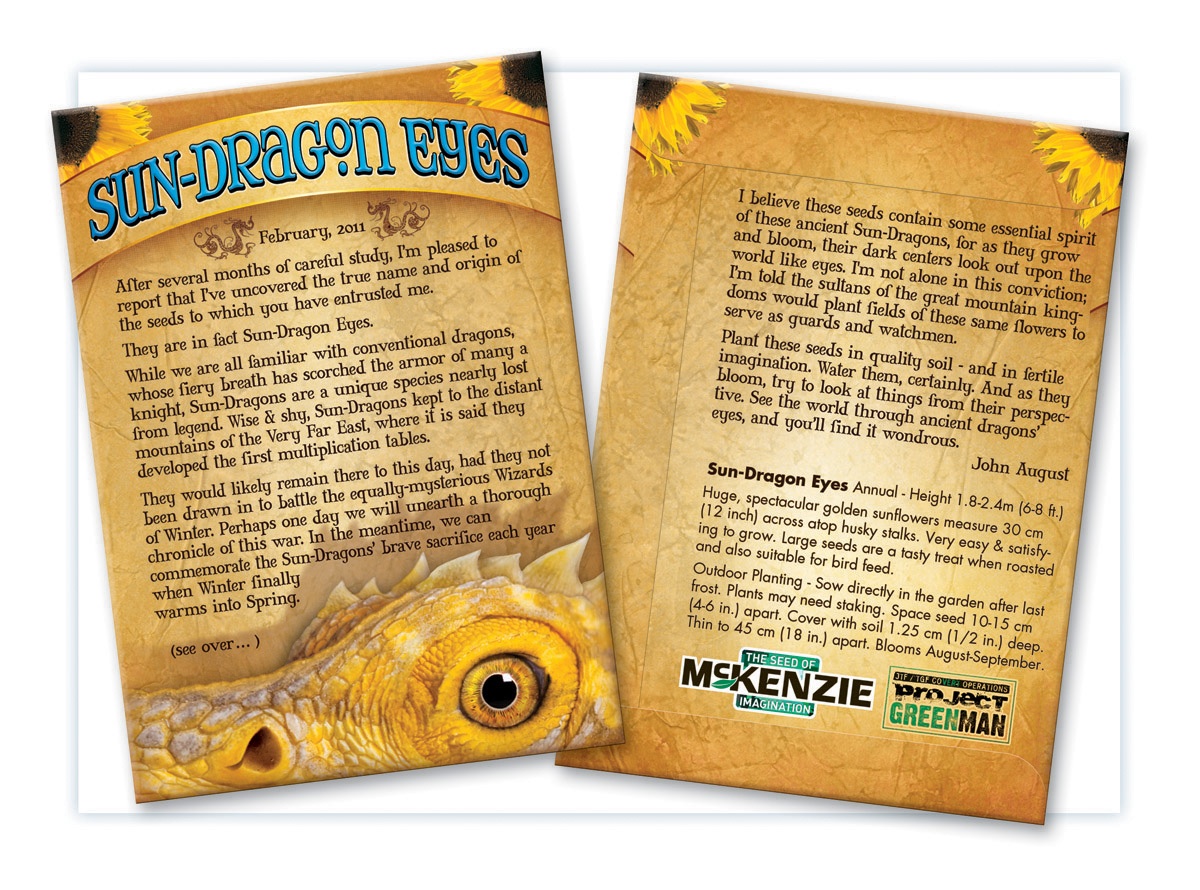
sun dragon packet

While the program targets elementary schools, the seed packets are available to anyone who wants them. For now, it’s snail-mail. Send a self-addressed stamped envelope (really!) to:

Sun Dragon Eyes/Project Greenman
Winchester Public School
547 Louise Street South
P.O. Box 280
Winchester, ON, K0C 2K0
Canada

If you’re a classroom that needs a bunch of packets, I’d [email](mailto:jeff.arsenault@ucdsb.on.ca) the organizer (Jeff Arsenault) directly. (They seeds actually come from [McKenzie Seeds](http://www.mckenzieseeds.com), so my hope is that you’ll eventually be able to order them through the site.)

The renowned Stan Lee has also created a line of seeds, but I’ll leave that to him to announce.

Redbox’s arbitrary winners

December 29, 2011 Awards, Film Industry

Redbox, the DVD rental kiosk company, sent out a [press release](http://www.marketwatch.com/story/and-the-winner-is-redbox-announces-its-top-rentals-in-2011-2011-12-29) with a list of their most-rented titles for 2011:

* Most-Rented Movie: Just Go With It
* Most-Rented Action Movie: The Green Hornet
* Most-Rented Comedy Movie: Just Go With It
* Most-Rented Drama Movie: The Tourist
* Most-Rented Family Movie: Rango
* Most-Rented Horror Movie: Insidious

Huh-wuh?

I couldn’t remember what Just Go With It even was — although I was pretty sure Katherine Heigl was in it.

But I was wrong.

Just Go With It was the Adam Sandler/Jennifer Aniston comedy I never saw. My first instinct was to write something snide about how Adam Sandler is a big star among Americans who get their cinema and broccoli at the same place.

However, that would be unfair. The movie was financially successful: $103 million domestic box office. But that ranks it [only #25](http://boxofficemojo.com/yearly/chart/?yr=2011&p=.htm) among the top movies of the year.

In fact, none of the films on Redbox’s most-rented list made the box office top 10 for the year — Rango made the most, landing at #19.

So why are they the winners here?

**Because they happened to come out early in 2011 (or late in 2010), and were on video longer.**

Title Theatrical Release Video Release
Just Go With It 2/11/11 6/7/2011
The Green Hornet 1/14/11 5/3/11
The Tourist 12/10/10 3/22/11
Rango 3/4/11 7/15/11
Insidious 4/1/11 7/12/11

Redbox’s list could more honestly be called, “Some movies that came out on video early in 2011.”

Workspace: Eric Heisserer

December 29, 2011 Workspace

eric heissererWho are you and what do you write?
—

My name is Eric Heisserer, a screenwriter and (soon to be) director. I’ve worked with a number of studios on a variety of genre films, but the ones that have withstood the arduous trek to screen are all horror movies like [Final Destination 5](http://finaldestinationmovie.warnerbros.com/) and [The Thing (2011)](http://www.universalstudiosentertainment.com/thing-the-2011/).

I’m looking to break that streak by shooting a script I wrote based on the short story [Hours](http://www.mulhollandbooks.com/popcornfiction/stories/Hours_by_Eric_Heisserer.html), first published on Derek Haas’ anthology site [Popcorn Fiction](http://www.mulhollandbooks.com/popcornfiction/). We’re in pre-production now, aiming for an April 2012 shoot date.

I’ve written a few other stories for Popcorn Fiction this year, like [Last Vegas](http://www.mulhollandbooks.com/popcornfiction/stories/Last_Vegas_by_Eric_Heisserer.html) and [Simultaneous](http://www.mulhollandbooks.com/popcornfiction/stories/Simultaneous_by_Eric_Heisserer.html). I try to write in at least two different mediums each year because it helps me develop/maintain new creative muscles.

On Twitter, I’m [@writerspry](http://twitter.com/writerspry).

Where and when do you write?
—-

workspaceI’m a hallway commuter with a home office. I’ve been writing at home my whole career (and before then, too), so I’ve come to find a discipline in keeping a normal work schedule. Before this I was a cubicle monkey in the white-collar world, so my body is used to getting up and putting in eight hours every weekday (typically 9 – 6).

If I don’t write at least a little each day, I start to feel nervous and on edge, as if I were quitting caffeine cold turkey. My best hours are typically just before and after lunch. When I need to stop for a meeting or to eat, I try to break at a point where I know the next thing I want to write, because it makes getting back into the work so much easier when I return to the keyboard.

In my home office I have my computer desk, a reading chair, a TV, and a cork wall where active projects are tacked in the form of a hundred different index cards plus photos and magazine clippings as visual inspiration. The cork wall and a few of my magazine clippings are relatively new to my process, courtesy of my brilliant wife Christine Boylan ([@KitMoxie](http://www.twitter.com/kitmoxie)), whose home office is just across the hall from me. (Check out [her Workspace post](http://johnaugust.com/2011/workspace-christine-boylan).)

What hardware to you use?
—-

I’ve recently upgraded to a desktop iMac with a cinema display, but my last iMac was four or five years old. I also have a small MacBook I take with me to set or when I’m going out of town. Both Macs get the job done, but I get best results from my desktop.

I use a lot of 3×5 index cards. White ones. Colored ones. Lined and unlined. I use whatever I can get my paws on when I’m seized with a new thought.

The cards are the first form my projects take, and they fall in two categories: Story and Snippets. In the story structure side of things I’ll have cards like “[hero] states his goal” or “[villain] collides with [hero] for the first time.” These are basic milestones that form the frame of the thing I’m building.

The Snippets side of the cork wall is for all the flotsam and jetsam that comes to me for the project. Specific details. A line of dialogue. A character description. An illustration from a comic book. A photo of a setting.

Once I have a critical mass of cards on the board, I take them all down and Voltron them into a single document. I will scan visuals if I need to. Then I create a new set of cards, this time designed to look more professional, and I print them on my color printer.

This is probably the most important step for me, because it tricks my brain into believing it’s a real project and not some crazy collection of thoughts. I use photos of actors to cast the major roles, and I look for images and key words that evoke the tone of the project. The casting choices aren’t meant to be realistic options for the actual production, but they remind me I’m writing words for someone else to say. And if I can’t envision the actors delivering a convincing performance in a scene, I know I’ve strayed off-course.

I do this with every project, but where these cards are most helpful is in a pitch. Studio and network exes love visuals and they love structure. It helps that the movie or pilot is already pseudo-cast for them, because it reinforces the tone and the size of the story. Through trial and error I’ve come to learn not to put too many words on a card, otherwise the execs will read them instead of listening to the pitch, and sometimes the writing on the card spoils a reveal before you speak it.

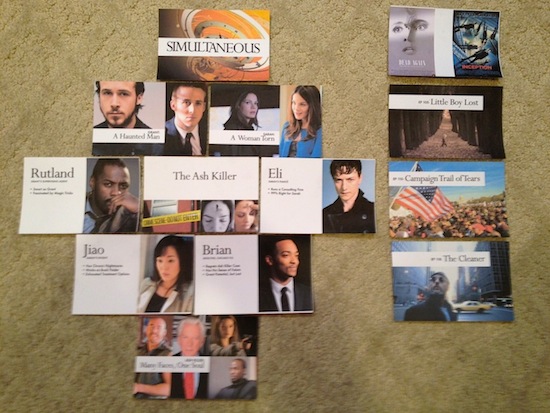
Here’s an example: I adapted the Popcorn Fiction story Simultaneous into a TV series concept, and then built the pilot structure as a modified procedural. When I designed my cards for the polished version, I made a title card (at top), my major characters, their supporting characters, and then the guest stars for that episode (at bottom). My villain/crime for the pilot episode is the card placed in the center; the Ash Killer card.

The right-hand column offers a card with two films as my thematic or tonal touchstone for this project, and then three sample episodes that I had developed. This particular layout of cards resembles a Tarot spread; the Celtic Cross. That was intentional, as one of my characters reads Tarot.

cards example

Again, at this stage there isn’t a lot of words on these cards, because all that content now lives in the Voltron document I built from my first round of index card collecting. These new cards go on my cork wall where I can see them as I write the script. They’re visual cues. They speak more to the characters’ motives than to story, because that can be my blind spot during scripting.

That was a terribly long tangent. Sorry. On to other hardware:

* **Sharpie pens.** For that first round of index cards. I like their fine-point retractable ones, but any will do as long as it’s black ink.

* **Office Depot 4×6 postcard sheets.** The fancy cards. There are other options; Avery makes some, but generic brand works just as well.

* **My Canon MP560 color printer.** For the fancy cards.

What software do you use?
—-

I use Photoshop and QuarkXPress for the card design process, because I worked in print design for many years, but they could just as easily be made in a word processing application. I’m just more familiar with Quark and Photoshop.

For the scriptwriting, I use Final Draft. I’ve worked in Movie Magic Screenwriter, too. Both get the job done.

What would you change?
—

Not to cheat off [Phil Hay’s answer](http://johnaugust.com/2011/workspace-phil-hay), but: I would write more.

I tend to abandon ideas before giving them the proper attention. I have a bad habit of expecting a reader or studio response long before I get one, and I can talk myself out of a good idea like a pro. I need to be better about silencing the voice who discourages new ideas and new hope with my work, because it is painfully easy to say “This won’t sell” or “This won’t survive production.”

There is a town full of people ready to say “No” to my projects. I can’t be one of them.

No podcast today

Episode -

Go to Archive

December 27, 2011 Scriptnotes

Craig and I are taking the week off. I have a mild chest cold. For the first time in my life, I coughed into a handkerchief and checked it for blood. No worries — unlike a character in a period movie, I’ll make it through the third act.

Meanwhile, Craig is busy with holiday-related travel — and he’s got [really fancy luggage](http://today.msnbc.msn.com/id/45796131/ns/today-entertainment/#.Tvn6CZi9tNQ).

If you’re missing your podcast fix, I strongly recommend checking out one of these fine programs:

* [Nerdist Writer’s Panel](http://www.nerdist.com/podcast/nerdist-writers-panel/)
* Erin Gibson and Bryan Safi’s [Throwing Shade](http://www.throwingshade.com/)
* All of Dan Benjamin’s [5by5 shows](http://5by5.tv/)

We’ll be back next week with way too much to talk about. Happy New Year!

Next Page »

Primary Sidebar

Newsletter

Inneresting Logo A Quote-Unquote Newsletter about Writing
Read Now

Explore

Projects

  • Aladdin (1)
  • Arlo Finch (27)
  • Big Fish (88)
  • Birdigo (2)
  • Charlie (39)
  • Charlie's Angels (16)
  • Chosen (2)
  • Corpse Bride (9)
  • Dead Projects (18)
  • Frankenweenie (10)
  • Go (29)
  • Karateka (4)
  • Monsterpocalypse (3)
  • One Hit Kill (6)
  • Ops (6)
  • Preacher (2)
  • Prince of Persia (13)
  • Shazam (6)
  • Snake People (6)
  • Tarzan (5)
  • The Nines (118)
  • The Remnants (12)
  • The Variant (22)

Apps

  • Bronson (14)
  • FDX Reader (11)
  • Fountain (32)
  • Highland (73)
  • Less IMDb (4)
  • Weekend Read (64)

Recommended Reading

  • First Person (87)
  • Geek Alert (151)
  • WGA (162)
  • Workspace (19)

Screenwriting Q&A

  • Adaptation (65)
  • Directors (90)
  • Education (49)
  • Film Industry (489)
  • Formatting (128)
  • Genres (89)
  • Glossary (6)
  • Pitches (29)
  • Producers (59)
  • Psych 101 (118)
  • Rights and Copyright (96)
  • So-Called Experts (47)
  • Story and Plot (170)
  • Television (165)
  • Treatments (21)
  • Words on the page (237)
  • Writing Process (177)

More screenwriting Q&A at screenwriting.io

© 2026 John August — All Rights Reserved.