• Skip to primary navigation
  • Skip to main content
  • Skip to primary sidebar

John August

  • Arlo Finch
  • Scriptnotes
  • Library
  • Store
  • About

Search Results for: characters

Where to find Natural Born Killers novelization

October 13, 2004 Adaptation, Projects, QandA

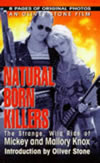
NBK bookI was just reading your site in hopes of finding out more about your novelization of the film Natural Born Killers. It appears as though the book can still be found in some circles but at [exorbitant prices](http://www.amazon.com/gp/product/offer-listing/0451183231/ref=dp_pb_a//002-9839875-9699269?condition=all). Do you happen to know of anywhere that I could order this book?

— MJD

The best advice I could give you is to save your money, because the book isn’t very good. You’re much better off reading Quentin Tarantino’s original screenplay. The only copy on the net I’ve found is an [awkwardly-formatted HTML version](http://www.godamongdirectors.com/scripts/killers.shtml), but it’s certainly better than nothing. [Update: A kind reader forwarded [this link](http://www.dailyscript.com/scripts/Natural_Born_Killers.PDF) to a proper .pdf.]

The things you love can hurt you the most, and that’s certainly the case with Natural Born Killers. I first read Tarantino’s script in the fall of 1992, when I was in my first year of grad school at USC. His was probably the 10th screenplay I ever read. The moment I finished it, I flipped back to page one and read the whole thing again. It was that good.

So I counted myself incredibly lucky to get to work on the movie the following year. Oliver Stone had directed a heavily-rewritten version of it, and I was hired as assistant to the two producers while the film was in editing. Even though I was mostly answering phones and writing coverage, it was exciting to be one office away from a big motion picture in post. When I finally got to see the cut, I was disheartened: so much of what I loved about Tarantino’s screenplay had been changed. It was like waiting all year for Christmas and finally opening that big wrapped box to discover what you hoped was an Atari was actually Sears Pong. Same idea, but disappointingly different.

I know there are people who love the movie, and with good reason, but to me the film is too much of too little.

Then, remarkably, I got the opportunity to work on the novelization. Penguin had hired writers to do it, but the editor wasn’t satisfied with what they were producing. After reading my first script and talking with my bosses, she asked me to write a new book. It gave me a chance to go back to Tarantino’s original script and incorporate things that had been dropped from the movie, and add new sequences that detailed other pit-stops on Mickey and Mallory’s trail of terror.

I wrote the book in three weeks, while finishing my master’s thesis and working full-time. I slept three hours a night — but you can do that when you’re 23.

I was really happy with the book I wrote, but before the draft went to Penguin, one of my bosses decided to rewrite it. And rewrite it poorly. That’s not just my opinion; on a purely objective level, the text is a mess. Because there was no time for proper copy-editing, characters’ names are spelled different ways in different chapters.

It’s frustrating to have my name on a book that I hate. But I try to look for the positive: I was paid $7,000 to write the book, which was enough money to get by for six months before I got my next writing job. (That next job was HOW TO EAT FRIED WORMS, a charming kid’s book for which Natural Born Killers was a terrible, terrible writing sample. I owe Ron Howard a lot for even considering me.)

I can’t put my original draft of the novel in the Downloads section, because the publisher controls the copyright. But if anyone reading this post is an enterprising young editor at Penguin, I’d love to show you what the book could have been.

Atom feed fixed

September 23, 2004 Geek Alert

The [Atom feed](http://johnaugust.com/atom.php) was choking on quotation marks and other special characters. That should be fixed now.

‘Data’ is singular

September 22, 2004 Rant

rantI make my living writing dialogue — which, like real speech, is largely ungrammatical. Characters say “gimme” and “gotta” and “woulda.” They speak in fragments. Like this.
So I tend to be forgiving when a writer bends the rules, or uses words differently than I would prefer. Split infinitives? Fine by me. Dangling participles? No objection here. In fact, the only choice that drives me insane is when writers cling to false rules. To me, the shibboleth is the word “data.” This, from the Los Angeles Times:

Another 32 million have some information on file, but the data are too sketchy to create a traditional credit score, he said.

Most reasonable people would say “data is” rather than “data are.” Not only does it sound better, but it makes more sense. In this case, “data” refers to “some information” — it’s not clear what the individual bits of information would even be.

In fact, another article in the Times does treat data as singular:

Information security deals with issues such as who should access the data and how the data is stored, controlled, marked, disseminated and disposed of.

My suspicion is that the official style guide for the LA Times instructs writers to use data as a plural; the second writer broke the rule. “Data is plural” seems to be a common mandate. From The Economist’s [style guide](http://www.economist.com/research/styleGuide/index.cfm?page=805687):

Propaganda looks plural but is not. Billiards, bowls, darts and fives are also singular. Data and media are plural. So are whereabouts. Teams that take the name of a town, country or university are plural, even when they look singular: England were bowled out for 56.

Why would publications insist on such arbitrary and wrong-sounding usages? Blame Latin. “Data” was originally the plural form of “datum,” which means “something given.” English speakers who use data as a plural noun, in constructions such as “these data” or “data are,” do so with conviction: they know intellectually that data is supposed to be plural, so they use it that way.

Unfortunately, many dictionaries disagree with them. From the [American Heritage Dictionary](http://dictionary.reference.com/search?q=data):

[M]ore often scientists and researchers think of data as a singular mass entity like information, and most people now follow this in general usage.

[Oxford Dictionary](http://www.askoxford.com/asktheexperts/faq/aboutgrammar/data) says the singular form is fine for us Yanks, and will probably become the rule in the Old World as well:

[T]here has been a growing tendency to use it as an equivalent to the uncountable noun information, followed by a singular verb. This is now regarded as generally acceptable in American use, and in the context of information technology. The traditional usage is still preferable, at least in Britain, but it may soon become a lost cause. Compare with agenda.

Yes, let’s. Following this logic, which I’ll call the Plurican Mandate —

If the word is plural in its source language, then it must be plural in English.

— the following sentences are correct:

(agendum, agenda)
* Let’s move on to the next agendum.
* The meeting’s agenda are long.

(graffito, graffiti)
* The boy was apprehended while spray-painting a graffito on the wall.
* Bathroom graffiti are particularly vulgar.

(forum, fora)
* This is the appropriate forum for this discussion.
* Due to a server problem, the fora are temporarily closed.

Obviously, I feel pretty strongly that blindly following the rules of the source language is ridiculous, or else I wouldn’t have written this interminable essay. But I’m not going to chastise individual writers for choosing the opposite tack. Different things sound right to different people. As long as no one is an asshole about it, Pluricans and Singlecrats can still get along.

All I would ask of the Pluricans is to get off their high horse. Saying “data are” is like an American putting a “u” in “color,” “honor,” or “valor.” No, it’s not technically wrong, but it’s showy, deliberate and vain.

It’s like over-pronouncing Italian at the Olive Garden. No one is impressed, and frankly, we’re just a little embarrassed for you.

More D.C. stuff available in the Downloads section

September 15, 2004 Dead Projects, Projects

DC logoChris Landa of Salt Lake City, Utah, wrote in to say:

I just finished reading your scripts of D.C. Do you have a series
bible that you could put on your site? I’m trying to find examples of series
bibles and would love to find out what happens to the characters of D.C.

A series “bible” is a document that’s usually created at the start of a television series, which contains all the vital information about the characters, their history, and relationships. The idea is that you update it as you go along, so that in season four, you don’t have a character saying something that conflicts with something in season two.

Apparently, some showrunners go much further, and really do map out years ahead. [J. Michael Straczynski](http://imdb.com/name/nm0833089/) is said to have plotted out all of the seasons of Babylon 5 before even starting to shoot the pilot.

All this said, I’ve never even seen a real series bible. Perhaps that’s because I’ve never worked on a show that lasted more than three episodes.

But Chris’s question brought up a point I keep trying to make: a writer’s job doesn’t start and end at the script. Particularly in television, a writer needs to be able to write a lot of different kinds of documents, many of which are designed to get others to share his or her vision for the show.

I’ve added five examples of this from D.C. in the [Downloads](http://johnaugust.com/downloads) section. Included you’ll find:

  1. the initial pitch I made to the WB
  2. the outline for the pilot
  3. a template for a “normal” episode
  4. and an exercise in which I look at God from each character’s perspective.

Also included is the pilot presentation script. In order to save money, the WB asked all its drama pilots to shoot a 30-minute version of the show (called a “pilot presentation”), rather than the whole hour. To do this, I had to omit a bunch of scenes, and rewrite some others so that it would all make sense. If it sounds like a difficult task, it was. When we got ordered for series, the first thing we had to do was go back and shoot the missing scenes from the pilot.

« Previous Page
Next Page »

Primary Sidebar

Newsletter

Inneresting Logo A Quote-Unquote Newsletter about Writing
Read Now

Explore

Projects

  • Aladdin (1)
  • Arlo Finch (27)
  • Big Fish (88)
  • Birdigo (2)
  • Charlie (39)
  • Charlie's Angels (16)
  • Chosen (2)
  • Corpse Bride (9)
  • Dead Projects (18)
  • Frankenweenie (10)
  • Go (29)
  • Karateka (4)
  • Monsterpocalypse (3)
  • One Hit Kill (6)
  • Ops (6)
  • Preacher (2)
  • Prince of Persia (13)
  • Shazam (6)
  • Snake People (6)
  • Tarzan (5)
  • The Nines (118)
  • The Remnants (12)
  • The Variant (22)

Apps

  • Bronson (14)
  • FDX Reader (11)
  • Fountain (32)
  • Highland (75)
  • Less IMDb (4)
  • Weekend Read (64)

Recommended Reading

  • First Person (87)
  • Geek Alert (151)
  • WGA (162)
  • Workspace (19)

Screenwriting Q&A

  • Adaptation (65)
  • Directors (90)
  • Education (49)
  • Film Industry (489)
  • Formatting (128)
  • Genres (89)
  • Glossary (6)
  • Pitches (29)
  • Producers (59)
  • Psych 101 (118)
  • Rights and Copyright (96)
  • So-Called Experts (47)
  • Story and Plot (170)
  • Television (165)
  • Treatments (21)
  • Words on the page (237)
  • Writing Process (177)

More screenwriting Q&A at screenwriting.io

© 2026 John August — All Rights Reserved.