• Skip to primary navigation
  • Skip to main content
  • Skip to primary sidebar

John August

  • Arlo Finch
  • Scriptnotes
  • Library
  • Store
  • About

Search Results for: characters

Because really, he should drive a Chrysler LeBaron

July 8, 2006 QandA, Rights and Copyright, The Nines

questionmark*My question concerns referencing branded objects in a screenplay. I’ve read that including name-brand references should be avoided in screenplays because you would need legal clearance in order to feature them.*

*That being said, what if my character drives a Chrysler LeBaron? Can’t I say he drives a beat-up Chrysler LeBaron? And not just as a description, but if it was mentioned in the dialogue as well.*

*Understandably, name brand references wouldn’t make or break my script, but I feel it adds a nice level of depth and detail to my characters if you know they like Gucci shoes and not fancy Italian boots.*

*I guess my question is, what are the do’s and don’ts of brand name references?*

*– Aaron Murphy*

In a screenplay, you can do anything. You can have Ronald McDonald shank Elmo with a sharpened Barbie over a pack of Marlboros.

The trouble comes when you’re moving from the printed word to the projected image. The corporations who hold these trademarks and copyrights don’t look kindly on other people profiting off them, even if the usage is not necessarily disparaging.

So, when you set out to make a movie, someone is generally assigned the chore of getting permission to use other people’s copyrights and trademarks. These “permission slips” are called clearances. During the summer of 1993, while I was interning at Universal, this was my job. I helped do clearances for [The War](http://imdb.com/title/tt0111667/) and [Reality Bites](http://imdb.com/title/tt0110950/), mostly working on props and set decoration.

How do you get permission? You ask.

A large part of the job is figuring out who to ask. In 1993, the Internet didn’t exist in anything approximating its current form, so my fingers got very fast at dialing New York information (212-555-1212) to track down corporate offices.

Once you get the right person on the phone (or email), you explain what the movie is, why you’re asking, and if they could sign and fax back the attached clearance form. As I mentioned in an [earlier article](http://johnaugust.com/archives/2004/getting-permission), Nolo Press’s book *Getting Permission* has templates for clearance forms, and a lot of information about how to handle everything from artwork to music. You can also see a generic version of what we used for The Movie here: [.pdf](http://johnaugust.com/Assets/clearance.pdf) or [.doc](http://johnaugust.com/Assets/clearance.doc).

My assistant Chad handled the majority of the clearances for The Movie, mostly artwork and books featured as props. It’s tedious work, but not particularly brain-draining. (In fact, I wrote my first screenplay while doing clearances.)

How do you know what needs to be cleared, and what you can just get away with using/saying?

I fall back on my standard advice: as a writer, just do what’s best for the script. If that’s Gucci shoes and Chrysler LeBarons, knock yourself out. Don’t worry about phantom problems. Rather, focus on writing the best screenplay you can.

Down the road, when your great script gets ready to become a great movie, there will be producers and other clever people to help you stress out over clearances.

What’s it like being the writer and director?

June 28, 2006 Directors, QandA, The Nines

Being the writer and the director on a project it seems that you both

create the story and then bring it to life. What are the biggest
struggles in doing this? And how much liberty do you allow an actor to
take with the lines?

— Steve
Lakeland, Florida

For readers who don’t know, I just finished directing an indie movie that will hopefully see the light of day in 2007. (I’ve been chastened against continuing to call it a tiny movie, because it’s not about an albino’s friendship with a cricket, or somesuch. The producers would like me to stress that it actually does have commercial prospects, even if not measured on a blockbuster scale.)

For me, the biggest challenge in being a writer/director is that I really wasn’t a writer while I was on set. I was 100% director, figuring out how to get the scene to work, how to get the performances right, how to get in four more setups before lunch. On other films, when I’ve been “just” the writer on set, I’d often notice things that the director might overlook — small inconsistencies or subtle changes that could screw things up four scenes later.

But here, there was no writer. There was just me. And I was too busy directing the scene to step out and think about the bigger picture.

To some degree, I’d anticipated this going in, so I tried to compensate. “John’s Big Notebook” was a fat three-ring binder that held not only the script and the storyboards, but also my notes on every scene — sort of a last chance for the writer to tell the director what to pay attention to. (In truth, I ran out of time in prep, so the scene notes stopped after the first act.)

During production, I got up at five every morning to write the day’s shot list, which is basically a crib sheet for what shots I thought I would need to shoot in order to complete a given scene. That was usually my last chance to really study the scripted scene and figure out what was important.

I also relied on others. The script supervisor would point out if I was omitting a scripted action, and my producers were nearby to offer assistance.

But at times, the writer resurfaced. One night while watching dailies, I realized something new about one of the characters. So I rewrote a scene for the next day. After two solid weeks of strictly directing, it was oddly exhilarating to remember that I am in fact a writer. Directing is just my day job.

In terms of leeway with the dialogue, I was always willing to let the actors say something better. Often, it wasn’t better, so after a take or two, I’d nudge them back onto the text. (This is also the script supervisor’s domain.) I don’t think I was being particularly writer-ly in getting actors to stick to the script. John August, director, knew what he wanted. Most actors, these actors, respond well to thoughtful requests.

One section of the movie has a combination of scripted and unscripted scenes, which ended up being my favorite thing to shoot. The luxury of having gifted actors and a lot of videotape is that they could simply start having a conversation in character, and seamlessly work in all of the scripted material. One scene had an 18-minute continuous take.

To me, this section was the best synthesis of writing and directing. While I was listening, I had to keep thinking how to steer the scene in an interesting direction. It was a screenwriter’s dream: My characters were alive in front of me, looking for something to talk about.

Making the geek movie

June 17, 2006 Geek Alert, Genres, QandA, Recycled

When you know computers pretty well, you start seeing certain things in certain movies as being rather idiotic. A huge amount of pictures scrolling by during a search, 3D graphics exploding out of an old laptop during hacking in [HACKERS](http://imdb.com/title/tt0113243/combined), people using Microsoft Word as a magical web search engine, etc. That stuff never happens in real life!

To a techie, it’s as realistic as trouts flying by in the background during a romantic love scene in a desert.

The good thing is, things are looking up. Real hacking is being shown in mainstream movies, a good example being the usage of NMap and an old SSH exploit in [MATRIX: RELOADED](http://imdb.com/title/tt0234215/combined). Sure, the movie wasn’t centered around it, but it was kind of neat. (There’s more such goodness in the original version of the [MATRIX](http://imdb.com/title/tt0133093/combined) script.)
[CONTACT](http://imdb.com/title/tt0118884/combined) was a movie built entirely around physics and technology that wasn’t afraid to use them and it was successful as well.

Do you think there’s room in the amateur movie scene for a movie that not only portrays the hacker subculture, (and by ‘hackers’ we mean ‘really experienced computer users’ not just the ‘evil’ ones) but literally swims in it, twisting and turning around it, weaving in and out of it, wrapping itself around it and being wrapped inside it, like a [Klein bottle](http://www.kleinbottle.com/)?

I mean, there’s a market for it, yes, but the market consists of, well, people like us. Could a technical movie be a success on film festivals? And what advice would you give us? (Other than “get a life and do something useful.”)


— Elver

Estonia

Great question, and great home country. I only spent about twelve hours in lovely Tallinn, Estonia, but it completely lived up to its over-hype about being the next Prague (but quainter). Doubters, may I direct you to [this photo](http://johnaugust.com/Assets/tallinn.jpg).

Now, on to the matter of your proposed geek opus.

Yes, Elver, yes. There is definitely room in the film universe for a uber-geek movie, be it a thriller, a drama, a comedy or whatever. Film festivals would love it, and even if your film didn’t cross over to become a giant mainstream movie, who cares?

Let me offer proof by way of comparison. Take Jim Taylor and Alexander Payne’s excellent [SIDEWAYS](http://imdb.com/title/tt0375063/combined), which is overwhelmingly obsessed with wine in ways that no normal audience member could hope to fathom. Even though we don’t really understand the intricacies of what they’re discussing — I dare you to find a topic less cinematic than pinot noir grapes — we believe the characters know what they’re talking about, and that helps make it fascinating. Sideways is a wine-geek movie, and if it hadn’t been brilliant on all its other levels, it still would have had a following among oenophiles.

An even closer comparison is Shane Carruth’s [PRIMER](http://imdb.com/title/tt0390384). Although it only progressed slightly beyond the festival circuit, it’s certain to do great on DVD. Like [Pi](http://imdb.com/title/tt0138704/combined) before it, Primer consists of geeky people saying a lot of ponderous gibberish without any nod to audience understanding. I loved it.

So by all means, make your geek movie. Hell, shoot it in Tallinn. Just make sure that while you’re being accurate and honest with all the techie details, you’re also being accurate and honest with the human emotions in the story. Do it right, do it well, and I’ll be the first in line.

(Originally posted January 21, 2005.)

Air vents are for air

April 25, 2006 Rant, Treatments

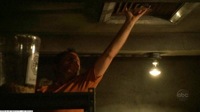
air ventOn a recent episode of “[Lost](http://imdb.com/title/tt0411008/),” a character climbed through air ducts to get past heavy blast doors, which had trapped him and another character. By narrative standards, this sequence would seem unremarkable. Except for one thing:

“Lost” takes place on a freaking magical island.

You’ve got polar bears, black smoke monsters, and a cabal of mysterious Others. There’s no shortage of dramatic opportunities, which is why it’s so disheartening to see the show reach for that lowest-hanging fruit: a guy in an air duct.

I’ve lived a fairly adventurous life. I’ve travelled to five continents. But the only time I’ve seen the inside of an air duct is television and movies, when a character — generally the hero — has to be clever enough (and small enough) to climb through a conveniently-accessible air duct.

Be it action-adventure, comedy or horror, the air duct has become the hack screenwriter’s go-to passageway. In fact, it’s rumored the season finale of “[Yes, Dear](http://imdb.com/title/tt0247144/)” will take place entirely in air ducts.

Ladies and gentlemen, screenwriters, it’s time to stop.

Let’s back away from the keyboard and look at the situation with fresh eyes.

1. Most air ducts are not nearly large enough to hold a grown man.
2. Even if large enough, they’re not built to support a grown man’s weight.
3. “Secure” facilities — where characters are most likely to climb through air vents — are exactly the places that wouldn’t have hero-sized air vents.

Thanks to continuous bombardment in television and movies, the idea of characters shimmying through air ducts has become not just a cliché, but almost a given. The moment a hero finds himself stuck someplace, we expect his eyes to drift north to that spot just below the ceiling, where an oversized grate is beckoning: “Just yank twice! I’m not screwed in or anything!”

Here’s what I’m proposing: **The Screenwriter’s Vow of Air Vent Chastity**.

I, John August, hereby swear that I shall never place a character inside an air duct, ventilation shaft, or any other euphemism for a building system designed to move air around.

One day, I’d love to win an Oscar. An Emmy. A Tony Award. But if all I accomplished in my screenwriting life were reducing the number of times characters climbed through air vents, I’d consider my work successful.

So if you’re on board, please sign in the comments section and tell all your screenwriting friends. Remember, only you can prevent clichés.

« Previous Page
Next Page »

Primary Sidebar

Newsletter

Inneresting Logo A Quote-Unquote Newsletter about Writing
Read Now

Explore

Projects

  • Aladdin (1)
  • Arlo Finch (27)
  • Big Fish (88)
  • Birdigo (2)
  • Charlie (39)
  • Charlie's Angels (16)
  • Chosen (2)
  • Corpse Bride (9)
  • Dead Projects (18)
  • Frankenweenie (10)
  • Go (29)
  • Karateka (4)
  • Monsterpocalypse (3)
  • One Hit Kill (6)
  • Ops (6)
  • Preacher (2)
  • Prince of Persia (13)
  • Shazam (6)
  • Snake People (6)
  • Tarzan (5)
  • The Nines (118)
  • The Remnants (12)
  • The Variant (22)

Apps

  • Bronson (14)
  • FDX Reader (11)
  • Fountain (32)
  • Highland (75)
  • Less IMDb (4)
  • Weekend Read (64)

Recommended Reading

  • First Person (87)
  • Geek Alert (151)
  • WGA (162)
  • Workspace (19)

Screenwriting Q&A

  • Adaptation (65)
  • Directors (90)
  • Education (49)
  • Film Industry (489)
  • Formatting (128)
  • Genres (89)
  • Glossary (6)
  • Pitches (29)
  • Producers (59)
  • Psych 101 (118)
  • Rights and Copyright (96)
  • So-Called Experts (47)
  • Story and Plot (170)
  • Television (165)
  • Treatments (21)
  • Words on the page (237)
  • Writing Process (177)

More screenwriting Q&A at screenwriting.io

© 2026 John August — All Rights Reserved.