• Skip to primary navigation
  • Skip to main content
  • Skip to primary sidebar

John August

  • Arlo Finch
  • Scriptnotes
  • Library
  • Store
  • About

Search Results for: characters

What does he want?

October 29, 2007 Education, QandA, So-Called Experts

questionmarkWhich screenwriting rules can you break and which ones can you not?

I have read so many times that your character has to have a goal and an opposition and so on and so forth. In these books and classes, they really limit examples to scripts with relatively simple solutions. I have heard everything from Indiana Jones to Romancing The Stone to Ghost. Of course we can pick out the goals and oppositions here.

For instance, in your script for “Go”, who is the central character and what is their goal and opposition? I get so stuck on these rules and it really discourages me in my writing because I don’t feel I have the right answers. I don’t know, but I am so afraid of being one of these awful writers described on your site.

-Robert V Gallegos
Chicago, IL

You might be an awful writer, but it’s not because you have a hard time figuring out how to implement the so-called rules. Most of them were dreamed up by non-writing film enthusiasts, who decided there had to be an underlying template behind all great movies.

I think there’s a place for the guidebooks, but only to degree the help lessen the stress of “getting it right.” There’s one I [recommend, with reservations](http://johnaugust.com/archives/2007/hollywood-standard). And it’s important to be able to talk about “second act breaks” even if you don’t really believe in them, since you’ll be hearing terms like that for the rest of your career.

In terms of the specific rule you cite, I think it’s always fair to ask, “What does this character want?” The answer to that question may or may not be the driving force of your story, but if you can’t answer the question at all, there’s probably something fundamentally wrong with your script.

Let’s look at Go. You have to approach it as three separate stories, each of which has a central character (or duo).

* In Part One, Ronna wants to make a very tiny drug deal in order to get enough money to pay her rent. Every decision she makes after that point stems from that desire.

* In Part Two, Simon wants to go wild in Vegas. That seems like a nebulous goal, but he’s weirdly aggressive about fulfilling his vision of a perfect night in Vegas.

* In Part Three, Adam and Zack want to finish the terms of their deal with the police. Individually, they each want to know who the other one is sleeping with, which becomes the primary goal once the business with Burke is finished.

None of these stories have a classic protagonist/antagonist setup. The central characters experience great obstacles, but the movie deliberately undercuts any sense that, “This was the night that everything changed.” A bunch of shit happens, then it’s over.

Asking what the characters want is something real screenwriters do. In two of the projects I’m writing at the moment, the biggest decisions are about exactly this issue, since that informs every action and the overall tone of the story. Often, the best answer is the simplest: something physical and achievable.
Heroes: Origins

October 11, 2007 News, Television

I’m writing and directing one of the Heroes: Origins episodes.

News of this leaked out over the past few weeks — it even shows up on my [IMDb page](http://www.imdb.com/name/nm0041864/) — but it wasn’t official until quite recently, so I didn’t want to blog about it.

For those who haven’t been obsessively following All Things Heroes, Origins is an anthology series that takes place in the same universe as [Heroes](http://www.nbc.com/Heroes/), but doesn’t correlate directly to the main season’s plotlines.And when I say “directly,” I should probably say, “at all.” I have no idea what’s going to be happening this season. Modeled after shows like [The Twilight Zone](http://www.imdb.com/title/tt0052520/), each week’s episode stands on its own, with new characters and self-contained situations.

I’m being careful not to say too much, because it’s not my show. It’s Tim Kring’s show. I’m just delighted to get to muck around in it.

How did I get the gig? I asked. Repeatedly. From the moment it was [first announced](http://www.variety.com/article/VR1117964868.html?categoryid=14&cs=1), I knew I wanted to do one. I love writing one-hour dramas — act breaks are amazing tools — but I didn’t want to write a pilot this season. And it’s almost impossible for a writer to drop in for just one episode of an ongoing series. Not only is it like trying to grab a moving train, but it would ruin all the enjoyment of watching one of my favorite shows.

So, an anthology series is incredibly appealing. I’m grateful they said yes.

Kevin Smith, Eli Roth and Michael Dougherty have already been announced for the series. The plan as I understand it is to air all of the Origins episodes after the main season concludes. (So, April?) With looming labor uncertainty, I don’t want to assume that calendars are set in stone. In fact, everything these days feels a little bit wobbly. But I’ve already enjoyed plotting out my episode with the Heroes folk, and look forward to shooting it. Fingers crossed.

The Challenge of Writing in a Digital Age

October 9, 2007 General

Last week, I blogged about [my upcoming speech](http://johnaugust.com/archives/2007/writing-the-future) at Drake University (my alma mater), which was entitled “The Challenge of Writing in a Digital Age.” I posted my basic thesis statements, and invited comments. As expected, the hive mind was very helpful in reshaping (and renaming) many of my thoughts, so I’m very grateful to those who wrote in.

The speech went well. It was a nearly-full house, with a lot of first-year students in the crowd, and they seemed to keep pretty engaged.

In terms of content, I don’t think the talk was the equal of the [speech on professionalism](http://johnaugust.com/archives/2006/professional-writing-and-the-rise-of-the-amateur) I gave at Trinity University last year, which covered some of the same ground and used one of the same anecdotes. This one wasn’t as organized or persuasive. I think there’s a much better speech to be written on a single one of these topics (such as Authority), but I’d already committed to the sampler platter.

I promised several professors I’d hold off posting the text of the speech until after extra-credit assignments were turned in. Those deadlines should have now passed.

If you’d prefer a .pdf version (it’s 19 pages), you can find it [here](http://johnaugust.com/Assets/writing_in_digital_age.pdf).


It’s an honor–a pleasure–to be back on campus, standing on this stage where just a couple of weeks ago, actual presidential candidates were trying to seem electable.

I feel I should stress: I have absolutely no political ambitions. But I do have a bit of a platform tonight, a list of observations about the things I see looming on the horizon, and what’s to be done about it. I’m not going to ask for your vote, but I am going to ask for your attention. And most importantly, I’m going to ask you to turn off that part of your brain that automatically goes, “Yeah, well, but that doesn’t apply to me.”

(Actually, you don’t have to turn that part of your brain off. Just put it on vibrate. Let your objections go to voicemail.)
What I’m going to try to convince you tonight is that writing matters. That seems like a pretty easy sell at a university. After all, most of you are students. You’re getting grades. Of course writing matters.

But I’m going to be a little more ambitious tonight. I’m not talking about just academic writing. I’m talking about all writing. I’m talking about email. Memos. Your blog. I’m talking about what you wrote on your friend’s Facebook wall. All that writing you don’t think you’re getting graded on–well, you are.

Whether you want to or not, you’re being judged on it. And you’re being judged differently because of the era you’re living in.

So if I do my job right tonight, I’m going to send you out of here a little bit rattled, a little bit paranoid, but hopefully better prepared. [Read more…] about The Challenge of Writing in a Digital Age

Back from Venice

September 6, 2007 International, Projects, The Nines

I’m back from the Venice Film Festival, where The Nines had its international premiere.

The movie screened three times, but the main public debut was 2:30 p.m. on Monday. At lunch that day, both the sales agent and the publicist separately pulled me aside to say, “So, John, you should know that if the audience doesn’t like the film, they might boo. Or they could throw things.”

And somehow I’m supposed to be psyched about giving a Q & A? Yikes.

So I drank more champagne and looked for escape exits.

Fortunately, during the end credits we got nice, sustained applause (better than Sundance, in fact) and pretty good questions after that. I really love doing a Q & A, though it was challenging dealing with the real-time translation, trying to pay attention to both the person asking the question and the woman whispering in my ear.

One woman asked a question about the ending which was actually a revelation to me, a misassumption made clear only because of the awkwardness of translation. This is really not a spoiler, but I’ll put it in the footnotes so it’s more easily skipped if you want to go in blind.About the ending: Some viewers exit the movie believing it to be a hallucination on the part of one of the female characters, in the vein of Mulholland Drive or Swimming Pool. As the author, I can say that was never the intent, nor is it backed up by the evidence of the movie. But as someone who’s had to write college term papers, I would never claim that any interpretation is wrong. Just less defensible, perhaps. The Nines invites speculation and alternative interpretations, so I’m not about to say one version is “wrong.” But it’s helpful for me to finally understand why some viewers insist on re-contextualizing the entire film in a way I never intended.

veniceThe movie was shown in English, with Italian subtitles. It played differently, with a lot of comedy not making it through translation. Part Two, which is about American television, might as well have been about Martian sodomy. But the audience really responded to the bigger, religious-adjacent stuff in Part Three.

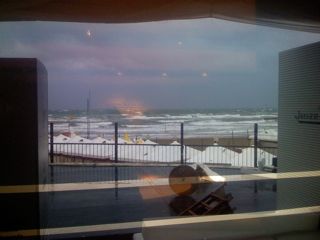
venice2We had a major storm on Tuesday, which knocked out power and made our press interviews challenging. Our main office was actually a temporary, tent-like structure, which held out the rain but kept flapping constantly.

Other observations:

* Ryan Reynolds is a apparently an action star in Italy. They have no idea he’s ever been in a comedy. Most of the journalists cited “Smokin’ Aces.”

* We stayed in Lido, the island where the screening themselves are held, which is a 60 euro water taxi ride from Venice proper.

* Our hotel was where [Death in Venice](http://www.imdb.com/title/tt0067445/) was shot. It hasn’t really been updated since then.

* If you’re going to not speak a language, Italian is a good language to not speak. Compared with many places I’ve traveled, it was a lot easier to wing it.

* We sold a bunch of territories: Argentina (Telexcel), Eastern Europe (Blue Sky), Greece (Village Roadshow), Israel (Forum Film), Middle East (Italia Film), Scandinavia (Non-Stop) and South Africa (Ster Kinekor). Optimum Releasing had already bought U.K. rights. As always, I’ll keep you posted about release dates. More will be announced at Toronto this week.

* The plan you pick for your iPhone makes a huge difference. Ryan was able to get (almost) full internet on his, while my partner’s iPhone was phone-only, and mine was basically just a pretty iPod. If you think you’re going to be using your iPhone overseas, consider getting the fancy plan.

« Previous Page
Next Page »

Primary Sidebar

Newsletter

Inneresting Logo A Quote-Unquote Newsletter about Writing
Read Now

Explore

Projects

  • Aladdin (1)
  • Arlo Finch (27)
  • Big Fish (88)
  • Birdigo (2)
  • Charlie (39)
  • Charlie's Angels (16)
  • Chosen (2)
  • Corpse Bride (9)
  • Dead Projects (18)
  • Frankenweenie (10)
  • Go (29)
  • Karateka (4)
  • Monsterpocalypse (3)
  • One Hit Kill (6)
  • Ops (6)
  • Preacher (2)
  • Prince of Persia (13)
  • Shazam (6)
  • Snake People (6)
  • Tarzan (5)
  • The Nines (118)
  • The Remnants (12)
  • The Variant (22)

Apps

  • Bronson (14)
  • FDX Reader (11)
  • Fountain (32)
  • Highland (75)
  • Less IMDb (4)
  • Weekend Read (64)

Recommended Reading

  • First Person (87)
  • Geek Alert (151)
  • WGA (162)
  • Workspace (19)

Screenwriting Q&A

  • Adaptation (65)
  • Directors (90)
  • Education (49)
  • Film Industry (489)
  • Formatting (128)
  • Genres (89)
  • Glossary (6)
  • Pitches (29)
  • Producers (59)
  • Psych 101 (118)
  • Rights and Copyright (96)
  • So-Called Experts (47)
  • Story and Plot (170)
  • Television (165)
  • Treatments (21)
  • Words on the page (237)
  • Writing Process (177)

More screenwriting Q&A at screenwriting.io

© 2026 John August — All Rights Reserved.