• Skip to primary navigation
  • Skip to main content
  • Skip to primary sidebar

John August

  • Arlo Finch
  • Scriptnotes
  • Library
  • Store
  • About

Search Results for: characters

If film studios developed videogames

June 17, 2008 Film Industry, Videogames

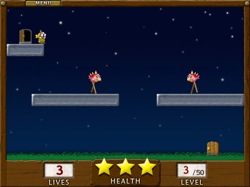
puzzle farterTo: FILE
From: Studio Development Group
Date: June 16, 2008
RE: PUZZLE FARTER, 6/2/08 draft

We think [this draft](http://puzzlefarter.com/) represents progress from the 5/01/08 draft, but there are still areas that need to be addressed to make this the strongest possible casual videogame. As always, we look forward to discussing these issues with you.

1. DEVELOPING THE CHARACTER ARC
——————————————
We’re lacking a clear backstory and dramatic arc for Puzzle Farter. Why is this story happening to this character, now? Why is he so gassy? He is literally a fish out of water, but we never develop this idea.

Let’s consider PRETTY WOMAN as a template: Puzzle Farter is trying to navigate a world in which he doesn’t fit in, but in trying to understand it, reveals its absurdities. (And falls in love. See note #4.)

In this spirt, we’d like to consider adding an event (an “Inciting Incident”) early in the story, explaining how Puzzle Farter entered this world.

Also, Puzzle Farter needs to talk. He needs to clearly articulate his goals in a funny, relatable way. We see Joe Pesci for the role, but are open to other suggestions.

2. KEEPING PUZZLE FARTER PROACTIVE
———————————————
Currently, Puzzle Farter spends much of his time reacting to outside pressures. We would like to find ways to keep him more in charge of the narrative — and for his decisions to have a deeper resonance in the story.

For example, right now, his only response to threats is to jump or run. Can we see him kill or otherwise incapacitate the other characters (hopefully in a charming way)? Like Grand Theft Auto 4, we’d also like to see a mission-based interface which would allow the character to explore on his own. (The “sandbox” model.)

Also, we’d like a system for keeping track of gold points.

3. CLARIFYING OBJECTIVES
——————————-
The addition of doors to each level has gone a long way towards making it clear what Puzzle Farter is attempting to achieve in each encounter. But we’re missing a bigger goal: What is Puzzle Farter hoping to find? What is his want? What does he need? (The conflict between these two questions can contribute a lot of second-act gravitas.)

Let’s consider adding a Fish Sister, who is kidnapped in the prologue. This would go a long way towards strengthening our Villain Plot.

4. LOVE INTEREST
———————
Puzzle Farter needs a love interest, someone who can match him toot for toot. We think Rachel McAdams would be perfect.

Also, players need to be able to select gender, so as not to eliminate the gay gamer demographic.

5. MULTIPLAYER
——————–
The game needs to be multiplayer. We should also discuss making it a MMORPG.

6. RATING AND CONTENT
——————————
To appeal to families, we need to be sensitive to content concerns. Let’s replace the farting with something less offensive.

Question sprint

June 9, 2008 Psych 101, QandA, Rights and Copyright, Story and Plot, Writing Process

A bunch of interesting questions have backed up in the queue, so let’s see how many we can get through while waiting for the new iPhone to be announced.

questionmarkI’m currently outlining a spec feature, 98% of which takes place at the Superbowl. I’m on the fence about proceeding, however, because a few creative executives I’ve pitched the idea to were concerned about 1) the production costs and 2) the need to secure the NFL’s approval. One of the execs did say, however, if the NFL took to the script and got involved it would be a potential dealmaker.

While the production costs aren’t as much of a concern for me (given that those particular naysayers hadn’t gotten past the logline), the seeming make-or-break nature of the NFL’s involvement is a bit daunting. Before I take the plunge from outline to first draft, do you think it’s worth the risk?

— Patrick
Los Angeles

Yes. If you believe in the story and the characters, go for it. If a producer or executive likes your script, she’ll be smart enough to the realize that the NFL of it all can be figured out. ((On the other hand, if she doesn’t like your script, the NFL factor is an easy explanation for why she’s passing. Which saves face for everyone.))

At a USC workshop this weekend, a student asked me about writing a spec Alien vs. Predator. I gave him roughly the same advice — if you think you can write a kick-ass version of it, don’t let the potential unmake-ability of it deter you. My caveat to him was that in the case of AVP, it’s a really tired franchise, so you’re starting with a significant enthusiasm gap. Better to make your own mythology.

questionmarkI’m about to re-write a script that I’ve been working on for a little while now. It’s a small character road trip drama in the spirit of 1970s American films (e.g. “Five Easy Pieces”, “Coming Home”, “Sugarland Express” — though not all films referenced there are road trip movies). This is my do or die draft — if it’s no good, then I will abandon it. But I’m hoping that some of your advice will help me avoid that outcome.

My concern is that too many of the scenes right now are overly reliant on dialog and I don’t want to tread into unnecessary exposition. At the same time, I want to be able to reveal character and backstory (and obviously, dialog plays a huge part in that). Do you have any general pointers on how to balance scenes (or sequences) of relatively quiet character moments, with the overall dramatic push that’s necessary to maintain tension? I want to make sure that both aspects remain compelling.

N.S.
Los Angeles

There’s nothing wrong with dialogue scenes if they’re moving the story ahead, or enjoyable enough on their own merits. But I suspect you’re finding that a lot of your dialogue scenes are telling us backstory about your characters, and the thing is, we just don’t care.

That’s hard to hear, but you need to hear it: except for crucial, story-twisting revelations, we simply don’t need to know more about who your characters were before they walked on screen.

So before you start that next draft, take a red pen to any chunk of dialogue that isn’t about what’s happening now. Be brutal. I suspect you’ll find that you have a lack of action and some unclear goals that were hiding behind the chatter.

The movies you cited, along with more recent ones like [Lost in Translation](http://www.imdb.com/title/tt0335266/), [Sideways](http://www.imdb.com/title/tt0375063/) and [Little Miss Sunshine](http://www.imdb.com/title/tt0449059/), are all good examples of movies that are talky without ever becoming expositional. Characters talk about what they want, what they fear, but they never dwell on what happened. And each movie finds moments to be quiet. Long stretches of each film play as montage, letting the characters do things without commenting on them.

questionmarkLet’s say you’re working on a script that’s based on a musician. He’s a fictional musician, so you’ve never heard anything this guy’s produced. As the story unfolds, we watch him build up his song. Is it okay to include the song? Or would that just kill everything and shut the reader down? I guess what I’m asking is, do you include lyrics or just leave them out and hype him like he’s as great as the supporting cast says he is?

— James

Give us lyrics. You’ll want to abbreviate a bit — cut out chorus repetitions, for starters. But it feels like too much of a tease to omit the words altogether.

questionmarkOften, when I am diligently working on a script, or close to being finished on a script, I find my mind and writing meandering to other ideas. For instance, I’ve written several drafts on a thoughtful spy movie and have an extensive set of notes (from peer review) I plan to implement. Instead of completing the script, I spend time thinking and making notes on new ideas — a drinking road trip film and a sentimental father-son story.

Is this a natural way for new and good ideas to develop or am I merely avoiding “finishing” a project for fear it will suck? Not being a professional, yet, I’m not bound by deadline to turn something in…but how does a disciplined, professional, writer deal with this issue of…distraction?

— Greg

The script you haven’t written is always better than the one you’re staring at, cursor blinking, its flaws so obvious that you can’t believe you ever started writing it. That doesn’t change over the course of a career. __You will always want to be writing something else.__

You’re left with two choices: toughing it out, or [changing horses mid-stream](http://johnaugust.com/archives/2008/changing-horses-mid-stream).

Look at your spy movie, and ask yourself, “If this script had just landed on my desk, would I be excited enough by the possibilities to do this rewrite?” If the answer is no, feel free to investigate one of your other projects.

Granted, there are times you’ll really need to force yourself to finish a new draft. For instance, if you’re getting paid, or if you’ve promised a draft to someone whose opinion matters. And don’t mistake pragmatism for laziness: If something is difficult but do-able, do it. Not only will you improve the script, but you’ll learn something in the process.

The time to move on is when reaching the “best version” of your script ceases to be interesting to you.

New Nines stuff in the Library

May 10, 2008 General

I’ve added two .pdfs to the [Library](/library). (Which is the rechristened “Downloads” section. Thanks to whichever reader suggested renaming it.)

* The visual FX breakdown for two of the sequences — the end of Part One, and the end of Part Three. Both are spoilers, so skip them if you haven’t seen the movie yet.

* The shooting schedule. This is pretty close to how we ended up doing it.

Shooting schedules are hard to read if you’ve never looked at one, so let me talk you through it.

strip

Starting at the left is the strip number. Because some scenes may have more than one part — for instance, a visual effect in addition the main action — you sometimes (rarely) need to refer to the strip rather than the scene number.

Next is the scene number. For The Nines, we numbered all of the Part One scenes in the 100s, Part Two in the 200s, and Part Three in the 300s. Most movies would just go sequentially from 1. [Read here](http://johnaugust.com/archives/2007/renumbering) for more info on scene numbers with letters.

The third column is a short description of the scene, along with INT or EXT, DAY or NIGHT. Note that the line producer or AD writes this description, so it’s not always what the writer would pick.

Fourth column is the length of the scene, measured in eighths of page.

The final column shows which characters are in the scene, by number. Generally, your most important characters are given the lowest numbers, with preference for the bigger stars. In the case of The Nines, our numbering system went as follows:

* Gary/Gavin/Gabriel = 1/5/18
* Margaret/Melissa/Mary = 2/7/19
* Sarah/Susan/Sierra = 3/6/20

To see how much work is scheduled on a given day, look down to the divider strips, marked “– END OF DAY…” This tells you how many pages you’re expecting to shoot.

As you’ll see, we shot 4-5 pages a day — fairly ambitious for a feature, though indies tend to shoot more pages per day simply because limited budgets mean short schedules.

You can find both documents [here](/library).

Secret history of the Kleinhardt Gambit

May 2, 2008 Charlie's Angels, Projects, QandA, Words on the page

questionmarkIn the second Charlie’s Angels, where did the phrase “Kleinhardt gambit” come from?

— Duane
Mount Pleasant

Duane is referring to this scene, near the end of the movie:

EXT. HIGH ROOF – NIGHT

Madison finds herself alone on a high, empty roof. Reeling, confused. A giant, blinking “LOS ANGELES” SIGN flashes.

A single telescope has been set up near the edge. Madison walks to it. Leans down to the eyepiece.

HER P.O.V.

On a distant rooftop, all of her gangster clients are being arrested by the F.B.I.

CLOSE ON MADISON

as she looks up from the eyepiece. Furious, but smiling. She speaks to the only ones who could be behind this:

MADISON

The Kleinhardt Gambit. Classic. Well done.

WIDEN TO REVEAL the Angels, approaching behind her.

NATALIE

Thanks.

SMASHCUT to a series of FAST FLASHBACKS:

MUSSO AND FRANK’S. SNAP ZOOM TO THE COAT CHECK ROOM. THE COAT CHECKER IS NATALIE, WITH BLACK HAIR AND SLINKY BLACK DRESS.

ROOSEVELT HOTEL, BATHROOM. THE HISPANIC DOORMAN QUICKLY RIPS OFF HIS LATEX FACE, REVEALING DYLAN.

(Those last three are separate scene numbers, by the way.)

Here, the “Kleinhardt Gambit” refers to the way the angels sent Madison’s buyers to the wrong rooftop through elaborate misdirection. The telescope is apparently not a key part of the gambit, but rather just to piss off Madison.

The action is pretty standard for Charlie’s Angels (or Mission: Impossible), so it makes sense that a fallen angel would recognize how she was duped, and would have a term for it. The term itself is completely invented, a ridiculous neologism. And believe me, there wasn’t a lot of deep thought going into it. The first combination of syllables that seemed reasonable got typed.

Science fiction does this constantly. What’s a [flux capacitor](http://en.wikipedia.org/wiki/Flux_capacitor)? How did Kirk prevail in the un-winnable [Kobayashi Maru](http://en.wikipedia.org/wiki/Kobayashi_Maru)? What are [midi-chlorians](http://www.theforce.net/midichlorians/), and how can we pretend we never heard of them?

Don’t be afraid to invent terms you think would exist in your fictional world. Done just right, jargon helps ground characters in their setting, much the way medical-ese makes you think those pretty people on TV could actually be doctors.

« Previous Page
Next Page »

Primary Sidebar

Newsletter

Inneresting Logo A Quote-Unquote Newsletter about Writing
Read Now

Explore

Projects

  • Aladdin (1)
  • Arlo Finch (27)
  • Big Fish (88)
  • Birdigo (2)
  • Charlie (39)
  • Charlie's Angels (16)
  • Chosen (2)
  • Corpse Bride (9)
  • Dead Projects (18)
  • Frankenweenie (10)
  • Go (29)
  • Karateka (4)
  • Monsterpocalypse (3)
  • One Hit Kill (6)
  • Ops (6)
  • Preacher (2)
  • Prince of Persia (13)
  • Shazam (6)
  • Snake People (6)
  • Tarzan (5)
  • The Nines (118)
  • The Remnants (12)
  • The Variant (22)

Apps

  • Bronson (14)
  • FDX Reader (11)
  • Fountain (32)
  • Highland (75)
  • Less IMDb (4)
  • Weekend Read (64)

Recommended Reading

  • First Person (87)
  • Geek Alert (151)
  • WGA (162)
  • Workspace (19)

Screenwriting Q&A

  • Adaptation (65)
  • Directors (90)
  • Education (49)
  • Film Industry (489)
  • Formatting (128)
  • Genres (89)
  • Glossary (6)
  • Pitches (29)
  • Producers (59)
  • Psych 101 (118)
  • Rights and Copyright (96)
  • So-Called Experts (47)
  • Story and Plot (170)
  • Television (165)
  • Treatments (21)
  • Words on the page (237)
  • Writing Process (177)

More screenwriting Q&A at screenwriting.io

© 2026 John August — All Rights Reserved.