• Skip to primary navigation
  • Skip to main content
  • Skip to primary sidebar

John August

  • Arlo Finch
  • Scriptnotes
  • Library
  • Store
  • About

Search Results for: 3 page challenge

Mistakes development executives make

Episode - 46

Go to Archive

July 17, 2012 Challenge, Film Industry, QandA, Scriptnotes, Transcribed

Craig and John skip Comic-Con so they can discuss annoying and unproductive habits of development executives, along with advice for working with screenwriters.

The back half of the podcast is devoted to the first-ever three page challenge, in which we critique listeners’ samples and offer suggestions. If you have a chance to **read the samples** before listening to the podcast — they’re in the links below — you’ll get more out of it, but we try to summarize things so that it’s useful even without the text.

Let us know what you thought of this experiment (on Twitter [@johnaugust](https://twitter.com/johnaugust) and [@clmazin](https://twitter.com/clmazin)) so we’ll know whether to do a round two. We received more than 200 entries for the challenge — more than enough, so please don’t send any more. If we do another pass, we’ll pull from what we have.

Our thanks to everyone who wrote in, and especially to Ajay, J. Nicholas and Bryan for letting us talk about their stuff online.

Also discussed this week: standing desks, music theory, laptop speakers and inflated podcast numbers.

LINKS:

* Anthro Cart [Adjusta desk](http://www.anthro.com/computer-furniture.aspx?desk=fit-adjusta)
* Three pages by [Ajay Bhai](http://johnaugust.com/Assets/ajay_bhai_3pages.pdf)
* Three pages by [J. Nicholas Smith](http://johnaugust.com/Assets/jn_smith_3pages.pdf)
* Three pages by [Bryan DeGuire](http://johnaugust.com/Assets/deguire_3pages.pdf)
* [Hooktheory](http://itunes.apple.com/us/book/hooktheory/id533715898?mt=11&ign-mpt=uo%3D4) for iBooks
* [Hooktheory](http://www.hooktheory.com/) site
* [Audio Essentials](http://www.srslabs.com/store/store/comersus_viewItem.asp?idProduct=51)
* INTRO: [Quincy, M.E.](http://www.youtube.com/watch?v=PXf4tV_aeDc) opening titles
* OUTRO: [Forrest Gump](http://itunes.apple.com/us/album/forrest-gump/id541953504?i=541953615) by Frank Ocean

You can download the episode here: [AAC](http://traffic.libsyn.com/scriptnotes/scriptnotes_ep_46.m4a).

**UPDATE** 7-19-12: The transcript of this episode can be found [here](http://johnaugust.com/2012/scriptnotes-ep-46-mistakes-development-executives-make-transcript).
Scriptnotes, Ep 45: Setting, perspective and terrible numbers — Transcript

July 12, 2012 Scriptnotes Transcript

The original post for this episode can be found [here](http://johnaugust.com/2012/setting-perspective-and-terrible-numbers).

**John August:** Hello and welcome. My name is John August.

**Craig Mazin:** My name is Craig Mazin.

**John:** And this is Scriptnotes, a podcast about screenwriting and things that are interesting to screenwriters.

So, Craig, my working theory is that most of our listeners are not actual screenwriters, or they’re people who are interested in screenwriting but they’re actively pursuing a career in screenwriting. Is that consistent with your perspective?

**Craig:** Given the numbers that you’ve been reporting, it has to be true.

**John:** Because there are no 65,000 aspiring screenwriters I would assume.

**Craig:** No.

**John:** So just people who are interested in screenwriting. And so I really thought this was great news that came out this week is that — it was a study released by the WGA. They released the earnings and clearly there’s never been a better time to not be a screenwriter.

**Craig:** [laughs] That’s exactly right. If that’s your interest, if you are actively pursuing not being a screenwriter the trends are definitely in your favor.

**John:** Definitely. Really pretty much any other career you might want to pick other than screenwriting, it’s looking great. Or if you were thinking, “Maybe screenwriting? Or maybe dog grooming?” Well, the numbers are pretty clear that dog grooming is really your future.

**Craig:** It couldn’t be worse than the screenwriting numbers. [laughs]

**John:** [laughs] So the numbers we’re talking about, and it’s really hard to talk about numbers and charts on a podcast so I’ll include links to them at johnaugust.com. The Writers Guild every year, I think, has to report earnings for its members.

**Craig:** That’s right.

**John:** And so essentially everyone who works as a screenwriter or TV writer in Hollywood is a member of the WGA, the Writers Guild, and the WGA has access to all their payment information, so they know how much these people are bringing in. And so what’s helpful is you can look historically to see how much did people make last year, or the year before, or ten years ago and see whether the trends are positive or negative.

**Craig:** Yeah.

**John:** And the trends are not positive if you are a person who wishes to be employed in the Hollywood system.

**Craig:** Certainly not for theatrical. For television maybe it’s a little bit better. But for screenwriting right now it’s horrendous.

**John:** Yes. So the number that you actually, the chart you sent me which is Earnings and Employment in Screen, was that for features or was that for TV and…

**Craig:** That’s just for features.

**John:** That’s just for features.

**Craig:** Yeah. The Screen is what they call movie screens.

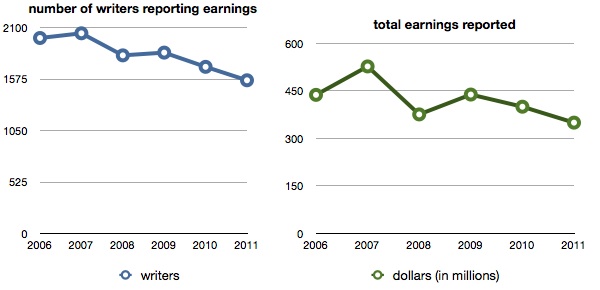
**John:** So, for this last year, for 2011, which is the last year that they have numbers, there are 1,562 writers reporting earnings for Screen, for the big screen.

**Craig:** Right.

**John:** Which was down 8.1%.

**Craig:** From the year before.

**John:** From the year before. And down significantly more from prior years. And the total amount of earnings of all those writers writing for feature films was down 12.6%, which is a lot.

**Craig:** Yeah. It’s a lot. And at some point you can’t quite…you have to get off of the thing of blaming just the economy. If you look at the sort of year-on-year trends you realize that even though we sort of hit rock bottom with the economy in 2008, somehow there are still so many fewer of us who are reporting any earnings. Reporting earnings means that you made a dollar. There are so many fewer of us reporting earnings now than in 2008. And we are making much less as an aggregate because so many fewer of us are reporting earnings.

And if you go back to the last number that the Guild reports historically, in 2006, to give you perspective on it, 1,993 writers earned money in screenwriting for movies. That’s down to 1,562. So that’s 431 jobs, or 431 writers that earn money, gone.

**John:** Yeah. So someone might be thinking, “Well, there’s less competition, so that’s a good thing.” But that’s not really the case at all. It’s probably the same number of writers pursuing fewer jobs, and in pursuing fewer jobs fewer of them actually end up landing jobs.

The other sort of dangerous statistic which is a temptation but I would urge you to really step back away from the precipice there is to take the total amount of earnings and divide it by the number of writers employed. Because that would give you a number that is like $200,000 which makes it sound like, “Wow, everyone’s making $200,000,” which is not a very useful metric by anything because you’re making up an imaginary average writer who doesn’t actually exist.

**Craig:** That’s right. There is a distribution of income across writers. And this is a… — I’ve actually asked one of our Guild board members to see if they can’t put a chart like this together for us because this is what I’m most interested in.

Typically you will see bell curves for income distribution in any field. So, the fewest people earn sort of the bottom end of the thing. Another small amount of people are in the top end, but most people working in the business tend to earn the sort of middle average salary for that business.

For us, I suspect we’re looking at something like an inverted bell curve, a U-curve where the bulk of people are either earning at the lower end or at the very high end. And it’s the middle class of writing that has been decimated as the amount of jobs that are available go down, and as the amount of writers who are employed go down, and as the amount of writers who are employed go down, and as the total earnings go down.

**John:** And that’s what we’ve talked about many times on the podcast is that screenwriting is essentially the research and development of the film industry. You are designing the movies that may or may not get made, but that’s what they’re bringing you in to do.

And it feels to me like the biggest crisis in the film industry right now, especially as it affects screenwriters, is the decision not to even do the research and development. We’re basically just deciding, “We’re going to make this movie and we’ll spend however much money we have to make this movie, but we’re not going to try to figure out other stuff. We’re not going to experiment along the way. And so we’re only writing big checks and we’re not writing any small checks.”

**Craig:** Yeah. And unfortunately what’s happening, I think, is sort of akin to what the New York Yankees went through under Steinbrenner in the last ’70s. And I know you know what I’m going to say, John.

**John:** Absolutely. 100%. A sports reference, a sports metaphor, I’ll totally be with you.

**Craig:** [laughs] George Steinbrenner in his zeal to win World Series would routinely trade away all his young farm system players, all of his prospects, for middle aged or aging superstars who could give you that one great season and push you over the line. And in doing so kind of mortgaging the future.

And I think right now studios are kidding themselves if they think they’re not hurting the movies ten years from now, because if they can’t figure out a way to make screenwriting an attractive occupation for smart people, smart people won’t do it. They just won’t do it. It’s too hard of a job. It’s too unpredictable of a job to throw your lot in and hope that maybe you can make $100,000 a year when you could go into finance, or law, or medicine or something that frankly is more satisfying on some kind of a human level. Whether your interests are financial or just quality of life, it’s too easy to go do something else.

So, who’s going to be writing these movies ten years from now if they can’t figure out how to make this a reasonable occupation? I don’t know the answer to that question.

**John:** No. But let’s not dwell on the glumness of that. It’s not something we’re going to solve here today. And sometimes our podcast does get a little negative, so I want to make sure that we’re not driving people to the bridge that they want to jump off.

**Craig:** I know. And we do do this and I apologize. The truth is it would be… — It is unfair, in a sense, to go on and on about this stuff in a discouraging way to the person out there who is going to end up making $1 million because they going to make $1 million, no matter what we say, no matter how bad things are. But it would be equally unfair, I think, to hide the truth for people which is that it’s looking not good.

The only thing I will say… Here, I will end on an optimistic note. So if you are driving to the bridge, pull over. This business is remarkably cyclical. Almost fetishistically cyclical. I think Hollywood is built on the notion that new is good. And that permeates everything, even business, I think. So, it seems like what’s going to happen is in a year or two, I’m hoping, they just get sick of the current way of doing it and try something new.

**John:** Great. And I want to believe, Craig. You know I want to believe. What I worry about is that the next stage isn’t going to be actually a better stage. It’s going to be a riskier stage that’s not going to actually be helpful to people.

**Craig:** Well, you know, I was trying to be helpful. [laughs]

**John:** Where I do think your thesis is correct is that this is a business that is built on the new, and so if you’re a person who is now entering the film and television industry, there may be opportunities that weren’t there before, and there’s new stuff that will come up and new opportunities and new ways to do things. That doesn’t necessarily help the person who reached the middle of the career and it’s just sort of going away now.

**Craig:** I was really struggling to say something hopeful and you killed it.

**John:** I did. I’m so sorry. We won’t try to spin gold out of this anymore. We’ll just go on to something new and happy.

Let’s talk about craft. Let’s talk about a question from Kyle, a reader who says, “It would be great to hear from you and Craig to discuss setting and its impact on character, conflict, and story. I’ve been reading a lot of scripts lately and the kitchen, the car, and the sidewalk are due for an upgrade.”

**Craig:** Yeah.

**John:** That’s a good observation. A lot of times you will see just sort of generic settings used in movies. And movies don’t have to take place in normal areas and necessarily probably shouldn’t. So settings should be one of those early things you’re thinking about in the conception of your movie. And, you know, think about it… — Remember, you’re not just writing a script, you’re writing a movie, so where will be the interesting place to stage those scenes of your movie that have the visual and emotional impact that they could have?

**Craig:** Yeah, for sure. It’s, to me, eventually somebody is gonna have to go scout, and how do you scout “Park?” How do you scout “Parking Lot?” How do you scout “Super Market?” There has to be something, I think, when you sit down and write a scene that connects the setting to what’s going on. And even if the nature of what’s going on is sort of setting independent, find a way to at least place it so it feels real. Interact with the world around you. Who is moving in and out of the space? What can the space tell us about the people who are employed there or the people who are visiting there, the people who are robbing from it?

Whatever it is, figure out how to make it integral. Otherwise, frankly, you’re just doing a sitcom, you know. It’s boring. Sets are boring.

**John:** The reason why you see the same settings again, and again, and again on TV is because TV is trying to shoot on a 7 or 8 day schedule. And so if you see parking garages a lot in TV that’s because they could get to the parking garage and it’s a location they can control. They don’t need to worry about day or night. Parking garages are common in TV because they’re easy to shoot. They’re sort of terrible for sound but they’re easy to shoot.

But if you’re writing a feature, well, I would say no matter what you’re writing, don’t be limited by what you tend to see on one-hour dramas. Think bigger. Classically a sort of like at this point clichéd-ly — is that the right way to say it? “Clichéd-ly?”

**Craig:** I’ll take it. Yeah.

**John:** Almost every Bruckheimer movie will have some scene that takes place in a boxing ring. And it will usually be some sort of exposition scene where somebody has to go to talk to somebody about something, and for whatever reason they’re going to be in a boxing ring. They just do that. Because it’s more visual.

And that’s a choice, but find your own boxing ring to stage that scene where two characters are talking.

**Craig:** By the way, the boxing ring is what happens when the screenwriter doesn’t come up with something better.

**John:** Yes.

**Craig:** Because the director is like, “Look, I’m not having two people talk about this over a sandwich. So, oh, here’s a great space. And here’s light shining through. And here’s something with aesthetic value that’s gonna look cinematic.”

Now the truth is those things seem ridiculous because they seem superimposed onto the drama of what matters. But to me that goes back to, okay, at least… — If that happens to you it’s because they just didn’t like your idea, but at least have an idea. Have a better, more interesting setting.

Your point about television is a great one. Remember: hour-long dramas are on budgets. They are shot for a small screen. And they are confined by time. The show must be certain length. Movies don’t have to be a certain length at all and they’re very, very big. So that means when somebody drives to a spot the camera can linger on it. It can rise up. It can reveal. It can really make a meal out of it if it’s interesting, you know.

So, if you are effectively seeing the scene in your head before you write it, that doesn’t mean just the people and their mouths. It means the world around the them, for sure. And think about…I always like to think about the things that you can’t see immediately but then you can see on people, like heat, wind, dust, smells. Really work with the world.

And, you know, you will find sometimes that you get comedy or interesting surprises out of characters who are desperately focused on the thing that is the story and yet distracted by the world around them. And that creates a verisimilitude that I think is very satisfying.

**John:** Definitely. If that scene is now walking through a meat packing plant it’s going to have a very different feel and texture and you’re giving the actor something to respond to as they’re going through things.

And I’ve kind of forked this answer into two parts. There’s the setting that come to, “This is the world in which this movie takes place.” And so quite early on in the process you’re figuring out, “What is the setting of this movie?” “What part of the world does this take place in?” “What kind of things are in this movie?”

There are two projects I’m working on right now where setting, those big setting questions are really key and crucial. One of them, the initial version of the project was taking place in sort of Park Slope, Brooklyn. And I like Park Slope, Brooklyn, but I have weird sort of sympathy issues with Park Slope, Brooklyn and our expectations that come bundled with people who live in that neighborhood. So, is that the right place to tell this story next, or should we tell it in a different neighborhood? So we’re looking at sort of what are the alternatives that gives a lot of what Park Slope has but doesn’t have all the pressures of what Park Slope would give you.

Another thing I’m thinking about, it’s a dark movie, but could we take this dark movie and do it in San Diego? And you don’t think about San Diego being dark, but if we were going to do it in San Diego, what are the dark parts of San Diego? And that could be really interesting.

**Craig:** Yeah, for sure. I mean, that is how directors approach the stuff and there’s no reason why we shouldn’t do that as well. For a lot of the complaining that we do as screenwriters about directors “screwing up” our screenplays, sometimes they do. Sometimes they’re filling in gaps we just didn’t get across.

**John:** Yeah.

**Craig:** And the more you can put into a script that conveys your intentions as an author, the more the director will tend to absorb that and use it directly or be influenced by it.

**John:** Look at The Hangover II. You had to make a choice very early on where you were going to set that movie. And picking, was it Thailand? Bangkok?

**Craig:** Yup.

**John:** Once you picked that place that was a fundamental decision about everything else that was going to radiate out from there. And so if for whatever reason you couldn’t have shot there, you could have moved the movie somewhere else but it would have been a very different movie and you would have had to go through probably every scene and look at sort of, “What is this? If we’re now in Tokyo rather than Bangkok, what is different about our movie?” And kind of everything is different about your movie.

**Craig:** Yeah. I think it would have just been a complete rewrite.

**John:** Yeah.

**Craig:** You can’t, particularly in a movie in which the location is such an enormous part of the plot itself, it needs to be tied in integrally, which means if you pull it out that’s not a simple stitch up. And frankly with that movie, Todd and I did a scout in Bangkok and in Malaysia and wrote — I probably rewrote 20% of the script just based on the locations that were there to be the locations we had wanted. So it was even, “Okay, we want to do something in a marketplace.” And we looked online and we studied and researched and found pictures.

So we wrote the scene crafted towards a marketplace. But then you get there and you walk around and you go back and you rewrite it again because you have to use what’s around you. It’s sort of fundamental to the gig. Which, by the way, another reason I feel like directors who sort of as a rule of thumb don’t like to have writers around during preproduction are hurting themselves.

**John:** Because they may have found an amazing location, but they’re going to try to shoehorn that location onto a scene that already exists. And if they’d actually brought the writer to that location and talked with them about like these are the opportunities at this place, “What do you think? What can we do? How could this affect the scene?” The writer might have great ideas for how it actually impacts things.

**Craig:** Absolutely. And, frankly, I’m okay with the director saying, “I want to shoot the scene here. I love the way this looks. I think it’s going to be exciting. And it’s going to put the audience in the mood I want. Please help me fit the scene as well for this space as you fit it for your theoretical space.”

**John:** Exactly. So, this is really staking to the other fork of the conversation is you’ve made the big setting choice in terms of this is the location, this is the world this is taking place in, and now it’s getting very specific. And so as you’re just the screenwriter working by yourself, you are approaching the scene and you’re sort of doing that looping in your head. You’re figuring out what’s in the scene. One of the first questions you should ask is, “Am I really setting this scene in the right place? Is this moment taking place in the most interesting place?”

A director I’m working with, one of her cardinal rules is she never wants to see the same set twice, which seems really, really hardcore but it’s actually a wonderful challenge. So you look at if you saw that character’s house before, she never wants to see that house again. She never wants to see that living room again. And so you’re constantly having to move on.

Her point, which I think is an interesting point, is that visually if we’ve been in a place before and we come back to that space it’s going to feel like, “Well, we’re just back to where we began.” Like we haven’t really moved forward.

So, you can go back to a space but only if you basically fundamentally destroyed something or completely changed what’s happened when you’ve gotten there.

**Craig:** It’s a good rule of thumb. It really is. In fact, I remember you were telling me about this and I looked back and it’s something that I naturally do anyway. I don’t adhere to it slavishly. There are a couple of times where you might see the same set twice for good reason. And certainly movies that are about journeys always require a return. But in general, yeah, that’s right.

**John:** You’ve got to burn the bridges behind the characters. And sometimes that literally means burning their house down. Always a good choice.

**Craig:** Absolutely.

**John:** So as you’re looking at that individual scene that you’re writing, and you’re looping it in your head, “Where is the best place for that to happen?” And your first instinct will probably be something kind of pedestrian. And it’s like, “Oh, it’s a normal real world kind of thing, but it doesn’t have to be that at all.” And so look for what it is.

And that’s not an invitation to go nuts on your scene description and sort of do that, again, that D&D description where you’re talking about the tapestries on the walls, but just give us someplace interesting that’s going to have not just hopefully something visually interesting to see but will create interesting opportunities with the people or the characters who would be in that spot.

**Craig:** Absolutely. There’s no reason to over-describe the space if the slug line does all the work for you. Like you said, “Meatpacking Plant. Two people are having a discussion. He walks in.” “It’s an interior Meatpacking Plant. Day. It is a fully-functioning meatpacking plant full of cows, and blood, and workers wearing chain mail, wielding knives. Chunks of meat hit the floor. So and so moves to…”

That’s it. And by the way, here’s the thing, and think about this as a reader, anybody reading a script is going to remember that. It’s instantly specific. And people complain sometimes about writers skimming, we’ll naturally skim over the generic every time. It’s just sort of a neurological glitch.

**John:** Yeah. So, specific, interesting. Try to sort of pick the least boring place possible to set that individual scene. And, as you’re approaching the big idea of your movie, where’s the best place for it to happen? Where’s going to be the most visually interesting and create the most challenges for your character as you’re going through it?

**Craig:** Yeah. And when you’re sitting around sort of thinking, “Okay, now how do I make this interesting because they’re going to have a fight and they’re going to have a chase?” Well how will it be interesting? Stop and go, space. The space will make it interesting. But then think about how the space makes it interesting. It’s your friend.

**John:** Next topic I want to switch to is something that came up with something that you and I both interacted with this last week, but also a project that I’m trying to set up. There’s a book that may be made into a movie that I’m sort of taking around town and pitching. And as people read the book they like the book a lot, but the book is complicated in that it has multiple narrators and there’s overlapping narrations, and the story is told from different points of view, and some of those points of view overlap so you see the same events from multiple places.

So, the first question that people ask me when they read the book and want to know how I’m going to do this movie is like, “Well, so who’s story are we telling? How are we seeing it?” And they assume that because I was the guy who wrote Go and The Nines that I had this really complicated plan for how I’m going to do it. And I say, “No, no, I’m actually doing it very simple and very straightforward and I’m telling it with a camera and we’re moving forward in time,” and people feel much more confident when I sort of talk them off that edge.

But that idea of point of view and perspective is something I want to talk into right now. Because every movie is going to be told from some character’s point of view. And as I read screenplays from newer writers, sometimes that point of view is really murky and unclear. And so I want to talk about some of the deliberate choices you make as a screenwriter for who’s point of view you’re telling a story from.

I thought I might start with Bridesmaids.

**Craig:** Okay.

**John:** So at the very start of Bridesmaids we’re seeing Kristen Wiig, we’re seeing Jon Hamm, and other important characters come through. There’s the other Bridesmaids. There’s Chris O’Dowd. Let’s just talk about Chris O’Dowd who plays the policeman, the unrealistically Irishman Irish police policeman. But he’s one of the main characters.

So, what if early on in the story we cut to a scene with Chris O’Dowd before we had met him with Kristen Wiig and we saw him going about his daily life, or we saw him like making an arrest? And a screenwriter might put that scene in saying like, “Oh, well this is going to be an important character. I want to know who he is. I want to know a little bit about him before we he and Kristen Wiig’s characters meet.”

That would change the script fundamentally if we had a scene with him that did not involve her. That’s my thesis.

**Craig:** Yes. Yes. Certainly, because it would start to feel much more like a romantic comedy centered around the two of them and less about the story of a woman growing up. Yeah, for sure. There are certain conventions that we use in the first act to cue the audience about what sort of story they are to expect and what kind of weight to apply to characters. And you’ll get this note constantly from studios to, “We need to see this person on their own. We need to get who they are, and where they live, and all the rest.” And that makes sense for some kinds of movies.

But like you say, for other kinds, no. No it does not.

**John:** So I would argue that in most movies your protagonist is going to be driving scenes, and by driving scenes I mean they are going to be the main engine behind a scene. And it would be very unusual to have a scene that does not involve your protagonist or some other characters providing some crucial service to your protagonist which could by your villain.

I mean, with something like Bridesmaids, though, let’s take for example what would happen if we did catch Chris O’Dowd. Our audience’s expectation would be this is going to be a two-hander. This is going to be a movie about how the two of these people meet and fall in love. And the only thing that would change is just that one extra scene with Chris O’Dowd would set that expectation.

If you have a movie that’s like a thriller and we’re following our hero and then suddenly this minor character who we’re cutting away to who is doing something, our expectation is going to be that that person is going to be very, very important. And so we’re going to watch and be waiting for that person. If that person doesn’t’ come back and do something interesting in the next 20 minutes we’re going to be frustrated.

**Craig:** Yeah, it’s a difficult thing to instruct. This is kind of one of those things you have to have a sense for. You have to have an ear for it. Because there are times where you could sort of feel like you might be able to go either way, or does this person deserve a little bit extra? You just kind of have to feel it. Yeah.

It’s funny that you mention because there is I know in Identity Thief, the first 10, 15 pages is kind of split perspective between Jason Bateman’s character and Melissa McCarthy’s character even though their nowhere near each other geographically, nor do they know each other. But that sets up the expectation that in fact the movie is about their relationship, which it is.

**John:** Yeah, exactly. So, it has a romantic comedy setup even though it’s not a classic romantic comedy.

**Craig:** Right. Exactly.

**John:** But if you did have that split setup and they were not going to overlap you have an audience revolt. If those two characters did not meet pretty quickly into the second act, your audience would get very, very impatient with you.

**Craig:** Yeah. I mean, you’re essentially… — The only people you introduce in the beginning, and from their perspective, are the key players of the key relationship. In an action movie you would obviously know your hero and you could split perspective to the villain, which they do all the time, because that’s the key relationship of the movie.

**John:** Yeah.

**Craig:** But beyond that, if it’s a story about one person growing up, the story about one person, I mean, because what is the central relationship in Bridesmaids? Well, you could argue it’s between her and the cop, you could argue it’s between her and Maya Rudolf, you could argue it’s between her and her friends, her and her mom, her and the world. It’s her. It’s her and herself. [laughs]

**John:** Yeah. The primary relationship is Kristen Wiig and herself.

**Craig:** Yeah, exactly. It’s the same thing with 40-Year-Old Virgin. We don’t spend time meeting other people on their own because everything is through the lens of the person who has to grow up. So, it is an important thing to figure out. Are you telling a story about one person kind of blossoming, or are you telling the story of one person locked in battle with one other person? Or are you telling the story of one person falling in love with one other person? And that should help you figure this out.

**John:** So, an alternative if you are faced with a situation where you do need to introduce this character but you’re having a hard time finding out about this person without, you know, basically your instinct is to give the cutaway scene where you can figure everything out about the Chris O’Dowd character or whoever, and you don’t know quite how to do it. You probably need to find a way that your protagonist can come to wherever that other character is and see them there in their setting.

If you need to find that character in a setting, somehow you’re going to need to take your protagonist and bring them there to see that, because otherwise we’re under the expectation that we can cut to that character at all times and that person is going to have equal weight in the story.

**Craig:** Yeah. I mean, you can’t leave the character. The character doesn’t get their own introduction. You can’t leave them flat and sort of uninteresting without a life, but one of the things that brings us and the audience closer to the protagonist which is precisely what you want.

It is for the protagonist to ask the questions we’re asking. So we’re going, “Well what’s the deal, why is that guy Irish? And what is the deal with him being a cop? And why does he live here?” And then she asks him, and that’s comforting to me because I think, “Oh, she’s like me.” And we want that. We want that.

**John:** She is your window into the movie. And so you’re seeing things from her point of view and you have the same questions that she would have in the scenes.

Now, a related issue which often comes up is voiceover. And voiceover is like POV but sort of like a super power POV. And that’s the ability of a character to talk directly to the audience. There’s probably two or three different flavors of voiceover. There’s the voiceover that’s not attached to anything, so that’s literally just the character is talking to you directly as the audience. And you see that in some movies that sort of set up the “once upon a time”, or the…

**Craig:** American Beauty.

**John:** Exactly. And so the person is talking directly to you. There’s the attached voiceover which is a character starts talking and then it transitions into something else and that character is talking kind of continuous over that. So, Forrest Gump does that where Forrest will start talking to somebody on a bench and then we’ll transition into that. At a certain point they kind of blur together because if it’s been so long since we went back to the attached scene we’re going to sort of forget that it’s attached to anything.

But Big Fish actually has examples of both kind of voiceover, where most of the voiceover in the story is something that Albert Finney or Ewan McGregor started talking about a story and then we transition to what that was. But Billy Crudup’s character does have sort of direct voiceover power to the audience. And that was a choice we had to make along the way: “How are we going to get inside their perspective on what this story is about to them?”

**Craig:** Voiceover is sort of unfairly maligned because so many bad screenwriters use it as a crutch. They pour it like ketchup all over something because they don’t know how else to convey the information in an interesting way. But that’s unfortunate because in the hands of masters voiceover is amazing. And it can also evoke a certain tone, a wonderful tone.

I mean, you know, Blade Runner is the great — the great debate over the voiceover in Blade Runner. I kind of love it. I just feel like, okay, it’s film noir, that’s the point. And that’s what film noir has. It has voiceover. I love it. And the voiceover is good.

**John:** Mm-hmm.

**Craig:** So I enjoy it.

One of the most fascinating uses of voiceover, perhaps misuses, is in Dune, the David Lynch film.

**John:** Absolutely. I love David Lynch, too.

**Craig:** I mean, I’m obsessed with this movie. I’ve watched it a billion times. It’s not a good movie, but it’s a wonderful movie anyway. It’s amazing. Parts of it are just stunningly incredibly great. Overall, I could see why, really the problem with the movie is I think you do have to watch it 12 times before you start to like it. [laughs] So that’s not really what you want out of a movie, but I love it.

But it has one of the.. — I don’t think any other movie has ever done this, where multiple characters will do voiceover of what they’re thinking. Sometimes in the same scene. One person will say something and then will hear what they are thinking.

Then you will cut to the other person they are talking to who will answer back and then will hear what they’re thinking. It’s bizarre. I just love that he did it.

**John:** Yeah. It feels very Lynchian, so there you go.

**Craig:** It does. It’s wild, man. But, you know, be careful with VO. A little goes a long way. And if you’re going to use it, just understand it has a big impact on the way the story is unfolding.

**John:** And the other related sort of super power tool that some characters are allowed to drive and some characters aren’t is flashbacks. And flashbacks are one of those controversial things because it’s like, “Oh, I need to find out more information about that character. I need to understand why they are saying this thing they are doing in the present.”

And that can be fine. There’s lots of movies that do flashbacks extraordinarily well, or that are built in a way that works them in really well. The big point of caution I would have with any sort of flashback situation is whenever you’re in a flashback that means that nothing bad can happen to your protagonist in the present. So, any time you are cutting away from the present tense storyline, you’re basically letting your character off the hook.

We know that nothing terrible is going to happen to them in the present which could be a bad thing if you’re in a thriller or some sort of action movie. But it’s also bad in a comedy because we were supposed to be caring about what was happening in the present tense of the comedy, and if you’re cutting away from the present tense of the comedy for a long period of time we have no idea what’s going on.

**Craig:** Yeah, comedies will sometimes use flashbacks just as goofs, you know, almost to make fun of the trope of flashbacks. The thing about flashbacks is that they are cheesy. So, if you’re going to do them, figure out how to do them in an un-cheesy way. Make them shocking, or confusing, or surprising. But, uh, you know…

**John:** I would also argue that anytime you’re going to a flashback, our having seen that flashback has to fundamentally change our experience of watching the present right at that moment. So you can’t just like — a character can’t just be sitting there on the lawn and then have a flashback to think about their life when they were a child, and then come back to them on the lawn and not have anything changed. It needs to be a crucial bit of revelation for us as an audience that changes what this character is doing next for us.

**Craig:** The only exception I can think of to that is if part of what is going on is that it’s not so much a flashback as a memory that is unconstructed or not completely realized. So a person is trying to remember something and they can remember all the way up to a point and then it collapses. And then that’s creating a mystery. But that’s really more about a memory and not a flashback.

I always feel like a flashback is the movie sending you somewhere, which I don’t like.

**John:** Yeah, it can be tough. Again, any of these techniques done masterfully are great, and they’re wonderful, and they’re awesome. And there are movies that do strange things with point of view and perspective that kind of shouldn’t work but because they do work they are kind of extra brilliant.

I love a movie that in the third act suddenly a character who shouldn’t really be able to drive a scene by him or herself does and it’s surprising and exciting. And that feels… — You notice that because it’s almost always a mistake. But then when it’s not a mistake it’s great.

**Craig:** Yeah. And can sort of recontextualize everything that came before it. And there are movies that sort of make a meal of being split perspective, and that’s a stylistic thing. The key is, of course, if you’re going to go for something, go for it and do it. So, Pulp Fiction fragments its perspective across a number of characters and just goes for it completely. It commits.

You know, there’s a fine line between mistake and on purpose, but it’s a line. So, if you’re going to do it, do it.

**John:** Quite early on in Go, I had to make the deliberate choice of every scene is from — as the movie starts — is from Ronna’s perspective. But then we’re able to cut back to Claire and Gaines at the apartment by themselves, and that was an important choice because that let the audience know that we were going to be jumping around between people and it’s going to be okay. And suddenly as the second act starts we’re going to be jumping to a whole new group of people who you kind of barely know and they’re going to have storytelling power for the next thirty minutes.

**Craig:** It’s funny, one of the most common words used in criticisms of big Hollywood movies is “Lazy.” They’ll say, “Well, it’s just a lazy movie.” But, frankly, I think there’s nothing lazier than a movie that doesn’t feel any obligation to make sense. I mean, god, give me two hours I write one of those.

**John:** Yeah, easy.

**Craig:** Easy!

**John:** Yeah, basically just write a bunch of scenes and then scramble them up and done.

**Craig:** Exactly. [laughs] Exactly. It’s why… — I don’t know if you’re familiar with The Shaggs.

**John:** I don’t know what The Shaggs are.

**Craig:** So The Shaggs were a…I hesitate to say a musical group. It was the 1960s and this guy in New Hampshire, I think, was looking at all these bands and a lot of the bands were family bands. And they were making money. And so he had three daughters and he bought each of them an instrument — a guitar, a bass guitar, and a drum set. And basically sent them to the barn because he was a farmer and said, “Learn how to play this and then I’ll write songs and then I’ll take you into Boston and well record an album.”

And the problem is they had absolutely no musical talent whatsoever. Nor music songwriting talent. In fact, they’re aggressively untalented. And he didn’t quite get that. And he took them to Boston and they recorded an album. And it’s the most amazing thing you’ve ever heard. And it’s freely available online. And Frank Zappa sort of famously said, “If any musician had done this on purpose they would be the greatest musician of all time.”

**John:** [laughs]

**Craig:** [laughs] Because the time signatures were incredibly complicated. The patterns were… — You really have to hear it; it’s remarkable.

**John:** It’s like outsider art.

**Craig:** It really is. It was just remarkable. And sometimes I feel like when I see really, really bad things that are just jumbled together and make no sense in and of itself, I think I couldn’t have done this if I tried. And no musician could do what The Shaggs did if they tried.

**John:** So maybe they shouldn’t try it.

**Craig:** Yeah, don’t try.

**John:** Don’t try.

**Craig:** Don’t try it.

**John:** I’m ready for Cool Things. Do you have a Cool Thing this week?

**Craig:** I do. I do. I have a really cool thing this week. This is like the coolest thing to me. It’s so stupid but I love it. [laughs] So, I love peanut butter. And I’ve always loved peanut butter. And peanut butter is one of those foods that depending on who you talk to it’s either good for you or bad for you because it’s lots of protein, it’s a legume, and the kind of fat that is has is very good fat, but there’s also a lot of fat, there’s a lot of oil in it, and it’s very caloric. So, you get differing opinions on this.

But there is this new thing called PB2 and basically this company took peanut butter and smashed out all the oil and then dehydrated it basically into a powder. And then you just mix it with water and you get what is essentially peanut butter with almost no fat in it at all.

**John:** Wow.

**Craig:** And so the caloric difference is like basically it goes from 200 calories to like 50 calories. It’s crazy. So I’ve been eating this stuff literally by the boatload. It’s spectacular. And so they have regular and they have chocolate flavored, so almost like a Nutella. And, okay, so the question is: Does it taste just like peanut butter? Almost! Yeah. And it’s not like “almost” like the way that Diet Coke “almost” tastes like Coke except it’s got that weird chemical thing going on. It’s totally natural. They haven’t put anything into it. They’ve just taken one thing out. And, oddly, you miss it less than you would think. So, you can get it on Amazon. I am not a paid endorser of this company, even though I sound like it. I just love it. I think it’s so cool.

**John:** We will put a link in the show notes.

**Craig:** Yeah, PB2.

**John:** I’m not a peanut butter eater. I’m an almond butter eater. I eat way too much almond butter. Like some days I think maybe 30% or 40% of my calories come from almonds in some form.

**Craig:** It’s good.

**John:** But, yeah, peanuts are good. Now, is the peanut butter fine enough that you could maybe distribute it in the ventilator system of a building and kill all the people with peanut allergies?

**Craig:** Absolutely.

**John:** Ah, see, we made a plot right here.

**Craig:** No question. No question. If you wanted to kill somebody with a peanut allergy it’s done.

**John:** Done.

**Craig:** Yeah.

**John:** Cool.

My Cool Thing is a simple little thing that you can buy at most office supply stores now. Now we talked in the podcast previously about how I tend to write by hand. So when I go off to do a first draft I will write by hand. I usually use sort of stiff-backed legal pad and white legal pad is my preferable legal pad. And it’s worked fine. The challenges of a legal pad is you’re always flipping the pages back over themselves and it gets to be a little bit unwieldy. So, I said, “Well maybe there might be a wirebound notebook that I would like.” And it turns out there’s one that’s amazing.

So, it’s the Cambridge Ivory Wirebound Notebook. And it looks just like kind of the notebook you remember from high school with like the little spiral wire thing, but it’s wider so that the pages are actually full size and have perfect perforations so you can rip out pages and they’re nice and neat and clean.

It’s slightly off-white which seems weird when you first look at it but it’s actually really comfortable for your eyes. It’s just the right heaviness and thickness.

So, I try not to be one of those people who’s obsessive about having to have one specific thing, or one specific pencil, or one specific anything, but I really love these notebooks. So, if you’re writing by hand I would urge you to pick up a three-pack of these because they’re really good.

**Craig:** I don’t understand. Because you said you don’t like flipping back and forth with the legal pad but don’t you have to flip back and forth with this, too.

**John:** No, here’s what I’m saying. As you’re writing on a legal pad you’re always bending those top pages back over.

**Craig:** Oh, I see.

**John:** Bending over the top of the sheet.

**Craig:** And then by the time you get to like the 80th page…

**John:** And it gets messy and those pages get sort of bent.

**Craig:** So this lays flat like a proper spiral.

**John:** It lays flat like a proper spiral. And it’s good. And it’s easier to sort of carry around because a lot times when I’m doing writing someplace, I’ll be in Vegas, or Boston, or whatever, I’m taking this pad around and it always sort of gets dinged up and this actually has a cover on it so you can do it properly.

**Craig:** Ah, yeah. If I ever use paper for anything I would probably get that.

**John:** Yeah. But you don’t use paper because you’re a digital boy.

**Craig:** I’m digital. But I will tell you what, I do use that PB2 for everything.

**John:** If you could write just on a sheet made of PB2. And then if you don’t like you could just eat your words.

**Craig:** Just eat it. I’d just eat it. Yeah. Yeah, it’s delicious.

**John:** What if you get sick of it? What if like three weeks from now you’re like, “God, I never want to see that stuff again?”

**Craig:** Well, you know, they send it to you in a regular peanut butter sized jar which I blow through really quickly. Like, you know, my wife was out of town. And I don’t know if it’s the same thing with you and Mike, but when my wife is out of town I don’t go to the grocery store.

**John:** Yeah.

**Craig:** So what happens is I just start going down layers of old food, [laughs] because at some point I’m like I haven’t eaten in eight hours, because I’m lazy, but I don’t want to leave the house. So now I’m going to eat graham crackers for dinner. Which is what I did last night.

So the PB2 has been a huge thing because Amazon shipped it over. But it doesn’t come in massive sizes. So you’ll get through it pretty quickly, and if you don’t like it just chuck it. Send it to me.

**John:** I’ll send it Craig. Craig will eat it.

**Craig:** And for those one or two of you who are thinking, “Oh, why isn’t he playing his guitar?” I was thinking about it and then I realized it’s a little dumb to pointlessly play guitar and sing on a podcast about screenwriting.

But then I thought, you know, what if we get to 100,000 people…

**John:** [gasps]

**Craig:** …Then I would do it.

**John:** Okay, so if people get their friends to listen to the podcast then…

**Craig:** Yeah. If we can get, I mean, 100,000 people, at that point I am playing for a venue that’s bigger than Dodger’s Stadium or the old Meadowlands. Then I’ll do it.

**John:** That feels like a lot of pressure, but it’s certainly a good opportunity.

**Craig:** No, I have…I’m fearless because I’m a sociopath.

**John:** Nice.

**Craig:** Yeah.

**John:** Yeah. So that’s one challenge. And then we talked before we got on the air today, a second challenge that we’re going to do for next week. Basically we’ll be taking submissions this next week, and it may not be the next podcast we record, but a subsequent podcast. Let’s do a first Three Page Challenge. So this is a thing where you send us the first three pages of your screenplay and we’ll sort of randomly pick through and grab some of these screenplays that are sent to us.

Only send the first three pages. If you send more than three pages we will not open it. We will just delete the email. So, only three pages of your script. And we will read the screenplay and we will probably talk about it on air. And we will tell you what was awesome and what was not so awesome.

And we’ll also include links to…so that other people who are wanting to read those first three pages can read it, too. So, first three pages, it could be any genre, it could be any kind of thing.

**Craig:** Does it have to be the first three. What if they do like…

**John:** It could be a disaster, honestly, as I’m talking about it. It could be a horrible thing but it could be a lot of fun.

**Craig:** What if they do three pages from the middle of the script?

**John:** Oh, that’s an interesting choice.

**Craig:** Yeah. Why don’t we just say any three pages.

**John:** Any three pages.

**Craig:** As long as they’re consecutive.

**John:** First three pages make a lot of sense. But if the middle three pages are more appealing, that’s great, too. First three pages we would probably talk more about how you’re setting up your story. Middle three pages we might talk a little bit more about the words you’re choosing and sort of what you’re doing on the page. So, your choice. Please only submit once.

Other disclaimers: Don’t see us for stealing your idea or something because we’ll just mock you endlessly.

**Craig:** You should actually probably, if you’re going to do this online, make them sign a thing.

**John:** Yeah. Signing stuff online is really weird, though.

**Craig:** Oh it is?

**John:** I’m not sure that it actually holds up. Because how is somebody to say that it was really their script and not somebody else’s script? Yeah, when I first considered the idea I thought maybe we’ll do, like we’ll assign them a topic so that they would have to write on a certain topic so therefore they wouldn’t feel like there’s the…we’re stealing someone’s idea.

**Craig:** Yeah, well, we’re not going to steal your idea.

**John:** Maybe we should have talked all about this before we actually got on the air and started recording it.

**Craig:** [laughs] Maybe we should quickly go to law school.

**John:** I am willing to try the Three Page Challenge.

**Craig:** Yeah. I think it will be fun. The only other thing I would say to people is don’t send us your three pages if you’re not willing to get punched in the face super hard if we don’t like it.

**John:** Absolutely. So if you want to use a fake, a handle, a pen name, pseudonym, go for it. But, we might talk about your thing on the air and we might love it, or we might not love it. So, do be aware of that.

**Craig:** Yeah. But otherwise, let’s do it.

**John:** So final bits of business here. Anything we talked about on the show today, including Craig’s weird peanut butter, and my notebook obsession, and…

**Craig:** The Shaggs.

**John:** Bridesmaids, and The Shaggs, of course. Bridesmaids, if you’ve never heard of that incredibly successful movie. And, of course, the WGA earnings stuff, all those links will be at johnaugust.com which is a website that I run.

**Craig:** [laughs] They know. They better know what dot com means.

**John:** [laughs] Yes. On Twitter I am @johnaugust. Craig is @clmazin?

**Craig:** Yup.

**John:** And that’s it. Thank you, Craig.

**Craig:** See you next time.

**John:** Take care. Bye.

**Craig:** Bye.

Setting, perspective and terrible numbers

July 10, 2012 Challenge, Scriptnotes, Story and Plot, Three Page Challenge, Transcribed, WGA

It’s two parts craft and one part business as Craig and John discuss the alarming earnings report coming out of the WGA, plus a deeper look at setting and POV.

For feature screenwriters, it’s hard to find a silver lining in the [WGA’s report](http://www.wga.org/uploadedFiles/who_we_are/annual_reports/annualreport12.pdf) on 2011 earnings. Numbers are down significantly, both in total dollars and the number of writers earning anything at all.

2011 earnings chart

Of course, you don’t have to be employed to write a script, so we spend the rest of the show talking about two crucial aspects of screenwriting: choosing effective settings and deciding on POV.

Setting is both a macro and micro decision. Early on, you need to figure out where your movie takes place. Everything about your story will be impacted by the world you choose. Then as you write individual scenes, you look for environments that provide opportunities and challenges for your characters — and for the director. Film is a visual medium, so smart screenwriters consider what settings will suit a big screen.

Perspective, or POV, is about figuring out which characters have storytelling power in your movie. Which characters can anchor a scene without the hero? Which characters can do voiceover? The choices you make greatly effect audience expectation, so it’s worth thinking about at the very start.

Finally, we talk about the Three Page Challenge. On an upcoming podcast, we’ll be critiquing three pages (and only three pages!) from listeners’ scripts. If you want to participate, visit [johnaugust.com/threepage](http://johnaugust.com/threepage) for details.

LINKS:

* [2012 WGAW Annual Report to Writers](http://www.wga.org/subpage_whoweare.aspx?id=230)
* [Bridesmaids](http://www.bridesmaidsmovie.com/index.php)
* [The Shaggs](http://www.shaggs.com/)
* [PB2 Peanut Butter Powder](http://www.amazon.com/dp/B002GJ9JWS/?tag=johnaugustcom-20) on Amazon
* [Cambridge Ivory Wirebound Notebook](http://www.amazon.com/dp/B003VIVX2M/?tag=johnaugustcom-20) on Amazon
* [The Scriptnotes Three Page Challenge](http://johnaugust.com/threepage)
* INTRO: [Lite Brite commercial](http://www.youtube.com/watch?v=Huat89z2WrA)
* OUTRO: [Super Mario Brothers on Classical Guitar](http://www.youtube.com/watch?v=d3UTHj16ukM)

You can download the episode here: [AAC](http://traffic.libsyn.com/scriptnotes/scriptnotes_ep_45.m4a).

**UPDATE** 7-12-12: The transcript of this episode can be found [here](http://johnaugust.com/2012/scriptnotes-ep-45-setting-perspective-and-terrible-numbers-transcript).

Scriptnotes, Ep. 29, MacGruber, McGarnagle, McBain — Transcript

March 22, 2012 Scriptnotes Transcript

The original post for this episode can be found [here](http://johnaugust.com/2012/macgruber-mcgarnagle-mcbain).

**John August:** Hello and welcome. My name is John August.

**Craig Mazin:** My name is Craig Mazin.

**John:** And you are listening to Scriptnotes, a podcast about screenwriting and things that are interesting to screenwriters. Craig, Happy St. Patrick’s Day.

**Craig:** Uh, Erin go Bragh, and so forth.

**John:** Yeah. Has Erin go Bragh been used as like a catch phrase/tag, like the last thing the hero says before shooting the bad guy?

**Craig:** Like “Erin go Bragh emmer effer?”

**John:** Yeah. Exactly.

**Craig:** Like, “Erin go Die?”

**John:** Like that.

**Craig:** No, I don’t think so. Maybe. I mean, I never saw those Boondock Saints movies, but it sounds like that.

**John:** It also feels like McGarnagle on The Simpsons might have done that, where there is sort of like an action hero. McGarnagle is the Schwarzenegger of the Simpsons’ world, I think.

**Craig:** That doesn’t sound right. It’s not McGarnagle. It’s… — I can’t remember. It’s not McGarnagle.

**John:** And now it is going to frustrate us.

**Craig:** Yeah.

**John:** Matt Selman, who is a Simpsons writer and producer, is a listener to the podcast. So I’m sure he will write in on that.

**Craig:** It’s McBain.

**John:** McBain! Why did I think McGarnagle?

**Craig:** You might be thinking of MacGruber, and you combined MacGruber with gargling.

**John:** But it feels like a McBain thing. “Erin go Bragh” — in some sort of Ireland episode they did that. What did you do for your St. Patrick’s Day? Did you do anything special?

**Craig:** No. No. No. Do you know what Jews do on St. Patrick’s Day?

**John:** Eat Chinese food?

**Craig:** Not drink.

**John:** [laughs]

**Craig:** That’s our thing. We don’t do it. We’re not big on the drinking.

**John:** This year, of course, I was in the epicenter for St. Patrick’s Day because I am in New York City. And so where I am working is right at Times Square. And so, it is like the center of gravity for all “I want to be drunk and Irish — or Irish-seeming — and I want to be wearing big green glasses and stupid hair.” And that’s where they are. They congregate there.

And it was just fantastic.

**Craig:** Did you have a little fun?

**John:** No. I didn’t really have any fun at all. Didn’t drink a beer. I went straight from work to seeing 21 Jump Street, which is actually quite good.

**Craig:** I hear that it is very funny. And I want to go see that. And I should also mention, as I often do every time MacGruber comes up, that I think MacGruber is a really funny movie. I always talk about MacGruber…

**John:** So horribly underrated.

**Craig:** It really is.

**John:** The fact that MacGruber goes for the offer of oral sex at any moment…

**Craig:** Right.

**John:** Just like, something goes wrong, he gets a hang nail, he will offer somebody oral sex. It’s good.

**Craig:** Yeah, there is so much… — If you haven’t seen MacGruber, I’m telling you, that movie is criminally underappreciated.

**John:** I saw it opening night at the Chinese.

**Craig:** Nice!

**John:** That’s how I roll.

**Craig:** Yeah.

**John:** And I should say, if people are hearing things a little bit different here, I’m in a very different room. It’s this apartment that I am renting. And I am near a firehouse. So, in addition to the Craig Mazin bus station background noise, you get some passing fire trucks every once and awhile.

**Craig:** Finally. Finally I am not the only one.

**John:** Other podcasts might give you quality information, but will they give you the same ambience? It is hard to say.

**Craig:** Right.

**John:** But we have questions. And so let’s do some questions, because there are good questions this week.

**Craig:** Let’s do it.

**John:** And I was trying to figure out how to best break these up, but we will start with the ones that you sent, because you sent two questions that actually have been posted on Done Deal Pro which is that message board full of aspiring writers. You do the Lord’s work going in there and interacting with them.

**Craig:** Yes. I should add that they were…

**John:** Here’s two questions that you sent me.

**Craig:** …well, they weren’t publicly posted. They were sent to me privately. So, make sure to strip out anything that you might think would be particularly identifying.

**John:** I will edit as I read.

**Craig:** Excellent.

**John:** “In the spirit of last month’s podcast on producers, I have got a question. I had a couple managers vying to sign me last month. I picked one over the other. Long effing story short, one of them is trying to jump on a spec as an EP, or executive producer, and it is the manager I passed on. I know, I know. Why would (blank),” he actually uses his name so I won’t use his name, “Why would you even? Like I said, long story. My question is, would a manager attaching himself as an executive producer affect another manager to sign one’s status, pay, say anyway, or just simply a coattail paycheck grab?”

**Craig:** That is the weirdest thing.

**John:** It’s the weirdest situation. So, I want to make sure I am actually understanding his scenario right. Of course, we can’t really ask him, but this is the scenario I think he is asking is he met with two different managers, Manager A and Manager B. He signed with Manager A. Manager B says, “I love your script and I want to attach myself as executive producer.” That is what it sounds like he is asking.

**Craig:** That is in fact what it sounds like he is asking. And the reason that you and I both feel so puzzled is because the answer is so obviously, “No.” Right? Where is the upside?

**John:** I don’t know what the upside is. The only thing I could imagine is if Manager B is really a producer who is sort of managing sometimes…

**Craig:** Right.

**John:** And he says it is a spec. I’m taking this as a feature spec, not as a TV thing, so I don’t even understand what executive producer really means. What is this person… — If he is trying to produce the movie, I guess I can kind of see that.

**Craig:** Right.

**John:** Signing on as executive producer, what is he trying to do as the executive producer? Executive producer for a feature is this nebulous title that could mean he brought money. It could mean that he brought some package element. But it is not the person who made the movie.

**Craig:** Right. I don’t quite get this. Again, we are sort of trying to figure out, well, how would this ever make sense? Or why would this question even be asked?

If the manager that this guy didn’t go with was a particularly powerful manager, and was at a place like 3 Arts, or one of those deals, where they represent a lot of actors as well, or directors, then maybe you could think, “Well, okay, he might be able to bring something to the table.” But it doesn’t sound like that is the case. And, frankly, if that were the case, why didn’t you just go with that guy?

So, no. This doesn’t make any sense at all. Look, studios don’t really like this sort of thing at all. The deal with managers is writers will pay them 10% unless the manager comes on board as a producer, which is something that agents can’t do, in which case the manager draws a producing fee from the studio and does not commission the writer at all, which is kind of great for the writer, not so great for the studio, obviously. And in general, studios just sort of detest this practice.

They will put up with it if that person is bringing along an element that makes the movie happen.

**John:** Such as a powerful director, an acting piece of talent that is worth something.

**Craig:** Yeah. But in the absence of that, and it sounds like… — I would imagine that this questioner would have included that; it is kind of an important detail. To me, it is such an obvious, “No, go away. You lost. Piss off.”

**John:** Yeah. In a more general sense, this person was picking between two managers. And you do have to make a choice. And when you make a choice, you say yes to one person, and you say no to the other person. And saying no to the other person doesn’t mean, like, “You are a terrible person; I never want to talk to you again in your life.” Just, you found somebody who you felt was a better choice for you.

And, you shouldn’t try to keep the relationship with the person you didn’t pick necessarily going on any great guns, because you aren’t working with them. You picked somebody else. It is like that whole horrible show, The Bachelor. Once you cut the girl from the show, once you don’t give her a rose or whatever and she has to go away, you don’t get keep dating her.

**Craig:** Yeah. That’s right.

**John:** That doesn’t mean that you can’t be perfectly nice when you bump into her at the grocery store, but you are done dating her.

**Craig:** Yeah. It’s funny — when I analogize this to sexual politics, I usually cast us in the role of a woman. Because I feel like women have mastered the art of selection. And only out of necessity, because men are far less selective about this stuff than women. Women have to be kind of choosy.

So, a woman walks into a bar, and there are 12 guys there that all of a sudden are on top of her. And she has to…

**John:** Well, not literally on top of her.

**Craig:** Not literally.

**John:** They are all potential suitors.

**Craig:** They are within proximity. And she has to make a choice. And when you choose, and when you turn a guy down, in the back of your head you should also know: if it doesn’t work out with this guy, and you called that guy and he was really into you, he would probably be okay with that. And it is the same thing with managers. Look, if it doesn’t work out with this one… — Managers and agents, they are into money. And if you are worth money, you can always change your mind. It is not the end of the world.

I think writers get so backwards on who is holding the gun in these situations.

**John:** The second question was also from Done Deal. I am editing as I scan through here. “My writing partner and I are repped at a very reputable management company and a boutique agency. The long and the short, our agent doesn’t like the way we are telling our story in our new spec script.” They have been with their agent three years and have made no sales. “We came close, but haven’t sold yet. Our managers came after our agent. Our agent has made it clear he won’t send out our new spec and doesn’t believe in it. I’m in a weird place right now because I take meetings with high-to-mid-tier producers in developing a few projects with them. Our managers seem like they don’t want to tell us to leave our agent for political reasons. Our agent is doing nothing for us and is really hindering our careers. And we feel very, very strongly about this new spec. What should a writer in my position do?”

**Craig:** [laughs]

**John:** “Should I tell my manager that I want to fire my agent? Should I just fire my agent? Also, my agent never gets us meetings…” [laughs]

So this is basically like, “My husband keeps beating me, what should I do?” “Dear Abby, my husband keeps beating me.”

**Craig:** I know. I mean, questions need to have two possible answers, otherwise they are not really questions.

**John:** Yeah. It should be like how should I handle the situation rather than should I leave or not.

**Craig:** Right. Exactly. Technically, “Will the sun come up tomorrow?” is a question, but it is not really a question.

**John:** No. It’s not a meaningful question.

**Craig:** No. There is no reason for you to not fire your agent, sir or madam. None of that makes sense.

First of all, I don’t care what an agent particularly thinks of a spec script. Agents, their skill set is not to evaluate material and say, “This is a brilliant piece of material.” Their skill set is to procure you employment that is currently being offered and to put you in rooms with people who could offer you employment, and to promote the work that you do. This is what you do. If they don’t like it, then you fire them and find somebody who does.

Obviously the managers are okay with it. I will point out that managers and agents always, always when asked, “Hey, should I fire the other guy?” will say, “Eh, you know, let’s not be hasty.” That is their default position on everything because you are not the only client the manager or agent represents. They are all intertwined in their business. They don’t want to get into a war.

It really comes down to you. You are the one who has to pull the trigger. Pull it. You already have a manager, so the point is that manager can help set you up on meetings with other agents. But, for God’s sake, why would you stay with this person? Why would you ask this question and why would you stay with this person?

**John:** The only devil’s advocate I will put here, not necessarily to stay with the person, is really about the script itself. And so I only want to sort of defend the agent who might say, “I don’t think this script is ready.” Because the agent is looking at the script as, “Is this something I can sell?” And if the agent looks at the script and says, “I don’t think I can sell this,” he doesn’t want to take it out on the town and have it not sell.

The flip side of that is some good scripts don’t sell, but that doesn’t mean they shouldn’t be shown to people because those scripts that don’t sell, people still like them, and people still read them. And they still say, “Oh, this is a good writer. I never considered this writing team for this kind of project, but look at what they just did here. This is really good. I should consider them for something else.”

Go, my script that sort of made me who I am, didn’t sell to any of the studios. It ended up getting picked up by a very small little company because all the studios said, “We can’t make this movie.” But it was very good that we took it out on the town, and honestly, the agent who I had as I started to write Go, he had read an early draft of it and didn’t like it, and didn’t think it was anything good. And that was my signal, “You know what? This is not the right agent for me to be with.” And so I looked for a new agent.

**Craig:** Right. Exactly. Exactly.

**John:** By the way, this is the perfect time to be going to a new agent because you have a new spec script that the new agent can take out on the town.

**Craig:** Right. And that is how you are going to figure out who the right agent is for you, because someone is going to respond to that material. Yes, it is possible that the material isn’t as good as it should be, or that there is some piece of it that could be improved. In fact, that is a certainty.

But, agents aren’t really particularly good at figuring out what those problems are and how to solve them. And, whether an agent likes it or not, I mean, this town is full of agents that have passed on clients that they should not have passed on. And in the end, you need a representative who is in creative sync with you.

If you stink, and all of your scripts are bad, it doesn’t matter who your agent is, so you might as well fire this guy anyway.

**John:** Yup. Done.

**Craig:** Done.

**John:** Everybody is going to be changing employment after listening to this podcast.

**Craig:** Yeah.

**John:** The agencies will be upset.

**Craig:** Meh, whatever.

**John:** Yeah, whatever.

**Craig:** Yeah.

**John:** Adam from Cincinnati wrote in to ask@johnaugust.com and wrote, “Where do script doctors fall in the various screenwriting jobs you discussed in the past?” So, he is basically confused about the term script doctors. “I have heard in the past how famous writers like Joss Whedon and Aaron Sorkin have been script doctors before lead writers, and I am always curious about that role because it had seemed to me like an enticing job — stalking into a project and tweaking someone else’s script, and then vanishing into the night with a paycheck.”

Oh, Adam. It’s delightful.

**Craig:** [laughs]

**John:** And I do remember this one [laughs]…this one fellow student in film school who ended up actually writing and directing a movie. So as his movie was set up, and they were getting financing for stuff, he came back and was like, “Oh, I’m just looking for some script doctoring work I could do.”

**Craig:** Hmm.

**John:** I’m like, “Who are you?!” So, let me explain what script doctors are. And it is a term that is kind of not really used in the industry the way it is used in popular press. I don’t even hear people…

**Craig:** No. It’s a…

**John:** It’s only a term you would see in like Premiere Magazine or Entertainment Weekly sometimes.

**Craig:** It is douchey, frankly.

**John:** It is a douchey word.

**Craig:** It’s a douche term, yeah.

**John:** So, what they are really referring to are not unknown writers, or like aspiring writers. It is really established, professional writers with big credits who make a lot of money who come in to do some surgical work. I think surgical is probably how it got to script doctoring I guess?

**Craig:** Maybe.

**John:** You do very targeted work on a screenplay before it goes into production to take care of some perceived problems. So, Steve Zaillian is a big script doctor. To some degree, I’m a script doctor. I’m a person who comes in and does weekly work on projects that are about to go into production and get them to where they need to be based on the needs of the director, the needs of the studio, the needs of the star, whatever.

**Craig:** Right.

**John:** Craig and I are friends with many of the people who would fall into this general category. It is not anything different than being a screenwriter.

**Craig:** No.

**John:** And there is no equivalent of, like, the theater dramaturge who is not really the playwright but is there to help figure out the textual meaning of stuff — it’s nothing like that at all. A script doctor, the way that they are trying to use it here, is just a very high level screenwriter who comes in to do some work on a script before production. And gets paid a lot of money for it.

**Craig:** Yeah. And it certainly doesn’t come prior to being what this questioner describes as being a lead writer, although that is also a term that doesn’t really exist.

**John:** No, it doesn’t.

**Craig:** First you establish yourself as a proper screenwriter who can write a full-length feature film that people are interested in. And then, over time, they might ask you to come in and pretty much everybody that you and I know who operates at a certain level has done this, or things like this. They ask you to come in on movies that are either right before they are going to go into production, or during production, or pre-production, to work for a few weeks to improve a character, or tighten up the third act.

There is usually some sort of aspect, you know. Or sometimes they are brought in by a star, an actor who just likes a certain writer to come in and do a dialogue pass with them so that they are more comfortable with the voice of it. But, script doctoring, that phrase is a result of this nonsense romanticization of what screenwriting is. There is nothing romantic about this. [laughs]

And, we are not dashing brilliant heart surgeons, swooping in to save the patient, and then disappearing into the night. I have never once disappeared into the night. I have tripped and falled. Fell. I said “falled.”

**John:** You did say “falled.”

**Craig:** Yeah. I tripped and falled.

**John:** That was a verbal…

**Craig:** I can’t even say it without blowing it. So, that is me trying to disappear into a sentence. Again, I’m so clumsy.

**John:** Yeah. So basically never say the word script doctor again.

**Craig:** No. Never.

**John:** The easiest answer to this question.

**Craig:** I will say that you and I both know a screenwriter who has posted on Facebook a reference to her script doctoring. And when she did it I went, “No, no, no, no, no. Don’t say that.”

**John:** Yeah. What you would actually say is, like, “I’m doing some weekly work on a project.”

**Craig:** Yeah.

**John:** A weekly is where they are actually paying your for a period of time, rather than for a full draft. And you go in, and you describe, “This is the work I think I can do in this week,” and they say, “That sounds great.” And you do that work, and you turn it in, and they may bring you on for another week, or another week. That does happen. But that is different.

**Craig:** Yeah. You could say, “I’m on a weekly.”

**John:** “I’m on a weekly right now.”

**Craig:** Yeah.

**John:** I’m not on a weekly right now.

**Craig:** I’m not on a weekly either.

**John:** Yeah. Doru asks, I don’t know where Doru is from. What a great name — Doru.

**Craig:** Doru. Nice.

**John:** Doru asks — he is from somewhere else, and I have cleaned up the language a little bit, but let’s see. “My script is set in a specific historical time. How much into details should I go when I talk about their clothes? In some scenes where the clothes are important to underline a social status I did, but in others I think it might be too much for the reader. Should I leave the clothes descriptions out of some of the places, even though they are not wearing jeans and t-shirts? Or should I explain in every scene what the characters are wearing?”

This is a 101 kind of question, but I think it is a valid question.

**Craig:** Yeah. I could see where it would be a little bit of a concern if you were writing something where you thought the reader wouldn’t quite get how they were dressed.

**John:** Yeah. So, if you are doing something that is not set in present day, where the clothes kind of matter, in early scenes it may be worth throwing a line of description about the kind of thing that they are wearing. But you would never do that in every scene. First, it would be annoying for the reader. It would be annoying for everyone else involved in the movie. You need to setup the flavor of what your movie is, and what your world is, but don’t go into every little detail or dress.

If there are specific things like, “She is wearing a stunning red dress,” because that becomes an important detail later on, or it becomes something that is spoken in dialogue, that is great.

**Craig:** Yes.

**John:** But, generally, no. It is not your responsibility to… — It’s great that you did the research, and you actually can kind of picture in your head what these people would look like, but you don’t need to tell us that. That is the difference between a screenplay and a novel.

**Craig:** For sure. Yeah. It is legal to say things like — he mentioned status at one point — to say, “So-and-so enters the room dressed in the regal garb of a royal.” I mean, that is fine in that kind of general sense. And in the beginning, you can sort of say, “We find ourselves in Agrabah where everyone is dressed in flowing turbans and silk,” just to sort of set the scene on page one. But then, that’s it. Stop.

**John:** Done. Done. Yeah.

And sometimes you just want that one specific word that lets you know, like, okay, I get what that is. And that is where… — God bless the Internet. For this one project I had to find this very specific cowboy hat. And I could picture what it looked like, but I had no idea what you call that hat. It was an Antietam hat.

**Craig:** Oh, an Antietam hat. Yeah.

**John:** And so I looked it up. So, the reader may not necessarily know what the Antietam hat is, but if he or she does, then I have specifically said it. If the reader doesn’t know it’s like, “Well, that sounds like an historical Civil War ear hat.” It has that connotation.

**Craig:** It does even more for you than that. Specificity is impressive to the reader. It makes them feel like you are in control. They don’t need to know what the Antietam hat is. They just know that you do, and that is comforting.

**John:** Yes.

**Craig:** It’s comforting.

**John:** Slight tangent, but the specificity also plays in comedies. And I think this expectation that people don’t know what those words mean, so they won’t know what you are really talking about — that doesn’t matter. It is that you believe that the characters in the world know what they are talking about.

So, if you see a Wall Street movie, most times you are not really going to understand what they are talking about. But sometimes you don’t really need to know what they are talking about as long as you believe they know what they are talking about.

If you are watching Frasier, Niles and Frasier will go off on a long tirade about sherry, and you have no idea what a quality sherry is, or sort of what it means, but you believe that they do. And it is funny to watch them get all freaked out about it.

**Craig:** Yeah. The comedy of trivia. I mean, the whole point is that they are arguing over stuff that none of us know about. And, yes, specificity is a wonderful thing, but you don’t want to…

**John:** But too much is deadly.

**Craig:** Yeah. You just don’t want to push people’s face into boredom on the page with endless description. I see this, frankly, on Done Deal where people will post pages and I will look through. We ask them to put, I think, four pages. And sometimes three of the four pages are just incredibly overwrought descriptions about the quality of the sunlight, and the blades of grass. And I am just like, “What is going on here?”

**John:** Don’t do that.

**Craig:** No. It enrages me.

**John:** Write a poem.

**Craig:** Yeah. Write a poem.

**John:** So, this afternoon I went to see John Carter of Mars, or John Carter. I’m not sure what I am supposed to call it. I went with Nima, the Jolly Elf Nima. And for people who play the drinking game, that, I think, was like three shots right there by saying “Jolly Elf Nima.”

**Craig:** Now it’s six shots.

**John:** See?

**Craig:** Because you said, “Jolly Elf Nima. Jolly Elf Nima.” And…you are hospitalized.

**John:** I enjoyed John Carter. And I remember swapping emails back and forth with Michael Chabon as he was working on it, so I was happy to see the end result of it. The strange thing about it, which also happens in Avatar, as I am watching and listening to it, there are a few sentences in the movie where more than half of the words are invented words.

So, like, when they are talking about, “We have to get something from helium to…” And like most of those words are actually not English that you just put in that sentence.

**Craig:** Yeah. Lord of the Rings would occasionally dip into that.

**John:** Oh yeah.

**Craig:** Like, well hold on a second. “If the error of Isolder is caught by the Nazgul, while he is entering Rivendell.” It is true. I actually feel like they could have done a much worse job of that in Lord of the Rings, and they must have been cognizant of it. Because if you read Tolkien, like that was his thing.

**John:** It is all that.

**Craig:** He was a linguist. So, he loved that stuff. You know, it was all that. But, probably not a good idea to jam-pack too many sentences with more than two.

**John:** Yeah. Michael asks, “My question concerns the often…” Okay, so I am just going to preface this: we have two questions left. Both of these questions could tick towards despair.

**Craig:** Oh, great! So everyone turn it up. [laughs]

**John:** [laughs] But here is a trick for you. Your facial muscles are related to your overall emotional state you are not fully cognizant of. So, it is hard to think negative thoughts while you are visibly smiling. So, if at any point listening to these next two questions you feel like, “Oh no, I’m going to have to jump off a bridge,” force yourself into a smile, and the bridge jumping thoughts will disappear.

**Craig:** Yeah, they will just… — You turn it off. Like a light switch, you turn it off. [sings]

**John:** Like a light switch, you turn it off. [sings]

**Craig:** Do- do-do-dee-do. [sings] I cut that off before we would have to pay royalties.

**John:** Yeah, that’s good. Thank you. What a great song. What a great musical.

**Craig:** Every song is great. The Book of Mormon.

**John:** So good.

**Craig:** The Book of Mormon. Spectacular. Spectacular arrangement of songs.

**John:** Okay…

**Craig:** Here we go…

**John:** …a little tangent. I really love the show. I have one song which is distinctly my least favorite song that I will always skip when it comes up on the playlist.

**Craig:** And that song is Hasa Diga Eebowai?

**John:** Oh, no, I love Hasa Diga Eebowai. It is Spooky Mormon Hell Dream.

**Craig:** Ah, it’s the best! [laughs]

**John:** I’m glad somebody likes it.

**Craig:** I love it!

**John:** It is just not my taste.

**Craig:** Well, it’s the most South Park of those songs.

**John:** Agreed.

**Craig:** Yes. But what is your favorite song?

**John:** It’s probably Turn it Off. I love Turn it Off.

**Craig:** Turn it Off is pretty great. But I think my favorite, it’s kind of a tossup here, between…it’s not fair to say a three-way tossup, because I will put Sal Tlay Ka Siti as number 2. Hello is tied at number one with I Believe. I Believe is my number one. I Believe.

**John:** I Believe is certainly a very strong anthem. I just love all of the storytelling that happens in Turn it Off. Because you always think about it, “Oh, he’s gay, he doesn’t want to admit it.” But then there is also the guy who is waiting in line for the iPhone… [laughs]

**Craig:** Exactly.

**John:** There’s so many things, like his father.

**Craig:** Yeah. His father is beating his mom when the Jazz would lose. But then, All American Prophet is also an amazing…

**John:** Oh, come on, great storytelling in that.

**Craig:** Amazing storytelling. It’s actually this beautiful little moment, because I think that some people feel maybe that The Book of Mormon is very anti-Mormon, and while it is… — I don’t know if I would say it is pro-Mormon, because they certainly point out some of the stranger things that Mormons believe, like God has his own planet, there is a beautiful little thing that happens when they are telling the story in All American Prophet of Joseph Smith.

So, an angel tells him to go dig up golden plates in his backyard, and he digs them up, and the Angel Moroni says, “These golden plates are our New Testament, and you have to write them down, but you cannot show them to anyone.” And Joseph Smith says, “But then no one will believe me.” And the angel says, “Yeah, but that is kind of what God is going for.”

And then they go through this whole song, and then Joseph Smith is shot by an angry mob, and as he is dying he is talking to God, and Heaven, and he just says, “Why did you let me die? You never let me show the golden tablets to anyone…”

**John:** [humming the score]

**Craig:** Yeah, “You never let me show the golden tablets to anyone. Now they will have no reason to believe in me. They will have to believe just ’cause.”

**John:** “’cause.”

**Craig:** And then there is a nice pause and he goes, “Oh, I guess that is what you were going for.”

**John:** “Going for.”

**Craig:** And it is a nice little discovery of the purpose of faith at the very end, and then he dies. It really is… — And I also would say for screenwriters, if you look at how much information and expository value there is in Hello, which is the opening number of The Book of Mormon, it is a great lesson for how to get information across.

For instance, Josh Gad’s character in The Book of Mormon has a problem with making things up. And right there in the middle of Hello, before we even know who he is or what he is doing, in the middle of a joke the church elder in charge of him says, “No, no, no. You are making things up, again.”

And that one little word, “Again,” has so much expository value.

**John:** Yeah.

**Craig:** Oh, okay. He always makes things up. Interesting. Yeah, great musical. Awesome stuff. Everyone should get it. Everyone.

**John:** Everyone should do it.

**Craig:** Everyone!

**John:** And you have seen the show, too? You are not just basing it on the…

**Craig:** No. No!

**John:** Oh my god! I can’t believe you haven’t seen it yet. Here’s the thing: part of the reason why I think I don’t like Spooky Mormon Hell Dream so much is it is a really busy number, but to me it is not the best staging of all the numbers. I am criticizing something that I think is really amazing, but of all the pieces and parts and stuff, that is the one that felt just the most chaotic to me.

So, I picture it when I hear it…

**Craig:** I got it. This is another reason I am so impressed with the musical, even though I haven’t seen it on stage yet, is because I feel like they did such a great job of telling the story through the songs, I know the story… — I bet I know the 85% version of what this show is just from the storytelling in the music. So, when I finally see it at the Pantages, I think it is coming here in September, it will be like slipping into an old pair of slippers.

**John:** That sounds good. So, with all of that happiness…

**Craig:** Let’s ruin it.

**John:** …we discussed.

**Craig:** Ruin it.

**John:** Michael asks, “My question concerns the often hopeless nature of writing.”

**Craig:** [laughs] “You turn it off, light a light switch.” [sings]

**John:** “I’m fine tuning a screenplay, writing a novel, and in the process of creating a comic. I work through thick and thin even if I absolutely don’t feel like it. As I write I look at the odds of receiving any interest for things that can often feel incredibly hopeless. Will I forever be stuck with my day job? Will I never be able to succeed as a writer? Will anyone actually ever care? I discard these doubts and continue trying, but it can often make for a miserable experience.”

**Craig:** Hmm. Okay, well, you know what? I won’t be particularly shattering about this. The answer, well, to the factual part of the question is sort of prospective part of it, which is “will any of this ever come to anything?” I don’t know. Maybe? Maybe not?

I mean, we all know the odds. They are long, but they are discrete. People do succeed. So, the real question is how do you handle the fact that there is this fear and doubt of failure. And the way you handle the fear and doubt of failure is, at least for me, here is my advice to you — two part advice.

Part number one: accept that you might fail. I was talking about this with another screenwriter friend of mine. And make your piece with that now. Don’t not make your piece with it because eventually that will harm your chances; literally the tightening up in fear of failure is going to make you a worse writer. So, make your piece with the possibility.

And then the other thing I always recommend, this is something I got from Dennis Palumbo, he is a former screenwriter and therapist, is the feelings that you have are normal, and natural — don’t assign logical meaning to them. If you feel like a failure, or if you feel like you are failing, it doesn’t mean you are. If you feel like this is all for naught, it doesn’t mean it is all for naught; it just means you feel that way.

So, just accept that the feeling is irrational, but real. Honor it. Respect it. But don’t over think it.

**John:** Yeah. I would say recognize what is under your control and what is not under your control. And failure is… — There’s really two things you are trying to address here. Will you fail to write something good? Well, that is under you control. Will you fail to be recognized for your good writing? That is less under your control.

The luxury of being a screenwriter is that no one can stop you, or any kind of writer — no one can stop you. You have full permission to write at any time. And that is remarkable. Because if you look at the other kind of professions, like an actor, well you can’t act unless somebody sort of lets you act; unless somebody invites you to act in their something, you are stuck, whereas a screenwriter can also write something new. And that is remarkable.

The challenge is that it is very hard to get a quantifiable gauge of how you are doing. And you can count how many pages you have written, but, like, “Are you a good writer, are you not a good writer?” Well, those are just two different people’s opinions. Versus, if you were playing a sport, it is like how many passes did you sink? That is something that is verifiable, and everyone can say, “He is a good basketball player.” No one can point to a person and say, “He’s a good writer,” and have everyone else agree. And that is just the nature of the profession you have chosen.

**Craig:** That is exactly right. And just accept it. And also know that you are far from alone. The percentage of writers that have experienced what you are experiencing is 100%. And that is up and down the chain. There is a wonderful thing if you look on the Internet. F. Scott Fitzgerald…no, I take it back, it was Steinbeck. Steinbeck had an editor that he worked with his whole career. And he would write him; they had this amazing correspondence.

And in one of the letters, Steinbeck basically talks about how he is pretty much every day just soaking in the fear that he is just no good. Steinbeck. You know? So, hey, if it is good enough for him, it is good enough for you.

**John:** I think so. So, our last question is a related thing. But, a little further down the assembly line. A reader named M asks, “When is the right time to call it quits? I have been working for the past six years to ‘break in’ to the screenwriting industry and have met with middling to mediocre results. I’m currently with my second manager. I have never had an agent. And other than receiving modest pay, non-union, for a few scripts that never got off the ground, I have never sold or optioned a screenplay.

I have always had a strong belief in my abilities as a writer, but the question comes up, ‘What am I doing?'”

**Craig:** Good question.

**John:** “It is appearing in the back of my mind with every word I have been typing lately into Final Draft. To shed a little bit of light on my situation, I currently have a 40-hour a week job. I also shoot and edit wedding videos on the side to make extra money. I’m not really in a situation now where I can give up either of those, and right now I am just tired and burned out from everything.

Screenwriting has always been my passion, but unfortunately I see that passion fading. Any advice would be greatly appreciated.”

**Craig:** Again, I sort of feel like this doesn’t have to be a mopey answer.

**John:** Okay.

**Craig:** I feel like there is nothing wrong with saying, “That’s that.” There is nothing wrong with saying… — Listen, screenwriting is not the be all/end all of life. There are a lot of wonderful things to do in life. And the truth of the matter is that we have passions for things, but those passions are never as much fun as when they are engaged in something that brings us success.

And I have a great passion for baseball, but I’m no good at it. I mean I can’t play. [laughs] You know, I play a little, but not the way I wish I could. It would have been insane for me to keep on, and keep on, and keep on. Whereas with screenwriting, I get feedback that is encouraging, and feeds and renews the passion as I go on.

If you are starting to get burnt out to the place where you feel like, “You know what? I just, I don’t know; I just don’t feel it the way I used to anymore.” Well, that’s normal. You are not getting that kind of feedback encouragement that you would want. You are 40-years-old. You have a career. Maybe you have a family. Invest in a passion that rewards you.

And if screenwriting is not rewarding you, let it go.

**John:** I agree. I answered offline a similar question someone had written in. And it was a person who actually had some success. They had been staff on TV shows. But just were really contemplating just stopping, and saying, “That’s failure.”

And I was, like, I almost wanted to reframe it as it is not actually failure if you are transitioning from something that is no longer giving you professional satisfaction, no longer paying the bills, and is no longer interesting to you to something that is interesting to you and can pay rent. That’s probably a good thing.

And, so, just because this was your dream, it doesn’t mean that you can’t have a different dream that will take its place or enable you to go someplace new that you really want to go. It’s not the only way.

I also feel like a lot of times people get into screenwriting because they kind of really want to get into movies, and they have no idea how to direct a movie, or how to do any other stuff, and that just takes so much money and so much time, versus the luxury of writing is anyone can be a writer.

**Craig:** Yeah.

**John:** But they are not really writers. And so they are doing it because they want to sort of be in the movie business somehow. But they never really…

**Craig:** That’s a great point.

**John:** They aren’t really screenwriters. They would never consider themselves a writer naturally. They just want to be in the film industry.

**Craig:** There is no barrier to starting.

**John:** Exactly. And honestly, I know some writers who are kind of successful, who I could, if we are really being honest, that is true for them. They are not really much of writers, but they are pretty good about making movies. Or they are pretty good about sort of…

**Craig:** Producers. Or…

**John:** Yeah. They are really producers who can write well enough that they are writing movies. And they are having a career, but I don’t think it is their passion at all. I think if you could give them permission to never write again, they would never write again.

**Craig:** Yeah. Yeah. I think that is a great point. That people get into screenwriting because it seems like the path of least resistance. Curiously, it may be the path of most resistance. And that is saying something because you think, like, “God, it would be so much harder to become an actor.” But every movie has lots, and lots, and lots of actors. Every movie tends to have one to four screenwriters.

And we work on a lot of those movies, overlapping kind of. It is very difficult. And if it is not working out, I don’t think… — I don’t even think of it as failure.

**John:** No.

**Craig:** To me, failure is like when I fail to do something that I could do. I could have written five pages today and I didn’t. I failed. That is different than, “I failed at being a professional singer. I just don’t think I am good enough to be a professional singer.” That is not a failure, it’s just the way it is.

**John:** Yeah.

**Craig:** You know, and I have got to say. There is a great essay out there that you should link to that Terry Rossio wrote years ago called, “Throw in the Towel.” And it is brutal, where he really goes after it. Because Terry and Ted Elliott ran the proto screenwriting website called Wordplayer. I think it is still there. I mean, the forum is powered on 1993 software. But, I guess at one point Terry just got fed up with the terrible, terrible scripts that people were sending him.

And he just wrote this really long thing about how you should throw in the towel and why. And then he kind of backed away from it at the end and said, “Well, if you can ignore all of that, then maybe you have a chance.” And I like that advice to some extent. But to another extent I sort of think, like, listen, I meet people and I just think, “Eh, it ain’t going to happen for you.”

**John:** Yeah. It goes back to, again, the quantitative versus qualitative judgment. Like, you are not going to get consistency of opinion about, “Is that a good basketball player?” Certainly. “Is that a good screenwriter?” Who knows? “Is that next script going to be great?” Who knows?

And, that is tough. That doesn’t mean that you need to stick it out forever. Especially if it sucks, don’t keep doing it.

**Craig:** Well, and that is why the stories of people who stick it out, and stick it out, and stick it out, and then finally you are discovered or make it are so dangerous, because they feed the dreams of so many incompetent people. And American Idol, part of the secret to their success was exposing that amazing phenomena of delusion.

You know, people say, “Well my friends all tell me I sound great.” God, you don’t.

**John:** You don’t.

**Craig:** I mean, my favorite phrase from American Idol is “Singing is not for you.” And I have met some people where I read their stuff and I just go, “Screenwriting is not for you.” You don’t have… — As Steve Martin said, “Some people have a way with words, and other people not have way.”

**John:** Here’s a question for you. If you are auditioning for American Idol, at what point is it most devastating to be cut? Is it most devastating to be cut at that big open call, or you made it through to the Vegas round, or you made it through and you didn’t make it down to the top?

**Craig:** I think the most devastating cut is the one where they split everybody into the four rooms, the two rooms make it through, but they didn’t really make it through. Only half of those people are going to make it through. And there is nothing you can even do about that. It is the weirdest thing that they pull.

So, it is the bit where you would go up the elevator to the room with the wooden floor. That is the worst, because, you didn’t even get a chance to change that. That was already in play when they said you are part of this good group, but not really. Only half of you are good. And that is brutal. That would be the worst.

**John:** Yeah. But you see all the tears that happen there, and you try to remind these kids, and really I am trying to remind these writers who are writing in is you got picked because you were one of the best singers they had, or one of the best writers they found. You got hired on to write a movie for somebody. That is amazing. No one else that you know, no one else back in Topeka that happened for.

And so, it is a setback when it doesn’t happen, but it doesn’t mean that you are a failure.

**Craig:** No, it doesn’t. Although we have to be realistic about something that writing screenplays professionally is akin to playing sports professionally. And there are amazing athletes who just aren’t amazing enough to be major league baseball players. And, at some point, you have got to be realistic about this.

If you are trying to be one of the best in the world, you are going to have to actually be one of the best in the world. And when everybody looks around in movies and goes, “Well that guy who writes that is a dope…”

Yeah, and he is one of the best in the world. So, you have got to beat that guy, you know?

**John:** Are we going to talk about Steve Koren and that whole article?

**Craig:** That was atrocious.

**John:** That was atrocious.

**Craig:** We should talk about it. That was gross.

**John:** We will link to it in the show notes. So, there is a screenwriter named Steve Koren who has written a bunch of the Adam Sandler comedies. And another screenwriter, who is not produced yet, but is… — Now I forget his name. He is the kid who is written about in the book…

**Craig:** A Heartbreaking Work of Staggering Genius.

**John:** A Heartbreaking Work. His last name is Eggers, so we will find his real name and figure out who he is. So, he wrote, the young version of the kid who was in this book, who has now grown up and now is a screenwriter wrote this article for Slate, I think, just excoriating Steve Koren’s work, and trying to start essentially a Kickstarter campaign…

**Craig:** “We have to stop Steve Koren!”

**John:** Exactly. “Let’s get him to stop writing.”

**Craig:** Yeah.

**John:** And it was such a weirdly misguided and just mean-spirited…

**Craig:** Infantile.

**John:** Infantile.

**Craig:** Yeah.

**John:** So, like, I don’t know Steve Koren. I have not seen his movies. I don’t really want to essentially see those movies. But to say that it is all Steve Koren’s fault that these movies exist is just ridiculous, and naive, and infantile.

**Craig:** Stupid. I mean, look: first of all, the writing credits are the writing credits, but other people work on movies. Second of all, the writer ultimately is not in charge of shooting that day’s work. And particularly when you working with big stars who control their work creatively, they are in control; and they will drift away and change the script.

Every screenwriter has had multiple examples of seeing their work on screen and thinking, “That’s actually not my work on screen. That is something else that I don’t like.”

**John:** Oh, yes. Yes.

**Craig:** So there is that whole thing. But even if every single movie that had Steve Koren’s name on it was a perfect reflection of what Steve Koren’s intention was, screw this guy for saying stop Steve Koren because you don’t like his movies. Guess what? You are not the only person out there. It is not all about you.

There is this thing called taste. And some people like different stuff. I don’t like Justin Bieber. Do you think I slap my daughter around because she does? She likes it. Does that make Justin Bieber stupid? No.

This whole thing of pop culture absolutism just blows my mind. Just blows my mind. That is why I always stick up for MacGruber. [laughs]

You know, it’s like, if it makes you laugh it is funny and you like it, and that is that. And it is so dumb. “Oh, let’s stop him.” Yeah, because that is what the world needs, to stop Steve Koren from writing, because that is the biggest problem we have right behind AIDS, and rape, and ball cancer.

**John:** I even want to step back to what you were saying. He didn’t direct these movies. There were other people involved. He didn’t start it. Even take Tyler Perry, who writes, and directs and stars in his movies. I don’t particularly want to see a Tyler Perry movie, but I am not going to try to stop all Tyler Perry movies from existing.

**Craig:** Right!

**John:** It is ultimately not a zero sum game. Yes, there is some degree to which by making those movies there are other movies that don’t get made. But Tyler Perry is not hurting you. He is not hurting anyone. And if people want to pay money to see those movies, God bless them.

**Craig:** Exactly. Here is the thing: I am not a churchy guy. Tyler Perry movies are churchy movies. If I were to say, “We have got to stop Tyler Perry,” it wouldn’t even be accurate. What I am really saying is we have to stop his audience. And what this guy really should have said, if he were to be accurate to his own stupidity is, “We have to stop the waves of humanity that have gone on to see Steve Koren films. Or who chose not to…” whatever, or, “the small chunks of humanity that went to go see Steve Koren films.” That is really what this is about. It is not anger at Steve Koren. It is resentment at an audience for liking something that you think is stupid.

Well, tough. Dammit.

**John:** Well said.

**Craig:** Yes.

**John:** On a similar note, I would say genres of movies — I watch all of the Sturm und Drang about the Battleship trailer, and about the Battleship movie. The Battleship movie doesn’t look great to movie, but I look at this movie as, like, “Wait, you really like Transformers and now you are going to go crazy about how bad Battleship looks?”

I don’t understand you people. There is not a fundamental difference between those two. So, if people are going to pay money to go see the Transformers movie, but they won’t pay money to go see the Battleship movie, I don’t get it.

**Craig:** Anybody who goes on the Internet months before a movie comes out, and announces based on the trailer why they have made a principled decision not to buy a ticket to that movie is a moron. They are a moron. And, also probably have some spectrum disorder. Because that is ridiculous.

It is not something to get worked up about. It is entertainment. My whole thing is, when I love a movie, I really, really love it. If I don’t like a movie, it’s over. It’s gone. I forget about it. It feels like people have gone backwards on this whole thing where they just enjoy hating a particular movie. So, like the whole Jack and Jill phenomenon, it was like there was just an orgy of hatred for this thing for even existing. But then the movies that they really love they kind of privately talk about it with their friends. It is so strange to me.

Who cares about Jack and Jill? Just let it be.

**John:** Rather than complain about it, why don’t you just go see Drive again and you are going to be happy.

**Craig:** Well, and that is the thing, and then they don’t. And by the way, Battleship will have a huge opening.

And I remember going to see… It’s funny, I remember going to see Transformers. And I just didn’t like it. I just didn’t like the movie. I didn’t like the story at all. I was wowed by the Michael Bay action, but I thought the story was just boring, and oftentimes made no sense, and just didn’t satisfy me. So I didn’t go back for the second two. But I don’t talk about it, because it doesn’t matter.

It just doesn’t matter. Never once have I ever thought, “What is wrong with America that they keep seeing Transformer movies?” No. I just don’t care! What is wrong with that, Eggers? Jerk.

**John:** Yeah. If you want better movies, buy tickets for better movies, and pay for them, and more of those movies get made.

**Craig:** And by the way, I will tell you what: even if they don’t make more of those movies, just go see the movies you like. [laughs]

You just go see the ones you like, and then when you see the one coming down the line that doesn’t match your taste, just ignore it.

**John:** Yeah.

**Craig:** I don’t go and eat mayonnaise in restaurants, because I hate mayonnaise. I don’t rail against Americans who love mayonnaise. I don’t make snarky comments about the mayonnaise industry. I don’t sit down and have another mayonnaise sandwich and then say, “Oh my God.”

**John:** To be fair, you do complain about mayonnaise pretty much constantly when we are not on the air, but at least you are not podcasting about your hatred of mayonnaise.

**Craig:** Well, I actually do have another podcast about that, that I do with another guy. It’s just a different guy.

**John:** [laughs]

**Craig:** Yeah. He’s a lot like you, though. He is very similar. But, what is wrong with these people? Don’t they have anything better to do? This guy is a screenwriter. Hey dude, how about this: you go ahead and write a script, and get it made, and go through that process, and then you will have earned the right to get up on your chair and go on about the great criminal Steve Koren who really deserves your wrath.

There is a target well-deserving of your ire. Until that time, you are just a blogger.

**John:** Yeah.

**Craig:** Piss off.

**John:** Yeah.

**Craig:** Oh, I feel good after that.

**John:** I feel better. It’s good. We got a lot off our chest there.

**Craig:** Oh my God. I want Steve Koren to come on our podcast. I want to…

**John:** Yeah. Matt Selman has volunteered to be on our podcast. And so we are talking about ways we can involve other writers on it. It has just been a two-man show so far, so we are thinking about doing that. We are thinking about doing a live show. There’s a lot of possibilities in the air.

**Craig:** I think Selman would be great. That would be fun to get him on. We could talk about The Simpsons.

**John:** I love The Simpsons so much.

**Craig:** I know. He is a cool guy. And, by the way, neither one of us, I’m speaking for you; neither one of us knows Steve Koren. I’ve never met the guy in my life. I’m just sticking up for him just on principle.

**John:** Yeah. Principle totally.

**Craig:** Yeah. The hell?!

**John:** The hell.

**Craig:** I know. In fact, don’t link to this guy’s thing. I don’t even want to give credit to him. People can Google it on their own.

**John:** Okay. There will be no link. Craig has declared there be no link.

**Craig:** No link! I have autocratically decided there will be no link.

**John:** Craig, thank you for another fun podcast.

**Craig:** Thank you, John. We will see you next time.

**John:** All right. Bye.

**Craig:** Bye.

« Previous Page
Next Page »

Primary Sidebar

Newsletter

Inneresting Logo A Quote-Unquote Newsletter about Writing
Read Now

Explore

Projects

  • Aladdin (1)
  • Arlo Finch (27)
  • Big Fish (88)
  • Birdigo (2)
  • Charlie (39)
  • Charlie's Angels (16)
  • Chosen (2)
  • Corpse Bride (9)
  • Dead Projects (18)
  • Frankenweenie (10)
  • Go (29)
  • Karateka (4)
  • Monsterpocalypse (3)
  • One Hit Kill (6)
  • Ops (6)
  • Preacher (2)
  • Prince of Persia (13)
  • Shazam (6)
  • Snake People (6)
  • Tarzan (5)
  • The Nines (118)
  • The Remnants (12)
  • The Variant (22)

Apps

  • Bronson (14)
  • FDX Reader (11)
  • Fountain (32)
  • Highland (75)
  • Less IMDb (4)
  • Weekend Read (64)

Recommended Reading

  • First Person (87)
  • Geek Alert (151)
  • WGA (162)
  • Workspace (19)

Screenwriting Q&A

  • Adaptation (65)
  • Directors (90)
  • Education (49)
  • Film Industry (489)
  • Formatting (128)
  • Genres (89)
  • Glossary (6)
  • Pitches (29)
  • Producers (59)
  • Psych 101 (118)
  • Rights and Copyright (96)
  • So-Called Experts (47)
  • Story and Plot (170)
  • Television (165)
  • Treatments (21)
  • Words on the page (238)
  • Writing Process (177)

More screenwriting Q&A at screenwriting.io

© 2026 John August — All Rights Reserved.