• Skip to primary navigation
  • Skip to main content
  • Skip to primary sidebar

John August

  • Arlo Finch
  • Scriptnotes
  • Library
  • Store
  • About

Search Results for: 3 page challenge

Scriptnotes, Ep 154: Making Things Better by Making Things Worse — Transcript

July 24, 2014 Scriptnotes Transcript

The original post for this episode can be found [here](http://johnaugust.com/2014/making-things-better-by-making-things-worse).

**John August:** Hello and welcome. My name is John August.

**Craig Mazin:** My name is Craig Mazin.

**John:** And this is Scriptnotes, a podcast about screenwriting and things that are interesting to screenwriters.

How are you, Craig?

**Craig:** Um, I’m doing spectacularly well.

**John:** Good. You and I are both taking trips to go off and write projects, and so we’re recording this a week ahead of its launch. So, by the time this episode comes out, everything in Hollywood might have changed.

**Craig:** That’s right. But I feel like that’s the case normally. I mean, anytime we do a podcast there’s always at least a day or two.

**John:** Just a flag.

**Craig:** Everything can… — I mean, you know at some point we’re going to do a podcast and the world will end.

**John:** Mm-hmm. But the question is, if the world ends will Stuart still be around to push the little button that makes the podcast go up on the Internet?

**Craig:** Again, this is not scientific, but I’m going to say yes.

**John:** So, if a podcast goes out in the world and there’s no one to hear it, was it ever really podcasted?

**Craig:** Well, somebody will be out there. I do see Stuart covered in radiation burns, slowly crawling over the course of 24 hours, to finally push the button with a finger that is more bone than flesh. And then dying with a smile on his face. “I did my duty!”

**John:** It really is an inspiring moment. It’s sort of like The Postman, that sort of post-apocalyptic Kevin Costner delivering mail.

**Craig:** Yeah.

**John:** Except it’s Stuart Friedel, so it’s automatically 10% better.

**Craig:** That’s right. Everything is 10% better with Stuart.

**John:** Well, today on the podcast we’re going to talk about making things worse, and how making things worse for your characters is honestly the best way to get your story working in many cases.

We’re also going to talk about what I call the organization of narrative information, which is sort of how you structure your story so that people know the things they need to know when they need to know them. So, that’s our podcast today.

But first we need to tell people about Austin. So, you and I are both going back to the Austin Film Festival this year.

**Craig:** Going back.

**John:** We had a very fun time last year. We will have a fun time this year. We are going to do a live Scriptnotes show there with an audience and questions and things.

**Craig:** Yeah.

**John:** We might do a live Three Page Challenge. There will be other fun things. There will be drinking. So, it’ll be a good, fun time.

**Craig:** Will there be a dunking booth?

**John:** I have never seen a dunking booth, but that doesn’t mean there couldn’t be a dunking booth.

**Craig:** Well, I’ll hold out hope.

**John:** Yes. There’s always hope.

So, Austin Film Festival this year is October 23 through the 26. If you register for it and you use the promo code Scriptnotes, all one word — Scriptnotes — they’ll give you $25 off your conference and producer’s badge. So, there’s a limited number of those Scriptnotes little special pass things, so if you know you’re going and you want to use that promo code, absolutely, why not use it? $25 saved.

**Craig:** That’s great. It’s getting a little, I mean, not only do we not ask you people for money. Now we’re just trying to give you money.

**John:** We’re basically just giving things away.

**Craig:** We’re just giving you money now. What is it — what do we got to do?

**John:** I don’t know what we’ve got to do. I think we need a stronger business sense or something.

**Craig:** Something. I mean, we’re not getting it from Stuart, that’s for sure.

**John:** Well, in many ways we are a classic startup though. We’re trying to get big and then we will figure out monetization later on.

**Craig:** Step one, start podcast. Step two, question mark. Step three, profit.

**John:** So, I will say in the monetization front, since we’ve ended this little side bar topic here, we make a little bit of money on the show. And how we make money is some people subscribe to the premium channel through scriptnotes.net. That gets you all the back episodes and occasional bonus content. That’s $2 a month and so once we split that with Libsyn who hosts us, it’s about $1 a month for each person who subscribes to that. And it’s not honestly a lot, but it helps pay for the transcripts, so we do transcripts for every episode. And it pays for Matthew who cuts things.

It doesn’t really pay for Stuart, but Stuart would be part of this enterprise anyway because Stuart is Stuart, he’s my assistant. So, it is useful. So, if you do want to support us in that way, we do really appreciate that, so that’s good.

**Craig:** When you say we make money, you mean we gross money. We have revenue but we don’t we actually profit.

**John:** Exactly. So, there’s money coming in the door to do that. Sometimes it works out enough money to actually pay for things. But, eh.

**Craig:** Cause you know it’s a big point of pride for me that this will always be a money-losing operation.

**John:** It will always be a money-losing podcast. Trust us on that.

**Craig:** Yes. We will never — we promise our shareholders that they will never, ever see a profit.

**John:** But I have asked Craig, like Craig used to have to write a check every once and awhile, because hosting was costing us so much. But we’ve taken care of those things, so we’ve made some smart business choices. But we’re sort of like one of those non-profits, like where you’re just trying to balance the books.

**Craig:** We’re like a church.

**John:** We’re like a church.

**Craig:** We’re like a church. And, John, you’re like our Jesus.

**John:** Thank you! And you are like the angry — are you the St. Augustine? Like are you the, who are you?

**Craig:** Oh, I like that. Yeah, I can see that. Actually, that does make sense. St. Augustine, I just wander off into the desert, super angry and shaking my fist. Although you could also suggest that perhaps I’m John and I’m having just whacked out schizophrenic hallucinations about hell and the beast and all the rest. That’s probably what I am.

Was that John in Revelations? I think it was, yeah.

**John:** Yeah, I think it was. Hmm, I’m not good at remembering Revelations. But I think it’s interesting that you picked both John and Augustine which would both be really good choices for me.

**Craig:** Wait a second. I think we, honestly, we just wrote the sequel to Angels and Demons. What was that — is it Dan Brown?

**John:** Dan Brown. Yeah, Dan Brown is listening to this podcast right now and he’s taking notes.

**Craig:** Somewhere Dan Brown is like that is a story I want to write with a lot of adverbs.

**John:** So, let’s give Dan Brown some helpful thoughts about creating a good movie narrative, because really essentially what he’s writing is books that will become movies starring Tom Hanks. So, let’s give him some help here.

**Craig:** Okay.

**John:** You’re going off to write your movie, I’m going off to write my movie. And so I’ve been working through some stuff on my movie this week and it was stuff we haven’t really talked about on the show. The movie I’m writing is a two-hander. And I should define a two-hander for people who don’t work in our weird little business.

A two-hander is a story with two important characters, where basically both characters are roughly equally important in the progress of the story. So, romantic comedies are generally two-handers, but really it applies to a lot of other kinds of movies, too. Lethal Weapon is a two-hander. The Sixth Sense is a two-hander. Identity Thief is a two-hander.

**Craig:** Yeah, you’ll see two-handers typically in the buddy cop genre, road trips, if you do a story that’s like a father/son kind of story, or you mentioned one that was also very common, like you see it all the time. There are certain genres that lend themselves to being two-handers, and others that don’t.

**John:** Yeah.

**Craig:** Which is this one of yours? Can you say?

**John:** This is a drama I’ll see. A drama or a thriller. And thriller two-handers sometimes happens. Like The Bourne Identity is a single hero and that’s very common in thrillers, but there’s two-handers in thrillers you see pretty often as well.

**Craig:** Yeah.

**John:** So, in a two-hander, generally each of the characters have something that he or she wants. And sometimes they have a shared goal, but they each have their own individual goals. And the work I’ve been doing this week has been each of these characters in my story has his or her own individual goal, and it’s been figuring out sort of which of those goals we sort of publicly state first and we sort of let them get started on achieving their thing.

**Craig:** Right.

**John:** I describe it honestly like a fuse. So, basically once a character has explicitly stated the thing they’re going off to try to do, you’re sort of lighting that fuse for that character. And then if you go off and do something else with the other character, or have to use your character to do something else to the other character’s plot line, you’re like, but wait, that fuse is already burning. Why are we doing this — you already said you’re going to do this. I want to see them do their thing.

**Craig:** Mm-hmm.

**John:** So, what I was juggling, it’s just sort of at the index card stage, or I’m just doing a little outline in WorkFlowy right now. It was figuring out which character’s storyline was really going to get precedence at the beginning of the story so we could basically get one of their things really going before I dealt with the other character explicitly stating what he was after.

**Craig:** Right. And sometimes that comes down to examining what is essential to the plot of your story. That will often give you a clue. One person’s story is more interconnected to the plot. They’re the ones that have to begin the adventure and then perhaps another person joins them.

So, for instance, you mention Sixth Sense. It begins with Bruce Willis. So, his want becomes — it lights the fuse in a sense.

**John:** But take a look at some of our movies. Like let’s take Stolen Identity right there.

**Craig:** Right. Identity Thiefy.

**John:** Identity Thiefy. So, we have to know that Bateman is going after Melissa McCarthy first. And he has to go on the road to get to her and actually has to find her before we should know anything about her agenda. Because if you had stopped and given us all sorts of her deal and her life we’d be like, wait, no, no, no, he’s not even met her yet. So, you had to start the story getting it from his side.

**Craig:** Yeah. And that was something that we ran around and around on. And where we ended up wasn’t exactly what I would have preferred, at least in the beginning, because I knew I wanted to see a hint of her in the beginning. I wanted to essentially show kind of a force of nature out there. And then indicate that she had stolen, she was using somebody else’s identity. And then I wanted to meet that person. And at that point I was happy to just stay with him.

And stay with him all the way through until he goes to find her. You know, in the battles that are fought sometimes you win, sometimes you lose.

**John:** But I would say there’s a difference between meeting a character and like knowing who the character is and having them articulate that thing that is that they’re going for. And in Identity Thiefy, you pushed back her real — you pushed back her danger and sort of what’s at stake in her life until they’re actually together.

**Craig:** That’s right. Exactly.

**John:** So, she’s not in danger until they’re together, which I think is a crucial.

**Craig:** That’s right. Yeah.

**John:** A similar dynamic happens in Romancing the Stone. So, Kathleen Turner is going down to find her sister I believe who’s missing somewhere in South America. And we do not know that much about Michael Douglas until they meet and until they are together, because if we had done a lot of cross cutting between the two of them it would have really hurt her motivation for getting down there. It would have sort spoiled her perspective on getting down there.

**Craig:** And this is something that you’ll see all the time in romantic comedies, even though they are movies about relationships, one person has a crisis that pushes them out of their loveless comfort zone and into some kind of arrangement that they have to navigate with another human being, whether it’s While You Were Sleeping, She sits in the toll booth, or the ticket booth at a train station, somebody gets pushed in front of a train. She has to act.

And in Shrek, you know, the kingdom confiscates his beloved swamp. And he has to act. And then they meet these people and, so you’re right, and that’s why you look at the plot — unless, if you don’t know what the plot is, you just know what a relationship is, then it’s kind of wide open. But typically you’ll have some sense of what the hook of the movie is.

**John:** And so the movies I was talking about are really two-handers where it’s like Character A/Character B and you just have to pick which one you’re going to sort of go with first. But it can also happen in more complicated movies. So, Go, as an example, there’s three basic plotlines, there are three sort of protagonist plotlines. You have Ronna who is trying to make this very tiny drug deal. You have Simon who is trying to get laid in Vegas, and you have Adam and Zack sort of as a group character who are trying to get through their situation with Burke.

And when I wrote that first section with just Ronna and sort of her trying to pull off this tiny drug deal, it was nice and tight and clean because it was very clear like this scene led to this scene led to this scene led to this scene led to this scene. There’s a good sense of consequence of each person’s actions.

When I went back to make the full version of the movie, one of my first decisions was, well, am I going to just try to intercut these scenes between the different plotlines, and I recognized it just wasn’t going to work at all, because once I had started the fuse of Ronna trying to make this drug deal, anything that wasn’t about that was going to not work. And I was going to hurt all of the other storylines by trying to interweave them.

So, being able to keep those storylines separate and let them each be their own chapter let each of those stories actually be the best version of that story.

**Craig:** Yeah. It’s very hard to do a true, I don’t know how you would describe the kind of Altman or Tarantino approach, or Paul Thomas Anderson does it as well, where it’s almost, I guess it’s like an anthology where you’re following different stories that have similar weights to them and you’re moving in between them.

**John:** But I think Tarantino is actually a good counter example, though, because if you look at sort of — Tarantino does tend to clump all of those plotlines together. So, like everything that’s going to be about this one character and what they’re doing here is going to stay together as one chunk, rather than cutting back and forth between a lot of different perspectives on something.

**Craig:** Yeah. Yes. That is true. I mean, they all tend to turn around a story. But I’m thinking of for instance in Kill Bill Volume 1 when you take a break from the narrative of the movie that’s clearly being driven by The Bride and her desire for revenge, and you watch an animated presentation of the history, the origin of O-Ren Ishii.

**John:** Yes.

**Craig:** Which is fascinating. It doesn’t really impact what happens in the main narrative, but it is its own side narrative that’s amazing. And it’s a tough thing to pull off. It’s a style choice, but in this case I think when you look at Tarantino’s stuff you’ll see, well, all the side stories actually have very high stakes to them. They are often all about violence, and love, and these deep passions.

If you have a story like that in your framework, and the other ones are just not quite as commanding or as urgent, then yes, the audience will get fussy.

**John:** They will get fussy. And, again, I have not watched Kill Bill Volume 1 for years, but my recollection is we stay with Bride’s story for a period of time and obviously her journey of revenge is going to take over two movies to get to, so we don’t have the expectation that we’re going to get through all the way to her revenge before we see any of these other stories. But you have to take her a certain distance.

I’m trying to remember what her first obstacle is. I mean, at times she has to get out of the hospital, or she has to get one thing done. And so as long as we sort of know that she was going after one thing, and she got to that one thing, then we’re sort of fine with like, okay, she was trying to do this one thing, she accomplished that one thing, now we can move on, or at least we got her to a place where we understand where she’s at. It’s when you leave something as dot-dot-dot, as a frustrating dot-dot-dot that it gets to be frustrating for the reader, for the viewer.

**Craig:** Yeah. If you’re going to distract us from a story that you’ve asked us to care about, and that story has elements that demand our concern, if you want to distract us from that, go for it, but you then need to also give us something that will be equally as demanding of our attention and concern. Or we will get fussy.

**John:** Absolutely. So, when we had Aline on the show two weeks ago we talked through tone which I loved that conversation and it was really great that we talked about that topic. And it got me thinking about sort of the questions we ask about a movie. And those sort of fundamental questions are really the same questions that they taught us in journalism class. And I’m sure you know the fundamental questions you’re supposed to have in a news story. Do you remember what those were?

**Craig:** Who? What? Where? When? How? Why?

**John:** Exactly. So, the 5 Ws and 1 H. And those are the thing they teach in every Journalism 1 class and that every news story is supposed to be able to quickly answer those questions so that you could theoretically lop off the news story at any given paragraph and it would still make sense.

I looked it up on Wikipedia and it turns out those questions are actually much, much older. And so it was the rhetor Hermagoras of Temnos who came up with Quis, quid, quando, ubi, cur, quem ad modum, quibus adminiculis, which is who, what, when, where, why, in what way, and by what means. And so our conversation with Aline about tone I think was really those two halves, the in what way and by what means. It’s not what’s happening but what does it feel like? What is the sense of it?

And I think the conversation we’re having right now is really the when question.

**Craig:** Mm-hmm.

**John:** Structure is really about when things happen and when you reveal certain information. And I get frustrated by screenwriting textbooks because they always talk about structure as when in the sense of like on this page you’re supposed to do this, and on this page you’re supposed to do this, and hitting these page counts, when really it’s so much more subtle than that. It’s when are you giving a piece of information to the audience so that they have — it’s how are you dolling out the information to the audience to get the best sense of what your story is.

**Craig:** I agree. The endless frustration with the screenwriting textbooks and the prima facie evidence that the people who write them aren’t really practitioners of the craft is that they typically make the mistake of thinking that plot is just about what, and what goes where when, I guess. As if these positions in linear time were there because they’re supposed to be there, because, it’s just a tautological way of thinking about structure.

Things that happened, the whats and the whens are connected to the why, I think. Everything is a choice. Yes, you can certainly see the patterns. Pulling patterns out of movies and saying, “Well, it does seem like typically the hero experiences a low point at the end of whatever we think of as Act 2.” Absolutely. Well noticed.

Here’s another observation: it does certainly appear that as we progress into the summer months that the day grows younger. Neither of those statements, the first statement about screenplays won’t help you write a screenplay. The second statement about the lengthening of days will not help you create a universe.

**John:** Nope.

**Craig:** It is just an observation. But why? Why? Why?

**John:** Yeah. When we had the episode about tone, which I thought was a great conversation, there were a couple tweets and a couple of questions that came into the account saying like, “Well how do I get better at tone?” And I was like that’s fundamentally a silly question. But you hear the same thing all the time about how do I get better at structure or how do I get better at character. And people try to answer these questions individually. And I think what I’d like to stress is the answer to all those questions is so deeply interconnected.

So, let’s take a look at those questions. Who. Who are the characters? Well, those characters are the people who are determining the what. They’re determining the plot. They’re determining what is actually going to happen in the course of your story. They’re usually affected by the where, by the locations that you’ve chosen, by the world in which your story is set.

**Craig:** Right.

**John:** The world in which your story is set, if it’s a revenge story set in Westeros versus a revenge story set on Wall Street, those are very different kinds of stories that affects the how in many ways. It affects whether you’re dealing with swords or some sort of stock selling revenge to get back at somebody, some sort of Trading Places kind of revenge.

**Craig:** Yeah. They’re also defined by the when.

**John:** Yes.

**Craig:** When do we meet them? What just happened to them? Why are we meeting them now?

**John:** Yes. Why did the movie decide to start right at this moment versus three days ago or 30 years later? And those are fundamental questions that are all interconnected. You can’t be good at one of those. You can’t say like, and you will hear people talk about like, “Oh, she’s really good at character stuff, but plot is not her strong point.”

**Craig:** Uh-huh. [laughs]

**John:** Or you’ll more hear about this about sort of beginning screenwriter people, but like, “I just need somebody who is good at structure. I’m really good at story, I’m just not really good at structure.” Well, that’s fundamentally a deep component of it.

**Craig:** Oh yeah. My favorite is, “He writes great dialogue, but the characters and the story…” Well what is the dialogue, what would be the purpose of that? That’s like a painter just throwing paint into the air. What?

No, this is what we do. No one has ever said to a sculptor, “Well, you know, what you’re really good at is curves. Not so good at the straight lines.” Nobody cares.

**John:** No. Now, is it absolutely — to me it’s absolutely true that you can read a script and say, “These are some aspects that were not working. And they weren’t working because of… I feel like you have the possibility of a good story here. But these are the things that are getting in the way.”

And then you might talk about some of the character issues that are getting in the way. You might talk about, “I think you’re setting this in a really boring location that’s not giving you the best potential.” But you can’t spray on a better location and suddenly everything is going to make — it’s not going to fix all the problems.

**Craig:** I totally agree. And similarly, you can’t wipe off something to reveal something great underneath. I’ve heard some people say, “Listen, it’s a really god script, it’s just that the dialogue isn’t very good.” So, if you just wipe that part off and then put new dialogue on top of this very good thing, but in fact, no, because what dialogue is is an expression of tone, of what the character wants, what the character is thinking. It is an expression of the relationship between two characters or three and how it is progressing.

No, there’s no such thing. Unfortunately, this is where the books that analyze these things analyze them as everyone analyzes everything. The idea is to take something that seems complicated and break it down into constituent pieces. And talk about how those constituent pieces all exist and then must be assembled like Lego bricks into this gestalt. But in fact while that is a useful thing for a beginner to do simply to understand what is roughly going on, it is very quickly useless to you. It is as useless to you writing an actual screenplay as, oh, I don’t know, fundamental arithmetic is useless to somebody who is trying to solve Fermat’s Last Theorem. You’re beyond that and that point. Way beyond that.

**John:** Yes. It’s a beginning math textbook talking about like these are the rules of how you add two numbers together, but then ignoring the actual execution of it. Basically, ignoring that you actually have to do that work, as if execution doesn’t matter. As long as you follow these simple steps and simple guideline, here is the net result.

**Craig:** Which is why these people make money. It’s the same, you know, how should I lose weight? Follow these steps. How should I get a boyfriend? Follow these steps. How can I get a better job? How can I win friends? How can I win influence? Follow these simple steps.

Nothing that is worth anything can be achieved through simple steps. It is the children in us that are looking for parents to give us instructions to follow. And we are all children looking for parents everywhere. In the end, however, in order to achieve anything of value you have to be your own parent and you have to be a grown up and you have to confront the messiness of it. And the messiness of screenwriting is this: the plot is the character, is the theme, is the dialogue, is the narrative, is the choices.

**John:** Is the location.

**Craig:** Is the location. The how is the what is the why is the when is the where is the how. Isn’t that awful, but that’s the way it is.

**John:** It’s just the worst.

**Craig:** It’s the worst.

**John:** I can’t believe you have taken something that was so simple and made it so complicated, Craig.

**Craig:** I’m a terrible person.

**John:** You’ve really been a huge disservice to screenwriters everywhere.

**Craig:** That’s right.

**John:** Because this is a thing that should be straightforward and you made it completely un-straightforward.

**Craig:** You know my favorite objection whenever I go on about these charlatans who take your money in exchange for nonsense, people will say, “Well, it’s easy for him to say because he works already.” Which is my favorite like, yeah, and how did that happen, through what? What, did I win a lottery or something?

And then the other one is, “He’s trying to keep us out by taking away the things that would give us the secrets that let us…” Oh, okay.

**John:** How dare you take their magic beans, Craig.

**Craig:** Yeah, there’s secrets. That’s it. It’s really just a secret. That’s like a lot of times when I’m in a restaurant I think, “I could make this food, I just need the secret.”

**John:** Yeah.

**Craig:** Just need the secret.

**John:** Whenever I watch one of those home improvement shows, or especially if I watch the New Yankee Workshop, it’s like I could do what Norm Abram does. I just need that table saw and those spinning spindle things, the lave. God, if I had a lave there’s no end to what I could do.

**Craig:** That’s why my favorite thing to watch when I was a kid was Bob Ross.

**John:** Oh yeah, so good. Happy Little Clouds.

**Craig:** Happy Little Clouds. And I have no ability to illustrate, to draw or paint. None. I can see things in my head, but my brain connecting to my hand is incapable of reproducing anything that is true in terms of painting or drawing or anything like that. I’m just terrible.

So, I watched Bob Ross and what I always was struck by was that for awhile, oh, and there was another guy, even better than Bob Ross. There was a guy named Robbins, I believe. There was a show on PBS, it was a reading show, and while somebody read a children’s story —

**John:** Oh, I know exactly what you’re talking about, Craig.

**Craig:** He would illustrate it, right? You remember that guy?

**John:** Absolutely. Because that’s actually where I learned sort of like forced perspective. Yes.

**Craig:** That guy, what always blew my mind about that guy was I had no idea what he was drawing for awhile. He would start making these lines, and curves, and shades, and shapes and I would think, well, this is just a mess. It’s a mishmash of nonsense. And then suddenly in a moment the image would appear. And it was just remarkable how integrated it all was to the point where — the way he broke it down, and was able to then construct it, what made no sense from a post-analysis way, none. You would have never thought to break it out.

And, by the way, I feel it’s the same thing. Like if people saw how you built something or I built something, they would say, “Well that’s not applicable to a book for other people. And then we would say, yeah, that’s right. It’s not. Go figure your own way out.

**John:** Well, it’s interesting you bring up these drawing examples, because you look at Bob Ross or this other perspective guy, or, you know, that simple like paint-by-numbers kind of thing, where draw from here, to here, to hear, the simple little instructions. You know, on some level it’s good if it’s getting somebody to actually sit down and do the work. I full commend that. And if it gets somebody who may actually have an aptitude for it to get started, and try it, and sort of keep working at it, then that’s not a bad thing necessarily.

But it’s when they’re selling you on the idea that all you have to do is exactly what I’m doing and you will be able to make great art, that’s incredibly unlikely.

**Craig:** Yeah. I agree. I found the guy by the way, just so you know. His name is John Robbins.

**John:** John Robbins. Very good. We’ll have a link —

**Craig:** It was called Cover to Cover and the Wishful Artist. Oh, god, so cool. Anyway.

**John:** Well, I do remember, I think he basically had like a big white board and he would just have a little marker and he would draw little things. And there would be little creatures coming out. It was great. I loved it.

**Craig:** Yeah, awesome.

**John:** This also reminds me of the conversation we were having about the — I think it was a New Yorker critic who was writing about how screenwriting is not really writing.

**Craig:** Eh.

**John:** Eh. Because if you were to try to tell someone like, “You can write a great American novel, just follow these simple steps.” Everyone would say, well that’s crazy. You can’t be Steinbeck. You can’t be Faulkner. There’s not a way you can reduce that to a simple pattern. Yet, we want to be able to do that for screenwriting because it seems like, well, it should be that way because I’ve seen a lot of movies. You can look at a script, it doesn’t seem that complicated. How challenging could it really be?

**Craig:** Well, yeah, I mean, this is where unfortunately the reason that these people exist and the reason they push this nonsense is because there is still a Gold Rush mentality about screenwriting.

**John:** That’s true.

**Craig:** You know, people still think that this is — the deal is that you’re going to sell you spec, make $4 million, hobnob with movie stars, marry an actress, and live happily ever after. And, no.

**John:** But I think we’ve also, helping the novelist, or what keeps people from going for that novelist dream so much is we’ve romanticized the idea of writing a novel as suffering.

**Craig:** Right.

**John:** And people don’t want to suffer. People just want to get it done and then like be a success. And we don’t have the idea that screenwriting is suffering. We have the idea that screenwriting is that lottery, like it was really so easy, I sat down, two weeks later, in 21 days I wrote my script. And then I sold it and now I’m a huge success and I have a pool.

**Craig:** Yeah.

**John:** And that is the dream but that’s the image that is being put out there in the world for people who aspire to write movies. People who aspire to write novels, we’ve not given them that dream. We’ve given them the dream of misery, and heartache, and at the very best maybe you’re David Foster Wallace, but then you still kill yourself.

**Craig:** Yeah, exactly. It’s true that there is a certain economic benefit to screenwriting that maybe isn’t there for the vast majority of novels. Individual novels obviously will break through. But people think, well, you know, every year somebody goes and sells a thing and they make a thing. And that’s true, but then saying that you’re five times more likely to make money as a screenwriter than you are as a novelist — so?

They’re both really, really small probabilities. And the only way you’re going to succeed as a novelist or as a screenwriter is if you have some innate talent and you understand how to integrate these various things and that you… — If you start approaching this stuff in a workman like way with these books, you’ll never integrate. You’ll never understand. You won’t be honest. The material just won’t be honest and true. And, by the way, I’ve gone through it. You know, there have been times where I just felt like I’m just plotting through this. I’m painting by numbers. This isn’t honest.

And I’ve really been making an effort over the last few years to be as honest as I can, even at the risk of somebody saying, “Well, but you know, we wanted the fake thing. We didn’t want you…”

**John:** Or, “We expected. We expected what we expected and you didn’t give us what we expected and therefore we’re confused.”

**Craig:** Yeah, like cherry flavor when you’re a kid is red. It’s that red fake cherry flavor. And then occasionally you would run into somebody who is like, “No, no, no, this is made with real cherries.” And you think, ew, it’s so gross. They’re like, “No, this actually costs money and it’s far, far better.” But I wanted the fake thing. I understand that impulse, but I can’t do it anymore, so.

**John:** My mom was telling me that this summer in Colorado they’ve had a lot of hikers killed by lightning strikes, so there are these storms that will pick up in the mountains late in the afternoon and if you don’t get off the mountain by two in the afternoon there’s a really good chance that you’ll encounter a lightning storm. And so they’ve had several hikers killed already this summer.

I could look up the real statistics, but it’s actually entirely possible that you’re more likely to be killed by lighting than sell a spec script.

**Craig:** I would imagine there’s a whole rafter of things, dying of viral meningitis. I know, it just seems like there’s so many things that happen more frequently than selling a screenplay. You should write screenplays because you love writing screenplays. And not for any other reason because, you know, any energy that you slop out in expense of any other thing is wasted energy. You know, caring about breaking in and all the rest of that, you should — you could do that, I guess, when you’ve finished your writing for the day, but better to just concentrate on writing well.

**John:** I agree. The other topic I wanted to talk about today was making things worse. And it occurred to me because I’ve been catching up on other TV shows over the summer and as you watch one-hour dramas especially, but also half-hours, you recognize that while the one-hour form especially has gotten so good lately and so many wonderful things have happened, there’s a fundamental challenge in television is that you have to be able to create stories that can repeat themselves. You have to be able to create something that can duplicate itself, so that you can actually have multiple episodes.

And, yes, there may be an overall journey over the course of episodes, but you kind of cant burn down the house every week. You can’t make things as bad for the characters as you can in a movie.

**Craig:** Right.

**John:** And that may be actually one of the fundamental characteristics of a movie is that a movie is something that should theoretically be able to happen to these characters only once in their lives, versus a TV show which is theoretically going to be happening over the course of their lives, or over many years of their lives. So, it’s a very different nature of story.

And as I’ve read some scripts recently, I really approach them from the perspective of are the writers willing to make things as difficult as they can for their heroes, for their protagonists. And in many cases I think they’re sometimes too sympathetic to their characters.

**Craig:** Mm-hmm.

**John:** They don’t want their — they love their characters They don’t want them to suffer. But it’s only through making things awful for them that they’re going to actually be able to overcome the real challenges you want them to overcome.

**Craig:** That’s right. And it’s not necessarily true for real life. You know, it’s quite common that you grow and achieve without suffering. However, that’s not good drama. In good drama we require the suffering. We need the sacrifice. We need blood. Even if it’s all metaphorically done, if the character experiences something early in the movie or in the midpoint of the movie and is surviving and continuing forward then apparently you haven’t hit them hard enough. At some point they need to be disintegrated by you so that they can be reintegrated as something better.

And there are movies that take this to extremes. Mel Gibson tends to do those. He loves to, you know —

**John:** Yeah. I think it’s written in his contract he must be beaten at a certain point in each of his films. Tortured.

**Craig:** He must experience a Christ-like, what is the word, the — not the Passion, is it?

**John:** The passion play aspect of it all.

**Craig:** The bad experience. So, in Braveheart it’s not enough for him to be poor. It’s not enough for him to be oppressed. It’s not enough that his wife is killed. It’s not enough for him to suffer in battle. It’s not enough for him to even be betrayed by a friend. He must be tortured publicly and humiliated publicly. And sometimes, of course, those characters do die and in dying they are transformed and they succeed. But in all cases, it’s not enough to get them into a bunch of trouble and then have them work their way out of trouble. There is always, and Pixar also, masters of this.

Pixar will punch a character repeatedly, and some of them will be jabs, and some will be nice right hooks, but they’re saving the big one for the end. They’re saving it — like how much more of a beating can Rocky take? Oh, watch this. That’s what’s I think at the heart of a lot of their success is that they have no problem really hurting their heroes.

**John:** Well, it’s one thing to have the movie hurt the hero, so some external force hurting the hero, but it’s often much more rewarding that the hero’s own choice is a bad choice. And they’re suffering the consequences of their decisions. And that’s a thing I don’t see happening enough in many scripts is where the character has to make a choice, and that choice either by necessity is going to lead them down a darker path, or they think they have made a choice, an easy choice, that has consequences down the road.

Forcing your characters to take action, even when sometimes those actions are more dangerous or sort of more harmful than the normal thing would be.

Again, in real life, if you gave a character a choice they would probably choose to go home, or call the police, or just get out of the situation, which is a reasonable response. So, your challenge as a writer is to find ways to take away the option of those reasonable responses and force them to take bigger actions.

**Craig:** Right. And Shakespeare, for instance, would typically look to the characters themselves and their tragic flaw as the reason that they make the choice that perhaps you might not. And those choices would get everybody into trouble.

**John:** Yeah. So, in Aliens, Ripley has no desire to go back to that planet, but she reluctantly agrees. She has no desire to actually go down to the planet itself, but she reluctantly agrees. She doesn’t want to have to be in charge of anything, but she ends up having to step up and take charge of something. She ends up having a relationship with Newt. She’s trying to protect Newt and trying to just get the hell off the base.

The movie very cleverly keeps adding new escalations to things. But it’s ultimately Ripley’s choice to go after Newt that makes the end so incredibly dangerous for herself. It’s her finally sort of coming into her maternal rage that powers the last part of that movie.

The movie makes things worse for her, but she’s also making the movie worse for herself, and that’s when movies are working really well, that’s what can happen.

**Craig:** Yeah. I also think that there’s something wonderful that can happen as the product of a series of bad choices and bad things. Your character may make mistakes and may make bad choices and get themselves deeper and deeper into trouble. But what that sets you up for in the ending is the realization that they now know what the right thing is to do. And that thing is even harder to do than all of the other stuff they’ve been doing. And then they’re really — they’re really, that’s why endings to feel so much more final than the middle parts of things because we understand that they are now asked to do something that is because it is good for them and because it goes against the grain of who they’ve been all along. It is now the hardest and most painful choice.

**John:** Yes. They had the opportunity to get the thing they’ve always wanted and they’re going to have to maybe sometimes surrender that thing for what they know is the right thing.

**Craig:** That’s right.

**John:** And it can be challenging.

**Craig:** In fact, that’s oftentimes very clearly the difference between the protagonist and the antagonist. The antagonist will not change. They refuse to let go. They can’t, and that is their downfall. That in some ways is the purpose of stories is to entice us to be brave enough to change.

**John:** So, I want to take a look at some television shows because my thesis was that it doesn’t often happen in television shows because television shows have to be able to repeat themselves.

So, you look at a show like Homeland, which did you watch Homeland?

**Craig:** No, you know I watch two shows.

**John:** You watch two shows. So, Homeland is a spectacular show and it’s essentially a two-hander. There’s other characters, but the Carrie character is fantastic and the show does a brilliant job of making things as incredibly difficult for her. And in many ways does what I’m saying in terms of like continually escalating and forcing her to make choices that make things much, much worse for herself. And she’s constantly losing allies and things are melting away.

But it ultimately paints that show into a very challenging corner because you can only destroy everything a certain number of times before it just becomes kind of silly.

**Craig:** Right.

**John:** Another counter example is Game of Thrones, which you do watch, and Game of Thrones has the luxury of having so many characters that it can actually sort of make things much, much worse for a character and ultimately kill a character, or kill a lot of characters because there’s room in that world to keep killing characters.

**Craig:** Well, I will say, answer this question for me about Homeland. Do you think in watching Homeland that the people who created it and currently make it, do you think that they conceive of it as something that will go on as long as it can go on? Or is there a story that they have with an absolute ending and when they get to that ending they’re going to say, “We’re not making Homeland anymore, no matter what our ratings are.”

**John:** I assumed that was going to be the end of season two. And I have not watched season three. So, there is a plan to continue into now season four, but they’ve made some fundamental character changes. I don’t know what those are ultimately going to be.

**Craig:** Because I look at Game of Thrones which has an endpoint. It’s moving towards an end. Breaking Bad is an even better example because it’s shorter, so there are five seasons of Breaking Bad, I think, is that correct, five?

**John:** Yeah.

**Craig:** And they played out as a long movie, a very long movie, and over the course of that long movie Walter White changes dramatically and irrevocably. There’s no kind of backing up the way, you know, in soap opera characters become evil, then they become good, then they become evil, and then they become good. That’s kind of the fun of it.

But in Breaking Bad there is a descent. It is a little bit like Heart of Darkness set in Albuquerque. Marlow goes down the river and is inexorably changed. And we watch those — so maybe that’s why, I mean, look, I love Breaking Bad for so many reasons, but I think as a television show I really appreciated it, but in a way by the way — I love The Sopranos, but The Sopranos was never laid out that way.

The Sopranos kind of just existed and did its stuff and then suddenly said, “Okay, we’ve got to bring this to an end,” so there was almost like a rush of changes that occurred. But not so Breaking Bad. It felt deliberate and like a very long movie.

**John:** Yeah. And I would say that many TV series, and many successful series are kind of all middle. And a given episode could happen anywhere in the order of the show and it basically feels the same. Possibly one of the reasons why a show like Heroes was a little bit frustrating is that a big super hero story doesn’t feel like it should all be middle. It’s meant to have beginnings, middles, and ends, and it just got to be weird that you were suddenly in the middle of this thing for so long.

**Craig:** Right.

**John:** I think our expectations of a super hero story is more a feature kind of expectation. Even in comic books they have those arcs and, yes, Heroes would try to have those little chapters or those little arcs, but it always just sort of felt like you were bound to what TV was supposed to be doing which is giving you the middle.

**Craig:** Yeah. And that’s why, for instance, I think it’s very smart what Nick Pizzolatto is doing with True Detective or what they do with American Horror Story. Okay, we’re going to do a season and we’ll do as many seasons as you give us, but each season is a story. So, we get to actually change people and have a beginning, middle, and an end.

This is a problem that sitcoms have because they are not designed to deliver story per se, they’re designed to deliver situations and laughs. They are literally defined as, you can call a situation comedy middle comedy. It’s second act comedy. And so what you’ll see in a long-running sitcom, take Friends for example. So, this one likes this one, but this one likes that one, but then they switch, but then they get married, but then they get divorced, but then somebody has a baby, then somebody does not have a baby.

It’s like you could see them just every year they’re like, “Well, let’s just go with this one and this one and make a new middle.” But you never get anywhere until at long last there’s some emotional farewell. But even those emotional farewells aren’t about story. They’re just about saying goodbye to people that we really liked hanging out with.

**John:** Absolutely. It’s like you were with them for five years of college and then now you’re done and you’re all doing your separate directions. So, you fell in love with the characters, but it was never about the journey that they had together.

**Craig:** By the way, that’s why I’m going to be an iconoclast here and say that my favorite final episode of a sitcom is Seinfeld’s last episode, which I know at the time was derided, but what I loved about it is it didn’t do — every other sitcom as far as I can tell, most of them, would turn into kind of a maudlin goodbye. And Seinfeld, [laughs], Seinfeld is great because it basically was like we’re now going to judge you. The series was not about hanging out with people that we now have to wistfully say goodbye to. The series was essentially we the audience are god, we’ve watched these people live on earth, and we will now judge them. And we judge them to be lacking.

**John:** Yes.

**Craig:** And they are now to spend the rest of eternity like the characters in Jean-Paul Sartre’s Huis Clos together. Together. In their own hell. How about that? How about that for fancy?

**John:** That is fancy. I’m trying to think of my favorite last episode of a sitcom. I don’t know that I necessarily have one.

**Craig:** They’re often forgettable.

**John:** They’re often forgettable. They’re often just like, you know, I remember Cheers ending, I remember Frasier ending, I remember liking all those characters but not feeling necessarily like, well, that was a transcendent episode of what they were supposed to be, partly because the nature of a sitcom is they’re designed to deliver laughs. They’re designed to deliver this situation. And then that situation is resolved and then you come back next week and you see the new situation. So, it’s a very different experience.

**Craig:** Yeah. Everybody loves the ending, that famous Newhart ending where it was all a dream and they bring back Suzanne Pleshette, and that was great because it was so clever, but —

**John:** It wasn’t part of the series. It wasn’t —

**Craig:** Yeah.

**John:** It didn’t have anything to do with that.

**Craig:** Yeah. It was clever.

**John:** Yeah, it was clever.

**Craig:** Usually those, it’s interesting how sitcoms try and become about story in their end. Suddenly they rush to grow up and become adults at the end of their series because they feel like that’s the only significance that those characters can actually have. And essentially they’re a movie that has been a second act for ten years and then five minutes of third act.

By then we don’t really care.

**John:** We’re done.

**Craig:** Yeah, we’re done.

**John:** Cool. All right. Well, let’s wrap this up. Do you have a One Cool Thing this week?

**Craig:** I do have a One Cool Thing this week. And my One Cool — well, I guess I have two now, because John Robbins is one of my Cool Things and we’ll find — I’m sure there’s some great videos and you can just watch how this guy makes an illustration out of a bunch of garbled up lines. Ah, what a genius.

**John:** I kind or remember him having like a number seven line. Like did he have names for the different lines he was doing?

**Craig:** I don’t know. I can’t remember that. I just remember that he had that very soft voice and a mustache and he was super ’70s out in a kind of like cool high all the time way. And he was just so talented.

My One Cool Thing this week, I’m taking a class at my son’s school, the headmaster has a summer great books class for adults who wanted to take it. And so I took it and it was great. And I read a short story that I had not read before that I thought was just amazing. And I’m a little embarrassed that I hadn’t read it before, because then when I did a little research, it’s sort of a seminal short story that I suppose I should read at some point. And it truly is short. It’s by an author named Delmore Schwartz who was something of a celebrated literary figure of the ’30s and ’40s. A poet and a short story author and editor. But by his own account never really was able to top his big debut which was this short story that he wrote when he was 23, I believe, called In Dreams Begin Responsibilities.

It’s a fantastically written short story about the terror of choice and of our own past, our present, and our future. Beautifully written and done. If you Google it you just might find a copy out there that you could read, although of course as content creators we always urge that you purchase it somehow responsibly. But it will take you ten minutes to read and probably the rest of your life to mull over. It’s really, really good.

**John:** That sounds terrific.

**Craig:** Yeah.

**John:** My One Cool Thing is a book I’m reading right now called The Answer to the Riddle is Me by David MacLean and has such a good setup. So, it’s a nonfiction. It’s a true story of this guy David MacLean who suddenly found himself in a train station in India with no idea of who he was. Complete amnesia in a way that is sort of what you think about in movies where someone literally has no sense of who they are at all.

So, he believes that he was a drug addict and that he may have hurt somebody and these people sort f take pity on him. He ends up in a mental institution in India, which doesn’t seem like an ideal place to end up in a mental institution.

**Craig:** No, not a good summer holiday.

**John:** And then ultimately the book sort of follows him trying to figure out who he is and sort of get his brain back together. So, I’m not spoiling anything to say that it’s based on a real thing that does happen, which is an allergic reaction to Lariam, which is a big malaria drug. And on a previous episode when we talked about Datura and like how no one should ever take Datura because it destroys your psyche, this was fascinating to me because where he was lacking most was a sense of inner narrative. He had no idea who he was because he had no story to sort of connect all these little bits and fragments of pieces.

**Craig:** Wow.

**John:** And so when he finally finds his family again he has all these photos that he’s in but he doesn’t know what they really mean, so he’s sort of artificially trying to force the memory, or he’s faking a memory for what these are so that it all makes sense to him. It’s a really well written story, and written in a very fragmented way that seems completely appropriate for the narrative.

**Craig:** That reminds me of that great line from Her. The past is a story we tell ourselves.

**John:** Absolutely.

**Craig:** Just love that.

**John:** One of the things it brings up is that we have an expectation about memory that’s so strange and specific. So, like we sort of kind of remember what books we read, but you don’t really remember the details about the books we’ve read. There’s like a threshold about what we expect ourselves to remember or not remember. And it’s only when you dip below that threshold that everything just sort of falls apart.

**Craig:** Yeah.

**John:** Yeah.

**Craig:** Deep. We both got a little deep there.

**John:** We got a little deep there. So, a reminder for folks, we have a few of those USB drives left that have the first 150 episodes of Scriptnotes on them. So, if you are a newcomer to the podcast and want to catch up, it’s a chance to get all those episodes at once. So, you can go to store.johnaugust.com and you will see them there and you can order those if you want to.

**Craig:** 100 Quatloos on the Newcomer.

**John:** Yup.

**Craig:** Is that right? Is it 100 Quatloos on the Newcomer? Do you know what I’m talking about?

**John:** No, I don’t know what that is.

**Craig:** It’s from Star Trek, the good, the original Star Trek. I’m almost said the good Star Trek and then I realized I was going to start a huge fight because I like Star Trek: The Next Generation, too.

**John:** Is it in Mudd’s Tavern? What’s going on there?

**Craig:** No, I think it’s like the thing where they all have to fight each other like —

**John:** Gladiator style?

**Craig:** Yeah. Exactly. Quatloos.

**John:** All the best. And do they have the little neck things around them?

**Craig:** I think, is it 100 Quatloos, or 1,000? I don’t know. [laughs]

**John:** The exchange rates these days, it’s really so hard. To value the quatloo, it’s really tough.

**Craig:** I don’t know how many quatloos, yeah, like the dollar to quatloo exchange rate is probably way out of whack at this point.

**John:** It’s got to be crazy. I started watching the original Star Treks with my daughter on Netflix. And it’s really fascinating because they went back through and they cleaned up the visual effects, which do make the show look a lot better and less cheesy, but the cheesiness is actually an inherent part of how the whole thing works.

So, they can fix the visual effects, but you can still see like, oh wow, you shot this whole thing on just like three sets.

**Craig:** Oh, yeah, you can change the visual effects, but you can’t change the fact that sometimes like the set seems to be shaking a little bit. [laughs] Yeah, I mean, come on, don’t clean it up.

**John:** Just leave it.

**Craig:** No, you should leave it as it is. I don’t understand that.

**John:** Well, what they did is when the Enterprise is circling a planet, that looks much better now. So, that was a useful thing to cleanup.

**Craig:** I guess. I guess. I liked it. I think that’s part of the fun.

**John:** Well, if you have an opinion about Star Trek and its cleaned up visual effects, you can tweet at Craig or John. Craig’s Twitter handle is @clmazin. I’m @johnaugust.

If you have a longer question, you can write to ask@johnaugust.com, and we answer some of those questions on the air. If you are on iTunes at this moment and wish to subscribe, you click that subscribe button. That’s always great and handy. You can also leave us a comment.

If you’re listening to us through [Stitch] or one of those other apps, that’s awesome, go ahead and do that. But it’s also great if you subscribe through iTunes just because that way other people can find us, or at least leave us a note there. That’s great. If you would like to listen to all those back episodes, you can go to scriptnotes.net, or you can go to the iOS or Android app for Scriptnotes and you can subscribe to all of those back episodes. Always good and fun.

Our episodes are produced by Stuart Friedel. They’re edited by Matthew Chilelli, who also did our outro this week, and that’s it for our show.

**Craig:** Yeah. How many quatloos is the USB drive?

**John:** It is, I think, well, in American dollars I think it’s $20 or $19.

**Craig:** Okay. I see. In quatloos it’s like 0.0001 quatloos.

**John:** Yeah, I mean you have to use your special quatloo calculator thing because it really changes based on the —

**Craig:** Well, lately, too, god, the dollar is just being crushed. They say that you don’t want the quatloo to go too high.

**John:** Well, actually because then it really hurts your export market.

**Craig:** It does.

**John:** Then no one can actually afford to buy your domestic tribble grains. Sorry, the quatloo lately, it gets way too expensive.

**Craig:** It’s really bad.

**John:** Yeah, it’s really tough.

**Craig:** Quatloos.

**John:** Craig, have a wonderful writing vacation.

**Craig:** Thank you. You, too, John.

**John:** And we’ll talk next week.

**Craig:** Fantastic. Bye.

**John:** Thanks.

Links:

* Badges for the 2014 Austin Film Festival [are available now](http://www.austinfilmfestival.com/shop/badges/)
* Scriptnotes archives are available on [scriptnotes.net](http://scriptnotes.net/) or at [the John August Store](http://store.johnaugust.com/)
* [Two-handers](http://screenwriting.io/what-is-a-two-hander/) on screenwriting.io
* Scriptnotes, Episode 152: [The Rocky Shoals (pages 70-90)](http://johnaugust.com/2014/the-rocky-shoals-pages-70-90)
* [The Five Ws](https://en.wikipedia.org/wiki/Five_Ws) on Wikipedia
* [John Robbins](https://en.wikipedia.org/wiki/John_Robbins_(illustrator)) on Wikipedia
* Scriptnotes, Episode 150: [Yes, screenwriting is actually writing](http://johnaugust.com/2014/yes-screenwriting-is-actually-writing)
* [In Dreams Begin Responsibilities and Other Stories](http://www.amazon.com/dp/0811206807/?tag=johnaugustcom-20) by Delmore Schwartz
* [The Answer to the Riddle is Me](http://www.amazon.com/dp/1907595163/?tag=johnaugustcom-20) by David Stuart MacLean
* [Outro](http://johnaugust.com/2013/scriptnotes-the-outros) by Scriptnotes editor Matthew Chilelli ([send us yours!](http://johnaugust.com/2014/outros-needed))
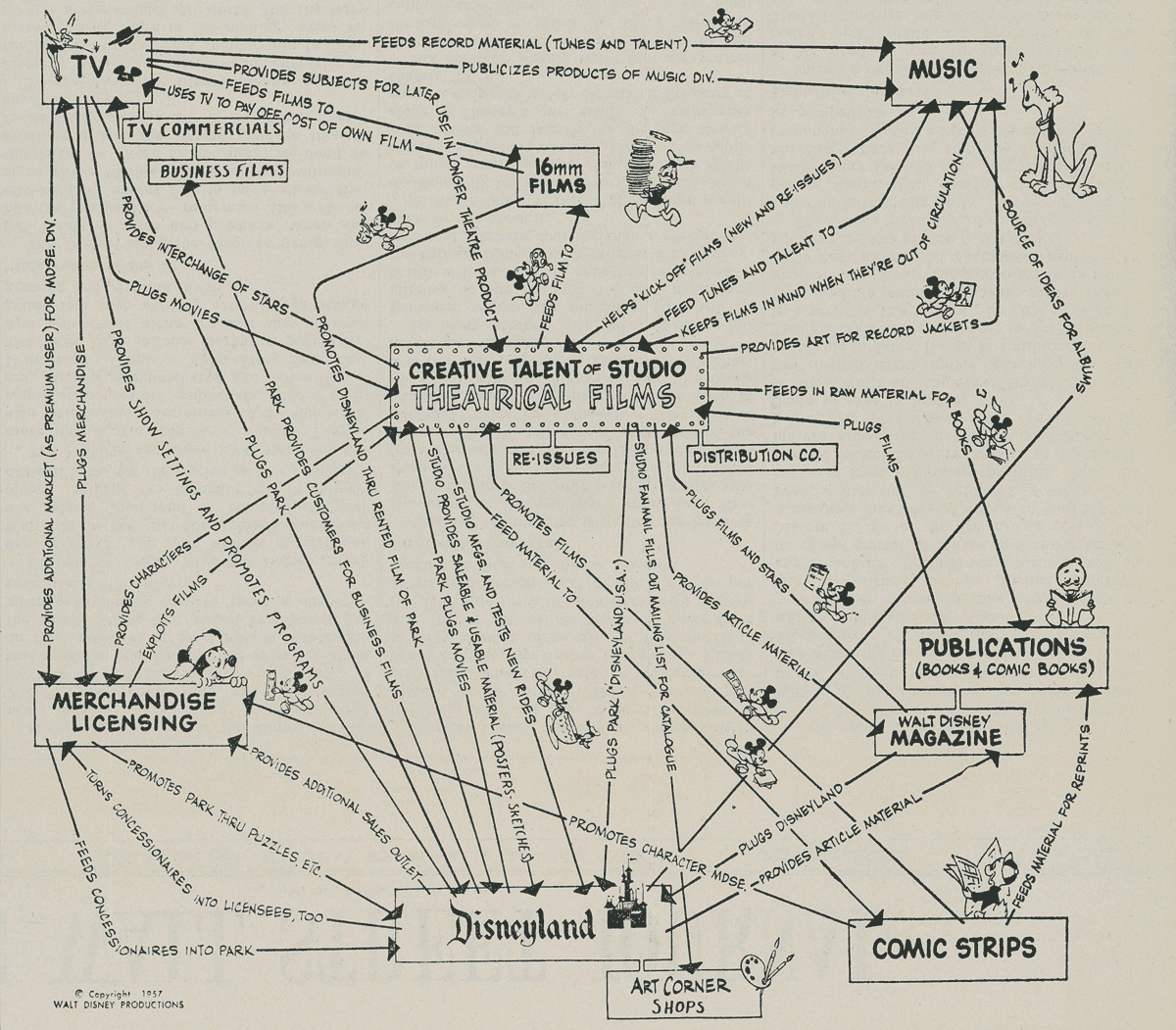
Disney’s corporate synergy, 1957 and today

July 24, 2014 Film Industry

I love [this graphic](http://johnaugust.com/wp-content/uploads/2014/07/disney_chart.jpg) from 1957 showing how the various elements of the Walt Disney company fit together.

corporate chart

You could make the same chart today.

Here is a partial list of the properties Disney owns in 2014:

Features:

* Walt Disney Pictures
* Touchstone Pictures
* Disneynature
* Disney Animation Studios
* Pixar
* Lucasfilm
* Marvel
* The Muppets
* DreamWorks (distribution)

Music:

* Walt Disney Records
* Hollywood Records
* Disney Music Publishing

Destinations:

* Disneyland/Disneyworld worldwide
* Disney Cruise Line
* Disney Vacation Club

Theatrical Group:

* Disney Theatrical Productions
* Disney on Ice
* Disney Live

Consumer Products:

* Disney Store
* Disney Baby
* The Baby Einstein Company

Books:

* Disney-Hyperion
* Marvel Press

Broadcasting:

– ABC Television Network
– ABC Family Worldwide
– Live Well Network
– A+E Networks (50%)
– Disney Channels Worldwide
– Radio Disney
– Disney Television Animation
– ESPN Inc. (80%)
– Hulu (32%)
– A+E Networks (50%), includes Lifetime and History

Online/Interactive:

– Disney Infinity
– Disney.com
– Maker Studio

Comics:

– Marvel
– Disney Comics

Almost every one of these items is a huge business just by itself. Which raises the question: If one were to make a new version of the 1957 chart, would Theatrical Films still deserve the central marquee spot?

Yes.

I’d argue that in 2014, film properties are probably still worth keeping near the middle of any Disney flowchart. The company makes money in many ways, but feature films are still the key drivers. You don’t get Cars merchandise without the movie.

The success of Frozen is an example of how Disney can capitalize on a hit film by using it in other divisions: Disneyland attractions, TV tie-ins (Once Upon a Time), music, books, merchandise, and possibly a Broadway musical.

As screenwriters, there are pros and cons to this kind of corporate synergy.

Giant corporations like Disney will keep making movies because it feeds the engine — and the better the movies, the bigger the multiplier in success. You can criticize individual films, but the juggernaut franchises have sprung from well-executed movies, and all of these movies began with screenwriters.

The challenge for screenwriters is that it’s increasingly difficult to get momentum on any movie that doesn’t seem to have the potential to work across divisions. An R-rated blockbuster like The Matrix can’t become a theme park ride, so why spend $100 million to make it?

Looking at the list of [top-grossing R-rated movies](http://www.boxofficemojo.com/alltime/domestic/mpaa.htm), Warners and New Line made seven of the top 10. With talk that [Fox may buy Warners](http://www.latimes.com/entertainment/envelope/cotown/la-et-ct-time-warner-white-knight-fox-20140722-story.html#page=1), I wonder if they would still be making those movies post-merger.

Selling without selling out

Episode - 153

Go to Archive

July 15, 2014 Apps, Film Industry, Highland, Producers, QandA, Screenwriting Software, Scriptnotes, Transcribed, Words on the page, Writing Process

In their first-ever live streaming episode, John and Craig open the mailbag to answer a bunch of listener questions.

– What research should a writer do before soliciting an agent or manager?
– What should a writer be willing to give up in order to make her first sale?
– Does a Mormon writer face special challenges in drink-and-drugging Hollywood?
– Why doesn’t Highland exist on Android?
– What determines “Story by” credit on a feature?
– How did we like DungeonWorld? (John asked this question.)

All this, plus the Fermi Paradox in this episode of Scriptnotes.

Links:

* [Scriptnotes, 76](http://johnaugust.com/2013/how-screenwriters-find-their-voice), with Three Pages by James Topham
* Scriptnotes, 115: [Back to Austin with Rian Johnson and Kelly Marcel](http://johnaugust.com/2013/scriptnotes-back-to-austin-with-rian-johnson-and-kelly-marcel)
* David Lynch [on the iPhone](https://www.youtube.com/watch?v=wKiIroiCvZ0)
* Björk, [Human Behavior](https://www.youtube.com/watch?v=GCGveA39VYA)
* [Dungeon World](http://www.dungeon-world.com/)
* Scriptnotes, 142: [The Angeles Crest Fiasco](http://johnaugust.com/2014/the-angeles-crest-fiasco)
* [Action Jackson](https://www.youtube.com/watch?v=-AvMn2Vh0fQ) trailer
* David Kwong at TED2014: [Two nerdy obsessions meet — and it’s magic](http://www.ted.com/talks/david_kwong_two_nerdy_obsessions_meet_and_it_s_magic)
* The Fermi paradox on [Wikipedia](http://en.wikipedia.org/wiki/Fermi_paradox), [Wait But Why](http://waitbutwhy.com/2014/05/fermi-paradox.html) and [Praxtime](http://praxtime.com/2013/11/25/sagan-syndrome-pay-heed-to-biologists-about-et/)
* Neil deGrasse Tyson [on chimps, humans and aliens](https://www.youtube.com/watch?v=_Ro9aebFZhM)
* John is [hiring a new UI designer](http://johnaugust.com/2014/hiring-a-ui-designer)
* Our USB drives [now have the first 150 episodes](http://store.johnaugust.com/collections/frontpage/products/scriptnotes-100-episode-usb-flash-drive)
* Archives are also [available on scriptnotes.net](http://scriptnotes.net/)
* This episode was broadcast live on [Mixlr](http://mixlr.com/scriptnotes/)
* [Outro](http://johnaugust.com/2013/scriptnotes-the-outros) by Scriptnotes listener Jeff Harms ([send us yours!](http://johnaugust.com/2014/outros-needed))

You can download the episode here: [AAC](http://traffic.libsyn.com/scriptnotes/scriptnotes_ep_153.m4a) | [mp3](http://traffic.libsyn.com/scriptnotes/scriptnotes_ep_153.mp3).

**UPDATE 7-18-14:** The transcript of this episode can be found [here](http://johnaugust.com/2014/scriptnotes-ep-153-selling-without-selling-out-transcript).

Scriptnotes, Ep 151: Secrets and Lies — Transcript

July 3, 2014 Scriptnotes Transcript

The original post for this episode can be found [here](http://johnaugust.com/2014/secrets-and-lies).

**Disclaimer:** Hey, this is John. Today’s audio was recorded in two separate sessions and Craig’s microphone was terrible during part of it, so just apologies for that. We got it fixed. If you hear the follow up section, Craig sounds much better, and healthier, and fuller of life, and that’s because we got his microphone all fixed up. So, sorry about that. And enjoy today’s episode.

**John August:** Hello and welcome. My name is John August.

**Craig Mazin:** My name is Craig Mazin.

**John:** And this is Episode 151 of Scriptnotes, a podcast about screenwriting and things that are interesting to screenwriters.

So, Craig, completely different environment for me here. I am sitting atop a mountain here at the Sundance Resort. I’m here for the Sundance Screenwriters Lab. And so it’s very much like how we normally talk over Skype, but just I’m in a very different place geographically.

**Craig:** Mentally, emotionally. Well, you sound great. You know, I was invited once to go do the Sundance Lab and then I had to cancel it because I was stuck in production. And then they never asked me back. [laughs]

**John:** Oh, that’s sad.

**Craig:** I’m thinking that maybe they just got… — I mean, it wasn’t like I canceled at the last minute. I canceled months in advance, but yeah, I think that that probably was it. That sealed my fate.

**John:** Yeah, you get the one shot.

I’ve been an advisor here since 2000 was my first year up here as an advisor. So, in ’99 I had, my movie Go was playing at the Sundance Film Festival and the next year they asked me up to be an advisor. What I didn’t tell them is that I’d actually applied to come to the labs before with a previous script and they had not even considered. I’d been rejected. So, I was never a fellow. I was only an advisor.

But, this process is great and I’ve talked about this on the show before, but they bring up a bunch of filmmakers who are working on their first or second features and in the summer session they are shooting some scenes just on video to sort of practice what it feels like to shoot scenes out of their movie. But they also have these five days where they’re talking with other screenwriters. And we’re reading their scripts and offering suggestions, but more importantly just an extra set of brains to help figure out how they’re going to tell their story. And it’s a great process.

**Craig:** I saw the picture online. Is that Howard Rodman lurking there in the background?

**John:** Howard Rodman is a fixture at the labs. He came up here the first year that I came up here. And this year he’s actually — he oversees all the advisors for this process.

**Craig:** He’s terrific. I’ve gone and spoken to his graduate class at USC a number of times.

**John:** He’s salt of the earth. A great guy.

**Craig:** Yes.

**John:** Today on the podcast, you suggested some topics, and I suggested some topics, and I think we’ve got a good show here for you. So, we’re going to talk about secrets and lies. We’re going to talk about the things that characters are concealing from each other, sometimes concealing from the reader. We’re going to talk about subjectivity and sort of the experience of how a character within a scene perceives information.

Based on all my reading up here, I have seven suggestions for how to pick character names so that people can understand which character is which. And then a reader had sent in a scene and then also the three pages that became that scene, which we thought were fascinating, so we’re going to talk about his three pages and the scene that he actually shot and what we can learn from seeing those two things. We’ll answer a question about following up after a meeting, so it’s going to be a busy show.

So, on the topic of follow up we have some follow up — on an earlier podcast we talked about Aereo, which was a service in New York City and a few other places that led people record live broadcast TV on these little tiny antennas and then stream that video that they recorded to their devices, their iPhones, their computers, wherever else they were. And this was a Supreme Court case, so the networks were suing Aereo saying that what they were doing was a violation of the Copyright Act. And the Supreme Court decided this week. And come down with a 6-3 decision in favor of the networks, saying that this was, in fact, a copyright violation.

**Craig:** Right. Yeah, so it’s an interesting thing. Aereo’s argument was essentially this: that they’re not really doing anything. This is all about broadcast network. So, broadcast networks send their content out over the public airwaves. And anyone in the public can receive it through an antenna, if they so choose, and then watch it in the privacy of their home.

Of course, now almost everybody is on, you know, uses cable to receive broadcast networks which in and of itself is relevant to this case. But, what Aereo essentially said was our service, all our service is really just a whole big bunch of antennas. They had like 10,000 tiny little dime-sized antennas. And the way the product worked is you would pay them a subscription fee and then if you wanted to watch, say, Big Bang Theory you would just say, “I want to watch Big Bang Theory,” you would send that to their servers, their servers would tune one of those individual antennas to Big Bang Theory —

**John:** And specifically your antenna, because essentially you’re renting one specific antenna.

**Craig:** That’s right. That’s just yours. Exactly. So, that one specific antenna would pick up the free broadcast signal of Big Bang Theory and then it would take that signal, put it onto a hard drive. It would essentially make a copy. And it would make a specific copy for each person that requested it. And then it would start streaming that copy with a slight lag behind the actual air time of a few seconds.

You could either watch it streaming at that point where you’d be essentially watching the broadcast signal a few seconds behind the actual broadcast signal. Or, you could time shift it and just watch it later as if it were a DVR. So, their argument was essentially we’re not doing anything other than simply allowing people to use one of our fancy antennas and nothing more.

**John:** But, they didn’t win. That argument did not go over. And six of the justices said, well, you know what you’re doing actually feels more like cable TV.

**Craig:** Mm-hmm.

**John:** I thought the decision was interesting because they kind of just said that. It’s like it’s sort of irrelevant how you’re doing it. The net result is sort of like cable TV and congress has previously decided that cable companies if they want to carry broadcast channels have to pay the networks and probably I think local people, too, in order to carry those signals.

**Craig:** This is an interesting area where I think a lot of powerful people’s desires intersect.

**John:** And also I think consumer’s desires. Consumer’s desire not just for cheaper access to broadcast television, or sort of better access to broadcast television, but just convenience. And Aereo was genuinely convenient and it was a useful thing for people. And so when you take that away there’s going to be some pushback on that as well.

It doesn’t necessarily by the way mean that Aereo has to go away. Aereo went into this saying that there was no Plan B, but of course their Plan B could essentially just do what cable companies do and negotiate terms for coverage on what they’re doing.

**Craig:** I don’t see what the Plan B is. Their entire business model was essentially built around a gimmick, a trick. And I do think frankly at its heart what they were doing was wrong. And I do think it was more than just ethically wrong. I agree with the court here. I think they were flouting the law. The law may, you know, I don’t know if every specific word was there to cover it. I mean, the law was written in ’76 I believe. Basically they were — I think they were breaking that law.

**John:** A second bit of follow up. We had a great shout-out from the people at the Slate Culture Gabfest, Julia Turner and Dana Stevens endorsed us as one of their cool things, that’s their equivalent of a One Cool Thing on their podcast this week. So, I just want to return the favor and say how much I enjoy the Slate Culture Gabfest which I listen to every week.

Craig, how did you even find out about it because you don’t listen to any podcasts at all?

**Craig:** Yeah, I didn’t realize there were other podcasts other than this one. I thought we were it. But somebody sent me a tweet about it and so I clicked on it because I so very often read anything positive about me in Slate. [laughs] And so I listened to that section of the podcast and they were both very complimentary and it was nice to hear that.

I mean, my favorite thing was when they were both done talking about it, the third person with them, a gentleman, there was like a pause and then he kind of John August-ed them, you know, where sometimes I’ll say something and then there’s a pause and you’re like, “So anyway…” [laughs]

**John:** He segued right out of it.

**Craig:** Yeah. He was like I’m bored with your Scriptnotes talk. So, I’m not going to talk about that guy. I like the people that like the podcast.

**John:** I love the people who love the podcast.

**Craig:** So we were talking on Twitter about maybe doing a crossover.

**John:** Which would be so much fun. The Nerdist crossover was fun.

**Craig:** It was.

**John:** It’s good. We’ll make it happen.

**Craig:** Awesome.

**John:** All right. On to today’s topics, so Craig what motivated this talk of liars and liars in scripts?

**Craig:** Well, I’m working on a movie right now that is essentially it’s a whodunit. And when you start to investigate the world of whodunits you — I’ve been reading a ton of Agatha Christie. I mean, I’ve always been a Doyle fan. And I’ve always been a Poe fan. Poe is really the kind of inventor of the modern whodunit detective story.

For this kind of movie I felt that Agatha Christie’s genre was the most appropriate, and so I’ve been just reading a lot of Agatha Christie. And one thing that I’ve noticed is all of the characters, with the exception of the detective, are liars. Part of the fun of a good mystery is that when you ask the question whodunit the answer is any one of these people could have done it.

And we think that they could have done it in part because perhaps they all had motive, they all have opportunity, but more importantly they are all lying. And it’s lying that makes us suspect them.

But as I started to think about this, I realized in fact everyone is a liar to some extent or another. All humans are liars. Lying is part of the human condition. But there are different kinds of liars. And there’s different kinds of lying. And when we talk sometimes about new writers who are writing and the characters — we’ll say, “Oh, everything seems on the nose or there’s not enough subtext,” in a weird way I think sometimes the mistake people are making is that they’re writing people and those people aren’t lying.

They’re writing truth-tellers.

**John:** Yes.

**Craig:** And it’s just less interesting. So I wanted to talk about how useful it is to think of your characters as liars, but also the different grades or categories of lying and lying characters that you’ll find.

**John:** I think it also feeds into our concept of motivation, why a person is saying the things that they want other people to believe is key to understanding who they are in a scene and overall in the film itself.

**Craig:** That’s right. The idea of drama and of experiencing a narrative where humans move through it and transform is that they are not at the end who they were in the beginning. And if they were just truth-tellers in the beginning, naturally they’re simply going to say, “Well, here’s the situation. I’m very scared of this. I’m scared of growing up, and I’m scared of telling you that I love you, but I do love you. And I’m hoping that by behaving better I will in fact grow up and whether I get you or not I will be a better person.”

[Yawns] Movie over. You know? Everyone has to be concealing something in some way. But then there are characters who are lying for other reasons. Maybe not such understandable or empathetic or sympathetic reasons.

So, let’s talk about some of the different kinds of lying there is. The most useful kind to me is self-deception. I think every protagonist to some level or another is engaging in self-deception. We’ll say the character has an arc. It is a bad character, a dramatically unsatisfying character who has complete access to his or her emotional states, weakness, flaws, and can pinpoint them perfectly and then throughout the course of the movie go about and achieve them.

One of my favorite examples of this, because it was done so cannily, is Jerry Maguire. I honestly think that Cameron Crowe pulled off one of the most brilliant self-delusional movies of all time. You know, we’ll see sometimes in comedies shine a — hang a lantern on it. If you have something that seems a little wonky in your story just go for it and embrace it and people feel like it’s intentional.

**John:** Yeah. Call it out to the audience so the audience knows that you recognize that it’s there.

**Craig:** That’s right. So, what does he do with this character of Jerry Maguire, and the movie begins with a man who in a moment of frustration writes a manifesto about the kind of person that is a good person. But he is still engaged in a very high level of self-delusion. He is in fact not that person. Even the writing of that manifesto is a manifestation of his self-delusion. He’s actually a bad person. The manifesto itself is really more of a temper tantrum, and nothing he actually thinks he should or could do.

As a result of writing that manifesto he loses his job and all of his clients except for two. And actually really what it comes down to is one. And then must struggle over the course of the movie, clinging all the while to his self-delusions, to finally get to the place where he realizes, oh my god, I’m supposed to be the person I wrote about in that manifesto.

That’s how strong self-delusion is, even when you can write down the truth of yourself, you do not believe it.

**John:** Self-delusion is commonly the starting place for a movie where the journey is for the character to come upon emotional honesty, emotional authenticity. And so when we talk about sort of how useful it is for a character to lie, that’s not that the movie should be lying. It’s that the character needs to have progress from this inauthentic state to an authentic state at the end, and Jerry Maguire is a great example of that.

**Craig:** Yeah. And I think all protagonists to some level or another have a self-delusion. If they have an arc it means they have a self-delusion.

Going into the world of animation, the character of Marlin in Finding Nemo, he is honest to himself to a point. He honestly believes that he must take care of Nemo at all costs. But he’s deluding himself because somewhere down there is access to a truth, an inherent truth, that this can’t last. The boy will grow up. He must let him go.

**John:** Even in movies that are more action-based or sort of have more classically sort of like here’s the hero protagonist you often see that the hero at the start of the movie is really kind of a series of poses, it’s acting the part of the hero but it doesn’t actually have the stuff inside him because he hasn’t been tested in ways to really show what it is that matters to him.

**Craig:** That’s right.

**John:** What it is that is sort of unique to his own journey.

**Craig:** Yeah, in fact that can start to give you a clue as to what — everybody is afraid of the second act, but this gives you a clue to your second act. What situations should this person go through so that their own delusion can be laid bare to them.

**John:** But they’re normal way of doing things and the normal person they’re presenting out into the world is called out in a way or is ineffective in a way and they’re forced to find a new identity.

**Craig:** Right. And this works in part because it is the function of drama to — why we are attracted to drama is because it illuminates our lives. All of us are delusional.

**John:** Yes.

**Craig:** Everyone on the planet is delusional. We are all walking around either ignoring something in ourselves, willfully or subconsciously, or simply misunderstanding ourselves. No matter how much therapy you go through, there will always be a glitch in the system because we’re made of meat. We are rational to a point, but the part of us that is irrational is not accessible by the rational, so therefore it’s happening out of our control.

**John:** Well, I would also question whether if you got rid of all your self-delusions, if you got rid of all of the lies, would you even have — would there even be a person left underneath there? I think of so many cases are personalities and sort of who we perceive ourselves to be is a narrative that is carefully constructed based on experiences, based on our hopes, based on our dreams. And you are sort of a story. And a story is made up of some fabrications.

**Craig:** That’s right. Just as you can’t step into the same river twice, every new realization you have changes your mind. It changes who you are and gives birth to a new level of potential self-delusion. One hopes that you, you know, you can improve your life and know thyself is a great goal. But you’re right, it’s actually an impossibility. To truly 100% know yourself, I mean, let’s get really heavy for a second. Are you familiar with Gödel’s theorem?

**John:** I don’t know Gödel’s theorem. Tell me.

**Craig:** Well, first of all, a great book. This is my One Cool Thing for everyday. Gödel, Escher, Bach. It’s an incredible book. Douglas, I want to say it’s Douglas Hofstadter I believe is the — and he wrote this I believe in the ’80s. This brilliant kind of mindboggling book that goes into mathematics, artificial intelligence, logic in ranges from Alice in Wonderland to the music of Bach, to the drawings of Escher, and then interestingly in to the work of Gödel.

And Gödel had this very famous mathematical theorem. And essentially what it said is for any given system of mathematics, you know, in math I don’t know if you remember, you can prove things.

**John:** Yes. Absolutely. That’s crucial.

**Craig:** Do you remember that? Right. So you have a system of rules and then somebody gives you an assertion. And then you can create a proof of that assertion using the rules and you can proof that it is true and that’s important.

**John:** Yes.

**Craig:** What his theorem said was there are — for any system of mathematics, there will always be things that are true that cannot be proven. And that’s kind of mindboggling in and of itself. And it gets to this whole idea of recursion, all the rest.

But what it really comes down to is our brains are closed systems. There will always be things that are true that are brain in its current state simply can’t prove. You’re right; self-deception is inherent to the human condition. So, wonderful thing to think about as you’re creating your character.

**John:** And if you go in further, if you actually were to strip away sort of everything you think about yourself, your entire narrative, I’ll put a link in, too, Datura, I may be pronouncing it wrong.

**Craig:** Oh god.

**John:** But you know that drug?

**Craig:** The worst.

**John:** It apparently just lays you completely bare and you sort of see yourself and your wholeness and all of your flaws. And very few people can withstand that sort of spotlight of scrutiny. When you lose yourself, you lose all of your lies.

**Craig:** Precisely. And that’s why the journey for a character that is struggling with their self-deception is difficult. When we talk about — see, bad screenwriting teachers will always talk in terms of bloodless structure, because that’s all they understand. So, they’ll say things like it’s important that your hero face obstacles. Why? Why? Let’s just start with these really fundamental questions.

Like I remember I took a philosophy class in college and the professor asked a question. it’s good to know that things are true, but why? Why is truth better than not truth? [laughs] Then you go, huh, I guess I should probably think about that. Well, why obstacles? Because if there are no obstacles — the obstacles aren’t the point. The obstacles are the symptom of the difficulty of undoing your self-deception. It’s hard.

**John:** All right. So, self-deception is a key thing. What other types of lies do you think are fundamental for storytellers?

**Craig:** So, that’s the first and that’s the most common class. Then there’s this second class that doesn’t apply to every character. And I call this the manipulators. These are people who lie for a purpose. They’re lying for an external purpose. And we can break them out into two subgroups. There is the protective manipulators and there are the manipulators who are lying for gain. So, protective liars are people that lie in order to avoid pain or hurt or to maintain some lifestyle that is their best option.

**John:** So, they’re not trying to deceive themselves. They’re trying to deceive other people to either protect what they have or protect the things they love.

**Craig:** Right. And you and I have both written movies that have this. Big Fish, Edward Bloom. He’s a protective liar. He is lying because it’s helpful to him. He’s certainly lying more than the average person. He’s not lying to get rich.

**John:** No.

**Craig:** And he’s not self-delusional. He’s lying purposely, but in order to protect himself on some level.

**John:** Yeah. I would push a little bit back on protect himself, is that he’s attempting to — the only thing he can pass on is his vision of how the world should be, so he’s attempting to use these fabrications in order to create an idealized world, a vision for what he wants for his son.

**Craig:** Yeah. And I actually think that that’s consistent with protecting yourself in the sense that if you don’t do it then you feel inept as a father. You know, that you’ve somehow failed. That this is something he needs to do for his son.

In Identity Thief, the character of Diana lies because she is lonely and unloved and the only way she can survive is by constantly lying. Constantly. It’s become a crutch. And these characters can be very sympathetic actually. They’re frustrating. They’re frustrating, and that’s fun. They create conflict, which we love of course. And they also keep the audience guess, which we love. And then, of course, they have the audience begin to connect with that person. The audience naturally tries to make sense of things. It’s part of what we do as human things.

So, don’t try and make sense of why this person is doing it, and now they’re doing your work for you. They are engaged. And your job when you finally explain why is to explain why in a way that is satisfying to them, that does make sense.

**John:** Absolutely. So, you’re describing the character’s secrets and lies, which is really the same thing. There is something that they’re not showing. There are cards they are holding back. And that’s a way of engaging the audience’s curiosity.

**Craig:** Correct.

**John:** And anything that makes your audience lean in to the story rather than sit back is a very good thing.

**Craig:** That’s right. Now, the second sub-heading under manipulators are the people who lie for gain. And these are typically villains. Sometimes, however, they’re heroes. For instance, Danny Ocean lies constantly for gain. He’s a thief. But, you’ll take a look at a villain like Hans Gruber in Die Hard. Wonderful liar. Wonderful, brilliant liar, and lying for gain. He also, too, is a thief.

These people who lie for gain are oftentimes much better liars than the people who lie to protect themselves or conceal a personal secret. And they’re definitely better liars than people who are simply self-delusional. They’re professional liars. So, you get to write somebody who is not only screwing with the people around them, but screwing with the audience, and this is important.

**John:** When you say they’re lying for gain, it’s not just necessarily monetary gain. If you look at Jeff Bridge’s character in Jagged Edge, that’s a character who is lying with a very specific agenda. He’s trying to protect himself, but he’s also — he gets so much more by establishing and maintaining this lie. It’s his natural way of going through the world is that lie.

**Craig:** Absolutely. And sometimes the reason, the gain is actually quite noble. Flick, the ant, goes and gets these guys to help save the village, but they’re just circus performers. And this lie has to be maintained until finally it’s laid bare.

There are all sorts of ways that people can lie for gain, but when they do so they have to do so with some skill. And therefore as a writer you have to actually think like a manipulative liar here who is trying to get something. The truth is no longer important. What’s far more important is what you have to say. And the audience shouldn’t always know. I mean, one of the great things about Ocean’s Eleven is that they lie to each other. They lie to Matt Damon. Not everybody knows what’s going on. And then the movie lies to us through their perspective, because we think we’re seeing something we’re not, and then they reveal how they’ve lied. So, that gives you so many opportunities.

**John:** I think the challenge for a screenwriter is recognizing when it is good to let the audience in and see the liar doing his work, because that can be really rewarding to see somebody be really good at the thing they’re doing. And when you’re better off holding back and keeping the audience in the same point of view as all the other characters where they’re being manipulated as well.

**Craig:** Yes. And the revelation of their lies should have the punch of some kind of climactic feel, because if you reveal it too soon you’ll simply lose interest. I mean, we understand the basic lie of Hans Gruber fairly early on, but there’s this other lie that he’s hiding from his own guys of what’s going to happen with that last bit of security lock. He hasn’t told them, which is actually kind of great. I mean, because look, realistically if you were leading a gang of henchmen into a building to rob it and you knew that there were seven things you had to get and the last one was an impossible-to-break electromagnetic seal on the vault, you would say, “Don’t worry. What we’re going to do is we’re going to stage a terrorist attack. Eventually they’ll follow the handbook, turn off all the power, and that will open the thing for us. You ask for a miracle, I give you the FBI.”

But he doesn’t tell them.

**John:** You like at Keyser Söze at the end of The Usual Suspects and you know that he is manipulative, you know that you can’t trust him, but you didn’t know that everything you’re experiencing was a lie. And it was the right choice to save that reveal to the very, very end so it is the punch line to the joke is the revelation of this last lie.

**Craig:** Right.

**John:** I’m sure there decisions and he probably went back and forth about like, well, if we revealed a little bit earlier then we could see, we would have the tension about will he get caught. And this was the decision like, nope, the whole movie has to be set up to this point.

**Craig:** Yes. Exactly. And that’s a great segue to our next category, because Keyser Söze is a perfect example of somebody that manipulates and lies for gain. He’s also a very bad person. But his badness isn’t his lying. His badness is that he’s a murderer. The lying is done to get him gain for his other badness, which is murdering.

But then there’s the last category of liar, and this is the worst liar, and these are always villains. And these are some of the scariest characters you can create. They are bad, bad people. These are the chaotic, pathological liars.

**John:** Yes.

**Craig:** These are the people that lie because they love trouble. And they lie to create strife and drama. They can’t control their lying. I don’t think they’re alive unless they’re lying. I don’t think they even know what the truth is.

So, the character that often comes to mind in this case is the latest incarnation of the Joker, the Heath Ledger Joker. One thing that I thought was just remarkable, I think everybody thought it was pretty amazing in Dark Knight was when the character the Joker explains how he got his facial scars. And it was kind of very scary, very revealing confession of a trauma.

**John:** It made you almost sympathetic for a moment.

**Craig:** It did. And then there is another scene later where he explains to somebody else how he got his scars and it is just as compelling, and just as terrifying, and just as true feeling, but it’s a completely different story.

**John:** Yes.

**Craig:** And that’s when you realize this man is just a liar.

**John:** Yeah, he’s truly a sociopath. A psychopath. I mean, all he can sort of do is lie. It’s the air he breathes. If he says hello, that’s a lie.

**Craig:** That’s right. And these characters are very difficult to write because for the most part we aren’t them. I mean, occasionally — god help us — we will run into these people.

**John:** I worked for a person — I worked for one of those people.

**Craig:** There you go. And part of the problem is they’re so good that you don’t really know for awhile what’s happening. And then eventually it becomes clear and then part of the struggle is it’s hard to wrap your mind around the fact that another person is actually doing… — You, like the audience, want to make sense of them. But you can’t, because they are operating in a way that, frankly, they don’t even care about their own destruction.

The Joker doesn’t care if he lives or dies. He has no interest in that. He loves chaos. He loves the chaos that lying can bring. And you’ll see these characters sometimes in noir, these characters will skew towards female, because when you put it in a man you immediately start to think, my god, he’s going to just start stabbing, shooting, killing, and all the rest, whereas women can maybe just scramble your brain and make you second guess your own name and all the rest of it. And then finally Bogart sends you up the river.

But, liars, pathological liars are very scary people. And if you’re going to write one, you just have to know that the movie will be deeply infected by them. That they are going to take over.

**John:** It’s a movie that hasn’t come out yet, but Kristen Wiig is terrific in a comedy I saw, I guess you’d call it a comedy, kind of a comedy, kind of a drama called Welcome to Me. It should be out later this year. And she’s not a psychopath, but it’s one of the rare cases where I’ve seen just a chaotic, manipulative person really at the center of a film, where she is supposed to be the protagonist, but she honestly kind of can’t protagonate in a meaningful way.

**Craig:** Right.

**John:** It’s a really challenging task for a writer and for an actress to put that person at the very center of a movie and not have that person be the villain.

**Craig:** Of course, because the protagonist at some basic level is trying to achieve something. We ask simple questions of our heroes. What do you want? What are you willing to do to get it? What scares you? This or that.

Well, what does the pathological, chaotic liar want? Trouble.

**John:** [laughs] Yes.

**Craig:** That’s what they want. They want trouble. So, the only person I’ve written like this, and I loved writing him, was Mr. Chow.

**John:** Mm-hmm. Yeah.

**Craig:** Mr. Chow is a chaotic, pathological liar. He does not care if he lives or dies. In fact, he thinks it’s awesome. He just loves trouble. But, because he’s so comic, and also embodied in this kind of very small, physically frail man, it’s funny. I mean —

**John:** But if you tried to have the Mr. Chow movie, good luck. It’s very, very challenging to put that person in the center of a movie and have them do any of the kinds of things you want a person at the center of a movie to be able to do.

**Craig:** Absolutely. In fact, Todd and I talked for a bit about the idea of what a Mr. Chow movie would look like. And it was totally different because it was the darkest thing imaginable. And I remember we had this one idea for a scene that sort of sums it up. Mr. Chow comes home to see his elderly father. And he walks in and his old, old father looks up at him and says something like, “Leslie, you returned to us, you came back.” And Mr. Chow walks over to him, and then cuts his throat. [laughs]

And as his father is dying, his father looks up at him and says, “Good job.” [laughs] Because that’s the only — that’s how Mr. Chow is born. It’s just pure, awful chaos and darkness, willful self-destruction. The only goal there is is to blow up the world, you know?

**John:** Yeah. Those characters are almost un-human, because they don’t work in our normal ways. Crispin Glover and I had a few conversations about taking his Thin Man character from the Charlie’s Angels movie and just doing his own movie. And ultimately nothing will ever come of that probably. But it’s a fascinating character, but such an incredibly challenging character to put at the center of anything because he is chaos. He’s like chaos and death in ways that’s very hard to — he’s challenging. It’s very hard to have insight into that character, because deliberately they’re supposed to be opaque and you just can’t know them.

Scarlett Johansson’s character in Under the Skin is a similar situation, is where she’s just this lioness. There’s not a human — there literally is not a human underneath that. It makes it very challenging.

**Craig:** Right. It essentially doesn’t work. It doesn’t work. There needs to be somebody in opposition to it, or they need to not be human and that’s sort of the point, and then the purpose of the movie is to illuminate the difference between humans and non-humans. But, they will infect your movie and you have to write them carefully. They can kind of get in your head.

And by all means if you run into one of these people —

**John:** Run away.

**Craig:** Go the other way.

**John:** The classic advice, and I’m trying to remember who originally said this, but the advice to young psychiatrists was if in your first meeting your patient talks about how awful their previous therapist was and how all these things — run away, because that person is probably a psychopath. There are people who are just — you’re just going to fall into their deep well and you’re never going to figure a way out of it.

**Craig:** That’s interesting. You know, it’s funny, Dennis Palumbo told me that when he sits down with a client for the first time, the first question he asks is have you had therapy before and can you tell me about that experience. All we’ve done now is we’ve given the chaotic liars a way to wiggle out of that.

**John:** Absolutely. They’ll say about how incredibly helpful it was and the skills they used. And it was really life-changing. They just need a little tune up.

**Craig:** Yeah. And then they crawl inside you and devour you from the inside.

**John:** Oh, yes, that’s never a good thing. So, let’s recap what we talked about with liars, because I think it’s really, really useful. So, liars who are self-deception, which is probably true to every character in your script. There’s going to be some aspect of self-deception.

Manipulative liars — manipulative liars who are lying to protect something, or manipulative liars, what was your second case of manipulative liars?

**Craig:** Or trying to gain something.

**John:** Exactly. So, protection or gain. And then finally the, I mean, what did you call it, the sociopathic liar?

**Craig:** Chaotic, pathological.

**John:** Pathological, yeah, where they can’t stop lying and they will lie for any reason. It’s like kleptomania. They don’t need that pack of gum, but they have to take that pack of gum.

**Craig:** That’s right, lying even to mess themselves up.

**John:** So, I had a boss who, when he got bored, this is pre-internet, when he got bored in the afternoon he would just call someone at Variety or Hollywood Reporter and just make up a lie about another project or another person, just to stir shit up.

**Craig:** Wow.

**John:** Yeah.

**Craig:** Wow! Blech.

**John:** Yuck. And you just don’t want to be around that for long.

**Craig:** No, that’s, Geez-Louise.

**John:** One of my favorite things to do at dinners here is to tell our terrible Hollywood stories about people who are just completely awful to us. And really you sort of collect them like little badges, like that was an awful thing but I’m so glad that happened because now I have a story about that.

**Craig:** It’s true. At some point the tragedy finally has enough time and then it becomes funny. But, oh gosh, in the middle of this stuff it can really just scramble you up. And that’s why we have to — writing is actually a way to maybe pop the balloon a little bit, because it’s fun. Look, it was fun for me to write Leslie Chow because he just didn’t care. He didn’t care about anything. He loved it. He was so excited to die, or for you to die, or for something to happen. Everything is funny. Everything.

**John:** Yeah. Hilarious.

**Craig:** Yeah, if a lion bit off his arm he would laugh and then he would tell the lion to choke on the arm and then he would laugh as the lion choked on the arm. He wouldn’t care.

**John:** Wouldn’t care.

**Craig:** Yeah. It’s nuts.

**John:** So, one of the writers I’ve gotten to meet up here at Sundance is Chris Terrio. Have you ever met him before?

**Craig:** No, I haven’t. But I enjoyed his movie.

**John:** Yeah, so he wrote Argo which is a great film. And so we screened it last night here and he did a Q&A afterwards. And one of the points he brought up which was really fascinating and I hadn’t really considered it in the way that he framed it. So, he was talking about a scene in which Ben Affleck’s character is driving and then it’s going to cut to news footage of talking about the Iranian hostages. And so it’s existing news footage. And in the edit Ben Affleck was driving and then it cuts to the news footage and he was pushing really hard for the way he had it in the script, which was a pre-lap, is that the Walter Cronkite or whoever is talking while Ben Affleck is driving and then we finally go to the news footage.

And that seems like a very small distinction. Like it’s sort of really when does the sound start. But his point was that by starting the sound while you’re with Ben Affleck’s character, you’re creating the experience of subjectivity. And what we’re about to see feels like it’s inside Ben Affleck’s mind. It feels like it’s that character thinking about it. It’s a way to sort of verbalize thoughts. It feels like it’s running around in his head. And then when we actually go to it we still feel like we’re with Ben Affleck’s experience.

Probably that music is also taking us through. It’s a way of letting that clip happen not just as a thing that happens. It’s inside Ben Affleck’s head. And that experience of subjectivity is really interesting and it makes me feel much better about how often I tend to use pre-lap in my scripts to explain that something is start — like a sound is starting, and dialogue is often starting before we get into that next scene. It’s anticipating the cut.

**Craig:** I love that. First of all, we’ve done a long discussion about transitions. I mean, it’s just generally a nicer, smoother transition. But I love that observation because, again, we want to try and have the audience do as much work for us as possible. They appreciate that. The bad feeling is when you feel like the spoon is entering your mouth and you already know what that food is and then, yup, it’s that food.

And so see the news report and then you show him in the car, well that was just a news report scene that feel like “and now a moment in the movie where we have to tell you stuff. And now here’s Ben Affleck driving.” But instead, simply by pre-lapping, showing him in the car and then completing the news report, by simply putting that sound and that image in parallel, the movie stops teaching us something and is now telling us that this is an experience that Ben Affleck has had. Either he heard this news report before. I mean, he’s not hearing it right now.

But the movie is essentially implying he knows this and that changes everything because then it’s about him and as Chris points out his subjectivity and his experience. This, by the way, is a great example of what I call the new screenwriter, who not only thinks like a filmmaker, but is involved.

**John:** Yes.

**Craig:** So that he can help the director and the producer towards these things because we actually are pretty freaking good at this. And I love the way that the movie business has opened up to the new screenwriter because the new screenwriter provides moments like that, which are great.

**John:** Sure. What’s also I think crucial about the sense of the pre-lap and the overlap is that it’s taking these things that are two scenes and made them one scene. It’s joined them so that they are fused together as one element. So, you look at like, oh, that’s when he was thinking about this, rather than that was him driving in his car. This is information about the hostage crisis. So, as you look at your own scripts, I think it’s important to really figure out how much information that you’re giving us can you find a way that it’s meaningful to the character who is giving us the information, or that the movie is giving you information. How can you put that in the subjective experience of one of the characters so you’re not just telling us?

And there are many examples of doing that, but it’s really thinking about who is the interesting person to be seeing these events through and how do you experience the movie? How do you find a place holder for who the audience is in this movie?

**Craig:** Yeah. It’s a good example of how sometimes a problem can lead to a solution. You’re sometimes stuck with something that has to happen but it feel clunky. And oftentimes if you sit back and look at it you realize it’s actually not a problem at all. It’s a benefit.

**John:** Yes.

**Craig:** It is clunky to simply show Walter Cronkite talking about stuff. And then it’s even more clunky to show the shoe leather of Ben Affleck driving in a car.

**John:** One thing, Argo is worth a rewatch. And one of the things you recognize they do really brilliantly is they insert the news footage clips in ways that are very smart. And oftentimes they’re playing on TVs in scenes in ways that are meaningful. Or one of the great examples is a cross-cut between the hostage woman talking about why they’ve taken the hostages and the table-reading of the Argo script. And so you have this really funny moment at this table read of this ridiculous cut intercut with this announcement of the hostages.

And by being able to do both things at once, that’s sort of the key to the tone of the movie is that it’s both a big Hollywood movie about big Hollywood movies and there’s real stakes in terms of these people’s lives.

**Craig:** Yeah. Anytime you can kind of take two things that maybe separately would be a little flat or a little empty or a little thin and layer them together. Yeah, there are times of course where you know that the dramatic focus is such that you don’t want to do that, you don’t want to get noisy, but one thing that I know about screenwriters is that those things are intentional and they’re purposeful. When he says, “No, it should be pre-lap and like this,” that’s not just a random… — I mean, look, for good screenwriters it’s not some random bit of technique. There’s a purpose.

And I like the fact that people are open to hearing what that purpose is, especially when they’re excellent filmmakers, which in this case Ben Affleck is a very, very good director.

**John:** Agreed. So, this last week I’ve had a chance to work with five different filmmakers and read five scripts. And I don’t read as many scripts as I used to. I used to read a ton of scripts, and now I tend to read what I’m writing, or read a few things that friends send through. So, when you look at five scripts over the course of a couple days you notice some patterns, and one of the patterns I noticed is that sometimes people are not making the best choices for naming characters.

And so while we were sitting in a meeting and people were talking about other stuff, I wrote up my seven suggestions for character names. So, I want to sort of share those with you.

My first suggestion we’ve talked about on the podcast before is pick different first letters for character’s names. So, if you have a character named John, you can’t have a Jim, or a James, or a Jackson. There should be one character named with a J. That’s a pretty good basic rule of thumb. Don’t double up. And you’re not likely to have 26 characters who really need names, so you’re going to be fine.

Helpful — pick a different number of characters in names. So, if you have a character named Tom and a character named Ben and they’re both talking a lot, people on the page they sort of skim down and scan and they notice different lengths of names. So, Tom and Ben, they’re going to get confused in people’s heads. So, you’re better off with a Tom and a Benjamin and keeping them straight than a Tom and a Ben.

**Craig:** Right.

**John:** Not only should names have different first letters, but they should also sound different. Because I think you actually do in some ways sound out those words you’re seeing in your head. So, if you have a character named Gene, G-E-N-E, and a character named John, you’re going to get those confused. They can sort of blur together. So, if you have a soft G sound and a J sound, those can blur together. So, if you can avoid that, that’s awesome.

**Craig:** Yes.

**John:** Try to avoid names that are semantically similar. So, if you have a character named Rose, don’t have a character named Tulip, because we’re going to get them confused. Because we thought flower and that’s all we’ll remember. Oh, it’s the girl with the name of the flower. Oh shit, which one is it?

**Craig:** Yeah, and the world suddenly seems so weirdly small that there are two people with flower names.

**John:** Absolutely. As much as you can, try to avoid gender ambiguity in names. So, names like Robin, Carrie, Kim, depending on the language, can get really confusing, especially if that’s not a character we see very often. So, if it’s been 20 pages and Carrie shows up again, you’re like, wait, is that a man or a woman, and then you start searching for pronouns to figure out who it is. That’s not your friend.

**Craig:** Unless you need the guy to be named Sandy.

**John:** Sandy. Sandy is perfect.

Use diverse names. And so people are not likely to confuse Bill and Sangeet, but they will confuse Bill and John. So, not only does using diverse help the reader out, but it also makes your world a little bit bigger. And hopefully signals to the casting directors and everybody else involved in the movie, hey, let’s look beyond just the five white guys for this movie. Sangeet is your friend.

**Craig:** Yes.

**John:** And last point, which I think we talked about on the podcast before, often it’s best to not name your day players. So, if a character only appears in one scene and that character’s function is clear, you might be much better off with Hotel Clerk than giving that person a name. Save names for people who actually need names.

**Craig:** That’s right. The only exception I would say to that is if you know that you want to actually get somebody really good in for the day. So, when we say day player we don’t just mean somebody that’s there for one day. We just mean basically a glorified extra and I’m sorry to insult people that are day players, but typically when I think of day player I think of the waitress who comes over and says, “What’ll it be?” As opposed to a cameo, because that’s somebody you do want to name.

**John:** Absolutely. A cameo is totally worth it, because the cameo is probably going to be a character who actually has some weight and substance and is really chancing the scene, is going to have a character — it’s meant to pull focus.

**Craig:** Yeah.

**John:** And if the character isn’t meant to take focus, don’t give them a name.

**Craig:** Precisely. And you’re going to have a hard time getting a good actor to do your cameo when their role is Cop. A name would be helpful. The one area — I love these. These are all correct. And I follow these all the time and I think about names all the time. The one thing I would say though is there are occasionally points where you can play around with names and break these rules if there’s a point.

And the example I always think of is Unforgiven. Clint Eastwood is a man named William Money. And the Sherriff that he goes up against played by Gene Hackman is Little Bill. So, there’s a William, and a Bill, and a Little Bill at that, and there’s a point to that.

**John:** But I’m trying to remember the Unforgiven script, because it’s been a long time since I read it, but when characters have dialogue, isn’t William Money called Money in his —

**Craig:** No, he’s called Will all the time by Morgan Freeman.

**John:** So, Will all the time. Okay. Is Hackman’s character called Bill?

**Craig:** Yeah. He’s called Little Bill or Bill. Yeah, Will and Bill. They are meant to be two sides of a coin. It’s clearly a thing going on there.

**John:** All right. Part of the reason why I think this actually matters is to remember that when people are seeing the movie, they don’t see character’s names, they don’t see how things are spelled. So, there are things which watching movie people aren’t going to get confused. It’s just that on the page we don’t have faces, and so all we have are those names. Let’s try to keep those names clear.

When you’re casting the movie, you’re going to try not to cast people who look too much like each other so people don’t get confused. So, don’t cast names in a script that are too confusing, too similar.

**Craig:** That’s exactly right.

**John:** All right. Our next thing, a reader wrote in and it’s actually a writer who I think comes from the videogame world and it turns out actually is represented by, has an agent who is a friend of mine, so he’s actually a working legit writer. But he sent through these three pages and said like, “Oh, and I actually shot this as a scene.” And I was like that’s really cool.

So, I thought it was a good example of so often we take a look at these three pages and we always think about what the movie could be like. Here this guy shot the scene and I think it’s really interesting. So, the guy’s name is Rob Yescombe. I hope I pronounced that right, Rob. The scene is called A Gun, so if you want to read along with us there will be a PDF attached in the show notes.

So, our scene starts in the marshlands of rural England. It’s 1352 AD in Birmingham, England. Marshy wet grass. There’s three people riding. There’s Tilton, who is 35 in a Friar’s robe, Roland who is stocky and drunk, and Durwin, who is unkempt and slack-jawed. They’re all in their thirties. Durwin says like, “There it is. It’s just what I said it was,” and it’s this tree that’s been burnt in the middle of this marshland and it’s sort of unusual for a tree, what caught on fire, and the Friar says, “Did you light it on fire? Tell me, honestly if you set it on fire.”

“No, no, God did it.” And as they’re investigating the tree, the drunk guy falls down in the water. He comes up and he’s found something and it is a 2013 Colt M45 Close Quarters Combat Pistol, with a silencer screwed tight onto the barrel. And that’s the end of our three pages.

**Craig:** Yeah, so I actually watched — I did it wrong, I did it backwards.

**John:** That’s fine. We’ll forgive you this once.

**Craig:** I watched the video, then I read the pages. But the thing, it’s funny, basically the things that I liked about the little movie were exactly the things I liked about these pages. And the one thing that bothered me about half the movie was exactly what bothers me on the page. So, in that sense everything went according to plan.

**John:** Yes.

**Craig:** And but in terms of the pages I think these are very well written. And there’s the one interesting difference that I would say between the pages and the movie other than like they’re not riding on horses because it’s hard to get horses, is that on page three when there’s the reveal of the gun, it’s a half page of careful sort of drawn out reveal of the gun, which is appropriate I think. When you’re reading you want to make a big deal of something and he made a big deal of it here.

Obviously in the movie it happens, but that’s the difference between audio visual and text. So, it’s okay to play a little bit of a trick with the text here to get that and then not go super — like for instance, here’s a mistake that gets made all the time in a screenplay and it’s made here. He pulls a large brown lump, something caked in soggy grass roots and soaking clay. And then I’ll just skip ahead. Tilton watches. Something shimmers.

They’re not going to shimmer. It can’t shimmer. It’s all covered in mud and it’s a gray day. But that’s okay. Because it’s happening ping — we’re getting the vibe of it, you know. We don’t care that when we actually see it it’s not shimmering. What we like right is that it’s a gun.

So, I thought it was very —

**John:** I thought that they were good pages. And it very much to me felt like in a weird way like the setup for — like the teaser for like an X-Files, like a medieval X-Files.

**Craig:** Yeah.

**John:** And there’s a possible thing and then you cut to opening credits and then you get back into the investigation and what’s actually really happened here. I like almost everything on the page. His use of semi-colons drove me a little bit crazy. Semi-colons are really useful in the rare cases where you really need them. And in the first case, in none of these cases where he was really using them in a way that semi-colons are best for which is where you have to join two independent — two thoughts that could be their own sentence but they’re much better joined together.

And in these cases they weren’t independent clauses. They were just things. Commas would have done the job.

**Craig:** Commas or dashes.

**John:** Yeah. Or periods.

**Craig:** Or periods.

**John:** But I really enjoyed it. So, the joy and the sort of special bonus we have is that there’s actually — he’s filmed this. And I suspect this was a filmed version just to show as a demo, to sort of show what it might feel like. And so there’s a link in the show notes also for his YouTube clip on it.

And so some of the changes you will notice is here in the script there are horses, in the movie they’re just walking. Walking is honestly kind of great.

He picked a really great location. It’s really just marshy, and muddy, and gross, and terrible.

**Craig:** And that one great tree, I mean, the focus of this thing is this tree that supposedly was burning impossibly. And there’s just one tree in the middle nowhere. It’s kind of great.

**John:** Which is great. Some of the challenges, I found — the tree is really great in wide shots. And then when we’re getting close I had a harder time understanding that it was burned. Some of the stuff about that the tree was on fire didn’t play as well in the video as I got it on the script. I think some of it was just shooting. Like we spent too long talking about the tree before we saw the burnt tree, to me.

**Craig:** Right.

**John:** Another thing which was a challenge is no one says anything about the footprint. And when I first watched the video I didn’t see the footprint at all.

**Craig:** Oh, I saw it. I saw the footprint.

**John:** You saw it clear?

**Craig:** Oh, yeah, yeah.

**John:** All right. I didn’t see it. But on the whole I thought it was just really a terrifically well done thing. And it’s the kind of thing we talk about our listeners doing is don’t just write pages. Try shooting some things. And you learn a lot by trying to film something.

**Craig:** Well, yeah, I mean, you learn a lot and you also impress people. I mean, I watched it and I thought well this guy can do this.

**John:** He can do this.

**Craig:** Which is great. He had a sense of composition.

**John:** He had a good sense of music. He had a good sense of tone.

**Craig:** Yeah, a good sense of music and tone. The three pages already told me he could do it because he understood how to create a mystery with dialogue. We don’t need to know what they’re talking about until we know what they’re talking about. And even then we don’t need to know what the hell is going on. The point is that they’re confused.

We get that Tilton, who is the —

**John:** Friar.

**Craig:** I’ll call him Friar. He already has knowledge these other two don’t. Clearly he knows — he may not know exactly what this means, but he knows something, because he’s just looking at it differently than they are. And that’s something that you can pull out of this and then pull out of the movie, which is great.

The one thing that I think the movie didn’t do as well as the pages was pacing. The pages moved at a certain pace. And the short film I think was a bit too languid. I think it could be paced up just a little bit. It got a little draggedy.

**John:** The one thing I was missing was, so Durwin is the person who apparently saw this tree burning, but if this is really the first introduction to any of this I wanted Durwin to say what he saw. And so if he describes like, you know, I was coming back from this and I saw it, bright as day, burning. That would actually paint in my mind what this looked like before it went out.

When you see a tree that’s been burned, we don’t know the context of how this guy saw it, what it looked like. That would actually be really helpful to me.

**Craig:** That’s right. Yeah, I mean, he’s saying, “See? Just as I said.” But it’s not just as he said.

**John:** Yes. So, if that conversation happened beforehand, better to just put that in the scene here itself.

**Craig:** I think that’s right. The other thing that I want to point out is that the drunk is just too drunk. He’s goofy drunk. He was goofy drunk on the page. And he’s goofy drunk in the short. And I’m not criticizing the actor. I think the actor did what was here on the page. I think it’s a page problem.

I always have a problem with unrealistic drinking on screen. I just struggle with people that can just drink what appears to be the equivalent of six glasses of wine in the course of a minute and a half. Frankly, then their talking is either way too slurry to be useful or interesting, or far too articulate for their mental state. I’m not sure why they’re that drunk. I don’t know why they need to be. This didn’t seem to call for that much constant drinking.

**John:** Yeah.

**Craig:** You know, maybe one purposeful swig? But it’s funny, even when I brought up Unforgiven, there’s this wonderful scene in Unforgiven where William Money has returned with the Schofield Kid, from killing the guys that there was the bounty on. And he doesn’t know exactly where Ned is at this point because they’ve split up. And one of the prostitutes from the town is riding up slowly with their money. And while she’s riding this kid is talking about how it’s the first time he ever killed somebody. And he’s obviously just distraught.

And the whole time he’s drinking from this bottle of whiskey. [laughs] And he drinks what would probably kill you, I think, you know? I mean, it’s so much drinking. I’m just like, oh my god, slow down. How are you even talking?

**John:** Yes. It’s because he was drinking iced tea and not —

**Craig:** Well, yes. But then in my mind I think, well, maybe in the Old West they just watered that stuff down. I don’t know. You know, because it’s so corny and old fashioned. Like men in movies used to be able to drink, like even Raiders of the Lost Ark which is an homage to all those serials, I mean, that drinking contest with Marion and that guy, they each had like 14 shots or something. [laughs] They would be in the hospital.

I know, I’m Jewish, so I think any amount of drinking is like, “Oh my god, how did they drink that much?”

**John:** Yeah, somehow up here at Sundance, the second year that I was up here, Tiger Williams who is another advisor up here, wrote Menace II Society, he and I got into a drinking contest. And we drank so much tequila. And he says that we had like 27 shots, which is of course actually impossible.

**Craig:** Impossible.

**John:** Like we would be dead.

**Craig:** Dead. Yeah.

**John:** We would be dead. And yet he maintains this to be true. I just know it was far, far, far, far, far too much tequila. And it was both a wonderful evening and a tremendous mistake. So, it [crosstalk] heavy drinking.

**Craig:** How bad was the aftermath?

**John:** So I never threw up. I have not thrown up sixth grade. I don’t know that my body can actually physically throw up. I tried to throw up. It was like that bad that I was trying to get it out of my system.

So, I got back to my room after that and I packed up. So, it was like two in the morning and the vans were going to take us to the airport at like seven in the morning.

**Craig:** Oh no.

**John:** It’s like I cannot go to sleep because I might not wake up. And so I just had to stay up all night and just ride it through. It was bad.

**Craig:** Oh my god. That’s terrible. Listen, you’re German, so I think that there’s a certain ethnic capacity for drinking. I’m not saying all Germans can drink, but they’re more likely to be able to drink than a Jew. If I have, honestly, more than four drinks, I’m in a bad place. I do. I puke. And I have a terrible headache. And I’m just in bed the next day and I’m miserable. I just can’t do it.

**John:** Sorry.

**Craig:** It’s probably a good thing.

**John:** That’s probably a good thing. It keeps you from —

**Craig:** But, boy, I’ll tell you what, man. I could eat cake. Ah!

**John:** Mm, cake is good. So, maybe you have built in genetic Antabuse. So, like drinking past a certain point kicks you into your sick mode.

**Craig:** Yeah. Like I’m on that thing that they give you. Isn’t there a pill that they can give you?

**John:** That’s what I said. Antabuse.

**Craig:** That’s what it’s called? I didn’t know that’s what it was. Yeah. That’s the thing that killed Keith Moon.

**John:** I didn’t know that.

**Craig:** Yeah, he was on that, and then he decided to go crazy and drink anyway. Keith Moon.

**John:** Oh, it’s like the people who get their stomach stapled and then figure out ways to manipulate the gastric band and stuff so that they can still eat all the stuff they want to eat.

**Craig:** That’s kind of awesome. How do they do that? Just milkshakes?

**John:** No, what you do is, I was talking with a woman who did that. And she was like, “Yeah, so if I try to eat a bunch of potato chips I couldn’t. But if I just let them dissolve in my mouth, then I can swallow them.” It’s like, oh my god.

**Craig:** That’s not the point!

**John:** That’s not the point.

We have one question we wanted to get to. So, this is Jonathan who wrote in. He said, “I just graduated from film school at the AFI where at the end of the program we go through a pitch fest. I sent out some scripts to interested parties, a few of whom were interested but passed for a wide range of reasons. My question is this. After someone passed on your script, is there a good way to keep in touch with those managers and agents to submit future scripts without feeling like I’m nagging them to death? Keep in mind that some of the agents and managers I’ve had meetings with and some of them I have not.”

So, if someone has expressed interest but then passes, do you think there is a way to sort of keep that relationship alive?

**Craig:** No.

**John:** I don’t know that there is either.

**Craig:** No. There is no relationship. Let’s just be honest about that. There is no relationship. There are many grades of no. So, there’s pass, or “I love it, it’s not right for us, but I’d love to see something else from you.”

**John:** Yeah, if they say that — let’s say that happens, because that’s actually the right case where you do need to figure out a way to follow up.

**Craig:** Right. They’re asking you to. They’ll let you know if they want to hear from you again.

**John:** So, what is a way that Jonathan could follow up with that person who said like, “But we’d love to see something else.” How often should he reach out? What should he do? What is your advice, Craig?

**Craig:** I mean, if somebody says I’d like to keep in touch with you and see what else you have. Send them what else you have. If you don’t have anything else say, “Great. I’m working on something like this. I will send it to you when I’m done.” And then just reference, make sure when you do, reference your prior conversation.

**John:** Yeah, so they remember.

**Craig:** So that they’ll remember, because they won’t. But if somebody says, “I’m sorry, I listened to your pitch or your material and it’s not for me,” there is no fire to rekindle.

**John:** Agree.

**Craig:** This is the girl at the bar has said, “No thank you. I have a boyfriend.” Return to your seat, like a gentleman.

**John:** So, in those situations where follow up is invited, I would say that the threshold of time for me is probably eight weeks, or two months. If more time than that has passed, I may just kind of forget about you and may forget that I ever liked you.

So, if there’s not something immediate to show them right after that, at least lob in an email — thank god email exists, because we had to do some of this before there was email. Lob an email saying like, “Hey, it was fantastic meeting you. Like you said, I’ll certainly send you this next thing when I’m ready to show it to people. Thank you so much.” That email to sort of like put that pin in there is great. But that doesn’t buy you a year. That buys you kind of like two months.

**Craig:** Right. And just understand that any email that doesn’t include some sort of actionable content is garbage.

**John:** Yes.

**Craig:** It’s just garbage emails. Nobody wants to get emails like, “Hey, just checking in. How are you doing? Just letting you know I’m still working on it.” Nobody cares.

**John:** No one cares.

**Craig:** Nobody cares. Send me a script, or shut up.

**John:** Yeah.

**Craig:** That’s basically the deal.

**John:** So, that first email though can be a thank you.

**Craig:** That’s right.

**John:** That’s the only thing I will say. A thank you email can just sort of like — it’s that one time you can put a pin in it.

**Craig:** And don’t vamp. You know, everybody out there vamps. You and I get emails from people where they’ve decided this email is their shot to prove to us how smart or clever or funny or what a wonderful grasp of vocabulary they have. Don’t vamp.

**John:** Don’t do it.

**Craig:** Just the facts, ma’am.

**John:** Yup.

**Craig:** Be polite. Be a gentleman. Be a gentle woman. Be a professional. Professional-professional. Act like you’ve been there. All the usual.

**John:** All the usuals.

**Craig:** Yeah.

**John:** Craig, do you have a One Cool Thing this week?

**Craig:** Yes.

**John:** What is yours?

**Craig:** I got this from someone on Twitter. Love this. I like, just about everybody, really, really hate the click-bait stuff out there. You know, this video shows something and what happens next will blow your mind. All this stuff.

Or even the things that are like, you know, news used to like — the headline used to tell you the story and then you would go further. Now like a particular — like for instance, here is a news headline at ABC, “Police: Burglars signed into victim’s Facebook. It’s what he forgot to do that got him caught.”

**John:** Oh man.

**Craig:** That’s a headline. Right? That’s a click-bait headline. You’re like, “What did he forget to do?” So, there’s a Twitter account called @SavedYouAClick. And all this guy or woman does is read this nonsense and then even their format is great. The answer to the click-bait question, and then what the headline is. So, for instance, the one I just read you, @SavedYouAClick writes, “Forgot to log out.” Retweet @ABC: Police: Burglar signed into victim’s Facebook. But it’s what he forgot to do that got him caught.

So, every single one of these things leads with the answer. He spoils every — and some of them are really funny. I like this one. And I’ll read the answer second just because it’s more fun that way over the air. Retweet @PostPolitics: What Google Trends tells you about who will win an election. And the answer is “Nothing.” [laughs]

**John:** [laughs] That’s awesome.

**Craig:** “Is America better at treating cancer than Europe? Statistically yes.” It’s the greatest thing. You never have to deal with stupid headlines again. So, I love this. I’m following @SavedYouAClick. I love @SavedYouAClick.

Oh, and you know, it says on their page that the tweets are by a gentleman named Jake Beckman.

**John:** Oh, now we know.

**Craig:** So, Jake Beckman, thank you for this most excellent service.

**John:** If you enjoy that Twitter feed then you should also probably The Onion’s new spinoff site called the Clickhole where they create stories for just those , really just parodies of those kinds of stories.

**Craig:** Is that a Twitter account or a website?

**John:** It’s a website. So, Clickhole, we’ll have a link to it in the show notes. It has those kind of hyperbolic headlines but also slide shows. And so it’s like, you know, “Reasons I’m glad I’m an American.”

**Craig:** I know! [laughs]

**John:** And so you’re clicking through, you’re clicking through, and then like slide number five is Gary Sinise. It keeps going. And like slide number 9 is Gary Sinise.

**Craig:** I mean, these are, it’s just — god, I hate the media so much. Like “Dr. Nancy, NBC News, on what makes the horrifying Ebola outbreak so deadline.” And @SavedYouAClick, “Very contagious.” [laughs] This guy is the best. I’m sorry, Jake Beckman, you’re the best. I love it.

**John:** So, my One Cool Thing is actually kind of related. It’s this book called How Not to Be Wrong: The Power of Mathematical Thinking, by Jordan Ellenberg. And it’s a great book on sort of popular mathematics and really a lot of what he talks about is these kind of stories where there’s these really misleading facts or sort of misleading charts or graphs or numbers that maybe not even deliberately but sort of play into our misassumptions about how math works and how the world works.

And so there’s not formulas in it. It’s really about what it’s like, the simple but fascinating things that happen in math and sort of how they affect us in our daily life.

A good example in the chapter I read last night, he talks about there was like this obesity study that was published that says like, you now, by 2048 all Americans will be obese. And it’s like, well, that’s very, very unlikely. But what makes it especially unlikely in the same report they talk about how African American men, their obesity is increasing at a slower rate, so they won’t all be obese until 2072.

**Craig:** Huh.

**John:** Of course, the inherent flaw here is that African American men are also all Americans, so which is it? Are all —

**Craig:** Right.

**John:** If the African American men aren’t going to be fat by then, but all Americans are going to be fat by then, it’s actually an impossible thing. So, that was his example to talk about limits and sort of like how things approach boundaries. But it’s really just a terrific book and so I think many of our readers would — listeners would really enjoy reading it.

**Craig:** That sounds great.

**John:** So, if you’d like to have more information about the things we talked about on the show today, you can click through the show notes. They’re at either johnaugust.com where you may be listening to this, or at scriptnotes.net, which is where we have all the stuff. So, we have links to many of the things we talked about, including Craig’s Twitter feed, and Datura, and all these other —

**Craig:** Oh, god, Datura. Never, please — please understand this for anybody listening to this who is some sort of pharmacological adventurist.

**John:** Don’t do it.

**Craig:** Never do it. I mean, there’s a website where they basically collect first person accounts of taking drugs of all kinds, legal and illegal, and so on and so forth. And that section is one of the most horrifying things you’ll ever read. Never, ever, ever, ever do that. Ever. Please.

**John:** Ever. No, don’t. Don’t do it.

**Craig:** Never do it.

**John:** No.

**Craig:** Never.

**John:** But what you should do is if you have something to say to Craig or me, you can send to us on Twitter. I’m @johnaugust. Craig is @clmazin.

We also love comments on iTunes. So, if you find Scriptnotes in iTunes and click and leave us a comment, that helps other people find our show as well. And we sometimes read those and it’s really nice. You could leave us a rating, too. That’s also great. And subscribe while you’re there, because you may be listening to this on the website or something, but also if you subscribe then that helps us go up the charts and more people find our show.

The last 20 episodes of Scriptnotes are always available on iTunes. The back catalog is available through scriptnotes.net and on our apps. We have an app for iOS and an app for Android. If you’d like to subscribe to those premium back episodes and some bonus content as well, that’s $1.99 a month. A bargain.

**Craig:** $1.99 a month!

**John:** A bargain!

**Craig:** Two dollars a month. It’s a bargain. And to reiterate to people, we do not profit from this show.

**John:** We are a money-losing venture.

**Craig:** We are a money-losing venture.

**John:** Through and through.

**Craig:** We are proud of being a money-losing venture. If you could help us lose a little less money, that would be awesome.

**John:** That would just be terrific.

**Craig:** Wouldn’t that be great?

**John:** It would be great.

**Craig:** But, hey, you know what, if you don’t, it’s also okay. [laughs]

**John:** It’s all good. If you have a longer question like the one that Jonathan asked today you can write ask@johnaugust.com and we will try to read some of those on the air. And thanks. And thanks Robert Yescombe for sending through that clip and the pages. That was really cool.

**Craig:** You know what? I’m going to get you a gift. I’m going to send you Gödel, Escher, Bach. I think you’re going to love it.

**John:** I’m sure I’ll love it.

**Craig:** I would love for people to… — God, that’s a gift. If you haven’t read that book and if you’re a left-brainy kind of person and you love artificial intelligence, and math, and art, and recursion, and brain-scrambly stuff —

**John:** Oh, is the Escher in there like MC Escher?

**Craig:** It is.

**John:** Okay. So, it’s all fitting together. I thought it was one person named Gödel Escher Bach.

**Craig:** No, no, no. It’s Gödel, Escher, and Bach.

**John:** All right.

**Craig:** The Eternal Golden Braid. By the way, that’s what it’s called Gödel, Escher, Bach: The Eternal Golden Braid. And notice that that’s EGB, also for Escher, Gödel, Bach. It’s going to scramble your mind. Great book.

**John:** Love it. Craig, thank you so much. Talk to you next week. Bye.

**Craig:** Thank you, John. Bye.

Links:

* [Sundance Screenwriters Lab](https://www.sundance.org/programs/screenwriters-lab/)
* Scriptnotes, Episode 131: [Procrastination and Pageorexia](http://johnaugust.com/2014/procrastination-and-pageorexia)
* The [Aereo lawsuit](http://upstart.bizjournals.com/companies/media/2014/02/14/aereo-vs-the-broadcasters-six.html?page=all) on Upstart
* The Supreme Court’s [Aereo decision](http://www.supremecourt.gov/opinions/13pdf/13-461_l537.pdf)
* Wikipedia on [cable television](https://en.wikipedia.org/wiki/Cable_television)
* [Slate Culture Gabfest “Summer Strut 2014” Edition](http://www.slate.com/articles/podcasts/culturegabfest/2014/06/slate_s_culture_gabfest_on_the_fosters_brooklyn_s_industrial_signs_and_the.html)
* [Gödel, Escher, Bach: An Eternal Golden Braid](http://www.amazon.com/dp/0465026567/?tag=johnaugustcom-20) by Douglas R. Hofstadter
* [Pre-lap](http://screenwriting.io/what-is-a-pre-lap/) on Screenwriting.io
* [Three Pages by Rob Yescombe](http://johnaugust.com/Assets/AGunSCENEEXTRACT.pdf), and [the scene on YouTube](https://www.youtube.com/watch?v=MOgHNw0AbhU)
* [Datura](https://en.wikipedia.org/wiki/Datura_stramonium) on Wikipedia
* [@SavedYouAClick](https://twitter.com/SavedYouAClick) on Twitter
* [Clickhole](http://www.clickhole.com/) by The Onion
* [How Not to Be Wrong: The Power of Mathematical Thinking](http://www.amazon.com/dp/1594205221/?tag=johnaugustcom-20) by Jordan Ellenberg
* [Outro](http://johnaugust.com/2013/scriptnotes-the-outros) by Scriptnotes listener Regis Duffy ([send us yours!](http://johnaugust.com/2014/outros-needed))

« Previous Page
Next Page »

Primary Sidebar

Newsletter

Inneresting Logo A Quote-Unquote Newsletter about Writing
Read Now

Explore

Projects

  • Aladdin (1)
  • Arlo Finch (27)
  • Big Fish (88)
  • Birdigo (2)
  • Charlie (39)
  • Charlie's Angels (16)
  • Chosen (2)
  • Corpse Bride (9)
  • Dead Projects (18)
  • Frankenweenie (10)
  • Go (29)
  • Karateka (4)
  • Monsterpocalypse (3)
  • One Hit Kill (6)
  • Ops (6)
  • Preacher (2)
  • Prince of Persia (13)
  • Shazam (6)
  • Snake People (6)
  • Tarzan (5)
  • The Nines (118)
  • The Remnants (12)
  • The Variant (22)

Apps

  • Bronson (14)
  • FDX Reader (11)
  • Fountain (32)
  • Highland (75)
  • Less IMDb (4)
  • Weekend Read (64)

Recommended Reading

  • First Person (87)
  • Geek Alert (151)
  • WGA (162)
  • Workspace (19)

Screenwriting Q&A

  • Adaptation (65)
  • Directors (90)
  • Education (49)
  • Film Industry (489)
  • Formatting (128)
  • Genres (89)
  • Glossary (6)
  • Pitches (29)
  • Producers (59)
  • Psych 101 (118)
  • Rights and Copyright (96)
  • So-Called Experts (47)
  • Story and Plot (170)
  • Television (165)
  • Treatments (21)
  • Words on the page (238)
  • Writing Process (177)

More screenwriting Q&A at screenwriting.io

© 2026 John August — All Rights Reserved.