• Skip to primary navigation
  • Skip to main content
  • Skip to primary sidebar

John August

  • Arlo Finch
  • Scriptnotes
  • Library
  • Store
  • About

Follow Up

Notes on the state of the industry

February 27, 2009 Film Industry, Follow Up, QandA, WGA

My assistant Matt went to the [WGA panel last night](http://johnaugust.com/archives/2009/script-to-greenlight-panel), and took notes for readers who couldn’t make it.

All panelists agree that the business is shrinking. Development slates are being cut in half. According to J.C. Spink, that means half the (400m?) dollars usually being paid out to writers and a much tougher market for selling. Studios walk away from deals much more easily than they used to.

Yes, but movies are doing well, right? Box office receipts are on the up and up.

True, but the motherships (Time Warner/GE etc.) suck out that revenue and use it to prop up other flagging sectors. So that money doesn’t go back into development or the pockets of writers. Also, Navid McIlhargey notes that while theatrical has made a comeback, DVD sales have dropped by roughly 30%. That means four things:

1. The financial models studios look at before greenlighting a picture are skewed. (Depending on various factors, DVD revenue used to be equal to or greater than domestic theatrical revenue.) The projections for break-even are falling short on movies that might have been easily greenlit a few years ago. One way to counter that is by exploiting the international marketplace, which translates to more big action, (male) star-driven movies.

2. Development gets shafted. David Beaubaire warns that you only get one shot at getting a movie through the system. If a script is passed up for greenlight that isn’t ready or doesn’t have a crystal clear idea for the marketing department to sell, that’s the end of the line. No going back into the development cycle for reworking.

3. Pre-branded material still rules the game. Amusement park rides, board games (CLUE), comic books will continue to win out over original material. Spink joked that they’re working up a treatment for STAIRMASTER, just because it’s a known entity. Hensleigh relayed (venomously) having to option a graphic novel similar to an idea he developed separately because, “The fucking idiots need a pre-branded thing to look at.” Spink doesn’t see an end to this until the financial system breaks down. It’s working too well.

4. Marketing is getting more involved in development. This fact sets writer Jonathan Hensleigh (THE ROCK, ARMAGGEDON) on fire. “Scripts can die a death of a thousand cuts when marketing starts giving notes,” Hensleigh warns, noting that it’s bad enough to deal with notes from ten young development execs at a time.

McIlhargy has run scripts by his marketing department for notes or approval before passing it up to his bosses because their input is so critical.

What does this all mean to the writer with hopes of getting a studio movie made?
=====

Concept is king. Write Big Ideas, well executed.

The executives were eager to argue that Hollywood’s not entirely a dehumanized assembly line, regurgitating and repackaging ideas.

Beaubaire believes that just because you’re reworking ideas from the past doesn’t mean it can’t be fresh, good and entertaining. In order for a movie to go forward, “I have to love the script,” Beaubaire says, adding that it must contain a “universally relatable idea” with better-than-stock characters.

Derek Dauchy requires a connection with the material before he tries to make a movie of it. He needs to feel there’s a good reason to make that movie, to put it out into the world.

McIlhargey cautions that with so many other options, there has to be a sense of immediacy behind making that movie at that time. There’s plenty of good material. Immediacy is, “The number one thing we look at before we pass it up.”

Advice for aspiring writers
====

__J.C. Spink:__ Writers have to be talented, collaborative and better at one thing. “Do one thing that distinguishes you.” Sadly, you’re “better off being the mediocre writer who’s good in a room” than the great writer who has a tough time coming out of their shell. Because of the Hollywood information “matrix,” if your script is good and marketable it will find the light of day. Competitions, the Nicholl excepted, are useless. There’s too many to keep track of. Successful people fail more than they succeed.

__David Beaubaire:__ As good as a script is, decision makers aren’t reading scripts. His job is to make sure they understand it and want to make it. His name isn’t on the movies, he does this because he loves movies and wants to make the best, most successful ones he possible can. In that process, no one is out to get the writer. Don’t worry about studio politics or what’s hot. Worry about delivering what you would want to see. Making movies is a game, but it’s golf not tennis.

__Navid McIlhargey:__ Before you write, ask yourself if this is a movie you would pay good money to see. Will it hold a release date? Then write with conviction.

__Derek Dauchy:__ If you can pitch and understand it as a title, it’s gigantic. If you can sell it with a logline, great. If you need a paragraph, you’re in trouble.

__Jonathan Hensleigh:__ You are the most important person in the process. Creation of fictional worlds is the engine room of this industry. Of course, no one will treat you like you’re the most important person. Once you’ve given all your blood to a project and they show you the door to bring on another writer, walk away without bitterness. (He was bitter about other writers coming onto THE ROCK but admits now that Aaron Sorkin and the rest improved a bunch of scenes).

Q&A
=====

1. Should writers do unpaid rewrites and polishes before handing in a script to the studio? Across the board, yes. Every panelist, especially Hensleigh, noted that writers have to ignore WGA rules and do as much work as needed to get the script in shape.

2. Does the success of SLUMDOG MILLIONAIRE change anyone’s viewpoint about what audiences want to see? Across the board, no. Every year Fox Searchlight does a great job marketing a small movie. It’s what they do; we’re in a different business.

3. Is making a short and putting it on Youtube a waste of time? Across the board, yes. Don’t do it. Write something good instead.

4. Biggest turnoffs when reading new material? Across the board: lack of original concept.

Keep in mind this is an all-male panel of big Hollywood studio filmmakers. Consider other viewpoints before dumping all ideas that aren’t as commercial as THE B TEAM.

Authors’ Guild vs. Kindle

February 26, 2009 Books, Follow Up, Rights and Copyright

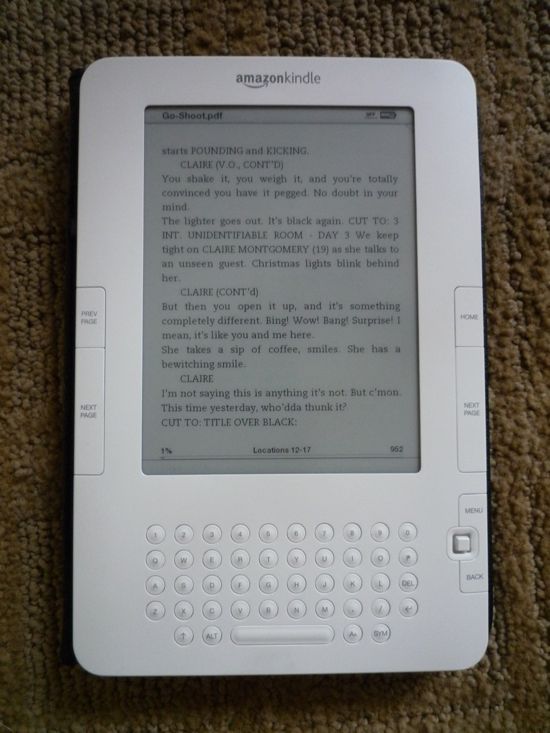
Cory Doctorow makes [many of the points](http://www.boingboing.net/2009/02/25/authors-guild-vs-rea.html) I would about the Authors’ Guild’s grumpiness over the Kindle’s text-to-speech function:

> Continuing to take Blount at his word, let’s assume that he’s right on the copyright question, namely, that:

> 1) Converting text to speech infringes copyright

> 2) Providing the software that is capable of committing copyright infringement makes you liable for copyright infringement, too

> 1) is going to be sticky — the Author’s Guild is setting itself up to fight the World Blind Union, phone makers, free software authors, ebook makers, and a whole host of people engaged in teaching computers to talk.

> But 2 is really hairy. If Blount believes that making a device capable of infringing copyright is the same as infringing copyright (something refuted by the Supreme Court in Betamax in 1984, the decision that legalized VCRs), then email, web-browsers, computers, photocopiers, cameras, and typewriters are all illegal, too.

That said, a colleague of mine made a good point: It’s sort of the Authors’ Guild’s job to stir the pot. They might be wrong — they might know they’re wrong — but it’s important to have a group trumpeting the issues of concern to their members.

I think the potential win here will be for Amazon and authors/publishers to find well-priced ways to bundle the text and (real, professional) audiobook versions. I’ve never bought an audiobook, but would consider it if the premium weren’t too high.

Official badasses

February 9, 2009 Awards, Follow Up

follow upMTV released its [final list](http://moviesblog.mtv.com/2009/02/09/watch-mtv-news-greatest-badass-panel-name-dirty-harry-the-winner/) of top-ten badasses, which included [contributions by me](http://johnaugust.com/archives/2009/top-10-movie-bad-asses) and a lot of other folks.

1. Dirty Harry – “Dirty Harry”
2. Ellen Ripley – “Alien/Aliens”
3. John McClane – “Die Hard”
4. Mad Max – “Mad Max”
5. Walker – “Point Blank”
6. Sarah Connor – “Terminator”
7. Pike Bishop – “The Wild Bunch”
8. Khan Noonien Singh – “Star Trek”
9. Boba Fett – “Star Wars”
10. John J. Rambo – “First Blood”

I picked 1.5 of those. I count Dirty Harry as a half, because I chose William Munny in Unforgiven, or “really, any Eastwood character.”

I went out of my way to pick characters others might not, so I’m not surprised I didn’t match up better to the final list. I never really understood the Boba Fett-ishization, and while I like John McClane, “badass” isn’t the primary descriptor I’d assign to him. I’m happy to see Sarah Connor included on the list, however. And it’s strange the degree to which Mad Max has disappeared from my film memory bank.

iMovie 09 is much better, still maddening

February 4, 2009 Follow Up, Software

follow upA few weeks ago, I [expressed exasperation](http://johnaugust.com/archives/2009/imovie-09-almost-certainly-maddening) upon seeing demos of iMovie 09, which seemed to be working hard to fix exactly the wrong problems. Now that I have it installed, I’ve been able to spend a few days playing around with it. And you know what?

It’s actually a lot better.

Yes, that could be damning with faint praise. iMovie 08 was terrible, a one-fingered monkey’s paw of doom. But iMovie 09 is genuinely useful and fun. The new themes are incredibly powerful; throw it a bunch of photos and you’ll have a slick slideshow in under 60 seconds. ((Granted, it will probably look like everyone else’s slick slideshow, so do yours first.)) The filmstrip-like browser is a smart way of showing projects. In addition to new eye candy, many little grievances have been fixed.

To demonstrate, here’s a slideshow of some of my [Africa photos](http://johnaugust.com/archives/2007/photos-from-malawi) that took three minutes from drop to export. Yes, it could be better, but the point is that it’s fairly competent even on automatic.

A big public thank you to all the Apple folks who clearly put a zillion hours into making it better.

That said, there are still a lot of little grievances. The interface is confusing at times, with a lot of unlabeled buttons, and contextual menus that only show up with a left click, rather than a right click. The only way to save a project is to duplicate it first in the project browser, so if you make a horrible muddle, there’s no going back to an earlier version. ((True: iPhoto doesn’t have a Save command either. But you’re not likely to spend an hour tweaking a single photo. And iPhoto always lets you revert to the original.)) I have no idea why Clip Trimmer exists. With the exception of very short clips, it simply lets you drag the handles you’d think you could in the normal view.

In short, iMovie 09 makes it easy to do very complicated things, and complicated to do very easy things.

By far the most maddening thing for me is iMovie’s bizarre alternative to a timeline, an unlabeled space I guess is called “Projects.” ((If you hover over the double-arrow button that divides top and bottom, it offers to “Swap Events and Projects.”)) As I’ve already confessed…

> Yes, I have the curse of knowledge: I know how an editing system is “supposed to” work, as it does in Final Cut, Avid and to some degree, the original iMovie. But I’m always game for a new and better idea, particularly if it makes heretofore complicated things easier for newcomers to understand.

This Projects space is a mess, no matter what your experience level. For starters, it wraps like a word processor. Every single piece of video you’ve ever seen on the web has had a playhead that goes from left to right. In iMovie, it goes left to right, top to bottom.

And I still have no idea why. It’s a fundamental decision Apple made with 08, and it persists. I wondered if it was to help people with smaller monitors, so I tried it out on my 13″ MacBook. Nope. It’s actually worse on a little screen. You see very little of your movie at a time. On a big monitor, you can make the area big enough to see most or all of a movie.

It’s not like a horizontal timeline is too complicated for the average user. GarageBand is nothing but a stack of scrolling horizontal tracks. (In fact, if you export a movie to GarageBand, you end up with a rough approximation of what the interface could be.)

Responding to the problem it created, Apple came up with Precision Editor, a genuinely clever way to visualize cuts and transitions that I hope and assume will gravitate up towards Final Cut Pro. I think they made the word-wrapping thing work as well as they could.

But it’s a good implementation of a bad idea.

For example, let’s say you need two songs to play — maybe you’re switching back and forth between them. In any other editor, this is trivial — you slice them up and put the pieces where they need to go, perhaps checkerboarding them. But, sticking with its word-wrap philosophy, iMovie only lets you treat music as an envelope wrapped around the whole thing. You can “unpin” music to slide it around, but if you’re coming back to a song six times, you need to add the same track six times. ((Yes, you could do this in GarageBand. But the point of cutting to music is *cutting* to music.))

iMovie 09 does a lot of things right. Some of its choices, like keeping sound effects pinned to a specific frame, are smart. And many of its new bells and whistles, like video stabilization, will be a huge help.

iMovie 10 needs something resembling a horizontal timeline. It doesn’t even have to have “time” per se. Since iMovie makes everything magnetically click together, it’s not nearly as important that the horizontal scale represent seconds. Just give us a playhead that shows us where we are in the project and lets us line up simultaneous events. (The current version comes tantalizingly close at times, such as when you add picture-in-picture, so it’s clearly an achievable goal.)

The new version is good enough that I’ll certainly use it for some projects that I would otherwise do in Final Cut Pro. That’s a big reversal for me.

« Previous Page
Next Page »

Primary Sidebar

Newsletter

Inneresting Logo A Quote-Unquote Newsletter about Writing
Read Now

Explore

Projects

  • Aladdin (1)
  • Arlo Finch (27)
  • Big Fish (88)
  • Birdigo (2)
  • Charlie (39)
  • Charlie's Angels (16)
  • Chosen (2)
  • Corpse Bride (9)
  • Dead Projects (18)
  • Frankenweenie (10)
  • Go (29)
  • Karateka (4)
  • Monsterpocalypse (3)
  • One Hit Kill (6)
  • Ops (6)
  • Preacher (2)
  • Prince of Persia (13)
  • Shazam (6)
  • Snake People (6)
  • Tarzan (5)
  • The Nines (118)
  • The Remnants (12)
  • The Variant (22)

Apps

  • Bronson (14)
  • FDX Reader (11)
  • Fountain (32)
  • Highland (73)
  • Less IMDb (4)
  • Weekend Read (64)

Recommended Reading

  • First Person (87)
  • Geek Alert (151)
  • WGA (162)
  • Workspace (19)

Screenwriting Q&A

  • Adaptation (65)
  • Directors (90)
  • Education (49)
  • Film Industry (490)
  • Formatting (128)
  • Genres (89)
  • Glossary (6)
  • Pitches (29)
  • Producers (59)
  • Psych 101 (118)
  • Rights and Copyright (96)
  • So-Called Experts (47)
  • Story and Plot (170)
  • Television (165)
  • Treatments (21)
  • Words on the page (237)
  • Writing Process (177)

More screenwriting Q&A at screenwriting.io

© 2026 John August — All Rights Reserved.