In February, I linked to an article by Eric Morris about pervasive Los Angeles transportation myths. He presented six statements, promising that two were (at best) half-truths, while the rest were flat-out myths.
I made my guesses, as did many readers. Over the past few weeks, he’s addressed the myths in follow-up articles, so I thought I’d provide some closure as well.
Here are the myths:
Los Angeles’s air is choked with smog.
I said false. He said half-true.
According to the American Lung Association, Los Angeles has the second-worst air quality in the nation, after Pittsburgh. But “choked with smog” is an exaggeration. It’s vastly better than it used to be — and much better than its reputation:
In 1979, the South Coast Air Basin (of which Los Angeles is a part) experienced 228 days above the state one-hour ozone standard; in 2007, the number of days in violation was down to 96. The change is even more dramatic when looking at individual communities. From 1979 to 2007, Pasadena dropped from 191 days over the limit to 13, Reseda from 138 to 22, Anaheim from 61 to 2, Pomona from 167 to 19, and West Los Angeles from 76 to 2. This story is replicated across the region. It is also broadly true for the other pollutants that comprise smog.
Los Angeles has developed in a low-density, sprawling pattern.
I said half-true. He said false.
As of the 2000 census, the Los Angeles region’s urbanized area had the highest population density in the nation. Yes, that was the word “highest,” not a smudge on your monitor. At 7,068 people per square mile, Los Angeles is considerably denser than New York-Newark, which ranks fourth at 5,309 people per square mile (behind San Francisco-Oakland and San Jose as well as Los Angeles).
I was fooled by the comparatively large percentage of single-family homes. But there’s an important distinction I overlooked:
Los Angeles’s homes sit on very small lots, in part due to the difficulty of providing water infrastructure to new developments. (Other southwestern cities share this trait.)
Angelenos spend more time stuck in traffic than any other drivers in the nation.
I said true. He said true.
According to the Texas Transportation Institute’s 2005 Mobility Report, Angelenos who traveled in the peak periods suffered 72 annual hours of delay. This was number one in the nation, by a large margin.
Traffic really does suck in Los Angeles, which is why you spend a lot of mental energy figuring out how to avoid it. Live near work. Or work at home.
Thanks to the great distances between far-flung destinations, and perhaps to Angelenos’ famed “love affair” with the car, Angelenos drive considerably more miles than most Americans.
I said false. He said false.
According to the Federal Highway Administration, Angelenos drive 23 miles per resident per day. This ranks the Los Angeles metro area 21st highest among the largest 37 cities. The champions (or losers) are probably Houston, followed by Jacksonville and Orlando, all of which are over 30 miles per day.
That doesn’t mean you’re not potentially spending a lot of time in your car, though. You just might not be traveling many miles.
Los Angeles is dominated by an overbuilt freeway system that promotes auto dependence.
I said false. He said half-true.
Los Angeles boasts an extensive freeway system. Counting Interstates and other expressways, the area ranks second in the nation in lane mileage, after New York.
But taking into account the area’s vast size, the network is one of the most underdeveloped in the U.S. According to the Federal Highway Administration, of the 36 largest metro areas, Los Angeles ranks dead last in terms of freeway lane miles per resident. (Chicago is second to last, and New York is near the bottom as well. The most freeway-heavy big city by this measure is Kansas City.)
The general solution to LA’s traffic woes isn’t going to be more freeways — although in places, more capacity would make sense. Reducing demand is crucial, and increasing density is, almost paradoxically, a good way to do that.
Los Angeles’s mass transit system is underdeveloped and inadequate.
I said half-true. He said false.
But compared with the majority of U.S. cities, Los Angeles is not a transit wasteland. The region is second in the nation in transit patronage, behind only New York. Even on a market share basis (passenger transit miles traveled as a share of all miles traveled), Los Angeles’s ridership rate is relatively high: 11th among the 50 largest urban areas.
Here’s where I think he’s really stretching. Sure, Los Angeles may have a lot more public transit than other big cities, but that isn’t evidence of adequacy. By the standards he’s held himself on the other questions, I think this should be half-true. And he seems to sense this:
Despite all of this, I can’t look you in the eye and tell you the car is not king in Los Angeles. It is. Our transit share is quite small: a bit under 2 percent.
Yes, two percent of 13 million is a lot of people. But when 98% of your population isn’t using your mass transit system, there’s a lot of opportunity.
 Following up on
 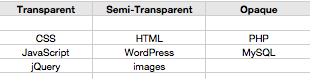 The “transparent” technologies are available for anyone interested in looking. And that’s mostly good: Peeking beneath the hood is a great way to learn how a technology works. I often find myself opening the CSS for sites I like to see how they’re constructed. ((Keep in mind that you can learn bad habits this way.))