• Skip to primary navigation
  • Skip to main content
  • Skip to primary sidebar

John August

  • Arlo Finch
  • Scriptnotes
  • Library
  • Store
  • About

John

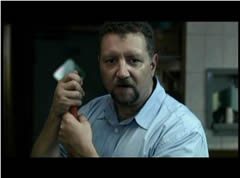
Good “Choose or Lose” spot

October 27, 2004 News

I haven’t written at all about the upcoming election, for two main reasons. First, a sizable percentage of readers live outside the United States. Second, it’s none of my damn business who you want to vote for.

I have definite opinions about the candidates and issues, but this site is about writing and filmmaking. Most of the writing and filmmaking associated with this campaign season has been tedious, dishonest and unworthy of any discussion. But this MTV Choose or Lose spot that does well on both fronts. (**Update March 2011:** I can’t find a good link for this video anymore.)

It’s written by Taras Wayner and directed by Josh Miller. Whether or not you agree with its message, admire it for its simplicity. While it has really good production values, it’s basically something any reader could do at home with a DV camera. It gets its impact through good writing, straightforward direction and a solid performance.
McGuffin and Set-Piece defined

October 22, 2004 Glossary

While I was fixing up the [Glossary](http://johnaugust.com/site/glossary) yesterday, I added two new requested definitions:

McGUFFIN
Often associated with Hitchcock, [PageWise](http://sc.essortment.com/alfredhitchcoc_rvhd.htm) has a good definition: A device or plot element that catches the viewer’s attention or drives the plot. It is generally something that every character is concerned with. The McGuffin is essentially something that the entire story is built around and yet has no real relevance. That is, it’s what the movie says it’s about, even though it really isn’t. In the first Charlie’s Angels, the McGuffin was stolen voice-identification software; in the second, it was a Federal Witness Protection List. In both cases, the villain’s real motivation was greed and revenge. In early drafts of Full Throttle, the Angels had to retrieve a glowing vial labelled “McGuffin Industries.”

SET-PIECE
A scene or sequence with escalated stakes and production values, as appropriate to the genre. For instance, in an action film, a set-piece might be a helicopter chase amid skyscrapers. In a musical, a set-piece might be a roller-blade dance number. In a high-concept comedy, a set piece might find the claustrophobic hero on an increasingly crowded bus, until he can’t take it anymore. Done right, set-pieces are moments you remember weeks after seeing a movie.

Where to find Natural Born Killers novelization

October 13, 2004 Adaptation, Projects, QandA

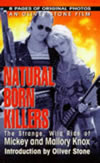
NBK bookI was just reading your site in hopes of finding out more about your novelization of the film Natural Born Killers. It appears as though the book can still be found in some circles but at [exorbitant prices](http://www.amazon.com/gp/product/offer-listing/0451183231/ref=dp_pb_a//002-9839875-9699269?condition=all). Do you happen to know of anywhere that I could order this book?

— MJD

The best advice I could give you is to save your money, because the book isn’t very good. You’re much better off reading Quentin Tarantino’s original screenplay. The only copy on the net I’ve found is an [awkwardly-formatted HTML version](http://www.godamongdirectors.com/scripts/killers.shtml), but it’s certainly better than nothing. [Update: A kind reader forwarded [this link](http://www.dailyscript.com/scripts/Natural_Born_Killers.PDF) to a proper .pdf.]

The things you love can hurt you the most, and that’s certainly the case with Natural Born Killers. I first read Tarantino’s script in the fall of 1992, when I was in my first year of grad school at USC. His was probably the 10th screenplay I ever read. The moment I finished it, I flipped back to page one and read the whole thing again. It was that good.

So I counted myself incredibly lucky to get to work on the movie the following year. Oliver Stone had directed a heavily-rewritten version of it, and I was hired as assistant to the two producers while the film was in editing. Even though I was mostly answering phones and writing coverage, it was exciting to be one office away from a big motion picture in post. When I finally got to see the cut, I was disheartened: so much of what I loved about Tarantino’s screenplay had been changed. It was like waiting all year for Christmas and finally opening that big wrapped box to discover what you hoped was an Atari was actually Sears Pong. Same idea, but disappointingly different.

I know there are people who love the movie, and with good reason, but to me the film is too much of too little.

Then, remarkably, I got the opportunity to work on the novelization. Penguin had hired writers to do it, but the editor wasn’t satisfied with what they were producing. After reading my first script and talking with my bosses, she asked me to write a new book. It gave me a chance to go back to Tarantino’s original script and incorporate things that had been dropped from the movie, and add new sequences that detailed other pit-stops on Mickey and Mallory’s trail of terror.

I wrote the book in three weeks, while finishing my master’s thesis and working full-time. I slept three hours a night — but you can do that when you’re 23.

I was really happy with the book I wrote, but before the draft went to Penguin, one of my bosses decided to rewrite it. And rewrite it poorly. That’s not just my opinion; on a purely objective level, the text is a mess. Because there was no time for proper copy-editing, characters’ names are spelled different ways in different chapters.

It’s frustrating to have my name on a book that I hate. But I try to look for the positive: I was paid $7,000 to write the book, which was enough money to get by for six months before I got my next writing job. (That next job was HOW TO EAT FRIED WORMS, a charming kid’s book for which Natural Born Killers was a terrible, terrible writing sample. I owe Ron Howard a lot for even considering me.)

I can’t put my original draft of the novel in the Downloads section, because the publisher controls the copyright. But if anyone reading this post is an enterprising young editor at Penguin, I’d love to show you what the book could have been.

How do I find out who represents a given actor?

September 30, 2004 Film Industry, QandA

I was wondering if it’s possible for you to tell me what agency Freddie Highmore is represented by.

–Jessi

No. And not only because your question was posted in the comments section of a random, unrelated topic.

However, I can tell you how to find out Freddie Highmore’s agent — or any actor’s agent. All film actors belong to some film acting union or guild — that’s how they get paid residuals when movies come out on video and television. In the U.S., that means SAG (Screen Actors Guild); the closest U.K. equivalent is probably Equity, but I trust an experienced U.K. reader will correct me if I’m wrong. For whichever guild, look up the phone number, call them, and ask for agent contact information. Voila.

The same basic process can be applied to directors or screenwriters.

Now for the more difficult question: why would you need to know who represents Freddie Highmore? Unless you’re calling to offer him gainful employment, an agent is not the one to help you. If you simply admire Highmore’s work — and why not, he’s a remarkable young actor — you’re much better off visiting a fan site where you can bond with others who feel likewise.

« Previous Page
Next Page »

Primary Sidebar

Newsletter

Inneresting Logo A Quote-Unquote Newsletter about Writing
Read Now

Explore

Projects

  • Aladdin (1)
  • Arlo Finch (27)
  • Big Fish (88)
  • Birdigo (2)
  • Charlie (39)
  • Charlie's Angels (16)
  • Chosen (2)
  • Corpse Bride (9)
  • Dead Projects (18)
  • Frankenweenie (10)
  • Go (29)
  • Karateka (4)
  • Monsterpocalypse (3)
  • One Hit Kill (6)
  • Ops (6)
  • Preacher (2)
  • Prince of Persia (13)
  • Shazam (6)
  • Snake People (6)
  • Tarzan (5)
  • The Nines (118)
  • The Remnants (12)
  • The Variant (22)

Apps

  • Bronson (14)
  • FDX Reader (11)
  • Fountain (32)
  • Highland (75)
  • Less IMDb (4)
  • Weekend Read (64)

Recommended Reading

  • First Person (87)
  • Geek Alert (151)
  • WGA (162)
  • Workspace (19)

Screenwriting Q&A

  • Adaptation (65)
  • Directors (90)
  • Education (49)
  • Film Industry (489)
  • Formatting (128)
  • Genres (89)
  • Glossary (6)
  • Pitches (29)
  • Producers (59)
  • Psych 101 (118)
  • Rights and Copyright (96)
  • So-Called Experts (47)
  • Story and Plot (170)
  • Television (165)
  • Treatments (21)
  • Words on the page (237)
  • Writing Process (177)

More screenwriting Q&A at screenwriting.io

© 2026 John August — All Rights Reserved.