• Skip to primary navigation
  • Skip to main content
  • Skip to primary sidebar

John August

  • Arlo Finch
  • Scriptnotes
  • Library
  • Store
  • About

John

How We Record Scriptnotes, 2020

August 6, 2020 Geek Alert, Meta, Tools

scripnotes coverMany listeners have asked how Craig and I record our weekly podcast. I [wrote about it in 2013](https://johnaugust.com/2013/how-we-record-scriptnotes), but a few things have changed. So here’s an updated look at our standard operating procedures and gear.

### When and what
Scriptnotes producer Megana Rao and Craig’s assistant Bo Shim figure out when we’re going to record. It’s usually a Thursday or Friday, late in the afternoon. Megana and I have usually talked over potential topics, but Craig and I will also text during the week to discuss. If it’s a [Three Page Challenge][3pc], Megana will send each of us PDFs of the entries she’s picked.

We’re all working off a shared outline in [WorkFlowy](http://workflowy.com), which includes the episode number, today’s topics, listener questions, various housekeeping bits, and our [One Cool Things][onecoolthing]. I recently made a [template](https://beta.workflowy.com/s/000-episode-title/9fdwp8NdYjZge65C). If there’s anything we need to read aloud — for example, a quote from an article — I usually copy-paste it into this outline.

Since Craig works in Pasadena and I work in Hollywood, it’s not practical for us to be in the room together, so we record the podcast on Skype. This is the part many people can’t fathom — *we’re almost never in the same room together.* I lived in Paris during 2016 and 2017, yet we kept doing the show pretty much as normal. Whether you’re miles or time zones apart, you can do it.

It takes practice to keep up a conversation when you don’t have the usual physical cues. The first few episodes were rough. But I think the podcast is actually much better with Craig and I being apart; like the audience, we’re only hearing each other’s voice, so everything we’re communicating needs to happen in speech.

I don’t care about hearing myself through the headphones, but if you do, you may want to consider a setup that lets you plug headphones into the mic or mixer. If you let the audio round-trip through the computer, the lag will drive you crazy.

### Editing
While Craig and I are talking on Skype, each of us has QuickTime running on our own computers to record only our side of the conversation. (File > New Audio Recording…) When we finish recording, we each save our audio into the same shared Dropbox folder. From there, editor Matthew Chilelli yanks out the audio and marries the two tracks in Logic.

Many podcasts simply record the Skype call, saving the step of marrying the two tracks. But it’s very handy to be able to manage the two sides of the conversation separately. We can edit out background noise and generally keep it much tighter.

As a backup, we have [Call Recorder](https://www.ecamm.com/mac/callrecorder/) for Skype running. It’s saved our bacon a few times.

Matthew ends up editing two versions of the episode: the normal one and the premium version, which includes an additional segment at the end. When he’s finished — generally Monday at around noon — he’ll put them back in Dropbox. Megana listens to them and writes up the text for the post, along with links and the outro. I sign off, then all that gets added into the files.

Megana then uploads the premium file to our [subscription service](http://scriptnotes.net), where it comes out immediately. She schedules the normal version to come out Tuesday morning.

###Nuts and bolts

For hardware, we started with Dan Benjamin’s really useful guide to [podcasting gear](https://danbenjamin.com/podcastmethod/), but ultimately made different choices over the years. I’ll include Amazon referral links for items available there, but certainly consider local retailers — or items you may already have.

For my mic, I’m using the [Shure BETA 87A Supercardioid Condenser Vocal Microphone](https://amzn.to/3kiPmCQ) mounted on a [Heil PL-2T boom][boom] with some generic pop screen. This mic requires a pre-amp and USB interface, so I’m using the [Focusrite Scarlett 2i2](https://amzn.to/3gvLYSO), which feels like overkill but has been problem-free for many years.

When I’m traveling, I’ve been packing the [Samson Q2U Handheld Dynamic USB Microphone](https://amzn.to/2Px6sig) instead. It’s really good for the price and simply plugs into USB. When we have remote guests I’ll often drop this mic off at their house if they’re in town, or just Amazon it to them if they’re somewhere else.

For listening, there’s nothing better than the Sony [MDR-7506 headphones][headphones], which not only sound great but seal well, keeping Craig’s audio from being recorded on my track. I like them so much that I’ll bring them with me on a trip.

Before the pandemic, we were recording more shows in-person at my office using a [RØDECaster Pro](https://www.rode.com/rodecasterpro), which is genuinely terrific. It combines a pre-amp, USB interface and recorder into a single interface. The new Zoom [PodTrack P4](https://zoomcorp.com/en/us/podtrak-recorders/podcast-recorders/podtrak-p4/) looks to meet a similar need and is probably also great. I’ve had a good experience with various Zoom recorders over the years.

For live shows, I’ve generally been recording on the [Zoom H6 digital recorder](https://amzn.to/33x0zd6). Even if we’re using audio from a sound board, I’ll still aim the Zoom at the audience to gather crowd noise.

[3pc]: http://johnaugust.com/threepage “three page challenge”
[onecoolthing]: http://johnaugust.com/onecoolthings “one cool thing”
[utility]: http://atp.fm/episodes/25-thrustmaster-joystick “slip sync”
[at2020]: http://www.amazon.com/gp/product/B001AS6OYC/ref=as_li_ss_tl?ie=UTF8&camp=1789&creative=390957&creativeASIN=B001AS6OYC&linkCode=as2&tag=johnaugustcom-20 “at2020”
[boom]: http://www.amazon.com/gp/product/B000SZVZ74/ref=as_li_ss_tl?ie=UTF8&camp=1789&creative=390957&creativeASIN=B000SZVZ74&linkCode=as2&tag=johnaugustcom-20 “boom”
[headphones]: http://www.amazon.com/gp/product/B000AJIF4E/ref=as_li_ss_tl?ie=UTF8&camp=1789&creative=390957&creativeASIN=B000AJIF4E&linkCode=as2&tag=johnaugustcom-20 “headphones”
[yeti]: http://www.amazon.com/gp/product/B002VA464S/ref=as_li_ss_tl?ie=UTF8&camp=1789&creative=390957&creativeASIN=B002VA464S&linkCode=as2&tag=johnaugustcom-20 “yeti”
[zoom]: http://www.amazon.com/gp/product/B001QWBM62/ref=as_li_ss_tl?ie=UTF8&camp=1789&creative=390957&creativeASIN=B001QWBM62&linkCode=as2&tag=johnaugustcom-20
Getting TextExpander and WorkFlowy to play nicely

July 24, 2020 Geek Alert, Meta, Software

We use [WorkFlowy](http://workflowy.com) to outline Scriptnotes before we record. After 462 episodes, I finally decided to make a template for it so that I wasn’t typing it all from scratch every time. So I made a skeleton outline, which you can see [here](https://beta.workflowy.com/s/000-episode-title/9fdwp8NdYjZge65C).

Excited for the all time I was going to save, I copy-pasted the outline into [TextExpander](https://textexpander.com), the app I use for such things. ((TextExpander is fine, but I suspect there are other macro apps that work just as well or better. This technique should work with any of them.)) I assigned it an abbreviation and tried it in WorkFlowy.

It failed.

It pasted plain text, with none of the indentation and formatting I wanted.

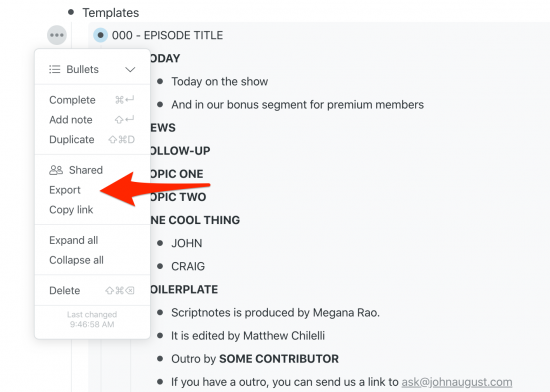
Naturally, I tried to Google a solution, but nothing turned up. So I experimented with different options. It turns out the trick is to Export the template (using the three-dot menu on the left) and choose OMPL as the format.

workflowy export

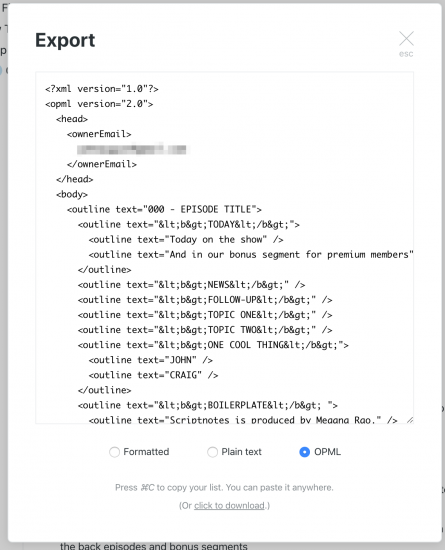
You get text that looks like this:

workflowy opml

A mess, right? But it works.

Copy-paste it into TextExpander. When expanded into WorkFlowy, it’ll be properly indented and formatted.

For the record, the amount of time I spent figuring out and blogging this time-saving technique is now probably a wash.

Normal is not an option

July 21, 2020 Psych 101, Rant

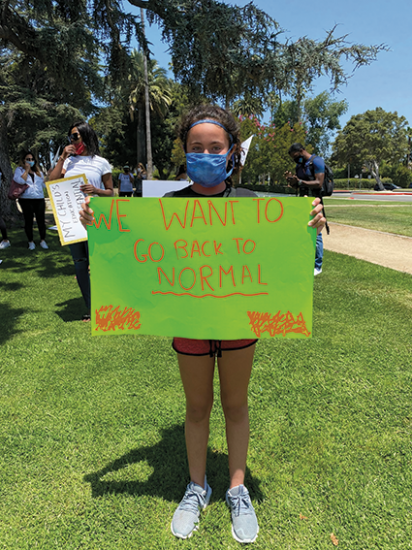
young woman holding homemade sign reading "I want to go back to normal"

The image that accompanies [this article](https://beverlypress.com/2020/07/beverly-hills-protesters-want-in-person-classes) on a school reopening protest captures a major mood in July 2020.

The photo comes courtesy of Victoria Conti, who is also quoted in the piece:

> I don’t want my kids to stay in front of a computer all day long. It’s not good for health, for mental health, there are too many reasons that it’s not good.

Conti is right, of course. It’s not healthy for any of us to sit in front of computers all day, particularly children.

My daughter is 15. Like most American kids, she finished her school year in Zoom classes of debatable quality. I want her back in school with her friends, just like I wanted her to go to her beloved sleepaway summer camp, and to be able to hug her grandmother.

Just like the girl in the photograph, *I want to go back to normal.*

But it’s simply not possible. Normal is not an option. Not now. Probably not until there’s a widely-available treatment or vaccine.

Demanding a return to normal in July 2020 is like yelling at the night to be less dark. It’s out of your control and everyone’s control. The more you complain about it, the more miserable you make yourself and others, and the more time and energy you waste.

Conti’s frustration about online classes is valid and understandable. I share it. But the real opponent isn’t the school district; it’s the coronavirus. That’s the barrier between teachers and students and in-person classes resuming. The virus doesn’t care because it’s a lump of genetic data. Scientists and public health officials care deeply but they can’t offer a cure at the moment.

In psychology, one strategy for dealing with these situations is [radical acceptance](https://www.betterhelp.com/advice/therapy/what-is-radical-acceptance-and-how-can-it-help-me/). You start by acknowledging the reality of the situation — and how much it sucks — so you can begin thinking about the future.

– It sucks that we can’t open most schools safely, so we need to work on ways to make online classes more accessible and less terrible.

– It sucks that we can’t go to bars and clubs and movies, so we need to find other ways to hang out and socialize that don’t spread the virus.

– It sucks that some jobs aren’t possible amidst the pandemic, so we need to find other ways for people to pay their bills.

– It sucks that we have to wear masks and yet it’s clear that they [save a lot of lives](https://www.wsj.com/articles/face-masks-really-do-matter-the-scientific-evidence-is-growing-11595083298).

Individually and as a society, we need to move past this idea of “back to normal” when it comes to coronavirus. Stop saying it. Stop pretending it’s an option. It’s night and the sun’s not coming up any faster. We need to do the best we can in the dark.

And we can do surprising things! For example, American retailers quickly adopted contactless payment and curbside pickup, along with a staggering amount of plexiglass. Businesses realized that a lot of work can be done from home. Talk shows figured out how to film from attics.

We’ve been forced to rethink and adapt because normal was not an option. It still isn’t. We need to acknowledge that this pandemic sucks and keep going.

Summer Reading

June 24, 2020 Author, Books, Los Angeles

On Saturday, I hosted a group of local authors to celebrate [Chevalier’s Books](https://www.chevaliersbooks.com), LA’s oldest independent bookstore, which recently reopened for pick-up orders.

Chevalier’s is our neighborhood bookstore, hosting many of our launch parties — including Arlo Finch — so we’re excited to see its doors semi-open.

The theme for our Zoom conversation was “summer reading.” We gave our picks for kids, teens and adults, with special focus on books about understanding race in America.

Guests include Stuart Gibbs, Leslie Margolis, Aline Brosh McKenna, Thomas Lennon, Sarah Mlynowski, Julie Buxbaum, Kayla Cagan and Julia Claiborne Johnson.

You can see their reading lists on [Chevalier’s site](https://www.chevaliersbooks.com/local-authors-060620), with links to order directly from Chevalier’s or bookshop.org.

My picks are below, along with a few additions I made as we were recording.

Support your local indie bookstore! Like Chevalier’s, many are partially open, and can easily get any book you’re looking for.

### Young Readers:

– [Don’t Let the Pigeon Drive the Bus](https://bookshop.org/a/2114/9780786819881) by Mo Willems
– [Raccoon Sick Day](https://www.indiebound.org/book/9781732761612) by C.E. Miller
– [Hair Love](https://bookshop.org/a/2114/9780525553366) by Matthew Cherry

### Middle Grade:

– [My Side of the Mountain](https://bookshop.org/a/2114/9780142401118) by Jean Craighead George
– [The Curious Incident of the Dog in the Night-Time](https://bookshop.org/a/2114/9781400032716) by Mark Haddon
– [Marvel Encyclopedia](https://bookshop.org/a/2114/9781465478900) by Stan Lee (DK)
– [Incredible Cross-Sections](https://bookshop.org/a/2114/9781465483898) by Stephen Biesty

### YA:

– [Dune](https://bookshop.org/a/2114/9780441172719) by Frank Herbert
– [Pride and Prejudice](https://bookshop.org/a/2114/9780141439518) by Jane Austen
– [Guns, Germs, and Steel: The Fates of Human Societies](https://bookshop.org/a/2114/9780393354324) by Jared Diamond
– [Things to Make and Do in the Fourth Dimension](https://bookshop.org/a/2114/9780374535636) by Matt Parker

### Adults:

– [Their Eyes Were Watching God](https://bookshop.org/a/2114/9780061120060) by Zora Neale Hurston 
– [The Autobiography of Malcolm X](https://bookshop.org/a/2114/9780345350688) as told to Alex Haley
– [Trick Mirror: Reflections on Self-Delusion](https://bookshop.org/a/2114/9780525510543) by Jia Tolentino
– [Free-Range Chickens](https://bookshop.org/a/2114/9780812977110) by Simon Rich
– [Station Eleven](https://bookshop.org/a/2114/9780804172448) by Emily St John Mandel
– [Atrocities: The 100 Deadliest Episodes in Human History](https://bookshop.org/a/2114/9780393345230) by Matthew White
– [The Hardest Job in the World: The American Presidency](https://bookshop.org/books/the-hardest-job-in-the-world-the-american-presidency/9781984854513) by John Dickerson
– [Raising White Kids](https://bookshop.org/a/2114/9781501878077) by Jennifer Harvey

« Previous Page
Next Page »

Primary Sidebar

Newsletter

Inneresting Logo A Quote-Unquote Newsletter about Writing
Read Now

Explore

Projects

  • Aladdin (1)
  • Arlo Finch (27)
  • Big Fish (88)
  • Birdigo (2)
  • Charlie (39)
  • Charlie's Angels (16)
  • Chosen (2)
  • Corpse Bride (9)
  • Dead Projects (18)
  • Frankenweenie (10)
  • Go (29)
  • Karateka (4)
  • Monsterpocalypse (3)
  • One Hit Kill (6)
  • Ops (6)
  • Preacher (2)
  • Prince of Persia (13)
  • Shazam (6)
  • Snake People (6)
  • Tarzan (5)
  • The Nines (118)
  • The Remnants (12)
  • The Variant (22)

Apps

  • Bronson (14)
  • FDX Reader (11)
  • Fountain (32)
  • Highland (74)
  • Less IMDb (4)
  • Weekend Read (64)

Recommended Reading

  • First Person (87)
  • Geek Alert (151)
  • WGA (162)
  • Workspace (19)

Screenwriting Q&A

  • Adaptation (65)
  • Directors (90)
  • Education (49)
  • Film Industry (489)
  • Formatting (128)
  • Genres (89)
  • Glossary (6)
  • Pitches (29)
  • Producers (59)
  • Psych 101 (118)
  • Rights and Copyright (96)
  • So-Called Experts (47)
  • Story and Plot (170)
  • Television (165)
  • Treatments (21)
  • Words on the page (237)
  • Writing Process (177)

More screenwriting Q&A at screenwriting.io

© 2026 John August — All Rights Reserved.