• Skip to primary navigation
  • Skip to main content
  • Skip to primary sidebar

John August

  • Arlo Finch
  • Scriptnotes
  • Library
  • Store
  • About

John

Why I changed my mind on end credits

October 7, 2021 Film Industry, News, WGA

This week, the WGA announced an [upcoming referendum](https://secure.wga.org/uploadedfiles/the-guild/elections/scrc_cover_letter.pdf) on a proposal to create an “Additional Literary Material” end credit for feature films.

I was part of the committee that drafted the proposal, and took the lead in writing up the [exhaustive explainer and FAQ](https://www.wga.org/uploadedfiles/the-guild/elections/screen_credits_explainer.pdf). ((I beg you, please read the explainer. We really tried to answer every question you might ask.))

Outside of my role on the committee, I want to talk through how and why my thinking about end credits has evolved over my 20+ years as a screenwriter, and why I think members should vote yes on the proposal.

## The way it’s always been

Going back decades, the WGA has had a process for determining who gets credit for writing on a movie. These are the familiar “by” credits: written by, screenplay by, story by, etc.

These credits denote authorship. Whether a film uses opening titles or end titles, the writing credit always comes right next to the director. They answer the question, “Who wrote that?”

But they don’t tell the whole story. In many cases, other writers worked on the project. If they didn’t meet the threshold for receiving this “by” credit, all record of their employment is erased.

That’s unique to the film industry. In television, members of a writing staff receive an employment credit (e.g. staff writer, story editor) in addition to a writing credit on episodes they write.

The idea of listing every writer who worked on a movie is not new. It’s always seemed absurd that a catering truck driver who worked one day on a film has their name in the credits, while a screenwriter who spent a year on the project and wrote major scenes goes uncredited.

And yet! **Screenwriters are not drivers.** Our work is fundamentally different. Authorship means something, both for the individual project and for the status of screenwriters as a profession. That’s why in the case of projects with multiple writers, the Guild has an arbitration process to determine the official writer(s) of the script.

*But what about listing the other writers in the end credits, away from the “by” credits?*

For at least 20 years, I’ve been able to argue both sides of the end credits question. Pro: Listing all the writers better reflects the reality of who worked on a movie. Con: Listing all the writers undercuts the purpose of the WGA determining credits in the first place. Like a high school debater, I knew the arguments and was ready to engage on either side of the debate.

I didn’t want to pick a side — but of course, I *was* picking a side. When the status quo is no end credits, doing nothing means perpetuating the current system.

During my year working on the committee, a few things got me to change my mind.

## Recognizing survivorship bias

I’ve received credit on films I wrote, and lost credits I thought I deserved. On the whole, it’s worked out. My resume looks pretty full, particularly in those crucial early years of my career *(Go, Charlie’s Angels, Big Fish)*.

Even on movies where I didn’t get credit, “the town” knew I did the work. I kept getting hired and increasing my quote.

Talking with many of my screenwriting peers — writers in their 40s and 50s — that’s largely been their experience as well. It’s not surprising given the phenomenon of [survivorship bias](https://en.wikipedia.org/wiki/Survivorship_bias). If you’re only looking at the screenwriters who made it, you’re going to assume the system is working well.

But what about the screenwriters who aren’t getting credit? What’s happening to them?

Talking with members currently at the early stages of their screenwriting careers, they describe a very different universe than I experienced, one with month-long writers rooms, simultaneous drafts and cultural sensitivity passes. Their missing credits are not because of bad luck, but rather because of an environment that makes it much less likely they could ever receive credit.

That sense that “the town” knows who really wrote something? There is no town anymore. Instead of six studios, there are countless production entities, many of them not based in LA. Netflix is so giant that one team has no idea what another team is making.

In 2021, when a screenwriter receives no credit on a film, it truly is like they never worked on it.

When thinking about missing screenwriting credits, I mistakenly assumed that my experience in the early 2000s matched screenwriters’ experiences today. It doesn’t.

## Comparing imagined harm to actual harm

Most of the status quo arguments I’ve heard for the past twenty years foretell grave consequences if additional writers were listed in the end credits. Some common predictions:

– It will devalue the worth of the “by” credits
– Studios or producers will hire friends just to get their names in the end credits
– It will hurt newer writers if a big-name writer showed up in the end credits

All I can say is, maybe! We’re screenwriters; it’s our job to imagine scenarios.

But it’s also important to check the facts. Earlier this year, the WGA [examined over a thousand feature contracts](https://www.wga.org/members/employment-resources/writers-deal-hub/screen-compensation-guide) to look at trends in compensation. One finding: credit matters a lot.
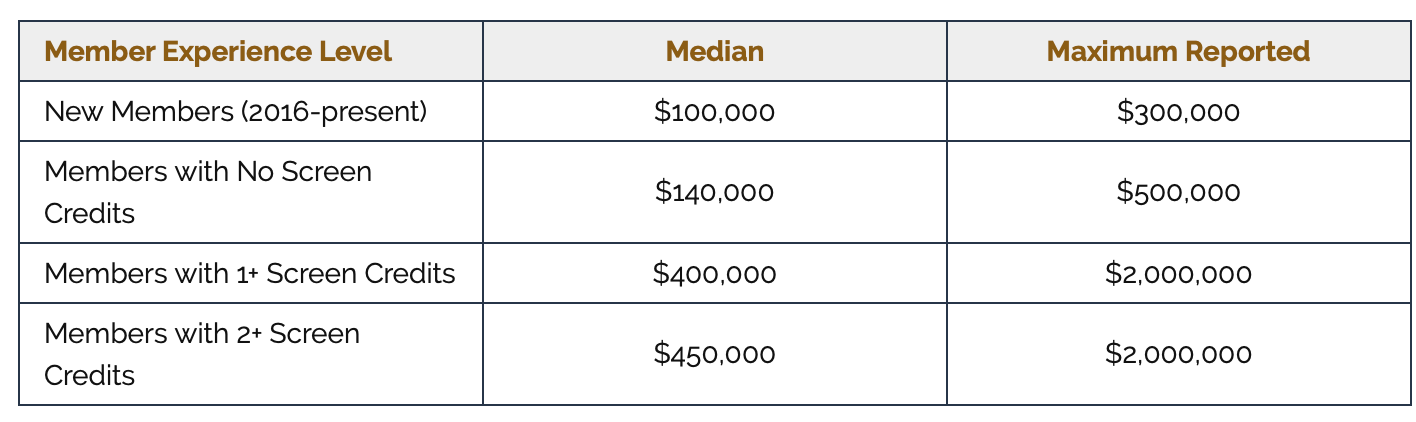
Chart showing that a feature writer with no credit earns median $100,000 while one with a single credit earns $140,000

The median guaranteed payment for a screenwriter with no credits was $140,000. The median guaranteed payment for a screenwriter with one credit was $400,000.

**A single feature credit more than doubled a screenwriter’s pay.**

Would receiving an “Additional Literary Material” credit result in the same bump? Likely not to the same degree. *But it would show that a screenwriter worked on a film that got made.* I strongly believe that’s going to be worth real dollars to that writer. In my discussions with newer writers, agents and executives, most of them agree.

This impacts quite a few writers. In 2020, 185 participating writers wrote on produced features for which they ultimately received no credit.

I should also note here the Guild’s Inclusion & Equity Group’s concern that the status quo disproportionately affects women and writers of color, for whom these resume gaps can be a substantial barrier to future employment.

When comparing the theoretical harms of end credits to the actual harms of doing nothing, I think it’s better to solve the real problems members are having.

## Finding a middle path

Even after acknowledging my survivorship bias and the actual harms screenwriters are facing, I wouldn’t have supported many of the more aggressive proposed changes to the credit system. For example, I don’t believe in changing the thresholds for the “by” credits, expanding the definition to include non-writing roundtable participants, or having all participating writers share in the residuals pool.

Instead, what the committee came up with after a year of sometimes-heated debate was a proposal that narrowly addresses the “resume problem” of missing employment credits without changing anything about the traditional writing credits. The result closely mirrors the system used in television for decades, where writers are credited for both their employment and their authorship.

The term “Additional Literary Material” is incredibly dull, but it’s also accurate. It reflects the reality that the people listed wrote material for the film without passing any judgement. It clearly delineates actual writing — words on paper — from participating in a roundtable.

Rather than diluting the authorship credit of the “by” writers, I’d argue the “Additional Literary Material” credit reinforces it. By definition, any writer listed it this block did not meet the thresholds for receiving “by” credit. (And if a writer chooses not to be included in “Additional Literary Material,” it’s their decision alone.)

In summary, I changed my mind on end credits because I realized I wasn’t looking at the reality experienced by many screenwriters in 2021. This proposal addresses a specific problem with minimal disruption to long-established screen credit processes.

Voting on the referendum begins November 2nd. I urge you to vote yes.

—

Supporters of the proposal are gathering signatures for a Pro statement. You can read it [here](https://docs.google.com/document/d/1hgg4aNTa5pY-eN1nFyb9X-0rc-dBj8KRTsVzOApdHBk/edit).

WGA members can sign on by sending an email to yesonendcredits@gmail.com with the subject line “PLEASE ADD MY NAME TO THE CREDITS PRO STATEMENT. Please include your name and preferred email address.

Getting Apple Pay to work on my M1 MacBook

April 29, 2021 Geek Alert, How-To

I love my 2020 MacBook Air and have had very few issues with it, except that I couldn’t get it to work with Apple Pay. Transactions would fail, and it wasn’t clear why. For months I just lived with it and used alternate ways of paying for things.

But man, I missed the convenience of Apple Pay, which worked fine on my much older machine. (This was my first Mac with Touch ID, which is relevant.)

Last night, while trying to buy [two](https://cottonbureau.com/products/i-got-the-shot#/8235576/tee-men-standard-tee-vintage-navy-tri-blend-s) [t-shirts](https://cottonbureau.com/products/vaccinated-ya-know#/8498865/tee-men-standard-tee-heather-white-tri-blend-s) at Cotton Bureau, I was determined to find a solution to my Apple Pay woes.

Checking the Wallet & Apple Pay pane in System Preferences showed my credit cards were there but disabled. It pointed me to this page at Apple:

[If Apple Pay on your Mac is disabled because security settings were modified](https://support.apple.com/en-us/HT209016)

Had my security settings been modified? No idea.

That page pointed me to this one:

[About Startup Security Utility](https://support.apple.com/en-us/HT208198)

It seemed that maybe I needed to boot into Recovery Mode and use the Startup Security Utility to set my Mac to a higher security threshold.

The article said you get to Recovery Mode by booting while holding down Command-R. **But on the new M1 Macs, instead you hold down the power (Touch ID) button instead.** This tripped me up for a few minutes.

In Recovery Mode, it was clear that all my system settings were fine.

Here’s what ultimately worked: **Deleting the credit cards in Wallet & Apple Pay, then re-adding them.** After that, transactions worked great.

My hunch is that the credit cards were imported when I set up this Mac but not properly authorized. Apple should change the language of the warnings or link to a better explanation.

In the meantime, hopefully this writeup has saved you some hassle.

Screenwriting competitions aren’t worth the money

March 5, 2021 Film Industry, First Person

*Since the early days of the site, I occasionally run posts by writers who can share their experience working in the industry. In this case, Paige wrote in to Scriptnotes with her take on screenplay contests.*

—

My name is Paige Feldman. I was a guest/contestant on a [Scriptnotes live show](https://www.youtube.com/watch?v=GRV5O0ZSNc0) about a year ago (the one with Ryan Reynolds and Phoebe Waller-Bridge). That’s still one of my best quarantine memories.

I’m writing because contest season is fast approaching. Nicholl, AFF and Final Draft all have deadlines in May. While I know most aspiring screenwriters will be champing at the bit to apply, I wanted to share something I discovered about the cost of entering contests like these: it’s a lot of money for little upside.

Like many not-yet-full-time screenwriters, I have entered multiple contests, hoping for placement or notice that might help me push to the next level. And, like many not-yet-full-time screenwriters, I have received glowing comments from readers — and no momentum.

In June 2020, I embarked on an experiment. For four months, I kept track of every screenwriting contest I was advertised (either through email, targeted ads, or coming across them organically on social media). And for every contest that I could enter without doing more work (e.g. I had a completed script I could ostensibly enter), I would take the cost of the entry fee and put it in my savings.

Over the course of four months, from June to October — so not even “contest season” — I saved $1424.

That is from individual contest entry fees alone. This does not count paying extra for coverage. It is not the early entry fee plus the regular entry fee plus the late entry fee. It’s one entry fee per contest. Extrapolated to a full year, that would mean spending nearly $4500 on contests.

I already knew screenwriting competitions were an industry, but the amount is just shocking to me. What even is this screenwriting contest industrial complex? And *why* is it? And how many people is it actually helping?

At the end of my experiment, I didn’t have answers to those questions, but I did have an extra almost-$1500 lying around thanks to my savings scheme. I decided to use it to further my career in a way a contest could never do.

I took one of my already-written pilots and adapted it for audio. Then, I hired actors and recorded it remotely over Zoom (modeled after how you, John, had me send you audio recorded on my computer for that show last year). I hired a composer to write original music, an artist to design a logo, and used YouTube to teach myself how to edit and process audio. And now I have an audio pilot up across podcasting platforms. Plus, it was such a fun experience that I wrote the remaining nine episodes of season 1 and we’re starting to record them this weekend!

Now, instead of a bunch of contest rejections, I have an actual product that I can share with people: [How to Fall in Love in the Hard Way](https://www.buzzsprout.com/1510291)

I wanted to write to you about this because I feel like the rhetoric that contests are the best way for unknown writers to break in continues to grow (especially on Twitter). I think it’s important to point out how much of an industry screenwriting competitions are becoming, how they help very few writers who invest that cash into them, and that there are other ways of becoming a working writer than winning a contest.

In my case, I met a director who hired me to write a script via someone I met in an acting class I accidentally took five years ago. That ended up being a better use of my money.

This isn’t a slam on all screenwriting competitions or the writers who’ve found some success through them. But for most aspiring screenwriters, I believe there are better ways to spend your time and money.

The Parable of the Potato Farmer

February 22, 2021 Random Advice

I can’t in good conscience recommend you watch all of [this video](https://youtu.be/09CeBwGbCeg), the third and final part of a series by Technoblade. But there’s wisdom to be found here.

> To the outside world, I’m an ordinary Minecraft YouTuber, but secretly I’ve spent the last year fighting to maintain my spot as the number one potato farmer in Skyblock. Opposing me is SquidKid, the former rank number one, a man whose obsession with potatoes is rivaled only by my own.

Like [Amundsen’s expedition](https://en.wikipedia.org/wiki/Amundsen%27s_South_Pole_expedition) to reach the South Pole, this is best thought of as a race, with two men competing to reach 500 million potatoes farmed. As with many battles, even the winner lost:

> why did i spend 600 hours on this war. this was a terrible idea.

Yes. It’s an **objectively terrible idea** to farm digital potatoes. But we can actually learn from Technoblade’s futile quest. Late in his video, he makes two salient observations:

1. It is only with a worthy rival we can reach our fullest potential.

2. Rank number one isn’t an achievement. It’s a prison which forces you to dedicate your life to defending a temporary title.

The truth is we’re all potato farmers to some degree. We chase meaningless status symbols. We optimize systems rather than questioning whether they should even exist. We villainize our competition and slink into ethical gray areas.

Technoblade wrote his own cautionary tale, an Aesop fable for the digital age. In the end, he wasted a lot of time, but at least he learned something from it.

> I gained a lot from the Potato War: patience, discipline, carpal tunnel.

Farming 500 million digital potatoes is stupid, but [registering 500,000 voters](https://www.reuters.com/article/usa-election-georgia/how-stacey-abrams-paved-the-way-for-a-democratic-victory-in-new-georgia-idUSKBN27P197) could swing an election. Exploiting a quirk in how minions behave is pointless, but convincing our cells to [manufacture a target virus protein](https://www.cdc.gov/coronavirus/2019-ncov/vaccines/different-vaccines/mrna.html) is a game-changer.

The difference ultimately isn’t in the amount of work, but the choice of the objective.

With this in mind, I’ve started asking this question about how I’m spending my time: Is this actually productive, or just potato farming?

« Previous Page
Next Page »

Primary Sidebar

Newsletter

Inneresting Logo A Quote-Unquote Newsletter about Writing
Read Now

Explore

Projects

  • Aladdin (1)
  • Arlo Finch (27)
  • Big Fish (88)
  • Birdigo (2)
  • Charlie (39)
  • Charlie's Angels (16)
  • Chosen (2)
  • Corpse Bride (9)
  • Dead Projects (18)
  • Frankenweenie (10)
  • Go (29)
  • Karateka (4)
  • Monsterpocalypse (3)
  • One Hit Kill (6)
  • Ops (6)
  • Preacher (2)
  • Prince of Persia (13)
  • Shazam (6)
  • Snake People (6)
  • Tarzan (5)
  • The Nines (118)
  • The Remnants (12)
  • The Variant (22)

Apps

  • Bronson (14)
  • FDX Reader (11)
  • Fountain (32)
  • Highland (74)
  • Less IMDb (4)
  • Weekend Read (64)

Recommended Reading

  • First Person (87)
  • Geek Alert (151)
  • WGA (162)
  • Workspace (19)

Screenwriting Q&A

  • Adaptation (65)
  • Directors (90)
  • Education (49)
  • Film Industry (489)
  • Formatting (128)
  • Genres (89)
  • Glossary (6)
  • Pitches (29)
  • Producers (59)
  • Psych 101 (118)
  • Rights and Copyright (96)
  • So-Called Experts (47)
  • Story and Plot (170)
  • Television (165)
  • Treatments (21)
  • Words on the page (237)
  • Writing Process (177)

More screenwriting Q&A at screenwriting.io

© 2026 John August — All Rights Reserved.