• Skip to primary navigation
  • Skip to main content
  • Skip to primary sidebar

John August

  • Arlo Finch
  • Scriptnotes
  • Library
  • Store
  • About

John

The Odd Joy of the Wizard/Paladin

May 5, 2022 Film Industry, First Person, Random Advice, Television

On [Scriptnotes 541](https://johnaugust.com/2022/intelligence-vs-charisma), Craig and I discussed which of the classic D&D attributes (Strength, Intelligence, Wisdom, Constitution, Dexterity and Charisma) were most important for an aspiring film and TV writer. We ranked intelligence first, while acknowledging that charisma was important for the social aspects of the job. We felt wisdom was gained through experience — which it is, in the real world.

Our discussion generated a lot of listener emails. [Nick Roth’s](https://www.imdb.com/name/nm0744965/) response felt like it deserved its own post. So here it is in full.

—

Sometimes, as a writer earlier in your career, and especially in the context of tv writing (my background is as a lower level writer on a network sitcom), it feels like you can’t just be a wizard who has maximized intelligence with secondary emphases on charisma and wisdom.

It feels like you have to multi-class as a Wizard/Paladin.

It’s a stupid multiclass. You have to approach your work like you’re on a holy quest, and everyone expects you to be a melee tank, but all you really want is to cast spells from the shadows. You have to have intelligence and charisma, and you have to have both strength and constitution to survive in a writers’ room, where you need thicker skin than mage armor can provide. And you also need to get yourself into the right place at the right time, so you can’t even take dexterity for granted, because there are barbarians out there with advantage on initiative rolls who will beat you to opportunities.

You have literally no [dump stat](https://tvtropes.org/pmwiki/pmwiki.php/Main/DumpStat). And, in this campaign setting, there are famously OP Backgrounds you probably don’t have access to — like having famous parents or being literally Malia Obama.

The point is it can feel impossible to roll this character. But here’s the thing: the best characters and the best campaigns aren’t made by rolling great attributes and min-maxing your abilities. They are made by figuring out the most hilarious and surprising and heartwarming ways of interpreting your critical successes and your critical fails. Okay, so you’ve insanely chosen to be a wizard-paladin and you rolled three negative modifiers. Big whoop. You can still have the best time saving the multiverse with this zany School of Police Procedurals Wizard who has taken an Oath of Musical Comedy. Maybe you fight a dragon, or maybe you reboot Cop Rock!

I feel like I lost the thread there, but you get the idea. Just like we must imagine Sisyphus happy, we have to love all the parts of being a screenwriter, no matter how absurd a multi-class it requires, even when we roll a 1 and had -3 to the check to begin with.

What to do about fake scripts

February 23, 2022 Aladdin, Projects, Rights and Copyright

A listener pointed me to [this listing](https://www.barnesandnoble.com/w/aladdin-meredith-day/1137444316?ean=9798671075434) on Barnes & Noble for “Aladdin: Screenplay” by Meredith Day. The listener writes:

> This is clearly a bootleg, and the Kindle preview shows it’s just a movie transcript without any proper formatting. You don’t even get credit as a screenwriter in the book.

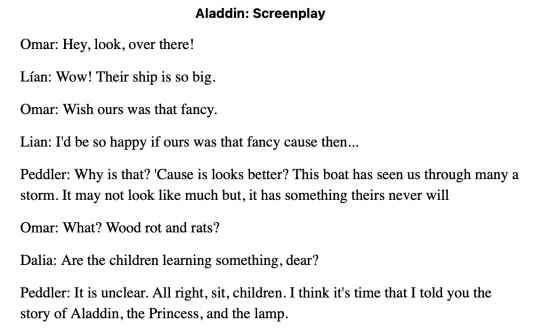
On Amazon you can find [dozens of books by Meredith Day](https://www.amazon.com/Meredith-Day/e/B000APLY0K/ref=dp_byline_cont_pop_ebooks_1), all of them “screenplays.” But they’re not actual screenplays. At most they’re transcripts, perhaps pulled from the closed captioning.

aladdin transcript page

The text isn’t the only thing that looks to be yoinked without permission. The cover artwork shows up in the [Artstation portfolio](https://www.artstation.com/artwork/v1wYz3) of Vietnamese artist Khánh Khánh as “Aladdin 2019 Fanart.”

The listener asks:

> I was wondering if you ever do anything to legally take these down? Have you ever considered official publications of your previous screenplays besides just the digital releases in your library?

Let’s take a moment to look at the copyright issues here.

Aladdin — both the character and the basic story elements — are wholly in the public domain. Everyone has the right to retell the story of the kid, the lamp and the genie.

*Disney’s Aladdin,* including its songs and dialogue, are property of the Mouse House. This book isn’t the public domain version of Aladdin; it’s a transcript of the film. It’s hard to imagine it passing any of the [standards of fair use](https://www.copyright.gov/fair-use/more-info.html), as it’s a commerical endeavor that uses the work in whole without commentary or transformation.

What’s more, it invites confusion about whether it’s an authorized product. To my knowledge, Disney hasn’t published the screenplay anywhere, but they have put out a [well-reviewed novelization](https://amzn.to/33KepeA).

As one of the credited writers of Aladdin, I considered filling out Amazon’s “Report Infringement” form, but Disney is the more properly aggrieved party here. It’s their call. ((Because the 2019 Aladdin is based on Disney’s IP, I don’t control any of the separated rights, including publishing a book of the script.))

As frustrating as it is to think of someone profiting off this hacky transcript, I honestly don’t think they’re profiting that much. A quick Google search will find you the same text for free. The best case for taking these fake scripts off Amazon and Barnes & Noble is that they’re terrible and certain to disappoint anyone who purchases them.

Writing with an invisible illness

January 14, 2022 First Person

Annie Hayes is a longtime friend of Scriptnotes, who first helped me out at the Austin Film Festival.

—
first personI’m currently a staff writer on the CW’s *In the Dark.* I previously had several different assistant jobs in the industry. I also have a genetic disease called cystic fibrosis.

As an assistant in Hollywood, you’re often told that this is the time for you to pay your dues, to work long hours and run yourself ragged for the pocket change they throw at you every week. You’re young, you can handle it.

Before I moved to LA, a producer I met at a CF research conference told me I would be crazy to try to get one of those jobs with my condition. I should stay home, write, and live off my mother for as long as I could get away with. I didn’t take his advice, but his words got in my head. No one really talks about what it’s like to navigate such a demanding industry with a chronic illness. I’ve learned it is possible, but I wish more people had been having this conversation a long time ago.

In [Scriptnotes episode 530](https://johnaugust.com/2021/the-one-with-jack-thorne), Jack Thorne mentions his complicated feelings about the word disability. I share them. I don’t feel “disabled” applies to me, but neither does the word healthy. We don’t really have commonly understood terms to describe the people who fall somewhere in the middle.

Our society still has a long way to go in terms of employers making workplaces accessible for the physically disabled. Accommodations for people with invisible illnesses are barely on the radar. I in no way mean to imply that I have it harder than someone who is blind or uses a wheelchair — working with disabled writers on a show about a disabled character, I am acutely aware that I do not. But it can be a very thorny path to navigate.

Over the past several years, I’ve come to realize that I greatly prefer being open and vocal about my illness. To anyone else with the same situation, I would say it’s important to present the people you’re working for with the solution rather than the problem. You may need to work a little differently or have a different schedule, but if you’ve figured out what that looks like and all they have to do is go along with your plan, it will be so much easier to get them on board.

For me, that once meant having to do my brand new script coordinator job from a hospital bed for a week. But nothing fell through the cracks, so in the end, no one gave it a second thought.

For aspiring writers, there’s also the question of trying to find the time and energy to write your own stuff on the side. I certainly know what it’s like to be so wiped out from the cumulative stressors of work and health that you have nothing left to give your own writing at the end of the day.

I just had to learn to forgive myself. You’re not being lazy, and you can’t judge yourself by other people’s standards. I’ve seen plenty of very healthy people struggle to get any writing done at all, so you’re not falling as far behind as you might think.

Cystic fibrosis is a progressive condition, so I have a lot of uncertainty about what my health will look like down the road. The silver lining of working in an industry this precarious is that our jobs rarely last more than a year, giving me built-in opportunities to continually re-evaluate what I’m capable of.

That’s changed over time; frankly, right now I probably couldn’t do the agency assistant job I loved five years ago. But I’m at peace with that. I never take a job with responsibilities beyond what I know I can currently handle. And if that were to change suddenly, I would just have to be honest with my boss. Granted, that’s easier as a writer, but I managed it as an assistant, too.

Ultimately, I wish I had known when I came to LA in 2016 that I would be able to handle it. That even though my health would get worse, it wouldn’t affect my career. To anyone else out there who may be having the same doubts, I say give it a shot.

Is a class in script coverage worth it?

December 11, 2021 Film Industry, QandA, So-Called Experts

Ethan in Northridge writes:

*Recently I was searching online on how to write script coverage and become a script reader as I felt I didn’t have a full understanding of those topics. In my search I found a website offering a free class that would “share the details of what it takes to become a reader.”*

*Since the class was free I decided to attend. It started out fine. The instructor was nice and eased us into talking about script coverage and their own background.*

*Then about halfway through the class, when the instructor promised to get more into the details about becoming a reader, the class clearly turned into an advertisement for their paid courses. The remainder of the class was largely them listing off how different parts of their courses have a $400, $2,000, or $11,000 value.*

*Most people in the class chat were praising this and saying it was a great deal, but I personally just felt uneasy about the whole thing.*

*Do you think I am correct in feeling uneasy about this? Or am I being judgmental and unfair to a legitimate business?*

—

Something can both be a legitimate business and make you feel uneasy. For example, pawns shops are legitimate businesses. So are gun ranges, drug paraphernalia stores and strip mall psychics. That doesn’t mean you need to give them any of your money.

Don’t get hung up whether something is legit or a scam. If a business doesn’t feel right for you, trust your gut and move on.

Let’s talk a little about script coverage, and whether it’s ever worth paying to study it.

I first learned how to write script coverage while in graduate school at USC, in a class taught by uber-producer Laura Ziskin. She showed us examples of good coverage and then told us to write some. For several weeks, we’d take home a script from her library and write up coverage on it. (You can read some of this early coverage in [my 1996 site](https://johnaugust.com/1996/aboutcoverage.html), although I can’t find any with proper top sheets intact.) Laura or one of her execs would mark it up and offer feedback.

How much did I pay to learn coverage in Ziskin’s class? And how much was it worth?

Since that was only a small part of the class, it’s hard to break it out to exact dollars. But I’d guess it was less than $500. As part of a class designed to teach us to think critically about script development, the section on coverage was definitely worth it. In fact, a few months later I started working as a paid freelance reader at TriStar.

Do you, Ethan, want to work as a reader? If so, a short, structured program focused on writing coverage might be worth it, assuming it’s taught by someone who does it for a living. You’d want something like what I had with Laura Ziskin: a look at what executives want to see in coverage, and then a few cracks at writing it, with good feedback on what you wrote.

But that’s if you want to be a reader. It’s much more likely you want to work as a screenwriter.

In that case, your time is better spent reading as many scripts as possible and writing just your reaction to the scripts. What worked for you? What didn’t — and *why* didn’t it work? Most importantly, what did you learn?

If you can find a group of peers to regularly discuss the scripts you’re reading, all the better. But I don’t think you need to do it as part of a class.

« Previous Page
Next Page »

Primary Sidebar

Newsletter

Inneresting Logo A Quote-Unquote Newsletter about Writing
Read Now

Explore

Projects

  • Aladdin (1)
  • Arlo Finch (27)
  • Big Fish (88)
  • Birdigo (2)
  • Charlie (39)
  • Charlie's Angels (16)
  • Chosen (2)
  • Corpse Bride (9)
  • Dead Projects (18)
  • Frankenweenie (10)
  • Go (29)
  • Karateka (4)
  • Monsterpocalypse (3)
  • One Hit Kill (6)
  • Ops (6)
  • Preacher (2)
  • Prince of Persia (13)
  • Shazam (6)
  • Snake People (6)
  • Tarzan (5)
  • The Nines (118)
  • The Remnants (12)
  • The Variant (22)

Apps

  • Bronson (14)
  • FDX Reader (11)
  • Fountain (32)
  • Highland (74)
  • Less IMDb (4)
  • Weekend Read (64)

Recommended Reading

  • First Person (87)
  • Geek Alert (151)
  • WGA (162)
  • Workspace (19)

Screenwriting Q&A

  • Adaptation (65)
  • Directors (90)
  • Education (49)
  • Film Industry (489)
  • Formatting (128)
  • Genres (89)
  • Glossary (6)
  • Pitches (29)
  • Producers (59)
  • Psych 101 (118)
  • Rights and Copyright (96)
  • So-Called Experts (47)
  • Story and Plot (170)
  • Television (165)
  • Treatments (21)
  • Words on the page (237)
  • Writing Process (177)

More screenwriting Q&A at screenwriting.io

© 2026 John August — All Rights Reserved.