• Skip to primary navigation
  • Skip to main content
  • Skip to primary sidebar

John August

  • Arlo Finch
  • Scriptnotes
  • Library
  • Store
  • About

Apps

Fountain for coders, or the joy of writing

April 15, 2014 Apps, Fountain, Geek Alert, Highland

Charles Forman, whose company OMGPOP developed Draw Something, is [writing a screenplay in Fountain](http://setpixel.com/writing/writing-a-screenplay-in-fountain/):

> I don’t work at a bank. However, I’m sure that on the first day of orientation, they teach you how to use an application written in 1999 in Visual Basic. It hasn’t been updated since 2001, it doesn’t work very well, everyone hates it, but it’s the way it is, and if you trick it, you might be able to do what you want, or wait until it’s 5 PM. It’s probably exactly what it’s like to use Final Draft.

> The joy of writing shouldn’t feel like working at a bank.

Forman offers a detailed look at writing in Fountain from the perspective of someone who’s written a lot of code. For his screenplay, he used both [Slugline](https://itunes.apple.com/us/app/slugline/id553754186?mt=12) and [Highland](https://itunes.apple.com/us/app/highland/id499329572?mt=12), but also built his own tools based on the libraries available on GitHub.

>”How many scenes do I have?” It’s a pretty simple question. Normally, in order to do this, you have to go through the whole script and count the sluglines. I used Javascript to parse my Fountain script. I looped through the sluglines and counted them. Then I was curious about the unique locations. How many times did person A talk vs. person B? I generated some basic stats and spit it out in the console by creating a tool in 20 minutes.

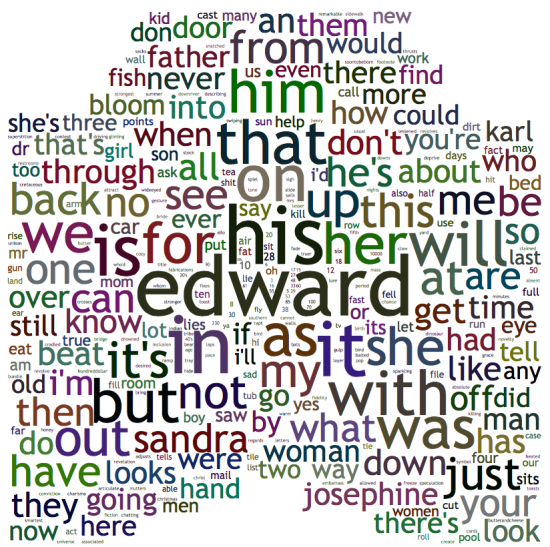
He also built a tool that [generates a word cloud](http://playground.setpixel.com/wordcloud/) based on a screenplay.

Here’s Big Fish:

big-fish-wordcloud

Forman listens to the podcast, so he’s heard us discussing the possibilities of a new screenplay format. He argues that we already have it in Fountain.

> Because Fountain is pretty flexible, you could add metadata for anything you might want to extend the screenplay with. In my case, I have included storyboards. You could add metadata for the song that is playing. You could add metadata about which characters are in the scene, if its not totally clear. You could add metadata about what the purpose of a scene is. You could add anything. If I could make a small ask to the Fountain team, I would love a specific way to insert metadata. I am using notes. I’m thinking about putting curly bracket objects inside of notes going forward.

This kind of thinking is why I’m so bullish Fountain: not just what it can do today, but what it can be repurposed for in the future.

The Deal with the Deal

Episode - 138

Go to Archive

April 8, 2014 Follow Up, Formatting, Highland, News, Scriptnotes, Transcribed, WGA, Writing Process

John and Craig talk with WGA President Chris Keyser about the tentative deal reached between writers and the studios, and why it’s more groundbreaking than it might appear at first glance.

We continue our discussion of a new screenwriting format by looking at how we got here, both the history of “modern” screenplay layout and the alternatives.

Finally, John just delivered a new script, the first one he wrote entirely in Highland. We discuss the difference between drafts and assemblies, and how much we like to know before digging in on a sequence.

Links:

* [Courier Prime](http://quoteunquoteapps.com/courierprime/)
* WGA President Chris Keyser on [IMDb](http://www.imdb.com/name/nm0450899/) and [Wikipedia](https://en.wikipedia.org/wiki/Christopher_Keyser)
* Deadline’s January article on [Chip Johannessen and Billy Ray’s letter to WGA members](http://www.deadline.com/2014/01/writers-guild-producers-pension-health-contribution-cuts-new-contract/)
* [Thomas Ince](https://en.wikipedia.org/wiki/Thomas_H._Ince) on Wikipedia
* [Sample pages](http://johnaugust.com/Assets/four-alternate-formats-final.pdf) from alternatively formatted screenplays
* Screenwriting.io on [multicamera script formatting](http://screenwriting.io/how-are-multicamera-tv-scripts-formatted/)
* [Highland](http://quoteunquoteapps.com/highland/)
* [The Way to Go](http://www.amazon.com/dp/1594204683/?tag=johnaugustcom-20) by Kate Ascher
* Lilly Onakuramara on [the Pitch Perfect wiki](http://pitch-perfect.wikia.com/wiki/Lilly_Onakuramara), and [a YouTube compilation of some of her best moments](https://www.youtube.com/watch?v=wdG6v7gkxm4)
* [Outro](http://johnaugust.com/2013/scriptnotes-the-outros) by Scriptnotes listener Blake Kuehn ([send us yours!](http://johnaugust.com/2014/outros-needed))

You can download the episode here: [AAC](http://traffic.libsyn.com/scriptnotes/scriptnotes_ep_138.m4a) | [mp3](http://traffic.libsyn.com/scriptnotes/scriptnotes_ep_138.mp3).

**UPDATE** 4-11-14: The transcript of this episode can be found [here](http://johnaugust.com/2014/scriptnotes-ep-138-the-deal-with-the-deal-transcript).

Folders, tags, and keeping things tidy

March 25, 2014 Apps, Weekend Read

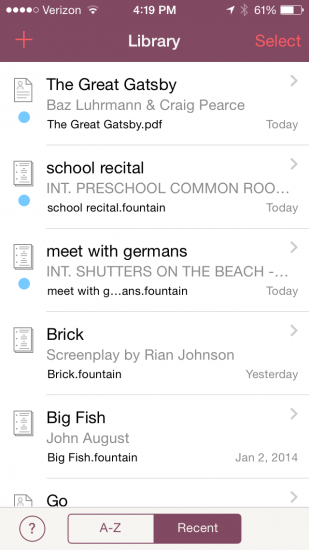
library viewYesterday, two users separately asked for folders in [Weekend Read](https://itunes.apple.com/us/app/weekend-read/id502725173?mt=8).

It’s something we’re considering, but it’s a significant UI challenge, so I thought I’d talk through some of the issues in blog form.

In Weekend Read, one of the main views is called the Library. Here you see a list of all the scripts and other files you’ve imported.

These files are “inside” Weekend Read on your iPhone, both conceptually and programmatically. That means that if you’re offline, the files are still there. If you modify the original file in Dropbox, the version in Weekend Read is unchanged. If you delete the app, you’ve deleted these files. Most users seem to intuitively understand this setup.

The challenge comes when a user wants to keep 10, 20 or 50 scripts in his Library. We offer the ability to sort the list (Recent or A-Z), but there’s no way to keep the Library organized. It can be hard to find what you want.

###Enter folders

On the desktop, folders have been a useful way to group and label things, so it’s natural to think of them for iOS.

For Weekend Read, a user might have a To Read folder and an Archive folder. Or she might have all the scripts of a certain show in one folder. An actor might keep audition sides separate from other scripts.

On the desktop, you drag-and-drop a file into a folder. Unfortunately, that behavior doesn’t have a great parallel in iOS. Tapping-and-holding on a scrolling list might mean you just want to scroll it.

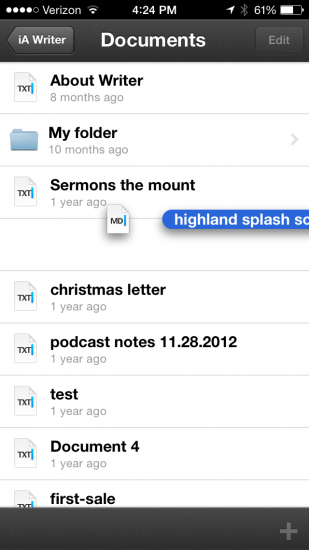
iA WriteriA Writer pulls it off pretty well, though. Tap-and-hold sucks the icon up from its slot in the list view. You can then drag it to an existing folder, or create a new folder by dropping it on another file. (Much like how app folders are made on the home screen in iOS.) To get a file out of a folder, you drag it to a button where the back arrow would be.

The more common solution you see in iOS is using Select to choose items from the list view, then offering the choice of moving them into a folder (or making a new one). This follows the tradition of Photos, and feels like the Apple Way. GoodReader and Byword both do it this way.

(Sidebar: Like Rene Ritchie, I wish Apple would follow the path of Photos and create [something like Files.app](http://www.imore.com/ios-7-and-my-continued-unrequited-desire-filesapp) to serve as a repository. It would greatly simplify interoperability between Weekend Read and apps that create Fountain files.)

Once you have files in folders, you have to figure out the right way to navigate through them. On the iPhone, we’ve come to accept that tapping on a folder moves you one screen to the right, where we show you the contents of that folder.

For Weekend Read, that mostly makes sense, but we’d have to put a back arrow where we current have the + to add a file. Not awful, but logically it might be nice to hit that plus and mean, *import a file into this folder.*

Further decisions:

* Does deleting a folder delete all the files inside it?
* How do you rename a folder?
* Can you nest folders?

###The Single Folder Solution

At our meeting today, Nima wondered if we could get by with just one folder called Archive. This tracks well with how people use Gmail, and might be enough for many users.

Essentially, everything you see in your Library would be stuff you’re reading now. Stuff in your Archive would be out of sight — still on your phone, but not cluttering your view. That’s not unlike the experience with Kindle, where you can always download something you’ve deleted off the device. It’s organizing by getting rid of things.

From a UI perspective, we’d probably make Archive a choice next to Delete when you swipe right-to-left. (And in the Archive, an equivalent choice would move it back to the Library.)

###Tagging

With folders, a file can only be in one place at a time. A script can be in the To Read folder or the Hannibal folder, but not both.

With tags, that script can be in both categories simultaneously. Evernote and Vesper both use tags extensively, and recent versions of Mac OS have encouraged tagging over folders.

In Weekend Read, we’d presumably allow users to tag files the same way we rename them, by tapping-and-holding on the file. One could also tag by Select-ing a group of files and applying the same tag to all of them.

Once tagged, we’d provide filtered views that only show matching files. (But how? Possibly by tapping on the Library title.)

There’s a lot to love about tagging, but in my heart of hearts, I just don’t see people embracing it. It feels like a power-user feature, and overkill for what we’re trying to do.

###Search

Regardless of which — if any — of these options we choose, one thing we will look at adding is a search field. On both Mac and iOS, I’ve gotten increasingly comfortable with just searching for what I want rather than trying to find it.

As it stands now, I’m leaning towards the one-folder solution, but I’m eager to hear more feedback from users and other folks interested in UI. [Weekend Read](https://itunes.apple.com/us/app/weekend-read/id502725173?mt=8) is free in the App Store. You can find me on Twitter [@johnaugust](https://twitter.com/johnaugust).

Opening a script from in Mail in Weekend Read

March 22, 2014 Apps, Weekend Read

One of the most common uses of [Weekend Read](https://itunes.apple.com/us/app/weekend-read/id502725173?mt=8) is to open a script someone has emailed you.

Here is the “right” way to do it:

1. Go to Mail.
2. Find the email with the file attached.
3. Tap and hold on the file, then choose “Open in Wknd Read.”

The trouble is, it’s entirely reasonable to go to Weekend Read first. We let you import a file from Dropbox or a clipboard URL. Why don’t we let you import from Mail?

Because we can’t. Apps are sandboxed, and there’s simply no way for Weekend Read to reach into Mail and see what files are there to be imported. ((GoodReader skirts around this by asking for your email login information and checking the mail server itself. That’s more responsibility than I felt comfortable having as an app developer.))

Yet it’s a normal, natural instinct for a user to want Weekend Read to work this way.

So for Weekend Read 1.0.2, I asked Ryan and Nima to add a Mail option that would simply switch the user over to Mail. Basically, “Oh, you want to import a file from Mail? Here, let me take you to Mail.”

But you can’t even do that. Apple provides a URL scheme for creating a new message in Mail, but not to simply switch to the inbox.

iPhone screenshot

Faced with these limitations, we still wanted to make adding a file from Mail as pleasant as possible. I asked Ryan Nelson to come up with a new animation that would show exactly how to add a file. I’m really happy with the result.

Now, whenever the user chooses Email from the list of import options, she is presented with a card acknowledging what she’s trying to do: “It’s easy to import a file from Mail.”

If she clicks on the “Show me how” button, she gets a looping animation that walks her through the process.

It’s entirely possible that a user will forget how to add a file from Mail and click on it again. That’s okay. The experience is consistent and predictable. If you’ve forgotten how to get to a file in Mail, you can learn again in 12 seconds.

Here’s the animation Ryan made:

Screenshots can show you what something looks like; animation can show you how something works.

But they can also be really annoying. When Facebook’s Paper app launched, it was criticized for its intrusive hand-holding. But I think this is a different case. Here, the animation only plays when you specifically ask for it. You want to know how to do it? Okay, let me show you.

If you want to see what the animation looks like in context, [Weekend Read](https://itunes.apple.com/us/app/weekend-read/id502725173?mt=8) is free in the App Store.

ETA: As I was writing this, a new release of Weekend Read (1.0.3) went live in the App Store, which addresses a minor display bug.

« Previous Page
Next Page »

Primary Sidebar

Newsletter

Inneresting Logo A Quote-Unquote Newsletter about Writing
Read Now

Explore

Projects

  • Aladdin (1)
  • Arlo Finch (27)
  • Big Fish (88)
  • Birdigo (2)
  • Charlie (39)
  • Charlie's Angels (16)
  • Chosen (2)
  • Corpse Bride (9)
  • Dead Projects (18)
  • Frankenweenie (10)
  • Go (29)
  • Karateka (4)
  • Monsterpocalypse (3)
  • One Hit Kill (6)
  • Ops (6)
  • Preacher (2)
  • Prince of Persia (13)
  • Shazam (6)
  • Snake People (6)
  • Tarzan (5)
  • The Nines (118)
  • The Remnants (12)
  • The Variant (22)

Apps

  • Bronson (14)
  • FDX Reader (11)
  • Fountain (32)
  • Highland (74)
  • Less IMDb (4)
  • Weekend Read (64)

Recommended Reading

  • First Person (87)
  • Geek Alert (151)
  • WGA (162)
  • Workspace (19)

Screenwriting Q&A

  • Adaptation (65)
  • Directors (90)
  • Education (49)
  • Film Industry (489)
  • Formatting (128)
  • Genres (89)
  • Glossary (6)
  • Pitches (29)
  • Producers (59)
  • Psych 101 (118)
  • Rights and Copyright (96)
  • So-Called Experts (47)
  • Story and Plot (170)
  • Television (165)
  • Treatments (21)
  • Words on the page (237)
  • Writing Process (177)

More screenwriting Q&A at screenwriting.io

© 2026 John August — All Rights Reserved.