• Skip to primary navigation
  • Skip to main content
  • Skip to primary sidebar

John August

  • Arlo Finch
  • Scriptnotes
  • Library
  • Store
  • About

Archives for 2014

Scriptnotes, Ep 149: The Long-Lost Austin Three Page Challenge — Transcript

June 22, 2014 Scriptnotes Transcript

The original post for this episode can be found [here](http://johnaugust.com/2014/the-lost-lost-austin-three-page-challenge).

**John August:** Hello, this is John. Craig Mazin is not here, but he was there back in 2013 when we sat down with some people at the Austin Film Festival and did a live Three Page Challenge. Now, this episode has actually been sitting in the vault for a long time. We’ve been holding on to it for a certain emergency like rip cord, like pull the rip cord, there’s no episode this week, we got to put up a new episode.

Well, we haven’t had any of those emergencies, so this episode has been sitting around for a really long time. And we feel bad for the people who are waiting for this episode to come out, specifically Krista Westervelt, Melody Cooper and David Elver, who were so generous to submit their pages and have us talk to them. And they kept waiting for this episode to come out and it’s finally coming out. So, sorry it took so long, it’s been like eight months I think. But it’s a good episode.

So next week we’ll be back live with a normal episode, but this is a good Three Page Challenge and I hope you enjoy. Thanks.

[Intro tone]

Hello and welcome, my name is John August.

**Craig Mazin:** My name is Craig Mazin.

**John:** And this is the Three Page Challenge, and we are here in Austin to talk about writing pages and specifically three pages. This is a thing that Craig and I do on our podcast not every week but every couple of weeks. It’s really Craig’s suggestion, so what Craig loves to do is to read the first couple pages of a person’s script and tell them whether they should stay as a writer or should give up the business completely.

**Craig:** Well, yeah, I said three pages. I could’ve gotten away with one. I actually do believe one page is probably enough. But we’ve been beneficiaries to some great Three Pages. A lot of the people who send them in, a lot, really do a good job. I think we’ve got some good ones today. But it’s a nice way also for us to not have to worry about whether you have a good idea for a movie or where it’s going or how it’s developing, but we just talk about the craft of how you’re actually putting the scenes on the page.

**John:** Yes. So Craig and I host a podcast called Scriptnotes and every week we’re talking about the business and craft of screenwriting. And it’s very hard to talk about the craft portion of it without having words in front of you. And so people have been really generous to send in the first three pages of their scripts and letting us talk about them on the air and hopefully give some constructive feedback.

At the Writers Guild Foundation about six months ago we were able to do the first time where we not only read through these pages but actually met the people who wrote these pages and then talked to them more about what was on the page and the rest of their script. And we’re so excited that here in Austin we get to do that again.

And so many of you in the audience have in your hands this little handout, this packet of these first three pages, which is awesome. If you didn’t get one of these or if you’re listening to this after the fact, you can also just go to my website johnaugust.com/austin and I have these three pages up here, so you can follow along with us if you don’t have those physically in hand.

So we have three very brave people who’ve shared with us their scripts.

**Craig:** Yes.

**John:** And let’s just get into it.

**Craig:** No. Before we do that we should just say congratulations. Everybody in here is at least a second rounder of this competition.

**John:** Which is great. So these are people who submitted to the Austin Film Festival and their scripts were considered awesome and made it through to the second round of the competition, which is great.

**Craig:** You’ve earned this. You and everyone who listens to a free podcast has earned this.

**John:**[laughs] For this chance.

**Craig:** Well done.

**John:** The first script we’re going to take a look at, first three pages we’re going to take a look at, is a script called Graceless and it’s by Krista Westervelt. Krista, where are you here in the audience?

Hi, Krista.

**Craig:** Hey Krista.

**John:** Thank you for coming to Austin. Hello. And so for people who are at home or like are driving in their car and therefore shouldn’t stop and try to read the pages, we’re going to give a little summary of what happened in the first three pages before we get going. I’ll do this first summary.

So we’re starting in Angela’s bedroom. So Angela Reeves, who is her early 20s, she’s sort of half-dressed, she’s getting dressed and she’s listening to voicemails. And the voicemails are from her mom saying where are you, the service starts in 20 minutes, are you hung over. Her dad also has a voicemail saying, “For the love of god, please show up.”

Angela arrives at this mega church parking lot. It’s the First Savior and Living Lord Church which is filled towards capacity. It’s there where we meet her father for the first time. Henry Reeves is 47. She sits down with him. The choir church is singing. Doug Richards, the pastor, scans the crowd from the pulpit. We meet Melinda Reeves, Angela’s mother, who we heard in the voicemail. She’s 47. A little description of her. She says, “Would it have troubled you to wear a skirt?” That’s sort of their first interaction.

Afterwards, we’re in the church sanctuary and we’re being introduced to Dottie who’s in her 50s, attractive woman with just a bit of menopausal softness and who’s greeting people as they’re exiting the church. We also see Dottie’s daughter Jamie who’s in her 20s. We end up with a conversation between Dottie and Jamie. Ultimately the conversation finishes up with just Jamie and Angela. They’re dialogue is bumping over each other. Jamie runs the singles, how long have you been, that sort of overlapping dialogue conversation.

And we exit the three pages on midway through their first conversation. And that is what’s happening in three pages. And Craig Mazin, start us out.

**Craig:** Well, are we going to be joined up here by —

**John:** I think we should talk a little bit about what we’ve experienced first.

**Craig:** Okay. And then we will — and then if they run out and then we can, they’ll come up here and…

Well, I enjoyed these pages. I started to get a little lost here and there but there’s a lot of good things. I like the use — I generally like the use, any time you can introduce a character without introducing the character is interesting. And I like that I was learning a little bit about the relationship between Melinda and her mom through the voicemail in theory. In practice, I’ve seen this a gazillion times. I’ve seen the voicemail and nobody has this voicemail anymore, by the way. That’s the other problem. Nobody has the beep, next message. You know, we all have our phones now, and so it’s a little cliché to hear the carping mom over the phone.

Also, I loved that, well, I liked that she sniffed her laundry because I do that. And that was interesting. And it was a nice touch that the dad also calls and has a different — already has a different voice from the mom. This is good, that’s good that you’re establishing those things. Mega churches are awesome in the sense that they are designed to make you feel like, whoa, I mean either you’re horrified or in love with them. Either way, they leave an impression.

And the name is spot on. But you didn’t give me the mega church feeling. I wanted a mega church feeling. If you walk me into a mega church, you say it’s a mega church but you write it like it’s a one-room chapel, you know? It seems very — even though there’s a stage and everything, everything seems short and down. There’s no spectacle. I want more spectacle. I want a feeling — I want to know what my main character is feeling walking into this mall of Jesus.

Her mom’s first line, would it have troubled you to wear a skirt, right idea. A lot of words to say that when I think my wife, if she sees my daughter doing that would have just said, “No skirt?” You know what I mean? There’s the — tailor the length of dialogue to the relationship because mothers and daughters have shorthand, obviously.

Where we’re going to get to is what, I mean, I don’t know, either this does or doesn’t turn into a lesbian church movie but it’s starting to feel like a lesbian church movie which I’m totally in favor of. But the way that Jamie and Angela meet feels un-cinematic. We’re just, you know, Dottie is the mom and we get that the mom is clueless and there’s just chitchat. There’s just chitchat going on. And when people are interested in each other I want to watch the spark happen. I don’t want to hear it. I want to watch it. It happens before words are ever said.

So I was — that’s what I would suggest to you is to really think about how you can create a moment before you get to the dialogue which has raced immediately to an almost 1930s-style screwball comedy, you know, repartee. It’s like two Jean Arthurs. So I would think about creating a moment before you have the moment. But by and large, it was — the characters felt really interesting and certainly there’s the promise of a very interesting story here, particularly if that mega church gets mega churchy.

**John:** Like Craig, I was really excited by where we were ending up on page 3. I was really fascinated just to know what was going to happen next, so congratulations on that because a lot of times we get to three pages like, “Oh, and I’m done with those three pages.” So that was exciting for me to be curious about what was going to happen next.

The issue of, you know, hearing the voicemails and the woman getting dressed, it’s just a thing we’ve seen before and it’s a little bit of a television kind of thing. It feels like a TV pilot kind of first moment. Maybe this is a TV pilot, I don’t know. But that felt a little both familiar and also not quite present day because, like Craig, I would say no one really has that sort of normal — the speaker phone. And that’s absolutely possibly a way to do it is essentially her iPhone is down and it’s going through those and she’s pressing the next one.

But it was the specificity of checking the smell of clothes felt really good and appropriate. Like Craig, I’m so excited about the mega church but I didn’t know where we were. I didn’t know sort of what part of America it was. I didn’t know if this was a southern mega church, if this was a western mega church, what kind of environment we were in. So more specificity and dressing about that would be great.

And I got a little misled in the wrong ways about sort of come to the service because like I was thinking like, well is it a wedding or is it a funeral? I immediately went to one of those two things. And if it’s a normal service then why does she need to go? And so if we’re not going to get those answers before we meet this new character who’s going to clearly be important, that just let me hanging a little bit.

But we should bring you up here because, you know, I’m talking directly to you —

**Craig:** Yeah, come on up.

**John:** Please come on up. And let’s welcome Krista.

Thank you very much.

**Krista Westervelt:** I can breathe now because I got through this.

**Craig:** Oh yeah, you got through the hard part. You got through the hard part.

**John:** So please, Krista tell us what happens on page four.

**Krista:** What happens on page four or just in general you want me to —

**Craig:** Well, four and…

**John:** Four and beyond.

**Krista:** Four and beyond.

Basically, Graceless is kind of dealing with the fallout that happens when this evangelical mega church pastor’s daughter starts dating a woman. So, yes, you were on the right track there —

**Craig:** Yay!

**Krista:** With the lesbian love interest thing.

**Craig:** I’m so good at picking up on lesbian church movies.

**Krista:** There you go.

**Craig:** It’s my thing.

**Krista:** There you go.

**John:** He has a wheelhouse. And so tell us about the impetus behind writing this thing. Is this the first thing you’ve written, have you written a bunch of other stuff? Where are you at?

**Krista:** This is actually the very first thing. I had originally, years back, started kind of playing around with the idea of writing as a novel and it just wasn’t happening. And then the spark that got me to finally sit down and write it because I was kind of seeing it sort of like a movie in my head and I wanted to kind of play around with that. My husband died in 2011 and it’s sort of that spark of, okay, life’s too short, stop putting shit off, you know, so to speak . And so I sat down and gave it a shot and got through it.

**Craig:** Yeah, I’m glad we didn’t beat you up because this would have been awkward. [laughs]

**John:** So talk to us about Angela Reeves. So she is our protagonist, I’m assuming.

**Krista:** Right.

**John:** She’s the first character we’re meeting.

**Krista:** Exactly.

**John:** Tell us some things that are special about her and let’s think if we can find some ways to learn about them earlier on or set them up.

**Krista:** Sure, sure. I think she’s close with her parents but her mother’s disappointed in her because she’s a lesbian and she’s this member of this church and she’s trying to be good and get her daughter saved. And maybe if I can get my daughter to come to church, maybe I can get her saved. If she can become friends with the pastor’s daughter, everything’s going to be perfect because, you know, who’s a better role model than the pastor’s daughter to get her saved and gay or whatever.

**Craig:** Well, okay, now that’s interesting because here’s an important fact that I want to start gleaning immediately from the beginning of the movie. There’s a difference between Angie’s mother and Jamie’s mother.

**Krista:** Right.

**Craig:** Angie’s mother knows she’s gay.

**Krista:** Right.

**Craig:** Jamie’s mother has no clue. Now, there’s a way that that can kind of come through.

**Krista:** Sure.

**Craig:** There’s a way that that can be indicated. I mean first of all, what John said about the TV-ishness of the voicemail is true. And when we’re writing a screenplay, that’s when we don’t — I mean unless you are, you know, blowing the earth up and we have of those coming soon, you don’t have to worry so much about budget. So think about space and think about ways to be cinematic.

I mean, here’s a woman and she’s waiting in this line to get into the mega church in her car and you’re just like, uh-uh-uh, and she finally gets up and then it’s her turn to go in and she turns around and leaves. And then, no, and then she turns around and gets back at the back of the line to go in. Something so that you start to sell this reluctance. And when she comes in and you’re selling it with a movie, you know?

**Krista:** Yeah.

**Craig:** When she comes in and sits down next to her mother, I could see her mother looking at her, just looking at the pants. And she’s like, “Mom…”

“No, no, it’s better than I thought. It’s better than I expected.”

**John:** Yeah.

**Craig:** Like the weariness of the mom who just is slowly just dealing with it.

**Krista:** Yes.

**Craig:** That’s an interesting circumstance. So let that inform how these two talk to each other.

**Krista:** Okay.

**Craig:** They’ve had — this is an old fight. But there’s a new fight that’s coming with the other ones, you know, so that makes it fun.

**Krista:** Yes.

**John:** I have a question for you.

**Krista:** Sure.

**John:** The first scene is set in Angela’s bedroom. But we know so little about her. We don’t know if she’s living in an apartment by herself or if she’s living at her family’s house, what is it?

**Krista:** I figure she lived in a studio apartment on her own.

**John:** Okay.

**Krista:** Yeah.

**John:** Great. So that might be a good thing to tell us here in this opening thing. So maybe get us out of that bedroom and see what her real living environment is because when you just give us bedroom we don’t know any bigger context. So if it is a studio apartment, then that is a studio apartment. There’s no such thing as a bedroom.

**Krista:** Right.

**John:** The fact that her bed is also her couch is — everything is really meaningful. And the fact that her dirty clothes are out, not just on the bedroom floor but like they’re out in the apartment. Like everything is together.

**Krista:** Right.

**John:** And so use each of those little things to give us more space. I don’t think you need to tell us that she’s a lesbian right from the get-go, which is great, but I do wonder if over the course of your movie we are going to have these two girls meet too — so early that there’s no surprise. We’re not going to get to know our hero before we meet the love interest. And so as much as you can do to let us know and love this girl before we sort of know who she’s going to love is going to be helpful.

**Krista:** Okay.

**Craig:** Cool. I think that’s right.

**John:** Hooray.

**Craig:** But you can do this.

**John:** Yes, you absolutely can do this.

**Krista:** Thank you.

**John:** And the words on the page felt solid and consistent and you definitely know what the form is and so I have no doubt you’re going to make some awesome scripts.

**Krista:** Wow, thanks.

**Craig:** Good job, good job. Way to go. Nice work.

**Krista:** Thank you.

**Craig:** Next victim.

**John:** Not victim. Next hero is Melody Cooper with Monstrous.

**Craig:** Hero. If you wish. Okay. And it’s Melody or Melanie?

**John:** Melody.

**Craig:** Melody. Is that you?

**Melody Cooper:** It is me.

**Craig:** Well, then I’ll have to trust you on that. Okay. And so Melody’s three pages are from a script called Monstrous. We open up, the sky over the Atlantic Ocean, night, and then along comes a single engine airplane. We’re now inside this small private plane. It’s dark and then we just see the flash of a woman’s face whispering, “Where is he? I can’t see anything.”

Another woman says, “Stay close, we can’t let them…” And then they scream and scream and they’re lost in the darkness. In the last row of the plane, we meet Moira. She’s 20s, red head, freaking out, she is shoving a small digital camera into a Ziploc bag, sealing it. Somebody dies near her. Blood splatters over her. She keeps going. She puts the bag, she attaches the bag to a life vest, says, “Stay bound together,” to herself in Gaelic or I guess, no, to the camera and the life preserver.

And then she gets out from her seat, tries to basically get out of the plane. But as she’s trying to get out of the plane, she’s dragged back by some unseen terrible thing, dismembered arm attached to the door handle, blood spraying everywhere. She kicks the vest out of the door, the life vest sails down towards the ocean, the airplane crashes into the water. But the vest is there along with the Ziploc bag holding the camera, which presumably has some evidence of what we’ve seen. That’s all on Page 1.5.

Now we’re in New York. We’re in Queens on a residential street. And in a building, David Harrison, 20s who’s a bit of a mess, he’s a gamer, he’s playing some sort of shoot them up game, first person shooter, while he’s drinking beer from a straw. He’s pissed off. He’s playing a game with a werewolf and a Griffin that are killing each other. He thinks he’s won until the zombies come. And when he finally pushes back from his TV having lost, we reveal that he’s in a wheelchair. And that were the first three pages of Monstrous.

**John:** Great. So this is a classic example of a cold open where the initial thing we’re seeing isn’t going to — the characters we’re seeing and the characters we’re meeting are setting up things about the story or things about the nature of the movie, but they’re not specifically talking — this is not — the hero of the story isn’t going to continue because she dead.

So it’s establishing what the world of the movie is like and then we’re going to cut to something brand new and ultimately this thing that we’ve established, this camera will end up becoming an important thing when we get to this guy.

So let’s sort of talk about these two things as separate things. We need to talk about this opening image and then what we’re learning about how the real engine and how the new story is going to start.

I really like the idea of the vest with the camera going out and like that’s the thing that is going to continue long after because we have this expectation that the woman will somehow survive and this things will get out. The idea of this vest and this camera are what remains of this seems really, really smart. And I have not seen that before and I’m really excited.

I got lost inside a small plane. And so I think a lot of my questions about this opening is really the geography and specificity of where we’re at in this place and what we as the audience are supposed to be expecting because sometimes as a reader I got confused and I didn’t know whether it was because I just wasn’t smart enough to do it or else it was just described in a way that wasn’t — I didn’t know if I was supposed to get it or not supposed to get it and it got confusing me in a way that was not especially helpful.

Some examples for it would be midway down the first page, “Slicing of flesh, blood sprays against the seat next and window next to Moira, some of it splatters on her face.” Slicing of flesh, I don’t know what that image is. And so it’s given to me as a slug line as an important thing but what’s slicing what? Like what’s doing the action? Is a knife cutting something as opposed to if it just said blood sprays. Well, blood sprays from something, that would be enough for me. Blood spraying as image —

**Craig:** Did you mean it as a sound?

**Melody:** Yes.

**Craig:** Okay.

**John:** Oh, great. And so when we see that line by itself, we’re going to assume that’s an image. We’re going to assume that the camera is looking at something. And slicing of flesh is not a thing we can sort of see. So if it’s meant to be a sound, I would say —

**Craig:** We hear —

**John:** We hear, either we hear or do the blood sprays as the slicing of flesh, you know, happens. Another thing that confused me would be Moira’s line here, in Gaelic, “Stay down together.” So she’s in Gaelic, but is that subtitled? Like how are we, as an audience, supposed to be processing that? Because as a script reader we know what she’s saying and so if it is supposed to be subtitled, in Gaelic, subtitle would be the thing.

Earlier on and the first lines we hear, “Where is he, I can’t see anything, stay close, we can’t let him,” and then there’s screams. And yet, I’m told that we’re in a private plane, so my internal geography of what a private plane is is that it is so small that how can anything kind of be loose in a private plane. So entirely possible, I just wasn’t seeing how it would work.

I got confused if there’s other people. I assume there’s other people but I’m only experiencing Moira, so that again. So sometimes that confusion is okay. But you sort of need to make it clear to the audience that like you’re kind of supposed to be confused. Like it’s chaotic and you end up using those words, but you’re not really quite sure what we’re seeing. Any more reaction on the first opening?

**Craig:** Well, it is fun. I mean, you know, it’s exciting to be thrown into the middle of a sequence like that and the camera and the life preserver are great. It seems to me like what we’re missing is something to ease us into it. I don’t think, given the circumstances of who’s on this plane and what he or it is doing, you may not be able to show the moment when things start to go bad.

But what I would — first of all, there was a huge question. Who’s flying the plane, right? That’s a big one. But let’s presume the plane is just flying. Now one thing you could do is you could just, you show this plane… — And by the way, I would try and eliminate a little bit — it gets a little too much like “a calm, clear night, high full moon, a single engine airplane across the sky, cabin windows are completely…” we’re not, we’re just seeing, you know what I mean?

**Melody:** Yeah.

**Craig:** And then we’re inside of it. So we can get a little tighter on that. I know you want to see what’s on the tail. Then you could sort of say, interior plane, a man is sleeping calmly, you know, as the plane hums along. You know, he nods and then his head flops to the right, blood. You know, okay, so, whoa, whoa, whoa, that’s not a sleeping business man, that’s a dead person.

Now, you could then see cockpit. The cockpit door is open. The pilot is dead, you know, the plane is on autopilot. And then you could see, you know, the lights go out or something. And then you could see a woman, like “Don’t move, don’t…” you know, whatever it is. Somehow you need to let us in slowly and make this, build it up so that we feel like the point is we’re supposed to be completely disoriented. Disorient us while orienting us. [laughs] I don’t know how else to put. You know what I mean?

**Melody:** Yes.

**Craig:** But that’s kind of the —

**John:** He’s saying you can’t be disoriented until you’re oriented in some capacity.

**Craig:** Right.

**John:** Right now it becomes just spinning wildly and we don’t know sort of where to start focusing.

**Craig:** Yeah.

**John:** I want to push back a little bit of what Craig said. It’s like I honestly thought your first sentences started stronger in that they were so short. And maybe there were a few too many —

**Craig:** You like short sentences, yeah.

**John:** And so it starts, “A calm, clear night. High full moon. A single engine airplane crosses the sky.” But then when we get inside the plane, suddenly our sentences get super long in a way that feels weird because the action is really choppy and the sentences got really long. So here’s the first sentence inside the private plane. “Moonlight, punctuated by the pulse of light from the wings, illuminates the darkness of the cabin of the 12-seater.” Those short sentences you started with would be a great thing to continue into this place.

Moonlight. The interior cabin is dark. You know, 12 seats and focus on whatever we’re supposed to be focusing on. That would invite me in a little bit more. Another very long sentence here. “In the last row of the plane sits Moira, 20s, red head, breathless and frantic, she keeps her eyes in front of the shadowy cabin as she shoves a small digital camera into a Ziploc bag. She seals it.”

As a reader, I’m having to store a lot of information in one sentence. I have to remember Moira and she’s a read head and she’s 20s and she has a digital camera and she’s panicked in the shadowy cabin. Breaking that into smaller bits is going to make it easier for me to process what’s happening and really give us a better feel of what the situation feels like to Moira.

So it’s a beautiful autumn afternoon and she’s strolling through the woods. These long sentences give you that sense of sweet. But if it is short and panicky, short and panicky sentences will be your friend.

**Craig:** Totally. And I just had an idea. So, okay, I realize why you keep talking about moon and moonlight. I get it finally. Here’s my suggestion for you. If you want to make a point, make the point, right? Don’t talk about the moon, don’t show the moon. Don’t refer to the moon. But when the plane crashes, “The inflated vest rocks in the rise and fall of the ocean as the water laps against it, the Ziploc bag that holds the camera still attached to its side. We crane up to see the full moon.”

**John:** Yeah.

**Craig:** You know what I mean? Like end on it, make it a thing, make it a reveal. Otherwise, we’re just going to be getting a lot of — some DP is going to be putting a dumb filter on a light and calling it a moonlight and no one’s going to care, you know?

So let’s talk about the Queens, the Astoria section.

**John:** Before we get to the Astoria section, on page 2 we’re moving from the wreckage of what happened with the plane and this camera. This is the moment where I think you really do need some sort of transitional element. So either transition to or cut to something to let us know that we’re not in a continuous bit of action, that we’re going to something completely new. So on the right margin, something that ends in TO: to let us know we’re at a new place and time.

**Craig:** Maybe the moon is a nice transitional element that could turn into a thing or a thing —

**John:** Yeah.

**Craig:** All right. So we’re in Astoria. Quite a bit of set up just to describe what was going on outside. I’m not sure any of it is relevant or not, perhaps it is. But that’s a third of a page of just, you know, slice of life on a Queens street. What did you think about the David Harrison scene?

**John:** So in the David Harrison scene, again, we have a lot of sounds that are given their own slug line. And so whenever we see a slug line, we think like that is something the camera is aimed at and the camera doesn’t aim at of sound. So that inhuman screech is probably a prelap. That’s probably something that we’re hearing before we make the cut inside the building, which is a great suggestion that something terrible is going to happen inside and it’s normal inside, it’s actually a video game is great.

I felt like once we were inside David Harrison’s apartment, the surprise we’re going to get to is that he’s in a wheelchair and sort of what his nature of stuff is. We spend a lot of time on a video game that was very specific and yet, you know, no one likes to watch people play video games. And so I would say as much as you can do to tighten that action and give us a general sense of the kind of thing he’s doing, but not sort of beat-by-beat what is happening on that screen because it felt like I was watching a guy play a video game for a minute. And that’s not going to be really the best.

**Craig:** Yeah. A couple of things. One, you have a tall, narrow figure staring out of the — standing and staring out of a fifth floor window. I will presume that the next shot I see of somebody inside a building is that guy. But at first I thought, well she just made a mistake here because he’s sitting now while he’s playing. He’s not standing. But it couldn’t have been him because he’s in a wheelchair. He’s not standing. So that’s a confusing juxtaposition.

If you want to show that he’s in the same building, you can see that guy and then camera can come down to find another window where we hear the growl, you know, but help us out there. The issue with the video games in movies is that unless you’re watching somebody play a real video game, they just, oh, they feel like that thing in a movie where somebody picks up a can of beer that says beer on it, you know. It’s always some fake game. And it’s hard to do well. So hearing it and maybe catching quick glimpses and giving us less and just having us fill in the gaps in our head is fine.

What he’s saying to the TV is also not real, you know. I am the guy that plays these games. I don’t do that. We don’t do that. We don’t talk like that. It’s pushed. You know what I mean? I think it’s a business like way of talking to your TV when you’re playing these games.

**John:** If he’s on a headset game playing with other players, then maybe some of that kind of dialogue could happen in a way that’s —

**Craig:** That’s its own kind of taunting thing. But when you just won a game, you’re like, yeah suck it, you know. But you wouldn’t, “You are no match for…” You know, he’s starting to do exposition here while he’s proud of the TV. And, you know, it’s rare that you play a video game and are surprised by the fact that zombies are suddenly on a level. It doesn’t quite work like that, you know.

Also, drinking beer out of a straw generally doesn’t work.

**John:** Yeah.

**Craig:** I mean just physically doesn’t work very well, you know. Beer, straw and beer and beer straws.

**John:** Can you come up so we can actually —

**Craig:** Yeah, come on up.

**John:** And talk through questions. So, applause.

**Craig:** There, it’s over.

**John:** There it’s over. So the scary part’s over and so let’s talk beer through a straw. Beer through a straw, is it because he is paraplegic? Is there a physical reason why you need to do that, or is he just really lazy?

**Melody:** Well, because his hands are engaged playing and like friends of mine who do the beer hats at games kind of —

**John:** Nice.

**Melody:** Version.

**John:** We’ve learned so much about you that you have friends who have beer hats at games. So I feel like that’s a character detail. So tell us about the script and tell us… — So, Craig’s right: you got a werewolf on a plane, did that just happen?

**Melody:** Yeah.

**John:** All right.

**Craig:** Werewolf on a plane. I am two for two.

**John:** Yeah. He’s really good at spotting lesbians and werewolves. So.

**Craig:** Super useful at different times. Both things are useful.

**John:** Can you fast-forward us through some of the things that we would experience in the script if we read the whole thing?

**Melody:** Sure. The werewolf that you meet in the beginning is actually a person who’s a serial killer that takes on the guise of other monsters once he kills them and kills people via those powers. And Harrison who we meet in the apartment is someone who ends up trying to track that serial killer with a next-door neighbor, the receding character in the building is the brother of a woman he ends up falling in love with who is half-human/half-monster. And they, the two of them team up to try to track this serial killer down before he kills more people by using the powers of monsters.

**Craig:** And Harrison is going to be tracking these monsters down?

**Melody:** Yes, yes.

**Craig:** In his wheelchair?

**Melody:** He doesn’t stay in a wheelchair because the women who were killed in the beginning are witches. And they figure in later.

**Craig:** Okay. So they cure him of wheelchair issues?

**Melody:** They help him out.

**Craig:** All right.

**Melody:** They give him a way to get out of the chair.

**Craig:** All right. That would be cool.

**John:** That’s great. So you have a real world that is populated heavily with supernatural aspects?

**Melody:** Yeah, yeah, yeah.

**John:** And so that is compelling in its pitch in a sense of like it’s a story about serial killer who is a werewolf and supernatural forces will have to stop him. So is that the thing that you’re trying to do both things at the same time to be procedural and also be supernatural?

**Melody:** Yes, and he takes on the power. He kills different types of monsters throughout the entire film. So he starts off as we see him in the very beginning, as a werewolf, but he takes on different forms and different monsters throughout the entire film and he has to be stopped. And so it is procedural and it’s also supernatural.

**John:** So it’s Sylar from Heroes. But the movie version of what that character could be.

**Craig:** And the video game isn’t a thing that matters later on, is it?

**Melody:** No, not that. It’s only a way to introduce the character especially that he himself is fascinated and thrilled by monsters. So that’s why it’s specific.

**Craig:** Sometimes it’s better when people who are asked to fight monsters are not fascinated and thrilled by monsters.

**Melody:** Yeah.

**Craig:** But in fact, they’re just like us. Just because it starts — one thing that happens that’s a little tricky is in movies with monsters, if everybody is either a monster or knows a monster or is interested in monsters, the audience starts going, what town is this? You know, how do all these people live in the same place? Is Moira a witch?

**Melody:** Yes.

**Craig:** Okay, good. So another suggestion for you because the scene that you have in the beginning on the plane tells me one thing, there is a monster, that’s it. And all these people are scared as they should be because of monsters.

But what if this one woman turns around when she sees the monster and isn’t afraid at all and just starts talking in Gaelic and then starts, “Whoa,” you know, and then the thing goes flying and you see blood and the plane goes down. And we go, okay, it’s not just that there are monsters. There are also people that know about the monsters who can fight with the monsters. It starts to at least give me a little bit more of a grounded sense of the world.

Once you do monsters, that’s your buy-in and if then you add on top of that buy-in that there’s also witches, you start to end up in that thing that happened in, was is it Stephen Sommers who did the movie with the werewolves versus the —

**John:** Van Helsing?

**Craig:** Van Helsing.

**Melody:** Van Helsing, yeah.

**Craig:** Where it just seemed like every 20 minutes are like, wait, here’s something else that is in this world that you did not know about.

**Melody:** Right, right, right.

**Craig:** And it gets exhausting, you know.

**Melody:** Yeah, yeah.

**Craig:** So the more you can give a sense of this is the deal, we’re in a world with da-da-da. And that in a sense Underworld I thought did a good job with that, you know, where they introduced where you’re like, oh okay, cool, you know, there’s two types of monsters. So anyway, things to think about.

**Melody:** Thanks.

**John:** As you start to establish your world where I wonder if it’s going to be a challenge is the rules of the world. And what he’s talking about with Van Helsing really is that. It’s like it feels like every time you’re going to introduce a new thing, it’s going to be like, “And here’s a new bit of exposition to explain this part of the rules.” So as simple as you can some of these things, the better. As you are re-approaching stuff, I wonder if you might want to just take this, think about this first moment.

And what if this first moment were 30 minutes. And what could happen on that plan, because I think you created a really amazing environment. And if that thing could go longer and really detail all that stuff and you can establish what is it like to have a werewolf on plane, that’s kind of awesome. What is it like to be a witch fighting a werewolf on a plane? That’s kind of awesome. That would be a great, that’s a great in and that might be a way to establish some of the rules of your world so that when we cut to our normal guy who’s in a more normal environment we can sort of have a sense of the scale of what kinds of things can happen in this movie.

**Melody:** Great idea.

**John:** So how many scripts have you written? Is this the first full-length thing you’ve done? What’s your —

**Melody:** No. Well, this is the first draft of the script. I’ve written a few others that are in the sci-fi/horror genre and some TV scripts. And they’ve, you know, placed or won in different festivals. But this is a very complex one. And I really wanted to submit it here to just to get this kind of feedback. And as I was, you know, struggling through, I since revised it, you know, quite a bit and actually simplified it because it had a lot going on.

**John:** Yeah.

**Melody:** But those are great comments in the opening scene in particular. I think that I already see ways that I can actually feed into, you know, how I can revise it to make it stronger.

**Craig:** Yeah, you know, as you go through these movies that are about science fiction and mysterious societies and secrets and re-presentations of things that we thought we knew, don’t forget that ultimately we’ll only really care about people and that the people part of it is the most important part. If you can, you know, get the people part right, the rest of it you can always massage into place.

**Melody:** Yeah.

**Craig:** But the character. And there’s something in the fact that you’ve got a guy in a wheelchair who eventually is going to walk or fly or something is really interesting. That’s a good people part, you know.

**Melody:** He flies.

**Craig:** There you go. See, flies? I am so good. Well great. Thank you so much.

**John:** Awesome. Melody, thank you so much.

**Craig:** Thank you. All right, next item up for bid is a script by David Elver. Elver.

**John:** Hello, David Elver. Thank you for joining us.

I am going to attempt to summarize the script we’ve read. So, in case people have had not the chance to read this all, as they are sitting down here with us. Over black we hear the distant sounds of amplified Arabic voice, a Muslim call to prayer, and also the beep-beep-beep of an EKG. We’re in a hospital triage tent outdoors. We’re near Cairo, it’s daytime. That eye snaps open. Blood red eye. We’re with a pretty young nurse who’s working with a respirator mask on this person who seems to be dying. The beep falls violent. There’s still the call to prayer. All this sequence is happening without real dialogue, just a bunch of sounds and images.

There’s a handful of doctors and nurses. Clearly like a big thing is happening because of this huge triage unit. The woman, the nurse goes back to check on this man, to check for his pulse. The skin of the man’s wrist peels off in her hand, which is nasty.

Pops, pops, explosions in the distance, artillery, a bigger explosion, a huge ball of fire and metal falls from the sky. It’s a city-size starship and envelopes in a halo flame. It’s crashing into central Cairo, destroying the city, the hospital, the pyramids, everything is consumed by fire. So a small contained little drama that we’re talking about here.

Now we’re in interstellar space. We’re black. And we learn some things about this giant ship we’re seeing, this giant cancerous, tumor of a ship. The ship is called Lazarus. We’re in 2349. We have an estimated time to Earth that is 23 hours, 47 minutes, 15 seconds and counting down quickly. We’re in a service quarter. We’re going to see Abel in his thirties. He is racing down the corridor, jumping and ducking over things. He’s a scruffy guy. At a huge power terminal he’s trying to turn something on or off. He’s trying to reset something. His arm gets stuck behind it. And as we get to the end of page 3 he’s trying to get his arm free from where it’s wedge behind this machinery. And that’s the three pages.

Craig?

**Craig:** David, these were good. Really good. I really enjoyed it. There’s a kind of writing for this sort of sequence. We’ll get to the spaceship sequence. But the beginning sequence, it’s essentially impressionistic writing. It’s something that people started doing in the 1800s and then forgot about somewhere in the 1900s.

But it’s great kind of writing where you are confused as you read it and then it’s resolved. It’s smart. It’s a good way of going about things. You have a lot of good imagery here. The beep-beep-beep of the EKG and the boop is something that we’ve seen lots of, but I’m okay with that. I don’t mind feeling like I’m in a normal situation. And then you pull back and you see this bigger situation with all these people and the pyramids in the background which is odd, what’s going on, war in the Middle East or something?

And then some horrifying disease. Little things give you information. When you think about how to get information across, here’s one way. A nurse turns back to the dead man. She checks for a pulse. The skin of the man’s wrist peels off in her hand. She turns to a doctor, “You need to look at this.” That’s one way. Or the other way is, the nurse stares at the smear of dead skin in her fingers, horrified. That’s a better way, you know, because I’m seeing that she wasn’t expecting that. That’s more visceral for me. It’s a little hard sometimes to see those things through glasses and masks, but it’s okay. That’s the director’s problem.

Really great reveal of the spaceship coming down. So we hear it, we’re not sure what it is and then it crashes. And, you know, these little things like the way you did the city, the hospital, the pyramids, I want stuff like that. It makes it interesting. I mean we all read billions and millions of scripts. So just, I don’t know, make it fun.

So everything is consumed by fire. Hard to do better than that as a screenwriting sentence. “Everything is consumed by fire.” I got it. Great. So I really enjoyed all of that.

Then we go into space. Interstellar space. “One by one, stars bleed into the darkness.” I wasn’t quite sure what that meant exactly. I don’t know what stars bleeding into darkness means. But I do know what the loud mechanical rumbling is. The Lazarus, a vast ugly, cancerous, tumor of a ship. So I get exactly what you mean. I know what it looks like. And then here’s this title. I don’t know. I suspect that we’ve jumped ahead in time. I suspect, but I’m not sure exactly. So you’ll have to let us know later on in the script.

The interior of the ship is really well-described. I enjoyed all of these descriptions of both the interior of the ship and Abel himself who’s running. And it’s really when he got to the terminal that the — I guess my only suggestion is I’m not sure, is this terminal really important?

**David Elver:** Yeah, what happens to it is on the next page.

**Craig:** Okay, fine. Then it is. Great. Then I understand why I’m wasting time with it. But I don’t know that he’s trying to hit a reset switch. That’s the only thing. If I need to know what he’s doing, right now he may be reaching for, you know, something he dropped back there or not. If it’s a reset switch show me his hand almost near the reset switch.

**John:** With the glowing amber switch right past.

**Craig:** Do you know what I mean? But geez, that’s my big freaking comment. I mean, good job. You hated it?

**John:** I hate it. Hated it. No, I adored it. But what I especially really appreciated was how you’re showing us and how you’re talking us through things and how you’re making the words on the page feel like what the movie would ultimately feel like, because we have to remember is that we’re really not writing scripts. We’re trying to write movies.

And the challenge is we’re only allowed to use 12-point Courier Prime on white paper to show what that movie is going to feel like ultimately. So we have to use those words very smartly to create the feeling of what we’re going to see and what we’re going to hear. You use both sound and visuals really well.

So let’s start at the very start. “Over black we hear the distant sound of an amplified Arabic voice.” I’m fine with we hears. This is a case where I don’t think you needed it, because if you took that out, “The distant sound of an amplified Arabic voice” Great. It’s a sound. We know. We’re hearing it and it’s over black.

This triage unit is really nicely set up and done. And a good example of midway through the page, a pretty young nurse wearing glasses over a respiratory mask. She’s not given a name. It’s awesome that she doesn’t have name because it tells us that she is an important character at this moment, but don’t bother learning her name because it’s not going to be important. And that’s good. And so you’re not causing the reader to have to make a little memory slot for who that person is. We don’t have to stop to remember her name. And you don’t remember her name because we didn’t need to. And it keeps going.

I did have an issue near the bottom of this page. The nurse turns back to the dead man, checks for a pulse. The fact that you said dead man and pulse, it’s looks like, well, she’s an idiot. He’s dead. So maybe that could be a way to —

**Craig:** It’s a good point. The EKG told her that there was no pulse.

**John:** Yeah, yeah.

**Craig:** I hate this. It stinks.

**John:** You hate this. I also had a little question of the skin of the man’s wrist peels off in her hand. Is it her gloved hand? Because I would believe that if it is this kind of infectious place and they know this that she’d wear gloves or not. It doesn’t necessarily need to be one or the other, but it stopped me for a second.

**David:** Yeah, she’s got a gloved hand.

**John:** Okay, great.

**David:** A slender gloved hand.

**John:** Great. So maybe remind us of that, because otherwise they’ll think it’s literally on her skin. And I got obsessed with that. But what Craig talks about on page 2 is a good example of some really non-traditional formatting that I think really helps sell what’s going on here. So, “The ship explodes like a sun going nova. A shockwave of fire flies outwards obliterating everything in its path. The city.” Indented, “The hospital.” Intended further, “The pyramids. Everything is consumed by fire.”

And so it feels very poem-y to do that kind of thing, but it’s actually very appropriate because it helps sell the idea of something going down, falling down. And that’s a really usual thing to do.

Where I thought you had an opportunity to further what you were doing, after consumed by fire. From the deafening war, we cut to interstellar space, black, silent. And give us that silent moment to also underscore that contrast because you’re going to have the mechanical sound come in. But that contrast between fire and noise and light to the blackness of space is going to be really rewarding. And let us know as a reader that that’s going to happen because that’s going to be amazing in the actual film.

Like Craig, I was confused in way that it may not have been the best way about where are we and what time are we at now. And I started to unfortunately go, I started to look back at the first statement and be like, oh wait, was that present day or was that the future in a way that was not the best choice on page 2. Where I was like suddenly re-questioning everything that happened the page before. So by giving us this year, 2349, being so specific, that may not necessarily help you in that moment. Just to be considering that. But I love the time is literally counting down as we’re going. That’s exciting too.

One grammar note on page 3. Interior service corridor. “Cramped, cluttered, claustrophobic.” Love those C-words. “Every square inch of the walls and ceiling are covered in battered pipes.” Every square inch IS covered.

**Craig:** IS covered. Every.

**John:** Every square inch is covered. But again, near the bottom page 3, you’re doing something else that’s really smart. “He strains at the effort, wincing. Can’t. Quite. Make it.” Again, it feels, the sentences feel like what the action feels like which is great and the way screenwriting drives.

**Craig:** That’s the point of it all. I mean in other words, the point isn’t to put together the best, most interesting vocabulary, the point is that somebody would read that and go, [makes struggling noises]. They get it. They know what you want them to see. So this is what it means when we talk about, constantly talking about writing a movie as opposed to writing a document. Movie, movie, movie. So very good, very good. And I don’t even like these kinds of movies. So, very good.

**John:** [laughs] David, come up here so we can talk more about some of this. Thank you. So talk to us about page four. What happens next? I assume, did he hit the switch or did not hit the switch?

**David:** In honor of Craig, it becomes a classic lesbian love story.

**John:** Nice.

**Craig:** Classic lesbian love story?

**David:** Traditional.

**Craig:** Did you say classy or classic? I don’t like the classy ones.

**John:** The classy ones, no.

**David:** Abel is about to be murdered. So he’s struggling with this terminal and —

**John:** Please tell me the person who kills him is not named Cane.

**David:** No. [laughs]

**Craig:** My god, I would have been so angry if that —

**John:** He’s about to be killed by a human being?

**David:** By a human being. By a human being who we don’t quite see until quite near the end of the film.

**John:** The opening sequence, is that present day or like present day?

**David:** You’re absolutely right, it’s present day and that was 300 years later.

**John:** So we did jump forward.

**David:** Yeah.

**John:** And what is the thrust of the action forward in the story? What is the quest of whoever we’re going to finally meet as our hero?

**David:** Essentially what happened was there was this pandemic that swept the globe, and so all the carriers were loaded up into a huge quarantine ship and sent away for 300 years. And now we start one day away from coming back to Earth. And this man, Abel, who’s murdered, the only law man on the ship is sent into and basically covered up so that there’s no hiccups on their way back to Earth and he finds symptoms that the virus is back. So he has to go through the ship and it’s a kind of tribal fiefdom —

**Craig:** That’s a cool story.

**David:** And he has to go through all these different levels from the bowels to the uppers to find out if the virus is back and, if so, by whom and why and —

**Craig:** Great, great.

**David:** And then —

**Craig:** You know what I like about that story is that I could start talking about what is dramatically interesting to me as an audience member. You know, I could, anybody could hear and say, okay, well, obviously this is dramatic for the people on the ship. But there are some universal things that are sort of implicated in what that story starts to set up. So very smart, very good, very good.

**John:** Well what’s also useful about that description is, we know what kind of movie it is. We know that movie can be made. And we’ve seen not that exact story, but conversions of that . You’ve seen the Neill Blomkamp movies that have done similar kinds of things that other, the more recent Judge Dredd, or Dredd, which have that sort of lockdown environment, futuristic, dystopia and the contrast between those two worlds.

We know that’s a thing that can be made and therefore it’s to read something, I don’t know. Sometimes it’s great to read a script that you’re like, well, this could never shoot. And it’s like this great writing but you can never shoot. It’s more exciting to be, like, I want this movie to get made. I can’t wait to see that film.

**David:** I would hazard to say, not only can be made, but should and must.

**John:** Great. Thank you. Important word substitutions. Now —

**David:** You’d be surprised how poorly that works. Yeah.

**John:** Indeed. You will it into existence. So talk to us about your writing and where does this fall and what you’ve written before and what you’re writing now.

**David:** I’ve been a writer all my life. I started out as an actor. Actually, I worked in TV. I’m from Vancouver. So I worked in TV.

**John:** I was going to ask where in Canada you’re from.

**David:** Vancouver.

**Craig:** Thank you.

**David:** But I worked as a writer my whole life. I was a speech writer for kind of our equivalent of senators and some —

**Craig:** Senator Ted Cruz?

**David:** That’s the man.

**Craig:** Canadian Ted Cruz?

**David:** Yeah. He says hi.

**Craig:** What an asshole.

**David:** And, but no, this is the second script I’ve written. So I just recently started to become passionate about writing for film and television.

**Craig:** Great.

**David:** And just a few weeks before I came down here, I just found out I was hired to write a couple of episodes of an animated show up in Canada.

**Craig:** Excellent. Good.

**John:** Fantastic.

**Craig:** Well, you’ve got the goods.

**John:** Any questions we can answer for you about this next part of the process or where you see this script now. So when you submitted this in, we only see the first three pages. How are you feeling about the rest of this? Is it working?

**David:** I’m in a bit of a conundrum about it because I think it’s working well, but I actually through a friend of a friend of a friend, I had it looked at by an agent at WME and he loved the first 60 pages and then wasn’t as crazy about the last 40 pages.

**Craig:** Okay. That can happen.

**David:** I’m not sure why. He didn’t give me any sort of feedback on what exactly. And I didn’t feel like there was a sudden drop off. But it’s kind of where I am with it right now.

**John:** My hunch is that the way that this movie gets made is the right person reads it and the right person who has the weird financing out of some place and like the one director connection which is crazy, somehow it all fits together. Or there is some role that you have in there that is perfect for that person who should be in the right kind of genre movie to make this a possible thing.

So I’m optimistic based on my naïve reading of three pages that I think you can get a movie made.

**Craig:** Have you thought about maybe putting this on the Black List website?

**David:** I just came from the panel with —

**Craig:** Franklin.

**David:** Franklin.

**Craig:** Yes.

**David:** And exactly the first —

**Craig:** I think that’s a good move. I think you will get a lot of interest and attention. This is very well-written. Awesome.

**John:** David, thank you so much.

**David:** Thank you.

**John:** Now we have a few minutes before we need to be finished up here. So I’d like to open up to some questions. If you guys have things you’d like to ask us about three pages, words on the page, things we’ve said today or things in general that you — questions you’ve always wanted to ask me or Craig, we are happy to answer them if anyone has a hand —

**Craig:** We also take medical questions.

**John:** Yeah? Does anyone have a bit more to say? We can wrap up early. It’s allowed. There’s no rule you have to go all the way to the bitter end. Cool

**Craig:** Oh look, he thought about it.

**John:** All right.

**Craig:** He thought about saying something.

**John:** We have a question about —

**Craig:** Medical questions. Anything.

**John:** Oh, you have a question now?

**Clever:** Yeah, I do.

**Craig:** Was that the question? Does it have to be three pages?

**Clever:** Like three wishes.

**John:** Yeah. All right.

**Craig:** Yeah.

**Clever:** No, my question is about a script I’ve got in the second round is a horror comedy and it’s very, very self-aware and it’s very convoluted. It’s like Charlie Kaufman writes a slasher film or something. And the structure is extremely complicated. It calls in on itself. It refers to things that the audience is seeing and seeing as part of the movie. Then suddenly is on the script page.

So it’s that kind of thing and it’s the Austin Screenwriting Group that told me this is entirely too clever. Just, you know, how do you feel about just working on weird structure and doing, just that example that I gave you. Is that off-putting to you?

**John:** It’s not off-putting to me. And I think the horror-comedy is one the few genres in which that you can get away with that more easily because we have this expectation like horror-comedy has already just been broken so thoroughly that we can sort of do anything with it after Scream and the after-Screams.

Like we’re used to that in a way that’s very useful. But even the Muppet Movie has the place where they stop and they look at the script itself. And so I wouldn’t rule that out. The challenge I think you’re going to face is that sometimes it just becomes so perplexing on the page that like you just sort of give up, or you stop caring about the characters as real things because it becomes just an intellectual exercise about the genre. And that’s going to be the real challenge you’re going to face is, yeah —

Male Audience Member: I understand and I think my characters are people —

**John:** Yeah. So finding a way to navigate that is challenging.

**Craig:** Good answer.

**John:** Yeah. You had a question.

**Page Count:** Yeah, I had a more general question about the formatting. I’m writing a pilot for a single-camera comedy. And I’m trying to compress it into 32 pages. But I think I’m, or actually 31 pages. But I made this in Final Draft and I eliminated like one of the spaces between the periods. I did a tight formatting —

**John:** Oh, don’t do tight formatting. Tight formatting looks gross.

**Craig:** What are you doing?

**Page Count:** And so I just wanted some basic guidance.

**Craig:** Yeah, here’s some basic guidance. Stop doing, I mean, what are you, you can’t, you’re not — who are you fooling?

**Page Count:** I know.

**Craig:** Who are you fooling?

**John:** And so here’s, let’s talk about what’s valid, valid ways to shrink page count which is so, I see. The space after a period is fine now. I’ve given up on two spaces after a period. Even in Courier, whatever. We’re used to it now. One space. Saves you a little bit of time. But as you’re going through, what Craig will confess to doing too is you’ll look for every place where something is knocking to the next page and wondering like how do I make that not knock to the next page?

And so there’s places where you’re carefully rewriting one sentence so that everything —

**Craig:** Cut words.

**John:** You cut words.

**Craig:** Cut words.

**John:** The other thing I will tell you is that, yes, you want your script to be short so that it doesn’t seem too long. But most of our half-hour comedies are going page-wise longer than that. So you’re not going to be alone in that universe to do that stuff.

I’d also just really take a hard look at it. Is there anything big you can cut. And if you can cut a big thing that saves you two pages, that’s going be much better than just trying to like, you know, move commas around to save it.

Like all this stuff, simplification can be your friend and by eliminating something that is not the best thing in the script, the stuff that is the best in the script will elevate and will seem that much brighter and sharper.

**Page Count:** I will beat them down.

**John:** All right.

**Pitcher:** I thought of a general question. It has to do with pitch fest that’s going on, too. What got me here is basically an ensemble piece. And I’m wondering in your experience is it better around town back there, is it better to try and pitch that as just talk about the main character and then stick in at the end, oh, I’ve got the multiple story lines. I’ve got — there’s depth to it, you know.

I’ve been told that it might be better when you’re doing your log lines with someone in an elevator to just stick to the main character, who the main persons are. But to me, it’s always been about — it’s a college reunion.

**Craig:** Yeah. No, but that’s, just do it.

**John:** No, you have to. You have to describe it that way. And ensemble things —

**Craig:** Just say The Big Chill of something, something, something.

**John:** Exactly. Ensemble things are tougher to summarize in a pitch. Like I could never really pitch Go because it’s just so complicated. And yet, sometimes you do pitch things that do have a larger ensemble. Like, Big Fish, I had to pitch a bunch of times, and so you talk about it from the perspective of the two main characters and what their relationship is and sort of how it’s going to feel.

If you’re talking about this, I mean, The Big Chill or some other good reference is a way into it. But you need to clarify like these are the threads we’re following and this is how they overlap. And you could still do that one-minute pitch version of that, you just have to really practice how you’re going to get through that. It’s possible.

We’ll take two more questions. How’s that? In the back, on the couch?

**First Pages:** Back to the three pages, what was for each of you like the first script that really brings you in or got you an agent, what happened in the first three pages of each of your scripts, and what was good about those three pages?

**John:** The script that got me an agent was this thing called Here and Now, which never sold, never got produced, should never be seen. But I will say that the opening sequence of it was, so there was this young woman like getting into her car, like, you know, post-holiday shopping and it was — I did a really good job in selling what it’s like to be in a wet, muddy, snowy parking lot and then to have an accident there. And like the scene painting was really good. And that was a usual thing for me.

The thing that sort of broke me out was Go. And in Go it has that sort of flash forward. So it’s giving you a sense of like these are the kind of things that are happening in the movie. But it’s all structured around one conversation and then we’re on Ronna as a checkout girl.
So you got a good sense of like this is the world of the movie. Here’s our main person. Go. And those were my first three pages of that that really I think landed attention for me.

**Craig:** Well, this is embarrassing. Of course, you know, your first scripts are tough. The first screenplay that got me noticed, some attention, the first three pages we saw a kid, he was a nine-year-old boy playing. He was pretending to be an astronaut. And he had his Legos and his stuff and he had his little helmet. And it was all very, it was just a very low-tech innocent thing where he would do, “Houston, I’m entering the lunar module. “And he was just sort of walking down the hall and he just toddled into the laundry room in his house and then got in the dryer and turned the dryer. And then closed the door and actually started rotating and started narrating his own terrible space disaster.

Maybe it’s not that embarrassing. Maybe it’s actually kind of good.

**John:** It is quite funny. It’s cute.

**Craig:** It was just not what you would have expected. I have a problem.

**John:** Yeah. Child abuse. Authorities came. If you were like adopting, like going through the adoption process, you should not show them those pages.

**Craig:** Oh, yeah, there’s a few other things I can’t show.

**John:** Yeah, probably so. Do we have one more question out there? Yes, hi.

**Notes:** I just wanted to add one more thing to this because, just how great it is to take notes like this that I think are great, and to go through the revisions and to keep working on it. The revision that I’ve done on this script got me my agent. I just signed a few months ago with Abrams Artist. And when I started out with, the lesson was, when something needs work don’t give up on it. This is so very helpful.

**Craig:** Well great.

**John:** Thank you very much.

**Craig:** That’s the idea. Thank you.

**John:** A wonderful place to close. Guys, thank you very, very much.

**Craig:** Thanks, guys.

Links:

* [The Austin Film Festival](https://www.austinfilmfestival.com/)
* Three Pages by [Krista Westervelt](http://johnaugust.com/Assets/KristaWestervelt.pdf)
* Three Pages by [Melody Cooper](http://johnaugust.com/Assets/MelodyCooper.pdf)
* Three Pages by [David Elver](http://johnaugust.com/Assets/DavidElver.pdf)
* Scriptnotes, Episode 58: [Writing your very first screenplay](http://johnaugust.com/2012/writing-your-very-first-screenplay)
* [Outro](http://johnaugust.com/2013/scriptnotes-the-outros) by Scriptnotes listener Betty Spinks ([send us yours!](http://johnaugust.com/2014/outros-needed))
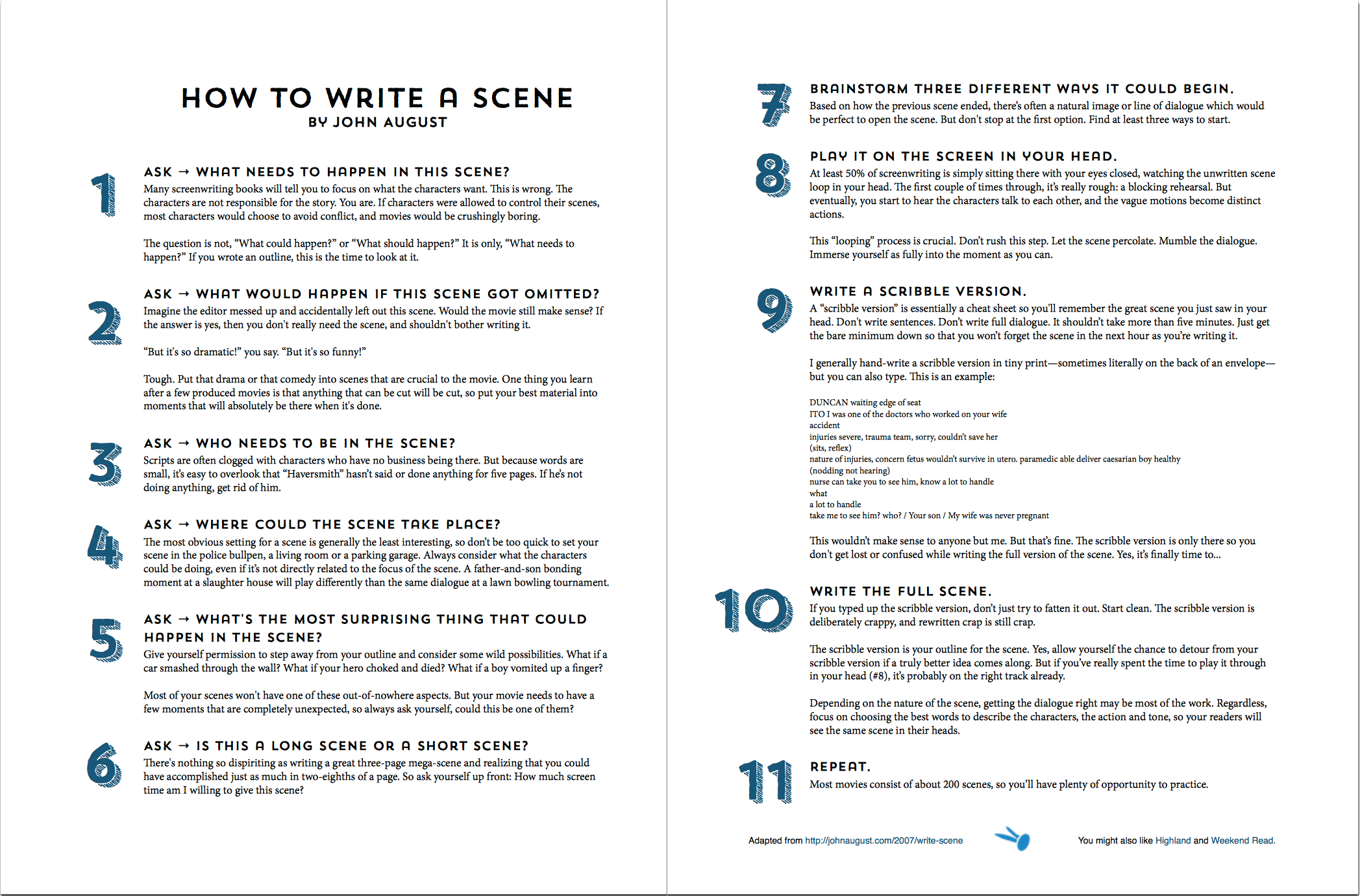
How to Write a Scene, now in handy two-page form

June 18, 2014 Follow Up, Writing Process

My 2007 post on [How to Write a Scene](http://johnaugust.com/2007/write-scene) got recirculated in [infographic form](http://johnaugust.com/2013/writing-a-scene-in-11-steps) last year, which featured only the bullet points.

Both versions are useful. The blog post is detailed; the infographic is handy. But screenwriter Zak Penn asked for something in-between:

> Can you send me PDF of your scene writing checklist? Want to use when I speak to students, thought it was excellent.

It’s a good idea. So here’s the original post, slightly edited and reformatted to fit onto [two pages](http://johnaugust.com/wp-content/uploads/2014/06/how-to-write-a-scene.pdf) you can print or email:

pdf link

Anyone is welcome to use it. I just ask that if you distribute it, please keep my name and the link on it.

And because you’ll ask, the fonts are [Minion Pro](http://store1.adobe.com/cfusion/store/html/index.cfm?event=displayFontPackage&code=1719) and [Trend Hand Made](http://www.myfonts.com/fonts/latinotype/trend-hand-made/).

The Long-Lost Austin Three Page Challenge

Episode - 149

Go to Archive

June 17, 2014 QandA, Scriptnotes, Three Page Challenge, Transcribed

John and Craig open the vault to bring you a never-before-heard episode recorded live at the 2013 Austin Film Festival, where we did a Three Page Challenge and met with the writers.

We’ve kept this episode banked for months just in case we can’t record a new episode. But we didn’t want to wait any longer.

We’ll be back with a normal episode next week.

Links:

* [The Austin Film Festival](https://www.austinfilmfestival.com/)
* Three Pages by [Krista Westervelt](http://johnaugust.com/Assets/KristaWestervelt.pdf)
* Three Pages by [Melody Cooper](http://johnaugust.com/Assets/MelodyCooper.pdf)
* Three Pages by [David Elver](http://johnaugust.com/Assets/DavidElver.pdf)
* Scriptnotes, Episode 58: [Writing your very first screenplay](http://johnaugust.com/2012/writing-your-very-first-screenplay)
* [Outro](http://johnaugust.com/2013/scriptnotes-the-outros) by Scriptnotes listener Betty Spinks ([send us yours!](http://johnaugust.com/2014/outros-needed))

You can download the episode here: [AAC](http://traffic.libsyn.com/scriptnotes/scriptnotes_ep_149.m4a) | [mp3](http://traffic.libsyn.com/scriptnotes/scriptnotes_ep_149.mp3).

**UPDATE 6-22-14:** The transcript of this episode can be found [here](http://johnaugust.com/2014/scriptnotes-ep-149-the-long-lost-austin-three-page-challenge-transcript).

Scriptnotes, Ep 148: From Debussy to VOD — Transcript

June 12, 2014 Scriptnotes Transcript

The original post for this episode can be found [here](http://johnaugust.com/2014/from-debussy-to-vod).

**John August:** Hello and welcome. My name is John August.

**Craig Mazin:** Hi. My name is Craig Mazin.

**John:** And this is Scriptnotes, a podcast about screenwriting and things that are interesting to screenwriters.

Craig, how are you today?

**Craig:** Really good. Really good. Super good, John. You’re going to have to constrain my exuberance.

**John:** I won’t even ask why. Or should I ask why?

**Craig:** Because, it’s kind of a bounce back day. You ever have a week where you felt a little low, felt a little blue, wasn’t really sure why? And then you have your bounce back day where everything is like, oh yeah, that’s right — I’m not going to be sort of glum for the rest of my life.

**John:** Oh, that’s a good thing.

**Craig:** Isn’t that nice.

**John:** So, welcome to the podcast where Craig Mazin is rapidly cycling bipolar.

**Craig:** Yeah!

**John:** Yeah! It’s going to be great.

**Craig:** Woo-hoo!

**John:** Well, today you’ll hear bipolar Craig talk about remakes versus reboots, classical music and how it relates to screenwriting. We’re going to talk about the future of the Three Page Challenge, and we’ll also be talking with Scott Tobias of The Dissolve about an article he wrote on Video On Demand and the sort of mysterious finances behind it.

So, it’s a busy show. Like most of our shows, it’s a pretty full show.

**Craig:** It’s a pretty full show. Before we get started with the pretty full show, a couple things, one, could we just talk about bipolar for a second? Everybody misuses this term.

**John:** Okay. Tell me about it.

**Craig:** Everybody thinks that bipolar is like, oh, I’m really moody and one day I’m this and one day I’m that, and I’m up and I’m down. Actual bipolar disease is fairly rare and it’s very, very serious. I was talking about this with a psychologist the other day, in fact. And real bipolar individuals have very often very severe clinical depression that lasts for a long time, not like a day, or two days, or a week, but a long time.

Then they shift into a different area, a different section where they become manic. And manic isn’t like really up and, hey, hey, hey, and kind of like cokey. Mania is closer to schizophrenia. They start to believe that they could bike across the ocean and that they could build a skyscraper with their hands. It’s a very serious mental disease. And I think sometimes people use bipolar when they really mean moody. [laughs]

**John:** [laughs] Yeah, so I do apologize for being a little dismissive of your feelings there and overextending the bipolar diagnosis to what is probably normal moodiness.

**Craig:** No, no, you don’t have to apologize to me. I just like talking about mental illness because it fascinates me. And I think, you know, because I do meet people who are like, “Oh, well he’s a little bipolar.” And I’m like let me stop you there. No one is a little bipolar. That’s like saying, well, he’s a little psychotic. Is he or is he not hallucinating? [laughs] You know, it’s one or the other.

Okay, so that was one thing. Bigger follow up was that I totally blew it last week. We were talking about Edgar Wright and his budgets and I mentioned that I thought that the budget for Hot Fuzz was something like $40 million. I wasn’t even close on that one. It was actually more like $16 million U.S. And so I do apologize; that was totally wrong.

Frankly, I’m even more impressed with that movie now that I know that he was able to do it with that budget. It’s pretty remarkable.

**John:** All right. I have some follow up as well. Last week we talked about — we gave some advice to Jason about whether he should spec a new screenplay over the summer or if he should chase some assignments. And weirdly we did a thing which I try not to do which is we offer those as like the two alternatives when really of course there are many other alternatives.

And one of the alternatives that people wrote in suggesting was, you know, the third choice is he could make something. And he could find a way, like, write something that he could shoot or do something else that is — so he’s not just having another script sitting there, but has something else as a sample to show — something he could shoot. And I think that’s actually a really good suggestion.

And so we don’t know about this guy who wrote in, whether he has aspirations about being a director, but if he does the summer is a good time to shoot something and always be looking for what is the next step you want to take to get you to your overall goals which maybe are being a screenwriter, but maybe they’re being a writer-director. So, do more stuff is a good suggestion.

**Craig:** Yeah. If he has something lying around that he loves, that he’s written, he can go shoot that. If he doesn’t, better to take a little time to write first. Get it in good shape, then go shoot. I’m not a big fan of just sort of ad hoc shooting.

**John:** Yeah. But in general I try to always catch myself when I’m trying to decide between two choices because whenever it looks like there are two choices, the first thing you should ask yourself is like are there other choices I’m not considering.

**Craig:** Right.

**John:** And in this case we were looking at just those two things and that wasn’t the full picture.

**Craig:** Yeah. Like drinking, for instance. Just —

**John:** Totally.

**Craig:** Just drink.

**John:** A good solution for most of life’s problems.

**Craig:** Right. Just drink it away.

**John:** Jake wrote in to say, “I was listening to your podcast today and thinking about watermarking and how difficult it is to keep a script secure. I wanted to share with you what we did on my first screenplay which sold a couple months ago.”

Well, congratulations that it sold. “To keep the script ultra secure we created 20 different versions of the script, each with tiny subtle differences in the script.”

**Craig:** Whoa.

**John:** “Mainly these were words, all in uppercase or underlined. Our writing style uses these anyway, so it didn’t look out of place. Then we created a spreadsheet with these changes marked. Example, like this word is in uppercase on page three and then gently let the recipient know that there were changes but not what the changes were.

“Who knows if this ever stopped the script from getting leaked, but it made it very difficult to get past a watermark.”

This is a totally valid thing and it’s not the first time I’ve heard of this. Have you ever done that, Craig?

**Craig:** No, I mean, what’s better about that than watermarking, other than that watermarking is ugly?

**John:** Yeah. So, it gets rid of like the visible watermark and if someone does disseminate you can tell which draft leaked. Basically you could tell who leaked it very easily based on like that word was different.

And it’s something I’ve seen other people do. And so it’s certainly a valid technique. It’s a giant pain in the ass to do it, but it might be a valid way to do it. So, in his situation this was a script that they were sending out to — a spec that they were sending out to specific buyers and I think they wanted to make sure that only those buyers were seeing it and that it wasn’t getting passed around too quickly too soon.

And for that reason it might have been a good choice to do it.

**Craig:** I guess. I mean, I still think a watermark does that same exact thing. I don’t mind watermarking.

**John:** I don’t really mind watermarking either. I make a program called Bronson Watermarker, so I really don’t mind it that much.

When we talked, in the new Bronson Watermarker we have this thing called Finger Printing. And when we were first developing the feature, what he described, what Jake described was really kind of what we were thinking about doing is basically we would make small changes to certain words. Like we’d substitute out the number one character for a lowercase L on a certain page. And we’d give you a little sheet that showed you what we did. The challenge is when you’re talking about a real PDF, we would have to break open the PDF in order to like insert that one little character. And it would just very likely ruin the script by doing that. You would ruin something, you’d knock of pages or things like that. So, we didn’t end up doing it.

So, our finger printing feature inserts invisible watermarks that stick with a file but don’t actually change any of the words on the page.

**Craig:** Oh. There’s a simplicity, and ease, and general industry acceptance for watermarking. This is a version of watermarking that’s less visually intrusive, but really cumbersome to manage on the other end. I don’t know.

**John:** I don’t know.

**Craig:** I don’t love it. I mean, it works. I just don’t love it.

**John:** All right. Let’s see if you’re going to love this. So, Ben wrote in, it’s our first new topic. He wrote in saying, “Okay, here’s a matter of some sort of Aspergery semantics. Reboot versus remake? To me, you remake a singular film and you reboot a franchise. Stargate can be rebooted because the TV series has continuity. You reboot or reset the continuity like a computer. There’s no real continuity to Cliffhanger, though. It was a one-shot story. So, it’s a remake of Cliffhanger, not a reboot. I believe the industry lingo does not make this distinction, but I want to. It’s been driving me nuts for years.”

Craig, where do you stand on reboot versus remake? Because I will tell you that I had never really thought about it but I do use them slightly differently. So, talk to me.

**Craig:** I actually never really understood my own distinction until now. I think… — Who wrote this question in?

**John:** This was Ben.

**Craig:** Ben, I think, is absolutely right. I think it’s actually kind of brilliant. He’s exactly right because a remake is a remake of — that’s how I think of a remake — they had a film and then they remade it. But when a movie has spooled itself into sequels, then when you’re starting the thing all over again with a fresh tone, a thing that can generate its own sequels within its own carved out universe, that does feel like a reboot. That’s what I think reboot is. Yeah, I think he’s totally right.

**John:** I think he’s totally right. If you think about Batman Begins, Batman Begins is clearly a reboot. You can’t think of that as being a remake of Tim Burton’s Batman.

**Craig:** Right.

**John:** That’s madness to think about that. It’s a reboot. And so some of the other things I would add into the idea of a reboot is that you are approaching an existing property with a really kind of brand new idea. It’s a new take on something, so it’s not just you’re updating necessarily, but it’s a real kind of re-thinking of what it is.

That’s why the new Star Trek franchise really is genuinely a reboot because it acknowledges the continuity of the old series and moves forward in a way that is completely different. And so the same kinds of characters are there, but they serve different functions. It really is, you know, it’s its own new thing.

**Craig:** Yeah. There are a couple of times where it’s a little thinky because, for instance, let’s take a look at the new Karate Kid. So, there were multiple Karate Kids.

**John:** Yeah.

**Craig:** And then they decided to start it again with Jaden Smith and Jackie Chan. And is that a reboot? Well, I saw that movie and it kind of felt more like a remake to me.

**John:** It feels like a remake also to me.

**Craig:** Because it really closely hued to the first story. Obviously they reset it in a place, but they really followed that story and the main beats from that. They didn’t actually reboot. I mean, he’s write to say it’s sort of like when you restart a franchise because what is a reboot? There’s something that’s been running in a sequence and then you’re restarting. And all of the sequencing should be gone.

**John:** Yeah.

**Craig:** Because you’re starting fresh again with a new thing. So, I thought like, okay, if — and I believe, have they made a second Karate Kid in this new version?

**John:** They haven’t.

**Craig:** Oh, they haven’t. Okay. Then I think of that as a remake, even though it is in fact a remake of a movie that is part of a franchise. But, generally speaking, yes, I think he’s right — rebooting comes from restarting something that is a franchise.

**John:** Yeah. I think you’re right.

**Craig:** I think he’s right.

**John:** I think we’re all right. I think, Ben, that is an important distinction and it’s not just Aspergers. I think we should be more careful in our choice of words.

**Craig:** Well, that may in fact be Aspergers. Listen, Aspergers obviously comes with enormous benefits.

**John:** It does.

**Craig:** And this is one of them. I mean, a really particular way of drilling into what language is. He’s right. I would — look, do you not have Aspergers just a little?

**John:** Oh, everyone needs a little whiff of Aspergers, I think, just to get through the day.

**Craig:** I do.

**John:** But here’s the thing though, again, we should back up to our bipolar thing. I think we end up being too flippant with a diagnosis just because it’s fun and convenient. So, to say like he’s a little bit Aspergers is like, no, he’s just actually like methodical and cares about things.

**Craig:** Maybe. I mean, the whole thing about Aspergers is that it is — it’s like sort of definitionally mild.

**John:** Yeah.

**Craig:** I guess there is something to be said of, oh, he’s got severe Aspergers, but wouldn’t that just be autism? I don’t know. That’s where I don’t know.

**John:** Let’s just go way off into the deep here. The same thing though can be said about like a whiff of many kinds of mental — I don’t want to say mental illness — but conditions that are negative when they’re too strong can be positive when they are mild.

**Craig:** That’s true.

**John:** And so even what we’re talking about with mania or depression to some degree, those can be useful things to certain people and certain circumstances. And so the people who often get a tremendous amount done, if you were to really step back and say like, okay, they were a little bit manic but like they weren’t trying to bicycle across the ocean. Instead they were trying to build a remarkable business and they succeeded in building that remarkable business.

**Craig:** Yeah…

**John:** Yeah. The people who just won’t stop at anything. There’s a relentlessness that’s crucial.

**Craig:** The psycho-pathological mania is less about super energetic and more about being delusional. But the point — the point is that I’m not flippant about Aspergers because I feel like most of my friends are — we didn’t have it. When you and I were kids we didn’t have that, right?

**John:** No, we didn’t have that.

**Craig:** Most of my friends would have been it. I would have been it, I think. [laughs] I think, to some extent. You know, I’ve never met somebody who had Aspergers who I thought, oh god, I’ve got to get away from this person — they have Aspergers. You know?

I think it actually can be… — Well, have you ever heard this theory that autism is an expression of what they call extreme male brain. Male Brain Syndrome.

**John:** Okay.

**Craig:** There’s a whole study of the gender differences in the brain itself and what testosterone does to the brain. And there are clear differences between male and female brains. But when you take the general male syndrome in extremists you can end up with autism. Of course, this doesn’t explain why some girls have autism. It’s a very confusing area of research.

Anyway, we’re not a podcast about any of that.

**John:** We’re not a podcast about that. The only last point I will say though is you’re saying, you know, with mania comes — you have this image of delusion or delusions of grandeur. But there’s a really fine line between delusions of grandeur and vision. And sometimes you have to have a little bit of delusion in order to do impossible things.

And many of the best directors I’ve worked with have just a little bit of that delusion and they have a little bit of that sort of — that unstoppability that is what lets them sort of keep pushing through on hour 17 and not sort of worry about the world around them. So, I’m just saying in the business that we’re in, you’re likely to encounter people who have conditions which could almost fit into the DSM and yet are tremendously successful in part because of that.

**Craig:** No, I’ve never actually met anybody that does what we do for a living that is — that doesn’t have something. [laughs] Honestly, I do. We are —

**John:** [laughs] No, it’s absolutely true.

**Craig:** We are not normal people. And you feel it most notably when you travel away and go home because it’s a funeral or something and you’re suddenly — there’s nobody there that works in the arts and you realize that you’re the freak.

**John:** Yeah. When you’re around the normals you’re like, oh no.

**Craig:** Civilians.

**John:** Yeah, like, man.

**Craig:** Yeah. You’re the weird one. That’s why, you know, like my son is really into drama at school, and musicals and stuff. And it makes me so happy because he’s with the freaks, like daddy. Just like daddy.

**John:** My daughter has taken her summer vacation and she’s writing a play she’s decided. And so her play is called True Blood. It’s like, really?

**Craig:** [laughs]

**John:** But she doesn’t know there’s another thing called True Blood. She’s like, “That’s a great title.” It’s like, okay…

**Craig:** Well, yes it is. It is actually —

**John:** It’s a really good title.

**Craig:** Good instincts.

**John:** Yeah. And I suspect that whatever she ends up writing will make more sense than the very late seasons of True Blood.

**Craig:** You know, I stopped watching True Blood because I just, I mean, my wife and I used to watch it early on, but somewhere in there — I hate saying “jumped the shark.” I don’t know what happened, but it just got crazy.

**John:** It got really super crazy. And, you know, their last season is coming up and I will watch the last season because I’m a completist. I was the person who watched every episode of many shows that never sort of made it through. And so I will watch it because I’m a completist and I think it’s a tremendously talented cast and it’s so difficult to make that show, so I have nothing but full love and respect for everybody on board with that show.

But, it did just get like crazy town.

**Craig:** Yeah, at some point I’m like, wait a second. What?!

**John:** What?!

**Craig:** I just did a lot of that, “What?!” My wife would say, “Shut up!”

**John:** So, our next topic is one you proposed and honestly I think it fits in very well because classical music, many of the people who have made the iconic classical music would have a little bit of a whiff of something not quite right about them.

**Craig:** Or a lot of a whiff. So, I was thinking about this because I don’t know if there is a particularly strong overlap between people who write and people who appreciate classical music, and the truth is I’m not — I’m not what you’d call a classical music buff. In fact, I’m going to give a couple of examples today that reveal that fully.

But, there are certain kinds of classical music that I think are really helpful for us as we think about what it means to create narrative in a let’s say — in a way that is separate from text. As writers, we are soaking in text and we are tasked with creating a lot of things that aren’t meant to exist in words with words. We have a weird gig. We’re attempting to capture emotions and feelings. We are attempting to inspire suspense and fear and joy and relief. And our ultimate goal is to do so with light and with sound. And we can’t use any of it. All we can use are words.

But music I find is analogous in that regard because they have sound, but for certain kinds of classical music you can start to see a narrative in your head, only with sound, and no words at all.

So, a couple examples I want to give. And, look, the early classical music, baroque, or the true classical period I don’t think is as useful for us in this regard. It’s beautiful music, but it’s very structured.

**John:** Yeah. You need to get into the romantic era and —

**Craig:** Yes. Yes. Where it really kicks in I think for our purposes for fun stuff is the romantic era, which by the way is what I think influences almost all of the classical scoring that you see in movies today, whether we’re talking about Tchaikovsky or Wagner, that kind of feeling.

So, I wanted to talk about a couple pieces that are so common it would almost be hackneyed, but if you just sit down and listen to them now as an exercise I think it might be useful to you. One is the 1812 Overture by Tchaikovsky. And the other is Rhapsody in Blue by Gershwin. And, they are both self-contained pieces somewhere around, what, 18 to 22 minutes, somewhere in that zone? And what I love about them is that they are telling stories just with music and you can start to detect it.

And you can see all of these tools in there that I think we should be thinking about when we’re writing. First of all, they have nice, long first acts. And they are clearly broken into acts. And in those nice, long first acts they are relaxed and they’re introducing themes. And those themes are for me analogous to characters. And as they do that they then begin to build. And as we — you know, one thing that we’re constantly dealing with when we’re writing is we’re building to things. And then we’re coming back down. And we’re building, and we’re coming back down, right?

We think of a movie as three acts and a climax, but really it’s a build and a climax, a build and a climax. It’s movies within movies within movies. It’s very fractal. And I think it’s the same way with these pieces. There are builds, crescendos, and then diminuendos, and in the builds there is tension and you can start to feel how tension works on a right brain level when you listen to this stuff.

Similarly, you can feel how the release of tension works, the importance of silence, and the saying of nothing. The competing themes, you can see how they bandy with each other and one gets the upper hand and then the other gets the upper hand. And then, of course, you start to see that one of them is winning. You start to feel like there is a hero in this. 1812 Overture is a great example because it’s about a war.

**John:** Yeah. And it feels like it’s about a war. And it feels like it’s about the dark scary moments of it, and also victory at the end of it.

**Craig:** Right. For instance, at the end of the 1812 Overture there is this moment that’s, I mean, textbook romantic orchestration. Tchaikovsky has this long descending chromatic action from the stings. [hums] And that goes on, and on, and on, and on.

Now, what do you think that is?

**John:** I think it’s the flag falling, isn’t it?

**Craig:** Well, essentially it’s the retreat of the French. They’re running away. And it’s so great because it’s done over and over and it’s beautiful. In and of itself you actually start to feel bad for them, you know, even though they’ve lost. But it’s emotional. We know that, again, this is the episode about neurology. For a typical right-handed person, because we don’t discuss those left-handed freaks on this show — no, actually left handers have an amazing advantage over us, we right handers. But for the typical crippled right hander, the left side of the brain controls speech, writing, language, vocabulary, grammar, all the stuff that we use. The right side is the music side. And I think that music is a great way to integrate the two.

**John:** So, when you talked about themes, like [hums], like you described that as being a character which I think is absolutely valid and true. You see a character reoccur. But it’s also an idea. And a theme can be, as we’re talking about screenplays, that theme can be expressed, or that idea can be expressed by multiple characters. And you can also think about that theme being expressed by multiple instruments in a piece.

And so you might here that theme being played by the woodwinds in the middle of the range, but then you hear it suddenly up on the flutes. And then you hear it very low on the bassoons. And that is something that also happens in our screenplays where different characters are expressing the same idea and you sort of see that idea being spread among multiple characters.

And so when your screenplay is really cooking, every person feels like they have a distinct voice, they have a distinct tone. You can hear sort of what a flute sounds like, but then you hear that flute expressing an idea that is key to the overall piece.

And so basically it is spread virally from one instrument to another instrument, from one character to another character. When things are working really well, that happens, and that is fantastic. And it feels like it sort of had to happen. Like everything was leading up to this next thing, was leading up to that next thing. And two themes combined become a new theme. That’s how lovers connect in your story. Those two things you wouldn’t think would necessarily fit together somehow magically, beautifully fit together.

**Craig:** Yeah. And you can see that perfectly at the end of Rhapsody in Blue where the two major themes come together and mesh perfectly. Rhapsody in Blue is far less of a literal, character-based discussion and is more about a setting. It’s about a city. It’s about the vibrance of a city and the clanging madness and beauty that are contained within the hustle and bustle of New York.

And that also is really valuable for us as we write our characters and we create our scenes. So often I think we are tempted to exclude the world save for the people in it, but the world is what we’re going to see. And I think movies that capture an entire scenario are the most successful.

And you look at Lawrence of Arabia, a story about Lawrence of Arabia. What you see — the beauty, the sweeping beauty of it is just astonishing, and so much of why that movie is a joy to watch and experience in its highs and lows. And, again, not surprisingly, if somebody said to me you could bring back one composer from the dead to score movies I would say Tchaikovsky.

**John:** Yeah. He’s a genius.

**Craig:** He’s amazing.

**John:** Another piece that I would recommend people listen to for that sense of like progression and arc is Ravel’s Boléro. The classically [hums] — that’s basically it. And then there’s one counter theme, [hums].

**Craig:** [hums] And then people rioted.

**John:** Yes. And it just keeps rising and rising and rising. And you’re thinking like, well, this can’t just keep going, but it’s going to keep going. And it actually keeps sort of reinventing itself until it becomes just triumphant at the end.

So, it’s that thing that could start incredibly slowly and build into sort of a giant fire. And great writing can do that same thing where it seems so simple and it becomes this sort of sweeping romantic statement based on its escalation.

**Craig:** Yeah. Absolutely. In the Hall of the Mountain King is another famous version of that kind of sustained melody that just builds, and builds, and builds until you go nuts.

**John:** Great. So, this was fun. It’s fun to talk about classical music on a podcast about screenwriting.

**Craig:** Yeah. Why not?

**John:** We should. We totally should.

**Craig:** Come on, people.

**John:** So, a thing I want to talk about next is Three Page Challenge. So, occasionally on the podcast we will do a Three Page Challenge. We will invite people to send in their three pages of their screenplay. We will take a look at them. We will talk though the things we thought worked fantastic and the things we thought could be better. And we’ve enjoyed doing it. It’s been sort of a thing about our podcast for quite a long time.

We did a Three Page Challenge at the live show and for that one we opened it up so people could vote on it and people could see what all the things were. We’ve reopened that submission process, so if you go to johnaugust.com/threepage, you can submit your script. You can click a link and attach your file and send it through.

And for now that’s what we’re doing. But, someone brought up and I thought it was a really good point, that it’s sort of weird that we talk about the Three Page Challenge and then we also talk about how we need to move past the idea of pages as being the defining unit of a screenplay.

**Craig:** It is weird.

**John:** It is weird. So, I asked Stuart to go through this last cohort of scripts and in the next Highland, in the Highland that comes out next week we added a word count feature. So, I had him take all of the Three Page Challenges and just do a word count on all of them.

**Craig:** Okay.

**John:** And figure out, so how many words do you think is average for three pages? Do you have any sense?

**Craig:** Oh my…I would say 300.

**John:** It’s actually 600. It’s more than you would think. So, 616 about. And so I want to propose to you and to see, just talk it through on the air, what if it was like a 600-Word Challenge rather than a Three Page Challenge? How would that change things?

**Craig:** Ah, it would just replace one arbitrary measurement with another.

**John:** Yeah, it would.

**Craig:** I mean, I wonder if we — it’s kind of an interesting experiment. What if we said to people it’s a One Sequence Challenge?

**John:** Mm-hmm.

**Craig:** And so instead of feeling like you can’t finish your sequence, send us a sequence. A sequence could be one page long, it could be two pages. It could be four pages. We will limit the sequence in some length just so that we don’t have to read too much. You could use words if you like because, again, we hate pages.

What if we said it’s a One Sequence Challenge?

**John:** Perhaps. That might be the way to do it. And we might provide very clear metrics so we can maybe read or not read certain things if they seem like they’re excessively long or, you know.

**Craig:** The other thing we could do is if somebody sends a One Sequence Challenge in, we could stop reading where the sequence ends. [laughs] In other words, if somebody thought that their sequence was longer than it was we go, no, here is where we stopped because that’s the end of your sequence.

**John:** Maybe so. So, we’ll think about the right way to do this. One theory I had, one idea I had which, again, is like really easy to think about and actually a pain in the ass to build — you probably aren’t familiar with it, but there’s a site called Code Pen. And what you can do there is you put up snippets of code and CSS and sort of show cool little things, animations you’ve made, and stuff like that.

Something like that might actually be the right way to do it where people are essentially just pasting in their script, it shows it nicely formatted, and everyone can see it. And then we can decide out of there which ones to do.

Because right now it’s essentially an email process. You’re clicking submit and it’s going to this black box that Stuart looks at.

**Craig:** Oh, Stuart’s brilliant filing system.

**John:** Yes. So, Stuart’s filing system has improved.

**Craig:** Oh really? Did you yell at Stuart?

**John:** I don’t yell at Stuart.

**Craig:** Did you give him like bad disappointed John talk?

**John:** [laughs] I asked ways that we could do better.

**Craig:** Ah! [laughs] Poor Stuart!

**John:** I inquired in a very positive way how we could do better.

**Craig:** “Stuart, let us have a discussion.”

**John:** So, maybe there’s a public way that we could have them all up there and some sort of authentication so you know sort of who it is that you’re actually talking with.

**Craig:** I’m game for anything. I don’t know if people have concerns about putting their stuff out there in public for everybody to see.

**John:** Yeah. I don’t know either.

**Craig:** But, you know —

**John:** But, actually everyone who submitted to the Three Page Challenge for the live show, they seemed delighted to have their stuff out there. So.

**Craig:** And, again, it’s one sequence.

**John:** It’s one sequence. That’s the thing. Maybe people shouldn’t be so worried.

**Craig:** I don’t think people should ever be worried, personally. But, that’s me. I’m carefree because I’m on a bounce back week.

**John:** Perfect.

**Craig:** Catch me next week, I’m going to just be grim.

**John:** So, now, I think it’s time we should talk to our guest on the show today. It’s Mr. Scott Tobias.

**Craig:** Great. So, Scott Tobias is the editor of The Dissolve, a film website. Before that he was a film reviewer and writer for the AV Club. Scott Tobias, welcome.

**Scott Tobias:** Oh, thanks for having me.

**John:** And you are recording from Chicago, so thank you, all the way from the Windy City joining us on the show.

**Scott:** That’s not a problem.

**John:** So, the reason why I wanted to talk to you is you had a post this last week titled The Hidden World of Video On Demand Profits. And we love to talk about great articles, but it’s so hard to recap an article on the podcast, so it would be so great if you could talk us through why you wrote this post and sort of what you found or what motivated you to write it.

**Scott:** Sure. Well, one of the things about running a website, I mean, the site is a little under one year old. And we want to try to cover the waterfront and we want to cover everything that comes out. And we want to figure out how people are — what people are watching and how people are watching it, which means that you have to kind of grapple with video on demand. And it’s been a real challenge for us, you know, sometimes just to even find the movies that we want to review, but also, you know, it’s kind of a dark world.

You have a lot of viewers who are migrating to video on demand, who are watching new movies this way, particularly independent movies, or specifically independent movies. And you sense that the ground beneath your feet is shifting really dramatically. There’s no actual — it can’t be quantified. You can only speak in generalities about it because there are no actual figures that are given for movies that are released on video on demand like there are for movies that are released theatrically.

**John:** So, it’s certainly a growing trend. I had a movie in 2007 called The Nines and we debuted at Sundance. We came out, had our sort of hand stamped theatrically, and then many, many months later we showed up on video. And that was sort of the last year that happened. The next year you had the Magnolias and those companies coming in.

And when they would buy one of these independent movies they would put it in theaters and on video on demand simultaneous, or increasingly it’s on video on demand first and then it’s showing up in theaters even sometimes a month later.

**Scott:** Yes.

**John:** So, how do you make the choice of which movies to cover and which movies to not cover? What is you process at The Dissolve?

**Scott:** Well, we try to cover everything that we can. If something is released theatrically, commercially in New York or other cities for an extended run of a week or more we cover it. VOD can be a little bit — if it’s VOD-only that can be a little bit shaky here. One thing we do, we have been doing that other publications haven’t done as much is that if a movie that say Magnolia releases on VOD first and then in theaters, we review it at the first window on VOD and then later in theaters. So, that’s kind of our approach to it.

But, you know, it changes. Again, we’re really trying to figure out how to best serve our readers and really what we end up doing with VOD before theatrical is review it for VOD first. And then when it cycles back around to theaters then we’ll run the review. Like this new Ti West movie, The Sacrament, was on VOD a month ago and it opened in theaters on Friday. So, we reran the review yesterday.

**John:** Now, are these movies making money, because that’s actually one of the tricky things to figure out is classically you sort of had a sense of how well a movie did based on how much money it made at the box office. As you point out in the article, it’s very hard to know how much a movie like Blue Ruin is actually making. In the article you say that it grossed $32,000 on seven screens in its opening weekend, which isn’t amazing. It’s maybe fine, but it’s not amazing, yet it had already been out on VOD, so you really have no good sense of whether that was a great showing for that or a bad showing for that.

**Scott:** Yeah, I mean, that one was day and days, which means it was released simultaneously in theaters and on VOD. And that was kind of, as I put in the article, it was sort of the canary and the coal mine for me because I’ve been sort of eyeing how independent genre films specifically have done in theaters.

And, you know, if you actually just look at the numbers you think these types of movies are not viable in theaters. These movies aren’t making any money at all. I mean, Blue Ruin is a film that had every possible advantage. It was a real sensation at Cannes where it was picked up by The Weinstein Company which released it through Radius-TWC which is their VOD/theatrical . It played at virtually every festival. The reviews were excellent. I mean, it was a film that was pretty much the chief buzz magnet when I was at Toronto last year and there was a lot of anticipation for it.

But then, you know, when it’s released theatrically these numbers are pretty weak. I think it maybe made $4,000 or so per screen, something like that, which is not that great. And I’m sure looking at what it’s made so far theatrically which I think is somewhere in the range of about $225,000 or something, that’s probably well less than what was paid for it.

But my suspicion is that it did very well on VOD, but it’s just a suspicion. I can’t know for sure. And that’s really kind of at the heart of the piece is that we really guess that these films are successful but we can’t know because we’re just not getting a clear picture.

**Craig:** Well, I want to talk a little bit about who the “we” is, because obviously the distributors know. They’re the ones who are collecting the money. On some level the creative guilds will know because we have residuals based on internet sales and internet rentals. And while we, at least conditionally rely on the studios to send us our fair share, the three guilds do something called a tri-guild audit fairly regularly where they go through the books to make sure that in fact we’re getting our fair share.

So, I guess one question I have for you is if the writers and the directors and the actors know, and the studios know, who else needs to know? In other words, why is it important that you guys know?

**Scott:** Actually, let me fire one question back to you, just as a point of clarification. Does this include films that are released not by a major studio but by Magnolia or by Film Buff or by really smaller distributors than that? I mean, do they know?

**Craig:** It depends. Like I said, the guilds will have a mechanism in place. So, if a movie is done non-union, which is different than independent because there are a lot of independent films that are done union, at least for the writers and the directors, sometimes not for the actors. But one component will at least be guild. And then somebody on some other side other than the company will know.

But if your point is that there are small companies that are operating outside of the auspices of the guild who can be shady about their reporting of box office or of — I would imagine those companies could also be just as shady about their reporting of video. In other words, I mean, my question is — I guess here’s my real question: is it something that you are most interested in because you think that how a movie does financially is of public interest value, or are you concerned about protecting the artists and making sure that they get taken care of? Or both?

**Scott:** I think it’s just about knowledge, you know, about getting a sense of what the landscape is like. I’m not personally much of a box office tracker. It’s not my — whatever interest I have in that has to do with, well, maybe if a movie is successful more movies like it will get made. But, I think we’re at such a critical juncture right now, for all of film really, just that transition to the digital age is so dramatic. It’s very dark, this understanding of this particular realm because nothing is disclosed.

So, I don’t know if that helps answer your question or not, but —

**John:** I would actually step in and say that I’m always curious about how a movie did largely because whether a movie is a success or a failure, you have some sense of is it perceived as a success or a failure. And in the case of Blue Ruin it’s very hard to know how we’re supposed to feel about it. So, if you as a journalist writing about, do you write about this that, you know, is it considered a success or not a success? And it’s very hard to know when you don’t have any of that information. And it’s all sort of hidden away.

I’m not saying that you’re necessarily going to get that information, but it’s harder to know how to feel about it. I think it’s also harder for other filmmakers to have a sense of what is normal and have a sense of what the expectations are.

I remember there was a time back in like the early ’90s probably, late ’80s/early ’90s where you had — if you made a gay film that was below a certain budget you could bank on making about $2 million theatrically. And there was just sort of a template for that. And it feels like without any of these numbers it’s really hard to know what the template is.

Now, certainly sales agents probably know what the template is. Distributors probably know what the template is. But that indie filmmaker really may have no sense of what the template is and what’s a good deal or what is the right amount of money to spend on something.

**Scott:** That’s a really good point. And actually it’s a point that was made by this producer named Travis Stevens who has done a lot of indie genre films, including his film Cheap Thrills that came out earlier this year. And he posted my article on Facebook and there was kind of a discussion between himself and a bunch of other indie filmmakers. And his point was that about when he deals with filmmakers a lot of his job is about managing expectations because they don’t — it’s very hard to make money and it’s hard to know. And my sense also, anecdotally, is that a lot of filmmakers really don’t know how well their films are doing when they’re released on VOD.

I think there are actually some pretty good motives for not only hiding failures on VOD but hiding successes. I mean, how much does it serve unless they absolutely have to tell a filmmaker how well a film is doing on VOD. Does it really serve them to say anything?

**John:** I can tell you from personal experience that I have zero idea how The Nines is really doing on VOD. So, we get these residual statements, but to try to go through and actually audit that and figure out what the dollars I’m making off of VOD is really, really tough. And, it is true.

Now, Craig, you were saying that residuals will show us some sense of how the VOD is doing, but what happens when you are doing day and date? Is that video considered first release, or is that video considered real true video?

**Craig:** It’s not considered part of the primary theatrical exposition. And, you know, this is an area where I suspect we’re going to be fighting some fights one day.

Right now the profit, or let’s put profit aside, the gross receipts that are not included for residuals and so are not considered ancillary are primary theatrical — exhibition I should be saying — exposition is an entirely different thing — exhibition and also curiously planes. For whatever reason when they run movies on planes they consider that part of the primary exhibition.

But, all video on demand of all sorts is not considered primary. We do get a percentage of that. So, if it’s sold on iTunes or if it’s run on HBO or pay per view on cable then we do get a percentage of that. There’s the wild west of exhibition and then there’s kind of the big city. And in the big city it’s still a problem, by the way. And you’re absolutely right that the companies have every reason to want to keep every number quiet. They don’t want anyone to know that they’ve made a lot of money. They don’t want anyone to know they’ve lost a lot of money because it will probably save them money in the long run to keep those cards close to their vest.

What this has unfortunately done is created a cottage industry of rubbernecking where people are very curious and there’s an enormous amount of speculation about movies that appear to have lost a ton of money. Similarly, there is a weird kind of fetishization of movies that appear to have made a lot of money, when in fact a lot of the reportage doesn’t include things that impact what the actual money really is.

We tend to over-dramatize money that’s earned here in the United States. We tend to underplay the variable cost of marketing which can be enormous.

And, beyond all that, my personal opinion is I just wish the entire discussion would go away because I don’t think it has anything to do with our appreciation of movies. I don’t care how much a movie has made. As a person who likes watching movies, I don’t care whether it’s lost money or made money. I just like it or I don’t. I just want to be able to enjoy the movie without feeling like… — It’s funny, a lot of the people who love movies and wish that they would not be commodities talk about movies constantly as commodities.

That said, there is a real problem for people who are in the wild west who don’t have access to a collective bargaining agency that is going to audit things for them. They are simply at the mercy of companies that collectively have a less than stellar reputation when it comes to full disclosure and honesty.

**John:** Yeah. I would just push back a little bit on what you just said Craig. I want to make sure that this industry is actually viable. And I want to know the general question of like is it viable to be launching day and date and video on demand as a filmmaker, as a writer. Is this is a thing that is good and profitable for people? I think that macro question is really important.

So, while I agree with like, you know, individual film by film judging success or failure isn’t as important. I do want to know whether overall this is a good thing that’s going to continue because I have friends who are making these movies that are coming out day and date on video on demand and I want to know that it’s going to work for them.

**Craig:** I agree.

**John:** And I don’t yet.

**Craig:** I agree. And I guess my point is by the time the news ends up on a blog, it’s probably too late because the people who know — the canaries in the coal mine will be the people who are spending the money. The first sign that this will be a profitable method will be the emergence of people with money asking to fund movies following this method. And the converse is also true: if that dries up, then we’ll know that in fact the money isn’t there. The money is the answer.

People simply — the kinds of people who invest in these things talk to the kinds of people who invest in these things and we will know very quickly what the real margins are.

But, you know, look, I’m all for some kind of transparency for the artists because we are making money off of this. I’ve never been particularly interested in the — there is a slight… — I don’t know. Look, maybe you disagree as a journalist, but I feel like there’s a slightly prurient aspect to the interest in how much money a movie makes or loses.

**Scott:** Oh, I completely agree with that actually. I’m not someone who writes about box office terribly much. And I agree about the whole rubbernecking aspect of it. But at the same time, viability is important and kind of getting a sense overall sort of the macro landscape is important.

One of the big concerns that I had was about specifically is indie genre filmmaking, but the other concern has to do with independent cinema period, because it seems to me like they’re the ones that are really suffering as a result of this migration because we may not be able to see the numbers for VOD, but we can see vastly diminished numbers for theatrical, for indie theatrical.

So, all of these indie theaters that have spent tens of thousands of dollars to convert from 35mm to digital are now in a position to where they’re on sort of the losing end of the whole thing, right?

I mean, and really the only reason I think that this was able back in the first place is because Magnolia Pictures bought Landmark. Right? So, the chief obstacle running movies day and date which would have been theater owners, when you buy the biggest indie theater company there is you just blow that obstacle right — you run it right over. And I am concerned with places like Music Box here in Chicago or Brattle in Boston or all of these other indie theaters that are really taking it on the chin because VOD, day before date, day and date VOD is just siphoning away all their viewers.

**Craig:** Yeah. I think that that’s absolutely correct. The theater experience is already under pretty savage attack and you can see how the theaters are attempting to pivot in the newly popular word from Silicon Valley — pivot, pivot, pivot — they’re pivoting. They’re trying a lot of different things. Independent film cinema is, I think, doomed. I just don’t see it lasting because the distribution of independent film is almost certainly going to go exclusively to a direct distribution model.

It’s very expensive to rent a movie theater. It’s just really expensive. And the most people you could fit into most of those theaters is much smaller than the amount of people you need to start to make sense out of that unless you think your movie is going to actually play there like Rocky Horror Picture Show over and over and over. But those days are gone.

And I think that that’s unfortunately a doomed business and it’s regrettable because I believe that there is something fundamental to the communal aspect of watching a film. And I’m concerned that it’s just going to go away, particularly if distributors are allowed to start purchasing these movie theaters because they’re just going to do different kinds of things with them. I mean, it was against the law for a long time to do that sort of thing.

**John:** Yeah. Well, Scott, you watch a lot more movies than we do, so I’m curious whether there’s any one or two or three movies you would recommend to our listeners that they should definitely try to check out this summer that they may not have heard of.

**Scott:** Well, you know, sure. Well, I mean, for one you couldn’t continue, you know, Blue Ruin is right there. It’s available to you and I would completely recommend checking that out if you’re a fan of sort of indie genre films as I am. It’s very much — it has kind of an early Coen Brothers vibe to it. Very Blood Simple-ish.

Another film that I really have been championing that’s still in theaters, not on VOD, is The Immigrant, which is written and directed by James Gray who did films like Two Lovers and Little Odessa and We Own the Night and this sort of thing. It’s got Marion Cotillard and Joaquin Phoenix. It’s an immigration story set I the early ’20s and it’s very classically filmed in a way that very few films are. And it’s really gorgeous and it’s been terribly mistreated by The Weinstein Company who just have completely dumped it despite —

**Craig:** That’s weird.

**Scott:** A lot of critics like — I know, it’s so out of character for them.

**Craig:** I know. I just don’t — that’s so surprising.

**Scott:** I know. And they’re doing the same thing with this film I’m really excited about by Bong Joon-ho, this great Korean director, called Snowpiercer.

**Craig:** Well, that story is even crazier what they did.

**Scott:** Yeah, they’ve been fighting with him forever and his cut incredibly is going to be the one that people see. So, I don’t know if they’re going to have trouble seeing it, which tends to be their response when they lose a fight is to just completely dump it like they did with Dead Man back in the day. But I’m really excited about that one. I haven’t seen it, but I think he’s one of the best filmmakers around.

**John:** Great. Scott, thank you so much for joining us on the podcast.

**Scott:** Yeah, it was a pleasure. Thanks guys.

**Craig:** Thank you, Scott.

**John:** All right. Bye.

And, Craig, it’s that time. It’s time for our One Cool Things. Do you have a One Cool Thing this week?

**Craig:** I do have a One Cool Thing this week. In keeping with our musical theme, it’s a song that I love. It is I think maybe the best opening song of any Broadway musical. And I know that this is going to invite criticism because there are some great, great show openers out there. There’s Tradition from Fiddler on the Roof and there’s Ragtime from Ragtime. There’s just some great opening songs.

But my favorite opening song is one of the oddest I think songs out there in a mainstream Broadway musical and that’s maybe why I love it so much. It’s called Life Is and it is the first song from Zorba, the musical. And in the original Broadway Cast — and I strongly recommend that that would be the version that you listen — it’s sung by Chorus and Leader. Leader is the woman who’s singing, mainly singing the song. The woman who played the part in the original cast I believe is Lorraine Serabian. A gorgeous voice.

But what I love about it so much is the lyrics. The idea is that you open on a scene and some folks are arguing about what life is. And they have all these silly theories, analogies about what life is, and then she shuts them all up. It’s very funny. She shuts them up. And she says, “I’ll tell you. Life is what you do while you’re waiting to do. This is how the time goes by.”

And it’s this remarkable song about embracing the absurdity and pointlessness of life. And it’s beautiful. I mean, really beautiful. And it builds. It has a great crescendo that goes to a total dead stop and then a rebuild at the end. The melody is perfect. The singing is insane and outrageous. I love this song. I’ve always loved this song. And I strongly recommend you take a listen.

**John:** I will take a listen. I’ve never heard it. I don’t know anything about Zorba the Greek. So, I will enjoy it.

How would you say it functions in the show in terms of setting up what the actual show is going to be? Or is it just a great song by itself?

**Craig:** Well, it is a great song by itself. But it introduces the audience to the idea that there is kind of a chorus. This is a little bit of a Greek drama where there’s a chorus and also provides people with a sense that this is not going to be a standard story. Zorba the Greek is very much a philosophical musing of people living during a time of crisis, and war, and misery. And about finding joy within that. And it’s very Greek. It’s very Greek. The kind of love of melancholy and catastrophe which are two wonderful Greek words, I think it’s just instructing the audience to buckle in. There’s going to be a little philosophy tonight. Not a ton, but a little bit. And that this is not going to be a feel good musical where Curly gets the girl at the end, you know ?

It’s a little different. And I did read when I was looking around to find — because I didn’t know the name of the woman who originated the part, and I believe it’s Lorraine Serabian, gorgeous voice. I guess when they did a revival — not a reboot but a remake —

**John:** Ah-ha!

**Craig:** One Broadway of Zorba that they changed that opening lyric to “Life is what you do…” They changed it and they watered it down so it isn’t “Life is what you do while you’re waiting to die.” They made it softer and not quite as harsh as that.

But it’s not harsh. It’s true. It’s true. [laughs] Yeah, because that’s the [sings] “only choice you’ve come..” Oh, it’s great, great song. Love it. Anyway, check it out.

**John:** I will check it out. My One Cool Thing is, I bet you could predict this, so this last week was the World Wide Developers Conference for Apple.

**Craig:** “Developers. Developers. Developers. Developers!”

**John:** And what’s weird about your “Developers. Developers. Developers,” I had a vague memory of it, but Ryan Nelson in the office pulled up the video and showed us like, oh my god, Craig was spot on.

**Craig:** Thank you.

**John:** Steve Ballmer, wow.

**Craig:** He went absolutely insane. “Developers. Developers. Developers.” You saw that his heart stopped a few times when he did that, right?

**John:** It’s amazing.

**Craig:** John, I so thought of you when I was watching that video because, aside from the fact that you got a shout-out, which is awesome, then the reaction of the crowd when Craig Federighi announced what I’m sure you’re One Cool Thing is, it was awesome.

**John:** Yeah. So, the One Cool Thing for me is Swift which is the new programming language that’s underlying all of Apple’s technologies now. And previously on the podcast I swear I had One Cool Things about Coffee Script which is like the JavaScript variant that I love so much. And I had sort of dreamed that, oh, at one point Apple will embrace something like Coffee Script to actually do the coding of the language because it’s just so much more elegant and it fits my brain so much better than Objective C does.

And suddenly they just did. And it’s so odd that like I’m living in a universe where this is suddenly a thing you can do now. So, if you are a developer or have interest in becoming a developer, if you download the developer’s kit and play around with Swift, there’s a little playground feature where you sort of type on the left hand side and it shows you the results on the right hand side. It’s just remarkably elegant. And if you’re a person who has done any programming in JavaScript, or Python, or Ruby, or any of the modern scripting languages, you will immediately see how it works. It’s just incredibly straight forward. And the fact that you can now use that to program sort of fundamental apps is great.

The fact that it’s actually faster than the current languages is great. So, it’s a wonderful time for us. As a place that makes apps it forces some decisions about like, well, do we rewrite Highland entirely in Swift. And, perhaps we do so that we don’t end up with sort of the Final Draft 9 situation where we have a technical debt to payoff. And yet it’s a big choice to do all that.

**Craig:** You know, speaking of Final Draft —

**John:** Yes?

**Craig:** It’s not like the fact that they have some legacy issues, some coding debt in there, that couldn’t possibly be impacting their bottom line. For instance, there’s still probably, if you were to compare say, I don’t know, Final Draft for iOS compared to like, I don’t know, Highland, I would imagine that Final Draft crushes Highland.

**John:** Final Draft sells for a lot more than Highland does. So, Final Draft sells for $199 and Highland this last week was $15. It’s normally $30. And so in grosses, yes, traditionally Final Draft does beat Highland.

**Craig:** But. But —

**John:** But this last week we actually beat them.

**Craig:** Ooh!

**John:** Which was remarkable. Yeah.

**Craig:** Wow! Holler!

**John:** For a brief moment we actually overtook them which was remarkable. So, again, it’s probably not the usual situation. We were on sale. So, I don’t want abundant enthusiasm to sort of cloud the reality of this.

**Craig:** I am over-exuberant now.

**John:** All right.

**Craig:** I am Alan Greenspan over-exuberant. I’m irrationally exuberant. [laughs]

**John:** So, it’s been nice that people have taken the opportunity to try out Highland and that’s fantastic. And that there are alternatives out there. So, it’s been great to sort of see that happen this last week.

We had the launch of Bronson and we had Highland and we had Weekend Read and they were all on sale for this last week. And I lot of people checked them out. The interesting thing is when you sell more apps you have more technical support issues, and that’s just sort of natural. Because if you’re going to get — if 10 percent of your users are going to have some problem, when you have a tremendous number more people installing your apps you’re going to have more people with problems. And so the one thing we had to do this last week was really change our tech support thing because basically we’d been using email before.

So, someone would write in and Nima would write back and that was all fine because Nima could do that. But it got to be so much more that we actually had to dig in and actually set up a whole tech support system so that we can track tickets and do all that stuff. And it feels like we’re a legitimate company.

**Craig:** You guys are like a real company now. I mean, are you — are you making a ton of money off of this?

**John:** We’re not making a ton of money. So, honestly, our goal is to make it so that it’s profitable for Nima and Ryan to be employed. [laughs] That’s not actually a very high bar and we’re just clearing that.

**Craig:** Okay. That’s good.

**John:** So, we’re not a company of 40 people. We’re a company of four people. And I don’t really count me or Stuart because we’re here anyway.

**Craig:** Right. And Stuart’s not exactly a person. He’s —

**John:** Well, Stuart is really an idea.

**Craig:** Stuart is an idea.

**John:** Stuart, he’s a philosophy.

**Craig:** [sings] “Stuart is what you do while you’re waiting to die.” She has this great accent. “This is how the time goes by..” Ooh, it’s such… — Anyway, congratulations for being mentioned on the WWDC. Developers. Developers. Developers. Developers.

My favorite moment of the whole thing was when Craig Federighi said, “What if we could have all of the power or all the things of Objective C without the baggage of C?” And in the audience there was like a [gasps], “Ooh! Ooh!”

**John:** [gasps] “It’s happening! It’s happening! It’s happening!”

**Craig:** Right. And I was sitting there like, “What does that even mean?” I had no idea what they were talking about. But it was exciting.

**John:** Yeah.

**Craig:** Yeah. “Without the baggage of…” That guy is cool by the way. You get the feeling that guy is going to run the whole show, don’t you?

**John:** Yeah. It was weird because I felt like in the first segment I was like — all I could think of was, wow, he seems like — he’s got the hair and he sort of seems like the soccer dad, sort of like the slick soccer dad kind of thing. But then he’s out there for so much that I ended up kind of loving him by the end of the presentation.

**Craig:** Well, he was sort of the breakout star of the last version of these things. And you could tell, like, Apple is so smart. They’re just like put out the guy that’s cool. But he also like obviously knows his stuff because he’s the head of engineering. Is that right?

**John:** He’s the head of software.

**Craig:** Software, okay. So, he really knows his stuff. But most importantly he’s a Craig.

**John:** Yeah.

**Craig:** And we’re all pretty good.

**John:** So, Craig, I think we’re committing to this idea that for Halloween you’re going to go as Ballmer and I’m going to have to learn how to — I’m going to get the gray wig, the silver wig and I’ll be Tim Cook and it’s going to be amazing.

**Craig:** [laughs] Oh my god. I’ve got to practice getting my voice real high. His voice is up here!

**John:** Uh-huh.

**Craig:** Oh my god. “How much for the phone — a phone is not a very good email device, so enterprises just won’t want to use it. It’s the most expensive phone in the world after subsidies. Okay, I mean…” God, that guy. Every time he talks. You’ve seen the video of him saying that iPhone, “No, nobody is going to like iPhone. ”

**John:** Oh yeah.

**Craig:** Every time it’s amazing.

**John:** I’ve been trying to practice my Tim Cook and it’s actually rally hard because it’s an Alabama accent, but it’s like, it’s a slow Alabama accent and it’s really hard to hit the vowels the way he hits them.

**Craig:** I don’t even know where I would begin, yeah.

**John:** Yeah. Fortunately we’ve got months ahead of us. And if worse comes to worse we still have the dialogue coach from Big Fish and she can just come in and give me a shake.

**Craig:** Yeah. And then you and I can show up at Hollywood Halloween parties. Doing that and no one will know who the hell we are.

**John:** [laughs] No, I think we should just go down Hollywood Boulevard and just be, that would just be our thing. We could be like those panhandlers on Hollywood Boulevard except we’re Steve Ballmer and Tim Cook.

**Craig:** [laughs] I’m okay with that. I still think in that crowd no one will know who the hell we are.

**John:** Oh, they won’t, and I think that’s more the fun of it. They won’t know —

**Craig:** That’s like amazing. It’s like the biggest celebration of the gay community in West Hollywood and you are there dressed as the most powerful gay man in the world and nobody will know who you are.

**John:** Yup.

**Craig:** Classic.

**John:** It’s good stuff.

**Craig:** It’s good stuff.

**John:** Craig, thank you for a fun show.

**Craig:** Thank you for a fun show, John.

**John:** Our usual boilerplate here at the end. If you like the show and are listening to the show on a device that listens to podcasts you might want to go to iTunes and look up Scriptnotes and actually subscribe because that would be a great place to subscribe to our show.

While you’re there you can leave a comment. That’s always fantastic. While you’re there you can also download the Scriptnotes app. The Scriptnotes app is there available for Android and for iOS devices. With the Scriptnotes app you can also download — you can subscribe to the premium features which gets you all the back episodes. So, this is episode 148. So, there are 147 previous episodes you’ve missed. So, that’s great and that’s fun.

If you would like to send a note to me or to Craig, on Twitter is best. I am @johnaugust. Craig is @clmazin. If you have a longer email-y kind of thing, email it to ask@johnaugust.com.

Our outro this week is by Robin Karlsson. Robin, thank you for writing this.

Our show is produced by Stuart Friedel. Or, the idea of Stuart Friedel. It is edited by Matthew Chilelli.

**Craig:** [laughs] The show is produced by the idea of Stuart Friedel. Oh, it’s so great.

**John:** And so edited by Matthew Chilelli. Thank you, Matthew. And thank you again to Scott Tobias for being on the show.

**Craig:** Yes. Thank you, Scott.

**John:** It’s very nice to have a guest. And we’ll see you again next week.

**Craig:** See you next week. Bye.

**John:** All right. Bye.

Links:

* [Bronson Watermarker PDF](http://quoteunquoteapps.com/bronson) is available now
* [Romantic-era classical music](https://en.wikipedia.org/wiki/Romantic_music) on Wikipedia
* Tchaikovsky’s [1812 Overture](https://www.youtube.com/watch?v=VbxgYlcNxE8), and [on Wikipedia](https://en.wikipedia.org/wiki/1812_Overture)
* Gershwin’s [Rhapsody in Blue](https://www.youtube.com/watch?v=eFHdRkeEnpM), and [on Wikipedia](https://en.wikipedia.org/wiki/Rhapsody_in_Blue)
* Ravel’s [Boléro](https://www.youtube.com/watch?v=Q4wb11w0ZHQ), and [on Wikipedia](https://en.wikipedia.org/wiki/Bol%C3%A9ro)
* Grieg’s [In the Hall of the Mountain King](https://www.youtube.com/watch?v=kLp_Hh6DKWc), and [on Wikipedia](https://en.wikipedia.org/wiki/In_the_Hall_of_the_Mountain_King)
* The [new Three Page Challenge submissions page](http://johnaugust.com/threepage) is now taking submissions
* The Dissolve’s [Scott Tobias](http://thedissolve.com/authors/scottt/)
* Scott’s article, [The hidden world of Video On Demand profits](http://thedissolve.com/features/exposition/594-the-hidden-world-of-video-on-demand-profits/) from The Dissolve
* WGA’s [Residuals Survival Guide](http://www.wga.org/subpage_writersresources.aspx?id=133)
* [Blue Ruin](http://blueruinmovie.com/), a film by Jeremy Saulnier
* James Gray’s [The Immigrant](https://en.wikipedia.org/wiki/The_Immigrant_(2013_film)) on Wikipedia
* Bong Joon-ho’s [Snowpiercer](https://en.wikipedia.org/wiki/Snowpiercer) on Wikipedia
* [Life Is](https://www.youtube.com/watch?v=ZMRb9Elttns) from Zorba
* Introducing [Swift](https://developer.apple.com/swift/)
* John’s [mention at WWDC](https://twitter.com/johnaugust/status/473597039016546305)
* [Highland](http://quoteunquoteapps.com/highland/)
* Apple’s [Craig Federighi](https://www.apple.com/pr/bios/craig-federighi.html)
* Steve Ballmer [on the impending release of the iPhone](https://www.youtube.com/watch?v=eywi0h_Y5_U)
* [Outro](http://johnaugust.com/2013/scriptnotes-the-outros) by Scriptnotes listener Robin Karlsson ([send us yours!](http://johnaugust.com/2014/outros-needed))

« Previous Page
Next Page »

Primary Sidebar

Newsletter

Inneresting Logo A Quote-Unquote Newsletter about Writing
Read Now

Explore

Projects

  • Aladdin (1)
  • Arlo Finch (27)
  • Big Fish (88)
  • Birdigo (2)
  • Charlie (39)
  • Charlie's Angels (16)
  • Chosen (2)
  • Corpse Bride (9)
  • Dead Projects (18)
  • Frankenweenie (10)
  • Go (29)
  • Karateka (4)
  • Monsterpocalypse (3)
  • One Hit Kill (6)
  • Ops (6)
  • Preacher (2)
  • Prince of Persia (13)
  • Shazam (6)
  • Snake People (6)
  • Tarzan (5)
  • The Nines (118)
  • The Remnants (12)
  • The Variant (22)

Apps

  • Bronson (14)
  • FDX Reader (11)
  • Fountain (32)
  • Highland (73)
  • Less IMDb (4)
  • Weekend Read (64)

Recommended Reading

  • First Person (87)
  • Geek Alert (151)
  • WGA (162)
  • Workspace (19)

Screenwriting Q&A

  • Adaptation (65)
  • Directors (90)
  • Education (49)
  • Film Industry (489)
  • Formatting (128)
  • Genres (89)
  • Glossary (6)
  • Pitches (29)
  • Producers (59)
  • Psych 101 (118)
  • Rights and Copyright (96)
  • So-Called Experts (47)
  • Story and Plot (170)
  • Television (165)
  • Treatments (21)
  • Words on the page (237)
  • Writing Process (177)

More screenwriting Q&A at screenwriting.io

© 2026 John August — All Rights Reserved.