• Skip to primary navigation
  • Skip to main content
  • Skip to primary sidebar

John August

  • Arlo Finch
  • Scriptnotes
  • Library
  • Store
  • About

Archives for 2009

Show your work

March 15, 2009 Awards, Directors, Rant

For math and science exams, we were often required to “show our work” — not merely to prove we weren’t cheating, but to demonstrate we understood the underlying principles involved.

I’ve been thinking about this in relation to screenwriting. When it comes to making a film, the screenwriter’s craft is probably the most direct and transparent. What did you do? You wrote the script, the 120-or-so pages of Courier around which everything else revolves. Your work is front-and-center.

Cinematographers, production designers and editors can’t point to a product which is “theirs.” In the finished film, the light is lovely; the world is stunning; the pacing is tight. All wonderful accomplishments, but inextricably bound to the work of others. That wonderful light would go unnoticed if it didn’t highlight the sets, and the sets would be meaningless if the editor favored close-ups. And the contribution of directors, who marshall all these forces in addition to actors’ performances, is probably the most difficult to judge.

As a concise, pre-existing document, the screenplay is probably the only thing that can be judged independently of the finished film. Put another way, the screenwriter shows his work.

But the irony is, after the film is made, no one asks to see his work.

Indeed, we award “best screenplay” based on a viewing of the finished film. If the movie was good, we figure the screenplay was probably pretty good. We guess. Even though we don’t need to guess, because the screenplays for “award contender” movies are commonly available. But frankly, it would be a lot of work to read all those screenplays, so we don’t make that a requirement, even for the WGA Awards. The more honest award would be titled, “Best Film based on a Screenplay which was Probably Good, and Presumably Didn’t Get Messed Up by the Director or Others.”

Worse, we also presume that a bad movie came from a bad screenplay. At some point, I’ll fund a comprehensive study of film reviews from the past 10 years, tracking exactly how many times the film’s screenwriter’s name is mentioned. My gut tells me that the writer’s name is three-to-four times more likely to be mentioned in a negative review than a positive one. But I’d love to see data.

In the meantime, screenwriting will continue to be the most transparent and opaque part of moviemaking.

Alternate with water

March 13, 2009 Random Advice

random adviceA significant percentage of this blog’s readership is still in school, so my hunch and hope is that many of these readers are still novice drinkers. So as I close out this week of random advice, let me offer one bit of wisdom that can carry you through the next 80 years, or at least this coming weekend:

__For every alcoholic drink, drink a glass of water.__

Do this and you will avoid 65 percent of drinking idiocy and embarrassment. It will pace you. It will dilute you. It will save you at least five pounds of the dreaded [freshman fifteen](http://en.wikipedia.org/wiki/Freshman_fifteen), and lessen possible hangovers.

To be clear: I don’t mean drink a half-gallon of water before you go to bed. I mean that when the beer or cocktail you are holding is finished, you drink a glass of water. No glass? Then fill that beer can with water from the tap.

There is no magic here. Water doesn’t undo what you drank, so you’re still just as much a menace on the roads. But with less alcohol consumed over a longer period of time, you’re less likely to make dumb decisions about driving, dating and diet.

Two related notes:

* When asking for water at a bar, always tip the bartender.

* When someone says they don’t drink, leave it at that. There’s invariably a good reason, and it’s never your business.

Based on an idea by…

March 11, 2009 Producers, QandA, Treatments, WGA

questionmarkSo, I’m watching “Gosford Park” and I notice that the film is “based upon an idea by Robert Altman and Bob Balaban.”
My question is: How does one get that credit? Do you have to do some actual writing for it or is it some sort of a vanity credit? (I assume it isn’t, because otherwise every producer or executive type would have a whole stack of those on their record.)

— Steffen
Nuremberg, Germany

[Craig Mazin](http://artfulwriter.com) is on the screen credits committee, so he can likely answer this more thoroughly. But I can at least give you my take on it.

For feature films, the official WGA credits are “Story by” and “Screenplay by,” which can be combined to make “Written by.” ((There is also a very rare “Adaptation by” credit, which is only given in specific, complicated situations.)) When something is based on preexisting source material, like a book or a play, that original writer gets a “based on a novel/play by Original Writer.” ((Where it gets weird is when a movie is based on an earlier movie’s screenplay, such as a remake of a foreign film. There is ongoing discussion in the Guild about how to best handle this.))

Your instincts are right: Producers often have ideas for movies, but rarely do they get a specific, additional credit for it. However, if they wrote those ideas down, even in prose form, they could very likely get “story” or “source material” credit.

Per the [Screen Credits Manual](http://www.wga.org/content/subpage_writersresources.aspx?id=171), the requirements for these two credits are as follows:

> 3) Source Material

> Source material is all material, other than story as hereinafter defined, upon which the story and/or screenplay is based.

> This means that source material is material assigned to the writer which was previously published or exploited and upon which the writer’s work is to be based (e.g., a novel, a produced play or series of published articles), or any other material written outside of the Guild’s jurisdiction (e.g., literary material purchased from a non-professional writer). Illustrative examples of source material credits are: “From a Play by”, “From a Novel by”, “Based upon a Story by”, “From a series of articles by”, “Based upon a Screenplay by” or other appropriate wording indicating the form in which such source material is acquired. Research material is not considered source material.

> 4) Story

> The term “story” means all writing covered by the provisions of the Minimum Basic Agreement representing a contribution “distinct from screenplay and consisting of basic narrative, idea, theme or outline indicating character development and action.”

> It is appropriate to award a “Story by” credit when: 1) the story was written under employment under Guild jurisdiction; 2) the story was purchased by a signatory company from a professional writer, as defined in the Minimum Basic Agreement; or 3) when the screenplay is based upon a sequel story written under the Guild’s jurisdiction. If the story is based upon source material of a story nature, see “screen story” below.

When you see a credit like “based on an idea by,” that’s clearly a “source material” type of credit. In the case of Gosford Park, it may have been the strange way Robert Altman shoots. Apparently, rather than a complete screenplay, they had a framework upon which his actors improvised, with screenwriter Julian Fellowes on set to help shape the scenes.

Regardless of the specific situation, I’m not a fan of the “based on an idea by” credit, and would like to see it stay rare. It over-emphasizes the vague conception of a movie, at the expense of the distinctions provided by characters, narrative, theme and action (that is, story).

For example, “a movie about the Civil War” is an idea. Gone With The Wind is a story. For them to have rough equivalence is absurd.

Use master lists for groceries and packing

March 11, 2009 Random Advice

random adviceThis really feels like [LifeHacker](http://lifehacker.com/) advice, but trust me: this will save you hours of frustration and countless forgotten items.

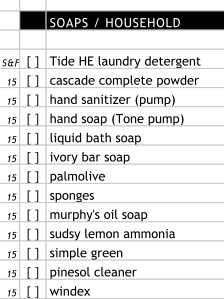
groceriesRather than use a sheet of blank paper to make a grocery list, start with a pre-printed list of all the things you would normally buy. Then just mark the things you need. Not only is it faster, but you’re much more likely to remember that you’re almost out of toothpaste and gin.

In our house, we keep the list as a spreadsheet in Google Docs. We have specific brands and aisle numbers noted so that either of us can get exactly the right thing.

The same technique works for packing lists. Make a list of everything you’re likely to need for any generic trip, then indicate quantities and special requirements. Do this, and you’ll remember to take both your prescriptions and your phone charger.

To get you started, here are .pdfs for our grocery and packing lists. I strongly encourage you to fashion your own in Excel, Numbers or Google Docs. Keep them up-to-date and handy.

* [Grocery List](http://johnaugust.com/Assets/groceries.pdf)

* [Packing List](http://johnaugust.com/Assets/packing_list.pdf)

« Previous Page
Next Page »

Primary Sidebar

Newsletter

Inneresting Logo A Quote-Unquote Newsletter about Writing
Read Now

Explore

Projects

  • Aladdin (1)
  • Arlo Finch (27)
  • Big Fish (88)
  • Birdigo (2)
  • Charlie (39)
  • Charlie's Angels (16)
  • Chosen (2)
  • Corpse Bride (9)
  • Dead Projects (18)
  • Frankenweenie (10)
  • Go (29)
  • Karateka (4)
  • Monsterpocalypse (3)
  • One Hit Kill (6)
  • Ops (6)
  • Preacher (2)
  • Prince of Persia (13)
  • Shazam (6)
  • Snake People (6)
  • Tarzan (5)
  • The Nines (118)
  • The Remnants (12)
  • The Variant (22)

Apps

  • Bronson (14)
  • FDX Reader (11)
  • Fountain (32)
  • Highland (73)
  • Less IMDb (4)
  • Weekend Read (64)

Recommended Reading

  • First Person (87)
  • Geek Alert (151)
  • WGA (162)
  • Workspace (19)

Screenwriting Q&A

  • Adaptation (65)
  • Directors (90)
  • Education (49)
  • Film Industry (489)
  • Formatting (128)
  • Genres (89)
  • Glossary (6)
  • Pitches (29)
  • Producers (59)
  • Psych 101 (118)
  • Rights and Copyright (96)
  • So-Called Experts (47)
  • Story and Plot (170)
  • Television (165)
  • Treatments (21)
  • Words on the page (237)
  • Writing Process (177)

More screenwriting Q&A at screenwriting.io

© 2026 John August — All Rights Reserved.