• Skip to primary navigation
  • Skip to main content
  • Skip to primary sidebar

John August

  • Arlo Finch
  • Scriptnotes
  • Library
  • Store
  • About

Archives for 2009

Cams, rips and release dates

March 18, 2009 Film Industry, Follow Up, Video

Following up on [last week’s post](http://johnaugust.com/archives/2009/fansubbing) about international release dates and subtitles, I’ve been asking around to find more information about studios’ anti-piracy efforts. I didn’t get into any specific numbers — and I wouldn’t know how seriously to take the numbers anyway.

But based on these conversations, I came across a few broad bullet points worth sharing:

* Studios have gotten more sophisticated about putting tracking marks in individual prints, often localized by country, to help them determine the source of a leak. It’s not just the ugly brown dots anymore.

* For almost every movie, they can trace back bootlegs to one or two “cams” (in-theater camcorder recordings) and just a handful of subsequent DVD rips. They assign letter grades to these bootlegs based on quality. And quality matters: a cam which rates a “C” won’t be nearly as much a factor as a “B.”

* For certain countries, studios will delay theatrical release because of a history of cams originating there. They’ll then release the DVD as soon as possible thereafter.

* The subtitles issue becomes important because a cam or rip in the wrong language isn’t especially appealing.

* In Italy, where custom greatly favors dubbing over subtitles, you don’t see much piracy until the local language DVD rip leaks.

Obviously, this is only talking about feature films. American television is at least as important to many international viewers, and much harder to lock down.

And for independent film, it’s a whole other clustermuck. You’re dealing with local distributors, so trying to coordinate any worldwide effort is going to be extremely difficult.

Last night, I was talking with another friend about 3D. It hadn’t occurred to me that a 3D film is probably more difficult to cam. Possible, certainly — it’s a fun mental exercise — but not as easy to get something usable.

How to handle a body-switching protagonist

March 18, 2009 QandA, Writing Process

questionmarkIn my script the appearance of the protagonist physically changes at the end of the first act. As I envision it, the same actor would not play the part from that point on. This is not a Face/Off situation where characters change places; the protagonist becomes a separate and new character (we’ll call him Tom) in the latter acts while retaining the previous mental identity (Jim) from the first act. I hope this makes sense with as little as I’m telling you.

The protagonist will then be referred to as Jim by those who knew him in the first act and meet him subsequently, and Tom by all those he meets in the 2nd act and beyond. My current solution is to refer to him as Jim in the first act and Tom in the latter two to match their physical appearance. Is it okay for me to rely on the context of my story to lead the reader through the transition (identity is a theme throughout) or am I risking confusing the reader?

— Jed
Fort Worth, TX

I understand what you’re trying to do, and so will your readers, as long as they’re engaged enough by your story to care. In fact, readers will follow you down almost any rabbit hole provided you can convince them something rewarding awaits.

When you’re pulling a big switch like this in a script, it’s okay to stop the action for a few lines and directly address the reader:

He ejects the DVD from the player and holds it up to see his reflection, an improvised mirror. He touches his face, confused.

Jim Maxwell is now TOM BARNHARD.

Mid-40’s, he has a similar build but a completely different face: rougher, darker. He is physically a different person.

(NOTE: From this point forward, we’ll be referring to this character as Tom. It is designed to be a different actor.)

Tom catches movement in the reflection. Another MAN. Charging right at him.

When dealing with potentially-confusing moments like these, it’s okay to give the reader slightly more concrete information than the viewing public might receive. The reader doesn’t have benefit of seeing that Derek Luke has suddenly become Denzel Washington.

Are writing groups a good idea?

March 17, 2009 Psych 101, QandA, Writing Process

questionmarkI was wondering if you have ever had any experience with writing groups. I know it’s good to network and build more of a community of contacts, but in your experience, can they improve your writing? Do you think they can be advantageous? Or do you just end up getting ever more sets of conflicting notes?

— Jack
Burbank

I’ve never been in an official writing group, but I did rely on an informal circle of writer friends for my first few years after film school, getting feedback, suggestions and a healthy amount of peer pressure. Reading other people’s writing — even bad writing — makes you think more about the words you put on the page, so it can be a worthwhile exercise even if the notes you get back on your script are less than ideal.

I’d recommend finding people who are interested in doing the same general kinds of movies. If most of you want to write comedies, the woman writing the drama about a girl’s troubled relationship with her alcoholic father is going to be a drag on the group. Likewise, if most of the writers in the group have emotion-laden scripts, your hilarious spec about a farting monkey won’t get much love.

Another suggestion: Accept and embrace that the group won’t hold together long. People will flake out, drop out or move on. In fact, it might be a good idea to put an expiration date on the group at the start: “We’ll be meeting every Monday for the next six weeks. That’s it.”

Show your work, pt. 2

March 16, 2009 Follow Up, Geek Alert, Rant

geek alertFollowing up on [last night’s post](http://johnaugust.com/archives/2009/show-your-work), it occurs to me that designing and programming for the web also has an aspect of showing your work. Nearly every browser lets you “View Source,” showing how the page was constructed…up to a point.
For example, if you View Source on the new [Answer Finder](http://johnaugust.com/answers) I built, you can see the JavaScript (and jQuery) that drives the menu and shows/hides the various sections.

What you can’t see is the PHP on the server that generated those sections. In my case, this is a good thing, because the PHP is so awful and kludgy that I can’t explain or defend why it works.

So to make that one page, I’m relying on a bunch of technologies with vastly different levels of transparency.

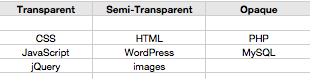
transparencyThe “transparent” technologies are available for anyone interested in looking. And that’s mostly good: Peeking beneath the hood is a great way to learn how a technology works. I often find myself opening the CSS for sites I like to see how they’re constructed. ((Keep in mind that you can learn bad habits this way.))

I’m classifying HTML as semi-transparent because so much of the HTML you see when you “View Source” for a site is generated by scripts running on the server, and it’s not automatically clear how or why. WordPress, for example, mixes in at least four parts (Header, Content, Footer and Sidebar) to make any given page. Someone familiar with WordPress might be able to deduce a basic structure, and figure out which parts were generated by The Loop. But in some cases it’s arbitrary. For example, the category links at the bottom of most pages on this site could be hard-coded or generated on the fly, and you wouldn’t be able to tell.

While you can find a lot of information about the images used on a site, including where they’re stored, you don’t necessarily know how they were generated. The chart above, for example, is a .png made from a snapshot of a Numbers document.

In the fully-opaque category are PHP and MySQL, who do most of the heavy lifting for the site but are completely insulated from the user.

Traditionally, programmers have been able to disappear behind the opacity of a compiler. Designers could hide behind the printing or manufacturing process. With the web, the process behind the product is much more visible.

(End of Geek Alert)
=====
The same thing is happening to movies. Not too long ago, a movie came into existence in popular culture just shortly before its release, when the first ads and trailers started running. I didn’t know anything about Die Hard before I saw a trailer. I saw The Blair Witch Project without any idea who made it or how.

Now, long before the marketing begins — before production even begins — details of projects spill across the internet for consumption and criticism. Scripts leak. Photographers sneak pictures of the set, or the costumes. The omission of a giant squid becomes the focal point of conversation for a movie that doesn’t yet exist.

For movies and television, I’m not sure we’re better off “showing the work” in advance.

I appreciate reading American Cinematographer to see how Robert Elswit lights There Will Be Blood, but I don’t read those articles before seeing the movie, lest I get too distracted by those details when I watch it. Likewise, I wish I didn’t know what I know about Terminator: Salvation or Dollhouse. It’s not insider knowledge, but rather the media reporting on the media.

This isn’t transparency, an invitation to come look inside. It’s forced exposure. It’s uncomfortable, and by nature we try to avoid uncomfortable things.

« Previous Page
Next Page »

Primary Sidebar

Newsletter

Inneresting Logo A Quote-Unquote Newsletter about Writing
Read Now

Explore

Projects

  • Aladdin (1)
  • Arlo Finch (27)
  • Big Fish (88)
  • Birdigo (2)
  • Charlie (39)
  • Charlie's Angels (16)
  • Chosen (2)
  • Corpse Bride (9)
  • Dead Projects (18)
  • Frankenweenie (10)
  • Go (29)
  • Karateka (4)
  • Monsterpocalypse (3)
  • One Hit Kill (6)
  • Ops (6)
  • Preacher (2)
  • Prince of Persia (13)
  • Shazam (6)
  • Snake People (6)
  • Tarzan (5)
  • The Nines (118)
  • The Remnants (12)
  • The Variant (22)

Apps

  • Bronson (14)
  • FDX Reader (11)
  • Fountain (32)
  • Highland (73)
  • Less IMDb (4)
  • Weekend Read (64)

Recommended Reading

  • First Person (87)
  • Geek Alert (151)
  • WGA (162)
  • Workspace (19)

Screenwriting Q&A

  • Adaptation (65)
  • Directors (90)
  • Education (49)
  • Film Industry (489)
  • Formatting (128)
  • Genres (89)
  • Glossary (6)
  • Pitches (29)
  • Producers (59)
  • Psych 101 (118)
  • Rights and Copyright (96)
  • So-Called Experts (47)
  • Story and Plot (170)
  • Television (165)
  • Treatments (21)
  • Words on the page (237)
  • Writing Process (177)

More screenwriting Q&A at screenwriting.io

© 2026 John August — All Rights Reserved.