• Skip to primary navigation
  • Skip to main content
  • Skip to primary sidebar

John August

  • Arlo Finch
  • Scriptnotes
  • Library
  • Store
  • About

Archives for 2006

Vampires are the imaginary numbers of modern literature

August 28, 2006 Genres, Reading

After a [bad beginning](http://johnaugust.com/archives/2006/to-the-guy-sitting-in-7a), I spent the flight home from Colorado reading Barry Mazur’s [Imagining Numbers](http://www.amazon.com/gp/product/0374174695/), which looks at how we might best conceive of imaginary numbers, those uncomfortable gremlins that occur when you start looking for the square root of negative numbers.

The book was only okay. It tried to be history lesson, philosophical study and math review all at once, and in its scattershot approach never quite achieved its stated thesis.

But one benefit of a mediocre book is that one’s mind is free to wander. Over the course of reading Mazur’s book, I decided:

1. To paint a giant number line on my daughter’s playroom wall. Addition and subtraction make a lot more sense with some geometry behind them, and Mazur’s description of numbers as verbs rather than nouns is revelatory.

2. The sense of needing “permission” to do something is generally an indication of an unasked question: “What would happen if I *did* take the square root of a negative number,” or “What if my protagonist *could* hear the voice-over narration?” (c.f. [Stranger Than Fiction](http://imdb.com/title/tt0420223/))

3. Vampires are the imaginary numbers of modern literature.

This last point merits further elaboration.

Vampires do not exist. That is, they do not exist in the same way you or I do. You’ve never met an undead blood-sucker, and neither have I. Yet we can both agree on quite a few characteristics of these non-existent beings:

* They drink blood.
* They avoid sunlight.
* They’re strong.
* They are undead and undying, except by special procedures.

This checklist is by no means complete: different writers may choose to add or subtract abilities. Shape-shifting and hypnosis were once pretty common traits that have all but disappeared from the modern vampire. Likewise, flight and coffin-sleeping seem to be on the wane.

In films, books and television, you can find urban vampires, feral vampires and even white-trash varieties. Yet the sense of “vampire-ness” seems fairly fixed. Here’s a test: grab a random teenager and ask him how to kill a vampire. Then ask him how to change a tire. I suspect the more complete answer will involve a wooden stake.

So how are vampires the imaginary numbers of modern literature?

Neither vampires nor imaginary numbers exist, yet we treat them like they do, simply because it suits our purposes. Imaginary numbers let us posit hypothetical mathematical scenarios; vampires let us imagine hypothetical human scenarios. Want an addiction analogy? Vampires. Epidemic? Vampires. Alienation? Vampires. Need to have your protagonist exist both now and two hundred years in the past? Just make him a vampire.

Modern literature has substituted vampires into every conceivable genre. And I don’t think it’s any accident that our bitey friends have become the go-to supernatural beings. Werewolves are only part-time monsters. Ghosts lack a consistent mythology. Vampires, well, *they’re just like us.*

But different. They’re imaginary numbers, who can’t be reduced beyond their glamorous other-ness.

I haven’t written a vampire movie yet, but the key word is “yet.” I came close last year, and it’s almost a given that I will at some point. It’s like a screenwriter’s rite of passage. And when I do, I intend to invoke some serious calculus on that shit.

To the guy sitting in 7A

August 28, 2006 Rant

Here’s the thing: When you arrive at the gate two minutes before the plane is supposed take off, you give up your right to complain. I don’t care what it says on your ticket. You take any available open seat.

That’s the deal. Maybe it’s not printed in all of the legalese, but it’s part of the social contract between all flyers: sit down, shut up, and let us push back from the gate.

What’s worse, it wasn’t even your seat. You claimed to have switched with some woman at the back of the plane, yet here you were at row seven, complaining that people weren’t in their assigned seats. J’accuse, my friend, j’accuse.

I wasn’t directly involved in the Great Seating Controversy of Flight 215. I was one row back, biting my tongue and proffering Cheerios to my daughter. Anything I might have said, any way I might have intervened, would have no doubt greater delayed our departure.

So instead, I spent a few minutes memorizing every detail of your face, so that at some point in the future when it won’t inconvenience 200 air travelers I might have the opportunity to let you know: You, sir, are a dick.

Additional photography

August 22, 2006 Los Angeles, Projects, The Nines

filmmingIn Hollywood parlance, “additional photography” is the polite term for what used to be called reshoots. It’s a rare case where the new word is better. Most of the time, you’re not reshooting anything. You’re getting new things you didn’t know you needed the first time around.

Woody Allen is famous for requiring additional days in his schedule (and budget) to allow for a different performance, a new scene, a funnier joke. Given how expensive a day of shooting is, that seems like a luxury, but as screenwriters it really shouldn’t. We’re accustomed to going through multiple drafts, trying things that might be Really Bad Ideas.

The chance to fuck up and fix it can be the difference between a so-so and solid.

I can speak from first-hand experience. For Go, we went back and shot several new scenes, including the resolution of the Simon-Gaines-Claire-Vics plotline. On paper, the new version wasn’t any better — in fact, it made considerably less sense. But as shot, it just worked better, condensing several scenes down to one, and wrapping up the movie faster.

For the first Charlie’s Angels, our additional photography was much more limited, basically just new establishing shots. But having seen the test scores for both the Before and After versions, I can testify to how much difference a few seconds of film can make. In most cases, it’s not that you’re adding something great, but rather that you’re replacing something sucky.

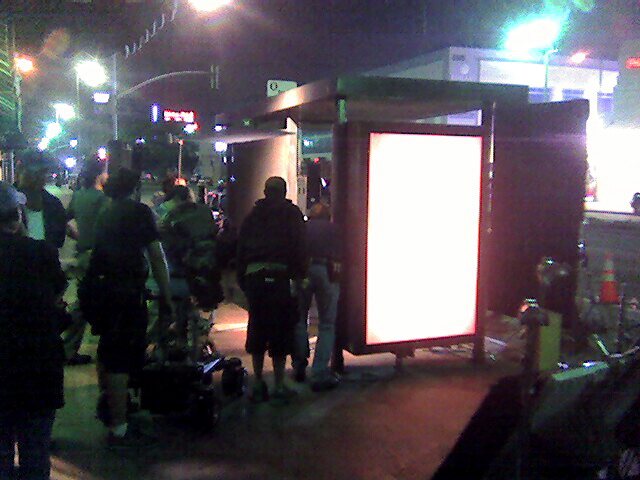
Last week, I was back in the director’s chair for additional photography on The Movie. It was only two days of shooting, but we added two new scenes, and got needed bits for three other sequences.

After seven weeks of editing, the strange thing about going back into production is that, well, it’s production. It means re-opening the production office, and hiring a crew of 45. If you’re lucky, you can hire the same crew who worked on the film the first time around. More likely, however, those people will have moved on to other productions, so you end up hiring a largely new crew. In our case, almost half of the crew who worked on these two days had no idea what The Movie was even about. That’s the remarkable thing about the below-the-line trades in Hollywood: because of how specifically the jobs are defined, they’re largely plug-and-play. The gaffer and key grip may have never met, but together they can light your scene. They don’t need to know why the scene is happening, just where the Chimera is supposed to be.

accebit posterThe bulk of our art department came from Veronica Mars, which has been back in production for over a month. Since the original crew wasn’t available, I got to rock my inner design geek and handle the printed graphics myself, something I haven’t done since college.

The “accebit” poster hangs at a Metro bus stop on Wilshire Blvd. Yes, it means something, so you classics majors can get to work.

This was our first time shooting night exterior, which meant new decisions about how we wanted things to look. Personally, I’m a big fan of very black skies — think high school football movies — so we aimed for that. We also aimed at finishing before 3 a.m. We came close.

Next step? Test screening, picture lock, then sound-a-palooza.

Monovision [update]

August 10, 2006 Rant

In George Orwell’s Animal Farm, the newly-empowered critters proclaim “four legs good, two legs bad,” only to later betray their entire belief system with the new wisdom that “four legs good, two legs better.”

I can relate. After extolling the virtues of wearing one contact lens (i.e. [monovision](http://johnaugust.com/archives/2006/monovision)), I took the bold step of putting the second lens in. Guess what?

One lens good, two lens better.

Sorry, monovision. I am fully committed to binocular vision.

And contact lenses aren’t bad at all. I had tried them a few years ago, and hated them. But the new lenses are comfortable enough that I genuinely forget that I’m wearing them. I’m a person who’s always had bad touching-my-eye squeamishness, but it’s been cake.

So my advice to my glasses-wearing brethren: give contacts a shot, even if you’re convinced you could never handle it.

The only reason I was trying contacts at all was as a trial-run for LASIK monovision. Now I’m just a guy who wears contacts. It’s really good, and doesn’t involve slicing my cornea.

« Previous Page
Next Page »

Primary Sidebar

Newsletter

Inneresting Logo A Quote-Unquote Newsletter about Writing
Read Now

Explore

Projects

  • Aladdin (1)
  • Arlo Finch (27)
  • Big Fish (88)
  • Birdigo (2)
  • Charlie (39)
  • Charlie's Angels (16)
  • Chosen (2)
  • Corpse Bride (9)
  • Dead Projects (18)
  • Frankenweenie (10)
  • Go (29)
  • Karateka (4)
  • Monsterpocalypse (3)
  • One Hit Kill (6)
  • Ops (6)
  • Preacher (2)
  • Prince of Persia (13)
  • Shazam (6)
  • Snake People (6)
  • Tarzan (5)
  • The Nines (118)
  • The Remnants (12)
  • The Variant (22)

Apps

  • Bronson (14)
  • FDX Reader (11)
  • Fountain (32)
  • Highland (73)
  • Less IMDb (4)
  • Weekend Read (64)

Recommended Reading

  • First Person (87)
  • Geek Alert (151)
  • WGA (162)
  • Workspace (19)

Screenwriting Q&A

  • Adaptation (65)
  • Directors (90)
  • Education (49)
  • Film Industry (489)
  • Formatting (128)
  • Genres (89)
  • Glossary (6)
  • Pitches (29)
  • Producers (59)
  • Psych 101 (118)
  • Rights and Copyright (96)
  • So-Called Experts (47)
  • Story and Plot (170)
  • Television (165)
  • Treatments (21)
  • Words on the page (237)
  • Writing Process (177)

More screenwriting Q&A at screenwriting.io

© 2026 John August — All Rights Reserved.