Per-screen average

As often happens in comment threads, the discussion for my post A hard time to be an indie focused less on the original article and more on the observations of a single commenter. In this case, Rebecca:

I’ve always wondered why the movie Lars and the Real Girl wasn’t released more widely. I only read rave reviews about it and everyone I know who saw it loved it. I thoroughly enjoyed it. They didn’t even release it widely enough to make a profit, the dumbasses.

Here are the numbers:

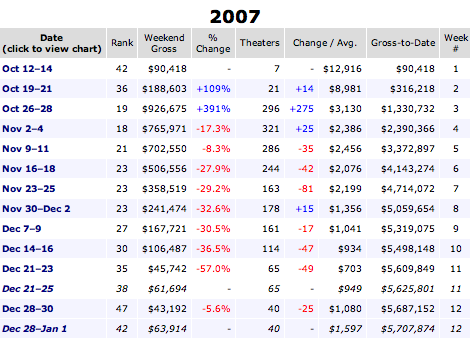
The movie had a $12,000,000 budget. According to boxofficemojo.com, it made $90,418 opening weekend in 7 theaters for a $12,916 average per theater.

The Proposal opened this past weekend in 3056 theaters and grossed $33,627,598 for an average of $11,004 per theater.

At 5 weeks, Lars and the Real Girl averaged $2,456 per theater after the number of theaters was reduced from its peak the week before.

The latest Night at the Museum, just averaged $2,636 this week, its 5th.

It looks to me like decent marketing in various markets, in conjunction with a much wider release, could have made this movie -– and everyone involved with it -– a LOT more money. Can you explain why it would not have made sense to release it into more than 321 theaters during its entire run? Other than thinking that challenging, quirky and maddening = noncommercial, I mean?

Apples, meet oranges.

Per-screen average is simply math: a given film’s box office divided by the number of screens it plays on.1 As a pure number, it tells you nothing about the size of theater, the percentage of seats sold, or what would be typical for that theater on that night.

Bringing in $2,300 over a weekend might be a great haul at a tiny theater in Des Moines, but would be a disaster at Grauman’s Chinese.

The number is only useful when comparing movies in fairly similar situations. If The Happy Harpist made $44,000 at four theaters, and My Third Elbow made $10,000 at three, it’s fair to say that Harpist is outperforming Elbow with an $11,000 per-screen average.

But drill deeper, and you might find reasons why Harpist’s numbers are misleading. For example, it’s possible Harpist made $34,000 on one of its screens, and only $10,000 on the other three. Maybe it’s a hometown director, or other special circumstance.2 Take away that one theater, and Harpist and Elbow are now a dead heat.

More importantly, if you’re one of the low-performing theaters for Harpist, your per-screen average is only $3,333. You will make your decisions about whether to keep playing the movie based on that number. Never forget that distributors don’t ultimately decide which movies stick around in theaters; the exhibitors do. They look at their internal numbers to decide which movies will make them the most money.

With a small number of screens, per-screen average is hugely affected by variations between individual venues. The denominator — which screens, and where — matters a lot.

Conversely…

With a big number of screens, per-screen average is relatively unaffected by variations between individual venues. If you’re playing in 4,000+ screens, it doesn’t matter nearly as much which screens those are. You’re a wide release, playing at every other megaplex in the country. Distributors desperately scramble to get as many good screens as they can, simply so they can generate as much money as they can. Per-screen average is the last thing on their mind.

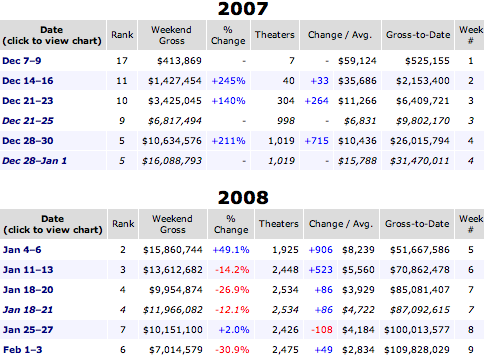
Some movies are able to successfully platform (expand) from a few screens to a lot. Juno, for example. But if you look at Juno’s weekend boxoffice breakdown, you’ll see that it never came close to its opening weekend $59,124 per-screen average again. As it climbed to 2,000 screens, the per-screen average plummeted because the denominator had gotten so big. Trust me: Fox Searchlight didn’t care. They were too busy making gobs of money.

Same for The Proposal. Same for Night at the Museum 2. Unlike the makers of Lars and the Real Girl, who carefully selected each of the seven venues it debuted upon — like Goldilocks, not too big, not too small — the studios releasing blockbusters want as many seats as possible. They’re not looking to expand. They don’t need to nurture. They simply want the maximum amount of money, preferably in the shortest amount of time.

Rebecca points to the fifth weekend of Night at the Museum 2 and its $2,636 per-screen average. She conveniently omits that on that weekend it earned $7.8 million. Money is money. Per-screen average is just a figure.

Back to Lars

While it’s absolutely fair to play Monday morning quarterback on a movie you love and believe could have made more money, the folks who released Lars and the Real Girl are not dumbasses. You can disagree with their marketing and perhaps their release date. I wouldn’t be surprised if the filmmakers feel disappointed. But they clearly tried to platform the movie much like Juno, and it didn’t work.

Courtesy Box Office Mojo, here are the numbers for Juno:
juno box office

And here’s Lars:

juno box office

Both Juno and Lars started in three theaters, then expanded to 300 in their third week. But Juno far out-earned Lars at every step. By the time it went wide, Juno also had the advantage of the Christmas holiday.

As you’re looking at the Lars chart, rather than focusing on the per-screen average, look at the red numbers in the % Change column. Starting with Nov 2-4, it was making less each week. It was on a decline. The distributor couldn’t justify the millions of dollars it would take to expand the run when it was earning a fraction of that each week.

In the end, Lars and the Real Girl made just under $6 million domestically. Many indies would love to reach that number.

Could Lars have made more money? Perhaps with a different combination of marketing and luck. But per-screen average has nothing to do with it, and using that figure to compare it to wide releases is specious. Limited releases have high per-screen averages because they’re on so few screens, not despite it.

  1. And even then, it’s a messy measurement. Particularly with wide releases, theaters can increase or decrease the number of screens devoted to a picture even over the course of a weekend, based on demand and sell-outs.
  2. Or maybe it’s The Nines. We debuted on two screens — one in New York, one in LA. Two-thirds of our money came from LA’s NuArt.
  • Digg
  • Facebook
  • Reddit
  • SphereIt
  • StumbleUpon
  • Twitter
June 30, 2009 @ 5:24 am | Comments (24)
Filed under: Film Industry, Follow Up, Projects, The Movie

24 Responses to “Per-screen average”

  1. Rebecca

    But is it possible for the general public to drill down further? The reason I glommed onto the per screen average is because it seemed like the only number that was NOT apples to oranges. But if it’s possible to get more detail, I’m not aware of it.

    Also, it’s really not that I conveniently omitted the grosses, it’s just that THOSE numbers actually ARE apples to oranges. You can’t compare the grosses of a movie in thousands of theaters to that of one in only a few hundred, so it wasn’t relevant to the argument I thought I was making.

    “Limited releases have high per-screen averages because they’re on so few screens, not despite it.”

    That argument only works if the theaters are in the same market area. If the movie is released in more markets, the ad dollars would naturally be much higher. But if the theaters in those market areas are geographically far enough apart, which is possible in many metropolitan areas, then they will not be in such close competition for seats. I’d love to have further data about this, whether it supports my argument or not, so if you know where I can find it to drill down, please let us know.

    I do think Juno is an excellent comparison to Lars, given the way they were each rolled out. However, I did mention I didn’t expect that Lars could have grossed nearly the amount that Juno did. All I said was that I was surprised it didn’t breeze through at least 12 to 15 million domestically and I believed that the reason it didn’t was because of mistakes in marketing/lack of a wider rollout. Based on the info available to me, a member of the general public, it looked like a reasonable argument.

    “Could Lars have made more money? Perhaps with a different combination of marketing and luck.”

    Well, luck is always the unknown factor, anyway. But I still think that studios should investigate ways of leveraging whatever info they can gain from viral marketing the trailers. Targeting releases to where they get the strongest response, if possible, would seem to be a more effective use of their marketing/distribution dollars.

  2. Eric B.

    Daniel Day-Lewis was EXCELLENT in My Third Elbow.

  3. Andreas Climent

    Nice explanation. I’ve been wondering about the real significance of per-screen averages for a while so thanks for clearing things up!

  4. Kevin Arbouet
    Also, it’s really not that I conveniently omitted the grosses, it’s just that THOSE numbers actually ARE apples to oranges. You can’t compare the grosses of a movie in thousands of theaters to that of one in only a few hundred, so it wasn’t relevant to the argument I thought I was making.

    Yes, you can. It’s simple math.

    1 Print= $2000

    So if a movie is on 2250 screens that costs 4.5 million dollars. So in the case Night at the Museum 2 (terrible movie), it made 7.8 million. In the case of Lars, at its most expanded it was in 321 theatres. That costs $642,000. It made $765,971 for that weekend. A profit of $123,000. That has to be spilt 60/40. With absolutely no other ancillary merchandise to capitalize on like NATM2. Not to mention that when it comes time for the real money maker, the DVD’s for NATM2…well, it’s just simple math.

  5. Murray

    First, Lars kind of sucked (and had a morally questionable ending – SPOILER… he killed her, killed her!!!).

    Second, Rebecca… it is apples and oranges. By concentrating the release of your film to a smaller pool of theatres you are automatically ratcheting up its per screen average potential (because you’ll be drawing in folks who will not wait for the flick to come to their town (or suburb)).

    For example, when Juno was released I drove 45 mins to see it because my local theatre wasn’t carrying it yet (I also saw it twice when my local theatre started carrying it… and now I hate, hate, hate it).

    Meaning, if one theatre has the exclusive showings for a particular flick it will attract an audience that usually wouldn’t attend that theatre. Meaning, the audience for these “specialty” flicks will ratchet up per screen average in a limited number of theatres but that will not translate to a wider release because, most likely, the audience that wants to see this flick will see it no matter what (even at the inconvenience of a 45 min drive). Sure a wider release might catch a few audience members unaware, but most likely would just water down the average. Let me explain further, if I had a choice between seeing Juno at my local theatre on opening weekend I would have seen it there – my ticket money would have gone to my local theatre and not to the one 45 mins away. Meaning, what was a Juno monopoly splits the audience in two and then splits the per screen average in two. Meaning, what was once a 300,000 dollar haul for one theatre (a 300,000 per screen average) becomes, most likely, a 300,000 dollar haul for two theatres (150,000 per screen average).

    Make sense? No, well dammit I suck.

  6. eve

    I’m one of those idealists who lives by “If you build it, they will come.” That’s my personal, blue-eyed focus as a filmmaker, because that’s where my leverage is.

    However, in the reality of a highly competitive marketplace there are many more factors that contribute to the success of a product. From personal experience I can say that sometimes it takes more than a good movie and simple math to succeed. There is a reason why companies generally pursue vertical integration and why studios schedule distribution years in advance.

    Distribution is where the congloms make minced meat out of indies.

  7. Nima

    Rebecca is my new favorite johnaugust.com commenter, and also the person I would least like to sit next to on a long flight. Huzzah!

  8. eve

    PS

    Regarding the “per screen average” you can go to Variety and sort the box office data by “Engagement Averge”.

    The results are confusing in that there doesn’t seem to be a direct correlation with profitability.

  9. Rebecca

    “You can’t compare the grosses of a movie in thousands of theaters to that of one in only a few hundred.”

    No. You can’t. There is no possible way that a movie in 300 theaters can gross anywhere near a movie that is in 3,000 theaters.

    Murray, I still don’t know if I would call it apples to oranges but, yes, that does make sense…except for the ‘part about Lars sucking. However, I’m willing to admit thats a matter of taste. I was thinking that, in a market like Dallas for instance. The ads would have covered such a large geographical area that each ad dollar would have been spread widely enough so theaters wouldn’t be competing each other so closely. But I guess if people are willing to drive 45 minutes, it kind of does dilute that theory.

  10. Moe the Sleaze

    “However, I’m willing to admit thats a matter of taste.”

    There’s the key line.

    Lars did really well where it played. Which I’m guess was mostly art house type theaters. When I lived in Iowa, there were a handful of theaters in Des Moines or Iowa City I’d drive to in order to see films that wouldn’t play closer to home. And I’m not just talking about the ‘Howard’s End of the Affair with the English Patient.’ I had to go there to see ‘Made.’

    Think as the owner of one of those small town cineplexes. Which would you show? A movie about a quirky teenage girl dealing with a pregnancy or a movie about a guy who’s in love with a glorified sex doll? Plus you have to factor in popcorn for a bunch of teengers vs. an older couple that splits a Toblerone.

  11. Paula

    Rebecca, Rebecca, Rebecca,

    What you’re missing is that both distributors and exhibitors are in the business of making profits. Which is why Kevin Arbouet’s EXCELLENT point about the fact that they barely squeezed out a profit for Lars when they expanded it to 321 theatres should settle the matter.

    With all due respect, I’m actually perplexed that you’re still arguing the same point. To pin Lars poor showing on a poor distribution strategy (and a faulty assumption that everyone loved the film as much as you did), when you know so little about distribution, seems odd.

    We’re all entitled to our opinions, of course, but this is a wonderful opportunity to LEARN about the BUSINESS of film, which will shape your reality as a filmmaker, if you are one.

    Sometimes it’s more important to listen than to press your point, particularly when the person speaking knows from whence he speaks. Although you may think the per screen average matters, no one else thinks that — not the distributors, not the exhibitors, and not the filmmakers whose films do well “per screen” but don’t actually turn a profit.

    One final point before I bow out for good: The assumption that simply running a film in more theatres will equal more profits contains a logical fallacy — in other words, your argument is based upon a faulty assumption. I won’t bother to detail it because it would likely fall on deaf ears.

  12. Stephan Vladimir Bugaj

    The problem is in assuming every film is a wide release film. Not every film has the same audience, which was (I believe) the whole point of John’s post that generated the comments that led to this post.

    Maybe the marketing plan and/or release date for Lars was not sufficiently well thought-out, and it could have platformed like Juno given a different release date and marketing strategy. It’s $12M budget seems to indicate that its backers thought that it might have, but it’s also possible that they made a $3M film for $12M, and had they understood their audience financially in addition to speaking to them artistically, they should have known to expect only $6M and considered themselves fabulously lucky if they made more.

    Or maybe it could have made $25-50M had it found its audience, and something went wrong in a plan that seemed correct. That happens, sometimes even to big blockbuster releases.

    I can’t say which one it might be, because I’m not privvy to their plans. But John’s analysis seems reasonable based on the data he cites: that they were trying to platform the release (a reasonable approach for a smaller film), expecting a bigger break-out and more than a $6M B.O., and failed for whatever reason (bad release date, not enough marketing, their platform launch theaters weren’t optimal, they should have gone wider sooner, they should have stayed narrower longer, the marketers made a mistake in the campaign design, some event more important to their core audience kept many of them out of theaters, the weather was such that most in their target audience didn’t go at all, etc.). All sorts of things can go wrong, even with the best laid plans.

    But many of those finanically unsuccessful films are still great films. Go see them, and buy them on DVD, and you’ll be doing your part to ensure that the filmmakers get to do it again. (And if you love a film, blog about it. Word of mouth can contribute to the success or failure of a film, especially an Indie film that’s using platformed release approach.)

  13. Dixon Steele

    Pesonally, I felt THE HAPPY HARPIST was vastly overrated. I wasn’t surprised when it plummeted after it went wide.

  14. Anonymous Production Assistant

    There’s a simple point that it seems no one has brought up. Per screen average is the box office gross divided by the number of theaters. If you double the number of theaters, that doesn’t mean the PSA will remain the same. In fact, the film may have reached its saturation point, and doubling the playdates will simply halve the PSA. (And, as Kevin pointed out, each new theater costs extra money, at least until films are distributed digitally.)

  15. Chris A

    I love these kinds of analyses! Is there any film-industry equivalent to “Moneyball”? That is, a producer or studio exec who determines which previously unexamined factors are most likely to lead to success?

  16. Kevin Arbouet

    Rebecca:

    No. You can’t. There is no possible way that a movie in 300 theaters can gross anywhere near a movie that is in 3,000 theaters.

    What an incredibly baseless and factually incorrect statement.

    Let me see if I can explain this to you without sounding like a condescending jerk. If I do, I apologize in advance.

    Let’s take Speed Racer. It debuted in 3606 theatres and made 18.5 million dollars over the weekend. So that costs the studio 7.21 million dollars in prints.

    Now let’s take Fahrenheit 911. It debuted in 868 theatres. And made 23 million that weekend. Which cost the studio 1.7 million in prints.

    Which brings us to Paula’s great point. There are too many people out there who call themselves filmmakers but haven’t taken the time to learn the business of filmmaking. I wouldn’t want a doctor operating on me just because he watches Grey’s Anatomy and no one should try and damn a studio for faulty marketing strategy just because they read an article in Entertainment Weekly.

    But Stephan Vladimir Bugaj brings up the greatest point of all. Why the hell did Lars cost 12 million dollars?!

    I’m not a studio guy but as an indie producer, 12 mil for that film is so incredibly ludicrous I could write my own post on that subject alone.

  17. Robert Bruens

    Re: Chris A

    I think the correct answer to that would be the Weinstein Bros (at least back in the day), Bob Shaye (founder of New Line Cinema) and Roger Corman. There are probably others as well. Bert Schneider and Bob Rafelson maybe.

  18. Paula

    Kevin Arbouet, you rock. Yeah, why the heck did Lars and the Real Girl cost $12M. That was a $1M film if I ever saw one. There’s nothing on screen that justifies the cost, not to mention that there wasn’t the audience to support it.

    In other but related news, check out this article on the making of the low-budget Frozen River from Slate.com:http://www.thebigmoney.com/articles/impressions/2009/02/18/selling-frozen-river.

  19. pepe

    Just because some website says it cost $12M to make doesn’t mean it’s true. I’m highly skeptical of that number. Unless the licensing on the doll cost $8M.

  20. Randall Bobbitt

    Rebecca,

    The biggest factor is Fox Searchlight spent A LOT more money marketing Juno then MGM did marketing Lars. I’d love to see those two budget side by side. But the biggest factor is most people in this country do not go see good movies. And that, is the sad reality.

  21. Randall Bobbitt

    CHRIS A…

    Yes. Roger Corman. Read “How I Made A Hundred Movies In Hollywood And Never Lost A Dime”.

  22. Kevin Arbouet

    The very first movie that I produced on my own (outside of Lee Daniels) starred Melissa Leo. She was fantastic. The movie was terrible…

    But it’s great when a small movie finds an audience. Most of my day consists of pitches from filmmakers who say that they can make a movie for $500,000 and I always respond by saying that you can make a movie for $500,000 but that doesn’t mean you can sell a movie for $500,000.

    Great article.

  23. Anonymous

    Hi All,

    Very interesting debate from all you guys. I had seen the trailer for Lars and the Real girl few years back, and was really looking forward to it in the screens. But then i never heard from it again, till now.

    And only today this movie came back to me and realised that it never realeased in my third world country and neither it is available on dvd to rent or buy.

    So what do i do?

    Option 1 – Order from Amazon or similar websites.

    Option 2 – Download

    Now, option 1 is a really expensive one for me coz its $23.96 (without tax) + standard international shipping. (including the time i need to wait for delivery)

    Option 2 is rarely available where i can download the full movie.

    Other options – Wait for it to come on HBO or Star Movies or any English movie channel. But herein lies the censorship issue of absuive language and sexual content, which hinder my experience of watching this film.

    So while on option 2, i turn to torrents. My best and easy source of download without any censor control or hassle or any money. Though i dont mind paying a decent amount, iam left with no choice.

    And there are many such movies that dont reach our turf. Any ideas on how to market content like these to the rest of the globe. (meaning there is world other than America and Europe)

  24. Kevin Arbouet

    Anonymous:

    Where do you live?


About

This site is run by screenwriter John August. Mostly, he answers reader-submitted questions about the craft, but occasionally he goes on tangents that run far afield of writing and filmmaking. You'll also find info on past, present and future projects.

Follow Me

On Twitter: @johnaugust

Ask a Question

If you have a question about screenwriting or my movies that hasn't been answered, by all means ask. There are a few guidelines to follow.

Featured Articles

101: Some screenwriting basics


There are more than 900 articles on the site. You can find category archives at the bottom of every page.

Read Me

  • The Variant
  • A new short story available for download, Kindle and iPhone.

Feeds