• Skip to primary navigation
  • Skip to main content
  • Skip to primary sidebar

John August

  • Arlo Finch
  • Scriptnotes
  • Library
  • Store
  • About

Search Results for: thusly

Looking back on #amazonfail

April 15, 2009 Meta

Two good write-ups today on the [weekend phenomenon](http://johnaugust.com/archives/2009/twitchforks) in which many smart people became swept up in moral outrage based on flimsy logic.

If you missed it, [Clay Shirky](http://www.shirky.com/weblog/2009/04/the-failure-of-amazonfail/) summarizes it thusly:

> After an enormous number of books relating to lesbian, gay, bi-sexual, and transgendered (LGBT) themes lost their Amazon sales rank, and therefore their visibility in certain Amazon list and search functions, we participated in a public campaign, largely coordinated via the Twitter keyword #amazonfail (a form of labeling called a hashtag) because of a perceived injustice at the hands of that company, an injustice that didn’t actually occur.

Mary Hodder would probably agree with most of that history. But in [her take](http://www.techcrunch.com/2009/04/14/guest-post-why-amazon-didnt-just-have-a-glitch/) on the event, she finds there is still reason for outrage, even if Amazon wasn’t deliberately trying to sweep gay titles under the rug:

> The issue with #AmazonFail isn’t that a French Employee pressed the wrong button or could affect the system by changing “false” to “true” in filtering certain “adult” classified items, it’s that Amazon’s system has assumptions such as: sexual orientation is part of “adult”. And “gay” is part of “adult.” In other words, #AmazonFail is about the subconscious assumptions of people built into algorithms and classification that contain discriminatory ideas. When other employees use the system, whether they themselves agree with the underlying assumptions of the algorithms and classification system, or even realize the system has these point’s of view built in, they can put those assumptions into force, as the Amazon France Employee apparently did according to Amazon.

Shirky found himself part of the #amazonfail mob, and is now embarrassed by his assumptions:

> Though the #amazonfail event is important for several reasons, I can’t write about it dispassionately, because I was an enthusiastic participant in its use on Sunday. I was wrong, because I believed things that weren’t true. As bad as that was, though, far worse is the retrofitting of alternate rationales to continue to view Amazon with suspicion, rationales that would not have provoked the outrage we felt had they been all we were asked to react to in the first place.

Shirky calls this “conservation of outrage.” Once you realize the original thing you were upset about doesn’t exist, there is a great temptation to find an alternate target. We’ve all done that.

Beyond the conspiracy theories, what I found most interesting about #amazonfail were tweets demanding to know why Amazon hadn’t corrected the problem just hours after the term had surged on Twitter. It speaks to the speed of popular culture — and the sugar-high of Twitter — that we expect every problem to be identified and remedied immediately. Five minutes feels like an eternity.
Snopes plugin

February 10, 2009 Geek Alert, Hive Mind

Whenever a family member forwards an email with a warning about an urgent peril to my health, I immediately visit [Snopes.com](http://snopes.com) to confirm my suspicion that it’s a hoax. I then copy a link to the article and send it back, with a gently-worded request to please check Snopes before sending out similar emails.

Today’s threat (phenylpropanolamine) seemed designed to work around this firewall. It began thusly:

> DRUG RECALL – VERY SERIOUS – CONFIRMED BY SNOPES.COM & FDA — tina
> ————————————————————————–
> All drugs containing PHENYLPROPANOLAMINE are being recalled.

Why, if it’s confirmed by Snopes, then it can’t be a hoax! But the [actual page on Snopes](http://www.snopes.com/medical/drugs/ppa.asp) says otherwise.

Dear developers, please answer my simple plea: a Snopes plugin for email.

It can take myriad forms, from server-side filtering ( “We think this is a hoax”) to a simple button or link ( “Check Snopes”). But it would save so much time and grief.

I voted

October 27, 2008 Rant

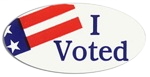
voting stickerThis past week, I trekked down to Norwalk for [early voting](http://www.lavote.net/VOTER/PDFS/EARLY_VOTING_INFO.pdf). I hadn’t originally planned to, but I kept envisioning getting hit by a car on my way to the polls, and watching the returns from a hospital room with two broken legs, despondent that I missed my chance at exercising my democratic right, and exorcising a democratic wrong.

It will shock exactly no one that I voted for Obama. Twenty months ago, I attended an early fundraiser for his campaign, and left with guarded optimism. “Wouldn’t it be great if..?” was how I spoke of his candidacy, trying to imagine a president who would inspire rather than infuriate. At every step, I tried to temper my hopes and brace for disappointment. But I was constantly surprised by the intelligence behind the eloquence, and the consistency of message and tone he maintained over a ridiculously long trial. It was a great pleasure to ink the dot beside his name.

While the presidential campaign has been going on since the Pleistocene, the more recent and urgent issue in California is Proposition 8, a ballot measure that would take away my marriage by amending the California constitution. I’ve written about it before, particularly in [Off-Topic](http://johnaugust.tumblr.com), and have had a virtual yard sign on the sidebar for months.

On Saturday, I sent a long email to friends and colleagues making sure they understood how urgent it was that this ballot issue be defeated. While only Californians can vote on this proposition, the impact will no doubt be felt nationally and beyond. So in that spirit, I’m reprinting my letter here. I know that a huge portion of the readership lives outside the state — and nearly a quarter of readers are overseas — but if it helps a few voters understand what’s at stake, that’s something.

We’re ten days away from the election.

Which seems as impossible as it is welcome. Can you even remember a time when the news wasn’t dominated by election coverage? What did we talk about? What did we do? I look forward to rediscovering it all on November 5th.

In all the non-stop coverage of the candidates and their foibles, a tremendously dangerous ballot initiative has gotten much less attention than it deserves:

__Proposition 8 would eliminate the right of same-sex couples to marry in California.__

Mike and I got married on June 28th. We want to remain married on November 5th. And without your help, we won’t.

[Read more…] about I voted

One. Million. Dollars.

October 7, 2008 Words on the page

This fall’s ongoing financial indigestion is depressing, if not an actual capital-d Depression. The world’s smartest folks are busy asking difficult questions about the billions and trillions of dollars involved. I certainly don’t have the answers.

Instead, I’d like to attempt to answer a question that’s perplexed me for a while: What’s so special about one million dollars?

In movies, TV, and actual conversation it’s by far the most frequently quoted dollar figure to mean “rich,” despite inflation. The top-shelf reality competition shows (Survivor, The Amazing Race) use that as the prize figure. But it’s not just a lot of money. It’s been mythologized as the transformative tipping point between the life we have and some mythological Good Life in which profound satisfaction is possible.

Consider this discussion from Office Space:

PETER

Our high school guidance counselor used to ask us what you’d do if you had a million dollars and you didn’t have to work. And invariably what you’d say was supposed to be your career. So, if you wanted to fix old cars then you’re supposed to be an auto mechanic.

SAMIR

So what did you say?

PETER

I never had an answer. I guess that’s why I’m working at Initech.

MICHAEL

No, you’re working at Initech because that question is bullshit to begin with. If everyone listened to her, there’d be no janitors, because no one would clean shit up if they had a million dollars.

SAMIR

You know what I would do if I had a million dollars? I would invest half of it in low risk mutual funds and then take the other half over to my friend Asadulah who works in securities...

MICHAEL

Samir, you’re missing the point.

But he’s not. Samir has it right: the question of what you’d do if you had a million dollars is essentially the same as what you’d do with a million dollars. Sure, you could answer, “If I had a million dollars, I’d light myself on fire and jump out of a tree.” But the question strongly implies “What would you do that you couldn’t do right now if you had a million dollars.” And while rich people often do stupid things, stupidity itself is free.

And Michael is right, too. The question is sort of bullshit. I’d argue that the phrase “and you didn’t have to work” is easy to challenge. Could you really retire on a one-time windfall of a million dollars? Even before taxes and inflation, it’s [less than you think](http://www.usnews.com/articles/business/retirement/2008/06/03/is-1-million-enough-to-retire-on.html):

> If you drew down 4 percent of your $1 million nest egg every year, a share many financial advisers recommend as prudent, you would receive about $40,000 annually, before adjusting for inflation — a pretty comfortable salary outside major metropolitan areas, especially if your house is paid off. Of course, how far that $3,333 a month goes depends on your lifestyle, health, and inflation.

Forty thousand dollars is not what most Americans would consider rich. It’s not first-class to Paris.

Of course, this is logic talking. And our mythologizing of one million dollars is more emotional than rational. I have a few working hunches why a million dollars seems so special.

1. **We have no personal frame of reference for “million.”** Most Americans earn five figures ($10,000 to $99,999). If we buy a house, we’re likely dealing with six figures ($100,000 to $999,999). But few Americans will ever encounter seven figures in relation to their own finances. So it seems like a magical and unobtainable sum.

2. **All rich people are millionaires, so all millionaires must be rich.** This failure of the symmetric property has been pointed out in books like The Millionaire Next Door, which shows that cost-containment and steady investment is a more realistic lifestyle for the average millionaire. Along the same lines, having a million dollars isn’t the same as making a million dollars. It’s easy to confuse assets with income. When stocks and home prices were rising, an increasing number of Americans became millionaires on paper. ((“On paper” is really a terrible term, because I don’t know any millionaires who keep a million in gold laying around.)) But since that’s not spendable cash, it’s not what most people mean by millionaire.

3. **What matters is the million, not the actual value.** Americans would rather have the million dollars than 750,000 euros. And two million dollars doesn’t feel twice as good as one million.

When a million is meaningless
====

Despite these defenses, I think the million dollars’ cinematic days on top are numbered, and screenwriters would be wise to avoid the figure in scripts. It’s simply not enough money to have a clear meaning. Consider:

EVELYN

Have you met Tom, her fiancé? His apartment in New York cost almost a million dollars!

Is the proper response…

TAMI

I always knew she’d marry money.

or…

TAMI

What is that, a one-bedroom?

(In fact, a million could be as little as a loft.)

If you need to have characters talk about money, you’re much better off referring an object (or service) than its price.

EVELYN

Her ring cost more than my car.

TAMI

She gets her hair done by this woman who flies in from Paris. Can you imagine?

EVELYN

She ripped out the limestone in the bathroom because it wasn’t organic. Turns out they don’t make organic limestone. So she got this stone from Italy. Used to be a church.

Billion is the new million. Sort of.
====

For now, I think you can safely get away with calling a billionaire rich. ((I’m speaking of the U.S. definition of billion, which is a thousand million.)) Keep in mind, it’s a staggering amount of money, so any character thusly defined would have to have a plausible explanation. For example, rich as he is, Will Smith is likely not a billionaire. With rare exception, you become a billionaire though canny investments or lucky inheritance.

Do millionaires dream of being billionaires? I don’t golf, so I haven’t heard this topic come up in conversation. But my experience of earning money in Hollywood has been that one’s financial ambition caps out at a certain point. The dream of a million dollars is a life free from financial worry: paying for the mortgage, college, and retirement. Once those fears are addressed — at a figure likely significantly higher than one million dollars — there is less to reach for financially.

So while I don’t advocate using the million dollar figure in scripts, I think it still has some real-world years ahead of it as a psychological milestone. Wealth isn’t simply what you can buy; it’s how much protection you have from poverty. A million dollars may not be “rich,” but it’s a comforting distance from poor.

« Previous Page
Next Page »

Primary Sidebar

Newsletter

Inneresting Logo A Quote-Unquote Newsletter about Writing
Read Now

Explore

Projects

  • Aladdin (1)
  • Arlo Finch (27)
  • Big Fish (88)
  • Birdigo (2)
  • Charlie (39)
  • Charlie's Angels (16)
  • Chosen (2)
  • Corpse Bride (9)
  • Dead Projects (18)
  • Frankenweenie (10)
  • Go (29)
  • Karateka (4)
  • Monsterpocalypse (3)
  • One Hit Kill (6)
  • Ops (6)
  • Preacher (2)
  • Prince of Persia (13)
  • Shazam (6)
  • Snake People (6)
  • Tarzan (5)
  • The Nines (118)
  • The Remnants (12)
  • The Variant (22)

Apps

  • Bronson (14)
  • FDX Reader (11)
  • Fountain (32)
  • Highland (74)
  • Less IMDb (4)
  • Weekend Read (64)

Recommended Reading

  • First Person (87)
  • Geek Alert (151)
  • WGA (162)
  • Workspace (19)

Screenwriting Q&A

  • Adaptation (65)
  • Directors (90)
  • Education (49)
  • Film Industry (489)
  • Formatting (128)
  • Genres (89)
  • Glossary (6)
  • Pitches (29)
  • Producers (59)
  • Psych 101 (118)
  • Rights and Copyright (96)
  • So-Called Experts (47)
  • Story and Plot (170)
  • Television (165)
  • Treatments (21)
  • Words on the page (237)
  • Writing Process (177)

More screenwriting Q&A at screenwriting.io

© 2026 John August — All Rights Reserved.