• Skip to primary navigation
  • Skip to main content
  • Skip to primary sidebar

John August

  • Arlo Finch
  • Scriptnotes
  • Library
  • Store
  • About

Search Results for: thusly

Dressing like a screenwriter

September 16, 2014 Highland, Los Angeles, News

Scriptnotes is a proudly money-losing podcast, with no ads or sponsors to defray the cost of editing, hosting and transcripts. So once a year we offer t-shirts to help fill both our coffers and your closets.

In past years, we’ve sold the Scriptnotes t-shirts in various colors. They’re lovely shirts, but three colors is plenty. This year we wanted to do something different.

So we made the [Scriptnotes Tour shirt](http://store.johnaugust.com/products/scriptnotes-tour-shirt).
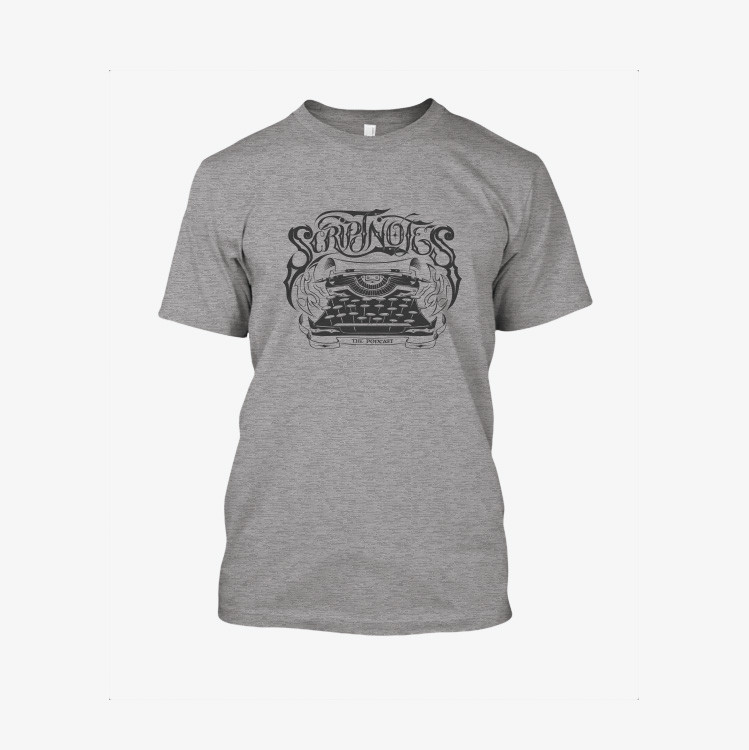
scriptnotes tour shirt

Illustrated by Simon Estrada, it’s the stadium rock band shirt made for people who listen to weekly podcasts about screenwriting. ((…And things that are interesting to screenwriters.)) For the first time ever, there’s printing on the back: a list of all the live shows, past and near-future.
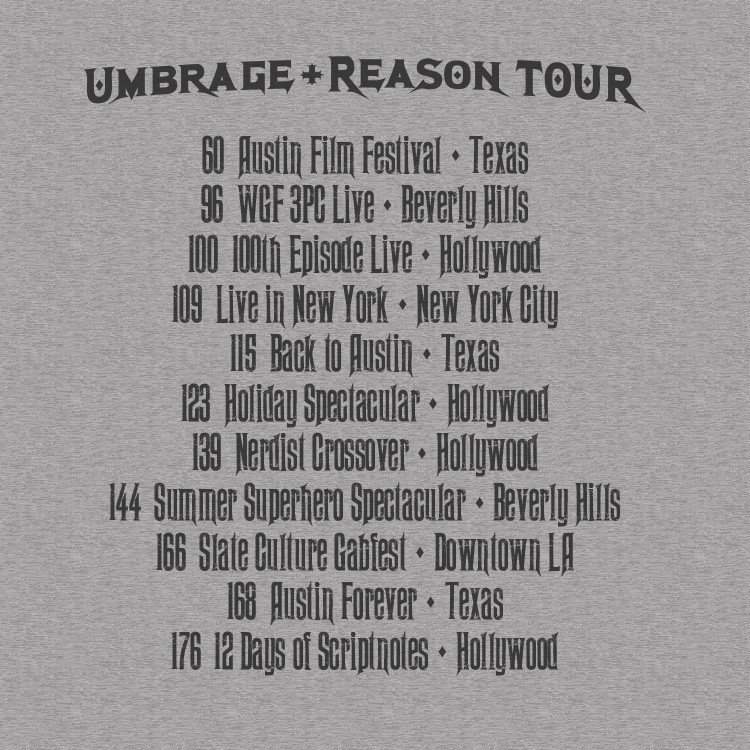
scriptnotes-tour-back-detail_1024x1024

Although the artwork is hard rock, it’s actually the softest shirt we’ve ever made. Stuart Friedel, our resident t-shirt expert, describes it thusly:

> The softest shirt I ever touched was the American Apparel gray-tag tri-blend from 2007. Nothing has come close until this. It’s like wearing a daydream.

Stuart’s sense of softness led us to an entirely new garment: our [first-ever hoodie](http://store.johnaugust.com/collections/frontpage/products/brad-hoodie). It’s spun from the downy tri-blend threads.
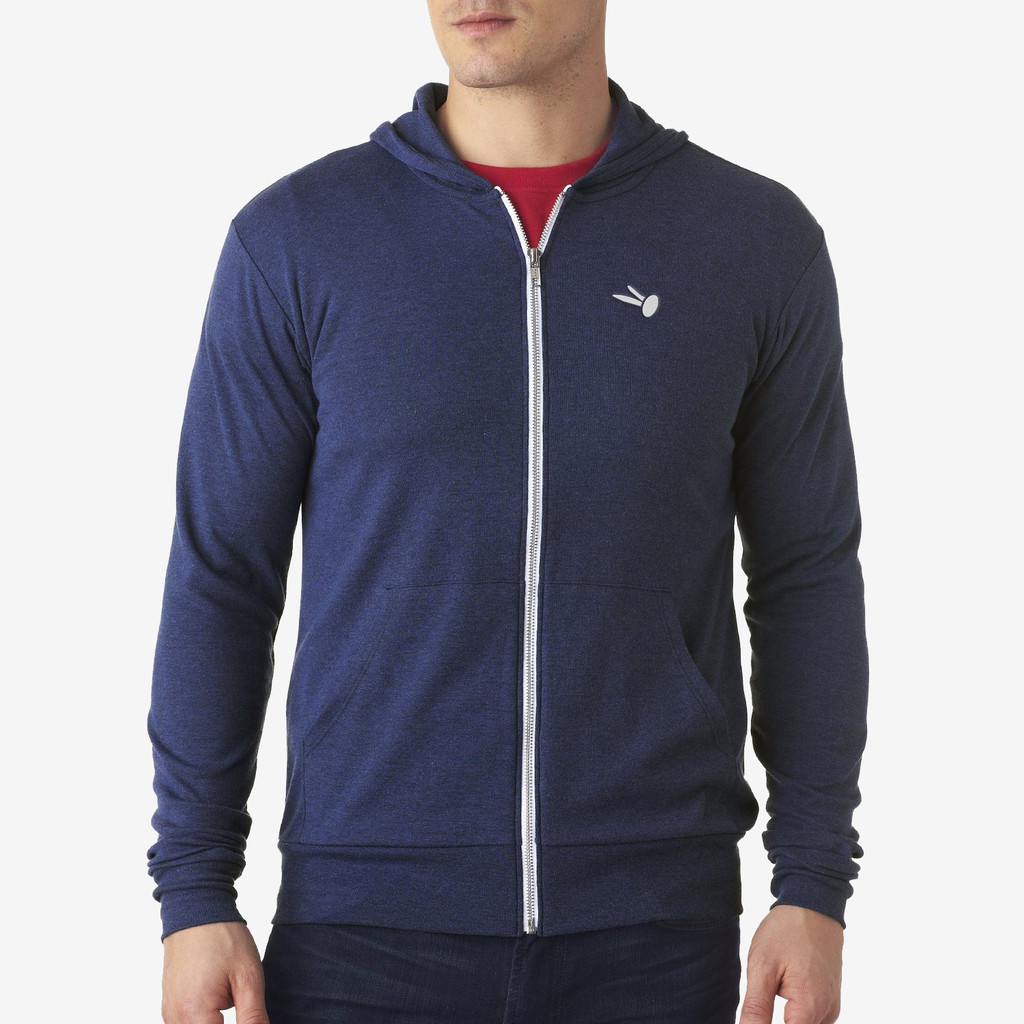
brad hoodie

We were originally going to make it a Scriptnotes hoodie, but the complicated typewriter logo translated poorly to embroidery. A much better choice was this blog’s brad icon: simple, iconic, and specific.

Hoodies are the fundamental outerwear of the modern screenwriter: dressy enough to wear to a water-bottle general meeting, casual enough to wear while walking your dog at Runyon Canyon.

We deliberately picked a lightweight fabric, perfect for an over-air-conditioned coffeeshop when it’s 100 degrees outside.

Our final bit of new schwag came to us from an email by George Gier:

> You may never know how much I appreciate Highland, but it turned reformatting hundreds of pages of garbage into two clicks of perfection. It rules. If you make a Highland T-shirt, I will be the first to buy one and wear it proudly.

George Gier, [this is your shirt](http://store.johnaugust.com/collections/frontpage/products/highland-t-shirt) (but everyone else can get them too):
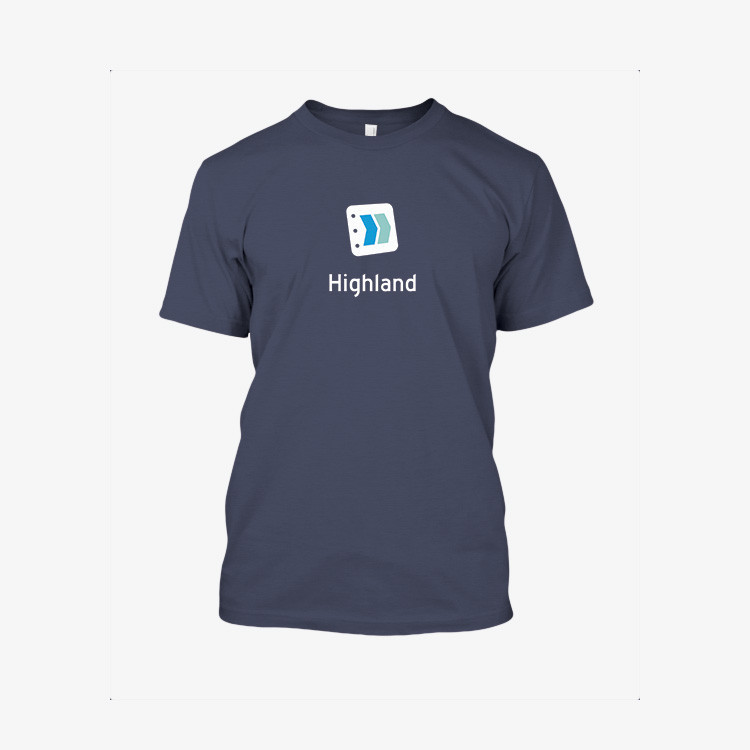
highland shirt

For the Highland shirt, we went back the same tee we used for the Karateka shirts: strong and simple, 100% cotton. It’s a deep indigo, reminiscent of [Dark Mode](http://johnaugust.com/2014/secrets-of-highlands-dark-mode).

Making the Highland icon work on a t-shirt was an interesting challenge. The “real” icon uses gradients and shadows that wouldn’t translate to screen printing, so Ryan Nelson flattened everything down.

Highland icons

I kind of love it. Mac icons are still supposed to have [depth and shadow](http://martiancraft.com/blog/2014/07/inspecting-yosemite-icons/), but don’t be surprised if future versions of Highland move a bit in this flatter direction.

If you’re wearing the Highland t-shirt, you’re not only promoting a great screenwriting app. You’re literally wearing the future.

### Getting the gear

Both the t-shirts and the hoodie are available for pre-order starting today. **Pre-orders end September 30th.** We only make enough to cover orders, so if you want one, *you have to get your order in*.

Note: Hoodies are a special case. Because the embroidery setup costs are higher, we can only make hoodies if we hit a minimum. If we don’t reach the threshold, we’ll give refunds to anyone who ordered one.

All orders ship beginning October 8th. You should have them in time for the Austin Film Festival.

Why France exhausts me

November 6, 2011 Books, Psych 101, Travel

I’ve only just started reading Daniel Kahneman’s Thinking, Fast and Slow, but it’s already verified something I’d observed several times: France exhausts me.

I speak enough French that I can follow a conversation. My husband and his French friends are allowed to speak at full speed as long as they don’t expect me to say anything substantive — or if they speak some English, I’ll contribute my portion in that.

At the end of any day in which I’ve had to keep up in French, I’m zombie-tired. I’ve always explained it thusly: “I can speak French as long as I donate every available brain cell to it.”

Kahneman has my back. Basically, you have two mental systems:

> *System 1* operates automatically and quickly, with little or no effort and no sense of voluntary control.

> *System 2* allocates attention to the effortful mental activities that demand it.

For languages you speak fluently, you’re working in System 1. It didn’t take any work for you to read this sentence. In fact, you couldn’t *not* understand the words in the sentence. It happens at a level below awareness or control.

But I don’t speak French fluently. I know just enough that I can process French in System 2, where I’m spending an enormous amount of mental energy trying to keep up with the conversation.

Kahneman would argue that “energy” is the way to think of it:

> System 2 and the electrical circuits in your home both have limited capacity, but they respond differently to threatened overload. A breaker trips when the demand for current is excessive, causing all devices on that circuit to lose power at once. In contrast, the response to mental overload is selective and precise: System 2 protects the most important activity, so it receives the attention it needs; “spare capacity” is allocated second by second to other tasks.

Either I can figure out how to get to the Louvre, or I can listen to Claire talk about her teaching job. I can’t do both.

It’s not me. It’s my brain.

The only ache should be in your soul

May 19, 2011 QandA, Writing Process

questionmarkI write six days a week, four hours a day. I’m putting together a portfolio for when I move out to L.A. next year. I’ve finished a musical comedy, am in the middle of a comedy drama, and have two children’s films outlined and in the queue. (One of which I’ve already written as a 35,000 word children’s novel.) So I’m on a surprisingly strict writing schedule considering I have no “real” deadlines.

My question to you is: Do your hands hurt?

Mine definitely ache. I stretch and ice them and beg for hand massages from friends and loved ones. I take ibuprofen, etc. I’m trying to determine if this is normal or if I should be freaking out?

Athletes live with a certain amount of pain for what they love. Same for professional writers?

Do you do anything special to take care of your hands?

— Asher Noël

answer iconTake it seriously. I’ve had problems in the past, and regretted waiting as long as I did to do something about it.

At my worst, not only would my hands hurt, my arms would go dead every night. Beyond pins-and-needles. I’d wake up with zombie appendages attached to my body. I’d have to flop over to get blood flowing into them.

I’m better now.

A Google search on ergonomics or carpal tunnel syndrome will give you a ton of information — too much information, probably — but I can synthesize it down for you thusly:

1. __You need to check your setup.__ Feet on the floor, arms at a comfortable 90-or-so degrees. I strongly believe in arm rests, but different things work for different people. Your typing surface probably needs to be a lot lower than you think. My desk lowers to just two inches above my knees. Everyone has different opinions on chairs. I’ve found the expensive ones aren’t necessarily better. Try a bunch.

2. __You need to change your keyboard.__ I use [this one](https://www.amazon.com/SafeType-Keyboard-Black-Color-V902/dp/B0049PFYWQ/ref=cm_cr_arp_d_product_top?ie=UTF8), which rightfully scares people, but I find works great. You may need to try a bunch of different ergonomic keyboards before you find one that works.

3. __You need to take breaks.__ A lot of them. Walk around. You’ll actually get more done if you’re not staring at the screen the whole time.

4. __Like crutches, gloves can help, but they’re not fixing the problem.__ These [Handeze support gloves](http://www.amazon.com/gp/product/B00009LI88/ref=as_li_ss_tl?ie=UTF8&tag=johnaugustcom-20&linkCode=as2&camp=217145&creative=399349&creativeASIN=B00009LI88) saved my life, but I’m happy not to need them now.

When it was really bad, I considered surgery. I’m glad I didn’t do it. I didn’t need it.

You won’t always be writing as much as you are now. But try to get into good habits now.

The Variant

variant coverThe Variant is a short story by John August.

It’s a spy thriller with a strong dose of science fiction, in the vein of The Prisoner and The Man from U.N.C.L.E., or the short stories of Jorge Luis Borges.

It’s 7,176 words, which is about 23 pages typeset.

It’s described on Amazon thusly:

After 35 years working at the Central Library, Vincent Lewis has perfected the art of unremarkability. But when a terrified woman falls through his bathroom ceiling, he’s forced back into a life of gunfights, double agents and paranormal research. The secret he’s been keeping for nearly four decades might reunite him with his lost love, or kill millions.

Who wrote it?

John August is the screenwriter of eight feature films, including Go, Big Fish, Charlie and the Chocolate Factory and Corpse Bride. He wrote and directed the 2007 movie The Nines. This is his website.

chabon quotegruber quote

Where can I read it?

kindleDo you have an iPad, iPhone or iPod Touch?

The Variant, for the Kindle app. It’s 99 cents via Amazon.

Or just search the free Kindle app for “variant.” Click and load. It’s 99 cents.


kindleDo you have a Kindle?

The Variant, on Kindle. It’s 99 cents via Amazon.


How about a sample?

kindleAbsolutely. You can get the first 13 pages of The Variant right now.

If you dig it, come back and get the whole thing.


Why 99 cents?

That’s the price we’ve seemed to set for a unit of cultural entertainment that’s enjoyable but not necessarily life-changing. For example, most of the games in the iPhone App Store are 99 cents. If one looks appealing, you’ll buy it, because 99 cents isn’t a lot to gamble.

If you think of a novel as being like a music album, a short story is sort of like a single. It’s self-contained and enjoyable on its own. No coincidence, a single on iTunes is 99 cents.

variant cover

Why not free?

If after reading the lengthy free sample, you decide you want to read the rest of the story but don’t want to pay 99 cents — or for some reason can’t — send an email to sales@johnaugust.com.

If you can present a coherent case for the story should be free (to everyone, or specifically in your situation), I’ll send you the .pdf at no charge. Note: In doing so, you agree to let me print your email in part or in full.

Thanks!

« Previous Page
Next Page »

Primary Sidebar

Newsletter

Inneresting Logo A Quote-Unquote Newsletter about Writing
Read Now

Explore

Projects

  • Aladdin (1)
  • Arlo Finch (27)
  • Big Fish (88)
  • Birdigo (2)
  • Charlie (39)
  • Charlie's Angels (16)
  • Chosen (2)
  • Corpse Bride (9)
  • Dead Projects (18)
  • Frankenweenie (10)
  • Go (29)
  • Karateka (4)
  • Monsterpocalypse (3)
  • One Hit Kill (6)
  • Ops (6)
  • Preacher (2)
  • Prince of Persia (13)
  • Shazam (6)
  • Snake People (6)
  • Tarzan (5)
  • The Nines (118)
  • The Remnants (12)
  • The Variant (22)

Apps

  • Bronson (14)
  • FDX Reader (11)
  • Fountain (32)
  • Highland (74)
  • Less IMDb (4)
  • Weekend Read (64)

Recommended Reading

  • First Person (87)
  • Geek Alert (151)
  • WGA (162)
  • Workspace (19)

Screenwriting Q&A

  • Adaptation (65)
  • Directors (90)
  • Education (49)
  • Film Industry (489)
  • Formatting (128)
  • Genres (89)
  • Glossary (6)
  • Pitches (29)
  • Producers (59)
  • Psych 101 (118)
  • Rights and Copyright (96)
  • So-Called Experts (47)
  • Story and Plot (170)
  • Television (165)
  • Treatments (21)
  • Words on the page (237)
  • Writing Process (177)

More screenwriting Q&A at screenwriting.io

© 2026 John August — All Rights Reserved.