
• Skip to primary navigation
  • Skip to main content
  • Skip to primary sidebar

John August

  • Arlo Finch
  • Scriptnotes
  • Library
  • Store
  • About

Search Results for: outline

More D.C. stuff available in the Downloads section

September 15, 2004 Dead Projects, Projects

DC logoChris Landa of Salt Lake City, Utah, wrote in to say:

I just finished reading your scripts of D.C. Do you have a series
bible that you could put on your site? I’m trying to find examples of series
bibles and would love to find out what happens to the characters of D.C.

A series “bible” is a document that’s usually created at the start of a television series, which contains all the vital information about the characters, their history, and relationships. The idea is that you update it as you go along, so that in season four, you don’t have a character saying something that conflicts with something in season two.

Apparently, some showrunners go much further, and really do map out years ahead. [J. Michael Straczynski](http://imdb.com/name/nm0833089/) is said to have plotted out all of the seasons of Babylon 5 before even starting to shoot the pilot.

All this said, I’ve never even seen a real series bible. Perhaps that’s because I’ve never worked on a show that lasted more than three episodes.

But Chris’s question brought up a point I keep trying to make: a writer’s job doesn’t start and end at the script. Particularly in television, a writer needs to be able to write a lot of different kinds of documents, many of which are designed to get others to share his or her vision for the show.

I’ve added five examples of this from D.C. in the [Downloads](http://johnaugust.com/downloads) section. Included you’ll find:

  1. the initial pitch I made to the WB
  2. the outline for the pilot
  3. a template for a “normal” episode
  4. and an exercise in which I look at God from each character’s perspective.

Also included is the pilot presentation script. In order to save money, the WB asked all its drama pilots to shoot a 30-minute version of the show (called a “pilot presentation”), rather than the whole hour. To do this, I had to omit a bunch of scenes, and rewrite some others so that it would all make sense. If it sounds like a difficult task, it was. When we got ordered for series, the first thing we had to do was go back and shoot the missing scenes from the pilot.
Get yer Downloads here

September 9, 2004 News, Projects

I’ve moved all of the .pdfs from the old site into one handy repository: the new [Downloads](http://johnaugust.com/library) section, which is available on the right-side menu.

All of the scripts and outlines from Go, Big Fish and The Circle are there. You’ll also find the scripts for my first ill-fated TV show, D.C., which staggered through a few episodes on the WB back in 2000. Or was it 2001? The mind has a wonderful way of dulling painful experiences.

Writing the script for a cooking show

August 7, 2004 Formatting, QandA

I am a culinary student with an idea for a cooking show. Every book I have read, and all the websites I have visited regarding script writing focus on television shows and film, but since my idea isn’t the typical script, how would you go about putting it on paper to pitch the idea?

Is there a standard formatting method for cooking shows? I have an outline with my concept and details for various segments, but I would like to give myself a chance and don’t want to embarrass myself by submitting something that isn’t formatted properly.

–Donald
Pennsauken, New Jersey

Non-fiction shows like the one you’re describing usually aren’t written in screenplay format. To the degree they’re scripted, the format is often done in two columns, with video on the left, and audio on the right. The product page for [Final Draft AV](http://www.finaldraft.com/products/av-features.php4) shows what a typical page looks like.

At this stage, I don’t think you need to worry about the script per se. Instead, I would concentrate on writing a proposal for the show, describing the goal, the host, the distinctive style, and how a typical episode would be structured — especially if there are multiple segments within an episode.

If you feel like writing the script for what the host would be talking about in the “pilot” episode, a two-column format would probably make the most sense. If any readers can point Donald to good examples of scripts from other cooking or home shows, please leave a comment.

New Final Draft version 7.0 is…marginally better

April 8, 2004 Formatting, Geek Alert

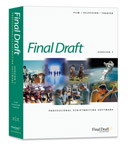
finaldraftjpg
My screenwriting software of choice has long been [Final Draft](http://www.finaldraft.com), which is 90% great, 10% maddening and significantly better than any of the other programs I’ve tried — and believe me, I’ve tried a bunch. This past month, Final Draft came out with version 7.0, which was the first major update in a while.

On the plus side, the new version is stable. It hasn’t quit on me, and it hasn’t had the same [refusing-to-launch problem](http://johnaugust.com/2004/when-final-draft-wont-open-under-os-x) the last version had. It doesn’t choke on the previous version’s files, which is a problem I’ve encountered every previous integer-level upgrade.

One nice new feature is the ability to split a document window, so you can see two parts of the script at the same time. You can show one of the panels in scene-navigator view, or as index cards — which can now have two sides. On a big screen, keeping the left panel open to the scene navigator lets me click through to specific sections quickly.

Splitting the screen is helpful, but hardly revolutionary. Many Mac programs — including Microsoft Word — have had split windows for over a decade. Final Draft runs into familiar problems with this setup. If you make a selection in one panel that extends into the region shown in the other panel, the program freaks out. Caveat selector.

I never use Final Draft’s index cards. While in theory it would be great to reorganize your script just by moving some cards around, real life screenplays never work that way. Scenes aren’t Legos, and they can’t be flopped around willy-nilly. In my opinion, better choices for outlining are [Omni Outliner](http://www.omnigroup.com/applications/omnioutliner/) and [Pyramid](http://www.mindcad.com/). Each of these has free demo versions.

Final Draft 7 is apparently better at exporting .pdf files. That may be new for Windows, but if you’re using Mac OS X, I’d highly recommend using “Print…” and “Save to .pdf” instead. That way, you have all the options of the print dialog box, and you’re guaranteed to get just what the printer would.

There are other features I wish Final Draft had, such as XML export for the web, a clipping bin, and less-aggressive Smart Lists. But on the whole, the program works well for what I make my living doing. And for screenwriters lucky enough to have an honest-to-goodness movie on their hands, the production features alone are worth the price. Final Draft does a very solid job locking pages and tracking revisions, which makes sending out colored pages considerably easier than it has any right to be.

Should you buy Final Draft? Probably. Should you upgrade? That depends. If you’re happy with version 6, there’s really no pressing need. Version 7 isn’t bad, but it isn’t a huge improvement.

« Previous Page
Next Page »

Primary Sidebar

Newsletter

Inneresting Logo A Quote-Unquote Newsletter about Writing
Read Now

Explore

Projects

  • Aladdin (1)
  • Arlo Finch (27)
  • Big Fish (88)
  • Birdigo (2)
  • Charlie (39)
  • Charlie's Angels (16)
  • Chosen (2)
  • Corpse Bride (9)
  • Dead Projects (18)
  • Frankenweenie (10)
  • Go (29)
  • Karateka (4)
  • Monsterpocalypse (3)
  • One Hit Kill (6)
  • Ops (6)
  • Preacher (2)
  • Prince of Persia (13)
  • Shazam (6)
  • Snake People (6)
  • Tarzan (5)
  • The Nines (118)
  • The Remnants (12)
  • The Variant (22)

Apps

  • Bronson (14)
  • FDX Reader (11)
  • Fountain (32)
  • Highland (75)
  • Less IMDb (4)
  • Weekend Read (64)

Recommended Reading

  • First Person (87)
  • Geek Alert (151)
  • WGA (162)
  • Workspace (19)

Screenwriting Q&A

  • Adaptation (65)
  • Directors (90)
  • Education (49)
  • Film Industry (489)
  • Formatting (128)
  • Genres (89)
  • Glossary (6)
  • Pitches (29)
  • Producers (59)
  • Psych 101 (118)
  • Rights and Copyright (96)
  • So-Called Experts (47)
  • Story and Plot (170)
  • Television (165)
  • Treatments (21)
  • Words on the page (237)
  • Writing Process (177)

More screenwriting Q&A at screenwriting.io

© 2026 John August — All Rights Reserved.