• Skip to primary navigation
  • Skip to main content
  • Skip to primary sidebar

John August

  • Arlo Finch
  • Scriptnotes
  • Library
  • Store
  • About

Search Results for: book rights

Scene challenge winners

May 8, 2008 Challenge, Follow Up

Y’know, I think we learned something today: Derivatives were maybe not the best choice for the [third-ever scene challenge](http://johnaugust.com/archives/2008/derivativ).[Scene Challenge]

I deliberately picked something tough because in real life, screenwriters are often faced with [challenging topics to explain](http://johnaugust.com/archives/2008/how-to-explain-quantum-mechanics). For example, last night I spoke with Ron Bass about the Einstein project he’s working on. Quick: Show special relativity.

But this wasn’t much easier. Readers tried hard to find a way to make these abstract financial instruments cinematically explicable, but it proved tougher than expected. First, you had to find a scenario in which derivatives would make sense. Then you needed to craft an explanation that didn’t read like a Wikipedia summary.

That’s assuming you really understood what derivatives were, and after reading 84 entries, I think I understand them less. In the end, I was happy to accept any of the sub-categories (options, futures, forwards), but kept hoping for more entries where the concept of a derivative was really key to the story, and not a throwaway bit of dialogue. That’s why I threw in my own piece of [Angel fan-fic](http://johnaugust.com/archives/2008/derivativ#comment-129753).

That said, I was happy to see that most of the entries didn’t take place on Wall Street, but rather ranged from fantasy ([Alan Scott](http://johnaugust.com/archives/2008/derivativ#comment-129712)) to bachelorhood ([Andy](http://johnaugust.com/archives/2008/derivativ#comment-129742)).

“John August” was introduced as an element in a [surprising](http://johnaugust.com/archives/2008/derivativ#comment-129847) [number](http://johnaugust.com/archives/2008/derivativ#comment-129801) of [scenarios](http://johnaugust.com/archives/2008/derivativ#comment-129851), a meta-quality that helped break up the sameness, but didn’t win any ribbons.

[Jonathan](http://johnaugust.com/archives/2008/derivativ#comment-129867), however, brought up an interesting and obvious analogy I’d overlooked:

ACCOUNTANT

Why don’t you just ask your blog readers to explain it for you?

JOHN

I’ve already tried that. You should have seen the dreck they wrote back. Besides, what do I pay you for?

ACCOUNTANT

(sighing)

When a studio wants to buy your script, but doesn’t want to risk all their money, what do they do?

JOHN

They option the script, so they can buy it at a future date. Crafty devils.

(Jonathan also put me in a jacuzzi with grape-feeding starlets, which suggests he might not know my biography that well.)

[Juicy Lucy](http://johnaugust.com/archives/2008/derivativ#comment-129898) found a good example of a character whose entire existence seems to be a pitiful derivative:

A COUGH from across the table causes Popeye and Olive Oyl both to look up, but their companion’s face hides behind his open newspaper, whose headline reads:

PRICE OF BEEF EXPECTED TO PLUMMET BY THE END OF THIS WEEKEND

The newspaper lowers to reveal WIMPY, his yellow top-hat perched precariously on his fat head, his already thin mustache stretching even further when he shoots a sh*t-eating grin at the approaching WAITRESS...

WIMPY

I’ll gladly pay you Tuesday, for a hamburger today.

I liked how [Unkatrazz](http://johnaugust.com/archives/2008/derivativ#comment-129935) made the distinction between a stock and derivative:

PAPERWEALTH

Why buy an investment...when you can make a bet on an investment?

Having a character explain his job was a natural choice for many readers. The best of these was [Jacob’s](http://johnaugust.com/archives/2008/derivativ#comment-129958):

Next date: Girish is animated. He holds a coffee cup and moves it around the table as he speaks.

GIRISH

Say there is a farmer growing coffee beans in Karala. It’s late July and harvest is still six months away. The problem is that market prices for coffee go up and down for reasons out of his control. In six months, prices could be higher than they are now, which would be lovely. But if prices are lower, he stands to lose his farm. In order to protect himself, he gets together with other farmers in the same position and signs a contract to sell tomorrow’s beans for today’s prices. He gets a little money now, and then when the contract comes due, he sells the beans to the buyer for the agreed-upon price.

Girish pauses, then speaks with emphasis.

GIRISH

Betting that prices will rise, I am that buyer.

Many entries took a glancing shot at derivatives, without really trying to explain them. Of these, [Andy’s](http://johnaugust.com/archives/2008/derivativ#comment-129972) was a favorite:

Scrawny BILL GATES (19) signs a contract in black ink.

BILL GATES

We’re in the 70s. Nobody signs in blood anymore.

He smirks at SATAN (∞), who fidgets nervously.

SATAN

I don’t get it.

BILL GATES

It’s basic finance. Derivatives. By the time you get my soul, it could be worth a lot more.

SATAN

Or a lot less.

BILL GATES

But you’re getting it cheap now. Look, either way you get it. You’re covered.

SATAN

Erm... I don’t know...

BILL GATES

Tell you what. I’ll throw in some stocks to sweeten the deal.

BILL GATES offers him the pen. Satan hesitates.

SATAN

Ah, fuck it.

He signs, and at that very moment, a new Circle is carved into Hell.

Crimeland figures played a role in many entries. [Mike Lavoie](http://johnaugust.com/archives/2008/derivativ#comment-130087) gets credit for working the most financial terms into a threat:

BURGER

There are four kinds of derivatives, Frank. Forwards, which is the direction we can move in now. Options, which you’re running out of. Futures, a couple of which you can decide now. And finally: swaps. As in: You give me my money and, in exchange, you get the rest of your wife.

The two top finishers come from the other side of the crime equation, with police-types investigating derivative wrongdoing. [David Nemesis](http://johnaugust.com/archives/2008/derivativ#comment-129841):

INT. BRANT BUILDING LOBBY – DAY

Eckes and Rosenfeld are walk-and-talking to Rosenfeld’s office.

ECKES

Stop, you lost me. What was Laszlo dabbling in?

ROSENFELD

Weather derivatives. Let’s say you’re Gruber Foods. Your bottom line depends on a good wheat harvest, there are any number of things that can mess that up, and you want to hedge your bets. So you buy up some weather futures.

ECKES

Okay. Wait, what?

ROSENFELD

Weather futures. They’re like an insurance policy on the weather, only no insurer would be crazy enough to put money on the weather. So you go to an options exchange and find someone who’ll sell you a contract that guarantees you a payout if certain things that aren’t likely to happen do happen.

ECKES

Like a snowstorm in the middle of Kansas in July?

ROSENFELD

Well...I’m sure they were thinking more along the lines of a few days of extra rainfall over a 60-day period. But yeah, pretty much. It’s all about variations from the norm. The seller’s taking a calculated risk that their forecasts will be close enough to accurate that they’ll get to keep all the money from the sale.

ECKES

So Laszlo was buying insurance policies which paid out if the weather did something unexpected?

ROSENFELD

Precisely. It’s a great investment opportunity if you just happen to be able to control the weather.

ECKES

Yeah, well, something tells me the folks in the derivatives market don’t know about super powers yet.

And this from [Anthony](http://johnaugust.com/archives/2008/derivativ#comment-129706):

AGENT

Your husband was leading something of a double life. Did you realize he was into derivatives?

WOMAN

(shocked)

You mean ... like transvestites or something?

(a beat)

AGENT

No ma’am. Derivatives. They’re financial instruments – futures, forwards, options.

(beat)

Sort of like stocks, but you’re buying the right or the obligation to make a transaction in the future. Your husband was trading derivatives online. Mostly options.

The woman stares blankly.

The Agent picks up a book from the couch – “Taste of the Town 2008”. It’s one of those coupon books school kids sell for fundraisers.

AGENT

Like the coupons in this book.

(shows her a page in the book)

This Burger Bonanza coupon here – “Any sandwich for 99 cents during the month of December”. That’s like a derivative. When you bought this coupon book you purchased the option to buy an item for a set price at a set time in the future.

WOMAN

I think I liked it better when he was just surfing the Internet for porn. At least my furniture didn’t disappear then.

In the end, I’m giving the imaginary award to Anthony for the coupon book metaphor. Well done. He can claim his bragging rights in the comments section.

Thanks to everyone who entered. I promise next time, it will be something a little more fun.

Authorship in the digital age

October 30, 2007 Follow Up

A few weeks ago, my friend [Howard Rodman](http://www.imdb.com/name/nm0734912/) was asked to give a talk at the 2007 Rencontres Cinématographiques de Dijon, speaking on a panel entitled “Copyright and Droit d’Auteur in the Digital Age.”

Being a reader of the blog, Howard asked if he might incorporate a few of the observations from my [Challenge of Writing in the Digital Age]() speech a few weeks earlier.

I said, “of course.” Especially if he would let me link back to his speech. It’s all very [Creative Commons](http://creativecommons.org/).

As I said at the time, I think my speech would have been improved by focusing on one or two issues, rather than the sampler platter I offered. Here’s a chance to demonstrate that fact.


Authorship in the Digital Age

**a talk by Howard Rodman**

howard rodmanAs the representative of what is, literally, a Writer’s Guild, I’d like first to talk about authorship. As someone who creates intellectual property that is licensed to others, I’d like second to talk about copyright. And ultimately, I’d like to talk about the disruptions, confusions, multiplications, collisions, perturbations, conflagrations, and weird opportunities wrought in both the areas by digital technologies.

Authorship
—

When someone painted on the wall of a cave in Lascaux, he—or she—was the author of that painting. The painter may have been doing it on behalf of a large group, expressing a grander vision. But the person who wielded the instrument, who left the mark—that person was the author.

This is clear. But anything after that—anything involving reproduction—begins to get fuzzy.

Let me throw out a bunch of questions:

* The person who takes pen in hand and writes an essay, is that the author? Well, yes.

* A medieval monk who copies a manuscript, is he the author? He’s the one wielding the instrument, he’s the one leaving the mark– But is he the author? Most of us instinctively would say, no. Because authorship involves more than the reproduction of a work—it seems to involve the creation of a work.

Each technological change brings about a new confusion of the concept of authorship.

Now, in the digital age, authorship is more and more diffuse. More fugitive. More difficult to locate.

Let me throw out some examples.

The American television personality Stephen Colbert, on his show on Comedy Central, stood up one night in front of a green screen and did this: “ZIP. ZAP.”

He challenged his viewers to use the material in creative ways.

Within less than 24 hours, versions popped up on YouTube. Colbert having a lightsabre battle with Star Wars characters. Colbert having a lightsabre battle with Dick Cheney.

Who is the author of these pieces? Is it Colbert? The writing staff of The Colbert Report? Comedy Central? The viewers who composited his image with new or found footage? George Lucas? Dick Cheney?

Last month the American screenwriter John August released his directorial debut, a film called The Nines. He also posted on his website some raw footage from The Nines, and encouraged the readers of his blog to download, remix, go wild. All manner of trailers for The Nines went up on the web: sad versions, funny versions, music video versions, poignant versions, violent versions, red kryptonite versions. This was John’s project, John’s vision. He wrote and directed the footage, he told his audience to edit. Is he the author? Are they the author? Is this a collaboration among authors who have never met? Is this, in a sense that the Surrealists would recognize, a cadvre exquis? Or is this a unique artifact of the 21st century, something that could not have existed prior to the specific technology that makes this strange new hybrid art form possible?

Now let me pose a more personal question about authorship.

I write a film. Meaning: I sit in my basement, and imagine characters, and imagine a story, and because there was nothing, and now there is something, I consider myself to be the author. I send it out, the screenplay attracts a producer, attracts actors, attracts financing. Now the film is made. Now I am in a theater, and the lights darken, and I am seeing on a large screen, and in the company of a large audience, the characters that three years previously I had dreamed up in my basement.

After the company logos, the first thing I see is a title that says “a film by.” But that name isn’t my name.

The last thing I see is small print which reads, “for the purposes of the Berne Convention for the Protection of Literary and Artistic Works and all applicable copyright treaties, the author of this work shall be considered to be TimeWarner Inc.”

So my work, the work that I wrote, is bookended by two statements of authorship, neither of which is mine.

There are two possible reactions to this. One is to descend into an abyss of self-pity. The preferred reaction, of course. But the other is to recognize that the changes brought about to concepts of authorship by technology, the changes brought about to concepts of authorship by copyright, make the old notions sentimental at best, and, most likely, obsolete.

Copyright
—

Let me now talk about copyright.

The concept of copyright didn’t exist until after the invention of the printing press. It didn’t have to. There was no need to protect things from being copied when there was no technology other than the pen for such copying.

In 1556 the Stationers Company maintained that once purchased, the rights to a manuscript belonged to the printer, and the author had no further say in its distribution, or stake in its revenues. So we see that the MPA has its roots in the 16th century.

Next, Charles II passed the Licensing Act of 1682, which established a register of licensed books.

Then in 1709 the Statute of Anne (not to be confused with the statue of Anne) named for Queen Anne. The first real copyright act. For the first time authors, rather than printers, are invested with the right to have a say in the reproduction of their work.

This was in sync with what was to become the French concept of droit morale, which began in many ways with the French Revolution (insert space for applause here) and the writings of Beaumarchais.

And so the principle of copyright, which in many ways still obtains today: you created it, you control its reproduction and distribution.

But there is another need, another social good: that of the free and unimpeded exchange of ideas. So the Statute of Anne also established a 14-year term of copyright (with a 21-year term for works already extant), as a way of balancing the author’s right to profit from his or her work against the public’s legitimate need to have works readily available.

Copyright law ever since has been a balancing act between these two competing needs, both legitimate, both reflecting desirable social outcomes.

But in the 20th century, as the drug manufacturers and the large intellectual property conglomerates became more powerful, they exercised more control over patent and copyright laws—and the balance has shifted.

In 1905, the patent holders went to Washington and essential bought themselves a new concept: work for hire. This was the first exception in American copyright law to the longstanding and intuitive concept that the legally-recognized author of a work is the person who created it.

Work for hire is what we do, as screenwriters, when we get an assignment. It means that we are creating something without most of the rights that typically inhere in the act of creation.

Now, with every re-enactment of the copyright act, the term of copyright grows longer and longer. See, for instance that part of the Digital Millennium Copyright Act called (and I’m not making this up) the “Sonny Bono Copyright Term Extension Act of 1998.”

The 1998 Digital Millennium Copyright Act (DMCA), and the extensions that most likely will be passed in our lifetimes, virtually ensure that neither you, nor I, nor most likely our children, nor, most probably, our grandchildren, will ever be able to draw a sketch of Mickey Mouse without fear of exposure to litigation.

And so of copyright, which was intended to balance the needs of the creator and the public, now primarily benefits the large intellectual property conglomerates. In many senses, we are heading back to the Stationers Act, to the 1500s—except now the stationery store has gone digital.

The DMCA, which, in response to the threat of piracy which Bob Pisano will talk about most eloquently and forcefully, now forbids specific forms of copying—whether the material being copied is copyrighted or not. If I have a DRM-protected DVD of *L’arrivée d’un train en gare de La Ciotat,* a piece of footage as old as cinema itself, and as classically in public domain as any moving footage anywhere, and if I circumvent the DRM to copy that footage, I am committing a crime.

But there are other, countervailing forces. My attorney, the intrepid Michael Donaldson, who plays in the fields of copyright and fair use, says that the copyright laws are in some respects more fair now than they were forty years ago. As he puts it, “In the past, the public’s voice has been absent from the drafting table for copyright legislation. Disinterest was rampant. This was not an area of the law that many people saw as touching their lives. In large part because of the egregiously aggressive behavior of RIAA and MPAA, the public has been alerted to the many ways that copyright touches their lives. And the public’s voice is now being heard.”

Regardless as to whether you see the law moving forwards or backwards, what is clear is that copyright is fluid. And just as the concept of what is an author changed as technology and social relations changed, so has the sense of what is a copyright, and what that copyright protects, and for whose benefit.

Digital Age
—

As Walter Benjamin pointed out in The Work of Art in the Age of Mechanical Reproduction, after the printing press, after photography, when you look at an object, you are often no longer looking, simply and straightforwardly, at an object. You are, instead, looking at the original of a reproduction—with all the associated loss of aura. Is that the Tour Eiffel? Or is that the original of a million postcards, T-shirts, shot glasses, keychains?

The digital age raises this confusion exponentially. For instance: in most previous history, the machinery used to create was distinct from the machinery used to copy. Think of the quill pen and the printing press. Think of the Remington typewriter and the Xerox machine. But now the laptop on which one creates is the laptop on which one copies. The two processes become conflated. And when cut and paste no longer involves scissors or library paste but is instant, is seamless, leaves the thing from which it was cut intact, is pasted without any trace into the new work– The distinction between original and reproduction becomes more slippery, more fugitive.

Even more tellingly, every previous reproduction differed from its original. The painting of the painting was distinguishable from the painting. The cassette tape of the vinyl recording of Pierre Fournier playing Bach’s Sixth Cello Suite was inferior to the vinyl itself. But now the copy is not just almost as good, or virtually as good, or three-places-to-the-right-of-the-decimal-point as good: the copy is indistinguishable from the original. Does it even make any sense, viewing two identical digital files, to speak of “the original.” In this digital age, can even the word “original” retain its original meaning?

Lautréamont famously said, “Poetry must be made by all, not by one.” Perhaps this is what he meant, and perhaps, were he with us at this moment, Lautréamont would be dancing in wild celebration. But then again: perhaps not.

Anyone who is young, or who lives in a house with anyone who is young, or who lives and breathes and drinks in the media of the 21st century, knows that the 20th century’s hallmark distinctions between what goes on a big screen, what goes on a small screen, what goes on a tiny screen, is eroded, perhaps lost. We know, too, the erosion and elision of what is owned, what can be accessed, what is borrowed, what is shared, what is stolen. This is a brave new world for authorship, and a brave new world for the protection of authorship.

And it’s not a worry for the future. As William Gibson famously said, “The future is already here. It’s just unevenly distributed.”

On behalf of the Writers Guild of America, which fights for authorship in this difficult and wonderful time, I thank you.

Based on your own novel

June 6, 2007 Adaptation, QandA

questionmarkWhen writing a screenplay (under contract) that is based on a book that you also wrote, do you still include the “Based on the book by…” line on the title page? Or would that be seen as pompous overkill?
In the same vein, if you have a PhD is there any reason to put it at the end of your name on the title page? (My personal opinion is that only a douchebag would do either of those things, but then again I’m not yet qualified to make that call.)

— Daniel
Portland, OR

Yes. “Based on his novel,” might be another way to handle it. It’s not boasting, really. It helps explains the rights situation, and might clear up confusion down the road.

No. A PhD means nothing in screenwriting, and to include it would only invite mockery..

A Captain Marvel Reader

April 6, 2007 Projects, Shazam

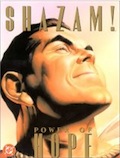
Hope CoverEver since I [announced](http://johnaugust.com/archives/2007/the-big-red-cheese) that I’m writing Shazam!/Captain Marvel, I’ve gotten some great questions and comments from longtime fans of the character, many with detailed pleas to include a specific cherished piece of the mythology.

But when I tell people face-to-face that I’m writing a Captain Marvel movie, I often notice a specific micro-reaction. Their eyes go up and to the left as they try to remember, who the hell is Captain Marvel? Half the time, they come up with Captain America instead.

So, in the interest of spreading general knowledge about Captain Marvel and why he kicks ass, I thought I’d share a reading list. Don’t worry; there’s no test. In fact, consider this a gentle education (or re-education) on why some of the best writing today is inked and colored.

Getting over comic anxiety

One reason adults can be scared off from comics is that the universes in which superheroes live tend to be incredibly complicated and interconnected. It’s the same reason I haven’t started watching Battlestar Galactica — I feel like I need to catch the first few seasons on DVD.

But it’s even more bewildering than that. You can think of any comic book series (Batman, Superman, JSA) as being roughly equivalent to a television series, with each issue serving much like an episode.Indeed, Joss Whedon is doing exactly that with his Buffy: Season 8. By this analogy, DC and Marvel Comics are like television networks — the difference being that *all their shows cross-over constantly.* Imagine if in order to follow Lost, you also had to keep up to speed with Grey’s Anatomy, Ugly Betty and According to Jim.

You’d want a guidebook. A cheat sheet.

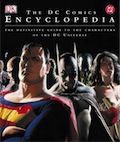
DC EncyclopediaFor the DC Universe in which Captain Marvel lives, the most helpful resource I’ve found is the [DC Comics Encyclopedia](http://astore.amazon.com/johnaugustcom-20/detail/075660592X/103-6872397-4470203).There’s a similar [Marvel Encyclopedia](http://www.amazon.com/gp/product/0756623588?ie=UTF8&tag=johnaugustcom-20&linkCode=as2&camp=1789&creative=9325&creativeASIN=0756623588) available as well. I just ordered it today, so I can’t vouch for it. It includes artwork and bios on pretty much every significant player (hero and villain) in the DC universe.Arguably, multiverse, but I don’t want to dip my toes into that debate. Suffice to say that Captain Marvel and his compatriots used to exist on an alternate Earth (one that didn’t have Superman et al.), but got folded in due to a massive cosmic event. Naturally, one consequence of the book’s breadth is its lack of depth. A few paragraphs can’t explain why a given character is important or relevant, and tends to overemphasize vintage characters who will never play a significant role in future storylines. (Old West gunslingers, I’m looking at you.)

Still, it’s invaluable. I’ve been paging through this book for the last two years,True confession: It’s my bathroom reader. constantly discovering new connections and relationships. The term “mythology” is overused in popular culture, but it really applies to superheroes. They’re our Greek gods and demigods, and their stories are just as tangled, fascinating and unlikely.Off topic, but what is the proper name for the religion that worships the classic Greek (or Roman) gods? Pan-Hellenism? That’s a church I’d like to visit.

Getting up to speed on Captain Marvel

Captain Marvel was originally published by Fawcett Comics, and for a time outsold Superman — in fact, it was a copyright infringement lawsuit that led to Fawcett ceasing publication.The lawsuit seems absurd today, because the two overlapping powers — strength and flight — are pretty much ubiquitous among today’s superheroes. DC Comics bought out the rights to the character in 1991, but for legal reasons can’t promote the comic book using the Captain Marvel name. From the [Wikipedia entry](http://en.wikipedia.org/wiki/Captain_Marvel_(DC_Comics):

Because Marvel Comics trademarked their Captain Marvel comic book during the interim between the original Captain Marvel’s Fawcett years and DC years, DC Comics is unable to promote and market their Captain Marvel/Marvel Family properties under that name. Since 1972, DC has instead used the trademark Shazam! as the title of their comic books and thus the name under which they market and promote the character. Consequently, Captain Marvel himself is sometimes erroneously referred to as “Shazam.”

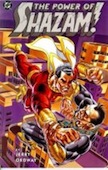
Power CoverA fairly classic genesis story for Captain Marvel can be found in Jerry Ordway’s [The Power of Shazam!](http://astore.amazon.com/johnaugustcom-20/detail/1563891530/103-6872397-4470203) It’s semi-period and kind of Mummy-like (a lot of Egyptian tomb business), but manages to evoke a vintage feel without the vintage dullness.

While he rarely has his own series, you find Captain Marvel sprinkled throughout the DC world. He’s particularly helpful when you need someone to go head-to-head with Superman. Captain Marvel isn’t vulnerable to kryptonite, and holds up better than the Man of Steel against magic.

First Thunder CoverA good place to start is Judd Winick’s [First Thunder](http://astore.amazon.com/johnaugustcom-20/detail/1401209238/103-6872397-4470203), which posits the first real encounter between these titans, and nicely contrasts not only the two heroes but their corresponding villains, Lex Luthor and Dr. Sivana. The book smartly moves beyond the smash-and-bash action to raise interesting questions: Is it fair to put this much responsibility on a young kid? Which identity is your “secret identity?” And what would Superman have done without the Kents to watch over him?

[Day of Vengeance](http://astore.amazon.com/johnaugustcom-20/detail/1401208401/103-6872397-4470203) (also by Judd Winick) features a very different Marvel/Superman matchup, as the Man of Steel finds himself possessed by the demon Eclipso. It’s a good battle, and it makes use of one of the Marvel family’s less-defined abilities: the magic thunderbolts which come when you call, “Shazam!” These thunderbolts can seemingly do anything. I keep waiting for some unhinged environmentalist to figure out he can use them to power the world’s electric grid — *but at a deadly price!*

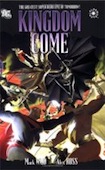
Kingdom Come coverIf you want bleak, look no further than Mark Wald’s [Kingdom Come](http://astore.amazon.com/johnaugustcom-20/detail/1563893304/103-6872397-4470203), in which the grown up Billy Batson is basically Lex Luthor’s pawn, a superpowered goon to protect the evil mastermind from Superman. Between this and [Watchmen](http://astore.amazon.com/johnaugustcom-20/detail/1401207138/103-6872397-4470203), one is left with the impression that superheroes don’t get better with age.

JSA and Black Adam

Captain Marvel can be found in many Justice Society of America books, but an even larger presence is Black Adam, who is sometimes an ally and often an adversary. Black Adam was the original champion chosen by the wizard Shazam, and is ostensibly as powerful as The Big Red Cheese. But he’s brutal and charismatic, which is why fans love him no matter which side he’s on.

Geoff Johns, who was gracious enough to listen to my pitch before we went in to New Line, has two books featuring Black Adam to check out: [Black Reign](http://astore.amazon.com/johnaugustcom-20/detail/1401204805/103-6872397-4470203) and [Black Vengeance](http://astore.amazon.com/johnaugustcom-20/detail/1401209661/103-6872397-4470203). The storylines continue into this past year’s [52](http://astore.amazon.com/johnaugustcom-20/detail/1401213537/103-6872397-4470203).

For a one-off making good use of the Rock of Eternity (home base of Captain Marvel), check out [Virtue and Vice](http://astore.amazon.com/johnaugustcom-20/detail/1401200400/103-6872397-4470203). Featuring both the JSA and the Justice League, it’s a sampler platter of powers and what-if scenarios, but well worth a look.

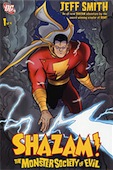
Monster Society CoverAmong current series, Judd Winick’s [Trials of Shazam!](http://astore.amazon.com/johnaugustcom-20/detail/1401213316/103-6872397-4470203) finds Billy Batson taking over for the wizard, and overseeing the training of his replacement. Meanwhile, Jeff Smith’s [Shazam!: The Monster Society of Evil](http://www.dccomics.com/comics/?cm=6829) is goofy and whimsical, a great alternative to the weary darkness of many comics today.

Why I’m not including the vintage collections

DC publishes hardcover anthologies that gather up decades’ worth of Captain Marvel comics. If I were writing a dissertation on the evolution of the Captain Marvel character, these would be invaluable. But I’m not. So every time I read one of these, I’m struck with the same realization I encounter trying to watch The Honeymooners or a black-and-white movie: Wow. Old things suck.

Yes, I know that will piss off the vintage comics fans, who insist that the original incarnations are the purest forms of a character. But what you quickly realize is that old-time comic books were awkwardly written, crudely drawn, and bewilderingly inconsistent with their rules. They were making up the art form as they went along, and today’s comic books are better for the accumulated wisdom.

Vintage fans are free to disagree. There’s a vast but finite amount of comic books to last them through their days.My brother is big into classic rock. I once pointed out to him that everything he will ever like has already been recorded. Which seems depressing, but will undoubtedly happen to most of us.

Beyond that, are there great books I’m leaving off, either intentionally or accidentally? Almost certainly. The comments are your chance to add to the reading list.

« Previous Page
Next Page »

Primary Sidebar

Newsletter

Inneresting Logo A Quote-Unquote Newsletter about Writing
Read Now

Explore

Projects

  • Aladdin (1)
  • Arlo Finch (27)
  • Big Fish (88)
  • Birdigo (2)
  • Charlie (39)
  • Charlie's Angels (16)
  • Chosen (2)
  • Corpse Bride (9)
  • Dead Projects (18)
  • Frankenweenie (10)
  • Go (29)
  • Karateka (4)
  • Monsterpocalypse (3)
  • One Hit Kill (6)
  • Ops (6)
  • Preacher (2)
  • Prince of Persia (13)
  • Shazam (6)
  • Snake People (6)
  • Tarzan (5)
  • The Nines (118)
  • The Remnants (12)
  • The Variant (22)

Apps

  • Bronson (14)
  • FDX Reader (11)
  • Fountain (32)
  • Highland (74)
  • Less IMDb (4)
  • Weekend Read (64)

Recommended Reading

  • First Person (87)
  • Geek Alert (151)
  • WGA (162)
  • Workspace (19)

Screenwriting Q&A

  • Adaptation (65)
  • Directors (90)
  • Education (49)
  • Film Industry (489)
  • Formatting (128)
  • Genres (89)
  • Glossary (6)
  • Pitches (29)
  • Producers (59)
  • Psych 101 (118)
  • Rights and Copyright (96)
  • So-Called Experts (47)
  • Story and Plot (170)
  • Television (165)
  • Treatments (21)
  • Words on the page (237)
  • Writing Process (177)

More screenwriting Q&A at screenwriting.io

© 2026 John August — All Rights Reserved.