• Skip to primary navigation
  • Skip to main content
  • Skip to primary sidebar

John August

  • Arlo Finch
  • Scriptnotes
  • Library
  • Store
  • About

Search Results for: book rights

Spelunking the Kindle market

June 2, 2009 Books, Follow Up, Projects, The Variant

How many books does Amazon sell on Kindle each day? How closely does it follow the 80/20 rule, in which a few top sellers account for a huge percentage of total sales? Is there a classic long tail — and is it even worth being on it?

Amazon is incredibly opaque with the details, even when you’re publishing on their system.
The day after its debut, my story [The Variant](http;//johnaugut.com) briefly reached #18 on the Kindle [bestsellers list](http://www.amazon.com/gp/bestsellers/digital-text/ref=pd_dp_ts_kinc_1). While that was exciting, I still don’t know exactly what it means.

Like other Amazon statistics, it seems to get recalculated hourly, but there’s no indication whether it’s a pure number of sales that hour (which would make for very erratic swings) or some sort of sliding average over time. Based on how it’s handled for physical books, it’s [probably a combination](http://www.webpronews.com/expertarticles/2006/06/15/navigating-the-amazon-sales-ranking):

> Only the top 10,000 books are updated every hour and the ranking does not depend upon the actual number of books sold, but rather, on a comparison against the sales figures of the other 9,999 books within that same hour. Simultaneously, a trending calculation is applied to arrive at a computerized sales trajectory. So, hypothetically, a book that held a ranking of 2,000 at 2pm and 3,000 at 3pm, might hold a 4,000 ranking at 4pm, even if it actually sold MORE books between 3-4 than it did between 2-3.

All I really know is that the day I hit #18, I sold about 500 copies. So my hunch is that titles around that spot in the list (say, 15 to 25) might sell around 500 copies per day. That is, they probably sell 500 as opposed to 50 or 5,000. I’m only try to get a sense of how many zeroes are involved.

Stephenie Meyer is rich
—–
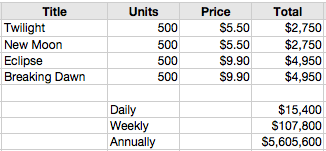
twilight salesAs it happens, all four of Stephenie Meyer’s Twilight books fall into this range, and have been here for quite a while. They’re priced at $5.50 (for the first two) and $9.99 (for the second two).

If each is selling around 500 copies each day, that means the four of them are generating $15,400 per day, or $107,800 per week. Granted, that 500 is a guess, but it’s probably a number with two zeroes.

We don’t know the split between Meyer, her publisher and Amazon — it’s possible that the retailer is deliberately taking a loss on the Twilight books in order to woo Kindle buyers — but it’s clearly a nice bit of money with no paper, shipping or inventory costs. ((Yes, clearly Meyer and her publisher are making great money off the printed versions of the books, which probably account for 95%+ of sales. But the Kindle sales aren’t insignificant.))

Worst bestsellers
——

Unlike the iTunes App Store, Amazon doesn’t distinguish between free and paid content on their Kindle bestseller list. In fact, 19 out of the top 50 books are free. There’s nothing wrong with free, but it’s a semantic and tactical mistake to include them on a “bestseller” list.

The current system keeps [Serial](http://www.amazon.com/gp/product/B002AJ7X2C?ie=UTF8&tag=johnaugustcom-20&linkCode=as2&camp=1789&creative=390957&creativeASIN=B002AJ7X2C) in the #1 slot for no real reason other than being free. I envision many brand-new Kindle owners powering up their devices for the first time, and wanting to download a book to test out the service.

Where do they find a book? The bestseller list. And look! The bestseller is free!

This isn’t a knock on Serial or its authors. In fact, one of the writers has a [useful post](http://jakonrath.blogspot.com/2009/05/more-on-amazon-kindle.html) of his experiences with publishing on the Kindle. He notes that…

> The freebies are being downloaded and read. There isn’t money changing hands, but branding and name-recognition — two essentials for every successful author — are happening.

Free should always be a choice. But I’d argue the free preview feature on every Kindle title is designed for exactly this sort of try-before-you-buy. If after forty pages you haven’t convinced a reader to pony up at least 99 cents, I don’t know that “branding” is really the issue.

By letting bestsellers be free, Amazon also makes it easy to game the system. [The Cook’s Illustrated How-to-Cook Library](http://www.amazon.com/Cooks-Illustrated-Cook-Library-step/dp/B001RF3U9U/ref=pd_ts_kinc_23?ie=UTF8&s=digital-text) got into the top 20 as a free book, then jacked up the price to $9.99. ((Indeed, many of the reviews are some variety of “I can’t believe it’s free!”)) Letting author-publishers change the price is smart; letting them monkey with your bestseller list is dumb.

I’d propose Amazon keep the zero-price option, but move free titles to their own list. After all, nothing else in Amazon’s ranking system has to compete with free.

But until they make that change, I’m considering organizing an online flash mob for The Variant. For one predetermined hour, I’ll set the price to zero and invite everyone I know to “buy” it. I’m curious how high I could get on the list.

Overall impressions
——

As I noted in my earlier post about [formatting for Kindle](http://johnaugust.com/archives/2009/kindle-formatting-for-web-geeks), getting a book published on Amazon’s platform is surprisingly straightforward. But I really hoped for better reporting. Should one raise or lower the price? Do ads work? Do reviews help?

Without better information, it’s tough to make any of these decisions.

The Kindle isn’t currently the (mythical?) indie goldmine the iTunes App Store has become. Despite Amazon’s first-mover advantage, there is clearly opportunity for competitors, like Google, Apple or Sony.

More pressingly, there’s a need for better international ebook distribution. The Kindle is U.S.-only, likely due to do rights issues. A European solution would be great; a global version would be better. My e-Junkie/PayPal system for pdfs and ePubs is just barely workable. If I could graft it onto a trusted store like Amazon or iTunes, everyone would feel more comfortable.

Why aren’t adaptations ok for competitions?

April 14, 2009 Adaptation, QandA, Television

questionmarkWhy can’t I find any screenwriting contests that accept scripts that are adapted from another source — in my case a book that I’ve got the option rights to?

Do you know of any? It seems everyone I see only accepts ‘original’ material.

— Matisse

Two reasons:

1. **Apples to Apples.** With an adapted screenplay, it’s not altogether obvious what awesomeness came from the screenwriter, and what came from the underlying material.

2. **Legal Awkwardness.** Let’s say a screenwriting competition gives first place to an adaptation of the third book of the Twilight series. Do you think Stephanie Meyer (or her business people) would be delighted?

One exception to all of this: television. Writing spec episodes of current television series is an accepted industry practice, and several competitions feature this, including [Austin](http://www.austinfilmfestival.com/new/screenplay).

Indie film, cont’d

October 20, 2008 Film Industry, Follow Up, Indie, Sundance, The Nines

At AFF this weekend, I had conversations with several writer-directors who had read my [earlier appraisal](http://johnaugust.com/archives/2008/nines-post-mortem) of the frustrating state of independent film distribution, and my experience with The Nines. One director of a college comedy (whose name and film escape me, unfortunately) was planning to do a get-in-the-van tour with [Todd Sklar of Box Elder](http://johnaugust.com/archives/2008/self-distributing-an-indie-feature). Probably a smart choice for his film and audience.

Others had different plans and questions. And while I didn’t have any new answers, I wanted to share some of what’s going on.

First up: [Splinter](http://splinterfilm.com/Home.html), which looks to be a straightforward and stylish creature horror movie. Director Toby Wilkins made the film for [Magnolia Pictures](http://www.magpictures.com/profile.aspx?id=fd521545-10ed-49f1-b017-b68146596d80), which is distributing it theatrically and via HD on demand. (In fact, the on-demand version is available right now.)

Here’s the trailer:

While it won’t be getting a big theatrical push — and there’s no point expanding it after Halloween — I bet this will do reasonably well for everyone involved. Horror fans are fairly easy to reach through genre sites and publications, and the mix of theatrical and video-on-demand creates a national release in advance of the DVD. Wilkins and writer Ian Shorr (a USC grad) will get more exposure than many horror filmmakers, who often find themselves hitting a few festivals before the movie eventually comes out on DVD, nearly forgotten from its earlier hype.

But will they get any more money? Hard to say. Since Magnolia has a relationship with HDNet, where they can theoretically show the movie as much as they want, is there the same motivation to squeeze every cent out of video, both in the U.S. and overseas? Time will tell. I was very hands-off with The Nines when it came to international video, which is part of the reason the DVD just came out last month in Australia. ((Ballast director Lance Hammer dropped out of a similar-sounding deal with IFC when the dollars involved were just too low, ultimately choosing to self-distribute. But Magnolia apparently invested in Splinter from the start, so their investment is likely quite a bit higher.))

summerhoodAnother filmmaker I spoke with was Jacob Medjuck, whose film [Summerhood](http://www.summerhood.com/Trailer_Site/Summerhood_Trailer_%28Facebook%29.html) has gotten a steady string of festival awards. It’s a summer camp comedy with John Cusack and Christopher McDonald, but it’s the little kid who (appropriately) seems to be the potential break-out star.((Note to all indie filmmakers: embrace embedding for your trailers.))

Jacob is trying to figure out what to do next in terms of distribution. Whereas Splinter was an easy sell based on genre, Summerhood is what we call “execution-dependent.” That is, in order to be worth something, Summerhood has to be better-than-good; Splinter just has to be competent. (For the record, I haven’t seen either movie.)

In a perfect world, Summerhood would sell to a distributor like Fox Searchlight, who could make it the next Juno. Or at least the next Waitress. But if that hasn’t happened yet, I would take all offers seriously, even if they’re really for TV and video rights. If a Magnolia-like company wants to do a day-and-date video/theatrical experiment, consider it. If iTunes gets an indie program going, try that.

Jacob wisely asked how he should be proportioning his time between working for his movie and working for his career. In truth, he should probably be splitting it 50/50 — but doing it with such intensity that it’s 100/100. He can probably get into 40 more film festivals this year, and if he has the inclination, he should. Festivals are probably his best bet for getting people to see his work on the big screen, and his persistence will lead to some good contacts along the way.

Both Toby and Jacob are evidently blog-readers, so I’m hoping they’ll jump in to answer any questions or comments that come up.

Aquaman is a Pescepublican

August 13, 2008 Dead Projects, Projects, Psych 101

Recent articles about the [political leanings](http://tor.com/index.php?option=com_content&view=blog&id=578) of popular comic book characters got me thinking about the uncanny valley between fictional and real-world ideologies. We’re happy to have characters speak in broad terms — “With great power comes great responsibility” — but the minute they start referring to specific issues, we become very uncomfortable.

How does The Flash feel about immigration? Is Wolverine pro-choice? Does Black Canary support the First Amendment rights of hate groups? We don’t know, and really don’t want to know.

To be certain, comics sometimes do have their characters take specific, controversial political stands. Famously, Frank Miller’s Superman in The Dark Knight Returns is literally working for Reagan. But more often, we get placeholders and parallels to soften the blow.

Wonder Woman’s homeland of Themiscyra is isolationist, as the U.S has been at times. The Green Lanterns police the universe, like U.N. peacekeepers writ large. And X-Men are mutants who fight prejudice, discrimination and mutant-phobia.

Sometimes the analogies are transparent. Black Adam rules Kahndaq with an iron fist — he’s literally a weapon of mass destruction, and a danger to the free world. But the facile Iraq/Al-Qaeda parallels only go so far. Yes, he’s a tyrant, but there’s no religion or oil at stake, no greater cause beyond his own ego. If Black Adam were to get sucked into a magic scarab, or sent to the farthest reaches of the universe, there would be no more “Kahndaq crisis.” ((As recent history has shown, simply getting rid of the leader achieves less than you’d think in the real world.))

And this is probably a good thing. I’d argue that the thematic success of comic book characters, and comic book storylines, comes from how closely they can approach the line separating Real from Too Real, without crossing it.

For example, this summer’s The Dark Knight is set in the most realistic Gotham City yet, but its characters still speak in broad philosophical proclamations. Just listen to Batman:

> Sometimes, truth isn’t good enough. Sometimes people deserve more. Sometimes people deserve to have their faith rewarded.

Sometimes, dialogue should only be spoken while wearing a mask. His statement makes sense in abstract, but you wouldn’t want it applied to, say, the invasion of a sovereign nation based on false evidence. Even Commissioner Gordon seems to understand that Batman is better suited to villain-thumping than leadership. His improbable answer to his young son’s question about why Batman is running:

> Because he’s the hero Gotham deserves, but not the one it needs right now…and so we’ll hunt him, because he can take it. Because he’s not a hero. He’s a silent guardian, a watchful protector…a dark knight.

(MUSIC RISES.)

Efforts to place TDK’s Batman on a real-world political spectrum are doomed. Sure, he’s tough on crime, but he’s also anti-gun. He holds himself outside the law, but destroys his own phone-tapping technology. Is he a [Conservative](http://online.wsj.com/article/SB121694247343482821.html?mod=opinion_main_commentaries)? A [Liberal](http://thatsrightnate.com/2008/07/20/dark-knight-liberal-propaganda-is-a-joke/)? ((Note: Dry humor at link. You have to read a few entries to get the gist of it.)) A [Libertarian](http://blog.mises.org/archives/008317.asp)?

Nope, he’s just Batman. And as a comic book character, he’s allowed to hold simultaneous incompatible philosophies.

I think fans are responding to this latest wave of superhero movies not because they’re more realistic, but because they safely insulate us from reality, letting us address epic themes without uncomfortable details. Law versus Chaos is entertaining in TDK, but messy when you look at Iraq. The military-industrial complex is, well, less complex when Tony Stark can simply stop making weapons. And become a weapon. Or something. (The important thing is, he beat up Jeff Bridges, who was visibly evil and bald.)

The episode of Heroes: Origins I was set to write and direct last year deliberately crossed that line between “somewhat believable” and “far too realistic.” It was structured as an installment of A&E’s great documentary series [Intervention](http://www.aetv.com/intervention/), and followed two addicts with superpowers. We never shot it — [the whole series got shelved](http://johnaugust.com/archives/2007/no-heroes) — but I’m not sure it would have worked. And the producers were certainly nervous. In Iron Man, Tony Stark’s alcoholism is fundamental but non-threatening; real addiction is too real, too uncomfortable.

On some level, we want to keep our heroes just pure enough to fight the bad guys without encumbrance.

« Previous Page
Next Page »

Primary Sidebar

Newsletter

Inneresting Logo A Quote-Unquote Newsletter about Writing
Read Now

Explore

Projects

  • Aladdin (1)
  • Arlo Finch (27)
  • Big Fish (88)
  • Birdigo (2)
  • Charlie (39)
  • Charlie's Angels (16)
  • Chosen (2)
  • Corpse Bride (9)
  • Dead Projects (18)
  • Frankenweenie (10)
  • Go (29)
  • Karateka (4)
  • Monsterpocalypse (3)
  • One Hit Kill (6)
  • Ops (6)
  • Preacher (2)
  • Prince of Persia (13)
  • Shazam (6)
  • Snake People (6)
  • Tarzan (5)
  • The Nines (118)
  • The Remnants (12)
  • The Variant (22)

Apps

  • Bronson (14)
  • FDX Reader (11)
  • Fountain (32)
  • Highland (74)
  • Less IMDb (4)
  • Weekend Read (64)

Recommended Reading

  • First Person (87)
  • Geek Alert (151)
  • WGA (162)
  • Workspace (19)

Screenwriting Q&A

  • Adaptation (65)
  • Directors (90)
  • Education (49)
  • Film Industry (489)
  • Formatting (128)
  • Genres (89)
  • Glossary (6)
  • Pitches (29)
  • Producers (59)
  • Psych 101 (118)
  • Rights and Copyright (96)
  • So-Called Experts (47)
  • Story and Plot (170)
  • Television (165)
  • Treatments (21)
  • Words on the page (237)
  • Writing Process (177)

More screenwriting Q&A at screenwriting.io

© 2026 John August — All Rights Reserved.