• Skip to primary navigation
  • Skip to main content
  • Skip to primary sidebar

John August

  • Arlo Finch
  • Scriptnotes
  • Library
  • Store
  • About

Search Results for: Dahl

Turns out, he was busy reconsidering Tyra Banks

July 28, 2006 First Person, Los Angeles

You know how you can go months without seeing someone, then suddenly, they’re everywhere? This morning as I was getting into my little Prius, screenwriter/neighbor/inconstant blogger [Josh Friedman](http://hucksblog.blogspot.com/) rolled up in the Death Star Escalade to discuss our respective children’s nap schedules in anticipation of a playdate.

Yeah, I said playdate. This is how we roll in the Southside.

Of Hancock Park.

I suspect Josh was taking his family to BLD (“Breakfast, Lunch, Dinner”), the new restaurant that took over where Red used to be, and is pretty much exactly like Red but white instead, and without those Mexican Cokes.

In typing that, I realize that I’ve now lived in L.A. long enough that I expect everyone to share my specific geo-cultural references. Or, more bluntly, I’ve now lived here long enough to stop caring when they don’t. It only takes a New Yorker six months to become this jaded. Los Angeles takes a decade.

Later today, I followed a link to the [trailer](http://trailers.apple.com/trailers/universal/theblackdahlia/) for Josh’s upcoming movie, The Black Dahlia. I don’t know how he got his name in red in the credit block, but from now on I’m putting that in my contract. I want red and a little box around it.

Upon checking the feeds this evening, I see Josh has finally posted [something new](http://hucksblog.blogspot.com/2006/07/snakes-on-motherfucking-catwalk.html) on the blog. And while I’d like to take credit for this rare occurrence, the more pressing matter is addressing some corrections/clarifications:

* My assistant does not bring me breakfast, though he often brings lunch. (However, I do not [blog about](http://www.janeespenson.com/) it.)

* In daily life, my house is light-filled like a Richard Curtis movie. However, to achieve the look of this on film for The Movie required giant lights and hard gels velcro-ed to all the doors and windows.

As Tyra knows, beauty takes work.

That’s all.
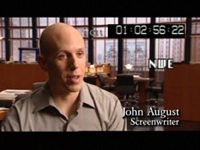
Professional Writing and the Rise of the Amateur

March 1, 2006 First Person, Rant, So-Called Experts

Last night, I had the pleasure of giving a guest lecture at Trinity University in San Antonio. While I speak at various screenwriter-oriented functions fairly often, this was unusual in that the event was university-wide, and the focus wasn’t specifically on film.

Part of the deal was that I had to announce the title of my speech months in advance. I picked, “Professional Writing and the Rise of the Amateur,” figuring that in the intervening months I would think of inspiring examples of how the World of Tomorrow was going to be a wonderland of possibility for the undergraduates in the audience.

But the more I thought about it, the less I wanted to talk about the future. Instead, I wanted to focus on one of the biggest challenges of today: in our celebration of the amateur, we kind of forget what it means to be professional.

As I spoke with various classes before the big presentation, I promised I’d post the whole speech on the site for those students who had night classes. And, of course, for anyone else who might be interested.

Let me warn you: this is __long__. My speech lasted 45 minutes, and that was without a lot of riffing. So if you’d rather read the whole thing as a .pdf, you can find it [here](http://johnaugust.com/Assets/professional.pdf).

. . .

It’s a pleasure to be here talking with you tonight. Over the last two days, I’ve been visiting a lot of classes, talking about screenwriting and movies, and well, basically talking about myself. Which I’m really good at. But when I agreed to give a formal public lecture, one of the requirements was that the presentation actually have a title. By which I mean a topic, a thesis. A point.

It all feels very academic, and I love that. I miss that. None of you will believe me now, but some day you’ll look back on your college careers and be wistful. Nostalgic. Because there’s something comforting about having to write a fifteen page paper on the use of floral imagery in “Pride and Prejudice.”

I think what it is, is that even if you’re completely wrong, it just doesn’t matter that much. For the rest of your life, you’re going to get called on bullshitting. In college, you’re graded on it.

Anyway.

I decided I wanted my lecture tonight to be not strictly about screenwriting, but about writing in general. Because everyone in this room is a writer. You might write screenplays; you might write research papers. You definitely write emails. Every one of you is, and will be, a professional writer in some field.

So I wanted to talk about what that means.

[Read more…] about Professional Writing and the Rise of the Amateur

Charlie out on DVD

November 8, 2005 Charlie

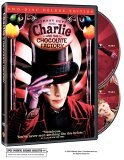
Charlie DVD
Charlie and the Chocolate Factory is out on DVD today (at least, in North America). There are three versions available: a widescreen version, a full screen version, and a two-disc set with bonus features.

Obviously, don’t get the full screen version.

It’s frustrating that they even sell one, much less call it “full screen.” In order to make the film fit on a conventional television set, they lop off a little on the right and left, or [pan-and-scan](http://en.wikipedia.org/wiki/Pan_and_scan). That means you’ll lose any Oompa-Loompas at the edge of the frame.

You wouldn’t kill an Oompa-Loompa, would you? So get the widescreen version.

Or better yet, get the two-disc set. The bonus disc has a lot of featurettes about the making of the film, including how they did the squirrels and Oompa-Loompas. On Amazon, it only costs $19.98, compared to $15.98 for the single-disc version.

john dvdI show up in several of the bonus features. My advice for any screenwriter lucky enough to have their movie come out on DVD: be really nice to the crew that films the bonus features. Think about what they’ll need when they’re editing. Specifically:

1. Tell the story. They need someone to help fill in pieces of the plot so that it makes sense.
2. Speak clearly.
3. If you screw up, or start rambling incoherently, just stop. Take a breath, and start over. They’ll use your clean take.
4. They won’t use the interviewer’s voice, so when they ask you a question, you have to answer as if unprompted. For example:

  • INTERVIEWER
  • Was is intimidating working with a book you loved so much?
  • YOU
  • It was intimidating working on this book I loved so much as as kid. I felt this responsibility to make sure that not just Roald Dahl’s words, but his spirit…etc.

As I’ve [mentioned before](http://johnaugust.com/archives/2004/big-fish-sells-2-million-dvds-in-its-first-week), the screenwriter doesn’t get a particularly big cut of the DVD profits. But it’s something. For Charlie, I’ll also get royalties for “Wonka’s Welcome Song,” for which I co-wrote lyrics.

If you feel like shooting an extra few pennies my way, you can order through Amazon here.

Why is Charlie so passive?

September 18, 2005 Charlie, Projects

questionmarkIn Charlie and the Chocolate Factory, why is Charlie so passive in the movie?

As the main character I would think he would do something during the big adventure in the factory but he does nothing. He faces no challenges. He is not tested in any way. He doesn’t even have the opportunity to make a single mistake.

He is simply the blandest and most uninteresting character in the entire group. He doesn’t even merit a song. I just don’t get it.

–Gilbert

Congratulations, Gilbert. You are now a studio executive.

The one consistent note Tim and I got from Warner Bros. about the script was, “Shouldn’t Charlie be trying harder?” To which we answered, “No.” And because Tim Burton is Tim Burton, they eventually stopped asking.

The world is full of movies where scrappy young heroes succeed by trying really hard, by being clever and saying witty things. But that’s not Roald Dahl’s Charlie Bucket at all. We didn’t want a classic Disney protagonist, so we left Charlie the way he was: a good kid.

Here’s what I wrote a [few weeks ago](http://johnaugust.com/archives/2005/whats-the-difference-between-hero-main-character-and-protagonist) about this issue:

However, Charlie is not a classic Protagonist. Charlie doesn’t grow or change over the course of the story. He doesn’t need to. He starts out a really nice kid, and ends up a really nice kid.

In terms of Classical Dramatic Structure, that leaves us one Protagonist short, which leads to the biggest change in the screenplay versus the book (or the 1971 film). In our movie, Willy Wonka is the protagonist. He grows and changes. We see his rise and fall, along with his nervous breakdown during the tour. Charlie’s the one who’s always asking – ever so politely, in the Freddie Highmore Whisperâ„¢ – the questions that lead to Wonka’s flashbacks upon his rotten childhood. (In Classic Dramatic terms, that makes Charlie an Antagonist. Not to be confused with a Villain. Are you sure you don’t want to read about some squirrels?)

As I pitched it to Tim: Charlie gets a factory, and Willy Wonka gets a family. It’s the whole want-versus-need thing. Charlie doesn’t need a factory. Wonka really needs a family. Otherwise, he’s going to die a giggling misanthropic weirdo.

Charlie “wins” because he’s genuinely good, in a quiet, unassuming way. He doesn’t get a song because the Oompa-Loompas only sing about rotten children.

I’m sorry that doesn’t float your boat, Gilbert, but I think the real issue may be how much you’re preconditioned by all the movies you’ve seen with plucky kids who outthink the adults. If you hurry, you can probably catch one at the multiplex.

[Deciding which parents get to visit the factory](http://johnaugust.com/archives/2005/deciding-which-parents-get-to-visit-the-factory)

« Previous Page
Next Page »

Primary Sidebar

Newsletter

Inneresting Logo A Quote-Unquote Newsletter about Writing
Read Now

Explore

Projects

  • Aladdin (1)
  • Arlo Finch (27)
  • Big Fish (88)
  • Birdigo (2)
  • Charlie (39)
  • Charlie's Angels (16)
  • Chosen (2)
  • Corpse Bride (9)
  • Dead Projects (18)
  • Frankenweenie (10)
  • Go (29)
  • Karateka (4)
  • Monsterpocalypse (3)
  • One Hit Kill (6)
  • Ops (6)
  • Preacher (2)
  • Prince of Persia (13)
  • Shazam (6)
  • Snake People (6)
  • Tarzan (5)
  • The Nines (118)
  • The Remnants (12)
  • The Variant (22)

Apps

  • Bronson (14)
  • FDX Reader (11)
  • Fountain (32)
  • Highland (74)
  • Less IMDb (4)
  • Weekend Read (64)

Recommended Reading

  • First Person (87)
  • Geek Alert (151)
  • WGA (162)
  • Workspace (19)

Screenwriting Q&A

  • Adaptation (65)
  • Directors (90)
  • Education (49)
  • Film Industry (489)
  • Formatting (128)
  • Genres (89)
  • Glossary (6)
  • Pitches (29)
  • Producers (59)
  • Psych 101 (118)
  • Rights and Copyright (96)
  • So-Called Experts (47)
  • Story and Plot (170)
  • Television (165)
  • Treatments (21)
  • Words on the page (237)
  • Writing Process (177)

More screenwriting Q&A at screenwriting.io

© 2026 John August — All Rights Reserved.