• Skip to primary navigation
  • Skip to main content
  • Skip to primary sidebar

John August

  • Arlo Finch
  • Scriptnotes
  • Library
  • Store
  • About

Search Results for: 3 page challenge

Scriptnotes, Ep 206: Everything but the dialogue — Transcript

July 17, 2015 Scriptnotes Transcript

The original post for this episode can be found here.

John August: Hello and welcome. My name is John August.

Craig Mazin: My name is Craig Mazin.

John: And this is Episode 206 of Scriptnotes, a podcast about screenwriting and things that are interesting to screenwriters.

Craig, it’s great to be back on the air with you. Last week was a strange episode because it was the first time in the Scriptnotes history where I had not actually listened to the episode before it was aired. So the interview with Alec Berg, I had heard none of it, and suddenly it’s there in my ears as I’m on the treadmill. And I thought it was delightful.

Craig: Well thank you. I was a little worried just because we were winging it technologically. I mean, we were just basically sitting around my laptop because I had stupidly forgotten the microphone and all that other stuff. But, you know, it’s proof that content is king. It doesn’t really matter what it sounds like as long as what people are saying are interesting. And Alec, as always, was fascinating.

John: He’s a great guy. And so thank you for doing that interview. We are back at our real microphones on Skype. We are on different coasts, but it’s more like a normal show this week. This week on the show we’re going to be talking about revenue sharing. We’re going to talk about scene description. And we’re going to talk about reshoots. These are three kind of cool topics. So, I’m eager to get into it.

But first, follow up. On last week’s episode of the show I talked about the USB drives that have all 200 episodes of Scriptnotes on them. I said that you could use the special promo code — what was the promo code, Craig?

Craig: Singularity.

John: I said you could use that promo code and save 20%. I was wrong. It’s 10%, which is $2. I just got math — math is hard for me in my head as I speak. So many people used the code Singularity that we’re almost sold out. So, it may be moot by the time you’re hearing this podcast. We may be sold out of those USB drives. But thank you to everyone who purchased one of those.

Craig: That’s great. I’m glad that people are picking those up. You know, it is our contention that if you don’t have the money to go to film school, but you do have — how much does this thing cost?

John: $20.

Craig: $20, minus ten percent.

John: Yes.

Craig: $18, plus tax, not a bad option. It’s certainly cheaper than the cheapest film school is per day.

John: Yes.

Craig: So, give it a shot.

John: Give it a shot. This week we want to talk about revenue sharing. And this was a topic that got sent into us by a friend on Twitter. I’m sorry, I didn’t look up who actually sent us the link to the article, but I thought it was really interesting because I had not heard about this kind of plan before. So, what’s happening is Paramount Pictures, AMC Theaters, and Cineplex Entertainment are cutting this new deal for two movies that they’re going to be releasing.

First is Paranormal Activity: The Ghost Dimension, and then there’s also Scout’s Guide to the Zombie Apocalypse. And when they release them into theaters, very shortly after being released in the theaters they will be coming out on home video. Now, we’ve seen other movies before that have done sort of day and date, a lot of indie films will do the same weekend they’re out in theaters they’ll be available on iTunes. But this is sort of a special case where it’s going to be wide releases of these movies and then at whatever point it drops below 300 screens it goes out on home video very shortly thereafter.

Craig, what did you make of this?

Craig: Well, it was very interesting. It’s smart, but I want to get into why it’s a very specific targeted strategy. Let’s walk back for a second to the history of this situation. There’s a natural push and pull between the studios and the exhibitors. The studios understand that they make most of their money from the first couple of weeks in exhibition, and then following that they get less and less coming back to them.

The theaters continue to take a pretty healthy piece of the ticket sales, but of course a bucket of popcorn costs just as much on week five of a movie as it does on week one. What concerns the movie theaters is, look, if you give us a movie and then you turn around four weeks later and put it out on digital, people just aren’t going to come to the theater. They’re just going to wait the four weeks because it’s maybe easier than driving to the theater. They’ll just wait and they’ll see it at home. They won’t feel like they’re missing out on an experience. They won’t feel like, you know, oh my god, everyone around me has seen this movie except for me and I’m waiting the three months before it’s available on video.

So, the studios naturally want to shrink the window between theatrical release and digital release. And the exhibitors want it to be as long as possible. So, here’s what Paramount does. They say, look, on these two films what we’re saying to you guys is let us release this thing on digital way earlier than we normally would. We’re going to really shrink that window. But to compensate you for this we’ll give you a piece of what we make on the digital following three months after the initial theatrical release. So we put it out in theaters, 17 days go by, and now it’s still running in your theaters, but you can also watch it digitally at home.

For those people who watch it digitally at home, from that — up until 90 days from the start of the theatrical release — we’ll kick back a little piece of it to you guys. And when I say a little piece, it could be a big piece. We don’t know what the actual percentage is.

And it’s fascinating because, of course, the exhibitors, the theater owners, they have nothing to do with you at home buying the movie. It’s basically the studio buying the right from the theaters to run the movie in the theater and then allow them to sell it to home video. Of course, look at the movies that they’re doing it with, and there’s where it gets —

John: Yeah. So, the two films are Paranormal Activity: The Ghost Dimension and Scout’s Guide to the Zombie Apocalypse. And those are genre movies and there’s a really telling quote from one of the theater owners. Ellis Jacobs says, “Some films generate 99% of their gross in the first four to six weeks of release, followed by a two-month window where they’re completely unavailable to the legitimate marketplace.” And that term “the legitimate marketplace” is really what’s underlying all of this discussion.

When movies are released in the theaters, people go see them in the theaters because that’s the only place to see them, until they show up on torrents. Until everyone is just illegally downloading them. And so there’s always been that period of time where people could download those movies and watch them at home. It just wasn’t legal.

And the studios are saying, listen, we want to actually capture some of that money and be able to make money off of these movies during this time when people are just streaming them, or illegally downloading them.

Craig: That’s right. So, the studios want to shrink the window in part because they want to make more money, and in part because they want to defeat piracy. On these two movies, the exhibitors understand that when they say — I think the quote you said, “99% is within the first four to six weeks of release.” He’s being really generous with that number. My guess is that on a movie like a Paranormal Activity title, 99% of the theatrical gross is within the first three weeks.

Because it’s such an opening night business. It’s very teenage driven. It’s also — they have a high Latino turnout. They have a high African American turnout. We know that Latinos and African Americans are big drivers of early movie-going, like first week of movie-going. They are right on those releases.

So, on a movie like a Paranormal Activity, everybody, Paramount and the theaters, they know that, meh, after 17 days of a theatrical run, a lot of that juice has been squeezed out of the orange anyway. So, this way the theaters are kind of saying, well, we probably weren’t going to make that much money off these movies anyway after 17 days. And since you guys are willing to kick back to us some of that sweet digital money for another 73 days, why not? What you won’t see are any arrangements like this with movies that theoretically play in a more traditional way.

John: Agreed. I think it’s important to understand that the relationship between studios and exhibitors, exhibitors being the theater chains, they are contractual, but there’s also some governmental influence underneath this. Because once upon on a time these used to be vertically integrated companies. And so Paramount used to own its theaters. And if we still were setup that same way, Paramount would have done this a long time ago. Paramount would have recognized that like, listen, why bother with a window. Just get it out there, get a big push, and like next week we should put it on digital.

But they have to have this complicated relationship with their exhibitors now because they’re not allowed to own them, so they have to have a negotiation. And that negotiation has been sometimes favored towards the studios, sometimes favored for their exhibitors, but they need each other, because they’re not allowed to own each other.

And so exhibitors quite reasonably are worried that if the average theater goer understands that a movie is going to be available two weeks after it’s on the big screen, they’re just going to wait and see it at home. And that is really their worry and that’s why they don’t want most films to go this way.

Craig: Yeah. I mean, the theaters and the studios do this interesting dance. It’s a dance of negotiation where the exhibitors desperately want the big movies. The studios want them to take all of their movies, right? So, there’s that whole negotiation. Yeah, you can have The Avengers if you also take this. Right?

Okay, so there’s that part. Then the theater owners obviously want as much time as possible in the theaters exclusively, because that’s why people go to the movie theaters. The companies, of course, want to make money however they can, as fast as they can. Then, the studios really want the exhibitors to make movie theaters as awesome as they can. The studios want movie theaters to be all digital, and have great seats, and to be clean.

They don’t want movie theaters to charge too much for tickets to drive people away, unless it’s a really great movie, then they would love that. If the movie theaters had their druthers, popcorn would be free, because they don’t make any money off of it. And they know that movie goers are annoyed by the high prices of concessions. All these interesting things are going on here. So, far so good — both businesses seem to be okay. It’s a weird thing.

I’ve always felt that the nature of the exhibition arrangement is one of the reasons why you see this remarkable permanency in Hollywood studio corporate history. You have these big five studios and they’ve always been the big five studios and they pretty much always will be because they’re the ones that have the libraries and the negotiation clout with the exhibitors.

John: Yeah. It’s one of those kind of weird oligopoly/olinopsony, what is the equivalent of the oligopoly for the buyer side? There’s a very limited number of buyers. There’s a very limited number of sellers. In this case you have two of the buyers, if you want to call them buyers, the exhibitors, dealing — cutting a deal with one of the big sellers. And it’s an experiment that I think everyone is going to be watching because a lot of studios are making movies that are in this window. A lot of Lions Gate movies feel like they’re kind of in this window.

Craig: I agree. And if it works out mutually to everyone’s success, now, of course, it creates a whole other channel of negotiations because if this works then the next thing that happens is the studios say, well, we’ll do it again, but we’re not going to give you quite as much of the digital. You know, this will always be the way that corporations deal with each other. It is fascinating.

I think from a screenwriter point of view, this is a good deal. Because all of our residuals are for what we call ancillary markets. So the primary or what they call secondary exhibition. Primary exhibition covers theatrical release and curiously enough releases on airplanes.

John: Yup.

Craig: So, we don’t get any money from the run in the theater. We only get money from sale to television, downloads, rentals, etc. This is good for the writers of Paranormal Activity: Ghost Dimension, and the writers of Scout’s Guide to the Zombie Apocalypse because they should get a nice boost on the digital sales. So, from a writing point of view, all of us should be very much in favor of this.

John: Fast forward to the next negotiation and how much do you want to bet the studios want to put a clause in there that defines ancillary markets as being markets that are encountered within like a 90-day window after theatrical. I just feel like there’s going to be some way that they’re going to claim that, well, this is still part of the theatrical release because we’re still sharing the proceeds back with the exhibitors.

Craig: I think they may ask. I mean, the obvious response is —

John: No.

Craig: You can share with anybody whatever you want. But we get a piece of your grosses, period, the end. That’s it. You can give it all to charity. We don’t care what you do with your end.

John: Mm-hmm. But I would not be surprised if this becomes — if this is successful and other studios try to emulate this model — I would not be surprised if we see this kind of hybrid approach being a factor in upcoming negotiations.

Craig: It may very well be. We’ll see. We’ll see. I hope not. Because to me it feels like kind of a big strike issue, unless we can show that this is a minor, minor deal. Like, okay, if you’re giving away 1% and you want to take away 1% of our residuals during that 67 days, I suppose there’s a negotiation there. Maybe. Because it’s minor. But, you know, but — ah…eh…

John: I don’t want us to put a dark cloud over what I think is overall an interesting idea and an interesting experiment because everyone who goes to see these kinds of movies recognizes that there’s something really weird and broken about sort of how long that window is between these kind of movies and when you can find them legally online.

Craig: Yeah.

John: And honestly, all screenwriters want — we’re not getting paid any residuals on those stolen movies, so —

Craig: That’s right.

John: We want those to be converted to legitimate sources.

Craig: That’s one of my beefs with the Writers Guild is that they — we should be as aligned as possible with anti-piracy efforts. Sometimes I feel like we’re not quite there the way that the DGA is. But, yeah, no question. The system is old in a new era. And these sorts of creative solutions will happen more and more, but I do think that they will happen in this way, in a very a la carte way. Because this is not a model that applies to most movies I would even argue. It just applies to some.

John: Yeah. So far we’ve only seen this applied to these kind of special genre movies and as we’ve talked about in previous episodes the day and date releases, home video, and theatrical for indie films, sort of like the Sundance movie —

Craig: Right. Because those movies tend to only be running theatrically in a few cities anyway.

John: Exactly. Cool. Our next topic is something we’ve never actually done before, which is, you know, we’ve done Three Page Challenges where we’ve looked at three pages that listeners have sent in and gone through them. We end up talking a lot about the scene description, but we’ve never really talked about scene description just by itself. And so I thought this week we would go through and take a look at seven examples of produced screenplays, movies you’ve seen, and what those looked like on the page.

And so if you want to read along home with us, there are little snippets that are available. You can follow the links in the show notes at johnaugust.com. And they’re just little graphics that take a screenshot of a piece of the page so that we can talk about what those words were on the page that became the scenes that you saw. So, the six movies that we’re going to look at are Aliens, Erin Brockovich, Ocean’s 11, Unforgiven, Wall-E, Wanted, and Whip It.

So, these are just a random sample I picked this morning of different movies, some of them are what we consider action movies, others are just dramas or comedies. But just a sense of what those words are like on the page and by scene description let’s just talk about our terms here. I’m really referring to everything that’s not the character’s talking.

So, it’s everything that would be on the page to help describe what the movie actually is, but isn’t a character talking. And so those are the action lines, those are how you are moving across the page. What punctuation you’re using. What nouns you’re choosing. What verbs you’re choosing to sort of show how things look.

Craig: Mm-hmm.

John: So, let’s take a look at Aliens. Aliens is really one of those movies that screenwriters of my generation sort of go back to, because it’s one of the first scripts we just read and loved and kind of tried to copy James Cameron’s style.

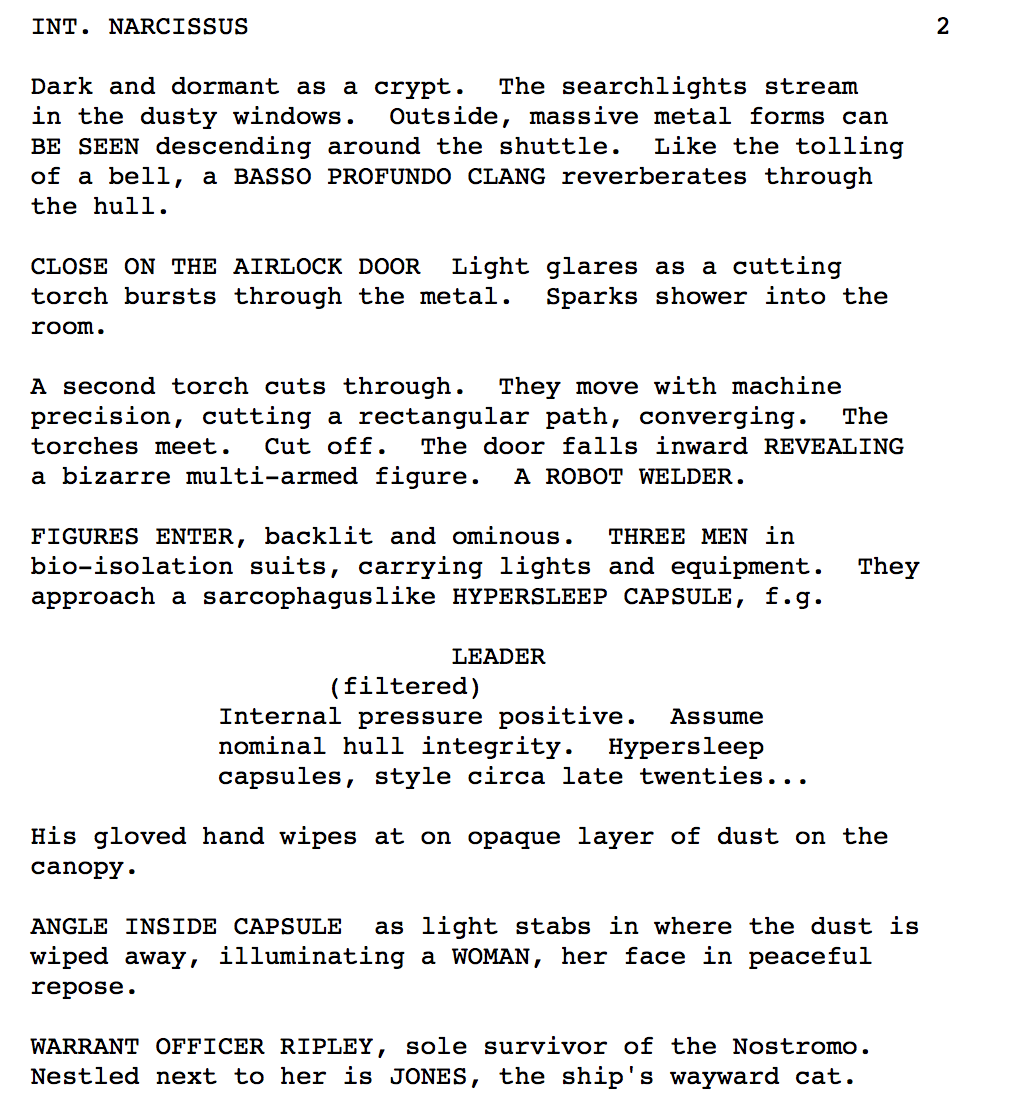
This is an example from the start of Aliens. This is him describing the Narcissus. I won’t go through all of this, but I’m just going to give you a sense of what it feels like on the page.

INT. NARCISSUS. There’s no day or night. Just INT. NARCISSUS.

Dark and dormant as a crypt. The searchlights stream in the dusty windows. Outside, massive metal forms can BE SEEN descending around the shuttle. Like the tolling of a bell, a BASSO PROFUNDO CLANG reverberates through the hull.

CLOSE ON THE AIRLOCK DOOR. Light glares as a cutting torch bursts through the metal. Sparks shower into the room.

A second torch cuts through. They move with machine precision, cutting a rectangular path, conversion as the torches meet. Cut off. The door falls inward revealing a bizarre multi-armed figure. A ROBOT WELDER.

So, that’s the very start of Aliens. This is coming to find Ripley in her spaceship. And I remember what that looks like when I saw it in the movie, but this would have given me a very good sense of what this movie felt like. Craig, how do you react to this?

Craig: Well, this to me, I think of this, and I’m not sure if it’s because the script was so influential, or if it’s simply within a tradition that’s longer, this feels like a very typical way of doing things. And I don’t mean to say boring at all. I mean to say this is sort of how you do it. Like when I think of like a good classic way of writing description, it is a little bit prosy, right? He doesn’t shy completely away from prose. “Dark and dormant as a crypt” is evocative.

But he’s using — he’s not writing full, complete sentences. He’s doing a lot of little bursts. Like, “Sparks shower into the room” is a technical sentence, but it’s not like a full, or like the words “Cut off” is a sentence. That obviously is a little bit of a fragment.

So, he kind of goes fragmented at times. Mostly the action description is focusing you on the visuals and on the audio, which is important. So, to me, this is a very classic way of doing things. There’s not a lot of stuff in here — there’s nothing cute. There’s nothing clever or referential to the reader. There’s nothing that you wouldn’t know if you weren’t watching or listening to the movie.

This, frankly, is pretty much the way I like to approach things. Also interesting is his use of capitalization which is very much the way I use it. And it’s when I feel like it.

John: Yeah.

Craig: So, you know, sometimes he’ll say, like he’s using it in a typical way when a new character enters. ROBOT WELDER. THREE MEN. Sometimes he uses it to call out a specific prop. HYPER SLEEP CAPSULE. Sometimes he uses it for a sound, or even an action. Like he says, “Outside, massive metal forms can BE SEEN.” And it’s there just to help you. It’s almost like you can see the camera swinging to it, you know what I mean?

John: Mm-hmm.

Craig: So, this is very classic. I think you could not go wrong if you adopt this as your style.

John: Absolutely. Let’s talk about the literary techniques he’s using. So you have metaphor and simile in here. So, “Dark and dormant as a crypt.” “Like the tolling of a bell.” So, obviously you can’t see metaphor and simile up on a screen, but that’s how you’re trying to create the image in the reader’s head, or create the sound in the reader’s head.

He’s not afraid of referencing the camera. So, it does say, “ANGLE INSIDE CAPSULE,” “f.g.” for foreground, which is not common, but you totally get what’s happening there. This feels like a script that was both written to be shot, and written to be read. He actually has a great appreciation for the person who is spending the time to read the script and is trying to create on the page as close to the experience as what he wants to create on the big screen down the road.

Craig: Right.

John: So, this is terrific on that level.

Craig: Yeah, I agree. And it’s one of the reasons I get so frustrated when so-called script whatevers say, “Don’t do…script…” because what he’s doing here isn’t so much writing a script like, oh, I’m just writing directorial notes for myself. What he’s doing is helping the reader watch a movie. Everything he writes in here, everything, is essentially him describing to you the movie that’s running in his head. So, “Dark and dormant as a crypt” is evocative and I can see it. And then I see, “Searchlights stream in the dusty windows.”

I see all of it, and it’s — even “Like the tolling of a bell, a BASSO PROFUNDO CLANG.” So, some people might not know what a Basso Profundo Clang is, but they know what the tolling of a bell is. So, we’re good.

John: Yeah.

Craig: “Light glares as a cutting torch bursts,” I can see it. It’s all about helping me see, and the angles help me see.

John: The next last paragraph, “ANGLE INSIDE CAPSULE as light stabs in where the dust is wiped away, illuminating a WOMAN, her face in peaceful repose.”

So, here we go. This is a long sentence for what this. So, “Inside the capsule, light stabs.” Great. I totally get what the stabbing is in that case. “As dust is wiped away.” So here it’s like we’ve moved to passive voice kind of here for a second. You know, dust is wiped away. But we’re inside and he’s using the whole sentence to sort of let us know this is a longer shot. We’re inside something. It’s meant to be mysterious and it’s meant to be a little bit more serene inside here. It’s just terrifically well done.

Craig: It’s so good. It’s so good. And it’s so purposeful. Like this is my favorite kind of description, frankly, because it is both creative and utilitarian. I’m a big fan of this sort of thing.

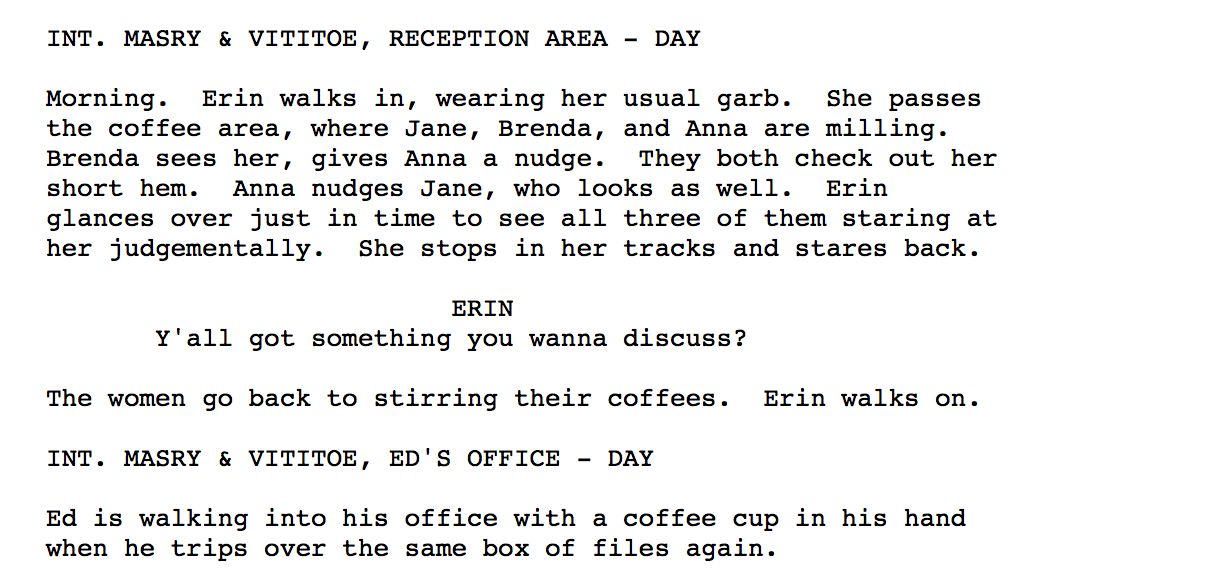
John: Great. Next up we have Erin Brockovich, and here’s a snippet of the script by Susannah Grant.

INT. MASRY & VITITOE — lord, I have no idea what the name is — RECEPTION AREA — DAY.

Morning. Erin walks in, wearing her usual garb. She passes the coffee area where Jane, Brenda, and Anna are milling. Brenda sees her, gives Anna a nudge. They both check out her short hem. Anna nudges Jane, who looks as well. Erin glances over just in time to see all three of them staring back at her judgmentally. She stops in her tracks and stares back.

Y’all got something you want to discuss?

The women go back to stirring their coffees. Erin walks on.

Next scene.

INT. ED’S OFFICE — DAY

Ed is walking over to his office with the coffee cup in his hand when he trips over the same box of files again.

So, a very different style here. This first paragraph, all the scene description before Erin talks is just one block. And yet it works really well for me because it gives me the feeling that this is a oner, that basically this is all happening in a single shot. This is all sort of one idea is them looking at her. And then we’re going to circle back around to what her reaction is to them looking at her.

Craig: Yeah. This is a very common way of describing scenes that are not about the camera. The camera should not be noticed here at all.

So, when we look at James Cameron’s opening, it’s incredibly visual because there is no dialogue and it’s entirely about telling the story of the mystery of a space that’s being illuminated and exciting things are going on.

This scene is about people and what’s going on in their heads. And about what looks mean and what looks don’t mean. And looking away and looking at. And in that case this is appropriate because I don’t need to know the angles on that, at all. The angles, frankly, will be incredibly boring and obvious.

It’s entirely about the performance, so in this case I like the fact that the action takes a back seat to the performance. And all of the action is now actually describing what’s happening inside people’s heads, so that when Erin says, “Y’all got something you want to discuss?” and then they go back to stirring their coffees, I know exactly what happened.

You could have done this in dialogue. You know, it could have been whispered. “You see what she’s wearing?” “Y’all got something to discuss?” “No, no, no.” Right?

And so I like that in this case you go, no, no, I don’t want to do that in dialogue. I want to do it in action. Well, this is how you do that in action.

John: Yup. I mean, if you didn’t understand English, you would still understand this scene. And you would understand that they are looking conspiratorially and reacting. And that she says something back that shuts them up. That’s all you really need to know. So, honestly the line of dialogue isn’t especially important for making the scene work.

Craig: Yeah. This is one area where — I don’t want people to think that just because I say you’re allowed to use camera angles means you should always use them. This would be a place where it would be very clunky to suddenly say, “Angle on Erin. She stops in her tracks and stares back.” You just don’t want that. Because it’s a boring shot.

John: Yeah. This makes it seem easy and sort of thrown off in a way that’s just right. I wanted to talk about that last line before we go to the next scene. “The women go back to stirring their coffees. Erin walks on.”

It’s a great example of just varying your sentence length to create a good rhythm on the page. So, those were some long sentences beforehand. It was a big long block. Here we just have two short sentences. “The women go back to stirring their coffees. Erin walks on.” A three-word sentence that lets us know that that scene is done and we’re on to the next thing.

You don’t need a Cut To when you have Erin walks on. That short sentence is your cut to.

Craig: That’s correct. And I would also say that let’s say your intention was that she would say, “Y’all got something you want to discuss?” and then you just for whatever reason wanted to cut away to something else, sometimes I’ll read in scripts where people end a scene on a dialogue line. It’s just a bad idea I think in general. Because you do want the line to land somehow.

Now, here you clearly need it to land, plus Erin is leaving. But I think in action it’s best to begin and end a scene with action.

John: Yeah. And of course you’re not making a blanket —

Craig: No.

John: Recommendation.

Craig: No, it’s just a good —

John: Yeah, so I’m sure you have scripts where you’ve deliberately ended on a line of dialogue and I’ve done it, too, but it’s a very sort of unique special case where you definitely want to leave the feeling that the camera is ending up on that person as they say this line, and you’re not supposed to be getting the reaction. That the next shot is the reaction to what they just said.

Craig: Yeah. I probably even in those circumstances, I’d probably pull a Cut To in there because I want some sense that I know what I’m doing. That it’s intentional.

John: Yeah. I think the Cut To is almost required for doing that technique.

Craig: Yeah. Ooh, I want to read this one.

John: You can read this one. This is Ocean’s 11 by Ted Griffin.

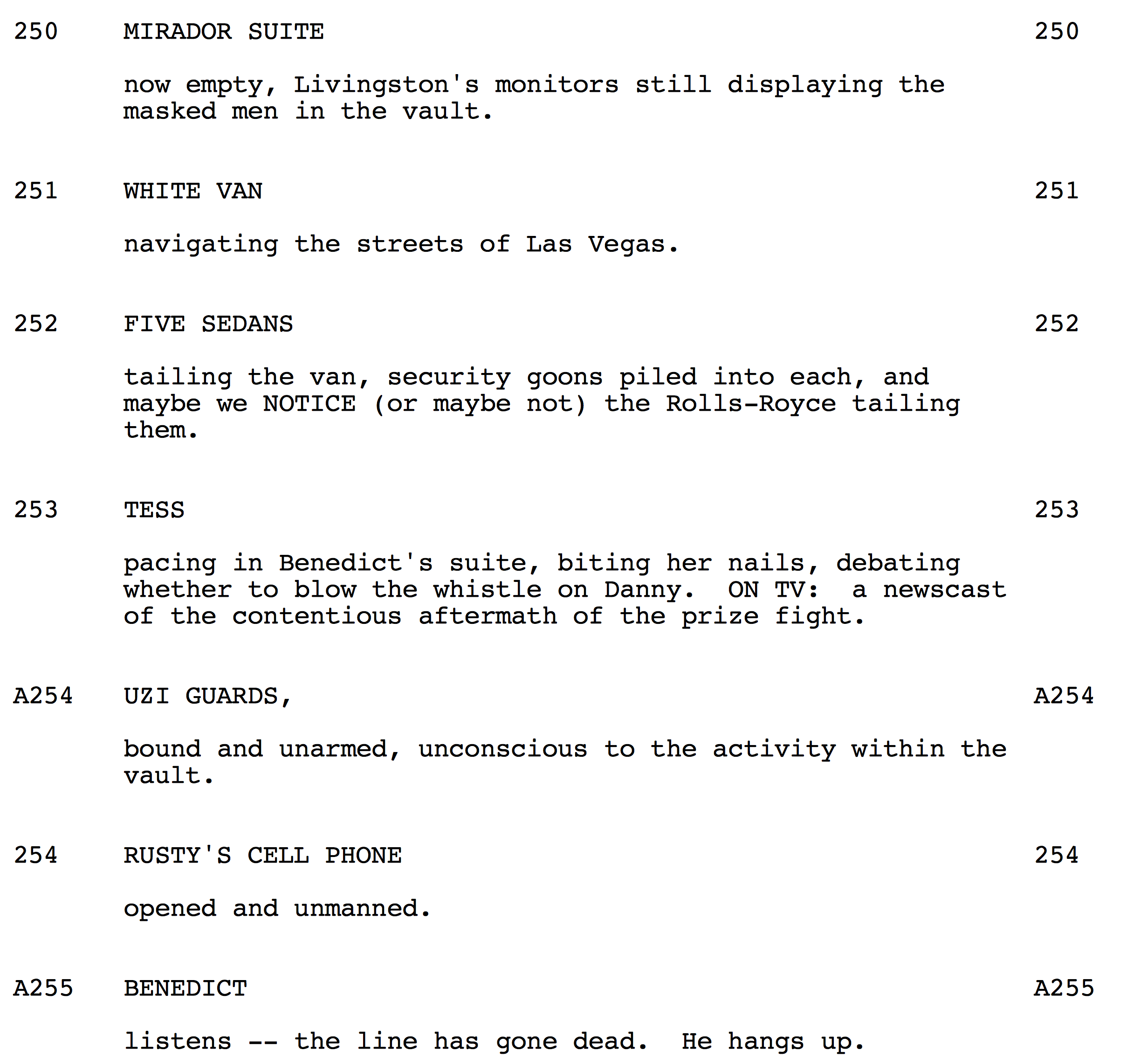
Craig: Right. And here in this little snippet you’ll see that these are all called out as individual scene numbers. So, this is from a production script where everything was numbered. So, I’ll sort of emphasize where things are capitalized.

MIRADOR SUITE. Now empty, Livingston’s monitors still displaying the masked men in the vault.

WHITE VAN. Navigating the streets of Las Vegas.

FIVE SEDANS. Tailing the van, security goons piled into each, and maybe we NOTICE (or maybe not) the Rolls-Royce tailing them.

TESS. Pacing in Benedict’s suite, biting her nails, debating whether to blow the whistle on Danny. ON TV: a newscast of the contentious aftermath of the prize fight.

UZI GUARDS, bound and unarmed, unconscious to the activity within the vault.

RUSTY’S CELL PHONE opened and unmanned.

BENEDICT listens — the line has gone dead. He hangs up.

Ooh, good job.

John: So good.

Craig: Good job, Ted.

John: Good job, Ted Griffin. I wanted to include this because so often you see like, well, the question is like well how do I do a montage, how do I format a montage and, you know, sometimes you do it with bullet points, sort of you quickly go through a list of shots. But this is more commonly what you’re really needing to do in a montage which is you’re moving between different people and different places and they all have to build up to sort of one greater sequence. And this is great example of how you actually do that.

So, you notice that the start of each one he’s in all caps in uppercase doing the where we’re at. So, MIRADOR SUITE, WHITE VAN, FIVE SEDANS, TESS. And then the description right after that is set up in a parallel structure, so it’s always navigating, tailing, pacing. He’s coming with an adjectival, participle phrase to sort of give you a sense of what the action is, but not really the verb. So, it could be, “White van navigates the streets of Las Vegas.” But instead it’s, “White van, navigating the streets of Las Vegas.”

It’s a continuous action that we’re just catching a glimpse of it while it’s going on.

Craig: Yeah. This is all about creating the sense of flow across things that otherwise would be considered fragmented. So, let’s just go right off the bat here. Ted gets rid of INTs and EXTs. Doesn’t need them. Doesn’t want to bother with them. And I don’t blame him at all, especially when you have so many of these in a row. It would be just like word salad to have all these INTs and EXTs, and we don’t need them. We know that the white van navigating the streets of Las Vegas is outside. And we know that Tess in Benedict’s suite is inside.

We’re getting all of that. So, he says, eh, screw all that formality. Don’t need it. I also love that the way it’s running here, there’s a rapidity to it. We can feel the pace of these scenes. We can see — there’s a motion going on to all of this.

And then there’s this interesting — this would fall — I would put this in the school of extreme utility. But, then there are these little twists. For instance, “FIVE SEDANS tailing the van, security goons piled into each, and maybe we NOTICE,” and in parenthesis, “(or maybe not) the Rolls-Royce tailing them,” which is great, because that’s different than what Cameron does. Cameron probably would never write that, because what do you mean, maybe not? Well either we do or we don’t, right?

But actually that is something. Like the instruction there is a careful viewer who is paying attention to that will see it, but otherwise they won’t. We’re not making a deal of it.

John: In the script I just turned in, there’s some scene description of an apartment that we go to the first time. And I call out that there’s some memorabilia from an earlier scene in the set decoration, but it’s not crucial. It’s like it’s a useful thing that’s there that helps sort of connect it to an earlier thing, but it’s not an urgent thing that the viewer doesn’t see it that the world comes crashing to an end.

And so that “or maybe not” is a useful thing. It’s not saying like throwing up your hands like you don’t care. It’s saying that it’s like it’s there and it’s interesting, but it’s not essential.

Craig: Right. Similarly, there’s a thing that probably I don’t think Cameron would do in his description, but I like that Ted does it here. On Tess, “Debating whether to blow the whistle on Danny.” Well, can you film that? Yes, you can.

As long as the screenplay has made it clear that she’s in a position where she would be debating that, what you’re saying there is act like you’re debating that. And I’ll see it. I should be able to see — that’s something that an actor can act. So, I like that that’s there. And then you see that on TV there’s this prize fight going on. So there’s all these layers of stuff.

I love that Rusty’s cell phone is his own scene. It’s just great. Because that — here’s the other thing. Once you start down the road of a pattern for a montage, you’re in that pattern.

John: Yup.

Craig: So, you can’t just suddenly go, okay, now here’s a bunch of things all together in one scene. No. Uzi guards and now Rusty’s cell phone is his own scene, just sitting there, all good, and then you go back to Benedict. “The line has gone dead.” Great. Great. Great.

Just a really good way to move you through this moment. It’s fun. You can feel — like you can almost feel the music through this which is great.

John: Absolutely. Probably a good sign for almost any montage is that you should be able to sense the underlying audio, which is generally music, that’s going to be the bed that’s going to tie all these things together.

And each of these shots feels about the same length, even though they consist of very different material in them.

Circling back to what you said about Tess, “Pacing in Benedict’s suite, biting her nails, debating whether to blow the whistle on Danny.” In all these examples, these are scenes that were already set up someplace else. And so if you’re coming back to something you don’t have to sort of do all the work again to establish who that person was, what they were doing. We had an earlier scene where we saw her. We saw or we knew what her situation was, so we don’t have to do the full recap here. It’s just like, you know, remind us like, oh, she’s debating what she’s going to do.

Craig: Right.

John: Great. We got it.

Craig: Yeah. And it’s really underscoring also how much work the screenplay has done well, because there’s a simplicity and a clarity. There’s no confusion at this point what her pacing is about. That means the screenplay has done its job. So, excellent work there. Ooh, can I read this one, too?

John: You can read this one, too.

Craig: Only because it’s like my favorite and I just feel like maybe I’ll get smarter for having read it. [laughs] So this is a little bit from Unforgiven by David Webb Peoples. Obviously one of the great, great screenplays ever.

BAH-WHOOM! Munny fires and smoke belches out…

Skinny is blown back against the wall and falls to the floor a bloody mess and…

Little Bill is reaching for the Spencer which is leaning against the bar near his leg but he freezes because…

Munny has turned the shotgun on him and Munny sees Ned’s Spencer there and his eyes show how feels about it.

For a moment while the smoke clears the bar is silent and there are nervous glances cast at the bloody body of Skinny but Little Bill keeps his eyes on Munny.

Little Bill says, “Well sir…You are a cowardly sonofabitch because you have just shot down an unarmed man.

Actually, I think in the movie they flipped that. Regardless.

Then….It has become a very formal moment and there are, figuratively speaking, only two people in the room, Munny and Little Bill…and WW Beauchamp is watching them, scared to death, but this is it, what all those Easterners dreamed about, the showdown in the saloon.

John: So much to love here. And so different than some of our other examples. And that’s why I thought we would include it.

Craig: Yeah.

John: So, let’s talk about dot-dot-dot and dash-dash. So, here David Webb Peoples is sort of continuing the continuity of the action by ending each line on a dot-dot-dot. So, and…, and…, because…. So, there’s a cause and effect to each time that we’re cutting.

You know, you don’t necessarily have to believe that each one of these paragraphs is its own shot, but it kind of feels that way.

We’re always in the present tense, and yet look at the choices he’s making about present tense. Skinny is blown against the wall. So, rather than saying the shot blows Skinny back, he is blown back, so we’re seeing the effect of that shot from a previous cut.

Little Bill is reaching for the Spencer which is leaning against the bar near his leg, so we are — so often in screenwriting books they’ll talk about like oh don’t use —

Craig: Get rid of I-N-G. Wah!

John: Yeah, exactly.

Craig: Blech.

John: But here twice in a row, because we’re establishing geography and location and sort of the continuity of a person’s action.

Craig: Right.

John: It’s so fascinating here, I think, where Munny has turned the shotgun on him. So rather than saying Munny turns the shotgun on him, like it has already happened, so we’re coming into a moment that has just happened, so we’re seeing the effect of what has just happened.

Craig: It’s so great. It’s so great. And, you know, this is where these, again, these screenwriting knucklehead gurus out there, I just want to put them all on a spaceship and send them into the sun, because they don’t even understand, ooh, here it comes, they don’t understand —

John: Yup. I knew it was coming.

Craig: They don’t understand the point of verbs. This is a — this is masterful. What peoples is doing here is masterful. And if you pay attention you can see the movie happening because of the verb tenses, right? Little Bill is reaching for the Spencer means when the camera cuts to Bill he’s already in motion. Not reaches for, which means he makes a decision to reach and then reaches. He’s already moving. The thing is already there. And then, but he freezes because Munny has turned the shotgun on him.

Munny has turned the shotgun on him means that Little Bill is discovering something that has happened off-screen that he didn’t realize happened, and that’s so impactful for the audience. Because it means that he’s going to see something first and we’re going to see in his eyes fear. And then we’re going to reveal what he’s scared of.

This is how verbs work, you enormous pile of [laughs] of exploitative —

John: You’re not talking to me. You’re talking to some strawman —

Craig: You exploitative mother-f’ers. “Don’t use I-N-G verbs.” You idiots. Right? So this is what it’s about.

And I love it!

John: Mm-hmm. This last paragraph is so fascinating to me, because “It has become a very formal moment and there are, figuratively speaking,” so it’s a huge long paragraph. This phrase, “it has become a very formal moment,” doesn’t that feel like a slow pullback to you?

Craig: Mm-hmm.

John: It’s like you’re just like you’re recognizing like, oh, we’ve been in these little moments and then suddenly we’re getting bigger and wider and we’re sort of seeing what exactly has happened here.

So, it’s like it’s taking stock of the last few moments and sort of like what the scene is like now. And you don’t have to do this, but in some ways to write to Unforgiven you have to do this, because that’s what the movie feels like.

Craig: Absolutely. And, by the way, I think wrong. I think that this is exactly the order that Little Bill said it in. It’s just maybe he fiddled with a couple of words. But, no, of course, it’s exactly right. So, here’s the deal, right, I love dot-dot-dots. I’m a huge fan of them because what dot-dot-dots do for me is they kind of imply you’re holding your breath. You know, like Walter Murch wrote this great book called In the Blink of an Eye where he talks how the audience will naturally blink where you kind of want to cut, you know.

And that’s just the way our brains work. And similarly, when things like this are happening, it’s common for people to say, “Oh my god, I finally breathed. Like I was holding my breath through that whole thing.” That’s what dot-dot-dot is doing. It’s saying hold your breath. Hold your breath. Hold your breath. And then Little Bill says this, and the way that David Peoples writes this last paragraph it implies you’re breathing now. In fact, we’re going to take our time to breathe and discover this tableau, that it’s now formal. Now, all the action is over and we have entered this new weird thing where two gods among men have dropped all the pretenses and are cutting to the truth.

And then I love this, “And WW Beauchamp is watching them, scared to death that this is, what all those Easterners dreamed about, the showdown in the saloon,” which is something that is acted beautifully in that moment. It’s just great. And there’s nothing wrong. It’s not too wordy, as far as I’m concerned. I feel like this is really bursty, like quick bursts, and exciting, and then when the movie becomes a little bit languid, the action becomes languid.

So this is poetry to me. The use of action is helping imply the pace of the scene itself.

John: Great. Our next example is from Wall-E, which has a similar sort of strange style to it, like sort of not conventional style. But completely suits the movie that Wall-E is. So, Wall-E, if you remember, so much of Wall-E takes place like a silent film. And if you read the script, it sort of feels that way.

So, I’ll describe this to you and if you look at the actual sample, these single sentences are all their own line. So there’s no paragraphs here. They’re all just given their own line. They’re blocked together in some ways to sort of imply a bit of more continuity of action, but they’re all single sentences.

EXT. TRUCK — NIGHT

Wally motors outside.
Turns over his Igloo cooler to clean it out.
Pauses to take in the night sky.
STARS struggle to be seen through the polluted haze.
Wally presses the “Play” button on his chest.
The newly sampled It Only Takes a Moment plays.

The wind picks up.
A WARNING LIGHT sounds on Wally’s chest.
He looks out into the night.
A RAGING SANDSTORM approaches off the bay…

Unfazed, Wally heads back in the truck.
It Only Takes a Moment still gently playing.

…The massive wave of sand roars closer…

Wally raises the door.
Pauses.
WHISTLES for his cockroach to come inside.
The door shuts just as the storm hits.
Obliterates everything in view.

Craig: Well, I love Wall-E. Love Wall-E. I would not recommend that people write traditional screenplays this way. I wouldn’t even recommend people write animated screenplays this way, because this document feels like a notes documents for people who are all working on a movie.

This document feels like it’s in support of reams and reams of storyboards and story art. And on its own is simply not going to do the job. Like, I read this and it doesn’t make me see the movie at all.

It feels like a support document. So, I think that this is a more technical way of doing things within a framework of a storyboarded process, but I don’t think that this would be advisable for a movie where somebody didn’t know your story at all and was going to read it.

John: I disagree with you. I think I could read this document and have a really good sense of what the movie felt like.

And it would take me a little while to get into this strange spare style, but honestly it does feel what certainly the first half of Wall-E feels like to me, which is a bunch of individual shots where he is a small figure against a large landscape or, you know, just he’s center frame and there’s just this giant emptiness around him.

I really dug it. And so even if you were to try to apply some of these lessons to a more conventionally written screenplay, I want to talk about trimming off subjects of sentences because you don’t need them a lot of times.

So, let’s imagine these first couple of sentences where in a more conventionally formatted script. “Wally motors outside. Turns over his Igloo cooler to clean it out. Pauses to take in the night sky.” You don’t need the He’s, you don’t need the It’s, you don’t need Wally’s, as long as you have parallel structure between those sentences, we get it.

And particularly if you’re writing action sequences, you’re very often going to trim off those subjects because we know who’s doing it, so just give us the verb and let’s keep going.

Craig: Yeah, I agree. I do that all the time, and I obviously write in a more traditional sense. Where this doesn’t work for me, if I weren’t familiar with Wall-E, if I didn’t see artwork, I hadn’t been looking at storyboards is things like, it says, “A raging sandstorm approaches off the bay…” but that’s it. It’s just a raging sandstorm. Okay.

And then it’s a “massive wave of sand.” And then it says, “The door shuts just as the storm hits.” It’s so flat and I’m not excited. And I want to be excited in things like that. He says, “Whistles for his cockroach to come inside.” I’m not sure if a cockroach does come inside there, or not. I don’t know. And it says “obliterates everything in view.” It’s all so flat and it feels very much like Wally himself, like Wally is writing this script. But I don’t want Wally to be writing the script. I want somebody like Pete Docter to be writing the script to make me feel for Wally, which is in fact what was going on.

I think it was Pete Docter who did this one, right?

John: Yeah. Pete Docter, Andrew Stanton.

Craig: Oh, Stanton.

John: Other credits were Jim Reardon, yeah.

Craig: I’m just fascinated by this. You know what I’m going to do? I’m going to ask our friend Emily Zulauf like what the deal is with this, because I can’t imagine that they would give this to somebody that didn’t know anything else and say what do you think of this movie we’re making. So, I’m in a different place than you are on this one.

John: Yeah. For sure you could imagine this document along with the artwork, or the sense of like each of these lines became one panel of a storyboard. And maybe that’s sort of how their internal process works. But I really do think this is a way you could write a script and have it be quite successful. So, all right, next is a much more conventional thing but also quite delightful thing from our friends Derek Haas and Michael Brandt. This is from the movie Wanted.

THWAP! A bullet finds its way through the space and hits the Electrician in the back of the shoulder, spinning him around.

CLOSE ON: Cross’s gun. Another shot and we follow the bullet, across the dock, and dipping low into the next space in the paper stack — right where Electrician is now leaning…

…the bullet buries in his eye, sending him to the floor.

Wesley sees Cross race for a set of stairs. Just as Wesley is about to cut him down, Cross fires at a wooden beam holding back some massive rolls of NEWSPAPER. The rolls tumble over and Wesley has to dive out of the way, allowing Cross to escape up the stairs.

Wesley, Fox, and the Waiter all race for the stairs.

Craig: Yeah. To me, this is, again, very traditional way of doing action. One thing that the guys do here is they’re not shying away from violence, right, so the action — when we write action, you can say like, “He’s shot, falls to the ground.” And the action is telling you this is a movie about the ballet of violence. When it’s “THWAP! A bullet finds its way through the space and hits the Electrician in the back of the shoulder, spinning him around,” we understand that we’re doing ballet now. First of all, we know that we’re actually following the bullet, which tells us, again, about pace.

When “the bullet buries in his eye, sending him to the floor,” it’s underlined. They’re like, hey, this is what we’re about here. This is a movie in which violence is supposed to be operatic.

And people running and dancing around, like I don’t know what these guys are thinking, and I don’t need to. I don’t know what their characters are in this moment. It’s not about that. So, contrast this with say like in Unforgiven we can see like, oh my god, he turns and then there’s this moment of dread. And then we reveal this. This is more pure action.

And this is a very typical way of writing pure action. High energy. And use the action to let us know exactly how lurid we’re going to be.

John: Yup. Also, the use of underlining is part of the reason why I chose this section of the script. Action scripts will tend to use underlining as like an extra form of punctuation. It’s like a way of sort of visually indicating what the key crucial beats are. And so you will underline the things that you want to make sure the reader doesn’t miss, but also it’s just going to give you a sense of this is already a very loud scene, so what are the loudest parts within this loud scene.

And sort of what do you need to make sure you’re focusing on. Even within the uppercase, like that NEWSPAPER still gets capitalized because — it’s not just because it’s a key prop, but because it’s a big thing you need to make sure you don’t miss. It’s a thing that’s going to be causing the action in the next section.

Craig: Right.

John: It’s essentially its own character for the rest of this paragraph.

Craig: Yeah. And so like if you don’t capitalize newspaper and so everything is just underlined there, you’ll notice it, but massive rolls of newspaper you’re like, well, okay, so massive rolls of newspaper. Newspaper doesn’t seem very massive to me. Massive rolls of all capitalized newspaper, I’m just already imagining lots of newspaper, like a massive amount of newspaper, which is what they want. So, they’re smart that way.

I thought this was done really, really well. And, by the way, just side note, love this movie. Love — so entertaining. I was so entertained by Wanted.

John: Yeah. Wanted is a movie that knows what it is in a way that so many movies don’t. It never shied away from being its own true self, and that’s what I really appreciated about it. It was nutso.

Craig: Yes, it was.

John: And wasn’t Chris Pratt in that? Chris Pratt plays like —

Craig: Yes, he plays like his jerk buddy at work who is screwing his girlfriend.

John: Like on a copy machine. There’s some crazy —

Craig: Yeah, exactly. He hits him in the face with the keyboard and the keyboard letters spell out F-U I think, or, I’m trying to keep it clean. But it was very cool. I don’t know, Timur is nuts, man. That guy — I love that movie.

John: Yeah. I love it, too. Whatever happened to Chris Pratt?

Craig: I don’t know. I don’t know. For a moment there, uh, you know, I think he’s just mostly doing that role, like he plays that guy, the jerk.

John: The jerk. Yeah.

Craig: Like the jerk who is in a movie for a scene to make the hero look good.

John: Yeah. Sometimes you get typecast because it’s really who you are.

Craig: Yeah, well he gained a ton of weight. He’s like 300 pounds now.

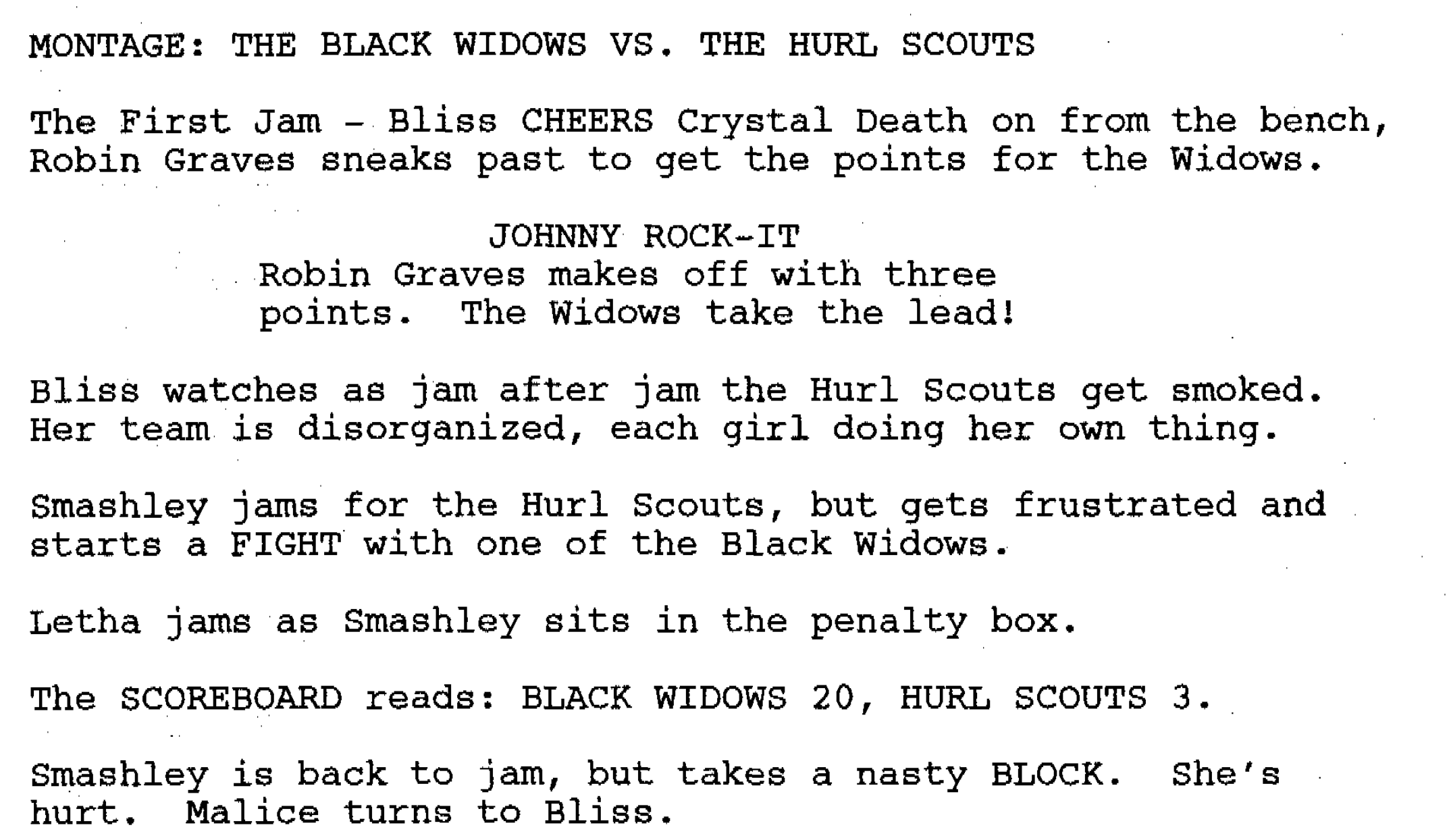
John: It’s rough. Our final example is from Whip It. And I wanted another example of a montage. And this is a movie that has a lot of montages because like most sports movies there’s time where you’re really trying to summarize down what a match feels like, what a game feels like, to sort of those key moments. So, here is one of the matches in Whip It.

MONTAGE: THE BLACK WIDOWS VS. THE HURL SCOUTS.

The First Jam — Bliss CHEERS Crystal Death on from the bench, Robin Graves sneaks past to get the points for the Widows.

Johnny Rock-It says, “Robin Graves makes off with three points. The Widows take the lead!”

Bliss watches as jam after jam the Hurl Scouts get smoked. Her team is disorganized, each girl doing her own thing.

Smashley jams for the Hurl Scouts, but gets frustrated and starts a FIGHT with one of the Black Widows.

Letha jams as Smashley sits in the penalty box.

The SCOREBOARD reads: BLACK WIDOWS 20, HURL SCOUTS 3.

Smashley is back to jam, but takes a nasty BLOCK. She’s hurt. Malice turns to Bliss.

Craig: Yeah, I mean, it gets the job done.

John: Absolutely.

Craig: Yeah, this is pretty spare, actually. I mean, I’m kind of a little surprised, because I’ve seen the movie which is so much fun, and these things are such high energy. I mean, I guess I am being a little critical. Like I kind of want sound. I want sound. I want crunching. I want like, you know, like starts a fight, like how? Like punches her?

John: Punches her? You know, I feel like I actually got some of that sound and some of the feel just by the use of the verbs she did choose. So, “jam after jam they get smoked.” Picking the fights. Takes a nasty block. I think this scene comes from later on in the movie, so this may be after we’ve had quite a few examples of like what these matches feel like, so this may be one of the shorter matches in the movie overall.

Craig: Right. Okay, well that’s a good point. Because there is a real fatigue that can set in. It’s one thing to do the ballet of the bullet smashing into eyes, and people smashing into each other, but if this is the ninth or tenth of these at some point in the movie, then I guess short-handing makes sense, because one thing that does happen — and everybody knows this as you’re reading a script — is you read faster. It’s like faster, faster, faster because if the script has done its done its job right, you want to see what happens

John: Yup.

Craig: You want to see what happens. So, you start to go faster and faster. You don’t want quite as much really painstaking detail in here. And perhaps, you know, if Smashley has started a fight before, then — and it’s been spelled out really clearly, then starts a fight here, I kind of get how she’s doing it.

So, that makes sense to me.

John: Cool. I hope this was helpful for people. So, you can find all of the examples that we talked about here. There’s little images that you can download on the Internet. Just go to johnaugust.com/Scriptnotes and in the show notes for this week’s show you’ll see all of these images that you can read along with us. Thank you, Craig.

Craig: You know what? That was great. I feel like we’ve got a pretty big show here. Maybe we should push reshoots to next week?

John: I think we’re going to push reshoots to next week. So, in next week’s episode we will talk about what are reshoots, why do movies have them. How do writers get involved with reshoots? What happens if the original writer is not the writer on the reshoots? And we’ll talk through some of our own examples with our films that have gone through reshoots and what has worked well and what has not worked well.

But there is time for One Cool Things if Craig has a One Cool Thing.

Craig: Uh, my One Cool Thing is your One Cool Thing.

John: All right. My One Cool Thing is A World Without Work. It’s an article by Derek Thompson in The Atlantic. And I thought it was just a really good think piece overall about what is the future of America and other western economies going to be like as more and more of our work gets replaced by technology. And so to date we’ve seen like factory jobs being replaced, but as clerk jobs and transportation jobs and other things get replaced, there may just not be a place for some people to have jobs in the classic sense that we’ve had jobs.

And what does the world look like, not just in terms of how does the economy work, but psychologically how do we deal with a society where not everyone is going to be employed or needs to be employed. And so I thought it was interesting for everyone to sort of take a look at.

Also, the kind of work that you and I do, Craig, is sort of kind of weird luxury work. And we’re not kind of crucial or fundamental to any part of the economy. And we could easily, while we’re not going to be replaced by computers tomorrow, it just got me thinking about sort of what my life would be like and what my identity would be like if it weren’t the job that I had.

Craig: You know, artists have never been essential to society the way that people that grow food are, or doctors are, but we’ve always been in demand. I mean, well, not all of them, but a bunch of them.

So, the nice thing is I always feel like what we do at least, there’s always a place for it. People will always want to be entertained. It’s just innate to the human condition. So, yeah, I don’t think we will be replaced by computers.

I think I could be replaced by a computer. [laughs] That’s just me.

John: I think it does, and this article does lay out, is that it does allow for a greater number of people who have artistic ambitions to sort of fulfill those artistic ambitions because there’s no fundamental need for them to be working.

And so I think it may create a class of people who were never kind of looking for a job, or just decided to have sort of the minimal jobs and just become artists in whatever capacity they wanted to be because there’s no pressure to define yourself by making a certain amount of money.

Craig: All right.

John: We’ll see.

Craig: Yup.

John: Craig, thank you so much for another fun podcast. Our show, as always, is produced by Stuart Friedel. It is edited by Matthew Chilelli. I’m not sure who did the outro this week, but if you have an outro for our show, you can write into ask@johnaugust.com. That’s also the place where you can send your questions, long questions are the place for that.

Short questions are great on Twitter. I’m @johnaugust. Craig is @clmazin.

If you would like to subscribe to our show, you should subscribe to it in iTunes. Just go to iTunes and search for Scriptnotes. Also in iTunes you can find the Scriptnotes App which lets you get access to all the back episodes of the show. There’s also one for Android.

If you would like a USB drive, there’s a small chance that there are still some left in the store. So you could go to store.johnaugust.com and get one of those. There’s a 10% discount if you use the code SINGULARITY.

And that’s our show this week. Craig, have a fun week.

Craig: You too, John.

John: Bye.

Craig: Bye.

Links:

  • Scriptnotes 200 Episode USB drives are available in the store while supplies last
  • Paramount, AMC and Cineplex try new revenue-sharing initiative on The Wrap
  • Excerpts from Aliens, Erin Brockovich, Oceans 11, Unforgiven, Wall-E, Wanted and Whip It
  • A World Without Work by Derek Thompson
  • Outro by Stuart Neville (send us yours!)

The Scriptnotes 200-episode USB drive

July 9, 2015 News, Writer Emergency, Writer Emergency Pack

For a limited time, we’re selling USB flash drives loaded with the first 200 episodes of Scriptnotes — including all the bonus shows, the Dirty Episode, and special interviews. They’re $20 and available in the [Store](http://store.johnaugust.com/products/scriptnotes-200-episode-usb-flash-drive).

[usb drive](http://store.johnaugust.com/products/scriptnotes-200-episode-usb-flash-drive)
These custom-printed 8-gigabyte USB flash drives include:

– Every episode in mp3
– Full transcripts
– Three Page Challenge pdfs
– Boundless love and umbrage
– Our autographs printed right on the side

[usb drive back](http://store.johnaugust.com/products/scriptnotes-200-episode-usb-flash-drive)
As of Thursday at 4pm PDT, we have fewer than 50 left, so we’ll likely run out. If you’re a collector, a completionist, or survivalist planning for the post-internet future, this is your chance.

We’re shipping these from the same warehouse that handles [Writer Emergency Pack](http://writeremergency.com), so if you want to get both, you can save yourself some shipping charges.

Both are available at [store.johnaugust.com](http://store.johnaugust.com).

Scriptnotes, Ep 204: No one makes those movies anymore — Transcript

July 2, 2015 Scriptnotes Transcript

The original post for this episode can be found [here](http://johnaugust.com/2015/no-one-makes-those-movies-anymore).

**John August:** Hello and welcome. My name is John August.

**Craig Mazin:** My name is Craig Mazin

**John:** And this is episode 204 of Scriptnotes, a podcast about screenwriting and things that are interesting to screenwriters.

So, Craig, as you know, I’m watching these two dogs for this summer and really enjoying it. I’m enjoying my life as a dog sitter. But as I was putting them to bed last night, I had a sudden flash of this one dog, who’s 12 years old. She’s, you know, she’s the Maggie Smith of these two dogs. She’s older, the dame —

**Craig:** The dame. The Dame Maggie Smith of dogs.

**John:** And so, while I want her to live another 20 years, that is just not just likely, and so she is at the — nearing twilight of her life. And I suddenly had this horrifying thought, like, what if people only lived as long as dogs? And whether society could even exist if humans did not live as long as they live?

**Craig:** I think so. It would look very different.

**John:** Mm-hmm.

**Craig:** There would be so much more sex.

**John:** Oh, yeah, it would have to be.

**Craig:** Yeah.

**John:** Well, except you would have sex with teenagers though.

**Craig:** Yeah.

**John:** That’s all weird.

**Craig:** Oh, oh, is that…

**John:** I guess, what I’m postulating is, what if humans developed as quickly as dogs do so they could actually, like, you know, that a four-year-old could do something useful and productive. But would you actually have society if people only live such a short period of time?

**Craig:** I think so. I think so — I mean, look, we’re the weird ones in the animal kingdom, you know. I mean, most four-year-old animals are perfectly capable of doing everything that animals must do. We’re born stupid because we have to be born too early because of our huge heads.

**John:** That said, you know, we are the weird ones, but we’re also the only ones who developed speech and culture and the ability to build cities and roads and do all sorts of other things. So I wonder if the other postulate would be, if we could live twice as long or three times as long, would society be vastly different?

**Craig:** It would be crankier, the driving would go downhill, just the overall quality of driving. I wouldn’t go anywhere near a farmer’s market, I’ll tell you that much.

**John:** Yeah, there would be so many slow shuffles

**Craig:** Oh, God. Just, you know, it would get — I think we’re in a decent spot now. They keep telling us that sooner or later, they’ll be able to take our brains and put them in a computer and we’ll live forever. Here’s my question for you, John. This is what keeps me up at night.

**John:** All right. I want to hear.

**Craig:** All right. So the brain is a big network of neurons, and though we can’t do it now, it’s — at least, let’s stipulate that one day it will be possible to take a scan of your brain, see every neuron, analyze every connection and then replicate it technologically.

**John:** I would agree.

**Craig:** Okay, fine. Stipulating that, what happens when I take you, copy your brain, put it in the computer and then I turn it on while you’re still alive.

**John:** Yeah.

**Craig:** There’s two of you now.

**John:** Well, you’ve made the world significantly better.

**Craig:** But here’s my question, which one is you? Is the computer you? Are you you? You don’t see through the computer’s eyes at the same time, so there’s two you. So, if I kill you — you, you, you’re dead. But then this other you is alive, so are you still alive?

**John:** Oh, no. You certainly committed a murder because you killed a human being. I think the other interesting question is, if you turned off that computer, did you — is that the same kind of murder as murdering a living, breathing human being?

**Craig:** But even putting aside murder, you don’t really live forever in that circumstance. What happens is your clone lives forever. But you, you, with the experience that you have, you’re going to die.

**John:** Yeah. You know, you’re fundamentally asking the question of, is a person the body and the organs and the everything else, or is the person the processes — is the person the hardware or the software? And that is a question that has been wrestled with by philosophers even before there was a real distinction between hardware and software.

**Craig:** Well, especially because the brain is both. You know, the brain is hardware-software. So I wonder about that. To me, really, what I’m hoping for here is that they figure out a way to take my brain and keep my brain alive forever because that’s me.

**John:** Yeah.

**Craig:** So then I’m good. I’m covered.

**John:** All right. In the first two minutes of this podcast, we’ve outlaid a number of premises for a sci-fi movies that Hollywood won’t make. But we can talk through the day’s work ahead of us, which is, the question is, is Hollywood making too many movies overall? What does Apple music mean for screenwriters? And we will also take a quick run-through a screenwriter’s job from pitch to premier. Those are big topics for today’s show.

But before we get to it, we have exciting news. So way back in Episode — I don’t know — 201, we asked our listeners whether — if we had a USB drive that had all of the episodes of Scriptnotes, all 200 episodes, plus the bonus episodes, would they want to buy such a mythical USB drive? And people said in a loud chorus, yes. So we are making those USB drives and we will be shipping them starting next week.

So if people would like to buy a USB drive with all the episodes of Scriptnotes and all the Three Page Challenges and all the other supplementary things, The Dirty Show with Rebel Wilson and Dan Savage, they can do so now. So it’s at store.johnaugust.com.

**Craig:** And would you say that’s like a $70,000 value?

**John:** It is — probably, you know, as we’ve gone through the ways that people could spend their money on screenwriting, I think it’s a pretty good bargain at $20.

**Craig:** I think it’s a great bargain at $20, yes.

**John:** But, Craig — I mean, do you want to offer any incentive to our long-time listeners? Is there anything we’d want to make sure that the people who actually listened to the show, who listened through our two minutes of philosophical ponderings about death and immortality —

**Craig:** Yeah.

**John:** Should we cut them a break? Should we give them a discount?

**Craig:** I hate discounts, but yes.

**John:** All right. So you can pick whatever words you would like and that can be the word that they can type in for a discount because we haven’t set this yet, so it’s your — it’s up to you, Craig.

**Craig:** I’m going to go with “singularity.”

**John:** Wow, that’s a challenging word but I like it. “Singularity”. So at checkout, if you type in the word “singularity” in a special little promo code box field, you can save 10%, so —

**Craig:** That’s $2. Totally worth it.

**John:** Totally worth it. That basically covers your shipping. So shipping in the US is like $2.79.

**Craig:** “Singularity” has saved you money.

**John:** Singularity has saved your money. Yes, so they’re brand new. If you bought the 100 episode one way back when, you’ll recognize it’s a similar kind of thing. So this one is white, it has our signatures on it, so, yeah.

**Craig:** Have we discontinued the confederate flag USB drive?

**John:** You know what? It was a controversial choice and it was really a lot of hemming and hawing, but no, we’re no longer selling the confederate flag USB drive that we never sold.

**Craig:** I’m disgusted. We’ve bowed to pressure, outside pressure. We had a tradition, sir. [laughs]

**John:** Yes, we had a tradition of not doing something and we’re going to continue not doing something.

**Craig:** Confederate flag, come on.

**John:** Oh, it’s madness

**Craig:** I know. That’s on our other podcast.

**John:** [laughs] Indeed. The old timey racism podcast.

**Craig:** Exactly.

**John:** Good stuff.

**Craig:** Yeah.

**John:** Craig, we have a lot to follow up on this week, and you wanted to start off with something about reversion, which is a topic we covered in last week’s episode.

**Craig:** Yeah, we got a nice comment in from a writer out there whose lawyer had, I guess, reviewed what we said and added one factor that I had forgotten about, and it’s absolutely true. We talked about if you write an original screenplay, you have the chance to get the rights back. It’s involved, you got to pay them the money they paid you and all that.

But the timeline was such that five years after the sale or the completion of your first employment on the project, you have this window. And it was basically a two-year window to get the rights back and set up somewhere else. And the little part that I forgot was that that two-year window has to happen within a five-year window. So you have these two years, but five years after the window begins, it shuts and you lose reversion possibility, I think permanently.

**John:** All right. So in my head, I’m trying to visualize this. And so what I see is a gray bar, and then after that gray bar that was five years long, and there’s an equally sized gray bar, equal size but like maybe a lighter gray bar, and within that lighter gray bar there’s like a red two-year slider that — it has to fall within that two-year slider within that five years. This is why movies are so rarely reverting to the original writers.

**Craig:** Yeah. You’ve got a very limited window. But the truth is, I wish that this were the worst part of it, but it’s not. The financials, the fact that the purchasing company has to pay back interest on all the development fees that the first studio paid. Those are the things that really make it very difficult. But the timeline is tough. I mean, look, the truth is, practically, if you haven’t figured out how to get the reversion rights back within, you know, two or three years of the window opening, it’s never going to happen anyway, so.

**John:** Yeah, I agree with you. What’s interesting to me is that the point at which the writer had the most leverage to try to negotiate better reversion terms is also the moment which he or she was not likely to push for them. So that moment at which you’re selling this project for the very first time, that was the moment where you could have pushed for really strong reversion rights. But you’re also pushing for a lot of other things, and mostly, you’re pushing for upfront money which is a very reasonable thing to be asking for. And paradoxically, that upfront money that you’re getting is money that would have to be paid back. There’s a whole bunch of other reasons why studios don’t want to pay both a lot of money and make it very easy for you to get the script back.

**Craig:** Yeah, it’s true. And there’s also psychologically a little bit of a problem when a studio says, “We want to buy your screenplay,” and you start negotiating with them and one of your big points is, “Now, when this doesn’t work, can I blank, blank, blank?” Just psychologically it’s a little harder to do that and to be really aggressive about it. Everybody on the other side starts thinking, “Why are you so concerned about this failing?” So it’s a tough one, but, yeah.

**John:** Craig, something that occurs to me, which we didn’t really get into in last week’s episode, was what happens when a studio goes bankrupt? So let’s say you sold this to a production company that no longer exists.

**Craig:** Right.

**John:** Those assets could theoretically be purchased by another studio or — is are there sort of fire sales on intellectual property? What have you seen?

**Craig:** Yes, that’s exactly what happens. Basically, if a company that — and let’s presume it’s a WGA Signatory, because otherwise it doesn’t really matter. A WGA Signatory that owns screenplays goes under, they are either bought by another company in whole or they begin to sell off their assets. The WGA — the minimum basic agreement has many, many, many pages dedicated to assumption agreements.

You’re assuming certain rights when you buy things that have WGA stuff, but it’s very complicated. It’s very complicated and it does come up. You know, I’ve never worked for anyone other than the big studios, so I’ve never worried about it. But interestingly, I had like a weird thing happen when — back when we were doing the Scary Movies.

When we started them, Miramax was owned by Disney. By the time we finished the second one, I think, they had gone off on their own. And when they split, Disney and Miramax kind of decided they would share custody of the Scary Movies stuff as part of the divorce agreement. So we had two employers there at one point. It gets complicated. But honestly, if I talked about assumption agreements, I would be way out on a limb. That is advanced lawyer stuff.

**John:** Absolutely. And part of the reason why assumption agreements are so important is that, sometimes these companies are bought and sold, but the movies that actually were produced, somebody has to be responsible for continuing to pay the money that is owed to those writers for residuals and everything else. So it becomes an important part of our contract.

**Craig:** Yeah. I mean, it’s like, if you buy a company and they’re selling you things that have liens on them essentially, so, I go out of business, I’m a restaurant owner, I’m selling you all my kitchen equipment, but I owe a bunch of people money for that kitchen equipment. Well, when you buy it, you now owe those people money for the kitchen equipment. And it’s the same thing with movies. They’re assuming responsibility for all the residuals.

Now, there is an interesting thing that happens. There have been cases where companies have gone out of business. The assets essentially don’t get purchased and they become what we call orphan works.

**John:** Yeah.

**Craig:** Most of the orphan works are very old but there’s been a real effort between the Directors Guild and the Writers Guild to get the United States government which controls the Copyright Office to recognize screenwriters and directors as co-authors. That means copyright holders of orphaned works that had been owned by other people as part of work for hire, but those entities no longer exist. So it’s an interesting thing. In modern era, it will never happen because everybody now understands how valuable IP is.

**John:** Yeah. Next bit of follow up, back in Episode 201, we talked about the FIFA scandal. And we wondered aloud if it could become a movie. Craig, what is the answer?

**Craig:** Yes.

**John:** Yes, indeed. So this past week, just today as we’re recording this, it was announced that Ben Affleck will be producing a FIFA movie for Warner Bros. all about the FIFA scandal. This is the summary here. Capping off eight days in negotiations, Warner Bros. has won a bidding war for Houses of Deceit, a book by BuzzFeed investigator reporter Ken Bensinger which is being seen as a definitive account of the American FIFA exec Chuck Blazer and his role in the largest sports and public corruption scandal in history.

**Craig:** Yes.

**John:** Gavin O’Connor who recently wrapped the Affleck thriller, The Accountant, for the studio is attached to direct and will co-write the script with Anthony Tambakis. So —

**Craig:** Right.

**John:** That movie is going to be there. So we were speculating what kind of movie they would make and this doesn’t say specifically, but it gives us some hint about it. They’re focusing on Chuck Blazer who’s an American exec, which is certainly kind of reasonable to make it for an American audience. What else do we see from this summary here?

**Craig:** Well, in terms of the tone, it sounds like they’re approaching it the way we thought a studio would, that is head on. Not from the side as a comedy or something else, but head on. One interesting thing that they had picked up on it, that we just didn’t know, you and I just didn’t know about it, is that this guy, Chuck Blazer, I think was involved in the corruption itself. He became, as far as I can tell, I could be wrong, but he became essentially an informer.

And so what you have now is more of — their take is a little bit more like the movie The Insider.

**John:** Yeah.

**Craig:** I don’t know if you remember that movie, a really good movie. And they did say, Loretta Lynch, I guess teamed up with this guy back when she was just working at the IRS or something like that, so she has been actually tracking this. Now that’s interesting. Because if you start this character before she’s — you know, we said, “Look, the Attorney-General is too big,” and we were right, but if she’s not yet the Attorney-General and she becomes the Attorney-General towards the end of it, that’s really interesting. So an interesting version of it.

I’m kind of curious to see what the theme of it is. I’m curious to see if the theme is at all related to my thing about America finding its way towards kind of promising American justice again, or if they go a different way and there’s a whole different theme. Very interesting. But note, the movie is about two people, it’s about a relationship, it’s about one who is a soccer person and one who isn’t a soccer person. We nailed it.

**John:** We did.

**Craig:** Not that hard really. [laughs]

**John:** It really wasn’t that hard.

**Craig:** It’s kind of obvious.

**John:** I was curious like who they would pick as the character to focus on. And I didn’t really know about Chuck Blazer’s role in this, but it seems like a very natural fit for the kind of movie we would actually want to make.

**Craig:** For sure.

**John:** Yeah, good luck to them.

**Craig:** Yeah.

**John:** So obviously, how many movies get announced versus get made? Quite a few. But I think the people involved have a good track record of being able to make movies, so let’s hope.

**Craig:** Also, good object lesson for people out there who are like, “Oh my God, they stole my movie idea.” No, they didn’t. Shut up. Is there one cell in your body that’s like, “We talked about it and now they’re doing it” — even one?

**John:** Not a bit. Oh, God, no. No.

**Craig:** No, no, no. It’s ridiculous. Ridiculous. I’m now manufacturing umbrage. I’m making something up that isn’t true and then getting angry about it.

**John:** Yeah.

**Craig:** You know why, because it’s been too long.

**John:** Yeah. Now, if next week there is a Hadron Super Collider romantic comedy announced — and actually, it turns out there was, like I think David Koepp had worked on a romantic comedy many years ago, somebody like sent us a link to that. But if all three of our what-ifs became movies, then I would be a little bit suspicious. Or I would wonder whether we were not making the best use of our time. That we should have been out pitching these movies rather than describing them for free on a podcast.

**Craig:** Hey man. Pitching is easy. It’s the writing that sucks.

**John:** Yeah. We’re going to talk about that in our third topic today.

**Craig:** Okay.

**John:** The next bit of follow-up comes from Joe in Rancho Cucamonga. So in episode 194, you guys answered a question for me about how I would receive credit on an indie movie I co-wrote if I were in the WGA, and now I have another question regarding that situation. The movie did in fact go into production and wrapped a couple of weeks ago.

**Craig:** Congrats.

**John:** I was sent a copy of the shooting script and I discovered that I did in fact receive a written by credit with the director but so did another writing team. There’s really nothing I can do about it. But what I want to know is, assuming the best case scenario, once the movie gets picked up for some kind of distribution, how can I benefit from this movie?

It’s impossible for anyone watching the movie to tell what I wrote, so how will agents or managers or producers know what value I have as a writer? Am I at the mercy of whatever opportunities come to the director’s way and hope he reaches out for me again? I contributed quite a bit to this movie, and if it’s successful, I’d like to be one of the people recognized for it. I’d love your opinion on how to proceed with all of this.

**Craig:** Okay. Well, I’m going to make an assumption here because it’s not quite clear in the question. And the assumption is that this movie was not a WGA movie.

**John:** No, it was not. So flashing back to the previous episode, he wrote this thing but it was not a WGA covered movie whatsoever. So he said, you know, “What would have been different if it had been a WGA movie?”

**Craig:** First of all, he’s not allowed to do that. I hope he knows. Not allowed to write on non-WGA movies if you’re in the WGA, I believe, but fine.

**John:** Clarify more. He is a writer who has not joined the WGA.

**Craig:** Oh.

**John:** So he’s a pre-WGA member. So he wrote on this indie film that is not a WGA film. He’s not WGA. So he wrote in asking in his initial question —

**Craig:** Oh, if I were.

**John:** Yeah. “How would it be different if I had been a member of the WGA?

**Craig:** Well, now that we cleared all that up, I have a clear answer for Joe from Rancho Cucamonga. So what happened is they decided on their own what the credit would be. That’s what happens when it’s not a WGA film. You get a written by credit sharing with an ampersand director and then these other two who the producers have stuck their names on perhaps legitimately and who knows also as written by. So written by A ampersand B, and C ampersand D.

What you’re asking is, how am I going to be credited for this in reality inside the business? The answer is that, in my opinion, you will absolutely be lumped in with the director. If people loved the movie, they’re going to immediately want to know who the director is. They’re going to see that the director was writing with somebody. And they’re going to lump you in as the director’s writing partner.

If you want to not continue to work with that director then you have to go and make an aggressive tour to say, “Look, let me explain the narrative of how this movie came to be,” and in that narrative you are the hero. And I’m just going to presume that that’s true.

**John:** Yeah.

**Craig:** Not that people don’t occasionally tell stories that aren’t true, but presuming that’s true, you say, “Look, here’s how this actually came about and here’s what I think the reality of that movie is.” And if you talk about it in a convincing way, then people will understand that you were clearly a part of it.

But I want to caution you, Joe, that there will not be, unless this movie is literally nominated for an Oscar or makes a hundred times its budget, you will not get waves of attention for this credit.

**John:** I completely agree. You know, we don’t know exactly what genre of movie this is. If it is a small little thriller or a horror film or whatever, if people like the movie, that’s great. And that will only help Joe. There’s nothing in the situation is going to hurt Joe. While he hasn’t taken any steps back with his credit, it hasn’t pushed him very far forward.

So I think he still needs to think of himself as, “I’m a writer who is very fortunate to have something I wrote produced.” And if you were talking with an agent or manager or producer, they can see like, “Oh, he’s actually been through the process to some degree, like words he’s written have actually been filmed.” So that’s useful. But they’re mostly going to be hiring you based on the script that they’re reading on the page rather than this movie that you were one of four writers on.

**Craig:** Correct.

**John:** Yeah, and so that’s fine.

**Craig:** It is. You’re right, there’s no bad news here. I mean, that he’s better off today than he was a year ago. But he does have to be realistic here. And I actually love that he’s asking the question because it’s an indication that he’s already — that A, he doesn’t have a tendency to sort of smell his own farts. I mean, he knows that he has work to do still. And he’s going to have to tackle this.

This isn’t necessarily a clean kill. So he’s right to think about how to circumvent the obstacles that that credit is created for.

**John:** So I would also say that if the movie is good, and he should be really honest about whether the movie is good, what his feelings are and what other people who see the movie, what their response is, and if his relationship with these producers and the director is good, he should try to become involved in the publicity and news of the movie as it goes out there. And so that means to the degree that there are screenings and stuff, try to make sure that he’s invited to those things so he can talk about the movie as a major participant in it.

If the movie is not good, he’s not helping himself by going to those things and he can just stay home and write.

**Craig:** I’m with you on that one.

**John:** Cool. Our first topic today, is Hollywood making too many movies? That is the headline which is usually generally best answered by Betteridge’s law of headlines, in which if the question mark comes at the end of the headline, the answer is no.

**Craig:** I love that.

**John:** So this is an article by Brent Lang writing for Variety. And the central question really is not is Hollywood making too many movies? But it’s looking at the kinds of movies that Hollywood makes and asking the question where are the sort of mid-level movies? Like, you know, we seem to be making a tremendous number of indie films and releasing them theatrically, and we’re also making a huge number of giant movies. We’re not making any sort of mid-budget level movies. And mid-budget but also sort of like mid-performer movies. We’re making very few movies that make between $50 million and $100 million dollars. We’re only making sort of giant blockbusters and things that make $0.30.

So some of the stats he cites, in 2004, roughly 490 films were released on fewer than 1,000 screens according to data compiled by NATO the people who actually track this stuff. Last year, that number ballooned to 563 movies. So 490 to 563. The problem is that the greater profits didn’t follow the influx of films.

In 2004, revenue from films in this sector hit $380 million while admissions topped at $61 million. Ten years later, revenue stood down at $370 million while admissions sputtered to $45 million. So basically, we released a lot more movies on fewer than 1,000 screens but they made collectively less money.

**Craig:** Yeah. John, I am so puzzled by this article. The statistics are irrelevant. They don’t answer the question that he’s asked. I’m so puzzled by Brent Lang’s article here.

**John:** I think this would have been much better served by kind of three different articles because I think trying to address this all in one article is part of where the problem lies. Lay? Lies?

**Craig:** One of those.

**John:** Yeah, either one is great. English is an evolving language, I could say either one.

**Craig:** That’s right.

**John:** So let’s talk about this Indie film argument because I think this is actually something I felt is real and true is that this sense of getting your hand stamped by a theatrical release and then going to video on demand. A ton of movies that are sort of put out every weekend to the point where the New York Times and other major outlets have said, “You know what? We don’t have enough resources to actually review every movie that comes out theatrically, sorry. We’re stopping that policy.”

**Craig:** Right.

**John:** That’s a real change the affects people who make smaller movies.

**Craig:** Ish. Ish. I mean, because look, when you say hand stamped, that’s exactly right. So people have to understand something. When financiers make an independent film, they are funding it not with money out of their own pocket typically but rather from foreign presales. So they’re going to all these overseas people and saying, “Would you be interested in having the rights to run a movie starring these three people about this topic?” And they go, “Yeah, we’ll give you this much for that. We don’t even care about the script and who’s in it. Just those names, that, we’ll give you this much money.” “Great, thank you.”

They collect all those pledges of money. Now they have enough to make the movies, sometimes they have more than the movie costs and off they go. But part of the deal is, “But you can’t just give us some direct to DVD movie or direct to online movie, we need it to be an actual theatrical release. And here are the terms of what qualifies as theatrical.” So that gets worked into the whole business plan. And then at times they will go out and do a “theatrical release.” That release is to qualify them to then go and collect on all the money from all the foreign distributors. So it’s not really being released is the point. If we have more of those movies, we will have more of these rubber stampers.

**John:** The scenario that you just described is absolutely true for certain kinds of movies. And I remember a couple of years ago, there was an article about this movie, Zyzzyx Road, that had made the least amount of money theatrically of any movie. And that really was one of those situations where it was completely just supposed to get its hand stamped. It ran like three showings at a tiny theatre somewhere in the U.S and it was that scenario.

What I see more often though now is the movie that was like pretty good at Sundance that used to not get a theatrical release which now does get a theatrical release because of this day and date video on demand releasing, so we’re releasing to theaters and video on demand at the same time. Now, I think an interesting question to ask is, is that theatrical release component mostly just there to please the filmmaker or does it have a true value for the good of the film?

**Craig:** I think, still, that most of the times when you’re talking about — even though — here is why the statistic is so bad. He’s talking about movies that are released on fewer than 1,000 screens. How many screens? 999 or 1?

**John:** Yeah, I think that’s a weird cutoff.

**Craig:** Way too broad of a number there, right? Because, you know, if you’re talking about movies that are released on fewer than 10 screens, it’s all rubber stamping, it’s all to satisfy the filmmaker or an actor or to satisfy the terms of the deal and has nothing to do with a real theatrical release. If you were to say to me, “Look, the world of movies that are released on 800 screens, that’s really suffering,” that would mean something. But I can’t tell that from this number. So I’m going to refuse to draw a conclusion about how movies with smaller releases are actually performing.

**John:** Great. So the more interesting article which I think you and I would actually love to talk about is the article that looks at, what movies are we not making? Because the only movies that get released theatrically are these tiny ones and these super giant blockbusters, the movies that are incredibly expensive, that open super wide, and have to make $200 million for the movie to be successful.

**Craig:** Right.

**John:** And those are genres in which you and I have traditionally written some movies and those movies are, in some cases, much harder to make these days.

**Craig:** That is true. And if only Brent had talked about any of that, but Brent doesn’t talk about that. Because what you’re talking about is budget. What Brent is talking about is how much the movies made, which is the weirdest choice of focus for this article and that question, that the headline questioner is asking or even what the article seems to be addressing.

I don’t care how much the movies make. He’s essentially equating high performance with high budget. That’s not the way it works. There are movies that cost $80 million that make $20 million and there are movies that cost $30 million that make $150 million. So there’s a really good question to be asked about the middle-budget movies.

**John:** So I think there’s sort of two questions that are co-related here. Are we not making these movies because they’re not successful at the box office? Or are they not successful at the box office because we’re just not making them? Is it evidence of absence or absence of evidence for the reason why we see so few mid-budget thrillers, why we see no romantic comedies of a certain size being released anymore?

**Craig:** All right. So now we’re talking about the article that you and I would write. And here’s what I would talk about. I do think that part of the issue with the middle budget movie is that in success, they don’t make enough, which is a weird thing to say. But the cost of marketing has accelerated dramatically as movie studios seek to drag you away not from just three networks but from 78 possible entertainment options at home, plus the Internet, plus whatever the hell else is going on in your life. So it’s really expensive.

If you make a $30 million movie, you’re going to be spending more than the cost of the movie to advertise it. That’s a tough one, right? You know, whereas if you make a $200 million movie, you’re probably going to spend $200 million to market it. That would be overkill. So they’re expensive. And you may say, “Well, the $30 million movie made $150 million domestically,” and they’d say “Great, it was profitable.” It wasn’t. I mean, like I can’t really do a jig that it’s profitable because the studio next door, they just put out Avengers 3 and grossed $2 billion. What am I supposed to be? Happy that my movie made $20 million? Nobody cares. It’s just — so there’s a question of how profitable can that middle budget be.

The other thing that’s squeezing the middle budget movies is that in the non-comedy areas, a lot of the genre that used to live there — thrillers, police stories, what we call adult dramas, not pornographic dramas, but dramas about adult things — television has really come so far and done such a great job narratively in those genres that people seem to be more interested in watching those things play out episodically than they are in a self-contained two-hour format. So there’s the double squeeze that’s happened there.

**John:** I agree with you. The marketing thing is the challenge of — it’s like a switch you flip and you have to spend a tremendous amount of money or sort of no money if you’re sort of just like putting it out on a screen and going to a home video. If you’ve committed to releasing a movie wide, you’re committed to spending tens of millions of dollars, and that’s just the reality of a wide release.

The other thing I think is a factor is salaries. And so if you want to cast Jason Sudeikis in your movie, and you’re making a tiny little indie movie, he does it for free, essentially he does it for scale. If you’re trying to cast Jason Sudeikis in a bigger sort of action comedy, he’s going to full rate. And so there’s — it becomes very difficult to make movies for the sort of inexpensively enough that you’re saving enough money to make it really make sense to make that middle budget movie. Either you’re paying him all his cost or not paying all of his cost. There’s no sort of in between rate for these sort of romantic comedies or something else.

The other thing I would talk about is technology. And so it’s true that it’s never been cheaper to make a great looking little indie film. And that’s because we have amazing cameras, we have ability to do great stuff in computers, we can make things look great. And so we see these demo reels of these sci-fi short films like, “My God, that looks like a full theatrical production.” It’s absolutely true, you can do amazing things.

The challenges on making a real feature film, the cost isn’t in the technology, the cost is in time and days. And that does not scale. That does not get cheaper you know with technology just days or days you’re spending money on actors in making a movie and trucks and all of that stuff. So it’s very hard to realize those cost savings from technology in making these movies. And so if you’re making a romantic comedy, at a certain point you’re still — you know, you’re still doing 40 days of shooting and that’s going to add up.

**Craig:** No question, it’s a really good point you’re making. Bob Weinstein, I remember he used to constantly complain, why does this cost so much? Some guy is doing this on his computer. Yeah, well he’s doing one shot on his computer. You’re exactly right. If you’re making a typical VFX-laden feature film, you’re talking about hundreds of shots, hundreds of VFX shots.

And the only places that can deliver that many shots, and you can’t divide it up between a hundred different companies. There has to be some cohesion, I mean you can use two or three, and plenty of movies do, but not much more than that. Well, the only places that can handle that bulk, are large places. And guess what? They are fully aware that they are in low supply. There are not a lot of companies that can do the work in the amount of time you have. Therefore, they charge you. Of course they do. And you’re right, they are charging you, as they say, good fast cheap pick two. Well, when you want it good and you want it fast, and trust me when you’re making a movie, it has to be fast. Cheap goes out the window. No question. Yes.

**John:** Absolutely true. So let’s take a look at sort of what some of the solutions are for this, because there are some movies and some genres that we’re able to make and make money at. And so I was thinking about the sort of low budget horror film that get released, you know, there’s one coming out this weekend. We have a template for that. We have a template for making those movies inexpensively, releasing them wide, and they make money. And so that’s the thing that we sort of figured out how to do. Tyler Perry figured out how to make movies with predominantly African-American casts that would make money.

There’s a pattern for how you make those things. And I wonder if we can find a pattern for making the mid-budget comedy, a pattern for making the romantic comedy again so that those things become profitable to make. And it may not be that the giant studios are going to be willing to spend the money and time to figure out how to do that because the point that you made is like, “Well you know the guys next door just made $2 billion. We need to make $2 billion.” But if you’re another company that’s making no movies at all, it may be worthwhile for you to look at like, “I would love to make a movie that makes $50 million.”

**Craig:** Sure, of course I mean that’s the problem. You’re sitting in the office, you’re running a studio, and you’ve got three movies that each cost $40 million. That’s three sets of producers that are driving you crazy, three sets of actors that are insane, three sets of directors that won’t listen to you, three sets of writers that screwed up. All the problems that you have running a studio, there’s three of them right? The best you think — you’re thinking though, “Each one might make $50 million.” That’s a $150 million for all the blood, sweat, and tears that go into managing three movies.

Down the street they’re only making one movie, that one movie makes $1 billion. And they only need to deal one crazy producer, one crazy director, one crazy actor. So you can see how seductive it becomes. And certainly, the world of corporate America is not to find in a binary fashion of make money or lose money. It’s, how much did you make. I can’t keep you on if everybody else in the competitive space is making more in profit than you are. There’s something wrong with you. That’s the way it works, right?

Now, that aside, we know that occasionally there are movies in that $30 million to $50 million space that make a ton of money and are also repeatable. So a film like Pitch Perfect for instance comes along. It’s a smaller budget movie. It doesn’t even do that well box office wise the first time out, but then has this huge second life in ancillary markets, so they can go and make another one and make a ton of money off of it. For comedy, I think the mid-budget comedy is actually still the rule.

**John:** And what would you define as mid-budget in 2015?

**Craig:** 2015 mid-budget is $20 million to $50 million. So between $20 million and $50 million — and really I think $20 million to $40 million is the sweet spot. What you’re trying to do is get one or two comic actors that you know are brand names with the audience. And you are trying to keep the production aspects as manageable as possible because you know from a comedy point of view that people aren’t laughing at stuff because it’s lavish, they’re laughing because it’s funny.

So a movie like Identity Thief is not — it’s far from lavish. I mean, it’s really what it was, ultimately, was an independent movie budget at a studio because by the time you’re done paying Jason and Melissa and me and Seth and Scott Stuber and all the people that are above the line, there’s not that much left to make the movie. You’re kind of making it shoestring, and you’re doing the best you can. And we were cutting corners everywhere. And that was okay, you know. And I’m sure part of what happens, it’s interesting, is when comedy directors have a bunch of hits in a row, they tend to start being able to command larger budgets. Inevitably there is a snap back at them because the larger budgets usually don’t end up warranting themselves.

You know it’s interesting like I’m looking at Spy. I don’t know what Spy cost, but I’m guessing it cost a lot. And it’s interesting because I don’t think it’s going to make that much more than The Heat did, at least not domestically, overseas it’s doing much better. But that’s where comedies get risky when you start getting into that, like the Hangover, the first Hangover I think was $32 million. Now the second and the third started costing a lot because of the above the line but it was understood they would make their money back, and they did. But to go out and make a first — like a first of a comedy, and have it be $70 million, it’s risky. I wouldn’t do it. I’d be nervous.

**John:** So Craig, not talking about any one specific ones of your movies, but let’s say you’re making a $40 million comedy, what is the split above the line versus below the line? And to explain terms, above the line is your top tier actors, it is your director, your producers, your writers. So what is the split between above the line and below the line?

**Craig:** If I’m looking at a $40 million comedy, I would have no problem. Literally no problem with like a 40-60 split, where like 40% of that went to cast, writer, director, producer, and the rest was to make the movie, because I know that people aren’t coming to see a spectacle, they’re coming to see Melissa McCarthy, they’re coming to see Zach Galifianakis, they’re coming to see Jennifer Lawrence. That’s what matter. You know when you’re making a Hunger Games, it’s Jennifer Lawrence. You need Jennifer Lawrence to pay for the spectacle. But for the comedy, you need Jennifer Lawrence so the people go see Jennifer Lawrence. That’s what they want you know. So I would be aggressive about that.

**John:** So circling back, you look at one of these comedies that you’re making for $40 million, and there is the possibility that it breaks out and it becomes a giant, giant hit. And those are wonderful when it happens, but more likely, it’s like well it’s going to make some good money. It’s going to cross over 100 and people are happy?

It reminds me though of a conversation that I was just listening to on StartUp Podcast. So StartUp, talks to a business that’s just beginning and is trying to raise VC capital and grow. And they’re talking about two kinds of businesses, they talk about you know the Twitter, the Facebook, the giant and sort of moon shot corporations, and those are the ones who are trying to become you know, reach a billion dollar valuation. And they talked about lifestyle businesses sort of pejoratively, basically it makes money but like it’s not really interesting to investors because it’s not a good use of their time and their money. And I think in many cases, we dismiss these other types of movies that aren’t going to make you know a billion dollars as kind of lifestyle businesses where they’re just like, “Yes, it’s not the thing we want to do.” And I think, to a large degree, the major studies have been focusing on just these giant hits because that’s the pressure that they’re under.

**Craig:** Yeah, I mean I honestly don’t blame them. I think that if I were running a studio, I would hand this off in a way say like, “Here’s a division that makes comedies from this number to this number.” And so then those people understand that it’s not a problem if their movie returns 10% or 20% on investment. And it’s not a problem that the people down the street just made a billion dollars because that’s not their job. Their job is to do this, and to make money this way. And it would be nice to see especially because the hits can really take off and be hits for a long time. And they generate money in the library for years and years and years.

You know I mean look, Vacation, I mean the movie Vacation was made decades ago. It was a risk like anything else. I guarantee you it didn’t cost a lot. Well, now there’s another Vacation and how many Vacation sequels were there? And there will certainly be many Vacation sequels of this Vacation reboot. And you know the upside is real for these things. So that’s what I would do, I would say, “Hey, big studios, make a little — make a little division, you know.”

**John:** You know our friend Billy Ray is directing a movie for this company STX, which I had no idea of what this company was. I saw their logo when I saw a little screening of his film. And it’s a company set up deliberately to try to make adult dramas that no one else is making. And maybe that’ll work, maybe it won’t work, but it was an opportunity for Billy to make a movie for grownups. And that is an exciting opportunity.

**Craig:** Yeah, there’s been a lot of written and many tears shed over the demise of the grownup movie. And I don’t know. I don’t know if they’re coming back. I — you know it would be nice, but I don’t know.

**John:** Ben Affleck will make his FIFA movie and maybe that will be a watershed.

**Craig:** FIFA!

**John:** FIFA! By the time this podcast comes out, Apple Music should be existing in the world. It’s supposed to launch Tuesday that this episode comes out. So Apple Music is a subscription music program that Apple has promised and should be unveiling. People can sign up to stream all the music they kind of want to stream. About two weeks ago, Taylor Swift sent an open letter to Apple complaining about their plan to not pay artists during the three-month free trial. Apple reverses course and is now going to pay its artists. So we are not singer-songwriters. Well, Craig sings, and I’ve written songs.

**Craig:** There you go.

**John:** But that is not our main focus of this podcast. We’re mostly talking about things interesting to screenwriters. So I wanted to talk about what does streaming mean for screenwriters and what analogous situations could we find for people who are writing for film and television to the singer-songwriters who are concerned about Apple Music?

**Craig:** Yeah, we’ve been in this situation for a while now. We just have one major difference between ourselves and singer-songwriters. So we’ve had iTunes streaming television shows and episodes for free supported by ads in certain circumstances or Hulu. And of course there’s Netflix. Netflix is the ultimate subscription service. You pay your monthly subscription and it’s all you can eat of the movies they have to offer you. And the difference between us and singer-songwriters like Taylor Swift is that Taylor Swift when she writes a song has copyright, we don’t. So the people that we fight with, all the time, in this circumstance become our best friends and our advocates.

This is the great value of the percentage base residuals formula. The more they make, the more we make. So we rely on the studios to be as rapacious with these other vendors as they are with us. And they are. So they negotiate very aggressively with Netflix and all these other companies to try and get as much as they can for the product that they’re giving them. And interestingly, the networks themselves like television networks will say to writers, “We want to stream. We, ourselves will stream a couple of episodes for free, to get people to sample the show and we’re not going to pay your residuals for those.” And we go, “Okay.” But they don’t let anybody else do that.

It’s not like they let Netflix stream their movies for free for a while. They don’t. So we’re actually fairly well covered in this front. And I’m glad that Taylor Swift did this because the truth is, that Apple can afford to pay everybody while they’re not making money for three months. Apple could afford to pay everybody while they’re not making money for 15 years. That’s the God’s honest truth. So while it made business sense for Apple to do that, I’m glad that they kind of caved to the pressure. It was the right thing to do.

**John:** Yeah, thinking about sort what our situation is versus the artists that are going to be covered by Apple Music, it also reminds me of like authors and their dealings with publishers and their dealings with Amazon. It’s very complicated, the nature of the people who make the work and the people who buy the work and what the relationship really is. And it’s also complicated by the fact that we’re moving to sort of post-ownership society. So traditionally when you or I have written a movie, and someone purchases that movie, they’re buying the DVD, and we get that residual payment exactly once. Now, that person pays to rent the movie, in this case, they’re paying a monthly fee to — the ability to stream whatever movies for sort of all they can eat. And we’re given a percentage of the money that the studio has gotten from Apple for that thing.

It’s just another layer of abstraction and it’s harder to track viewing or units or anything like that. We just know that a number comes to us, and that is the money that we are receiving.

**Craig:** That’s right, and so the guilds will collectively audit the companies every few years. I suspect this is part of it. The companies themselves have to do a pretty good job of the counting because part of their decision about making movies now is, — well, okay, let’s run the model. How much will we get from Box Office? How much will we get from paid TV, from free TV? How much are we going to get from Netflix? So when they get — Netflix says, “Well, we’ll give you this much for this movie. And then these many people stream it and we’ll give you…”I don’t know how it works. All I know is that they have to, the studios have to account for the Netflix money.

It’s not like, “Oh, we just have a bunch of Netflix money. This movie got this much Netflix money, this movie got this much.” So that’s how we get our little piece of it. It’s a pretty good arrangement for us actually, because we don’t have to go toe to toe. We don’t have an ASCAP or BMI that we’re dealing with. But the real question is, and this is the thing that people have been puzzling over is, “What will end up getting us more? The old way where people would buy the DVD or the new way where people will…” — I mean I’ve watched my daughter rent the same movie five times. I’m like “ehh.” But that happens a lot.

**John:** It does.

**Craig:** And we actually, our deal on internet rentals is spectacular.

**John:** Talk to us about the deal, difference between internet rentals and internet streaming and sort of which is generally better for a screenwriter.

**Craig:** The best thing you can do to support directors and — well, I don’t know what the directing deal is — the best thing you can do to support screenwriters is to rent on the internet. So, you go to iTunes, it’s not a Netflix deal, you’re going to iTunes and you’re renting the movie and let’s say it’s, I don’t know whatever it is, like three bucks to rent or something. We get whatever the studio gets. So Apple keeps a piece, they send the rest off to the studio. Of that amount, we get 1.2%.

**John:** That’s good.

**Craig:** It’s very good. If somebody buys the movie on the internet and that’s like $9.99 or whatever, Apple takes their cut, they send the rest to the studio, we get something like 0.6%.

**John:** All right.

**Craig:** It’s not as good.

**John:** Yeah, and it’s not as good also because if your daughter rents the same movie three times in a row, we’ve made so much more money.

**Craig:** Yeah, it’s just a better deal.

**John:** So basically, our financial solvency is dependent on your daughter making irresponsible choices.

**Craig:** On my specific daughter which I think bodes well for all of us.

**John:** [laughs] She’ll never learn.

**Craig:** She will never learn.

**John:** Talk to us about the accounting for the Netflix model. So Netflix agrees to purchase a bundle of movies, the rights to a bundle of movies that they can air during a certain window.

**Craig:** Yeah.

**John:** Now, if I choose to watch Identity Thief which is while it’s on Netflix, is my individual viewing of Identity Thief at all accounted for you in your residuals, or was it only in the deal that was struck between the studio and Netflix for that window of time?

**Craig:** The God’s honest truth is that I don’t know.

**John:** It’s so complicated.

**Craig:** Yeah, I know for instance when you talk about HBO, it’s not accounted for by viewing. So HBO will negotiate to air a particular movie. They’ll say, “Okay, I want to put Go on HBO. What’s going to cost me to run Go for a year?” And they’ll give you a number and they’ll negotiate and that’s the number and that’s it. It doesn’t matter if a million people see Go or five people see Go. Obviously, the people that are selling Go will try and figure that number out because if it seems super popular, they’re going charge HBO more for the next cycle. I imagine the same thing is true for Netflix but I don’t know. Netflix may even have a situation with the studios where they are apportioning things out by these — I just don’t know.

**John:** Yeah.

**Craig:** They’re really secretive about the whole thing. I mean they won’t even publish the viewing data for the shows they make.

**John:** Yup.

**Craig:** I don’t blame them.

**John:** Yeah. All right, let’s talk through really quick, we’ll try to do this in two minutes, the process of a screenwriter’s job from the initial idea and pitch to premiere. And just look at sort of what are the stages that a screenwriter goes through, and also really notate at what points in this process are you getting paid? Because I think there’s a misconception sometimes along the way. So, let’s say you have an idea for a movie, Craig, that is about, it can go back to your initial idea of what if people lived for only 12 years and then they were dead.

**Craig:** That was your idea.

**John:** Oh, it’s my idea but you can take it.

**Craig:** Oh, great. Thank you. Okay, so I have this idea, I write up a little pitch on my own, and then I call up my agent and say, “I’ve got this idea for a movie, set me some pitches up.” And he calls around and people say, “Yeah, I like that or I don’t.” And then I have a bunch of meetings. I’d go and I’d pitch it out and I get a call. One or more than that were interested and we agree that’s the one and we make a deal.

**John:** Great. So, at this point you’ve done a lot of work, but you’ve not received any money.

**Craig:** Not a dime.

**John:** Not a dime. But the deal is now made.

**Craig:** Yeah.

**John:** And so you’ve signed your contracts, the contracts have gone in, and you are starting to write, and you’re writing your first script and ka-ching, you get paid.

**Craig:** Kind of.

**John:** Kind of?

**Craig:** Maybe. So a lot of places will say, especially new writers, we’re not going to pay you until the full long form contract is signed, and we’re going to take months to create that long form contract. Most places with established screenwriters or if your lawyer has a good working relationship with, the company will say, “While we’re working on the long form contract, can we all agree that these are the basic points of the deal? Let’s sign a certificate of authorship where the writer is saying okay, I’m officially acknowledging that you guys own copyright in this, I’m doing it as work for hire, that will get me my delivery money.” So get your delivery money.

The key is, when you’re ready to turn that first draft in, make sure you get your — if you haven’t gotten your commencement money yet, sorry, it’s commencement money to begin with. If you haven’t gotten your commencement money, don’t turn it in.

**John:** Yeah. For people who don’t understand, usually, when you’re writing for a studio, you’re paid half the money upfront and half the money when you deliver the script. So it’s just sort of keeps both sides honest that you’re not doing this for free and that you actually have to deliver in order to get the rest of your money.

**Craig:** So, you’ve written the script, you’ve turned it in, you’ve gotten your commencement money, you’ve gotten your delivery money, now they have a whole bunch of notes and you’re going to move on to your next step. And you’re going to do it again, and maybe there’s a polish and blah, blah, blah, and then suddenly they’re like, “You know what, we like this movie. Let’s go out to a director.”

**John:** Great. And you might have a chance to weigh in on who that director is, you might not. You will hopefully have a chance to meet with that director and discuss your shared visions for what the movie is supposed to be. That doesn’t always happen, it’s just really situational.

**Craig:** That’s exactly right. It runs the gamut from, “Oh, did you hear? There’s a director on your movie now, to sit in a room with us while we audition directors.” And I’ve been in both of those spots.

But then they’ll say, “We have our director and we’re going to go into production.” At this point, the director — and I’m just presuming that you haven’t been fired yet. So the director’s like, “Hey, I’ve got a bunch of thoughts, let’s sit for a while and talk about this.” So you start doing some production work on the movie. And you’re doing your pages and your asterisks, and your scene numbers if you’re a good-doobie.

**John:** Absolutely, and perhaps there’s even a table reading where all the actors gather around the table and read your script aloud just once so you know they actually did read it once. And maybe you’re doing some work after that because you’ve realized that certain actors cannot say certain words or that there are opportunities that you had not foreseen until you had this cast in front of you.

**Craig:** And God forbid maybe one of your precious lines of dialogue is sucky. It happens. So then you — there’s a big production meeting, the day or a couple days before the first day of shooting where all the departments sit around a big, big table and they ask questions and occasionally someone turns to you and goes, “Yeah, what is that? What did you mean there? When you said a tree, what kind of tree?” So you have that big meeting and then there’s production where you hopefully have some time to be on the set and watch your work being produced.

**John:** Yeah, and that can, again, run the gamut from being there every frame shot to — oh, hi! This is the writer. Okay, bye. And then you’re done.

**Craig:** Yeah.

**John:** You don’t know what it’s going to be, but you probably have some sense of what it’s going to be based what the process has been up to that point.

**Craig:** That’s right. At that point, by the time production rolls around, you should know where your place is in the world of this movie. And then the movie is done, right? So they’re going to run a screening, you’re probably going to go to the first test screening if you’re still involved with the movie. There may be some additional photography required. You know what, we really need a scene here.

**John:** Yeah. Some of my best experiences in making movies has been in that post-production process where you’re sitting in the editing room, you’re seeing opportunities, you are offering suggestions to help make that movie better because you have some fresh eyes that the director does not have because she’s been starting at this footage this entire time. You can remember what the original intention was. So maybe you’re useful in that point.

**Craig:** And also when you are writing for additional photography, it’s so surgical, it’s so targeted, everybody — you know that you’re writing something that fits right in between existing footage so it’s just easier to do I think. You know, there’s less of a theory about it and more of a fact, a plan.

**John:** Yeah. And I do want to point out one thing. So everything we’ve described, the only times you’ve gotten paid, have been times where we said write.

**Craig:** That’s right.

**John:** And so, you weren’t getting paid for these meetings about directors, you weren’t getting paid for usually the time that you were in — it depends. The time that you’re in production, contractually by WGA standards they don’t have to pay you if you’re just watching. Is that correct?

**Craig:** Yeah, they have to pay you if you’re writing stuff down on paper. So, if you are going to be doing any writing, what they usually do at that point is make what they call an “all services deal” where you’re no longer delivering drafts, you’re just — they’re just saying, “This is an amount of money for all the writing we need you to do from now until the movie is done.”

**John:** Exactly, so could include these rewrites you did during post-production or additional photography — there’s some deal that you’re probably happy to sign because your movie is getting made. Hooray.

**Craig:** Yup.

**John:** Yup.

**Craig:** And then they sell it, they make posters and trailers. You usually look at the trailer and you go, “Oh my God.” And then you send some thoughts to somebody that maybe gets listened to and maybe doesn’t. And then there’s a premiere and you get two tickets.

**John:** Ooh boy.

**Craig:** Usually. Sometimes you get more. You go to the premiere, you realize that you don’t know anybody there, you realize that the premiere is not at all for people that made the movie. The premiere is to sell the movie. You are uncomfortable typically at the premiere. There’s a party afterwards. You again don’t know any of the people there. If the movie does really well, there could be an awards thing going on. Most movies, that is not the case.

**John:** Some cases you will have to do some post release marketing so even if it’s not awards stuff, there might be things about the home video release or might be like going in and doing a DVD commentary. They’re may be some additional stuff they ask you to do or other special screenings that they set up after the release. I remember for Big Fish having to go out to the Palm Springs Film Festival and they wanted somebody from the movie to be there, so it’s me and Alison Lohman. And they had these fish balloons for us to stand by, but they were like the Finding Nemo fish.

**Craig:** Wow.

**John:** And so there’s these great photos out there of like, me and Alison Lohman and the Finding Nemo fish for Big Fish.

**Craig:** That’s terrible.

**John:** Yes. So was I getting paid for any of that? No.

**Craig:** No.

**John:** Because as a writer, you get paid for writing, you don’t get paid for anything else.

**Craig:** Correct. Literary material as they say. And then you’re — at this point, you probably never want to think about that movie again.

**John:** The only thing you might want to think about is, if this was your original idea, which in this case it was, you do own the publishing rights to the screenplay so you could theoretically publish the book form of the screen play and you would make absolutely no money in that, but that is a thing you could do.

**Craig:** You mean that’s not valued at $70,000?

**John:** No. It’s not valued at really any money whatsoever.

**Craig:** Bummer.

**John:** That took more than two minutes, but I just wanted to sort of really walk through the whole process and point out that writers only get paid for writing and there’s so many more parts of the job that you have to do and sometimes your life coaches and marketers and other hats you have to wear, all of which are just part of your job but not getting paid part of your job. It’s time for One Cool Things.

**Craig:** So, my One Cool Thing, easy, gay marriage.

**John:** Hooray.

**Craig:** So the Supreme Court, five to four, I don’t think that tally is at all surprising. If anything, maybe it could have been six to three. We didn’t quite know where Roberts was going to end up, but five to four. And you know what, what I kind of — other than the fact that I think it’s a terrific decision and a well-warranted decision, what I thought today was, you know, it’s so American to beat up America. It’s what we do. The rest of the world thinks that we’re all self-absorbed and self-satisfied. Far from it.

We beat up America more than anybody else does in a way that French people don’t beat up France and English people don’t beat up England. We really are this — we think of America like a business that could be doing better all the time. But I have a certain American optimism as well and my optimism is that even though at times it seems like we’re going backwards or down, that over time, America gets better. Over time I believe that. And I think that today was a real sign of how over time, America got better.

**John:** I agree with you. And so I’ve been involved with various versions of lawsuits challenging for federal marriage equality for eight years now?

**Craig:** Yeah.

**John:** And so it’s a great outcome and so I’m incredibly happy for everyone involved and I liked as people have acknowledged this victory that it was actually the result of many, many, many tiny steps all along the way and little acts of courage. I was gratified to see this and hopeful for what it bodes for the future.

My One Cool Thing is Neil Gaiman’s advice to writers who just can’t get anything on paper. And so I will put a link to this in the show notes, but essentially some fan wrote to ask, you know, I have all these great ideas but I can’t seem to put it down on paper. And Neil Gaiman wrote a fantastic Tumblr post of his advice for how to get those things down on paper which includes in part, “You must catch, with your bare hands, the smallest of the crows, and you must force it to give up the berry. The crows do not swallow the berries. They carry them across the ocean, to an enchanter’s garden to drop one by one, into the mouth of the daughter, who will awake from an enchanted sleep only when a thousand such berries have been fed to her.”

So he goes through this elaborate process for everything you can do if you choose not to actually just sit your butt down in a chair and write. There’s a whole magical way that Neil Gaiman outlines for getting your story written.

**Craig:** That is the most Neil Gaiman-y anything ever.

**John:** I loved it.

**Craig:** An enchanter’s garden, dropping berries into the mouth of his daughter, she has enchanted sleep. Very Neil Gaiman.

**John:** It’s very Neil Gaiman. And this has been our very Scriptnotesy podcast. So if you would like to subscribe to our show, you should go to iTunes and subscribe to Scriptnotes. If you would like a USB drive of 200 episodes —

**Craig:** Wow.

**John:** Plus bonus episodes of the show, you should go to store.johnaugust.com and you should enter the promo code “singularity” in order to save 10%. That’s Craig’s choice for “Singularity.” Our show is produced by Stuart Friedel. It is edited by Matthew Chilelli. If you have a question for Craig Mazin, you should write to him on Twitter, he’s @clmazin, I’m @johnaugust. Longer questions you can write into ask@johnaugust.com. And, Craig, thank you so much.

**Craig:** Thank you, John.

**John:** See ya. Bye.

**Craig:** Bye.

Links:

* [Scriptnotes 200 Episode USB drives are available now!](http://store.johnaugust.com/)
* [Ben Affleck to Produce FIFA Scandal Film for Warner Bros.](http://www.hollywoodreporter.com/bookmark/fifa-scandal-ben-affleck-producing-805295)
* [Scriptnotes, 194: Poking the Bear](http://johnaugust.com/2015/poking-the-bear)
* [Is Hollywood Making Too Many Movies?](http://variety.com/2015/film/news/hollywood-making-too-many-movies-1201526094/)
* [Betteridge’s law of headlines](https://en.wikipedia.org/wiki/Betteridge’s_law_of_headlines)
* [STX Entertainment](https://stxentertainment.com/) and [on Wikipedia](https://en.wikipedia.org/wiki/STX_Entertainment)
* [To Apple, Love Taylor](http://taylorswift.tumblr.com/post/122071902085/to-apple-love-taylor)
* [Taylor Swift Scuffle Aside, Apple’s New Music Service Is Expected to Thrive](http://www.nytimes.com/2015/06/29/business/apple-can-skate-by-taylor-swift-but-not-product-missteps.html?_r=0)
* [Supreme Court Ruling Makes Same-Sex Marriage a Right Nationwide](http://www.nytimes.com/2015/06/27/us/supreme-court-same-sex-marriage.html)
* [Neil Gaiman’s advice for getting idea on paper](http://neil-gaiman.tumblr.com/post/107713982316/i-have-been-trying-to-write-for-a-while-now-i)
* [Outro](http://johnaugust.com/2013/scriptnotes-the-outros) by Rajesh Naroth ([send us yours!](http://johnaugust.com/2014/outros-needed))

Responding to App Store reviews

June 30, 2015 Apps, Highland

At the start of the month, I wrote a post urging readers to [go ahead and send happy support emails](http://johnaugust.com/2015/go-ahead-and-send-happy-support-emails). Quite a few users took me up on the offer. Thanks to everyone who wrote in.

Emailing developers is a great way to let them know you like what they’re doing.

Leaving a review in the App Store helps pay it forward, letting potential buyers know that an app has fans. We get an alert in Slack whenever a new review is posted, and immediately take a look.

Here are the four most recent [Highland](https://itunes.apple.com/us/app/highland/id499329572?mt=12) reviews: three raves, and one disappointed user.

This afternoon, pdx-j [wrote](https://launchkit.io/reviews/dsD3d2lLDlg):

> Of all the screenwriting apps I’ve tried, this is my favorite by far. Once you learn to write in Fountain (it’s really not that hard; I promise), writing in Highland becomes intuitive.

> I hate having to tab through different screenplay aspects and becoming distracted by how your writing appears on the screen. It hampers the creative flow. Most of the other screenwriting apps out there are so busy and complicated, filled with cumbersome extras in order to make it appear it’s worth the high price.

> With Highland, you can just write and write and then convert it all into screenplay format at the end of the day. Fantastic. And because you write in plain text, you can write in pretty much any word processor and easily paste it into Highland. I often write scenes in Evernote on my phone when I’m away from my computer, and then just paste it into Highland later. I’ve never had any problems with this process.

> And that’s just the writing portion of this app. The ability to convert files between PDFs, Final Draft, and Fountain plain text is amazing. Thanks for making a great app!

An MBA might say that Highland has good “market fit” with pdx-j. We’re an app that works the way he wants us to work. Both sides are happy.

As we go through reviews and support emails, we find at least half of the negative ones are from users who were expecting a different kind of app. We’re unlikely to be able to make them happy. That’s why we make our Mac App Store screenshots clear and straightforward. It’s also why we have a standard email that walks users through the process of getting a refund from Apple.

On Friday, ngonzale3 [wrote](https://launchkit.io/reviews/ZbdyTkR8rN4):

> It really is like magic how Highland works out the formatting so that the writer can go on writing. I have Final Draft 8 and instead of upgrading to 9, I upgraded to Highland.

> My only, constructive criticism is that it would be great to have the software remember some of the names that will repeat themselves somehow. This way we can save more time from setting up the names for Highland to format it properly.

> Again this is a minor, spoiled-bratty request from a truly grateful writer. This software actually makes me believe that I am, strangely as that sounds, rather than a programer trying to write a screenplay, the way Final Draft can.

Auto-completing character names is a completely reasonable request. Other screenwriting apps do it, and it doesn’t violate the spirit of Fountain or Highland.

The challenge comes in designing an interface for dealing with the list of character names. Do you let users see the list? Edit it? Export it? Each “yes” adds complexity, so it needs to be worth it.

In May, David Witus [wrote](https://launchkit.io/reviews/Y_ND1StTtSY):

> I really liked Highland for the first month or so that I used it. But then I started noticing two problems.

> 1) it would quit unexpectedly. This wasn’t a huge problem because it seemed like it could re-open easily enough without any lost (unsaved) work. That is, it seemed to just pick up right where it left off.

> But 2) the PDF output would drop text at the bottom on assorted pages. This was a much bigger problem.

> Dialogue that I knew did not follow other dialog appeared in the PDF saved version, but in the input version, it was there. I could not figure out why this was happening and noticed that if I added an action, it would go away. But it would come back up eventually somewhere else.

> When you are talking about a 120-page screenplay, this is a huge problem. In fact, I registered a script that had this problem before I realized it and had to get the Copyright Office to reset the link so that I could upload a corrected version. I chose a different application for the second try, and have not used Highland again.

David encountered bugs that made him lose his trust in an app that he really liked.

Highland is a pretty mature app, so why does it have bugs at all? I can think of a few reasons:

1. **It’s dealing with a lot of files it didn’t create.** While its native Fountain format is pretty much bulletproof, both PDF and Final Draft files can be incredibly strange. Importing and exporting these documents can be problematic. And each time a new app comes on the scene, its files may be weird in entirely new ways.

2. **Squashing bugs sometimes introduces new ones.** When Nima gets a support email, he often asks for a sample file so he can reproduce the problem. Once he fixes the issue with that file, how can he be sure it won’t mess something up with another document? The best answer is probably to run the new build through a large corpus of known files and look for anomalies, so we’ve started to do exactly that. But…

3. **We’re never quite sure what people are trying to do.** Because Highland is essentially a text editor, you can type anything into it. You can type a novel, a grocery list, or a 4,000 page manifesto with no white space. When you hit the preview button, it shouldn’t crash. But because the app is expecting Fountain format, it’s making guesses that may be very wrong. In the case of David’s screenplay, it sounds like Highland was miscounting page lines. Without seeing the file, Nima wouldn’t be able to figure out where the issue arose.

These are explanations, but not excuses. If I had David’s experience, I’d be frustrated too. Had he emailed us first, Nima might have been able to send him an interim build that fixed his issue. But I understand the instinct behind leaving the two-star review.

(As far as I know, David may still have Highland installed, so the most recent build may have already addressed his issues.)

On Wednesday, kencarell [wrote](https://launchkit.io/reviews/eVn6ziX3G3E):

> Love this app. I was using Adobe Story for a while but it was clunky and hard to use.

> It takes a little getting used to if you’re used to those auto-format screenwriting softwares but after some practice, it’s really easy to use. I like that you can switch the font you’re typing in around but it still shows up in Courier (or Courier New or Prime, depending on your settings) when you look at it in preview mode.

> My only critique with it is I would like to see some more added to it in future versions. I know it’s not meant to be a whole production software but add something as simple as scene numbers would be nice.

> A lock mode would be good too with revisions afterward (so it numbers pages with A/B, etc.). I know this is supposed to be very streamlined so it’s unlikely these things will be added but they would be a good bonus.

> Otherwise though, love how clean and smooth this software runs. Great stuff John!

Highland actually already has scene numbers. Simply put the number surrounded by hashtags after the scene header.

INT. HOUSE – DAY #32#

In the preview, that number will move to both the left and right margins.

I use Highland every day — in fact, I’m writing this post in it. A lot of what the app is today and will become in the future is driven by my needs.

Upcoming versions of Highland will be adding some remarkably useful things, but we’re not looking to become a Final Draft or Fade In killer. Each of these apps does a credible job with locked pages and other production drudgery. It’s simply not that interesting for us to try to do it better.

Rather, we want to create apps that make writing slightly more delightful. All four of the reviews above feel like they came from our ideal users: writers who want an app that gets out of the way and lets them focus on the words. So our goal is to keep those people extremely happy.

You can find Highland and all of its reviews on the [Mac App Store](https://itunes.apple.com/us/app/highland/id499329572?mt=12).

« Previous Page
Next Page »

Primary Sidebar

Newsletter

Inneresting Logo A Quote-Unquote Newsletter about Writing
Read Now

Explore

Projects

  • Aladdin (1)
  • Arlo Finch (27)
  • Big Fish (88)
  • Birdigo (2)
  • Charlie (39)
  • Charlie's Angels (16)
  • Chosen (2)
  • Corpse Bride (9)
  • Dead Projects (18)
  • Frankenweenie (10)
  • Go (29)
  • Karateka (4)
  • Monsterpocalypse (3)
  • One Hit Kill (6)
  • Ops (6)
  • Preacher (2)
  • Prince of Persia (13)
  • Shazam (6)
  • Snake People (6)
  • Tarzan (5)
  • The Nines (118)
  • The Remnants (12)
  • The Variant (22)

Apps

  • Bronson (14)
  • FDX Reader (11)
  • Fountain (32)
  • Highland (75)
  • Less IMDb (4)
  • Weekend Read (64)

Recommended Reading

  • First Person (87)
  • Geek Alert (151)
  • WGA (162)
  • Workspace (19)

Screenwriting Q&A

  • Adaptation (65)
  • Directors (90)
  • Education (49)
  • Film Industry (489)
  • Formatting (128)
  • Genres (89)
  • Glossary (6)
  • Pitches (29)
  • Producers (59)
  • Psych 101 (118)
  • Rights and Copyright (96)
  • So-Called Experts (47)
  • Story and Plot (170)
  • Television (165)
  • Treatments (21)
  • Words on the page (238)
  • Writing Process (177)

More screenwriting Q&A at screenwriting.io

© 2026 John August — All Rights Reserved.