• Skip to primary navigation
  • Skip to main content
  • Skip to primary sidebar

John August

  • Arlo Finch
  • Scriptnotes
  • Library
  • Store
  • About

QandA

Your projectionist and you

November 3, 2011 Film Industry, Geek Alert

Witney Seibold has an extremely useful explanation of what a projectionist does, and [why filmmakers should care](http://www.craveonline.com/film/articles/177245-free-film-school-20-your-projectionist-and-you):

> There is, however, one person in the film industry who always, without exception, has final cut: The projectionist at the movie theater. It is they, after all, who are exhibiting the film on a ground level. It is the theater projectionist who is the final arbiter on how a film looks, how much lighting it has, how well displayed it is. The chef may have made a great meal, but it’s the polite waitress that you’ll remember.

On next week’s podcast, Craig and I will talk about exhibition (among other things), and how all parties involved want better projection systems — and why no one wants to pay for it.

If you read nothing else, keep this in mind:

> Also, never yell “Focus!” while sitting in the theater. The projection booth is way up above the audience, and is usually sealed off, with no direct access to the theater. The projectionist is standing next to a hot, noisy machine. They cannot hear you. If there is a projection problem, leave the theater to talk to someone immediately. Yes, you actually have to be that a**hole. It’s worth it, though, to keep the film going, isn’t it?

Good actors and bad writing partners

Episode - 10

Go to Archive

November 1, 2011 QandA, Scriptnotes, Transcribed

Craig and John go through the mailbox to answer listener questions. Can great actors save bad writing? What happens when writing partners split up? Are flashbacks always a bad idea? Should a young British comedy writer move to America?

All this, plus discussion of Halloween, Screenwriting.io and dressing up dogs.

We have a Facebook fan page: [facebook.com/scriptnotes](http://www.facebook.com/scriptnotes). Like us, follow us and force your interests into your friends’ feeds.

LINKS:

* [Halloween pop-ups’ key to turning profit is no trick](http://www.washingtonpost.com/business/capitalbusiness/halloween-pop-up-stores-are-taking-over-area-shopping-centers/2011/10/13/gIQAg3AApL_story.html)
* [Jack Chick tracts](http://www.chick.com/default.asp)
* [American Horror Story](http://www.fxnetwork.com/shows/originals/ahs/)
* [I Am Wonder Woman](http://www.amazon.com/dp/0060565179/?tag=johnaugustcom-20) by Nina Jaffe
* Intro: [Wonder Woman Spins, season two](http://www.youtube.com/watch?v=4RzfLXzebs4)
* Outro: [Songs that Answer Questions](http://www.youtube.com/watch?v=pDfiGooHLeU) by the Gaither Vocal Band

You can download the episode here: [AAC](http://traffic.libsyn.com/scriptnotes/scriptnotes_ep_10.m4a).

UPDATE 11-7-11: The transcript of this episode can be found [here](http://johnaugust.com/2011/scriptnotes-ep-10-good-actors-and-bad-writing-partners-transcript).

Introducing Screenwriting.io

October 31, 2011 News, QandA

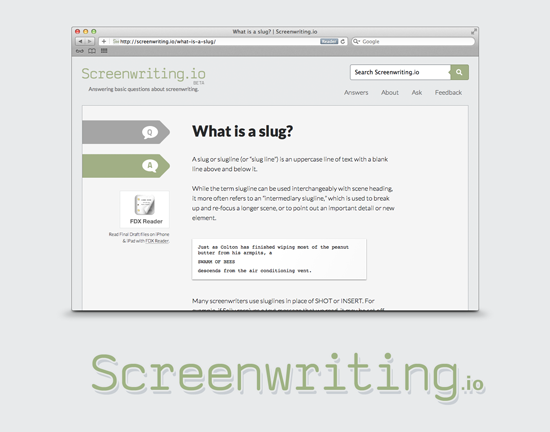
Introducing Screenwriting.io

I’ve been answering online questions about screenwriting since June 2000, when IMDb asked me to be a columnist for their brand-new [Ask a Filmmaker](http://www.imdb.com/indie/ask-archive-toc) section. Those early questions and answers were short and basic — but evergreen, covering topics like copyright, film school and getting an agent.

Frustrated by IMDb’s weekly-column format, I set up this website (johnaugust.com) in 2003 with the goal of answering these questions more fully and forever. If you look through the posts from the [early years](http://johnaugust.com/2004), they’re almost entirely Q&As. Over time, I’ve added features like [Answer Finder](http://johnaugust.com/answers) to make sorting through the 1500+ posts more manageable.

While I still answer reader questions, it’s not this site’s primary focus anymore.

I’ve gotten bloggier, with more here’s-what-I-think posts and Kottke-style link-to articles. I’m also featuring more solicited series like First Person and Workspace. Plus the podcast.

It’s a long way from where I started, and that’s a good thing.

But I still think there’s a need for high-quality answers to basic screenwriting questions. That’s why I’ve asked Stuart and Ryan to build a new site we’re launching today: [Screenwriting.io](http://screenwriting.io).

Screenwriting.io is simply questions and answers about screenwriting:

* [What is a slugline?](http://screenwriting.io/what-is-a-slug/)
* [How do you format a montage in a screenplay?](http://screenwriting.io/how-do-you-format-a-montage-in-a-screenplay/)
* [Can scene headers be bold?](http://screenwriting.io/can-scene-headers-be-bold/)

These are questions so basic they would feel awkward on johnaugust.com.

My mandate to Ryan and Stuart was straightforward: each page should be The Answer. If answering one question raises new questions, new pages should answer those questions.

While we’re not quite going for [Simple English](http://simple.wikipedia.org/wiki/Simple_English_Wikipedia), the language on Screenwriting.io is deliberately unsophisticated. If a sixth-grader in Boston or Belgium or Barbados wants to write a report about screenwriting, she will find the site approachable.

I’ll be supervising the content at Screenwriting.io, but it’s really Ryan and Stuart’s domain.

The new site has been in beta for several weeks. A big thank you to the readers who’ve volunteered to check it out. We will stay in beta for the next month or two while we roll out to the wider world. In the meantime, check it out and leave some [feedback](http://screenwriting.io/feedback/).

I’ll continue to answer questions both on johnaugust.com and on the podcast, but will focus on more difficult topics that don’t have one clear answer — the “what should I do?” questions rather than the whats and whys and hows.

Who killed the mystery?

October 20, 2011 Television

As June Thomas points out, the recent crop of one hour dramas aren’t satisfied with [simply solving crime](http://www.slate.com/articles/arts/culturebox/2011/10/unforgettable_person_of_interest_why_the_next_generation_of_proc.single.html):

> Why are TV writers making their mysteries less mysterious? I think it’s because lots of new procedurals try to fit more than just a case of the week into the 44-minute running time. Most shows also have a serial element, a mystery — usually a quest for elusive information — that lasts throughout the whole series. In the case of Unforgettable, it’s Carrie’s attempt to remember the day her sister was murdered; on Person of Interest, it’s a driven cop’s attempt to capture Reese, who is wanted for a number of serious crimes around the world.

On “pure” procedurals like CSI or Law & Order, ongoing character arcs are squeezed in the margins, with an off-hand comment here, a long look there. You could watch three seasons before you meet a character’s wife — and when you do, watch out, because she’ll likely be dead soon.

With their Sudoku-like straightforwardness, traditional procedurals are easy to watch but hard to obsess over, with the same low barriers to entry making it easy to leave. To use the modern lingo, they’re not *sticky.*

I haven’t watched either Unforgettable or Person of Interest, but the procedural-plus genre can work: consider Sherlock, which features twisty mysteries, ongoing arcs and plenty of snogging. ((And no, I don’t think Sherlock’s epic episode length is the main thing that makes it possible. Buffy and Angel were short and largely procedural (monster of the week), but very arc-y.))

Procedural-plus shows are simply more difficult to pull off, both at the whiteboard stage and in the finished episode. Once you’ve established the stakes of the A-plot — a killer is on the loose! — any scene that doesn’t address that feels like filler. So writers need to find ways to weave character moments into plot scenes, which can be a bear.

Too often, what you end up with is neither plotty enough for crime fans or sophisticated enough for the drama crowd.

« Previous Page
Next Page »

Primary Sidebar

Newsletter

Inneresting Logo A Quote-Unquote Newsletter about Writing
Read Now

Explore

Projects

  • Aladdin (1)
  • Arlo Finch (27)
  • Big Fish (88)
  • Birdigo (2)
  • Charlie (39)
  • Charlie's Angels (16)
  • Chosen (2)
  • Corpse Bride (9)
  • Dead Projects (18)
  • Frankenweenie (10)
  • Go (29)
  • Karateka (4)
  • Monsterpocalypse (3)
  • One Hit Kill (6)
  • Ops (6)
  • Preacher (2)
  • Prince of Persia (13)
  • Shazam (6)
  • Snake People (6)
  • Tarzan (5)
  • The Nines (118)
  • The Remnants (12)
  • The Variant (22)

Apps

  • Bronson (14)
  • FDX Reader (11)
  • Fountain (32)
  • Highland (73)
  • Less IMDb (4)
  • Weekend Read (64)

Recommended Reading

  • First Person (87)
  • Geek Alert (151)
  • WGA (162)
  • Workspace (19)

Screenwriting Q&A

  • Adaptation (65)
  • Directors (90)
  • Education (49)
  • Film Industry (490)
  • Formatting (128)
  • Genres (89)
  • Glossary (6)
  • Pitches (29)
  • Producers (59)
  • Psych 101 (118)
  • Rights and Copyright (96)
  • So-Called Experts (47)
  • Story and Plot (170)
  • Television (165)
  • Treatments (21)
  • Words on the page (237)
  • Writing Process (177)

More screenwriting Q&A at screenwriting.io

© 2026 John August — All Rights Reserved.