• Skip to primary navigation
  • Skip to main content
  • Skip to primary sidebar

John August

  • Arlo Finch
  • Scriptnotes
  • Library
  • Store
  • About

QandA

Spending a year on Ringer

May 8, 2012 First Person, Follow Up, Television

Last year, Jay Faerber wrote a First Person post on [his experience in the Warner Bros TV Writers Workshop](http://johnaugust.com/2011/transitioning-from-comics-to-tv). At that time, he was just finishing up the workshop and staffing season was underway. I asked him for an update.

—

first personThe great thing about the Warner Bros workshop (in addition to what I learned in the program itself) is that it creates a strong incentive for any Warner Bros show that wants to hire a workshopper: the workshop will pay your salary for about the first 13 episodes. So it really gives workshop people a leg up when going out on meetings and competing against other lower-level writers.
Despite that, as any writer will tell you, staffing season is enormously stressful.

While I had that great Warner Bros backing, I was still competing with the seven other drama writers from my workshop. I ended up going on meetings for two bubble shows, plus another pilot. Then upfronts happened, and the two bubble shows were cancelled and the pilot didn’t get picked up.

At this point, I think most of my workshop colleagues had already been staffed, so I was starting to sweat a little. Then Ringer, which had been developed for CBS, got picked up by The CW, which made it a Warner Bros show and therefore a viable option for workshop graduates. I got a meeting on Ringer and was able to get a meeting on another Warner Bros pilot that had been picked up, and if I remember correctly, I got an offer to join the Ringer staff the evening after I had my meeting.

I accepted the offer and started work the Wednesday after Memorial Day.

Getting down to work
—-

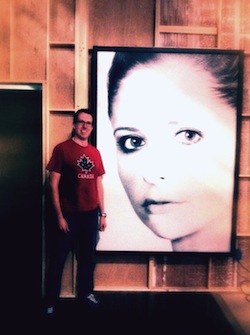
jay faerber ringerThat first day at Ringer had a kind of first-day-of-school feeling, as all the writers got to know each other. It became apparent pretty quickly that I had lucked out — everyone on the writing staff was really cool.

One of the things that really stuck with me from the workshop was the importance of determining what’s expected of the staff writer. Some writers’ rooms adhere to a strict hierarchy and the staff writer is expected to only speak when spoken to (if that!). Others take an all-writers-are-created-equal approach, and everyone’s encouraged to chime in.

But it can get even more complicated than that.

I heard a story of a staff writer who’d been told by a higher level writer to keep his mouth shut and sit back and learn, but then the showrunner declined to pick up the staff writer’s option (after the 13th episode) because the staff writer never contributed. Whether this was a misunderstanding or deliberate sabotage by the higher level writer is up for debate. But I made it a point on that first day to simply ask our showrunner what she expected of me. She made it clear that all of us were expected to contribute.

On Ringer, all the stories were broken collectively by the writers in the room. Once we had the story fully boarded (all of the beats up on the white board), the writer of that episode would go off to write the story arena (or story area — different shows call them different things), then the outline, and then the script.

I’ve been a comic book writer for a long time, so this collaborative way of breaking stories was new to me, but I think I took to it pretty well. And my background helped in other ways. Serialized shows like Ringer have a lot of plot threads to keep track of, as do comics, so my brain was automatically wired for that.

Learning to love the white board
—-

Our writers’ room was lined on three walls with white boards. On the fourth wall was a TV. There were no windows. As the season progressed, two whole walls were taken up with charting the plot developments for each of the main characters in each episode. This helped us keep track of the various plot threads. The remaining third wall was what we used to break the story for each episode.

We’d start out by breaking each character’s story in a linear fashion. Bridget was usually the “A” story, then maybe a Machado or Andrew or Juliet “B” story, then a Siobhan “C” story, then sometimes a Flashback story. Once we had all these stories broken to our satisfaction, we’d start “blending” them — weaving the various stories together and figuring out where they fit into each act.

I quickly became the go-to guy to write on the white board throughout this process. I have good handwriting, and I didn’t mind doing it. It gave me a clear role in the room, and let me feel like I was contributing something even when I wasn’t pitching ideas.

I was also the only writer on staff with an active Twitter account (you can follow me [@JayFaerber](http://twitter.com/JayFaerber)), so I would sometimes Tweet about the show. It was an interesting experience. I wasn’t the “official” spokesman for the show by any means, but I tried to be accessible to fans. Most of my answers were probably vague and unsatisfying, since so many of them were of the “You’ll find out…” or “That’s not my department” variety. And because I was just a staff writer, I didn’t have the authority to be as forthcoming as Shawn Ryan or Jeff Eastin when they’re tweeting about their shows. But it was still fun (for the most part) to interact with the fans.

As is standard in TV, all the writers had initial contracts for the first thirteen episodes, and after that the showrunner could chose to pick up our option…or not. I was kept on, and over the course of the first season I got three scripts: one solo, and two that I co-wrote.

We shot Ringer in LA, and the writers were on set for the entire production of their episodes, which means I got a chair with my name on it and everything.

Someone once said that being a writer on set is like being a fireman — you sit around for long periods of time, and occasionally someone needs you. And that’s a pretty apt description. Most television directors are basically hired guns — they come in, direct an episode, and move on to the next gig on another show. As talented as these directors can be, they don’t always know the show, so it’s important for one of the writers to be there to make sure what’s being shot captures what we intended.

Not every show sends their writers to set. I have friends who wrote on shows that shot out of town, and they never got to be involved in production. And while these friends have been TV writers longer than I have, I feel like I have a leg up on them when it comes to production.

Back on the market
—

Ratings on Ringer haven’t been great and as we ended the season we were very much a “bubble show.” We might get renewed, we might not. The powers-that-be at The CW are probably waiting to see how their pilots turn out before they make any decisions.

This means that I’m going out for staffing season again. It’s a different experience now, since I’m not fresh out of the workshop. I’m competing with every other staff writer and story editor out there — not to mention this year’s new workshop graduates. But I’ve also got a year of experience under my belt, including three produced scripts.

I’m discovering staffing season requires you to be in a weird emotional space.

I want Ringer to come back because I love working with the writers and I really enjoy the world we spent the past year building. It’s a good job, and I’d like it to continue.

But in order to go out and meet with the showrunners of other shows, I have to sort of emotionally disconnect from Ringer so that I can allow myself to get excited about the idea of working on something else.

This isn’t a unique situation I’m in — a lot of shows end their season not knowing if they’re going to renewed. This type of emotional disconnect seems to be something worth developing if you’re going to have a career in TV.

I’ve spent the past couple months reading pilots and going on meetings for new shows, but I’m also still in touch with all the writers from Ringer. Hopefully we’ll be back in our writers’ room next season, and if not, I can only hope my next job is as great as my first one.

Writer’s block and other romantic myths

Episode - 36

Go to Archive

May 8, 2012 QandA, Scriptnotes, Transcribed, Writing Process

John and Craig open the 36th Scriptnotes with a brief discussion about contracts, and then face writer’s block head on.

“Writer’s block” is an overused term. When a writer claims to be suffering from it, he is usually wrestling with some combination of three common problems: procrastination, perfectionism, and fear. “Writer’s block” is a romanticized catch-all that distracts from these real issues.

Screenwriters can use a range of techniques to get over the hump, from setting a kitchen timer, to breaking work down into manageable chunks, to writing in an order that makes sense for the way you work.

They then take two quick listener questions before closing out the episode with this week’s One Cool Thing (TM).

It’s Tuesday! So head over to Panda Express and get yourself a celebratory meal to enjoy with episode 36 of Scriptnotes.

LINKS:

* [Jajangmyeon](http://en.wikipedia.org/wiki/Jajangmyeon), Craig’s Korean noodles
* George Lucas, Seven Spielberg, and Lawrence Kasdan’s [Raiders Story Conference](http://mysterymanonfilm.blogspot.com/2009/03/raiders-story-conference.html)
* [Old Jews Telling Jokes](http://oldjewstellingjokes.com/)
* Charlie Seibel, [Giving a Bull an Enema](http://oldjewstellingjokes.com/post/22190142833) on OJTJ
* [iScore](http://iscorecentral.com/baseball/)
* INTRO: [Simon & Simon](http://www.youtube.com/watch?v=IDhz_mVcVCQ) theme
* OUTRO: [Umbrellas](http://www.youtube.com/watch?v=q9qF1W5xX8Q) by Fredo Viola

You can download the episode here: [AAC](http://traffic.libsyn.com/scriptnotes/scriptnotes_ep_36.m4a).

**UPDATE** 5-9-12: The transcript of this episode can be found [here](http://johnaugust.com/2012/scriptnotes-ep-36-writers-block-and-other-romantic-myths-transcript).

The Disney Dilemma

May 1, 2012 News, QandA, Scriptnotes

On the 35th episode of Scriptnotes, John and Craig discuss the small, currently leaderless world of Walt Disney Studios, along with its challenges and opportunities.

With so many of Disney’s distribution slots taken up by DreamWorks, Marvel, Pixar and Bruckheimer, whoever gets the job of chief probably won’t be making many movies on his or her own. Yet the Disney brand is one of the only ones that still means something to ticket-buyers, so finding a way to make Disney movies feels like a priority.

A discussion of Gregory Poirier’s recent article on misguided cost-cutting segues to a letter from a veteran Hollywood screenwriter frustrated by just how bad studio development has gotten. That’s followed by more listener questions:

* What distinguishes a well-developed character from a flat one?

* How should a recent college graduate from Colorado go about starting a screenwriting career?

* Where do pitches come from?

* How long should it take for your agent to return your call?

John extols his favorite site for sheet music, while Craig gets nostalgic for his first real computer, the Franklin Ace 1000.

All this and more on Scriptnotes: A podcast about parking, and things that are interesting to parkers.

LINKS:

* [John’s post](http://johnaugust.com/2012/how-cost-cutting-hurt-movies) on Gregory Poirier’s article
* Jason Robert Brown on copyright and [fighting with teenagers](http://www.jasonrobertbrown.com/weblog/2010/06/fighting_with_teenagers_a_copy.php)
* Musicnotes version of [Jar of Hearts](http://www.musicnotes.com/sheetmusic/mtdFPE.asp?ppn=MN0085778&)
* Craig’s first computer, the [Franklin Ace 1000](http://www.vintage-computer.com/franklin.shtml)
* INTRO: [Wonderful World of Disney intro](http://www.youtube.com/watch?v=yzj9vlWRUIw&feature=related)
* OUTRO: [HardChord DynaMix – Jar of Creep](http://www.youtube.com/watch?v=mub_xRooWAQ)

You can download the episode here: [AAC](http://traffic.libsyn.com/scriptnotes/scriptnotes_ep_35.m4a).

**UPDATE** 5-4-12: The transcript of this episode can be found [here](http://johnaugust.com/2012/scriptnotes-ep-35-the-disney-dilemma-transcript).

Confessions of a trust-fund screenwriter

April 30, 2012 Film Industry, First Person, Follow Up, Psych 101

In response to [the podcast discusson](http://johnaugust.com/2012/professional-screenwriting-and-why-no-one-really-breaks-in) Craig and I recently had about the perceptions of nepotism and wealth in the film industry, a listener wrote in to share his experience.

—

first personI am a trust fund screenwriter. Or was. I moved out here with a lot of family backing (though no real connections). For my first two years in LA, I sat in my apartment all day, trying to make myself write, as I could afford it and thought it the best use of my time.

But the key word there is ‘trying.’

Having a trust fund is nice, but it didn’t help me become a writer. It’s very hard to sit down and force yourself to write for eight hours a day when there’s nothing else in your life.

Even when I did write, it didn’t make me a screenwriter; there’s still the whole business side of the business I needed to learn.

And when I didn’t write (because of writer’s block or whatever) the thought of “I’m wasting my time” crept into my head, and made it even harder. That’s not the only issue, though.

The issue is one of access. Yes, I have some family money (enough to live on for a while, but not enough for reality TV), but I don’t have family connections in LA. And so, while spending two years in my apartment trying to write all day, I met no one — no executives, no agents, no managers — assuming that once I’d completed my perfect script, they’d come flocking to me.

And that was wrong on two counts.

One, they wouldn’t have come flocking. From my couch, I didn’t meet anyone willing to read my script and help my career.

Second, I couldn’t write a perfect script, or even a very good one. While I was wasting time in my apartment, I wasn’t learning. I wasn’t living. I didn’t grow as a person, and the stagnancy I felt in my life was reflected in my scripts. They were interesting ideas, but, like me, had no life.

I’d never leap in from the outside. I’d never write anything great by staying on my couch. I wouldn’t meet the right people, learn the way things work. I still needed talent. I needed to know the industry outside and in before I could expect to fully be a part of it.

Staying at home, living off my trust fund and writing didn’t work.

My father, who unlike me worked himself up from nothing to the point where he could give his children trust funds, always said the thing that drove him was the knowledge that he didn’t have any other options. And for me, the trust fund is always another option. I’ve always had a safety net. Which isn’t to blame the trust fund or to imply in any way that having a trust fund isn’t a good problem to have. I’m not that blind.

But my money couldn’t buy connections, and reveling in my financial comfort didn’t breed creativity.

Getting off the golden couch
—-

I started going out more. Because I have enough to live on, I could afford to work internships, which I did for a year. That’s an advantage I have. But I don’t think most of the other interns at my level had that advantage.

Now, finally, after almost a year of working for nearly nothing, things are happening. I’ve met lots of people who are able and willing to help me, whether by reading my scripts or making introductions for me. I’m working now—for actual, cash money—as a script reader, as an administrator for a screenplay contest, and as a freelance video producer.

And I’m still writing. Better than ever before.

I’ve grown as a writer exponentially more while working than I grew in the two years I spent just writing. There’s nothing like reading 400 scripts as a contest judge to teach you what not to do in a screenplay.

I’m not a professional writer yet. And it’s possible that if I’d had to work to support myself, I’d have found myself so stressed and overworked that I’d have given up long ago. But I don’t think so. I’m working now, and I’m writing just as much as before.

Maybe the money held me back. It’s possible that if I’d been working in the industry, supporting myself and meeting people while writing in my free time, I’d be much farther along than I am now. I’d have experienced failure and hardship in my career sooner, and maybe I’d have learned sooner how to translate that into a truly great screenplay.

And maybe I’d have written that screenplay in my spare time instead of the crap I wrote from my couch. And maybe one of my friends and connections and mentors — which I never had from my apartment — would have read that script and passed it on, and I’d be a professional writer right now.

Maybe they’d pay me millions of dollars to write the next big movie. I’d spend all day by the pool in my Beverly Hills mansion, trying to write for eight hours because it’d be my full-time job.

I still probably couldn’t do it.

Not for eight hours a day. Not from home. Not by myself.

My trust fund is a blessing, and I recognize that. Many things are easier for me than other people. Being a screenwriter is not one of them.

« Previous Page
Next Page »

Primary Sidebar

Newsletter

Inneresting Logo A Quote-Unquote Newsletter about Writing
Read Now

Explore

Projects

  • Aladdin (1)
  • Arlo Finch (27)
  • Big Fish (88)
  • Birdigo (2)
  • Charlie (39)
  • Charlie's Angels (16)
  • Chosen (2)
  • Corpse Bride (9)
  • Dead Projects (18)
  • Frankenweenie (10)
  • Go (29)
  • Karateka (4)
  • Monsterpocalypse (3)
  • One Hit Kill (6)
  • Ops (6)
  • Preacher (2)
  • Prince of Persia (13)
  • Shazam (6)
  • Snake People (6)
  • Tarzan (5)
  • The Nines (118)
  • The Remnants (12)
  • The Variant (22)

Apps

  • Bronson (14)
  • FDX Reader (11)
  • Fountain (32)
  • Highland (73)
  • Less IMDb (4)
  • Weekend Read (64)

Recommended Reading

  • First Person (87)
  • Geek Alert (151)
  • WGA (162)
  • Workspace (19)

Screenwriting Q&A

  • Adaptation (65)
  • Directors (90)
  • Education (49)
  • Film Industry (490)
  • Formatting (128)
  • Genres (89)
  • Glossary (6)
  • Pitches (29)
  • Producers (59)
  • Psych 101 (118)
  • Rights and Copyright (96)
  • So-Called Experts (47)
  • Story and Plot (170)
  • Television (165)
  • Treatments (21)
  • Words on the page (237)
  • Writing Process (177)

More screenwriting Q&A at screenwriting.io

© 2026 John August — All Rights Reserved.