• Skip to primary navigation
  • Skip to main content
  • Skip to primary sidebar

John August

  • Arlo Finch
  • Scriptnotes
  • Library
  • Store
  • About

QandA

In which Stuart reads the Save the Cat! books and tells you what he thought

July 11, 2012 Books, So-Called Experts, Stuart

I don’t read how-to books on screenwriting, but Stuart does, so I occasionally ask him to write up his impressions. For this round, he tackled the three Save the Cat! books by Blake Snyder.

**tl;dr version:** Stuart liked them. While I don’t endorse any how-to gurus, it sounds like these books are better than most.

—-

by_stuartWhenever screenwriting books or gurus are mentioned on John’s site, it is with near death-or-taxes certainty someone will bring up the Save the Cat! series in the comments.
Blake Snyder’s resume is offered as a counter-example to the “those that can’t do teach” complaint. Snyder, who passed away in 2009, was an actual screenwriter, having written Blank Check and Stop! Or My Mom Will Shoot. You can debate the merits of those credits, but those are two credits more than most screenwriting gurus can offer.

Over the years, I had sat down with [the first Save the Cat!](http://www.amazon.com/dp/1932907009/?tag=johnaugustcom-20) a few times, but had never managed to get past the first chapter, where Snyder repeatedly cites the brilliance of Four Christmases, which at that time was nothing more than a title and logline. Still, multiple people whose opinions I trust had assured me StC is worthwhile. I started to feel like someone who was having trouble getting past the first few episodes of The Wire. “You’ll see – it’s great.” “It’s worth it.” “You’ll get it soon.”

And they were right.

Getting the lingo
—

Save the Cat! has become a sort-of brand of its own. The books now have companion software for both computers and iOS devices, a blog that offers advice and film analysis through the StC lens, and seminars that have continued since Snyder’s death.

StC has its own vocabulary. “Save the cat” refers to the idea that our hero should win over the audience from the outset by doing something likeable the first time we meet her, like saving a cat. “Pope in the pool” is the name given to distractions used to disguise exposition.

There are a lot of these — some specific, some general, all helpful. But most people can discuss first acts even if you haven’t read Syd Field. To speak StC, you have to speak StC.

The books’ basic argument is that well-constructed, emotionally satisfying movies can be broken into 15 essential beats, which Blake outlines on his BS2 (Blake Snyder Beat Sheet):

>1. Opening image (page 1)
>2. Theme stated (5)
>3. Set up (1 – 10)
>4. Catalyst (12)
>5. Debate (12 – 25)
>6. Break in two (25)
>7. B-story (30)
>8. Fun and games (30 – 55)
>9. Midpoint (55)
>10. Bad guy closes in (55 – 75)
>11. All is lost (75)
>12. Dark night of the soul (75 – 85)
>13. Break into three (85)
>14. Finale (85 – 110)
>15. Final image (110)

For those of you who have read other screenwriting how-to books before, this may feel old hat. This is Snyder’s version of the formula that is the backbone to all of these.

Snyder explores the idea in more specific detail by defining the ten basic stories all movies tell, and demonstrating the way the formula applies to each. Those stories are:

>* **Monster in the House** — Of which *Jaws, Tremors, Alien, The Exorcist, Fatal Attraction,* and *Panic Room* are examples.
>* **Golden Fleece** — This is the category of movie best exemplified by *Star Wars; the Wizard of Oz; Planes, Trains and Automobiles; Back To The Future;* and most “heist movies.”
>* **Out of the Bottle** — This incorporates films like *Liar, Liar; Bruce Almighty; Love Potion #9; Freaky Friday; Flubber;* and even my own little kid hit from Disney, *Blank Check*.
>* **Dude with a Problem** — This is a genre that ranges in style, tone, and emotional substance from *Breakdown* and *Die Hard* to *Titanic* and *Schindler’s List*.
>* **Rites of Passage** — Every change-of-life story from *10* to *Ordinary People* to *Days of Wine and Roses* makes this category.
>* **Buddy Love** — This genre is about more than the buddy movie dynamic as seen in cop buddy pictures, *Dumb & Dumber*, and *Rain Man* — but also every love story ever made!
>* **Whydunit** — Who cares *who*, it’s *why* that counts. Includes *Chinatown, China Syndrome, JFK,* and *The Insider*.
>* **The Fool Triumphant** — One of the oldest story types, this category includes *Being There, Forrest Gump, Dave, The Jerk, Amadeus,* and the work of silent clowns like Chaplin, Keaton, and Lloyd.
>* **Institutionalized** — Just like it sounds, this is about groups: *Animal House, M\*A\*S\*H, One Flew Over the Cuckoo’s Nest,* and “family” sags such as *American Beauty* and *The Godfather*.
>* **Superhero** — This isn’t just about the obvious tales you’d think of, like *Superman* and *Batman*, but also includes *Dracula, Frankenstein,* even *Gladiator* and *A Beautiful Mind*.

The second book, [Save the Cat! Goes to the Movies](http://www.amazon.com/dp/1932907351/?tag=johnaugustcom-20), is dedicated to breaking down movies that exemplify each of these stories’ sub-categories. And his blog continues to offer breakdowns of current movies.

The first book goes on to offer methods for constructing your own stories quickly and efficiently once you’ve accepted these basics. Snyder lays out plans for an easy and well-organized 40-beat note card board (ten each for acts 1, 2a, 2b, and 3), ways to organize said beats so they work together emotionally and build towards a whole, and ways to break down the beats into manageable chunks.

Snyder makes the whole task of writing a screenplay seem downright doable.

The first book is also full of advice about loglines, titles, pitches, double checking your story, adding weight — all the standard fare, discussed thoroughly and simply. And the third book, [Save the Cat! Strikes Back](http://www.amazon.com/dp/0984157603/?tag=johnaugustcom-20), is more of the same, although it focuses on addressing common questions he heard from people who have read the first two books, and discusses some after-the-writing questions, like how to dress for a pitch or how to handle your first meeting.

The three add up to a fairly comprehensive overview of a screenwriter’s career, and really work well as complements.

What’s not so great
—

This is not to say they are without issue, however. When discussing the problems with screenwriting books, people often point to Save the Cat! as the ones that get it right. But really, the StC books are not essentially unique. They fail in the same places most other screenwriting books do.

At times, and increasingly as the books go on, Blake writes as if he is leading a seminar. I found the self-helpy tone annoying:

>And while so many other screenwriting schools focus on the can’ts, that’s how Strike Back U. is different.

>Because we know you can.

In this case and others, this tone does no good. It is both belittling and falsely optimistic, as it presents an optimism that is based on nothing. It implies that this isn’t just a course for beginners, but a magic key that will unlock the secrets to screenwriting success.

Snyder is also a little too unapologetically commercial. While I praise him for not giving into critics who fault his mainstream taste, he eschews defenses when defenses are warranted. He will make passing mention of how his breakdowns can be applied to less-commercial movies too, but more often than not it almost feels like he’s taunting his critics.

Snyder tells writers to get through writer’s block by thinking, “Here’s the bad way to do this,” and then doing it. He points to Four Christmases’s 22% Rotten Tomatoes score as something we should find encouraging. And on some level, the very nature of the exercise feels like one of imitation.

Frankly, I think the StC series is the best of the how-to books I’ve read, but they’re not fundamentally different. Sure, they are written by somebody with a little more experience. But if you disagree with the thesis at the heart of this class of books — the idea that there is a formula, and you can learn it — the Save the Cat! books will not change your mind.

But if you’re okay with the notion that there is a universally and emotionally pleasing cadence to movies and you are looking for some help mastering it, the Save the Cat! books present these ideas clearly and manageably without forcing it. The books offer a lot of simple and well-thought-out tips to make your movies better, and they present Hollywood in a realistic (yet painfully optimistic) way.

Bottom line: The StC books are not the Holy Grail counter-example they’re often purported to be, but from what I have read, they are indeed the best how-tos being sold.

Setting, perspective and terrible numbers

Episode - 45

Go to Archive

July 10, 2012 Challenge, Scriptnotes, Story and Plot, Three Page Challenge, Transcribed, WGA

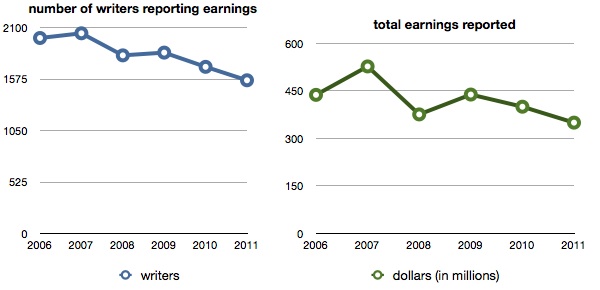
It’s two parts craft and one part business as Craig and John discuss the alarming earnings report coming out of the WGA, plus a deeper look at setting and POV.

For feature screenwriters, it’s hard to find a silver lining in the [WGA’s report](http://www.wga.org/uploadedFiles/who_we_are/annual_reports/annualreport12.pdf) on 2011 earnings. Numbers are down significantly, both in total dollars and the number of writers earning anything at all.

2011 earnings chart

Of course, you don’t have to be employed to write a script, so we spend the rest of the show talking about two crucial aspects of screenwriting: choosing effective settings and deciding on POV.

Setting is both a macro and micro decision. Early on, you need to figure out where your movie takes place. Everything about your story will be impacted by the world you choose. Then as you write individual scenes, you look for environments that provide opportunities and challenges for your characters — and for the director. Film is a visual medium, so smart screenwriters consider what settings will suit a big screen.

Perspective, or POV, is about figuring out which characters have storytelling power in your movie. Which characters can anchor a scene without the hero? Which characters can do voiceover? The choices you make greatly effect audience expectation, so it’s worth thinking about at the very start.

Finally, we talk about the Three Page Challenge. On an upcoming podcast, we’ll be critiquing three pages (and only three pages!) from listeners’ scripts. If you want to participate, visit [johnaugust.com/threepage](http://johnaugust.com/threepage) for details.

LINKS:

* [2012 WGAW Annual Report to Writers](http://www.wga.org/subpage_whoweare.aspx?id=230)
* [Bridesmaids](http://www.bridesmaidsmovie.com/index.php)
* [The Shaggs](http://www.shaggs.com/)
* [PB2 Peanut Butter Powder](http://www.amazon.com/dp/B002GJ9JWS/?tag=johnaugustcom-20) on Amazon
* [Cambridge Ivory Wirebound Notebook](http://www.amazon.com/dp/B003VIVX2M/?tag=johnaugustcom-20) on Amazon
* [The Scriptnotes Three Page Challenge](http://johnaugust.com/threepage)
* INTRO: [Lite Brite commercial](http://www.youtube.com/watch?v=Huat89z2WrA)
* OUTRO: [Super Mario Brothers on Classical Guitar](http://www.youtube.com/watch?v=d3UTHj16ukM)

You can download the episode here: [AAC](http://traffic.libsyn.com/scriptnotes/scriptnotes_ep_45.m4a).

**UPDATE** 7-12-12: The transcript of this episode can be found [here](http://johnaugust.com/2012/scriptnotes-ep-45-setting-perspective-and-terrible-numbers-transcript).

Standing up for ticket-takers

July 9, 2012 Film Industry

Employees are suing AMC Theaters, arguing that they should be [allowed to sit down](http://www.hollywoodreporter.com/thr-esq/amc-theaters-ticket-takers-sue-345605?utm_source=feedburner&utm_medium=feed&utm_campaign=Feed%3A+thr%2Ffilm+%28The+Hollywood+Reporter+-+Movies%29):

> McInerney is representing Andrew Allen and all other AMC employees similarly situated, claiming they are being forced to endure long hours on their feet when taking money and checking tickets. The proposed class action alleges a violation of California Labor Code Section 1198 and Wage Order 7-2001, Section 14, which says that “all working employees shall be provided with suitable seats when the nature of the work reasonably permits the use of seats.”

Two things. First, my full love and support to theater employees, who perform all the customer service aspects of the motion picture business for low wages and little appreciation. Sure, some theater employees are terrible, but to the good ones: You’re doing the Lord’s work. Thank you.

Second, sitting is [pretty terrible for you](http://www.nytimes.com/2011/04/17/magazine/mag-17sitting-t.html?_r=3&src=me&ref=homepage), too. (And yes, I’m typing this at a standing desk.)

My hunch is that most Americans would be healthier working at a theater, with all its standing and activity, than at a conventional job behind a desk.

Endings for beginners

July 3, 2012 Scriptnotes, Story and Plot, Transcribed

John and Craig look at how to write satisfying third acts. That doesn’t necessarily mean a happy ending, but rather one that feels earned.

If the first 10 pages of a script establish a contract between reader and writer — give me your undivided attention and I will make it worthwhile — the last 10 pages are where that contract is paid out. This is where screenwriters generally need to spend much more time, yet it’s often hurried and rushed.

Looking at the headlines, Craig fills us in on Hayden Christiansen’s lawsuit against USA Network’s Royal Pains and what it means for screenwriters. (Expect to be signing new forms.)

We also discuss a listener’s lament that studio execs have learned all the wrong lessons from the success of Avengers (and the failure of Abraham Lincoln: Vampire Hunter).

All this and vocal fry in the new installment of Scriptnotes.

LINKS:

* [Hayden Christensen Wins Big Victory Against USA Network in ‘Royal Pains’ Appeal](http://www.hollywoodreporter.com/thr-esq/hayden-christensen-royal-pains-usa-lawsuit-342497)
* INTRO: [ABC’s 1976 Bicentennial Celebration](http://www.youtube.com/watch?v=tImKevSPH6Y)
* OUTRO: [Chet Atkins, Stars and Stripes Forever](http://www.youtube.com/watch?v=Cyiq6lewgOk)

You can download the episode here: [AAC](http://traffic.libsyn.com/scriptnotes/scriptnotes_ep_44.m4a).

**UPDATE** 7-6-12: The transcript of this episode can be found [here](http://johnaugust.com/2012/scriptnotes-ep-44-endings-for-beginners-transcript).

« Previous Page
Next Page »

Primary Sidebar

Newsletter

Inneresting Logo A Quote-Unquote Newsletter about Writing
Read Now

Explore

Projects

  • Aladdin (1)
  • Arlo Finch (27)
  • Big Fish (88)
  • Birdigo (2)
  • Charlie (39)
  • Charlie's Angels (16)
  • Chosen (2)
  • Corpse Bride (9)
  • Dead Projects (18)
  • Frankenweenie (10)
  • Go (29)
  • Karateka (4)
  • Monsterpocalypse (3)
  • One Hit Kill (6)
  • Ops (6)
  • Preacher (2)
  • Prince of Persia (13)
  • Shazam (6)
  • Snake People (6)
  • Tarzan (5)
  • The Nines (118)
  • The Remnants (12)
  • The Variant (22)

Apps

  • Bronson (14)
  • FDX Reader (11)
  • Fountain (32)
  • Highland (73)
  • Less IMDb (4)
  • Weekend Read (64)

Recommended Reading

  • First Person (87)
  • Geek Alert (151)
  • WGA (162)
  • Workspace (19)

Screenwriting Q&A

  • Adaptation (65)
  • Directors (90)
  • Education (49)
  • Film Industry (490)
  • Formatting (128)
  • Genres (89)
  • Glossary (6)
  • Pitches (29)
  • Producers (59)
  • Psych 101 (118)
  • Rights and Copyright (96)
  • So-Called Experts (47)
  • Story and Plot (170)
  • Television (165)
  • Treatments (21)
  • Words on the page (237)
  • Writing Process (177)

More screenwriting Q&A at screenwriting.io

© 2026 John August — All Rights Reserved.