• Skip to primary navigation
  • Skip to main content
  • Skip to primary sidebar

John August

  • Arlo Finch
  • Scriptnotes
  • Library
  • Store
  • About

QandA

Selling a script, but holding on to the characters

August 16, 2012 QandA, Rights and Copyright

questionmarkI’m a first time writer in the UK, who is in the process of having an original movie script picked up by a start-up production company. Everyone who has read the script loves it and they all say it’s wide open for a sequel or maybe even a spin-off TV series.
I’m obviously thrilled to have the script picked up, but I was wondering of there is a way I can legally retain the rights to the characters so I can write a sequel at some point in the future? Because the company is a start-up they don’t have much money to spend, so I’m willing to take a much reduced payment for the script, provided I can somehow retain the rights to the characters I created.

Is the answer simply a carefully drafted contracts, to include reference to the rights reverting to me after one production?

— Andy
Derbyshire, England

Short answer: Yes.

Longer answer: In most cases, when you’re selling (or optioning) a screenplay to a production entity, they want absolutely everything, including the right to make sequels and spin-offs. Contracts will often have built-in payments for these derivative works.

But it doesn’t have to be that way.

If you’re willing to take less money upfront — perhaps because the production entity can’t afford to pay you more — you can often negotiate terms that make sense for you, including holding on to some rights you’d otherwise give up.

Bottom line: You need an entertainment attorney. This isn’t standard boilerplate language, and will require significant negotiation. You want to protect yourself in case of disaster or wild success, and small glitches in the contract could cause huge problems.

Keep in mind that the buyer has a very good reason for wanting those sequel and spin-off rights. They want to be able to sell the movie to a larger buyer, and a possible franchise is worth more than a one-off movie.

Related trivia: My first spec sale, Go, was a similarly small deal with special terms, including my becoming co-producer. While there was never serious talk about a sequel, there was a TV spin-off. I wasn’t involved, but Sony TV did develop a show based on it. I think they shot a pilot — [The Malloys](http://en.wikipedia.org/wiki/The_Malloys) were involved, if I recall correctly — but it never went to series.

Death and advertising

August 13, 2012 Rights and Copyright

In his will, Beastie Boy Adam “MCA” Yauch left instructions that “in no event may my image or name or any music or any artistic property created by me be used for advertising purposes.” Wendy S. Goff looks at why that [opens a legal can of worms](http://www.forbes.com/sites/deborahljacobs/2012/08/13/part-of-beastie-boy-adam-yauchs-will-banning-use-of-music-in-ads-may-not-be-valid/):

> In a sentence that referred to publicity rights, the words Yauch added introduced the matter of copyright. The two are very different legal animals.

> Publicity rights refers to Yauch’s interest, while he lived and in some states after he died, in protecting his image and his name, which had value because he was a celebrity. Legally, they couldn’t be used in advertising without his permission (or that of his heirs). Someone who violated this right could be required to pay a fine for the value of the damages they caused, and turn over any profits they made as a result.

> Contrast that right with copyright — the federal law that covers a literary, artistic, musical, or other creative work. Copyright owners have the right to control the use of their work and get paid for it. In the music industry, it covers not only the written composition (sheet music and lyrics), but also sound recordings. To make things more complicated still, the composer of the music and the lyricist are both considered authors.

Yauch and his heirs clearly control his publicity rights. But most of his music copyrights are likely shared with his bandmates and others; his estate can’t constrain what it doesn’t own. Music is especially hard to pin down:

> When songs have been distributed to the public under certain conditions, the owner of the composer’s copyright cannot prevent other artists from “sampling” or making “covers” of the song.

> The mandatory license right forces the owner to license the rights to others who may make their own recordings and sell them for a profit. (Whether Monster Beverage exceeded the rights afforded by a mandatory compulsory license, and therefore infringed on the Beastie Boys’ copyrights is the subject of a lawsuit.) Therefore Yauch’s heirs may be forced to license his work, whether or not the terms of his will allow them to derive any profit from it.

Philosophically, it’s easy to see what Yauch was going for. Practically, this was a situation that needed more-nuanced legalese to avoid unintended consequences.

Link via [Jen Pollack Bianco](https://twitter.com/lax2nrt/status/235019303383080960).

Lego story rules

August 13, 2012 Story and Plot

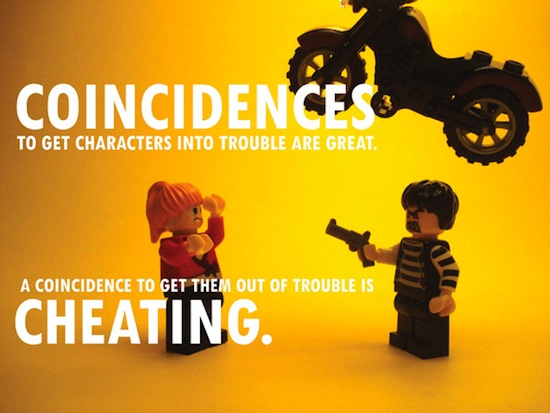
Emma Coats’s list of [22 story rules](http://www.pixartouchbook.com/blog/2011/5/15/pixar-story-rules-one-version.html) moves from useful to delightful when
[illustrated with Lego](http://slacktory.com/2012/07/pixar-story-rules-illustrated-by-icanlegothat/):

pixar coincidence

(I’ve written about the [perils of coincidence](http://johnaugust.com/2007/perils-of-coincidence) as well.)

Illustration by Alex Eylar, link via [David Anaxagoras](http://davidanaxagoras.com).

Losing sleep over critics

Episode - 49

Go to Archive

August 9, 2012 Follow Up, QandA, Scriptnotes, Transcribed

John and Craig talk critics, and how trying to anticipate their reviews can cause paralysis.

It’s funny how the screenwriter only seems to get mentioned in negative reviews. Well, not funny, actually. Frustrating. And possibly statistically verifiable, so listen in if you’re looking for a research project.

Also this week: Craig’s insomnia, traffic apps, bake-offs done better, and capitalizing on a big star attachment. Plus fun things you can do in the shower!

All this and more in this slightly-delayed Scriptnotes!

LINKS:

* [AquaNotes](http://www.myaquanotes.com/)
* [Inrix](http://www.inrixtraffic.com/) traffic app
* INTRO: [Good Times opening titles](http://www.youtube.com/watch?v=ZFKHg5CP7pk)
* OUTRO: [Cars](http://www.youtube.com/watch?v=6qlUFKFHNIU), NIN featuring Gary Numan

You can download the episode here: [AAC](http://traffic.libsyn.com/scriptnotes/scriptnotes_ep_49.m4a).

**UPDATE** 8-14-12: The transcript of this episode can be found [here](http://johnaugust.com/2012/scriptnotes-ep-49-losing-sleep-over-critics-transcript).

« Previous Page
Next Page »

Primary Sidebar

Newsletter

Inneresting Logo A Quote-Unquote Newsletter about Writing
Read Now

Explore

Projects

  • Aladdin (1)
  • Arlo Finch (27)
  • Big Fish (88)
  • Birdigo (2)
  • Charlie (39)
  • Charlie's Angels (16)
  • Chosen (2)
  • Corpse Bride (9)
  • Dead Projects (18)
  • Frankenweenie (10)
  • Go (29)
  • Karateka (4)
  • Monsterpocalypse (3)
  • One Hit Kill (6)
  • Ops (6)
  • Preacher (2)
  • Prince of Persia (13)
  • Shazam (6)
  • Snake People (6)
  • Tarzan (5)
  • The Nines (118)
  • The Remnants (12)
  • The Variant (22)

Apps

  • Bronson (14)
  • FDX Reader (11)
  • Fountain (32)
  • Highland (73)
  • Less IMDb (4)
  • Weekend Read (64)

Recommended Reading

  • First Person (87)
  • Geek Alert (151)
  • WGA (162)
  • Workspace (19)

Screenwriting Q&A

  • Adaptation (65)
  • Directors (90)
  • Education (49)
  • Film Industry (490)
  • Formatting (128)
  • Genres (89)
  • Glossary (6)
  • Pitches (29)
  • Producers (59)
  • Psych 101 (118)
  • Rights and Copyright (96)
  • So-Called Experts (47)
  • Story and Plot (170)
  • Television (165)
  • Treatments (21)
  • Words on the page (237)
  • Writing Process (177)

More screenwriting Q&A at screenwriting.io

© 2026 John August — All Rights Reserved.