
Daniel Wallace, author of the novel Big Fish, has opened his own website with information about his books, illustrations and screenplays. It’s great. In fact, it has me sick with envy. Daniel even has links through which you can buy his books from Amazon — which you should, because that way he’ll get an extra couple percent in addition to royalties.  And if that gets him to write more, well, you’ve done your part to make the world better.
Projects
New Big Fish paperback
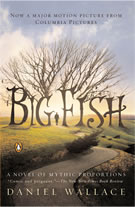
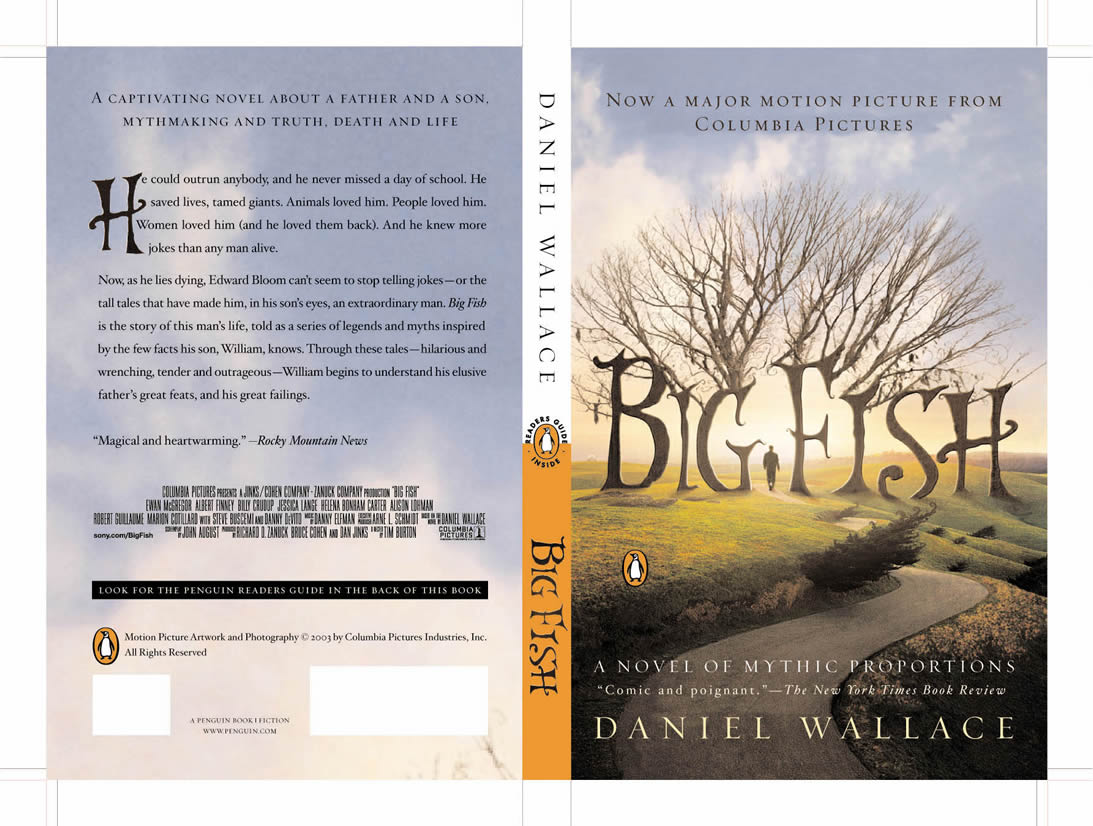
Penguin is issuing a special paperback version of Daniel Wallace’s “Big Fish” with the new cover artwork. (You can see the bigger version of it here.) The cover is essentially the same as the upcoming one-sheet poster.
More on becoming a co-producer
How did you come to be a co-producer on GO?
–David Demchuk
Although Columbia Pictures ultimately released GO, they weren’t the original
buyer of the script (in fact, every studio in town had passed on it, feeling
the subject matter was too dark). A tiny company called Banner Entertainment
read the script and wanted to make the movie, but since they didn’t have a
lot of money to put up front, they offered a few things a studio normally wouldn’t.
First, they guaranteed I would be the first, last and only writer on the project.
Second, they would give me the right to buy the script back if the movie hadn’t
gone into production within 18 months. Finally, they would keep me on board
as co-producer.
The various flavors of producer credit (executive
producer, associate producer,
co-producer) are tossed around a bit too easily in Hollywood, and all too often
they’re given to people who don’t really deserve them, such as an actor’s mananger.
In my case, I actually earned my masters degree in the film producer’s program
at USC, so I was weirdly well qualified for the job.
For the first week or two, I just sat quietly in meetings, happy to be there.
But ultimately I got highly involved in every aspect of the production, from
hiring Doug Liman to direct it to scrambling for funds when our foreign financing
fell apart (I had just made a deal with Columbia’s sister studio, Tri-Star,
which is a large reason why the movie ended up there). During production, I
was on-set from call to wrap, and sat in on five months of editing. It was
an amazing experience.
In total, there were five producers on GO. The three "full" producers
were Paul Rosenberg, who had set up the script and given me my first two jobs
in the business; Mickey Liddell, who ran Banner Entertainment; and Matt Freeman,
who worked with Mickey and brought him the script. The other co-producer was
Paddy Cullen, who oversaw the physical production, including the budget, schedule
and insurance.
Looking back, it’s hard to imagine making the movie without all those people
doing their part. While GO had some unique challenges, every production needs
its good cops and bad cops, peacemakers and war-bringers. A writer can go off
and work by himself, but a producer needs to lead dozens of other people. It’s
a very different set of skills.
Since GO, I have co-executive produced a television series, and signed on
to produce a big-budget monster movie that I’m writing at Columbia. But even
on projects where I’m "just" a writer, the experience of having produced
is a tremendous advantage in anticipating the needs of the filmmakers.
Writers on art direction and cinematography
I am a film school student in southern CA, and I just saw
a preview for CHARLIE’S ANGELS. I was very intrigued with the mis-en-scene
of the picture and I wonder: How much influence does the writer (in this case)
have
over the
art direction
and style of photography?
–Anonymous
Well, clearly you’re a film student because you used the term "mis-en-scene."
In the case of CHARLIE’S ANGELS, I was more involved than usual during pre-production because of the overall coolness of the director, McG, and production issues
that would end up affecting the script. So I saw storyboards and got to know
Russell Carpenter, the director of photography. But that’s the exception, rather
than the rule.
In general, a writer doesn’t have a lot of direct input on the art direction
or photographic style of the movie. Unless it’s important, you don’t mention
the color of the walls or whether the light is incandescent or fluorescent.
Not only would all these details piss off the people whose job it is to make
these decisions, they would make your screenplay unreadable.
That said, remember that it is the screenwriter’s job to evoke the experience
of watching the movie through words. Somehow, you have to give a sense of the
visual style of the movie without mentioning it all the time. For instance,
CHARLIE’S ANGELS tweaks a lot of the conventions of the original TV show, with
triptychs and wipes, so when appropriate I included those in the movie. And
the plot itself lent a lot to the visual style, setting it entirely in Southern
California and featuring three beautiful women who go undercover in all sort
of disguises.
How much description is too much? The first time your script visits a location,
you can give a sentence or two to describe it. More if you really have to.
And if a character is wearing something important to the plot, you absolutely
need to describe it.