Some readers had questions they didn’t get to ask on the call-in show last night, so I answered them this morning.
Unanswered Questions from John August on Vimeo.
Some readers had questions they didn’t get to ask on the call-in show last night, so I answered them this morning.
Unanswered Questions from John August on Vimeo.
One sentence in yesterday’s screencast drew a number of questions in the comments section:
Seated at a laptop computer, Phil is watching live video from a tiny camera in Mike’s headset.
First off, that’s not passive voice, as some readers suggested. Passive voice would reverse subject and object, so the clause would be…
...live video from a tiny camera in Mike’s headset is being watched by Phil.
…which is truly awful. Rather, “Phil is watching” is called present continuous, or present progressive. You can almost always substitute the simple present tense.
Seated at a laptop computer, Phil watches live video from a tiny camera in Mike’s headset.
And that’s fine.
But what I like about present progressive in this case is that it implies that he’s been doing this for a while, and that he’s not completing the action in this moment. Consider the difference between these two sentences:
Mary is cutting coupons.
Mary cuts coupons.
With the second one, you get the sense she might have put the scissors back in the drawer and moved on to something else. Or that her coupon-cutting is something she routinely does, perhaps as a character trait. (“Well, you know Mary. She cuts coupons.”)
Remember, screenwriting is about what is happening at exactly this moment. Traditional fiction is rarely written in this super-present tense, which may be why some readers find screenplays weird. ((Also worth noting: Many languages don’t have the same plethora of pseudo-tenses as English, or use them differently. A non-native speaker will find they don’t match up particularly well. Q: “Did she have dinner?” A: “She does.”))
For screenwriting, the most useful thing about the present progressive is that it’s interruptible:
Bob is scrubbing the ketchup out of his hair when he hears a SCREAM.
That’s handy.
Here’s the thing: No screenwriter is ever going to talk about the present progressive tense. It’s not a movie thing; it’s grammar esoterica. In fact, I had to look it up to make sure I was using the right term.
Rather, writers use the words and forms that best suit what they’re trying to do. In screenwriting, you’re always looking for the shortest, most elegant way to get the point across — which is usually the simplest. Focus on getting the words to flow together naturally, rather than proscriptive rules.
In 2007, I asked Adam Davis, a young alum from Drake University, to write about his first year starting out in Hollywood. He’s back with a follow-up.
 As of a few weeks ago, I’ve been living, working, and scraping by in Los Angeles for two years. Looking back is an interesting thing, because for me it all seems more daunting after the fact. It brings up thoughts of “Wow, I got to work on that?”, “Gosh, was I naive,” or “I put up with that for how long?” Some of the jobs I’ve had have been badges of honor, others, badges of courage. But everything, good and bad, has been a master’s course in the film industry and life.
 So where did I leave off in the last post? Ah, an indie film, fifty dollars a day. After that I jumped on to another project as a set PA, a beach volleyball movie which shot, appropriately, on a beach for a month. Every time I watch Lost, I have the utmost sympathy for that crew because trudging through the sand for twelve hours a day is rough. Probably the fittest I’ve ever been though. At the end of that grueling shoot was an opportunity I didn’t think I’d be so lucky to get. The line producer asked me if I wanted to be the director’s assistant for an indy horror feature he was prepping. As an aspiring feature director myself, this was the holy grail of jobs.
Being very hands-on in the pre-production process was a great learning experience. I got to be involved in casting, crew interviews, stage rental, set building, scheduling. The director was a first-timer, so there was a lot of trial and error. I learned what to do and more importantly, what not to do. I also received my first uncredited, unpaid rewrite on the script, which I’m still proud of. This job happened to take place during the writer’s strike so I was lucky to be working. At the end of 2007, I was riding high on good feelings and a good credit.
Then 2008 came and work was slow. Really slow. Fallout from the writer’s strike hit productions hard, and after a full month and a half of not working, I began to stress out a bit. I couldn’t imagine having to get a normal job, but it was looming over me. Luckily, I was invited to PA on The Remnants for John, which honestly was one of the better shoots I worked on in 2008. After that, the ball got rolling again with back-to-back work on a couple of Hallmark MOW’s.
At this point in my career, these two PA jobs were crucial because I found out that I wasn’t learning anything new anymore. I was pretty good at PA’ing, but it was no longer a challenge. I was feeling starved to create something of my own. I hadn’t directed anything since college because I was so concerned about being able to subsist on PA wages and get steady work. I had finally accomplished that. I hadn’t applied to a job for almost a year because my contacts were broad enough that I was getting calls for work often. I was writing, but only on weekends because that was all I had time for. Working fourteen hours a day, sometimes six days a week left me no time to do what truly makes me happy.
So in the spring, after the second Hallmark gig, I adapted a short I wrote my junior year of college into a pilot for a sci-fi web series. I used my friends and contacts to gather a crew, auditioned actors willing to work for meals and credit, rented some equipment, and produced it. It was my first time working with trained (and good) actors and a knowledgeable crew. It was stressful and strenuous, but on the drive home from Burbank after we wrapped, I was happier and more excited than I had been in years. I once again knew I was on the right path and my place in the world was set. It was exactly the boost I needed.
The next big job I got was something of a long shot. Back in Minnesota, my dad had crew members from the new Coen Brothers movie scouting his work for a location. Of course, being the wonderful man he is, he tried pitching me to them and handed off my resume for consideration. Figuring they’d just toss it, I asked around, got some email addresses, and sent off a cover letter and resume of my own. Amazingly, I got called in for an interview and was told that if I wanted to work in my hometown for a month, they’d be happy to have me. I flew home, surprised my parents and indulged myself in homemade meals. Being able to observe the Coen’s in action was an experience I’ll never forget. The way the crew worked, how silent the set was, how great everyone was, that’s something I’m going to try to emulate as much as possible on my sets.
Strangely, during the month away, I started missing L.A. I had the itch to get back. It slowly becoming winter in Minnesota didn’t help, so I hightailed it back and got my last job of 2008 as a PA/Driver on a new P. Diddy reality show. During the hours spent sitting in my minivan, something vague crystallized itself in my mind: I didn’t want to PA anymore. Don’t get me wrong, I regret not one single job I had. All of them were great learning experiences, I made some friends, got solid contacts, and learned the ins and outs of production which will benefit me in my directing career. But at this point, I believed it was the wrong path to continue heading down. I needed more time. Time at night to write, time on weekends to shoot. I needed something steady, something I could work my way up in so if none of my dreams came true, I’d at least have a career. I needed to be able to make more contacts on the development and agency side for when I was ready to think about getting an agent.
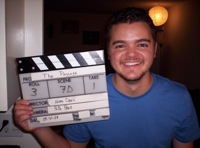 Overall, I needed a more well-rounded life. The true epiphany came when my dad told me that I couldn’t keep living like a monk, just working, coming home, writing, watching movies. I needed to grow. So I decided to contact an old friend at Marvel and see if there was anything going on. I learned that they needed some help with their move to new facilities in the new year, so I was hired on. I eventually got hired into a full-time position and that’s where I’m sitting at today. I got exactly what I wanted and needed, which doesn’t always happen in life. I’ve got a steady job, which is a true blessing in these times and enough extra time to write and start producing. I’m doing what I’ve never been able to: write every single day. I’m working on a new feature, but most of my time is spent retooling my sci-fi web series with a new concept. Right now I’m writing the first thirteen episodes, and in a few months I and my creative team will start casting with the goal of self-producing and self-distributing on a shoe-string budget.
Truthfully, in the back of my mind, I’ve always had the slightly “tortured artist” mentality, like I needed to be miserable in one part of my life in order to be creative. But now, I’m busy working, writing, having a social life, dating, having more fun and I’ve never been more productive. I don’t know what wisdom I can impart on anyone. Each person’s path and situation is different. But for me, I had to really listen to what the small voice inside was saying. I had to look at myself in the mirror, find out my truth, what would be the best for me and go after it, leaping over detours as they came. After two years, I feel like I’m still very much in the beginning stages. But it’s being here that’s teaching me everything I’ll need to propel to the next plateau. I know I’m on my way, the right path materializing with every step I take. And I’m taking them. To crib a classic Marvel line: ‘Nuff said. At least for now.
This story in today’s Variety seems to run counter to last week’s post about how studios often delay releasing movies overseas in an attempt to reduce piracy:
Russia and Ukraine aren’t the usual launching pads for Hollywood event pics, so it came as a surprise when Paramount and DreamWorks Animation decided to open 3-D toon “Monsters vs. Aliens” in those markets first.
Why would they do that? Wouldn’t that make it more likely to get bootlegged?
Ah, but wait:
In a precautionary move to ward off pirates, Paramount supplied only dubbed prints of “Monsters” to Russian and Ukrainian theaters.
Animation works well dubbed, and most crucially, a cam in Russian or Ukranian is not particularly useful worldwide.