• Skip to primary navigation
  • Skip to main content
  • Skip to primary sidebar

John August

  • Arlo Finch
  • Scriptnotes
  • Library
  • Store
  • About

Follow Up

Spelunking the Kindle market

June 2, 2009 Books, Follow Up, Projects, The Variant

How many books does Amazon sell on Kindle each day? How closely does it follow the 80/20 rule, in which a few top sellers account for a huge percentage of total sales? Is there a classic long tail — and is it even worth being on it?

Amazon is incredibly opaque with the details, even when you’re publishing on their system.
The day after its debut, my story [The Variant](http;//johnaugut.com) briefly reached #18 on the Kindle [bestsellers list](http://www.amazon.com/gp/bestsellers/digital-text/ref=pd_dp_ts_kinc_1). While that was exciting, I still don’t know exactly what it means.

Like other Amazon statistics, it seems to get recalculated hourly, but there’s no indication whether it’s a pure number of sales that hour (which would make for very erratic swings) or some sort of sliding average over time. Based on how it’s handled for physical books, it’s [probably a combination](http://www.webpronews.com/expertarticles/2006/06/15/navigating-the-amazon-sales-ranking):

> Only the top 10,000 books are updated every hour and the ranking does not depend upon the actual number of books sold, but rather, on a comparison against the sales figures of the other 9,999 books within that same hour. Simultaneously, a trending calculation is applied to arrive at a computerized sales trajectory. So, hypothetically, a book that held a ranking of 2,000 at 2pm and 3,000 at 3pm, might hold a 4,000 ranking at 4pm, even if it actually sold MORE books between 3-4 than it did between 2-3.

All I really know is that the day I hit #18, I sold about 500 copies. So my hunch is that titles around that spot in the list (say, 15 to 25) might sell around 500 copies per day. That is, they probably sell 500 as opposed to 50 or 5,000. I’m only try to get a sense of how many zeroes are involved.

Stephenie Meyer is rich
—–

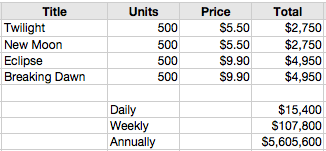
twilight salesAs it happens, all four of Stephenie Meyer’s Twilight books fall into this range, and have been here for quite a while. They’re priced at $5.50 (for the first two) and $9.99 (for the second two).

If each is selling around 500 copies each day, that means the four of them are generating $15,400 per day, or $107,800 per week. Granted, that 500 is a guess, but it’s probably a number with two zeroes.

We don’t know the split between Meyer, her publisher and Amazon — it’s possible that the retailer is deliberately taking a loss on the Twilight books in order to woo Kindle buyers — but it’s clearly a nice bit of money with no paper, shipping or inventory costs. ((Yes, clearly Meyer and her publisher are making great money off the printed versions of the books, which probably account for 95%+ of sales. But the Kindle sales aren’t insignificant.))

Worst bestsellers
——

Unlike the iTunes App Store, Amazon doesn’t distinguish between free and paid content on their Kindle bestseller list. In fact, 19 out of the top 50 books are free. There’s nothing wrong with free, but it’s a semantic and tactical mistake to include them on a “bestseller” list.

The current system keeps [Serial](http://www.amazon.com/gp/product/B002AJ7X2C?ie=UTF8&tag=johnaugustcom-20&linkCode=as2&camp=1789&creative=390957&creativeASIN=B002AJ7X2C) in the #1 slot for no real reason other than being free. I envision many brand-new Kindle owners powering up their devices for the first time, and wanting to download a book to test out the service.

Where do they find a book? The bestseller list. And look! The bestseller is free!

This isn’t a knock on Serial or its authors. In fact, one of the writers has a [useful post](http://jakonrath.blogspot.com/2009/05/more-on-amazon-kindle.html) of his experiences with publishing on the Kindle. He notes that…

> The freebies are being downloaded and read. There isn’t money changing hands, but branding and name-recognition — two essentials for every successful author — are happening.

Free should always be a choice. But I’d argue the free preview feature on every Kindle title is designed for exactly this sort of try-before-you-buy. If after forty pages you haven’t convinced a reader to pony up at least 99 cents, I don’t know that “branding” is really the issue.

By letting bestsellers be free, Amazon also makes it easy to game the system. [The Cook’s Illustrated How-to-Cook Library](http://www.amazon.com/Cooks-Illustrated-Cook-Library-step/dp/B001RF3U9U/ref=pd_ts_kinc_23?ie=UTF8&s=digital-text) got into the top 20 as a free book, then jacked up the price to $9.99. ((Indeed, many of the reviews are some variety of “I can’t believe it’s free!”)) Letting author-publishers change the price is smart; letting them monkey with your bestseller list is dumb.

I’d propose Amazon keep the zero-price option, but move free titles to their own list. After all, nothing else in Amazon’s ranking system has to compete with free.

But until they make that change, I’m considering organizing an online flash mob for The Variant. For one predetermined hour, I’ll set the price to zero and invite everyone I know to “buy” it. I’m curious how high I could get on the list.

Overall impressions
——

As I noted in my earlier post about [formatting for Kindle](http://johnaugust.com/archives/2009/kindle-formatting-for-web-geeks), getting a book published on Amazon’s platform is surprisingly straightforward. But I really hoped for better reporting. Should one raise or lower the price? Do ads work? Do reviews help?

Without better information, it’s tough to make any of these decisions.

The Kindle isn’t currently the (mythical?) indie goldmine the iTunes App Store has become. Despite Amazon’s first-mover advantage, there is clearly opportunity for competitors, like Google, Apple or Sony.

More pressingly, there’s a need for better international ebook distribution. The Kindle is U.S.-only, likely due to do rights issues. A European solution would be great; a global version would be better. My e-Junkie/PayPal system for pdfs and ePubs is just barely workable. If I could graft it onto a trusted store like Amazon or iTunes, everyone would feel more comfortable.

How much does a short story earn in a magazine?

June 1, 2009 Follow Up, Genres, QandA, The Variant

questionmarkWould a writer of your stature have made more by publishing The Variant in a literary magazine?

— Brett

I really had no idea what people were getting paid for short stories, so I asked Matt to dig up some numbers based on [The Variant’s](http://johnaugust.com/variant) 7,123-word length.

These are rough and gathered from feedback writers give to [duotrope.com](http://duotrope.com) and various publication websites. If any short story writers have more firsthand information, please share.

Matt chose a range of literary and genre magazines — but to be honest, I’m not sure The Variant would have found a home in any of them, with or without my name value.

Literary magazines
—–

* The New Yorker: $7,500 (estimate based on Dan Baum’s
[tweets](http://www.danbaum.com/Nine_Lives/New_Yorker_tweets.html))

* Kenyon Review: $356 ($.05 per word)

* New England Review: $230 ($10 per page)

* Ploughshares: $575 ($25 per page)

Genre magazines
—–

* Asimov’s Science Fiction: $427 ($.06 per word)

* Strange Horizons: $356 ($.05 per word)

* Carve (Raymond Carver): $20-50

Given these numbers, I doubt I would have been better off trying to get The Variant into a printed magazine. It made less than $1,000 in its first week, but it will be available online — and earning money — for at least the next few years. And if a reader likes the short story, it’s much easier to send a link to a friend than a printed story.

Welcome, NY Times readers

June 1, 2009 Follow Up, Projects, The Variant

The NY Times has an article today about [The Variant](http://johnaugust.com/variant), the Kindle, and my [Twitter followers](http://twitter.com/johnaugust).

> Mr. August, who wrote it for possible inclusion in an anthology of work by well-known screenwriters, tested the story with about two dozen of the 6,000 or so people who follow him on Twitter. They persuaded him to change the first sentence, trim some paragraphs and shorten the title from “The Egyptian Variant.”

You can read the whole article [here](http://www.nytimes.com/2009/06/01/business/media/01august.html).

One correction: In the interview, I said that I’d earned enough to buy “about four Kindles.” But I misremembered how much they cost: $359.

As of Friday, I’d made enough to buy 2.73 Kindles.

A week of The Variant

May 31, 2009 Follow Up, Projects, The Variant

My short story [The Variant](http://johnaugust.com/variant) has been on the market for a week. As promised, here’s an update on how the 99-cent experiment has gone.

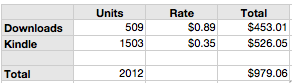
variant sales table

Short version: I sold more copies than I expected, with fewer technical issues. I had picked the Friday of Memorial Day weekend precisely because I hoped it would be slower-paced, allowing me to fix whatever disasters struck without a crush of weekday traffic. But I could have been more ambitious, and a mid-week launch would have made more sense.

I get 35 cents on each Kindle sale, versus 89 cents on each download.

I’d be less grumbly about Amazon’s 65 percent cut if their reporting were better. Their DTP publisher tells you almost nothing about your sales. It only shows how many total units, with no breakdowns at all — not by day, not by state, nothing. Fortunately, I had embedded my Amazon tracking number in links from my site, so I do know that 458 of my Kindle sales came from people who clicked through from the launch page. That’s only a third of the Kindle sales, so many people were getting it in one of three alternate ways:

* Following a direct link from an outside site, such as [Daring Fireball](http://daringfireball.net/linked/2009/05/22/the-variant).
* Buying it through Kindle itself, either the device or the iPhone app. ((I have a hunch that a lot of readers tried out the iPhone app for the first time buying the book.))
* Finding the book on the Kindle bestseller list. ((I’ll have more to say about the bestseller list in another post.))

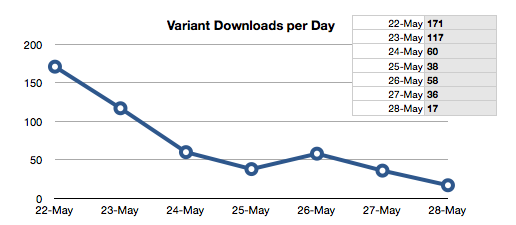
Downloads provide a lot more data. I’ve already written about the [international readers](http://johnaugust.com/archives/2009/mapping-the-variant), but the numbers also help show the falloff over time. It sold ten times more on the first day than the seventh.

variant downloads chart

(Note: I grabbed data at different times, so this total is 12 units shy of the table above.)

Today’s [NY Times article about The Variant](http://www.nytimes.com/2009/06/01/business/media/01august.html?ref=business) may provide a bump, but an esteemed colleague (Ze) cautions that he’s never seen a real spike from stories in traditional media.

At this point, I don’t have any big sense of What It All Means.

It’s a fine number of sales for a short story that would have likely been buried in some specialty magazine. But I’m not sure I can offer any meaningful analysis of the publishing model, partly because I started with a higher profile than many fiction writers might.

Could an established novelist duplicate (or exceed) these results? Probably. Could a talented but unknown upstart? Not as likely.

This kind of self-publishing certainly reduces the barriers, but literary brand recognition is still a huge asset. It is reading, after all. People would rather do almost anything than risk reading something bad. Free previews and a 99-cent price tag help, but the reputation of the author is likely a major factor in deciding to buy.

« Previous Page
Next Page »

Primary Sidebar

Newsletter

Inneresting Logo A Quote-Unquote Newsletter about Writing
Read Now

Explore

Projects

  • Aladdin (1)
  • Arlo Finch (27)
  • Big Fish (88)
  • Birdigo (2)
  • Charlie (39)
  • Charlie's Angels (16)
  • Chosen (2)
  • Corpse Bride (9)
  • Dead Projects (18)
  • Frankenweenie (10)
  • Go (29)
  • Karateka (4)
  • Monsterpocalypse (3)
  • One Hit Kill (6)
  • Ops (6)
  • Preacher (2)
  • Prince of Persia (13)
  • Shazam (6)
  • Snake People (6)
  • Tarzan (5)
  • The Nines (118)
  • The Remnants (12)
  • The Variant (22)

Apps

  • Bronson (14)
  • FDX Reader (11)
  • Fountain (32)
  • Highland (75)
  • Less IMDb (4)
  • Weekend Read (64)

Recommended Reading

  • First Person (87)
  • Geek Alert (151)
  • WGA (162)
  • Workspace (19)

Screenwriting Q&A

  • Adaptation (65)
  • Directors (90)
  • Education (49)
  • Film Industry (489)
  • Formatting (128)
  • Genres (89)
  • Glossary (6)
  • Pitches (29)
  • Producers (59)
  • Psych 101 (118)
  • Rights and Copyright (96)
  • So-Called Experts (47)
  • Story and Plot (170)
  • Television (165)
  • Treatments (21)
  • Words on the page (238)
  • Writing Process (177)

More screenwriting Q&A at screenwriting.io

© 2026 John August — All Rights Reserved.