• Skip to primary navigation
  • Skip to main content
  • Skip to primary sidebar

John August

  • Arlo Finch
  • Scriptnotes
  • Library
  • Store
  • About

Follow Up

Per-screen average

June 30, 2009 Film Industry, Follow Up, Projects, The Nines

As often happens in comment threads, the discussion for my post [A hard time to be an indie](http://johnaugust.com/archives/2009/hard-indie) focused less on the original article and more on the observations of a single commenter. In this case, [Rebecca](http://johnaugust.com/archives/2009/hard-indie#comment-171902):

> I’ve always wondered why the movie Lars and the Real Girl wasn’t released more widely. I only read rave reviews about it and everyone I know who saw it loved it. I thoroughly enjoyed it. They didn’t even release it widely enough to make a profit, the dumbasses.

> Here are the numbers:

> The movie had a $12,000,000 budget. [According to boxofficemojo.com](http://www.boxofficemojo.com/movies/?page=weekend&id=larsandtherealgirl.htm), it made $90,418 opening weekend in 7 theaters for a $12,916 average per theater.

> The Proposal opened this past weekend in 3056 theaters and grossed $33,627,598 for an average of $11,004 per theater.

> At 5 weeks, Lars and the Real Girl averaged $2,456 per theater after the number of theaters was reduced from its peak the week before.

> The latest Night at the Museum, just averaged $2,636 this week, its 5th.

> It looks to me like decent marketing in various markets, in conjunction with a much wider release, could have made this movie -– and everyone involved with it -– a LOT more money. Can you explain why it would not have made sense to release it into more than 321 theaters during its entire run? Other than thinking that challenging, quirky and maddening = noncommercial, I mean?

Apples, meet oranges.

Per-screen average is simply math: a given film’s box office divided by the number of screens it plays on. ((And even then, it’s a messy measurement. Particularly with wide releases, theaters can increase or decrease the number of screens devoted to a picture even over the course of a weekend, based on demand and sell-outs.)) As a pure number, it tells you nothing about the size of theater, the percentage of seats sold, or what would be typical for that theater on that night.

Bringing in $2,300 over a weekend might be a great haul at a tiny theater in Des Moines, but would be a disaster at Grauman’s Chinese.

The number is only useful when comparing movies in fairly similar situations. If The Happy Harpist made $44,000 at four theaters, and My Third Elbow made $10,000 at three, it’s fair to say that Harpist is outperforming Elbow with an $11,000 per-screen average.

But drill deeper, and you might find reasons why Harpist’s numbers are misleading. For example, it’s possible Harpist made $34,000 on one of its screens, and only $10,000 on the other three. Maybe it’s a hometown director, or other special circumstance. ((Or maybe it’s The Nines. We debuted on two screens — one in New York, one in LA. Two-thirds of our money came from LA’s NuArt.)) Take away that one theater, and Harpist and Elbow are now a dead heat.

More importantly, if you’re one of the low-performing theaters for Harpist, *your* per-screen average is only $3,333. You will make your decisions about whether to keep playing the movie based on that number. Never forget that distributors don’t ultimately decide which movies stick around in theaters; the exhibitors do. They look at their internal numbers to decide which movies will make them the most money.

**With a small number of screens, per-screen average is hugely affected by variations between individual venues.** The denominator — which screens, and where — matters a lot.

Conversely…

**With a big number of screens, per-screen average is relatively unaffected by variations between individual venues.** If you’re playing in 4,000+ screens, it doesn’t matter nearly as much which screens those are. You’re a wide release, playing at every other megaplex in the country. Distributors desperately scramble to get as many good screens as they can, simply so they can generate as much money as they can. Per-screen average is the last thing on their mind.

Some movies are able to successfully platform (expand) from a few screens to a lot. Juno, for example. But if you look at Juno’s [weekend boxoffice breakdown](http://www.boxofficemojo.com/movies/?page=weekend&id=juno.htm), you’ll see that it never came close to its opening weekend $59,124 per-screen average again. As it climbed to 2,000 screens, the per-screen average plummeted because the denominator had gotten so big. Trust me: Fox Searchlight didn’t care. They were too busy making gobs of money.

Same for The Proposal. Same for Night at the Museum 2. Unlike the makers of Lars and the Real Girl, who carefully selected each of the seven venues it debuted upon — like Goldilocks, not too big, not too small — the studios releasing blockbusters want as many seats as possible. They’re not looking to expand. They don’t need to nurture. They simply want the maximum amount of money, preferably in the shortest amount of time.

Rebecca points to the fifth weekend of Night at the Museum 2 and its $2,636 per-screen average. She conveniently omits that on that weekend it earned $7.8 million. **Money is money. Per-screen average is just a figure.**

Back to Lars
—–

While it’s absolutely fair to play Monday morning quarterback on a movie you love and believe could have made more money, the folks who released Lars and the Real Girl are not dumbasses. You can disagree with their marketing and perhaps their release date. I wouldn’t be surprised if the filmmakers feel disappointed. But they clearly tried to platform the movie much like Juno, and it didn’t work.

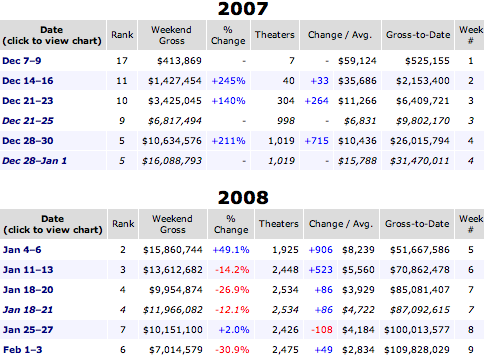
Courtesy Box Office Mojo, here are the [numbers for Juno](http://www.boxofficemojo.com/movies/?page=weekend&id=juno.htm):

juno box office

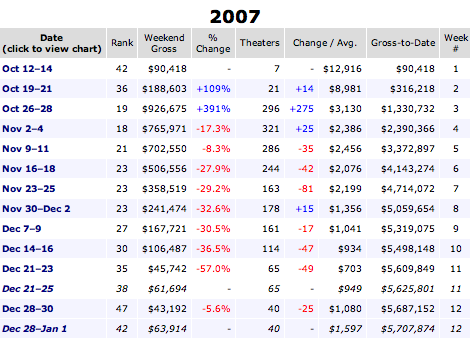
And here’s [Lars](http://www.boxofficemojo.com/movies/?page=weekend&id=larsandtherealgirl.htm):

juno box office

Both Juno and Lars started in three theaters, then expanded to 300 in their third week. But Juno far out-earned Lars at every step. By the time it went wide, Juno also had the advantage of the Christmas holiday.

As you’re looking at the Lars chart, rather than focusing on the per-screen average, look at the red numbers in the % Change column. Starting with Nov 2-4, it was making less each week. It was on a decline. The distributor couldn’t justify the millions of dollars it would take to expand the run when it was earning a fraction of that each week.

In the end, Lars and the Real Girl made just under $6 million domestically. Many indies would love to reach that number.

Could Lars have made more money? Perhaps with a different combination of marketing and luck. But per-screen average has nothing to do with it, and using that figure to compare it to wide releases is specious. Limited releases have high per-screen averages *because* they’re on so few screens, not despite it.

NPR on Twitter and The Variant

June 18, 2009 Follow Up, News, Projects, The Variant

NPR’s All Things Considered has a piece tonight by Alex Cohen about how artists use Twitter, including me with my short story [The Variant](http://johnaugust.com/variant).

If you missed it, you can catch the clip [in the archives](http://www.npr.org/templates/story/story.php?storyId=105620633), or download it [here](http://public.npr.org/anon.npr-mp3/npr/atc/2009/06/20090618_atc_08.mp3?dl=1).

The “test screenings” I did with The Variant were hugely helpful, and led to some significant trim and changes, including the title and the very first sentence.

If you’d like to read that early feedback, I’ve unlocked the password protection so you can see their comments on [the first draft](http://johnaugust.com/variant/the-egyptian-variant) and the [revised version](http://johnaugust.com/variant/the-variant). (Obviously, both links are chock full of spoilers.)

Greeks

June 4, 2009 Follow Up, Projects

Many thanks to the 43 readers who [added reviews](http://www.amazon.com/gp/product/B0029ZAPRW) at Amazon. Here’s the scene I [promised yesterday](http://johnaugust.com/archives/2009/40-reviews-in-24-hours).

This comes from Greeks, a comedy I never finished — and barely started, honestly. It’s set in ancient times, and would have retold several of the great myths in significantly less epic ways. I set it aside to write The Nines and never went back to it.

Most writers will have a few dozen folders with these kinds of half-conceived projects. Both The Nines and [The Variant](http://johnaugust.com/variant) lived in those folders for years. In fact, the working title for The Variant was The Nines. Vincent Lewis kept seeing the number nine everywhere, which was one reason he started wondering if something was off with this world.

But back to Greeks.

EXT. CYPRESS GROVE – DAY

Lunch. Sacriticides’ class has broken into distinct cliques: wrestlers, poets, the drama club. Being his first day, Perseus isn’t sure where he belongs, so he keeps on the periphery.

He finds a suitable sitting rock and unwraps his bread, grapes and olives. He notices Abbas is not seated with any particular group as he rips into lunch -- a single pomegranate, its bloody juices dripping everywhere.

Perseus decides to risk conversation...

PERSEUS

Pomegranate, huh?

ABBAS

Yeah.

PERSEUS

Grapes.

(shows fingers)

Less evidence.

ABBAS

Yeah.

And that’s that, apparently. Perseus goes back to his lunch.

But then Abbas suddenly restarts the conversation.

ABBAS

(introducing himself)

I’m Abbas.

PERSEUS

Perseus.

ABBAS

Anyone call you Percy?

PERSEUS

No. So how long have you been studying with Sacriticides?

ABBAS

Since my dad died.

PERSEUS

Oh. Sorry.

ABBAS

Yeah, well. Philosophy is sort of the family business. My dad invented logic.

PERSEUS

That’s pretty major.

ABBAS

He got eaten by a lion. He was trying to teach it ethics.

(beat)

So, after class, a bunch of us are going down to the beach. New school of mermaids are coming through.

PERSEUS

Oh.

ABBAS

If you wanna...

PERSEUS

I’ll pass.

ABBAS

There’ll be mer-dudes too, if you’re...

PERSEUS

No, I like girls. But with legs.

ABBAS

That’s cool.

PERSEUS

I’ve got a strange thing about the sea. My step-father’s a fisherman and I can’t even eat fish.

ABBAS

Wow. What do think that’s from?

Perseus shrugs it off. Then reconsiders...

PERSEUS

When I was little, my grandfather locked me and my mother in a chest and threw us in the ocean, because he was convinced I was going to kill him. Prophecy and stuff. So we were in this box, and we floated around for three weeks and sort of went mad from dehydration. We washed up on this island, and I’ve never gone back in the water since.

A beat.

ABBAS

Man, I love the ocean. Fish and chicks, it’s all good.

PERSEUS

Definitely. Except for, it’s not. Because of the trauma of my childhood.

ABBAS

(not listening; re: pomegranate)

Perspehone? She ate just one of these seeds. Now she has to spend winter in Hades.

PERSEUS

Actually, she’s my half-sister. We don’t see her much. Big family.

A CHEER in the background. Two of the WRESTLERS are throwing down, Greco-Roman style. Abbas joins in the excitement, running over to them.

PERSEUS

Good talking with...okay.

Spelunking the Kindle market

June 2, 2009 Books, Follow Up, Projects, The Variant

How many books does Amazon sell on Kindle each day? How closely does it follow the 80/20 rule, in which a few top sellers account for a huge percentage of total sales? Is there a classic long tail — and is it even worth being on it?

Amazon is incredibly opaque with the details, even when you’re publishing on their system.

The day after its debut, my story [The Variant](http;//johnaugut.com) briefly reached #18 on the Kindle [bestsellers list](http://www.amazon.com/gp/bestsellers/digital-text/ref=pd_dp_ts_kinc_1). While that was exciting, I still don’t know exactly what it means.

Like other Amazon statistics, it seems to get recalculated hourly, but there’s no indication whether it’s a pure number of sales that hour (which would make for very erratic swings) or some sort of sliding average over time. Based on how it’s handled for physical books, it’s [probably a combination](http://www.webpronews.com/expertarticles/2006/06/15/navigating-the-amazon-sales-ranking):

> Only the top 10,000 books are updated every hour and the ranking does not depend upon the actual number of books sold, but rather, on a comparison against the sales figures of the other 9,999 books within that same hour. Simultaneously, a trending calculation is applied to arrive at a computerized sales trajectory. So, hypothetically, a book that held a ranking of 2,000 at 2pm and 3,000 at 3pm, might hold a 4,000 ranking at 4pm, even if it actually sold MORE books between 3-4 than it did between 2-3.

All I really know is that the day I hit #18, I sold about 500 copies. So my hunch is that titles around that spot in the list (say, 15 to 25) might sell around 500 copies per day. That is, they probably sell 500 as opposed to 50 or 5,000. I’m only try to get a sense of how many zeroes are involved.

Stephenie Meyer is rich
—–

twilight salesAs it happens, all four of Stephenie Meyer’s Twilight books fall into this range, and have been here for quite a while. They’re priced at $5.50 (for the first two) and $9.99 (for the second two).

If each is selling around 500 copies each day, that means the four of them are generating $15,400 per day, or $107,800 per week. Granted, that 500 is a guess, but it’s probably a number with two zeroes.

We don’t know the split between Meyer, her publisher and Amazon — it’s possible that the retailer is deliberately taking a loss on the Twilight books in order to woo Kindle buyers — but it’s clearly a nice bit of money with no paper, shipping or inventory costs. ((Yes, clearly Meyer and her publisher are making great money off the printed versions of the books, which probably account for 95%+ of sales. But the Kindle sales aren’t insignificant.))

Worst bestsellers
——

Unlike the iTunes App Store, Amazon doesn’t distinguish between free and paid content on their Kindle bestseller list. In fact, 19 out of the top 50 books are free. There’s nothing wrong with free, but it’s a semantic and tactical mistake to include them on a “bestseller” list.

The current system keeps [Serial](http://www.amazon.com/gp/product/B002AJ7X2C?ie=UTF8&tag=johnaugustcom-20&linkCode=as2&camp=1789&creative=390957&creativeASIN=B002AJ7X2C) in the #1 slot for no real reason other than being free. I envision many brand-new Kindle owners powering up their devices for the first time, and wanting to download a book to test out the service.

Where do they find a book? The bestseller list. And look! The bestseller is free!

This isn’t a knock on Serial or its authors. In fact, one of the writers has a [useful post](http://jakonrath.blogspot.com/2009/05/more-on-amazon-kindle.html) of his experiences with publishing on the Kindle. He notes that…

> The freebies are being downloaded and read. There isn’t money changing hands, but branding and name-recognition — two essentials for every successful author — are happening.

Free should always be a choice. But I’d argue the free preview feature on every Kindle title is designed for exactly this sort of try-before-you-buy. If after forty pages you haven’t convinced a reader to pony up at least 99 cents, I don’t know that “branding” is really the issue.

By letting bestsellers be free, Amazon also makes it easy to game the system. [The Cook’s Illustrated How-to-Cook Library](http://www.amazon.com/Cooks-Illustrated-Cook-Library-step/dp/B001RF3U9U/ref=pd_ts_kinc_23?ie=UTF8&s=digital-text) got into the top 20 as a free book, then jacked up the price to $9.99. ((Indeed, many of the reviews are some variety of “I can’t believe it’s free!”)) Letting author-publishers change the price is smart; letting them monkey with your bestseller list is dumb.

I’d propose Amazon keep the zero-price option, but move free titles to their own list. After all, nothing else in Amazon’s ranking system has to compete with free.

But until they make that change, I’m considering organizing an online flash mob for The Variant. For one predetermined hour, I’ll set the price to zero and invite everyone I know to “buy” it. I’m curious how high I could get on the list.

Overall impressions
——

As I noted in my earlier post about [formatting for Kindle](http://johnaugust.com/archives/2009/kindle-formatting-for-web-geeks), getting a book published on Amazon’s platform is surprisingly straightforward. But I really hoped for better reporting. Should one raise or lower the price? Do ads work? Do reviews help?

Without better information, it’s tough to make any of these decisions.

The Kindle isn’t currently the (mythical?) indie goldmine the iTunes App Store has become. Despite Amazon’s first-mover advantage, there is clearly opportunity for competitors, like Google, Apple or Sony.

More pressingly, there’s a need for better international ebook distribution. The Kindle is U.S.-only, likely due to do rights issues. A European solution would be great; a global version would be better. My e-Junkie/PayPal system for pdfs and ePubs is just barely workable. If I could graft it onto a trusted store like Amazon or iTunes, everyone would feel more comfortable.

« Previous Page
Next Page »

Primary Sidebar

Newsletter

Inneresting Logo A Quote-Unquote Newsletter about Writing
Read Now

Explore

Projects

  • Aladdin (1)
  • Arlo Finch (27)
  • Big Fish (88)
  • Birdigo (2)
  • Charlie (39)
  • Charlie's Angels (16)
  • Chosen (2)
  • Corpse Bride (9)
  • Dead Projects (18)
  • Frankenweenie (10)
  • Go (29)
  • Karateka (4)
  • Monsterpocalypse (3)
  • One Hit Kill (6)
  • Ops (6)
  • Preacher (2)
  • Prince of Persia (13)
  • Shazam (6)
  • Snake People (6)
  • Tarzan (5)
  • The Nines (118)
  • The Remnants (12)
  • The Variant (22)

Apps

  • Bronson (14)
  • FDX Reader (11)
  • Fountain (32)
  • Highland (73)
  • Less IMDb (4)
  • Weekend Read (64)

Recommended Reading

  • First Person (87)
  • Geek Alert (151)
  • WGA (162)
  • Workspace (19)

Screenwriting Q&A

  • Adaptation (65)
  • Directors (90)
  • Education (49)
  • Film Industry (490)
  • Formatting (128)
  • Genres (89)
  • Glossary (6)
  • Pitches (29)
  • Producers (59)
  • Psych 101 (118)
  • Rights and Copyright (96)
  • So-Called Experts (47)
  • Story and Plot (170)
  • Television (165)
  • Treatments (21)
  • Words on the page (237)
  • Writing Process (177)

More screenwriting Q&A at screenwriting.io

© 2026 John August — All Rights Reserved.