• Skip to primary navigation
  • Skip to main content
  • Skip to primary sidebar

John August

  • Arlo Finch
  • Scriptnotes
  • Library
  • Store
  • About

Follow Up

The further angst of Kaufman

January 9, 2012 Follow Up

Responding to our podcast [Zen and the Angst of Kaufman](http://johnaugust.com/2012/zen-and-the-angst-of-kaufman), reader Scott argues that Charlie Kaufman is in fact thinking of the audience:

> He’s just like you. He’s trying to write movies that HE would want to sit in a theater and watch. But what he likes to watch is something true, not something he’s seen before in a slightly different form. We may not be entertained by this, either because our culture has trained us that a movie should be a certain way, or because we simply like different things than Charlie Kaufman likes (because everyone’s different).

> He’s putting himself in the theater seats as he writes, as we writers should, but he’s asking us to be a more critical audience of ourselves than real audiences actually are.

We’re conflating two points here. I think both are valid, but they shouldn’t be confused:

1. Screenwriters should write movies they themselves want to see.
2. Screenwriters should consider the point-of-view of the audience.

Violate the first rule, and you have hacky trash.

Violate the second rule, and you have solipsistic indulgence.

Kaufman is clearly writing movies he wants to see. That’s good. But if another screenwriter loves horror movies and wants to see more movies like Halloween, his intentions should be considered just as pure despite being more commercial.

Scott feels Kaufman knows what “real audiences” are like, but holds himself to a higher standard. Okay. But if this higher standard makes the screenwriter’s work inaccessible or uninteresting to an audience — or at least, a large chunk of the audience — I don’t think it’s fair to put all the blame at the feet of “the system.”

In his BAFTA speech, Kaufman isn’t complaining as much as explaining (or exploring) why he feels compelled to write the movies he writes, and the resulting frustration.

Scott continues:

> The Hollywood model panders to the universal truths that we already know are universal, because that will translate to the largest demographic and therefore the largest box office. What’s funny to me is that one fairly common “truth” sold by many of these films is that “money isn’t everything” (or some variation thereof). Yet the person (or committee) who wrote the script, the people who greenlit it, the people they hired to make it, and the people marketing it are solely concerned with it making the most amount of money possible.

Agreed. It’s likely because the credit-slash-blame for movies is shared among so many people that this thematic hypocrisy goes unnoticed.

Resenting your audience

January 4, 2012 Follow Up, Psych 101

Pivoting off the discussion Craig and I had about [Charlie Kaufman’s speech](http://johnaugust.com/2012/zen-and-the-angst-of-kaufman), Josh Barkey outlines a path that may lead screenwriters to [resent their audience](http://joshbarkey.blogspot.com/2012/01/why-charlie-kaufman-might-hate-you.html):

> A. Art is often an outgrowth of the self’s desire to be loved. An artist’s motivation for making things is often, at some primal level, an attempt to say to other people: please, please love me.

> B. If the artist is honest, works hard, and tells the truth, art patrons will often recognize themselves in the art. They’ll respond emotionally, and some of the love they feel for the artist’s product will inevitably spill over to the artist.

> C. This love is, however, conditional. It requires the artist to make new and interesting things, and quickly becomes bored and withdraws love when the artist does not.

> D. The artist feels betrayed by what he or she perceives as mis-directed and conditional love, and begins to resent the audience for not loving unconditionally enough.

> E. Although the artist might even be aware of the irrationality of this resentment, the resentment can nonetheless shrivel into bitterness, which eventually shrivels into hatred.

I’d argue that for screenwriters, the “audience” is very often not movie-goers but rather the producers and studios who pay us to write. These are the people we’re trying to please and impress.

When they love our work, we feel loved and validated. When they don’t love our work — even though we know it’s better work than they previously praised — we can’t help but feel jilted.

More posts, more visitors

January 2, 2012 Follow Up, Meta

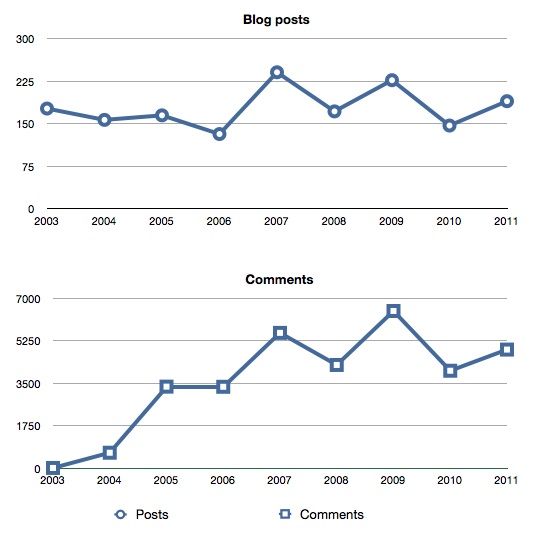
Looking at the [uptick in visitors](http://johnaugust.com/2012/2011-by-the-numbers) for 2011, I speculated that it might be because of Twitter.

I had Ryan pull some numbers, and my new theory is much simpler: more posts means more visitors. The number of visitors was down slightly for 2010 because there were fewer posts.

blog comments chart

Year 2003 2004 2005 2006 2007 2008 2009 2010 2011
Posts 177 157 165 132 241 172 227 147 190
Comments 16 643 3364 3358 5578 4257 6479 4019 4890

How residuals get divided between writers

Episode -

Go to Archive

December 14, 2011 Follow Up, Scriptnotes, WGA

We answered 13 questions by Daniel Barkeley on [yesterday’s podcast](http://johnaugust.com/2011/thirteen-questions-about-one-thing), but he wrote in asking for clarification on one issue:

> We’ve established that the “written by” gets 100% of the residual, the “screenplay or teleplay by” gets 75% of the residual and “story by” gets 25% of the residual. But what happens when multiple writers are attached to a single credit?

> For instance The Hangover Part 2 has three writers with the “written by” credit. How is that 100% residual divided between you three? Is it always equal, or is there some attempt made to compensate for varying levels of involvement in the project?

If two writers share a credit slot (like screenplay), that portion of residuals is split squarely between them. For example, let’s look at Charlie’s Angels: Full Throttle. I got sole story credit; I shared screenplay credit with The Wibberleys (a team, so they count as one writer).

My share of residuals equals 25% (story) + half of 75% (screenplay) for a total of 62.5%.

The Wibbs get half of 75% (screenplay), which gives them 37.5%.

If you add that up, 62.5 plus 37.5 equals 100 percent of residuals. Yay, math!

« Previous Page
Next Page »

Primary Sidebar

Newsletter

Inneresting Logo A Quote-Unquote Newsletter about Writing
Read Now

Explore

Projects

  • Aladdin (1)
  • Arlo Finch (27)
  • Big Fish (88)
  • Birdigo (2)
  • Charlie (39)
  • Charlie's Angels (16)
  • Chosen (2)
  • Corpse Bride (9)
  • Dead Projects (18)
  • Frankenweenie (10)
  • Go (29)
  • Karateka (4)
  • Monsterpocalypse (3)
  • One Hit Kill (6)
  • Ops (6)
  • Preacher (2)
  • Prince of Persia (13)
  • Shazam (6)
  • Snake People (6)
  • Tarzan (5)
  • The Nines (118)
  • The Remnants (12)
  • The Variant (22)

Apps

  • Bronson (14)
  • FDX Reader (11)
  • Fountain (32)
  • Highland (73)
  • Less IMDb (4)
  • Weekend Read (64)

Recommended Reading

  • First Person (87)
  • Geek Alert (151)
  • WGA (162)
  • Workspace (19)

Screenwriting Q&A

  • Adaptation (65)
  • Directors (90)
  • Education (49)
  • Film Industry (490)
  • Formatting (128)
  • Genres (89)
  • Glossary (6)
  • Pitches (29)
  • Producers (59)
  • Psych 101 (118)
  • Rights and Copyright (96)
  • So-Called Experts (47)
  • Story and Plot (170)
  • Television (165)
  • Treatments (21)
  • Words on the page (237)
  • Writing Process (177)

More screenwriting Q&A at screenwriting.io

© 2026 John August — All Rights Reserved.