• Skip to primary navigation
  • Skip to main content
  • Skip to primary sidebar

John August

  • Arlo Finch
  • Scriptnotes
  • Library
  • Store
  • About

John

Adapting The Wizard of Oz

July 3, 2014 Film Industry, Genres

Gregory Maguire, author of the novel Wicked, takes a look at screenwriter Noel Langley’s early draft of the script for [The Wizard of Oz](http://www.smithsonianmag.com/arts-culture/early-script-wizard-oz-offers-rare-glimpse-creation-iconic-film-180951858/):

> The differences between this version and the final shooting script? Hardly a page escapes without crossed-out speeches and handwritten substitutions. Plot points abound that are later abandoned (the Wicked Witch of the West has a son named Bulbo?). Only a couple of scenes refer to singing, and none of the famous lyrics appear. What would become “Over the Rainbow,” which I call America’s unofficial national anthem, is referred to as “the Kansas song.”

> What this draft achieves is the compression of choice elements from a best-selling, although rambling, children’s book. In the original novel, the Wicked Witch of the West dies on Page 155, but Dorothy doesn’t leave Oz until 100 pages on. If Langley stuffs in extraneous characters for ballast (a Kansas farmhand and his sweetheart among them), he also abbreviates the trajectory of the story so that the demise of the Wicked Witch of the West kick-starts Dorothy’s return to Kansas.

Adapting a book to film means figuring out which elements of the source material really belong on the big screen. It many cases, you end up dropping things not because they’re “un-cinematic,” but rather because they don’t help you tell the two-hour version of the story.

Sometimes, the choices you make feel better than the original:

> The American author-illustrator Maurice Sendak believed that The Wizard of Oz film was a rare example of a movie that improves on the original book. I agree with him. Langley consolidates two good witches into one. He eliminates distracting sequences involving populations Dorothy encounters after the Wizard has left in his balloon —the china people (porcelain figures) and the Hammer-Heads (a hard-noggined race).

You’d have a harder time taking these liberties with a popular novel now. The Harry Potter films were faithful and tremendously successful, as was Twilight and The Hunger Games. Studios see this and take note.

Over the last ten years when I’ve been approached to adapt current best-sellers, one of the first concerns has been not angering authors and fans. That may be the smart choice financially, but it doesn’t always result in the best movie.

Had Langely been given this directive when adapting The Wizard of Oz, I doubt we’d remember the movie at all.
Why did Weekend Read spike?

July 1, 2014 Apps, Weekend Read

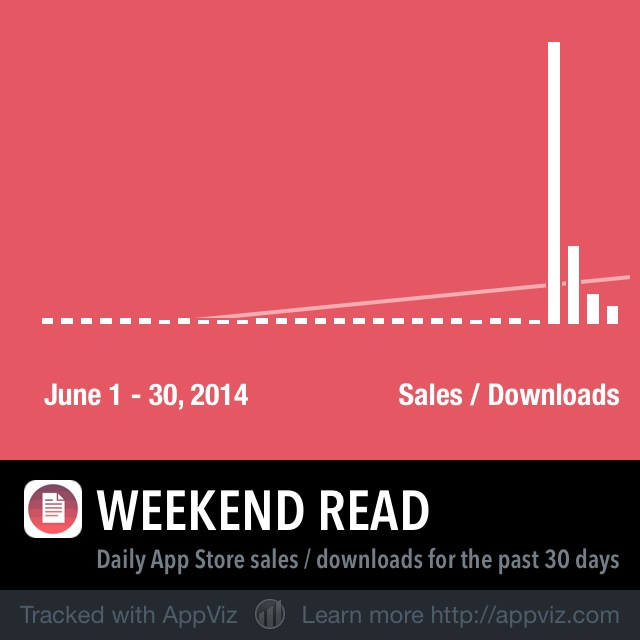
This past Friday, download numbers for [Weekend Read](https://itunes.apple.com/us/app/weekend-read/id502725173?mt=8) shot through the roof for no apparent reason.

chart

To give some sense of scale, those ordinary days on the left range from 50 to 75 downloads per day. The spike is 3,591. ((The graphic comes from the iOS version of App Viz, which I love. The trend line is certainly misleading in this case.))

Weekend Read is a free app, so it’s certainly possible that an online mention convinced a lot of people to download it. ((In-app purchases of Weekend Read Unlocked, which gives users an unlimited library, were not up proportionately to downloads.))

Or perhaps it was featured on a section of the App Store.

Was it related to Rian Johnson and his Star Wars news? The scripts for Rian’s first three movies are available inside the app. Maybe someone linked to that in a Star Wars forum.

Or perhaps it really just was a fluke — a flurry of downloads that pushed it up higher and higher in the charts, creating a virtuous cycle. (We peaked at 162 in Productivity.)

Weekend Read sends our server a ping when it’s first installed, but we can’t track the source of download unless it comes from a specially-crafted URL such as [this one](http://apps.quoteunquoteapps.com/wr-blog).

We may never know exactly what happened. Apple currently gives developers no way of tracking where traffic is coming from. Better analytics are coming in a future version of iTunes Connect, but for now all we get are mysterious numbers. It’s our own little [Wow! signal](http://en.wikipedia.org/wiki/Wow!_signal).

How to Write a Scene, now in handy two-page form

June 18, 2014 Follow Up, Writing Process

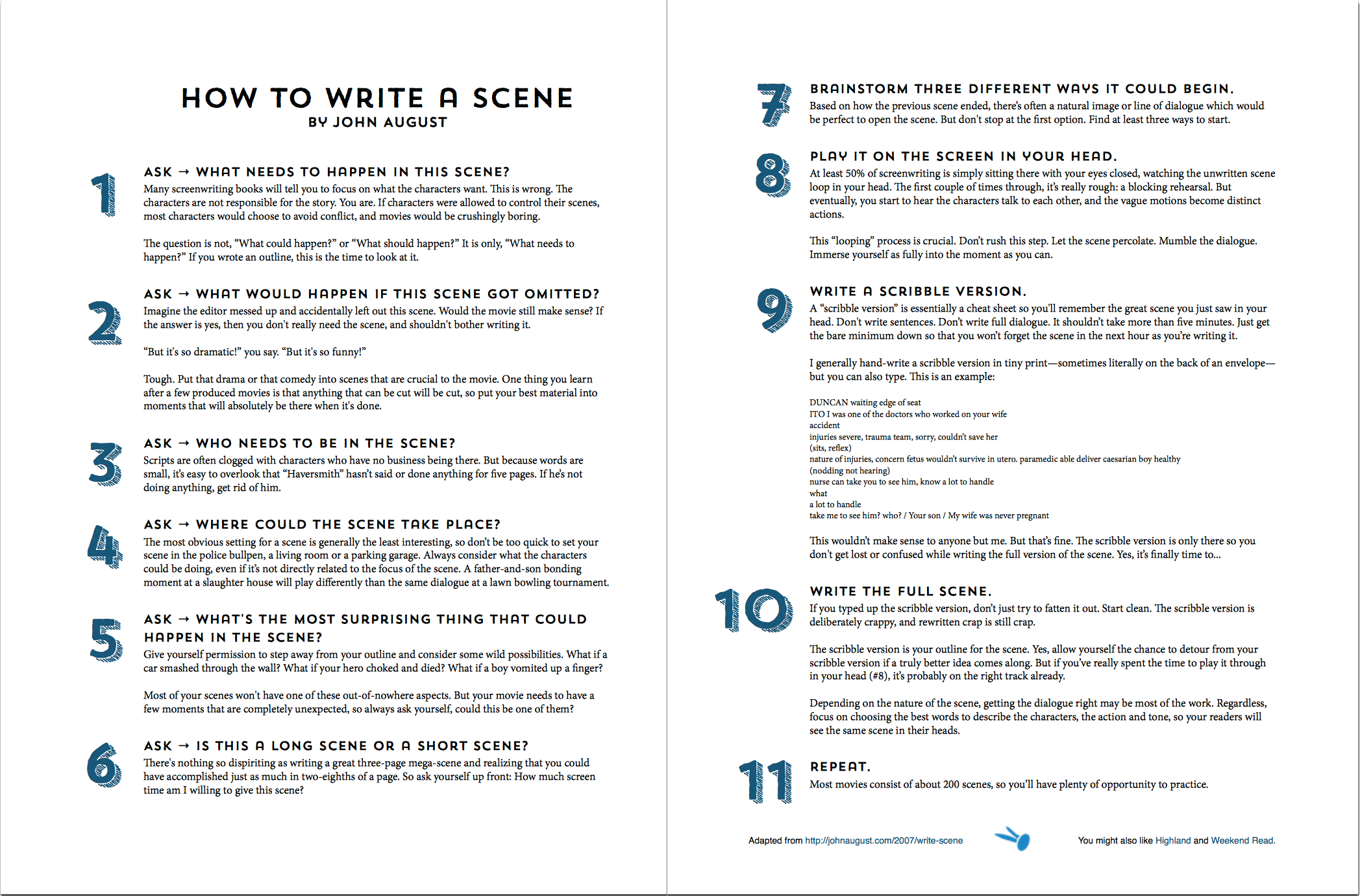
My 2007 post on [How to Write a Scene](http://johnaugust.com/2007/write-scene) got recirculated in [infographic form](http://johnaugust.com/2013/writing-a-scene-in-11-steps) last year, which featured only the bullet points.

Both versions are useful. The blog post is detailed; the infographic is handy. But screenwriter Zak Penn asked for something in-between:

> Can you send me PDF of your scene writing checklist? Want to use when I speak to students, thought it was excellent.

It’s a good idea. So here’s the original post, slightly edited and reformatted to fit onto [two pages](http://johnaugust.com/wp-content/uploads/2014/06/how-to-write-a-scene.pdf) you can print or email:

pdf link

Anyone is welcome to use it. I just ask that if you distribute it, please keep my name and the link on it.

And because you’ll ask, the fonts are [Minion Pro](http://store1.adobe.com/cfusion/store/html/index.cfm?event=displayFontPackage&code=1719) and [Trend Hand Made](http://www.myfonts.com/fonts/latinotype/trend-hand-made/).

Storyboarding your film using Fountain

June 11, 2014 Apps, Directors, Fountain

Charles Forman, who has already made some really [interesting](http://playground.setpixel.com/scriptvisualizer/) [tools](http://playground.setpixel.com/wordcloud/) for visualizing Fountain screenplays, is back with [Storyboard Fountain](http://storyboardfountain.com):

> Storyboard Fountain works with a Fountain screenplay file. Open it, and the entire script is displayed on the left of the file. Action, dialogue, and parenthetical lines are shown as elements, so you can create boards for every filmable line in the movie. In fact, you can have as many boards as you want per line, or even choose not to have a board, if it’s not necessary.

> As you draw, each drawing tool you use is saved on its own layer. The images are saved in a folder next to your Fountain file on your hard drive. The reference to each board is saved in location in the Fountain file itself. As a result, you can use the Fountain editor of your choice to edit your script while maintaining the integrity of the location of the storyboards.

Developers Charles Forman and Chris Smoak have released an open-sourced alpha version for the Mac.

Do most screenwriters need this kind of tool? No.

But screenplays aren’t just for writers. They’re platforms upon which to build a movie, a process that involves many different artists and professions. For some films, storyboarding is key part of the process, so anything that can help couple the words to the images is a win.

I love to see developers using Fountain to build applications like these. It’s an exciting time.

« Previous Page
Next Page »

Primary Sidebar

Newsletter

Inneresting Logo A Quote-Unquote Newsletter about Writing
Read Now

Explore

Projects

  • Aladdin (1)
  • Arlo Finch (27)
  • Big Fish (88)
  • Birdigo (2)
  • Charlie (39)
  • Charlie's Angels (16)
  • Chosen (2)
  • Corpse Bride (9)
  • Dead Projects (18)
  • Frankenweenie (10)
  • Go (29)
  • Karateka (4)
  • Monsterpocalypse (3)
  • One Hit Kill (6)
  • Ops (6)
  • Preacher (2)
  • Prince of Persia (13)
  • Shazam (6)
  • Snake People (6)
  • Tarzan (5)
  • The Nines (118)
  • The Remnants (12)
  • The Variant (22)

Apps

  • Bronson (14)
  • FDX Reader (11)
  • Fountain (32)
  • Highland (75)
  • Less IMDb (4)
  • Weekend Read (64)

Recommended Reading

  • First Person (87)
  • Geek Alert (151)
  • WGA (162)
  • Workspace (19)

Screenwriting Q&A

  • Adaptation (65)
  • Directors (90)
  • Education (49)
  • Film Industry (489)
  • Formatting (128)
  • Genres (89)
  • Glossary (6)
  • Pitches (29)
  • Producers (59)
  • Psych 101 (118)
  • Rights and Copyright (96)
  • So-Called Experts (47)
  • Story and Plot (170)
  • Television (165)
  • Treatments (21)
  • Words on the page (237)
  • Writing Process (177)

More screenwriting Q&A at screenwriting.io

© 2026 John August — All Rights Reserved.