• Skip to primary navigation
  • Skip to main content
  • Skip to primary sidebar

John August

  • Arlo Finch
  • Scriptnotes
  • Library
  • Store
  • About

John

Michael Arndt on Endings

July 2, 2018 Genres, Random Advice, Story and Plot

Screenwriter Michael Arndt (Little Miss Sunshine, Toy Story 3) has been thinking a lot about endings. He’s put his observations together as a terrific video that offers great insights and practical advice.

After you’ve watched this, go back and check out his video on Beginnings.
How (and why) to write a novel in Highland 2

May 27, 2018 Apps, Arlo Finch, Books, Highland, Projects

I wrote both [Arlo Finch][arlo] novels entirely in beta versions of Highland 2.

It’s either brave or foolish to trust your essential daily work to unfinished software. But in three years of writing in Highland 2, I never lost a word. What’s more, the decision to write Arlo Finch in Highland 2 influenced both the books and the app itself.

In this post, I want to talk through my workflow for writing Arlo in Highland 2. The app is [now available on the Mac App Store][mas] as a free download, so you can work along with me if you’d like.

You can also find the first six chapters of Arlo Finch in .highland on our [website][h2]. (And of course, Arlo Finch in the Valley of Fire is available pretty much [wherever books are sold][arlo].)

## A chapter at a time

As a screenwriter, I tend to start working on a script by handwriting individual scenes. This keeps me from going back and editing too much, too soon. I try to get at least a third of it handwritten before I switch to the keyboard and begin assembling the script.

With books, I’ve found writing by hand simply isn’t practical. There are just too many words. If I’d stuck with my screenwriting technique, I’d still be writing the first book.

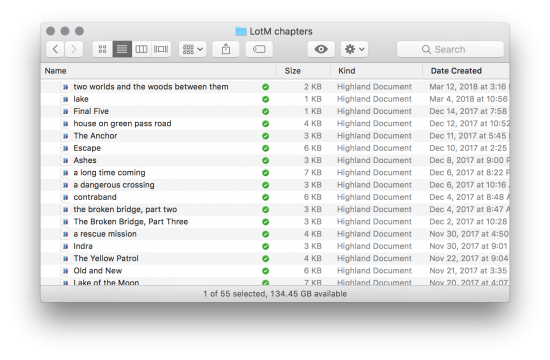
But the basic idea of working in small chunks rather than a massive file remains sound. For Arlo Finch, I wrote each chapter as a separate file. This helped enormously.

For starters, it helped me keep my chapter lengths relatively consistent. For middle grade fantasy fiction, you want them to be between 1,000 to 2,000 words. That’s long enough to propel the story forward, but not too long for bedside chapter-a-night reading. If I’d written the book as one giant file, it would be harder to know how long each individual chapter was.

Keeping chapters as separate files also kept me from going back and endlessly tweaking earlier chapters. I’ve found it’s important to start the day’s work as the next thing you’re writing, not second-guessing what you wrote before. It’s fine to run your pen through yesterday’s work to get up to speed, but the further back you go, the less forward progress you’re likely to make.

finder window showing chapters

This basic idea of writing a book with separate files for each chapter could be done using any app. But Highland 2 makes it much easier thanks to a little bit of magic.

In addition to my files for individual chapters, I made a new document called Arlo Assembly. ((In movies, an assembly is the film editor’s first pass at putting all the scenes in order.)) This file isn’t for writing anything, but rather links to all the individual chapters, which I add by simply dragging them in from the Finder.

—

When you drag a text file into a Highland 2 document, it creates an {{INCLUDE}}. It’s not importing the text itself, but rather a secure bookmark to the original file. Then, whenever you preview the document, Highland 2 finds the original file and includes that text.

Here’s why using INCLUDE is so useful.

1. **It’s not creating a copy of the text.** If I {{INCLUDE}} a chapter, then make a change in the original file, that change will show up the next time I preview the assembly. The original chapter file is still the “real” version.
2. **You can quickly get an overview.** How long is the book so far? It can be hard to tell. But it’s easy to check the assembly to see that you’ve spent 60 pages away from a major character.
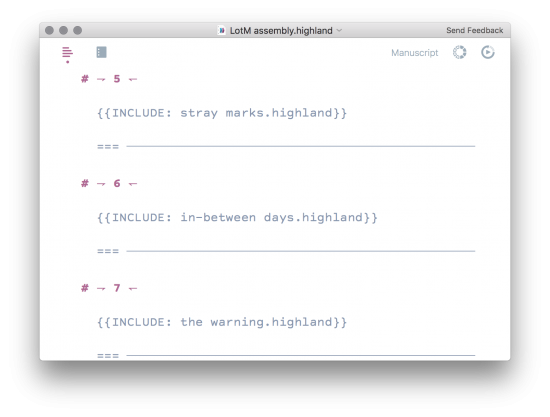
3. **You can wait to number the chapters until you’re finished.** For book one, I named and numbered chapters in their individual files, which made it a hassle when I decided to move one chapter earlier. So for book two, I numbered the chapters only in the assembly. Here’s what that looked like:

assembly window

The # are headers for the page numbers, while === represents a forced page break.

Once I had all the chapters written and included, I used File > Assemble… to generate a new document that had all the text copied in. From that point forward, this was the “real” version of the book.

## Just the words

Other apps can do similar things with small files organized as larger projects. Scrivener is probably the best-known of these.

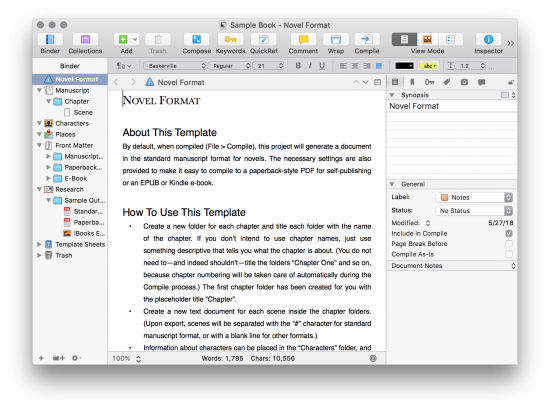
Here’s the default view in Scrivener:

scrivener window

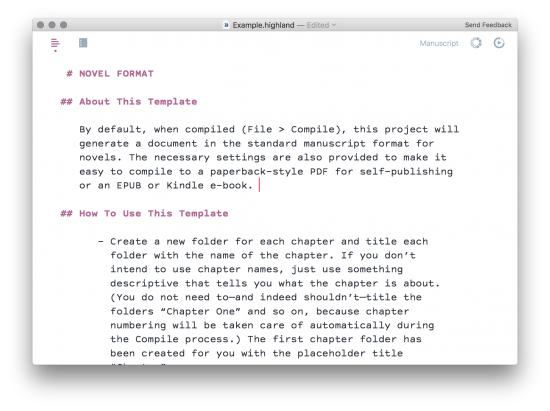
Here’s the equivalent view of the same text in Highland 2:

highland window

Which would you rather write in?

To be fair, some novelists love Scrivener, and it can do some things that Highland 2 cannot. It has a cork board and key words and dozens of other tools of questionable utility. Like a traditional word processor, Scrivener lets you set each sentence — each individual character — in its own font and size.

But to me, Scrivener feels like piloting the space shuttle to the grocery store. It’s way too much app for daily writing, and makes the job of a novelist seem technical rather than intuitive. I think Scrivener’s bells and whistles are counterproductive distractions.

## Sprinting a marathon

Avoiding distraction was the motivation behind one of my favorite features in Highland 2: Sprints.

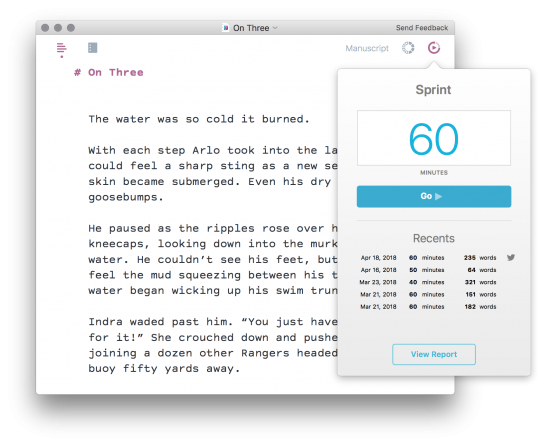
I like to work in 60 minute installments. That is, I’ll decide that for next 60 minutes I’m writing and doing nothing else. No Twitter, no phone, no looking things up online. Then when the time is up, I’ll step away and do something else.

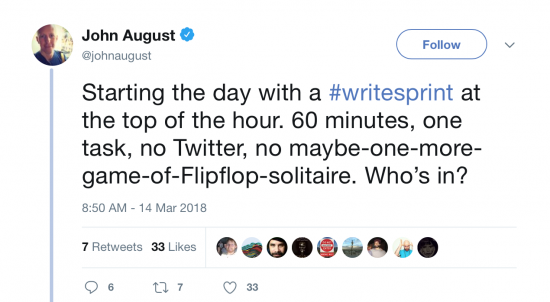
I’ll often announce when I’m about to start one of these #writesprints so others can join me.

tweet about writesprint

Highland 2’s new Sprint tool makes these dead simple to do.

sprint panel

Two or three sprints a day generally keep me on track for 1,000 words per day. I’d estimate that I wrote at least 70 percent of the second Arlo Finch in sprint mode.

## The right template

Like screenplays, manuscripts have standardized formatting, with lines double-spaced and paragraphs indented. Many novelists simply type in this layout in Word, but it’s not particularly efficient. You can’t see multiple paragraphs at once, which makes it hard to get a sense of the flow. *Wait, did I say “suddenly” ten lines back?*

In Highland, you’re writing single-space in regular non-indended chunks, just like an email. Only when you preview do you see the manuscript formatting, thanks to the new Manuscript template. You’ve got your choice of Courier Prime or Times. That’s it. That’s all you need.

## The Bin

Highland 2’s final innovation is one of its most helpful, and I used it extensively for Arlo Finch, particularly after I had assembled all the chapters into one big file.

A thing writers face all the time is there are bits of text you need to cut, but you also need to hold onto. It could be a paragraph describing a location, or a chunk of dialogue that needs to find a new home.

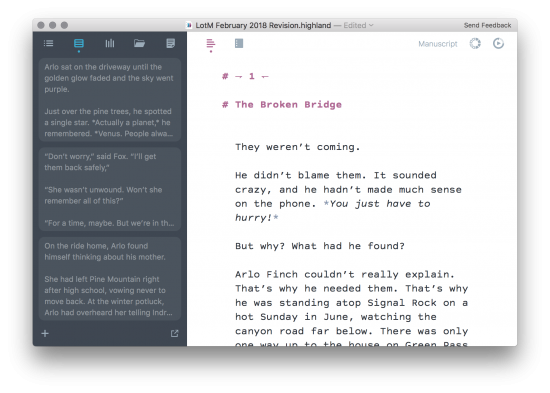
What most writers do with these bits of text is to save them in a new scratch file. In Highland 2, you simply drag them to the sidebar in a new location we call the Bin. ((The Bin is also a film editing term. It’s where you hold all the piece of film you’re working with.))

Highland 2's bin

If I need any of those pieces again, I can just drag them back in. I can also export the Bin as its own file if necessary.

## Speed matters

Once I’d finished my first draft, I submitted it to editor Connie Hsu as a PDF. We went through two rounds of notes, then it was time for the copy edit.

Copy editing is the process books go through where proofreaders and production editors carefully check the manuscript for mistakes, everything from typos to grammar goofs to logic errors. It’s painstaking work, and is almost always done in Microsoft Word using its Track Changes feature.

So for both books, at this stage I had to switch away from Highland. I exported an RTF and imported it into Word.

And groaned in frustration. A lot.

Microsoft Word is often mentioned as bloatware, with a thousand toolbars and obscure features. I used to think the criticism was mostly about its user interface, but the truth is that at least on the Mac, Word is glacially slow when handling long documents.

In a moment of pique, I made a video to compare just how slow it is compared to Highland 2.

—

But I’m lucky. Through the whole process of writing Arlo Finch, I’ve had to spend less than three weeks in Word, while I’ve spent three years in Highland 2. Using an app so tailored to my process is a pleasure.

Yes, the writing itself is still difficult. Trying to make words obey your intentions is always a struggle. But with Highland 2, I’m wrestling with the work rather than than app.

In the end, any application is simply a tool. After all, Leo Tolstoy [wrote War and Peace by hand][twitter] and George R.R. Martin sticks with his [WordStar 4.0][martin]. I’m sure I could have written Arlo some other way. But I didn’t. I used Highland 2 and I loved it.

[twitter]: https://twitter.com/lit_books/status/466949240020021249
[martin]: http://www.slate.com/blogs/future_tense/2014/05/14/george_r_r_martin_writes_on_dos_based_wordstar_4_0_software_from_the_1980s.html
[arlo]: http://johnaugust.com/arlo-finch
[mas]: https://itunes.apple.com/us/app/highland-2/id1171820258
[h2]: https://quoteunquoteapps.com/highland-2/

On Big Fish, inclusion and family-friendliness

May 17, 2018 Big Fish

The Big Fish musical that Andrew Lippa and I wrote has been staged hundreds of times across the US. Logistics are all handled by our [licensing company](https://www.theatricalrights.com/show/big-fish/), which provides the script, score and other materials. Usually, the only time Andrew and I hear about a given production is when someone tags us in Instagram.

Occasionally, however, something comes up that merits our getting involved. This is one of those cases.

—

This week we learned that an upcoming production of BIG FISH at the Palisade Playhouse in Pittsburgh [has been canceled](https://www.broadwayworld.com/article/Pittsburgh-Community-Theatre-Cancels-BIG-FISH-Following-Directors-Inclusion-Of-Gay-Ensemble-Characters-20180516) over a disagreement between the director and the theatre. Specifically, the director planned to include a same-sex couple as part of the background action during the song “Stranger.”

In defending their decision, the theatre argues that, “the script did not include any reference to the LGBT+ community.” That’s correct; nowhere in the script does it say that any character is gay or lesbian or trans. But nor does it say they aren’t. A director’s decision to signal that two silent characters are same-sex parents isn’t changing the text. It’s providing context and framing. It’s directing.

BIG FISH is a musical about parenthood, family and love. These are shared experiences of all human beings.

The theatre continues: “This added moment of focus created questions about whether the director’s addition would convey a message about gay marriage in a way that would be seen as inclusive to some but exclusive to others.”

Which feels another way of saying, “We didn’t want to risk offending anyone.”

And look, we get it. BIG FISH has been produced hundreds of times in the U.S. in part because it’s so family-friendly and unlikely to offend. There’s no sex or violence. In some cases, we will allow for words to be changed or omitted. We do this because we want as many people as possible to get to experience it – both as an audience and as part of a production.

But “family-friendly” shouldn’t mean ignoring reality. Let’s remember that in America there are all kinds of families, including ones with two dads, two moms, people of all gender identity, color and creed. Family-friendly is something bigger than it once was.

This notion of “thinking bigger” is something Big Fish’s hero Edward Bloom would certainly endorse. After all, his friends include a giant, a witch and a werewolf.

When we see #bigfishmusical videos on Instagram of high schools doing Be The Hero, it reminds us that the show we wrote inevitably changes with every production, every player, every choice. That’s theater. It exists only because people come together to put on a show.

We’re sorry the show won’t go on at Palisade Playhouse, but look forward to working with the director and company to find a new home for their production.

– John August and Andrew Lippa

True confessions of a knife-juggling bear

May 1, 2018 Arlo Finch, Projects, Psych 101

This [profile on me](https://www.thrillist.com/entertainment/nation/big-fish-john-august-interview-launch-podcast) by Dan Jackson in Thrillist was originally supposed to be about Arlo Finch and Launch, but grew into a bigger piece on the many different projects I tackle simultaneously.

> John August presides over a mini-empire steered by curiosity, fortified by experience, and fueled by brain power. With only 24 hours in a day, the multitasking writer of movies like *Charlie’s Angels*, *Big Fish*, and *Charlie and the Chocolate Factory* scribbles out scripts for big budget Hollywood blockbusters, outlines sequels to middle-grade fantasy novels, maps future episodes of his hit podcast, designs apps for other creative professionals looking to optimize their time, and finds time to invent fonts. If you were granted a golden ticket to tour the laboratory that is his bald head, you’d find a jolly team of meticulous, laser-focused Oompa-Loompas.

That’s not really accurate, though. My inner Oompa-Loompas aren’t laser-focused. They’re a rowdy bunch fighting for control of my various gears and levers, each with a different idea about what the factory should make.

Over the years, I’ve gotten better at managing them, in part because I’ve recognized that I *am* them. There’s not a me separate from my interests and fears and jealousies.

I’m the product of these competing impulses, not the master.

But I’ve gotten good at recognizing when an Oompa-Loompa has an interesting idea, and then marshalling the forces to try it.

> “I’m really curious about how things work, and generally the only way to know how things work is to actually do the thing,” he tells me over the phone one morning. “Rather than planning the thing or reading up about the thing or interviewing someone about how the thing works, I’ll tend to just start doing the thing and then figure it out as it goes along.”

I don’t second-guess whether it’s a good idea, or get fixated on what might go wrong. I don’t ask permission. I just assume I’m not any worse than someone else, and I’ll figure it out. That’s how I started writing my first script, my first musical and my first novel.

But I also leave a lot of projects half-finished. Sometimes they finally come into being years later (Writer Emergency Pack), yet often they don’t (an animated short; a new stage musical; my next directing project).

Giving yourself permission to move on to a better idea is tough. You’re always wondering if you’re one draft away. *This will be the one that does it.*

But as I look back over the past 20 years, most of my successes — both creatively and commercially — have come from the projects I was excited to do rather than the projects I felt an obligation to start or finish.

I’ve also had things I love fail. It’s heartbreaking.

But the projects I never really cared about? They’re worse in a way, because it was just wasted time.

If I have any general recommendations, it’s to aim to fill your day and your mind with interesting things, even if it’s messy and unfocused. Or as the article puts it:

> It’s like watching a dancing bear juggle knives.

Such a life is unlikely to go quite as planned, but at least it’ll be exciting.

« Previous Page
Next Page »

Primary Sidebar

Newsletter

Inneresting Logo A Quote-Unquote Newsletter about Writing
Read Now

Explore

Projects

  • Aladdin (1)
  • Arlo Finch (27)
  • Big Fish (88)
  • Birdigo (2)
  • Charlie (39)
  • Charlie's Angels (16)
  • Chosen (2)
  • Corpse Bride (9)
  • Dead Projects (18)
  • Frankenweenie (10)
  • Go (29)
  • Karateka (4)
  • Monsterpocalypse (3)
  • One Hit Kill (6)
  • Ops (6)
  • Preacher (2)
  • Prince of Persia (13)
  • Shazam (6)
  • Snake People (6)
  • Tarzan (5)
  • The Nines (118)
  • The Remnants (12)
  • The Variant (22)

Apps

  • Bronson (14)
  • FDX Reader (11)
  • Fountain (32)
  • Highland (74)
  • Less IMDb (4)
  • Weekend Read (64)

Recommended Reading

  • First Person (87)
  • Geek Alert (151)
  • WGA (162)
  • Workspace (19)

Screenwriting Q&A

  • Adaptation (65)
  • Directors (90)
  • Education (49)
  • Film Industry (489)
  • Formatting (128)
  • Genres (89)
  • Glossary (6)
  • Pitches (29)
  • Producers (59)
  • Psych 101 (118)
  • Rights and Copyright (96)
  • So-Called Experts (47)
  • Story and Plot (170)
  • Television (165)
  • Treatments (21)
  • Words on the page (237)
  • Writing Process (177)

More screenwriting Q&A at screenwriting.io

© 2026 John August — All Rights Reserved.