• Skip to primary navigation
  • Skip to main content
  • Skip to primary sidebar

John August

  • Arlo Finch
  • Scriptnotes
  • Library
  • Store
  • About

John

‘Wherefore’ does not mean where

January 7, 2009 Rant, Words on the page

A headline in today’s Hollywood Reporter:

> Wherefore art thou, ‘Juliet’? It’s at Uni.

The story is about a book set up at Universal. The headline is incredibly frustrating. Wherefore isn’t a fancy way of saying where. It’s a fancy way of saying why or therefore:
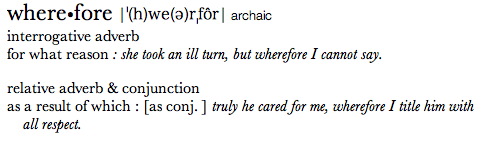
wherefore

As longtime readers will know, I’m generally not Mr. Stickler when it comes to word usage. I’ve gotten several terms wrong over the years, including “begging the question.” I fully understand that words change meaning over time as languages grow and adapt. English is particularly nimble in this regard, and that’s a good thing. [English is not Latin](http://johnaugust.com/archives/2005/english-is-not-latin).

So why my beef with “wherefore?”

Wherefore isn’t a modern word in any sense. Its only use is in lame callbacks to the balcony scene in Shakespeare’s Romeo and Juliet. So every time it’s misused as a synonym for “where,” the writer reveals a fundamental misunderstanding of the iconic scene.

JULIET

O Romeo, Romeo, wherefore art thou Romeo? Deny thy father and refuse thy name; or if thou wilt not, be but sworn my love and I’ll no longer be a Capulet.

ROMEO

(aside)

Shall I hear more, or shall I speak at this?

JULIET

‘Tis but thy name that is my enemy: thou art thyself, though not a Montague. What’s Montague? It is nor hand nor foot, nor arm nor face, nor any other part belonging to a man. O be some other name!

She’s not asking where he is. She’s asking why this hot guy she’s in love with has to be Romeo, a Montague, member of the rival gang. If we were writing that line now, it would be something like:

JULIET

O Romeo, Romeo, why must thou be Romeo?

But the where/wherefore mistake is so fundamentally entrenched that we now expect Juliet to be straining at the edge of the balcony, looking out in the night with hopes of seeing her true love. It sets up the idea that she knows he’s coming, that a rendezvous has been set. It changes the scene in fundamental ways.

I’m a realist: this fight will never be won. I’m certain I’ll go to my grave having just read a headline on the Mentalinet which makes the exact same mistake. I’m calling it out simply in hopes that some of my readers might join the fraternity of people who know that it’s wrong, and will bristle when they see it.

Postmodernism will eat itself

January 6, 2009 Follow Up

In the comments thread to my post on [Charlie Brown, advertising, and whatever comes after postmodernism](http://johnaugust.com/archives/2008/charlie-brown-postmodern), reader Michael makes an important point:

> If everything is a reference to a reference to a reference, as so much creative work is currently, then audiences are forced to either “get” everything, or else be alienated by everything. It may work in the short term for a target audience, but the work won’t hold up for long. Once the references become irrelevant, the work built on references becomes, likewise, irrelevant.

That’s the crux and the crisis: you’re creating things that won’t make sense 20 years from now. Or 20 minutes, given the speed of our culture.

Certainly there are things forged out of this postmodern, paste-it-together ethic that will last — probably because they have some artistic achievement beyond their ability to string together pop-culture references. “Single Ladies” is really well shot and performed. If you put it in a time capsule, it will still make sense, the same way Tina Turner’s “Proud Mary” holds up.

But as an extreme example, consider Weezer’s deliberately memetastic “Pork and Beans” video ([link](http://www.youtube.com/watch?v=PQHPYelqr0E), not embeddable). It’s fantastic and won’t make a lick of sense to anyone who didn’t use YouTube from 2004 to 2008.

Charlie Brown, advertising, and whatever comes after postmodernism

December 26, 2008 Film Industry, Meta, Video

I went to undergrad hoping for a career in advertising. This video reminds me why I’m happy I bailed:

It also reminds me of my junior-year class in postmodernism, in which we spent at least half the semester trying to arrive at a definition for the term — and never really got one. This video certainly has aspects of what we were seeking. It appropriates familiar cultural elements (The Charlie Brown Christmas Special) for use in unexpected contexts (advertising), much the way Michael Graves used the Disney dwarfs to hold up the roof of the [Team Disney building](http://www.bluffton.edu/~sullivanm/gravesdisney/disney.html). And in both cases, the project doesn’t really make sense unless you’re familiar with what it’s playing off. In this case, Lucy isn’t Lucy and Linus isn’t Linus, but the joke doesn’t work unless you understand who they usually are.

But I’d argue that the video also represents more than whatever postmodernism is or was. It’s the kind of thing you can’t imagine existing without YouTube. While the technology to make it could exist independently of internet distribution, the idea of doing it feels net-dependent. If Ernie doing M.O.P. is the quintessential video mash-up —

— then The Charlie Brown Ad Agency is its close kin. A mix-in, maybe. And it exists in the same metaverse as Beyoncé’s [Single Ladies video](http://www.youtube.com/watch?v=4m1EFMoRFvY), which remakes a mash-up ([Walk It Out Fosse](http://www.youtube.com/watch?v=X8iLBQFeX4c)).

I offer these observations without any clear idea about what it means for screenwriting, but you can look at many current films through this lens. The Dark Knight is less a Batman movie than a Big Serious Movie with Batman mixed in. Twilight isn’t a vampire story. It’s a teen girl fantasy with a small thread of vampirism — not even real vampires, but something almost wholly different — woven in.

And I think that’s what our books and movies are going to be for a while: Aliens vs. Predator vs. Mr. Magoo. Our cultural world is vast and ephemeral, so we look for familiar icons that we can recall and repurpose. We want to know just what we’re getting, yet still be surprised. We’re toddlers that way.

Go on Hulu

December 15, 2008 Go, Projects, Video

Online video service Hulu is now featuring my first movie, Go. If you haven’t seen it — and you live in U.S., and you’re over 17 — it’s worth a look. It even has a great, minimalist URL:

[http://www.hulu.com/go](http://www.hulu.com/go)

(**Update March 2011:** Depending on licensing agreements, Go is sometimes available on Hulu. Other times, you’ll find it on Crackle, Netflix Instant or Amazon Streaming. It’s almost always available somwhere.)

I really doubted Hulu when it was first announced, because everything the studios touch tends to be needlessly complicated and crappy. But Hulu works great for catching up on old TV shows, and now movies. The advertising isn’t terribly intrusive, either.

Will I get residuals? We’ll see. But considering Go is easily available in hundreds of illegal sites online, I’m just happy to find it in a clean, well-lighted place with 480p resolution.

« Previous Page
Next Page »

Primary Sidebar

Newsletter

Inneresting Logo A Quote-Unquote Newsletter about Writing
Read Now

Explore

Projects

  • Aladdin (1)
  • Arlo Finch (27)
  • Big Fish (88)
  • Birdigo (2)
  • Charlie (39)
  • Charlie's Angels (16)
  • Chosen (2)
  • Corpse Bride (9)
  • Dead Projects (18)
  • Frankenweenie (10)
  • Go (29)
  • Karateka (4)
  • Monsterpocalypse (3)
  • One Hit Kill (6)
  • Ops (6)
  • Preacher (2)
  • Prince of Persia (13)
  • Shazam (6)
  • Snake People (6)
  • Tarzan (5)
  • The Nines (118)
  • The Remnants (12)
  • The Variant (22)

Apps

  • Bronson (14)
  • FDX Reader (11)
  • Fountain (32)
  • Highland (75)
  • Less IMDb (4)
  • Weekend Read (64)

Recommended Reading

  • First Person (87)
  • Geek Alert (151)
  • WGA (162)
  • Workspace (19)

Screenwriting Q&A

  • Adaptation (65)
  • Directors (90)
  • Education (49)
  • Film Industry (489)
  • Formatting (128)
  • Genres (89)
  • Glossary (6)
  • Pitches (29)
  • Producers (59)
  • Psych 101 (118)
  • Rights and Copyright (96)
  • So-Called Experts (47)
  • Story and Plot (170)
  • Television (165)
  • Treatments (21)
  • Words on the page (237)
  • Writing Process (177)

More screenwriting Q&A at screenwriting.io

© 2026 John August — All Rights Reserved.